Category: Opinion

Opinion pieces from our editors and contributors

  • The end of Kodak? Shades of Minolta…

    Having written this piece tonight, I find myself deciding to put it on Photoclubalpha although it’s not Sony or Minolta related. The websites I run for professionals are seen by very few people, this is seen by 40,000 in a decent month. Therefore, you have a truly diverted article (with pictures taken on Sony and Minolta) – David Kilpatrick

    ————————————–

    Photograph by and © Shirley Kilpatrick/Alpha 580, Sigma 18-250mm OS

    Those who say ‘Kodak is dead’ are reacting a little prematurely. The US Chapter 11 filing for protection from bankruptcy has no equivalent in Britain, and allows time for revenues to be garnered which can save the core of a corporation rather than leave the corpse.

    Kodak’s patent battles are not over. While most companies making digital cameras or smartphones have signed royalty agreements accepting that they needed to use patents legitimately, some including their biggest rival Fuji have resisted.

    One possibility is that patents – including a portfolio which will bring in substantial earnings for several years to come – will be sold. If a major disputed patent infringer is the buyer, they become the owners of patents which otherwise put a question mark over their balance sheet. As long as a case is in court, any corporation may see its capital value reduced (with its share price) by the amount of the possible liability.

    That could make Fuji, Apple or Samsung potential buyers for Kodak. Who has the money to buy Kodak? American, and therefore likely to get permission and support? Apple…

    Kodak’s brand has big value worldwide. Control of corporate identity may be limited to providing tins of yellow and red paint, but it works! Karnak, Egypt ©DK

    Unfortunately, it does not work the other way round. Pursuing an action for billions does not necessarily convince the market that this is a hidden asset. So while Kodak has aggressively launched several new patent infringement claims in the last few weeks, they had at best a temporary effect on the company’s value, more than matched by reversals.

    However, at a time when all stocks have been artificially depressed and the entire market worth a quarter of what was once its stable value, it becomes very difficult to judge the long-term situation. Kodak has a massive theoretical value as a brand, and nearly 5,000 patents still extant from the digital era (the last quarter-century) though all patents do eventually expire. What does not expire is the backdated royalty claim which can be made against a company proven to have infringed patents over a long period.

    Kodak stand, photokina 2006 – the market they chased then was the market Sony, to a large extent, owns today ©DK

    That’s why Kodak buying some time in Chapter 11 (accompanied by a $950m loan to keep the business running) is significant. If the corporation can avoid being wound up or taken over for long enough to win a patent case, it may rise again. In January, suits were launched against Samsung, Apple and Fuji claiming patent infringement.

    Smartphones and pads now do what the excellent little Kodak Z-series pocket video cameras offered in 2008 when the Zi-6 was launched. Ahead of its time, with YouTube connectivity branding, it doesn’t use all the patents Kodak is now defending – which cover wifi, automatic email and network address image uploading, and related photo sharing concepts. ©DK

    Think back twenty years. Honeywell had filed actions against many companies for infringement of their autofocus patents, most settled and added to Honeywell’s revenue stream. Minolta, pioneers of autofocus and makers of the first AF SLR system, allowed the case to go to court instead of settling. Though the Minolta photographic division was to survive 15 more years, the huge award in Honeywell’s favour destroyed their reserves and ultimately was the root of their decline and eventual absorption by Sony. That’s what is at stake with claims like this, the patent owner having the chance to grab a huge chunk of a rival’s assets, capital or future revenues.

    Kodak did manage to do things within the digital world, from their 1994 Chinon-based first consumer camera to the demise of the DCS Pro 14 megapixel full-frame Canon and Nikon bodies a little over twenty years later. On the consumer front, they made one of the best bridge cameras – the only one that really matched the Konica Minolta Dimage A2. But the P880 was slow, late, ugly and arrived just when bridge cameras were departing this life.

    Look, other people’s babies ALWAYS look ugly! Someone at Kodak loved this one. ©DK

    For partly sentimental reasons, I bought a few Kodak shares in late 2011 when the signs of doom could be seen. Kodak has been worth tens of thousands to me over the last 40 years, helping from my first days as a photographic journalist. It was in Kodak’s London offices we held our editorial meetings in the 1970s, and twenty years later Kodak’s Gold Awards defined the ultimate professional standard. I may win, I may lose on a handful of shares but I have been able to follow their fluctuations daily.

    Abandoning the professional

    My 40-year ride with Kodak has not been all good. In 1982, I still had a Kodak direct account as a professional photographer and a Kodak rep would call in monthly. From that catalogue we could buy anything from a pack of lens cleaning tissue to a complete 5 x 4″ monorail camera. All kids of studio equipment, darkroom equipment and sundries joined the vital supplies of film, chemicals and paper in the price list. We became customers for such things as Kodatrace graphic arts foil, grey cards and colour targets.

    Then Kodak took the first of the great bad decisions; they closed all direct professional photographer accounts. The reasons given in private, by their executives, were that professional photographers were a huge risk – bad and late payers, takers of excessive credit, unreliable and prone to going bankrupt (hmmm…).

    I will agree that the 1980s encouraged businesses to hang on each rung of the turnover ladder by their fingertips, with credit costing a fortune in interest rates, and a tax régime which punished the smaller operation. My own business, however well it did, was always struggling to pay tax bills and when you look at the advance cashflow we had to cover, it is no wonder. Our clients in turn struggled to pay us, but we were charging them a sum for one day’s photography which would pay one month’s average wages.

    Back then our business was like a salmon fighting upstream through the rapids to the spawning-grounds. Now it’s like a frog sitting on a lilypad and occasionally flicking out a tongue to catch passing flies. Wonder if the same process, quietly, happened to the Big Yellow Box?

    The latitude, colour and tonal quality of Fujichrome 50 exploited in the mid-1980s with a reportage shot of a great antique shop in Martin, Lincolnshire, using Hasselblad SWC. ©DK

    Kodak passed their business to trade counters and labs, and took the reps off the road. The trade counters and labs promptly offered rival products alongside Kodak. Within months, we had switched entirely to using Fuji reversal film as their E6 Fujichrome – introduced by our new suppliers – had far superior colours to Ektachrome. The difference was great that in 1983 we were able to open a commercial studio in Nottingham city centre, and grab tens of thousands in business from one long-established rival just because our Fujichrome test shots outshone their Kodak output on the lightbox.

    Konica offered us a direct account, and did the same for the local minilab which did much of our machine processing and printing. We bought in Konica for our hand printing, and started using Konica colour negative stock. Then we sealed a deal with the local National Trust region to supply the first film counter dispensers for their shops, and the film supplied was Konica. Ilford Limited, Kodak’s old honourable rival, sourced exactly the same Konica stock and rebranded it as new Ilfocolor and Ilfochrome 100.

    Where Kodak discontinued materials, Konica wanted to have more. For many years, Icon’s magazines participated in the annual special order to get infrared film made – something we persuaded Konica to do through PHOTOpro (not the US one, or the current UK magazine, they both nicked our 1989 magazine title).

    Kodachrome said fare-thee-well in June, 2009, vanquished by digital media. See that DX coding? Minolta and Kodak worked together on that and Minolta had some of the first cameras with automatically set ISO when you loaded the film. Contrary to many statements, Kodachrome was not especially permanent, undeveloped image life was minimal, processing was highly variable and it didn’t scan well… but photographers still loved it. See baby above. ©DK

    From the 1980s on, almost every major Kodak decision was a contraction or a withdrawal when seen from the perspective of a UK photographic business. Kodak film manufacture in Britain ended in 2005 when the last equipment from the Annesley film plant was sold off, but long before this  so many excellent members of the professional division staff, so many activities and ambitions had been curtailed. The loss of the Kodak Gold Awards was a body-blow. The end of the Kodak Wedding and Portrait Awards, a knockout punch. Ultimately, Kodak gave up autonomous distribution even to the trade; it all goes through a distributor (Photologic) before it reaches a trade counter or lab.

    A Kodak Express outlet in Leith Ocean Terminal, just on the day of opening in 2008, with shelves awaiting stock. It’s still going strong. This is the closest I get to seeing Kodak as a business now – and it is, basically, just a very good franchise operation. ©DK

    Where once, every respectable pro photographic studio or small photo shop was a direct Kodak customer and talked to Kodak daily, photographers are now two or three steps removed. There is no longer a connection and it’s unlikely there will be again.

    Photographers still do buy Kodak materials – photographic and inkjet papers alike – and the public buys Kodak printers for their honest approach to ink costs. Plenty of clever and excellent digital cameras are bought every day, and Kodak Express shops occupy small but good positions in busy shopping malls. User-operated printing systems turn digital snaps into Kodak prints.

    Using Kodak media-card digital printing touch screen systems at photokina 2008. These dye-sublimation printers are actually very affordable for store counters, but there’s no film processing, no film sales, no chemical sales and no silver imaging paper involved. ©DK

    It is not yet the time to say R.I.P., Kodak but it’s long past the time that the profession said au revoir, Kodak. It does not have to be adieu, yet. Hasta la vista!

     

  • Does Canon EOS-1D X point the way?

    Rhetorical question. Actually, if you read the information carefully, it’s pretty clear that the 1D X is more or less a 1D MkIV (16 megapixels,1.3X frame factor) with the sensor area increased to full frame. The pixels are actually larger than the MkIV so for any given telephoto lens, the true resolution of a sports/news/wildlife subject will be lower.

    The 1D MkIV has a 27.9mm x 18.6mm sensor capturing 4896 x 3264 pixels or 175 pixels per millimetre.The 1D X has a 24 x 36mm sensor capturing 5184 x 3456 pixels or just 144 pixels per millimetre. The photon-capturing area, all other things being equal which they probably are not, is approximately 50% greater for every 1D X sensel compared to every 1D MkIV sensel.

    That, if you like, can account for half of the one-stop maximum senstivity gain in the new camera; improved microlenses and filters, manufacturing and design will account for the rest. Canon, however, claims that the new Twin Digic 5+ processors are actually responsible for the noise reduction (as well as moiré reduction in video – a related function).

    This is from the press info:

    “Offering performance up to three times faster than standard DIGIC 5, each processor is designed to manage huge levels of image data while simultaneously reducing image noise”.

    So there is no specific claim that the CMOS itself is lower noise, mostly that the Digic 5+ dual processing does this. That is something fairly new in a world which complains about raw file noise reduction. Does it matter whether the final image quality is a result of processing, or the result of a clean readout from a good signal to noise ratio CMOS?

    The claim is that the X is two stops better for noise. Having used the 1D MkIV, I can confirm that this is already pretty amazing even at ISO 25,600 and perfectly usable at 6400. If Canon’s claim is correct, the X will be as good at 25,600 and then has a usable 51,200. Beyond this, 102k and 204k EI – the highest ISO equivalent ever in a DSLR – could be usable for extreme conditions in news, military, surveillance. It’s hard to think why else you would be shooting in the dark.

    The processors also allow continuous (no limit) 14-bit raw shooting using twin UDMA CF card slots, at 12fps. There’s a huge gulf between the 11 to 18 shot bursts which the Alpha 77 can handle, and never slowing down at all. By swtiching to JPEG, the capture speed can be increased to 14fps and again it never slows down.

    The camera itself is very much a 1D but with improvements to the ergonomics and interface which are long overdue. Canon has stuck with a 1990s design because familiarity from generation to generation has been a key point when persuading professionals to buy the new models. Most pros don’t want to see a single button moved a single millimetre, or any change in the way the camera responds. News agencies have actually hired tech support companies to sit down with batches of new cameras and spend an hour making sure all the deeply-hidden custom settings match those on the outgoing gear.

    Here’s what Canon says about the X: “The menu system also features a comprehensively redesigned user interface, incorporating Help functions to make camera operation faster, clearer and easier. Additionally, a new dedicated AF tab allows photographers to access and customise AF pre-sets for common shooting situations or subjects, allowing users to concentrate on capturing the moment without the need to constantly adjust camera settings.”

    About time too! I have almost been lynched by Canon and Nikon owners alike for taking a new camera out of the box, setting it to P, and shooting everyday scenes only to find half my intended subjects out of focus. But then, I’m testing the camera, not my own ability to configure it. This has been a major problem for all advanced AF models with complex sensors (the X has a 61-point wide AF sensor with 41 cross-type, 5 double-cross and an integrated 100,000 pixel RGB metering sensor which links to AF also provides face and horizon/vertical line detection). Sony does seem to have avoided issues by keeping the A77 AF fairly simple. Anyone who has used a Canon 7D with the wrong focus behaviour set, and seen their chosen subject suddenly zap out of focus just before pressing the shutter, will know that responsiveness and auto selection of focus points can lose pictures.

    So I for one am happy to see that Canon has addressed an issue often denied and brought some key AF behaviour control up front instead of buried in obscure custom settings.

    Are Canon owners really gearheads? Maybe not. Canon also announced they just passed the 50 million EOS cameras mark, and the 70 million EOS lenses, the same time as the 1D X launch. That’s just 1.4 lenses for each Canon EOS body. Sigma must be doing well. But, as upgrading Alpha owners know well enough, body-only sales are very common these days. And Canon lenses just keep going the same way those old Minolta lenses do. There will be plenty of 1980s glass still in use on this 2011 camera.

    Back to the rhetorical question – yes and no. Sony has never had a 1.3X sensor size, so could not do something like apparently increasing the pixel count while actually lowering the resolution (and thus the telephoto true reach). All Sony could do would be to backtrack from 24 megapixels towards 16, on either full frame or APS-C – or keep full frame at 24, and transform the performance and speed of the 9xx series.

    For those who feel a bit peeved than Canon’s $7000 camera has just stolen the high-speed crown from Sony’s $1300 Alpha by offering 12fps and a boosted 14fps, just remember that with 255 pixels per millimetre the Alpha 77 captures subjects at a 77% higher magnification (100% pixel view) than the new 1D X and that means your humble A77 user with a 70-400mm SSM G is punching at the same weight as a 1D X user with a 125-700mm zoom.

    And that 14fps is achieved with the mirror locked up and the focus and exposure locked on the first frame – strictly a tripod job or one for a steady hand, with no ability to see the subject once the shutter is pressed. And, even though the Canon offers sixteen times the senstivity for low light shootings, the Alpha can actually meter the light in conditions four times darker than the Canon at EV-2 rather than EV0.

    These cameras are not competing, obviously, so my comments are not to be taken seriously. It’s just interesting to see how high end consumer SLT technology and specifications compare to fifth-generation heavy duty professional SLR.

    – David Kilpatrick

  • Sony ‘HowTo’ videos – a different level

    Paul Genge of Sony UK noted my criticism of the Sony corporate videos. Well, what Sony were not publicizing so well was that Paul has been making some rather homespun but far more valuable and interesting videos – in fact, going beyond the usual remit of Sony staff to do stuff almost off the cuff.

    I remember Paul telling me a few years ago that Sony was most cautious about any publicity material, especially its wording. Even short press releases had to be approved by a management meeting and looked over by the lawyers. That is not unusual with large corporations.

    It’s also, back in the 1970s to 90s, what made Dick Bryant’s job with Minolta so remarkable – he had a roving brief and an expense account and he could travel pretty much anywhere in the world and publish any set of images he wanted (such as his exceptional treatment of Eugene Smith’s Minimata essay). He may have reported back to Osaka but he certainly had a degree of freedom, creative and fiscal, which very few representatives of corporations seem to have today.

    Could Paul convince Sony that uncontrived, honest, genuine enthusiastic reporting and involvement with photographers merited a similar job today? Doing a Dick Bryant?

    Here’s one example, Paul with our friend Gustav Kiburg on Inner Farne in July.

    What you need to do, though, is visit Paul’s complete SonyHowTo YouTube collection (as I write this I think there are 27 short vids up, varying from wobbly and unpolished to pretty good – all well edited, with excellent use of inset illustrations and still photo examples).

    Here’s the link:

    http://www.youtube.com/user/SonyHowTo

    So far Paul’s channel only has 44 subscribers (Sept 1st, I’ll bet that changes) and if you subscribe you can also ask to be notified by email of new vids. Also, you can chat with Paul on the comments sections, and you can probably request subjects to be covered. I think we should ask for – using the Alpha 99 and 500mm G lens…

    – DK

  • Smoke and Mirrors – an idea for Sony

    With the latest Alpha 77, Sony has introduced SLT version II, the new upgraded ‘Translucent’ mirror. This is in an attempt to reduce the ghosting effects created by having an angled mirror between the lens and sensor, the image forming rays passing through a semi-silvered (pellicle) surface, through a thickness of polymer film, and then to the sensor. Having tried it out (update, September 8th) we can confirm that it works. You honestly would never know there was anything between the lens and the sensor.

    But Sony, like all makers, has continued to think in terms of SLR design and the old world of film negatives and slides, where the image always had to be a certain way up on the film, or it would end up being printed and projected reversed left to right.

    In the past a simple reflex mirror for a TLR viewing screen – like the Rolleiflex – did a useful job of turning an inverted image the right way up for viewing. On film at the back of the camera, the image was both inverted and left-to-right. But that did not matter, as the film was viewed through its reverse (back) side to see or print the image.

    Somehow, this old design has been continued to new cameras – but today we use digital sensors. The upside-down or left-to-rightness of the image does not matter as we view the image on a screen or using an EVF. No matter how the image ends up on the sensor, it can always be the right way up and the right way round for us to view.

    So, Sony, when you make you that full-frame Alpha 99 camera change the entire approach. Position the SLT mirror so it reflects the image sideways, upways or downways! And put the SENSOR where it receives the image from the REFLECTED lightpath. Make the mirror reflect 70% of the light and transmit 30%, instead of the other way round.

    There will be no double imaging, no flare patches, no ghosting and not even an extra substrate or layer for the image forming rays to pass through, if the sensor receives the reflected image not the transmitted one. The AF sensor, in the meantime, can be positioned in direct line to the lens where the imaging sensor has been in the past, measuring the image through the SLT mirror.

    This arrangement (©David Kilpatrick, Friday morning, August 26th 2011, scrambled eggs with smoked salmon for breakfast) will in a single stroke remove all the complaints about image degradation as the mirror will provide a perfect image.

    But – would it? Slight lack of plane perfection in the SLT mirror used to transmit the image-forming light, and reflect the AF-measuring light, does not have much effect on the image. Anything less than an optically perfect mirror would fail to create a quality image. It would be like sticking a cheap filter on your lens, or worse. And of course it would never fit into a normally shaped camera body with a full frame sensor and shutter.

    Solid solution

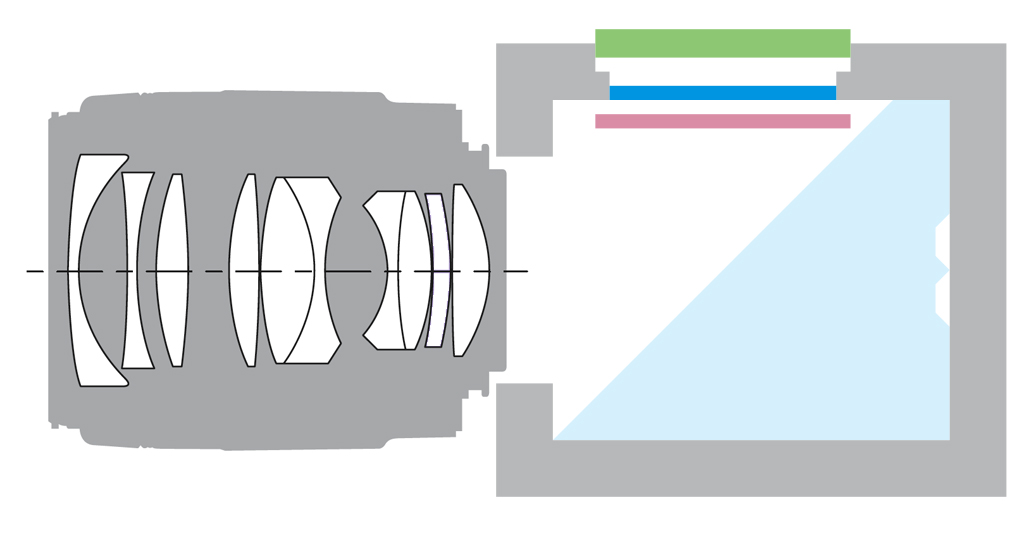
    Ah – the AF sensor, unlike the imaging sensor, does not need cleaning to remove dust spots. So the mirror would not have to be movable. Actually, it would not have to be a pellicle mirror. It could be a lovely big lump of pure glass prism moulded straight on to the AF module itself, even including the condensor-collimator lenses of the AF system. It could be solid glass all the way from mirror surface to AF receptor, and the 45° front face could be to the same optical perfection as the best Sony G lens. Or even the best Carl Zeiss lens. Hell, it could be a Carl Zeiss prism and then the camera could have the CZ logo!

    Diagram above: light blue = solid glass optical prism with 45 degree semisilvered front face; the two white indents at the right hand side indicate AF modules set into the prism rear face. Pink = shutter (optional, ideal system would have electronic shutter only). Dark blue = sensor. Green = top mounted waist level viewing screen, also articulated. A secondary eye-level EVF would or could be used. Design ©DK with a bit of nicked Sony lens cross-section.

    Design? Rollei 6000 all the way! A professional, Hasselbox-shaped thingy to cradle in your hand. With a rotating 24 x 36mm sensor too, so that you change the format aspect by pressing a button not maneouvring the camera body. A 3 inch square OLED on the top like a giant waist-level finder, showing the image vertically or horizontally as you turn the sensor. A waist-level viewing hood for a giant magnified view. Maybe even a monster top prism for the biggest EVF you could imagine!

    Mor realistically, an eye-level EVF in addition to a top plate OLED or LCD panel designed to be hinged up/rotated/twisted – rather like the LCD of the Sony Cyber-Shot DCS R-1, one of the best ever ‘waist level finder’ options fitted to a digital camera to date. In fact something like s giant updated R-1 full framer might do well.

    As for the image sensor, that could be in the well of the camera (mirror aiming down) but maybe having it in the top of the camera, below the viewing screen (mirror facing up) would help gravity reduce the dust issue.

    The point is – it does not matter where the image sensor is placed, it does not have be where the film once was. It does not matter whether the image reaching it is inverted or reflected, as unlike film it does not have an emulsion side or a film-base side, the electronic viewfinder is independent of the orientation of the optical image.

    Future ‘SLT’ EVF cameras – especially a future Alpha 900 replacement – do not need even to resemble today’s DSLRs and can be made better by abandoning ideas fixed in designers’ minds since the era of film cameras.

    – DK

    Technical note: angled partial mirrors, whether prism surface or semi silvered, create polarisation effects, colour shifts and a varying efficiency of reflection depending on the angle of incidence of the ray. This is one barrier to the use of pellicle mirror design for a full-frame model, as the back focus or telecentricity of lenses relative to the format would mean a greater range of incident angles across the mirror surface. Sony appears to have overcome any such problems in the existing APS-C SLT design, and the slightly forward tilt of the mirror (not a true 45°) helps in this respect. I propose the above design in full awareness of related optical and technical issues. I’m not assuming they do not exist – they would need solving.

  • Sony DEV-5 and DEV-3 digital HD filming binoculars

    An invitation to a Sony event on August 15th seemed perfectly timed for the announcement of the Alpha 77 and 65, NEX-7 and NEX-5n. In fact, those cameras were launched in Greece on August 24th – and Photoclubalpha, as a very minor player in this business, was not on the guest list. Nor could we have attended if invited as the diary was already full that week (four days of the Master Photography Awards judging and their Fellowship and Associate annual admissions to be covered).

    Wild geese – red-breasted geese, Branta ruficollis, fleeing the camera (©Shirley Kilpatrick, A580, Sigma 18-250mm OS)

    However, when the invitation to an event at the London Wetland Centre was issued, with strict limits on the numbers able to register and some air of importance, we decided to do the 700 mile round trip, stay a couple of days for some stock photo shooting, and hope for the best. My mistake, one of our photo mag friends said he didn’t attend because he was tipped off it was not really for photo mags. Even so, most of those present seemed to be photo press not wildlife press…

    The Wetland Centre, while a fairly poor location for photography due to the extreme distance the hides are from the wildlife, would have been a good place to launch an Alpha 77 and Alpha 65 (both equipped with improved GPS) and teamed up with the long-awaited 500mm f/4.5 Sony Apo G SSM.

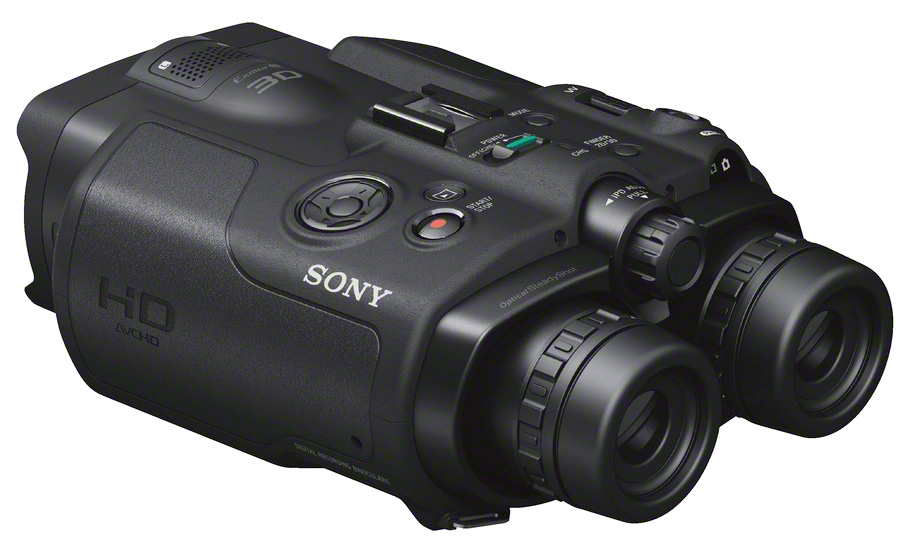
    Sadly, it all turned out to be a wild goose chase for Photclubalpha. The object being launched was the new Sony invention of 3D digital binoculars, the DEV-3 and DEV-5 models aimed at high end binocular users wanting to spend their £1300-£2000 on something novel. While impressive enough if you want an electronic viewfinder version of binoculars, they are almost useless to photographers as the still capture resolution is a mere 7.1 megapixels from a small EXMOR-R back illuminated sensor. JPEG only, no raw, no control of still capture settings beyond very basic adjustments.

    Digital scoping

    Sony took their lead on development, it seems, from digiscoping. Their research showed that serious bird watchers have been fixing compact digital cameras (and occasional DSLRs) to the end of high power spotting scopes to secure unfeasibly long focal length equivalents and capture acceptable frame-fillers of bird life from the distances bird life prefers to remain.

    Their research also showed that bird watchers will spend £2000 without hesitation on a high end pair of binoculars.

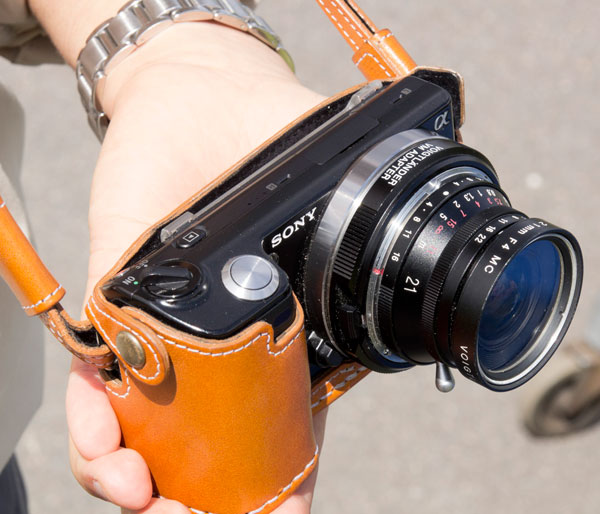
    Now I’m going to stick my neck out and suggest that much of the appeal of digiscoping is exactly the same as the appeal of adaptors and alien lenses used on the NEX. One of Sony’s own Japanese executives at the event was wearing a NEX-5 with a Voigtländer adaptor and a 21mm f/4 Voigtländer lens in Leica M mount.

    Digiscopers like their rigs of camera and scope because part of the challenge is to create a perfect digiscoping set up and discover the best cameras, scopes, eyepieces and adaptors for the job. Creating the equipment is part of the hobby. Also, the scope continues to have a purpose of its own as an optical device. It does not matter that the combo weighs 4.5kg and needs a tripod (even that is part of the Meccano-Lego factor, building your personal solution).

    Paul Genge of Sony explained how much lighter the system will be than digiscoping – but omitted the fun of making your own digiscoping rig, which is half the point of it

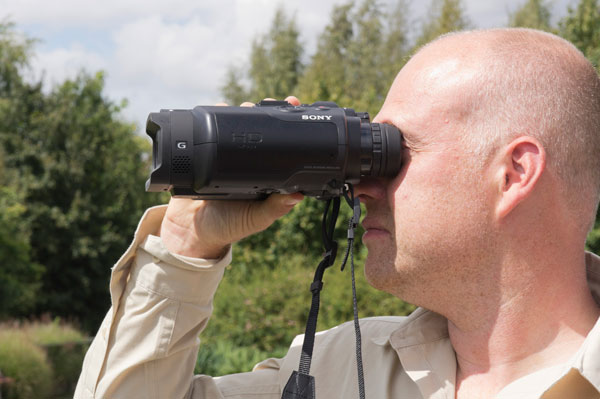
    The Sony Electronic HD video capable binoculars do one thing well, and only one thing. They capture HD1080p video at 50fps (60fps in the USA) with the option to use both sensors for 3D video, which is interlaced instead. With lens-based stabilisation counteracting complex rotational movements which may affect each of the two lenses reciprocally, they are a technical masterpiece.

    Unfortunately, they don’t have the new high resolution EVF of the Alpha 77/65/NEX-7, but use one closer to the Alpha 55 in detail. Actually, they use two, fed by separate sensors, as a true binocular system with the eyepieces adjustable for interpupillary distance and dioptre settings. They can simulate using electronic screens a binocular view, with a 16:9 or 4:3 format (the sensor is actually 4:3 ratio, and cropped for HD).

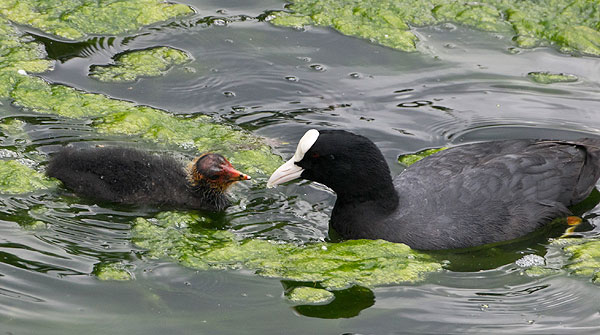
    This was not at the Wetland Centre (mother coot feeding chick) but at Kew Gardens, which actually put photographers much closer to wildlife more accustomed to humans at close quarters (©Shirley Kilpatrick, A580, Sigma 18-250mm)

    But in my pocket was a Minox 6x16X monocular, and in Shirley’s bag a similar Minox 8x16X – lovely little Zeiss-optic metal devices intended for concerts and travel. So I was able to compare the view through the 10X DEV-3 with a simple, monocular, low-cost Minox optical image. There is simply no way ever that any serious nature-watcher would wish to observe the world through the electronic version. It is a world without the individual colours within the feathers of a bird; indeed, it doesn’t even have the individual feathers. Compared to looking through the electronic finder, the optical view was breathtaking in crystal clarity and brightness with exquisite detail enabling the identification and study of subjects.

    Real birders use 20×30, 20×50, even up to 30X (Olympus zoom binoculars, for example). Some may choose stabilised binoculars, offered by Canon in specifications including an 18 x 50 with all-weather body. The stabilised view of the DEV-3 and DEV-5 is still a good feature and goes some way to make up for the lack of true image detail.

    The zoom of these devices is not the same as the limited range of binocular zooming – and the same goes for focusing. They can focus down to 80cm and retain 3D video, due to the close spacing of the objective lenses; in 2D, macro shots close to the lens are possible, and indoors you can even shoot normal people and group shots though there’s no flash of course. In this sense the Sony invention goes beyond being a binocular, just as much as it falls short of being a true one.

    If this looks familiar, the embedded front bit is basically a Sony Handycam TD10E lens and sensor assembly

    That’s because all the DEV-3 and DEV-5 actually consist of is the front part of the Sony Handycam TD10E with some optical and design modifications, and a stereo viewing system bolted on the back. This £1300 camcorder offers a 17X zoom range but it’s hard to express that in the same terms as binocular magnification. Its recording is technically identical, the same bitrate and quality of 1080p or 3D 1080i, and its stills are the same 7.1 megapixel maximum. This was admitted by Paul Genge, Sony’s technical sales executive, when showing us the DEV-5.

    Most oddly for the target markets of birding, wildlife, safaris, peeping toms, police, military, racegoers and suchlike the DEV models are not ruggedized or water and dust proof. They do accept an external microphone but it’s most unlikely any camera-mounted mic, even a special shotgun unidirectional type, will satisfy wildlife film makers.

    Of course, the DEV-5 does include GPS and will record the location of filming but there’s no built-in magnetic compass so it does not tell the full story. The DEV-3, with its lower maximum zoom power, omits the GPS and that is reflected in the price (update – we are told by Paul that the interest shown since the launch is almost entirely in the higher end model with GPS – it provides valuable evidence to bird-spotters, and evidence appears to be what they value most).

    Despite the two lenses, the DEV models do not capture 3D stills – only 3D video. Binocular experts will point out that the closely spaced objectives reduce the 3D impression given by long-range binos which have a wider front lens separation. This is vital for close focusing. You either must have adjustable front lens spacing for close-ups (difficult to achieve) or a very limited true stereoscopic effect.

    No test

    We were not allowed to take any footage with the DEV-5 or DEV-3 though Paul showed some tests of his own, taken during a week trying out the new product all round Britain (between visits to key dealers such as Park Cameras, who are selling them at the Bird Fair which opened on August 19th at Rutland Water, with a free extra chunky high power battery thrown in).

    Report from this event, added September 8th – Paul Genge says it was a great success, with over one thousand visitors to the Sony stand trying the DEV models. Many of these visitors had tried digiscoping but had consistently poor results despite much investment in bits and pieces to get it working, and saw the DEV concept as a simple, elegant, nearly perfect solution to their problems.

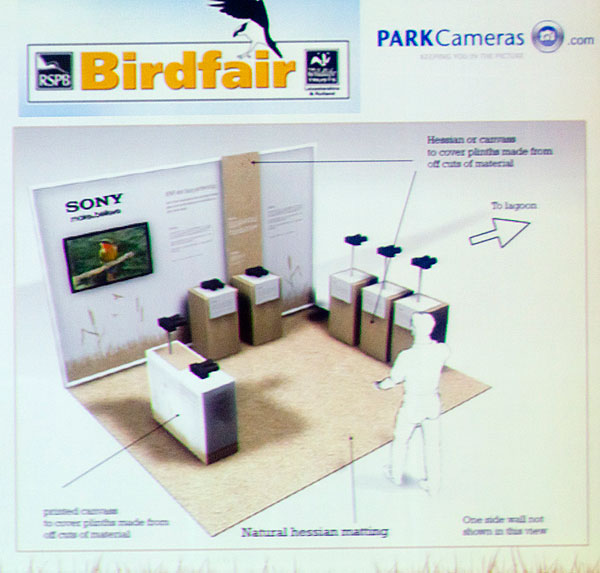
    Birdfair at Rutland Water on August 19th – the blueprint above turned into a real Sony DEV-3/5 booth. Park Cameras offered special deals as the first main distributor and took several orders, all for the DEV-5 model, on the day.

    The results looked very impressive as HD movies.

    However, there are a few functions which the DEV models could have included had they been designed from the ground up and not based on an existing camcorder. One is pre-shot capture, where the buffer is constantly recording a rolling second or two of video, to be included with the take when you press the button to film. This avoids missing the critical first part of movement of the subject which triggers your own reactions.

    The second is slow-motion capture at reduced resolution; 50/60p is already capable of half-speed playback and the shutter speed control use in the DEV models favours better motion freezing than some camcorders which aim for purely cinematic shutter speeds (1/30-1/50th and so on). Had controls been added to force fast shutter speed capture that is very useful for analysing wildlife film frame by frame, or extracting a valuable still image. Had 720p at 100/120 frames per second been enabled, that enables quarter-speed playback of action.

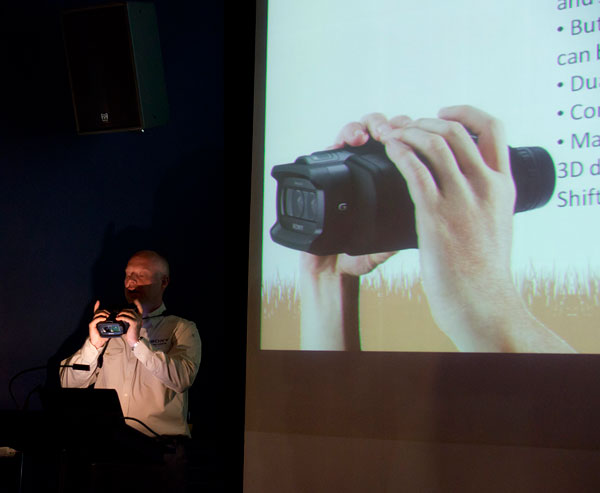
    Single-handed operation by Paul Genge – but he’s had a week of weight training before the event! They are actually pretty light, just rather large.

    Finally, make no mistake these babies are big. They are not overly heavy, as they are mainly empty plastic shaped to look like a military device. But they are not especially travel friendly, or all that easy to pop under your jacket in a cloudburst.

    The ultimate use

    Shirley’s verdict was – these are just made for festivals and stadium gigs! The one use not mentioned in Sony’s presentation, and a very popular use for binoculars and camcorders alike, is to see stage performances better and record music. Those little Minox monoculars we carry everywhere with us now were bought some years ago, en-route to an R.E.M concert. And sure enough, from our vantage point in Stirling Castle, they were a good investment.

    Now if the tiny Minox monocular happened to include a 1080p HD movie recorder – which it very easily could in terms of size, think of mobile phones, Sony Bloggie and the like – it would be an even better concert companion.

    The Sony DEV digital binoculars might get in past some security staff but we reckon they will soon be recognised and banned from events.

    Nothing new

    The first time we discovered binoculars combined with a camera, we actually got to be the first UK journalists to write them up. This was the Nicnon binocular camera, in its final version around 1975 (it had existed in a cruder design from the late 1960s) – it worked fairly well, but didn’t give any more real magnification than a regular 35mm camera with a 165mm lens and had a useless fastest shutter speed of 1/250th, only barely short enough to avoid camera shake in every shot and never able to stop action.

    Later on we tried the Tasco 110 binocular camera but the results were almost useless. Today, of course, we have pocket digicams with zoom lenses going to an equivalent of over 500mm and a resolution which matches 35mm not 110. These can even challenge the concept of the DEV-3 and DEV-5, though I doubt that anything made comes close to the HD video quality. In the end, something is new about the DEV-3 and DEV-5, and that is the HD video in a binocular form.

    We can only wish Sony the best of luck with this product. Any serious wildlife watcher or bird spotter will need their regular optical binoculars and their regular tele-equipped DSLR in addition to the DEV-3 or DEV-5. Regardless of six hour battery life and other commendable features, they simply do not and can not replace the other key equipment used in the field, with the exception of digiscope rigs or tele-capable camcorders.

    They will sell to wealthy gadget enthusiasts and garden birdwatchers with poor eyesight and big flat screen teles. Over 50s, get in an orderly queue now…

    For us, our four-day venture to the former wastelands of Barnes was a wild goose chase (we did see a few). Life was enlivened by road closures due to Olympic ‘test run’ cyclists. This product is not really of any interest to our dedicated photographer readership, for £2000 an Alpha 65 and 70-400mm SSM G would be a better investment for everything except the 3D video. And the market murmur is that 3D has failed, yet again. It’s simply not selling.

    Get the full PRESS RELEASE here.

    – David & Shirley Kilpatrick


  • Sony UK’s ‘Howto’ videos released

    The press release below has just come out from Sony UK. I fear you will be disappointed if you are expecting to watch informative, instructional videos because they are not – they are devoid of high value content, and are just rather superficial plugs for features on Sony cameras. Not all these are even correctly explained or demonstrated, the Low Light video for example has the commentator referring to a camera making two exposures while the LCD display clearly says three (HDR) and talking about DRO-Auto after showing the mode dial carefully being turned to Manual (which disables DRO entirely).

    It costs real money to make videos which are meaningful and valuable to the viewer. Real money may have gone on making these, but it’s not reflected in the quality or value of their content. Even the simplest of the subjects covered remains largely untouched by the video, and key information is omitted. Some information is quite misleading, such as the discussion of when to use S, M or L JPEG settings without ever mentioning that large image sizes can be downsized but small ones can not be enlarged without loss of detail.

    ‘Make sure you use the right image size for the job in hand’ must rank as some of the worst advice ever issued, encouraging digital camera owners to move off Large image size capture and lose vital detail which allows cropping, correction, resizing and higher overall quality. Telling them, in short, to throw away what they have paid for.

    Watch the videos, they are free. But they really do not help the digital camera owner or Sony. – DK

    ————————————————-

    Sony Introduces ‘Howto’ video guides

    Discover how to get the most out of your Sony Digital Imaging Products

    Sony has launched a series of Howto guides across multiple platforms, to give customers handy visual guides to getting the most out of their Sony Digital Imaging products.

    The guides, available via YouTube and a number of major retailers’ websites include easy to understand tips and tricks to enhance the Sony product experience and provide answers to the most commonly asked product related questions. The videos are also available via Sony’s BRAVIA Internet Video service, delivered direct to the TV, Blu-ray player or Netbox.

    The guides cover all of Sony’s key product ranges, including Digital Imaging, Network Communication, Home Entertainment and Essentials. They also help explain some of the underlying technologies such as HDMI and DLNA, allowing customers to easily understand the features and benefits of their products.

    A snapshot of the featured Howto guides including handy tips for your Sony Digital Imaging products include the below among many more:

    Capture 3D photographs and video with your new Sony Cybershot or Handycam
    Get the benefits of interchangeable lens cameras
    Use Bloggie, Picture Motion Browser and Personal Space
    Get better results from your digital camera
    Learn to shoot photos in low light

    All of the Sony Howto videos are professionally recorded and, where possible, made available in HD. If consumers want to find out even more, each video includes a link to a website where further details are available. This can be accessed via a shortened URL or QR code for smartphones, allowing users to receive product information whenever and wherever they may be.

    ‘Howto’ content development is based on input from customers, Sony user forums and the Sony support centre.

    More HowTo guides are planned and outside of the YouTube channel, the guides will also be used as additional training material for Sony retail staff. Keep an eye on the Sony YouTube Channel for the latest content and product information.

  • Sony’s London warehouse burned to the ground in riots

    The Sony Enfield warehouse and distribution centre was torched by rioting ratboys last night. There are several vidoes on YouTube. Comments include that 750 people have lost their jobs (not sure what this means).

    Sony is due to hold a press launch event in south London, just one mile away from the Ealing and Clapham riot zones, early next week. We are booked into a hotel in Kingston on Thames (our expense, not Sony – thought that if we had to travel 350 miles to see whatever new stuff was around, we might as well spend a couple of days visiting our former capital city to remind us why we decided to move to rural Scotland 23 years ago…)

    We may decide to call that one off. Will be contacting Sony today.

    http://gizmodo.com/5829003/sony-distribution-center-goes-up-in-flames-during-london-riots

    Our thoughts are with all those unlucky enough to be trying live alongside alongside these morons.

    – David & Shirley Kilpatrick

  • Watch the birdie – will Sony’s GPS surprise?

    Before reading this article, which has attracted a lot of traffic and attention, please remember this is my personal speculation and could be entirely wrong (I’ll be very disappointed if it is miles off target and they omit GPS… or my reading-between-the-lines turns out to relate to a different product like a superzoom pocket camera with improved GPS).

    There are plenty of detailed rumours about the specifications of the forthcoming Alpha 77, Alpha 65, NEX-7 and NEX-5n to be found on the Sonyalpharumours website:

    http://www.sonyalpharumors.com/sr5-the-full-a77-a65-nex-7-and-nex-5n-specs/

    I’m not here to confirm or deny any of this (like most mainstream journalists, even those with some connection to Sony, I don’t get advance information and I am not running a camera-test website which demands a pre-production preview under strict non-disclosure terms).

    The image currently circulating most, purporting to show a new Alpha – 77 or 65. Real or not, it looks good enough.

    The 12fps stated maximum shooting speed of the semi-pro specification A77 fits in with information given to me as long as three years ago. A vaguely Alpha 700 like prototype was being tested in the Australasia region with 15fps. Most of the other specifications, such as the magnesium or magalloy body, were apparent right from the first mockups being shown if you know your Alpha construction. The strap lugs were the giveaway. You can tell an A900/850/700 type camera (solid metal carcase under a plastic skin) from an A1/2/3/4/5xx Alpha by the strap lugs connected through the skin to the casting.

    But what Sonyalpharumours doesn’t elaborate on its something I believe Sony has put into the new Alpha 77 which will make it the ultimate cameras for bird watchers, aircraft spotters, wilderness ramblers, explorers, police forces and the military. It has GPS. I think that when it is seen by the press later this month the GPS will be a big point.

    It will be the fastest locking-on GPS built in to any camera, and it will be the first to record ALL the data you need. That will include not only the latitude and longitude and height above sea level, but also the compass direction the camera is aiming in and the inclination of the camera. Combined with very accurate focal length, focus distance and AF locus data, this will make it possible to use the Alpha 77 for photogrammetry (measurement, mapping, object size identification).

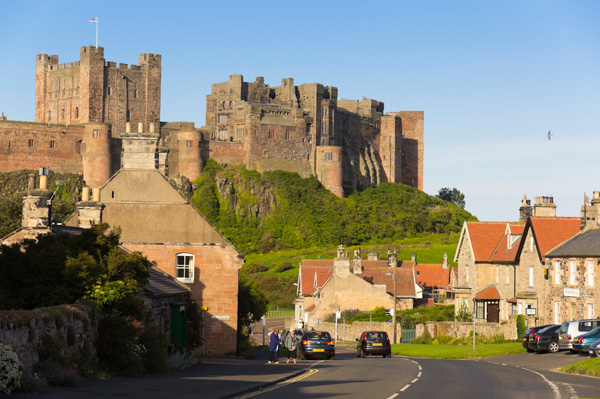
    I parked illegally and jumped out of the car for this shot of Bamburgh Castle from the village’s main road. For once, the Alpha 55 GPS locked on instantly and gave me the exact location of the camera on the Google Earth terrain view below.

    But two days later I spent ten minutes, using a tripod, carefully photographing an uncommon slightly edible mushroom in our garden over 30 miles from this shot. Needless to say, all the frames of the mushroom display the GPS data from Bamburgh as it had failed to update its position.

    This is Leucoagaricus nympharum – white field mushroom with ‘dancing maidens’ on its distinctive cap. Some sources state it is edible. For me, it was. For Shirley – noted as one to avoid for the future… but a great photographic subject. Natural light, CZ 16-80mm, 1/3rd of a second at f/14, 80mm, ISO 100, manual focus and settings.

    The GPS in my Alpha 55 has been a real help in travel photography. I use Media Pro, the Phase One cataloguing and keywording software. Since this moved away from Microsoft ownership it no longer has its own own Microsoft Virtual Earth pane to open when GPS embedded data is found. Instead, it opens my web browser to the usual Google Map and Earth page. It’s not as neat as having the map tab within the Media Pro software but it works just as well.

    However, the A55 GPS frequently doesn’t get a signal during many minutes of shooting at a new location. I have entire shoots of places, lasting several minutes in clear open conditions, wrongly tagged for the last spot visited. Fortunately, if I have left the camera switched on I sometimes find the correct location attached to the next place en route…

    The Alpha 77 will, I believe, see an end to poor GPS and it will add the vital compass and inclination functions. Combined with the 24 megapixel resolution, near-silent mirrorfree high speed sequences, and the 1.4X and 2X teleconverter functions (cropping the sensor field but retaining full HD 1080p video, we hope) this will make the 77 the world’s best camera for wildlife safaris. And for those who like to log their natural history subjects, the accurate GPS tagging is the closest thing you can get to digital evidence of the authenticity of your shot.

    All major camera companies have their eye on government and military budgets. It was the US forces’ decision to buy Topcon SLR cameras in the 1960s which gave that small but excellent camera brand a few years of glory. They achieved it by making a camera which was tougher and more versatile (in some ways) that the rival Nikon F – with accurate TTL metering that did not need a bulky prism head.

    At different times Olympus, Nikon, Leica, Hasselblad and even Minolta have been favourites for government and military use. I think Sony, realising what the high resolution and very fast capture rate of their new technology mean to such users, will have sealed the deal by upgrading the GPS. The Alpha 77 will not only be the world’s best wildlife and wilnderness companion, it will also be the best evidence camera, surveillance camera and spy’s best friend.

    Of course this is all pure speculation. It is based on a well-grounded hunch, and on what I would do myself, if I was in charge of the Sony development plan for the A77. There’s no way I would let another GPS module out in the world with less reliability than the average pocket digicam’s version. I would want my top SLR (SLT) GPS to be a world-beater.

    Now you’ll just have to wait and see. But wouldn’t it be good if I’m right?

    – David KIlpatrick

  • The truth about 24 megapixels

    There is a rumour, which the ides of August may stab in the back or elevate to divine truth, that the coming Alpha 77 will have 24 megapixels.

    Because of this rumour, there is a lot of very negative discussion going round to the effect that 24MP on APS-C is far too much and the results will be poor (etc).

    Well, they may be, if you think Canon’s results are poor – you can judge that for yourself, try a Canon. But they do not have 24MP sensors!

    They also do not have APS-C sensors, in the same way that Sony does. They have smaller APS-C sensors with lots of pixels cut off all round the edges. Sony has chunky big APS-C sensors with acres of extra pixels to spare. This is a slight exaggeration of the situation, but hey, I may as well join in the mood of unrestrained opinion!

    Facts: Canon’s 18-megapixel sensor makes images 3456 x 5184 pixels in size (give or take a few, depending on your raw processor). Fact: their smaller 1.6X factor sensor measures 22.3 x 14.9mm. Fact: Canon states it is approximately a 19 megapixel sensor with 18 megapixel final output.

    Facts: Sony’s 16.2 megapixel sensor measures 23.5 x 15.6mm and into this packs 3264 x 4912 pixels (active area).

    If you made a current Canon pixel-pitch sensor the same 1.5X size as a Sony sensor, it would be around 19.7 megapixels active from a 21 megapixel total. If you put Canon pixels on an existing Sony 1.5X sensor, you would be up to 3618 x 5463 pixels and 24 megapixels needs to be 4000 x 6000.

    Clearly it’s not the quantum leap some people think, just a quantum leapfrog over Canon’s back with the benefit of the larger sensor. And it’s worth considering that APS-C covers sensor sizes up to a true 24 x 16mm, for Super-35 video use, and that such sensors have already been made. A few wide-angle lenses and zooms might be a bit tight on the image circle, but that half millimetre one way, 0.4mm the other way, adds up to a surprising number of pixels, enough to take the 19.7 megapixels up to 20.7 megapixels without changing from Canon’s current pixel pitch.

    So don’t panic. The chances are that 24 megapixels on proper, big Sony APS-C will perform very well. If you’ve got the glass and the technique to make it…

    – David Kilpatrick


  • Photoclubalpha Facebook Page

    Photoclubalpha now has a Facebook page, which you can ‘LIKE’ to help promote its ranking. Discussions, photo links, are welcome.

    https://www.facebook.com/pages/Photoclubalpha/160342994031131

    – DK