Flagship medium-format digital rangefinder-style design revives classic Fujica handling
100MP 44x33mm sensor and fixed 35mm f/4 lens
4K movie capability, and less than £4,700
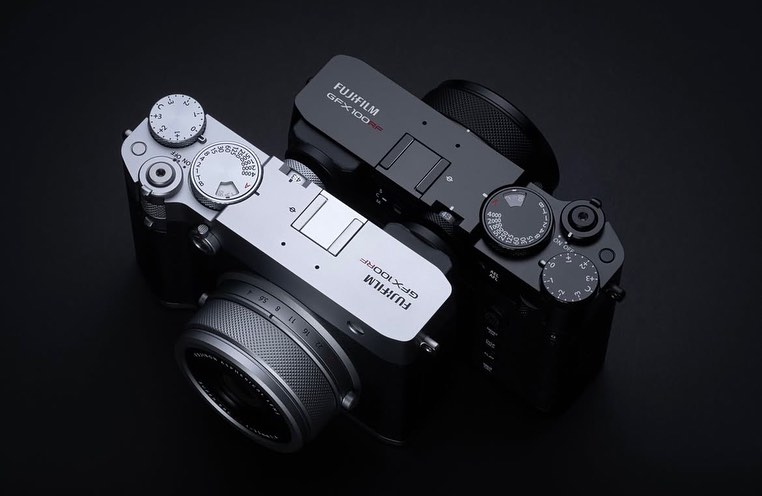
Anyone remember the Fujfilm GS645W, that robust go-anywhere 120 rollfilm leaf shutter viewfinder (focus by estimation) model with a 45mm f/5.6 wide-angle lens, or its electronic GA645W with faster AF f/4? Well, in a slightly different body form the medium format digital GFX series is revisiting this amazingly popular minority choice for landscape, travel and everyday use. This is the GFX100RF.
The GFX100RF is essentially unique on the market, but you may consider a Hasselblad X2D II 100C for the minimalist body, paired with either the 28mm or 45mm f/4 lightweight lenses. It will cost twice as much – albeit, with the benefit of in-body stabilisation and interchangeable lenses. That logic would also put Fuji’s own medium-format mirrorless system camera in the running – the GFX100S II with 35-70mm kit lens is around £600 more than the 100RF, but is a more conventional DSLR-style design and much larger, even with a compact prime.
Fujifilm GFX100RF specifications
102 megapixel 44 x 33mm CMOS sensor
Fixed 35mm f/4 Fujinon Super EBC Aspherical lens
Angle of view similar to 28mm on 35mm full frame
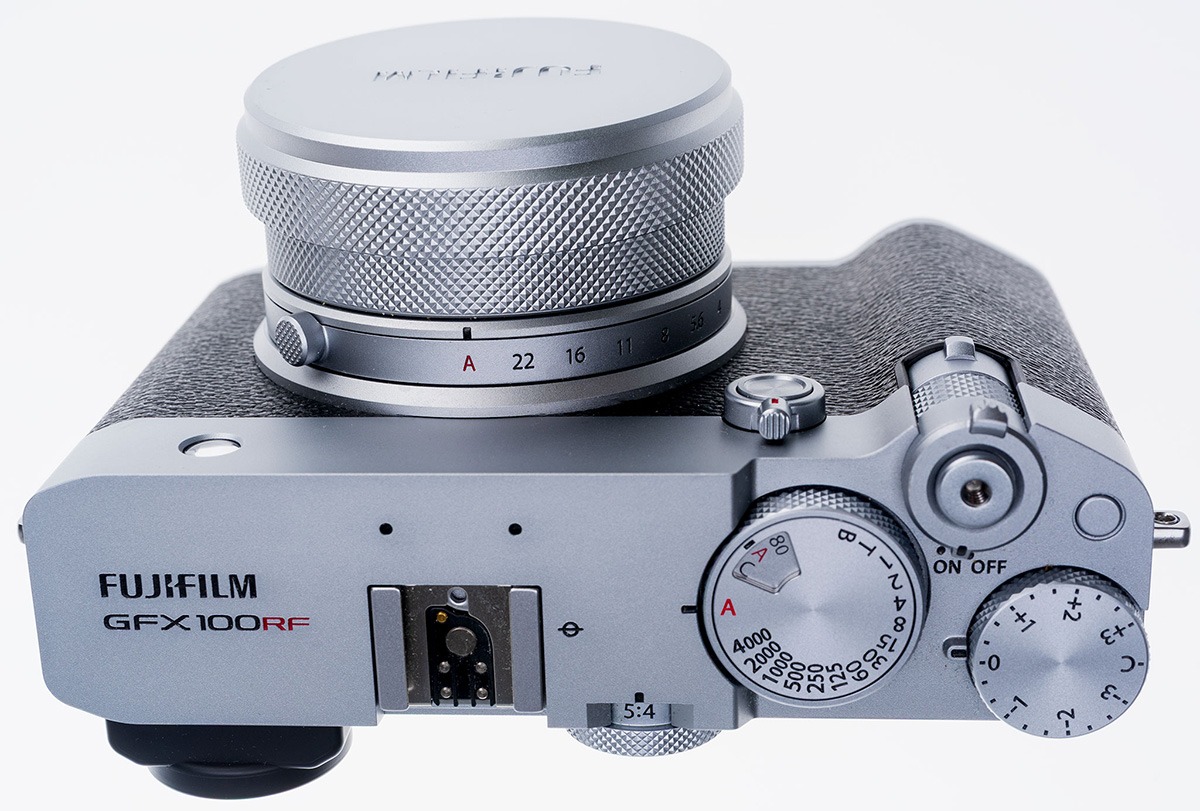
Mechanical leaf shutter 1 second to 1/4000s with physical top dial setting
Apertures down to f/22 set by physical aperture ring on lens with A setting for aperture priority auto
EV over-ride for auto metering or manual setting from +3 to -3 stops
Selectable format ratios 4:3, 2:3, 1:1, 16:9, 5:4, 7:6, 17:6 and 24:65
Digital converter by embedding metadata crop in raw file, cropping in-camera JPEG
Full range of Fujifilm film simulation looks and BW with filters
4K movie, Bluetooth GPS location data and Fujifilm X app compatible
Weight 735g, size 133 x 90mm
GFX100RF: handling and controls
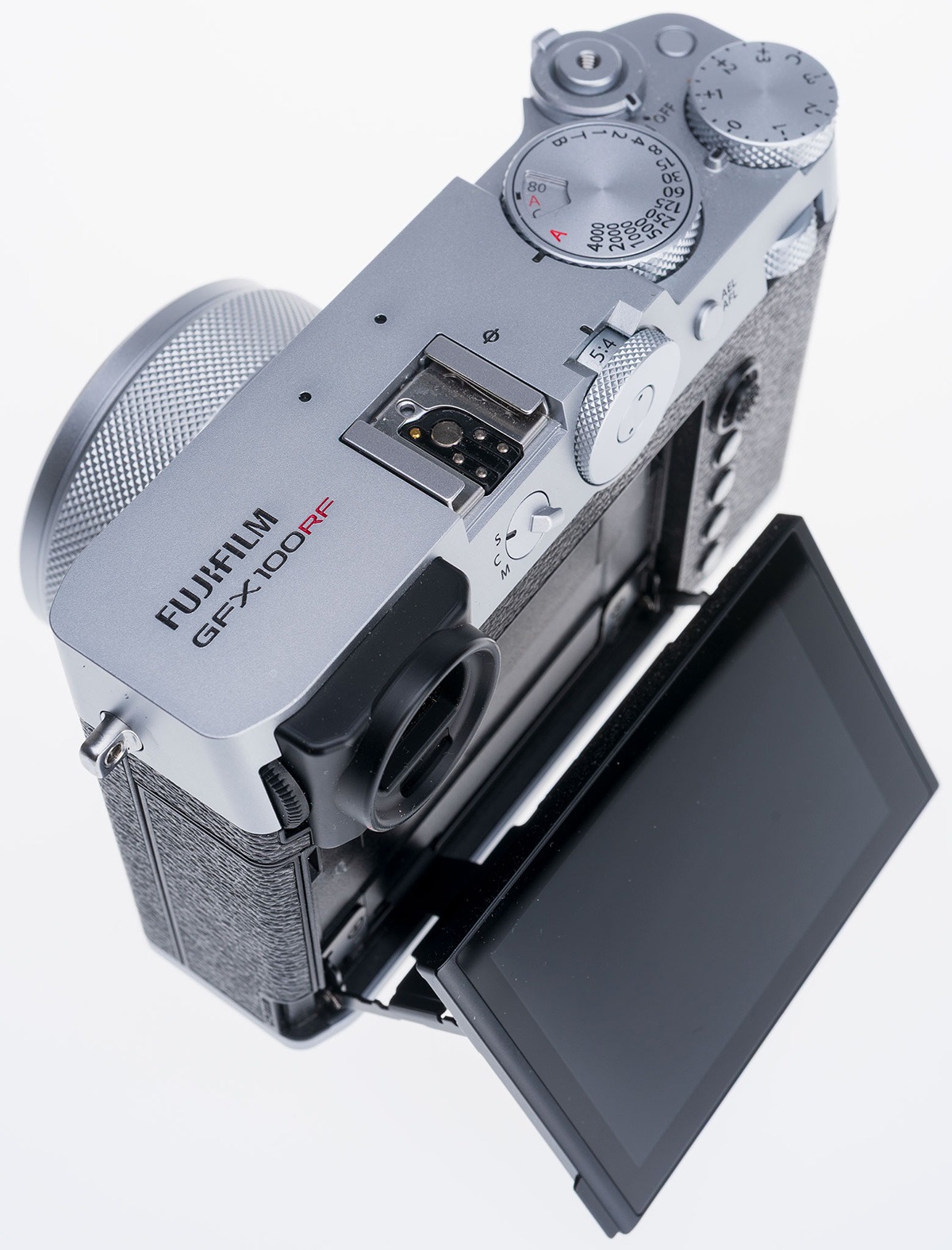
If you like physical controls and the feel of fine engineering, you’ll fall in love with the fixed lens medium format Fujifilm GFX100RF. It looks, handles and performs unlike any other and my brief acquaintance with it only scratches the surface. That may not be the right term, as this camera has a ‘machined from solid’ aluminium housing with a surface treatment which should look as good in a decade as it does now.
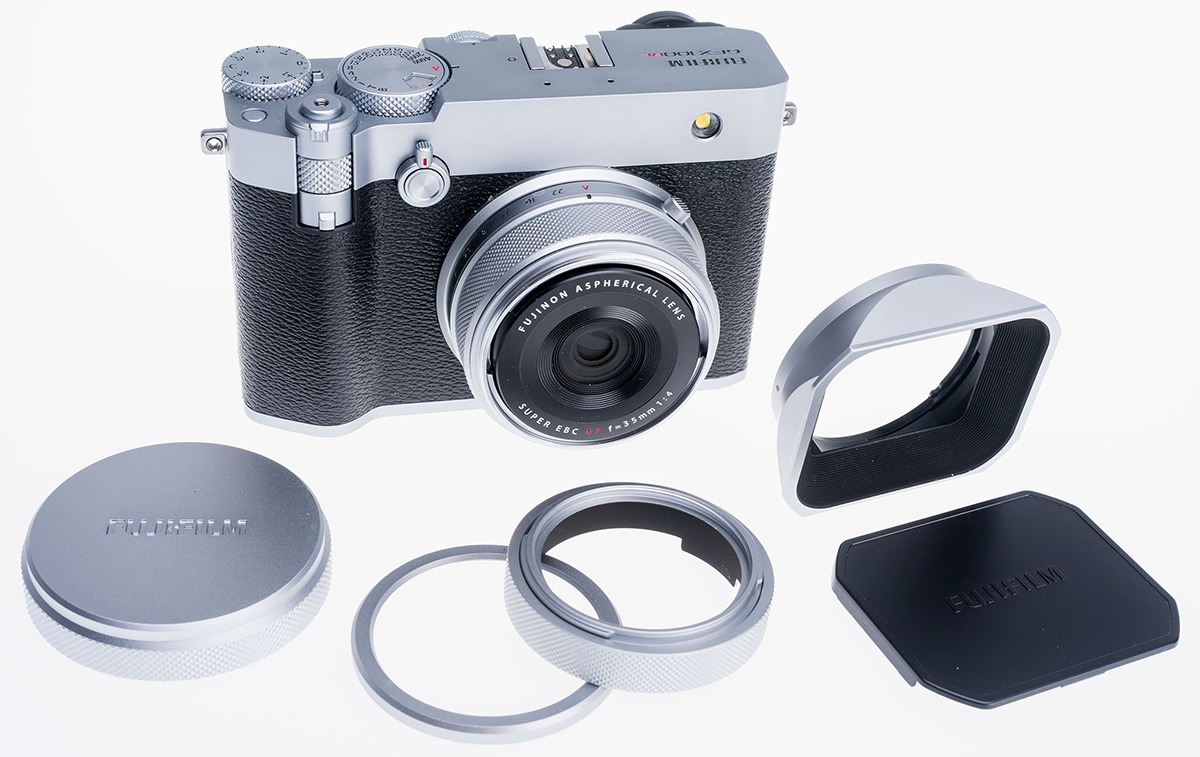
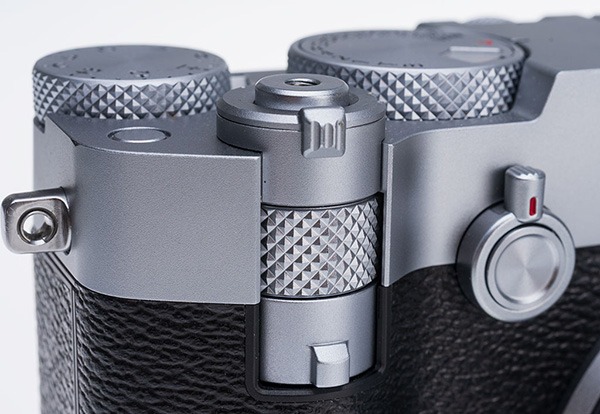
It’s a pity our sample was missing its flash shoe cover as that completes the design. Every dial, wheel and roller is finely knurled. Below the shutter release is a roller you can turn, a cylindrical pillar with the on/off switch above and a left-right toggle below it. You can customise functions, but out of the box the roller scrolls through nine image ratios and the bottom toggle further changes the crop with four lens simulations.
There’s another toggle lever (with a red mark) to move between EVF and rear screen viewing. A smaller roller with pushbutton function falling under your thumb positions the AF area, a rear top plate mounted dial gives an alternative way to set the default format ratio on power up, and on the top in the usual position is a shutter speed dial with lift and drop ISO setting collar (80-8,000, expandable to 40-102,400).
Most of this could be accomplished using the screen or EVF and menu settings. Instead this camera reasserts Fujifilm’s affinity for real controls as found in other GFX, the X100 and X-Pro ranges.
It is most akin to the X100 models, including a choice of silver or black finish. It’s also not much bigger despite the 33 x 44mm sensor. The X100VI is larger than its APS-C sensor predecessors because of the sensor stabilisation, and the GFX100S II is fairly large for the same reason. IBIS adds about 1cm all round to a sensor assembly.
The GFX100RF has no form of stabilisation, optical or sensor based, except a digital type dependent on a crop which can be activated for shooting the 4K and lesser movie formats. I did not test movie shooting, and also didn’t experiment with the interesting multi-exposure function.
For me, this camera came as more of a digital reprise of the classic Fuji GA645 rollfilm autofocus camera. It also manages to cover the role played by the G690 and G670 ‘giant Leica’ models, and the G617 panoramic 120 rollfilm camera which shot a 55 x 165mm format using a 105mm lens.
Switch the GFX100RF to its 17:6 ratio, and the 35mm f/4 Fujinon Super EBC lens gives exactly the same panoramic view. The JPEGs produced are cropped, and the raw .RAF files get an embedded sidecar file which makes Lightroom, Bridge, Camera Raw and other software preview and open them using the crop seen in the viewfinder.
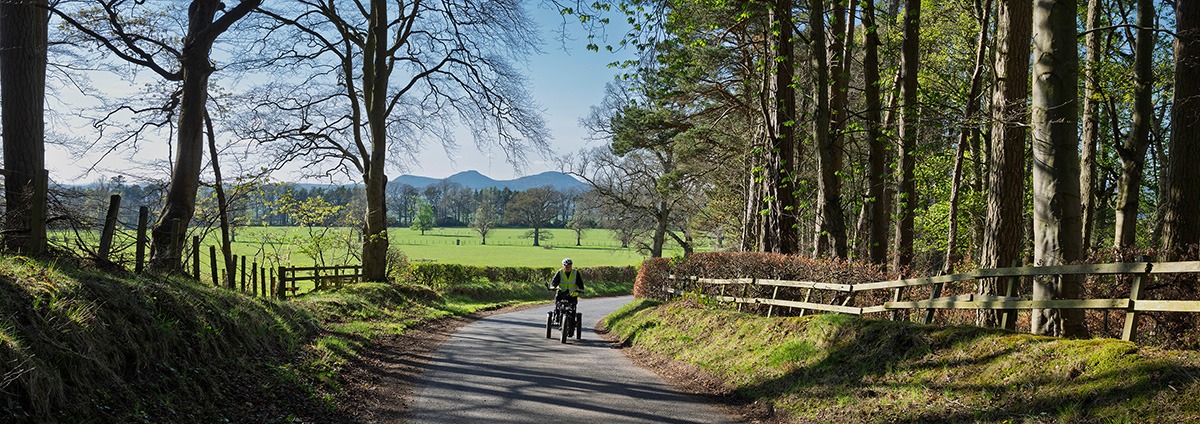
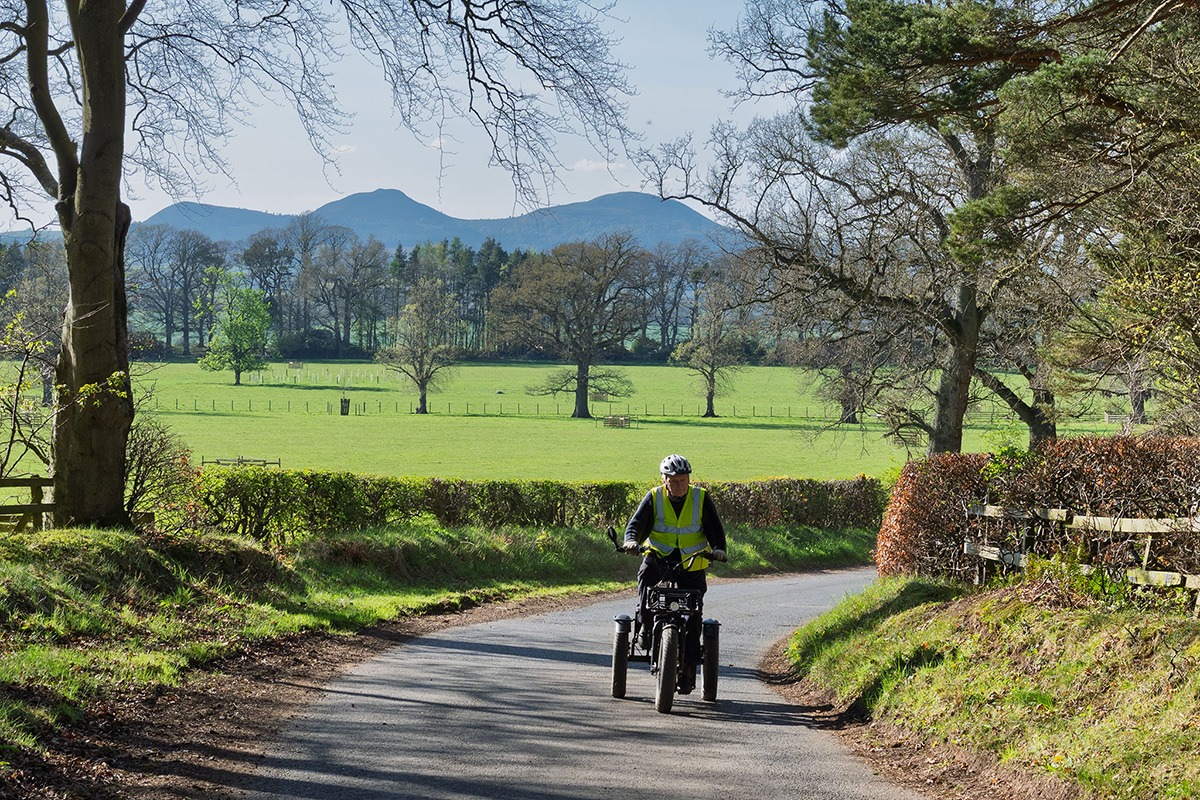
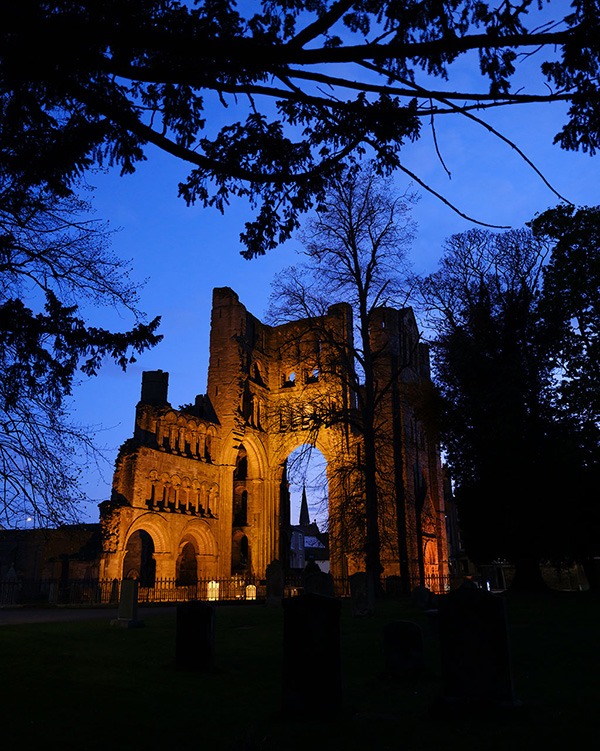
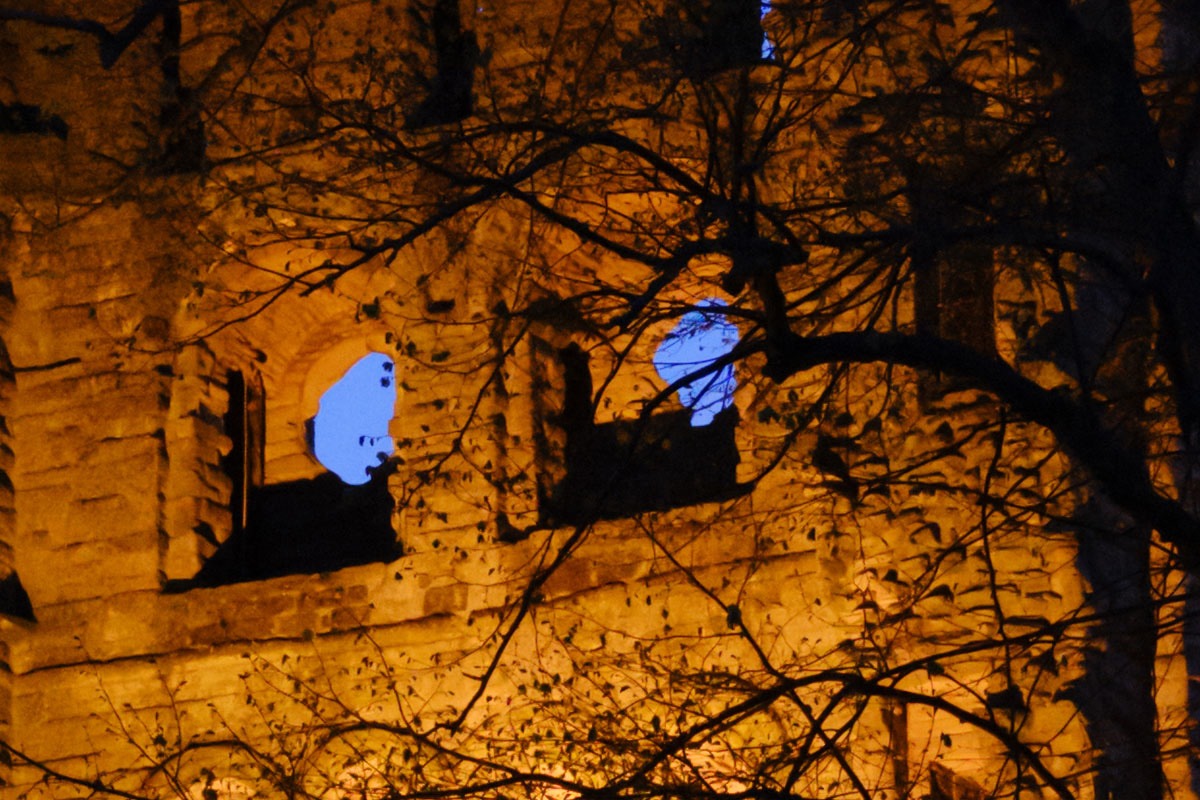
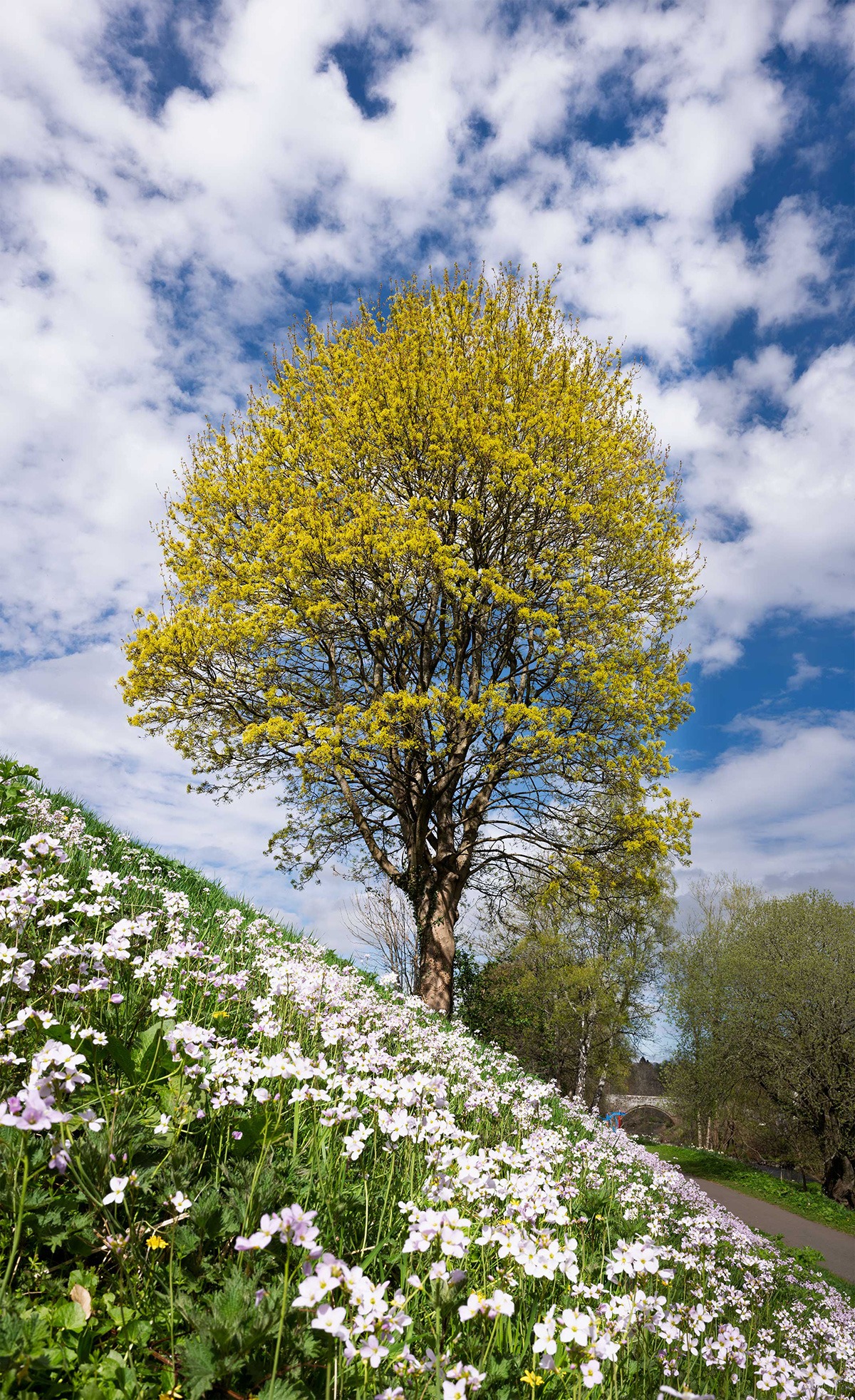
You can cancel this and access the entire 4:3 ratio image instead of the 17:6 – or the 65:24 (XPan), 16:9, 3:2, 5:4, 7:6 and 1:1 options as well as a vertical ‘half frame’ 3:4 ideal for portraits without holding the camera vertically. It’s still more than half the 102MP sensor! Eildon Hills and EV tricyclist in April.
With movie/audio functions similar to the X100VI, dual SD UHS-II card slots, CPU and screen/EVF similar to the GFX100S II I’ll refer readers back to reviews of these for other evaluation.
Part of the appeal of the GFX100RF is that it’s very familiar in detail and functions for any dedicated Fujifilm shooter. It offers all the same film simulations such as the ACROS+R red filtered BW, Velvia and Astia all of which I used at different times during this trial. However, to get the degree of control I wanted from each frame without diving into the detailed adjustments possible on the camera, I found Adobe’s Camera Matching ACROS+R combined with Strong curve and brightness increase more like the kind of print I’d aim for.
The Lindisfarne boat hut and chunky rope was taken at f/11 and there is enough depth of field for an A2 print with only the distant buildings slightly soft.
Fuji GFX100RF: the 35mm F4 lens
What’s very different is the 35mm f/4 fixed lens. It is not really comparable to the fixed 23mm f/2 of the X100 series, though some will claim f/2 on APS-C ‘equals’ f/4 on 33 x 44mm MF. That only holds true for depth of field, and then only for an identical pixel count determining the print or monitoring viewing conditions.
This lens is similar to a 26 to 28mm in field of view depending on whether you use the full 4:3 sensor ratio or crop to 3:2 35mm shape, where the X100 series lens is like a 35mm semi-wide on 35mm.
It’s a surprisingly simple 10-element 8-group inverted retrofocus with just two aspherical elements. In a similar fashion to lenses which pioneered this design in 1990s luxury compacts and later digital reprises, it uses a large element close to the sensor. It’s more or less a giant Ricoh GR despite Fujifilm pedigree. For calendar picture-postcard views the angle is perfect.
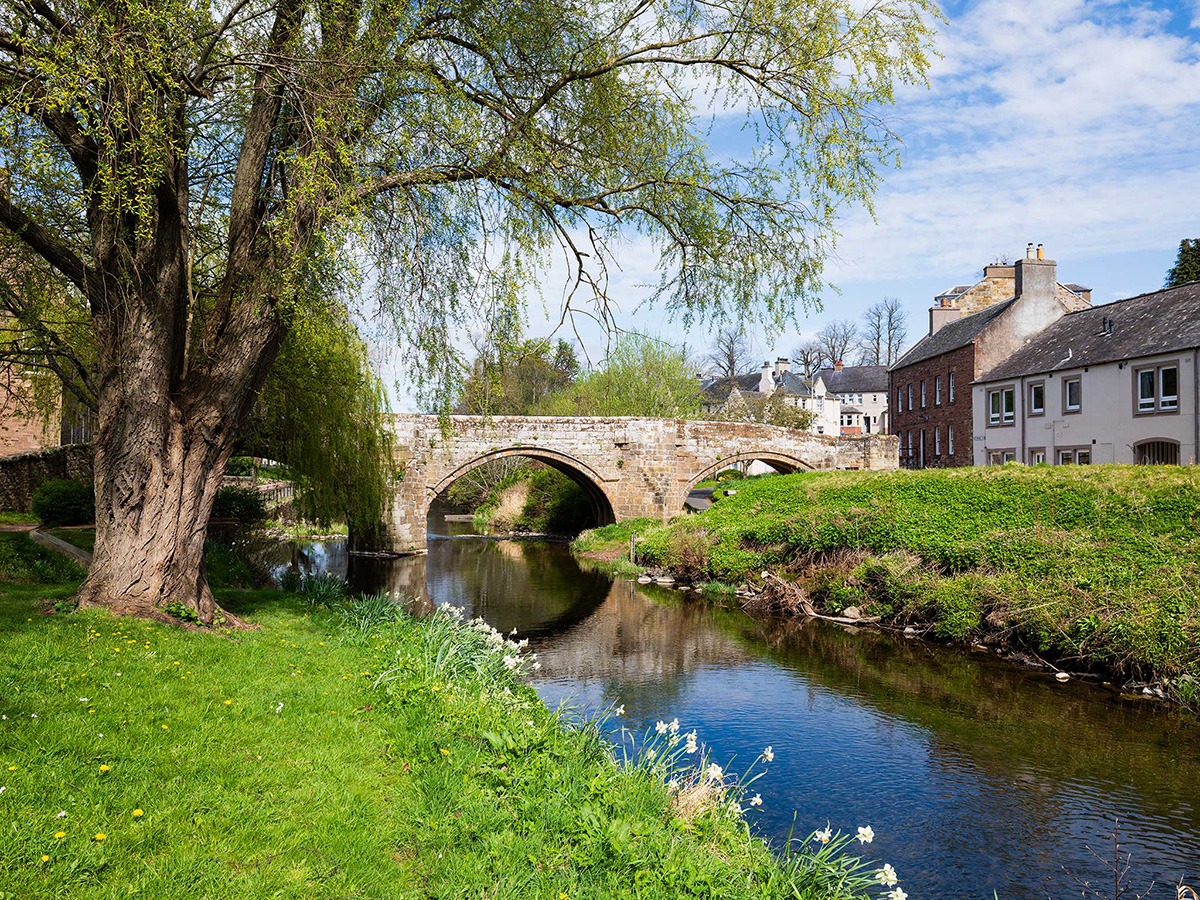
Jed Water running through Jedburgh.
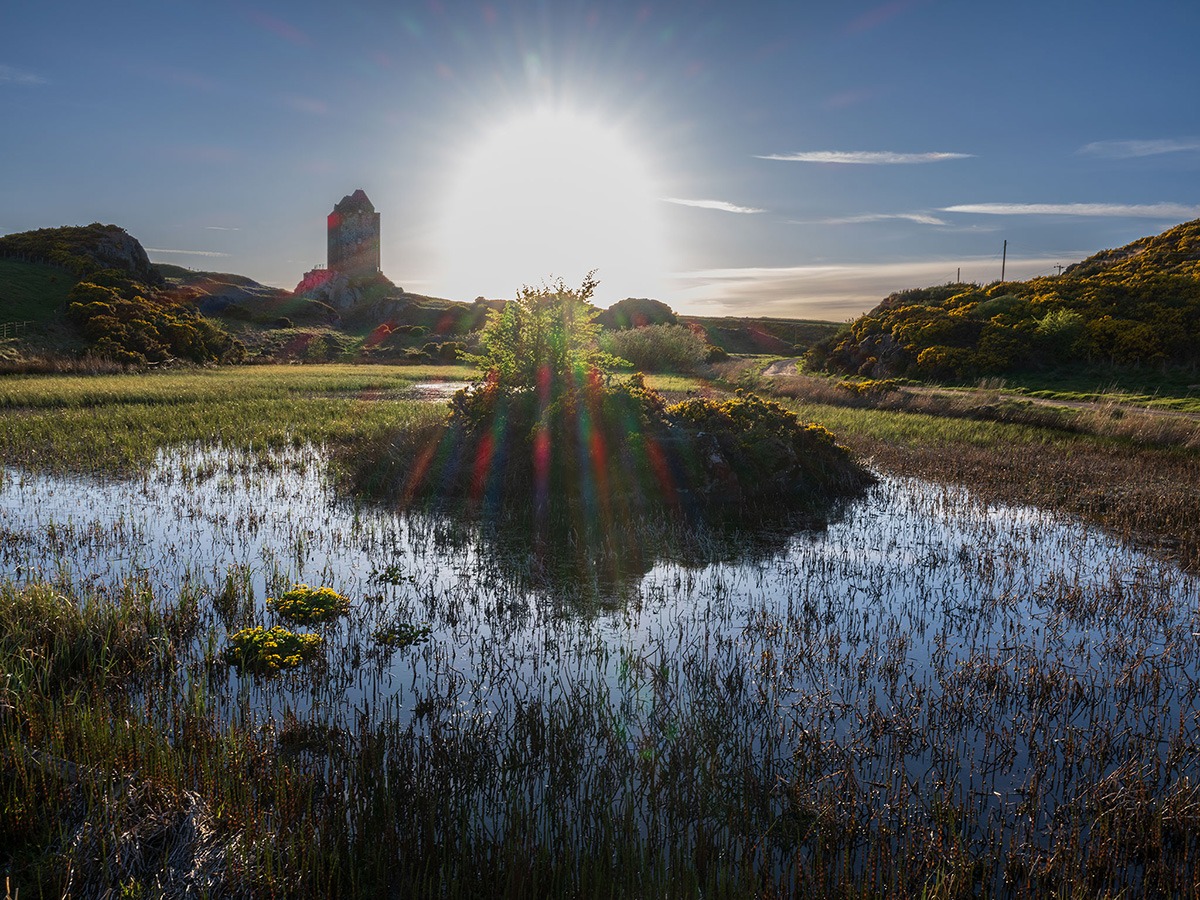
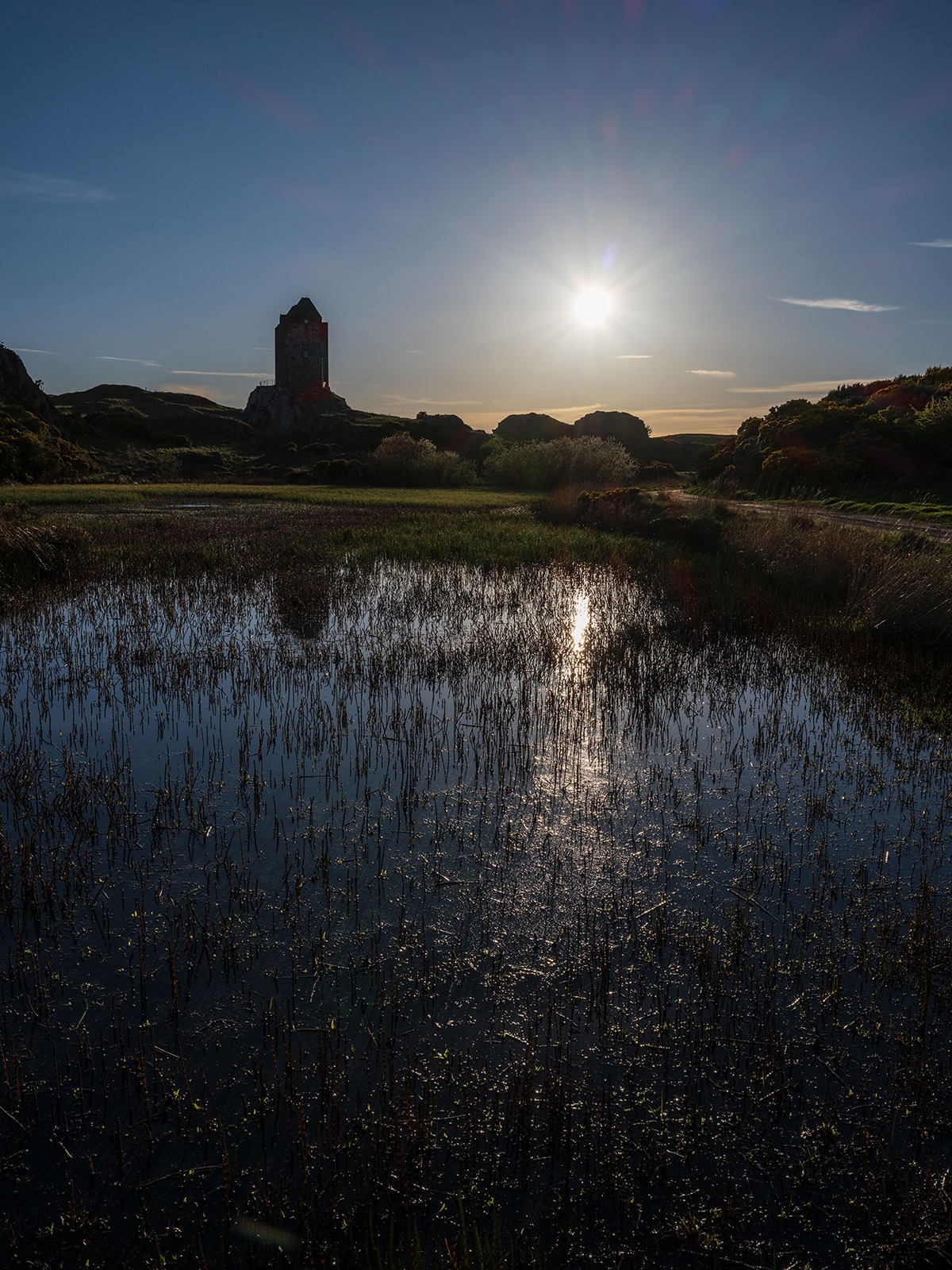
Despite the EBC coating, which I first encountered creating unrivalled flare-freedom in a 1975 55mm f/2.2 EBC Fujinon which used only five elements, the internal leaf shutter and iris combine with the lens design and probably also the sensor to produce some distinct flare patterns when shooting with a light source in the frame. These become dramatic from f/11 to f/22, resembling a diffraction grating or special effect rainbow star filter as below taken at f/22.
Fortunately the lens performance at f/4 is impeccable and using wider apertures can kill this flare, with the benefit of a 4X ND filter option inside the lens and the 1/4,000s fast leaf shutter speed or the electronic extreme of 1/16,000s. Flash sync works up to 1/2,000s or 1/4,000s depending on aperture.There’s no PC sync terminal, the flash shoe is your only connection. But flare is not inevitable, the shot below is at f/14.
Putting all this together with finely engineered focus and aperture rings (to 20cm, and third stop soft detents) we get a masterpiece of compact lens design on this larger format. Unscrew a front trim, fit the supplied 49mm filter on the bayonet lens hood adaptor and the camera becomes weather-sealed. Add the machined rectangular lens hood with its deep matt black inner and aluminium outer skins, and a supplied slide-on front cap completes the rig. The slide-on design could very easily be used to make a dedicated filter holder for grads or effects (hint to Fujifilm).
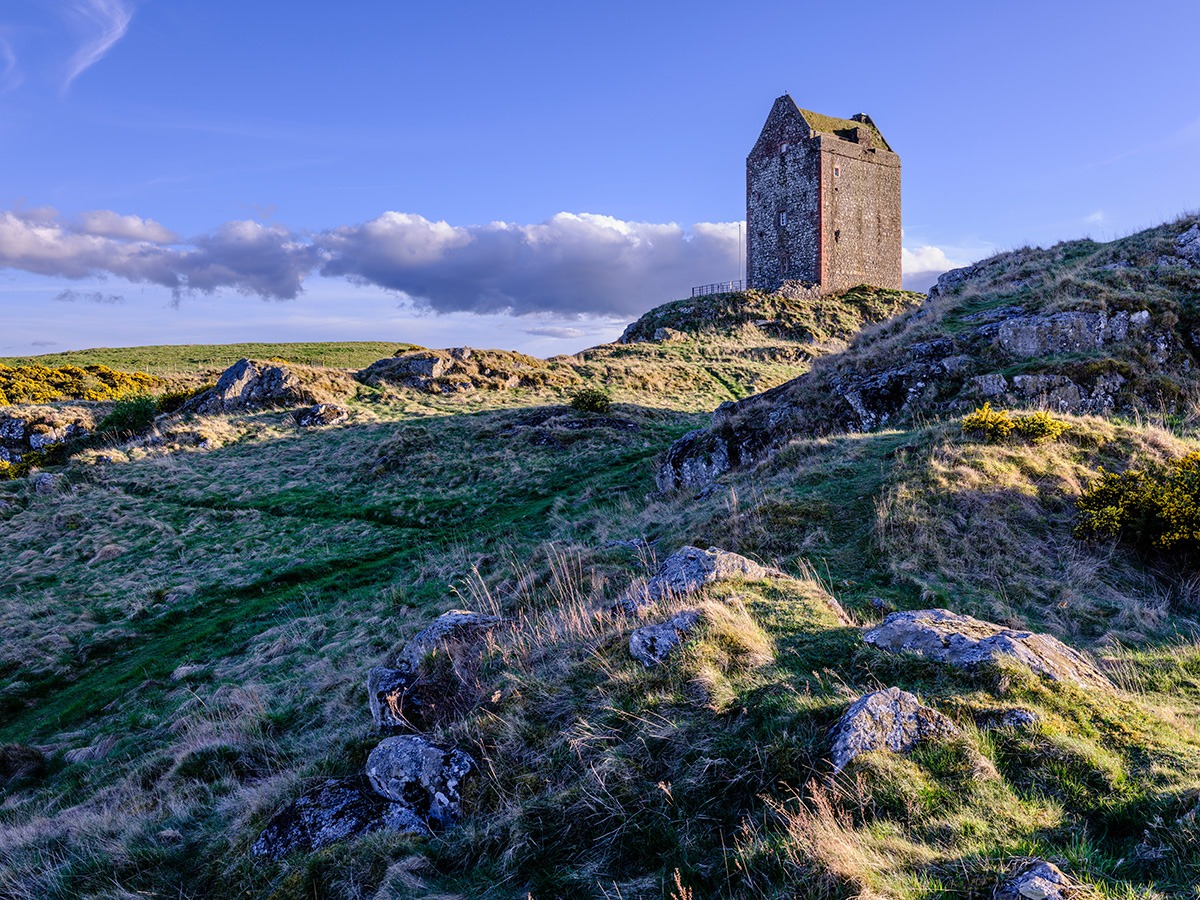
Generous use of Adobe Camera Raw ‘Shadow’ control put noise-free detail into the shaded parts of the foreground. 1/80s at f/9, ISO 200. Location – Smailholm Tower.
It’s difficult to fault the lens when you see in-camera JPEGs. The Super Fine option is so good, and the exposure so accurate, you might never need to shoot raw. At ISO 200, the deepest shadow detail on a JPEG can be pulled up with extreme levels adjustment in Photoshop and show no excessive noise or tone breaks. An underexposed JPEG from this sensor is almost as good as .RAF for post-processing.
It’s just as well that using the two cards to record the raw and JPEG gives you the best backup, film simulations (with EVF/screen preview) and cropped results. You can set the digital zoom to 35mm, 45mm, 50mm or 80mm in addition to those format ratios. If raw is recorded, in-camera processing allows application of all these settings later on. Sit down with the camera and a coffee, use the 5.7 million pixel EVF to view the results, and save a new JPEG.
Cropping, whether in-camera or later, provides great scope despite the fixed wide-angle lens. The 45mm digital onverter setting crops to exactly 35mm full frame bar the 4:3 ratio, and at 62MP closely matches the Sony A7RV with a 35mm lens. The 63mm crop gives a 50mm view with 31MP file and the 80mm a 20MP file with 63mm view. For best quality, an A4 print needs a 10MP+ image. One ninth of the full GFX picture is good enough for this, an effective 3X ‘converter’ giving a 105mm view though you must do this in post, there’s no camera setting.
When using the digital converter, the entire EVF or screen is filled by the cropped image. This leads on to the issue of ergonomics and those wonderfully engineered controls.
Check your change
After a few sorties out with the GFX I noticed that the digital converter and the format ratio had a tendency to be wrongly set. The greyed out non-image areas of the finder view meant accidental nudging of the ratio was not a huge problem, but changing the crop and the angle of view was.
When picking up the camera whether turning it on or just lifting it to the eye from neck-strap hanging, I was all too often touching the front roller and the digital converter (crop) toggle switch because both fall naturally under the right hand fingers. It’s an issue a long-term owner would learn to live with, avoided by turning the camera on only after lifting it to the eye, or by customising functions.
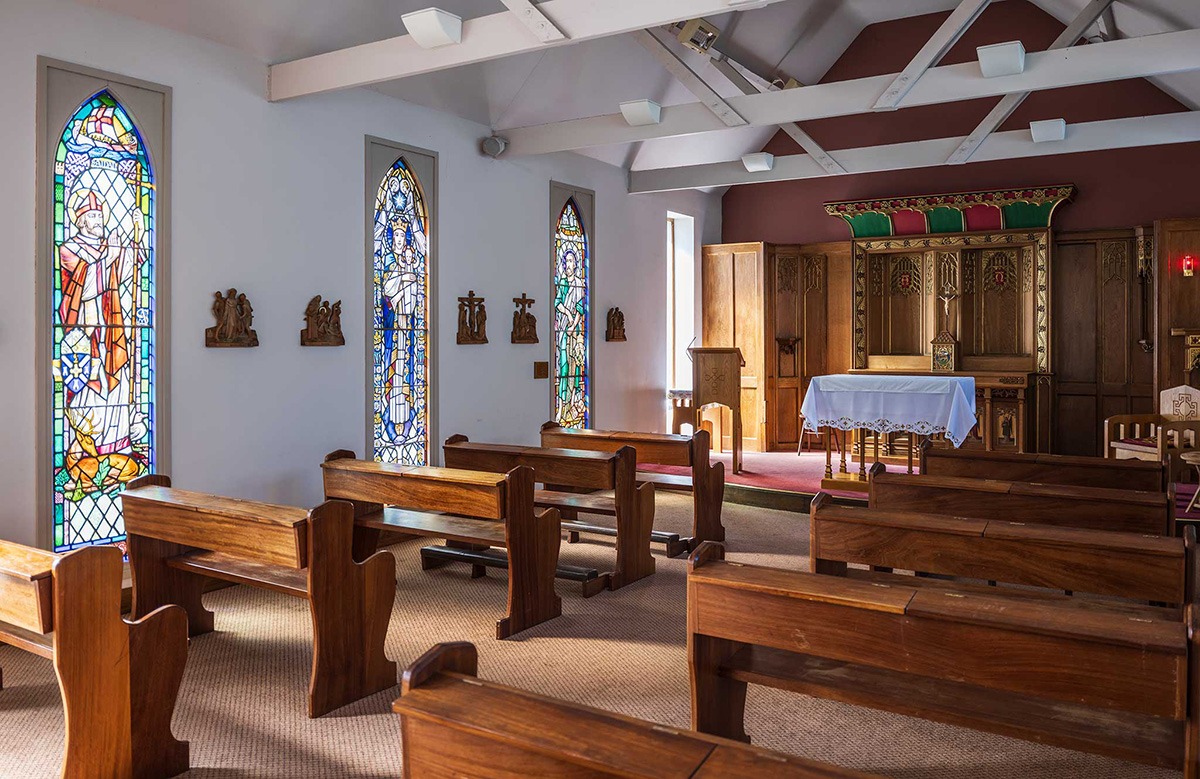
The interior of a Lindisfarne church, showing the 28mm angle of view.
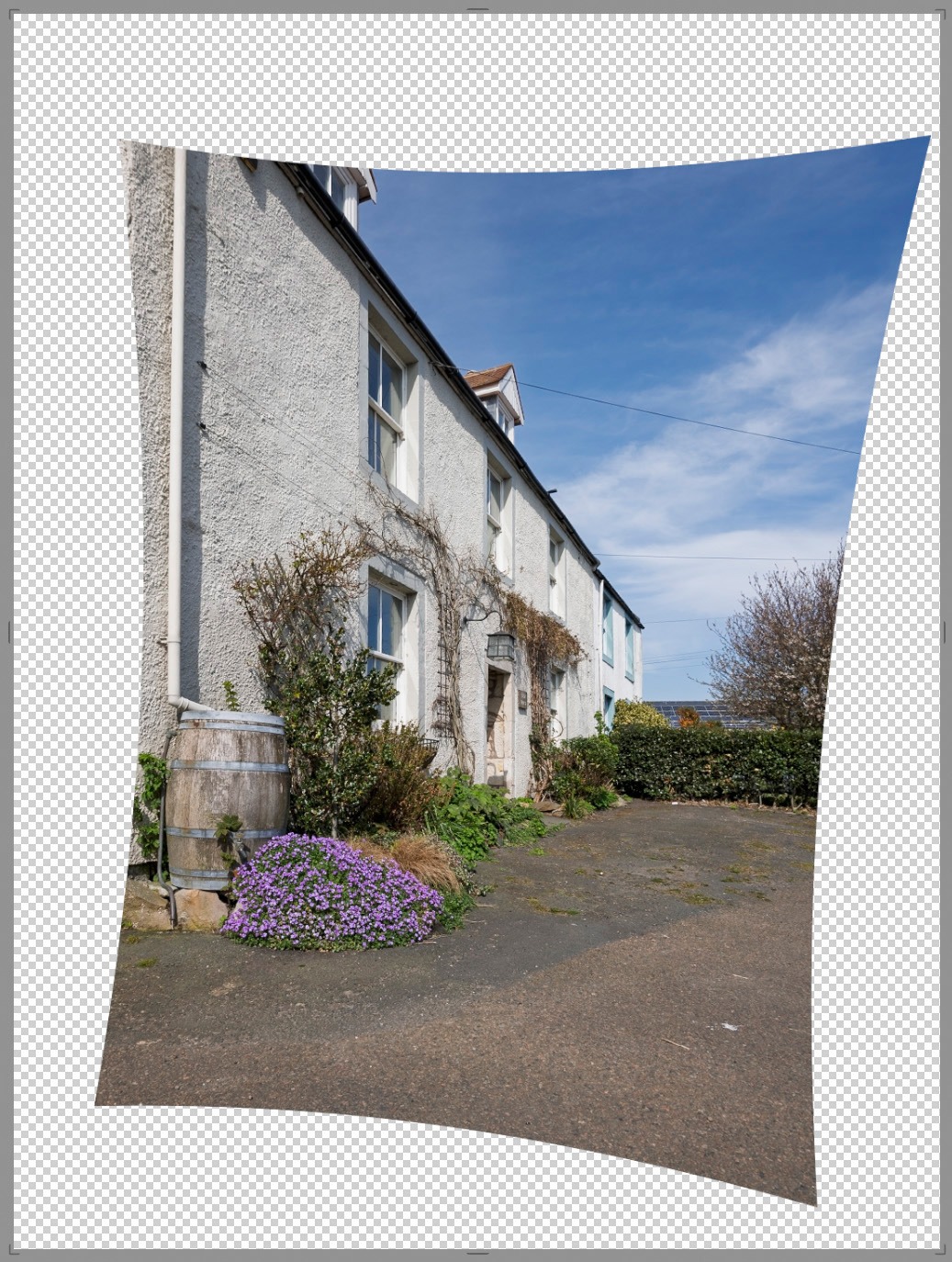
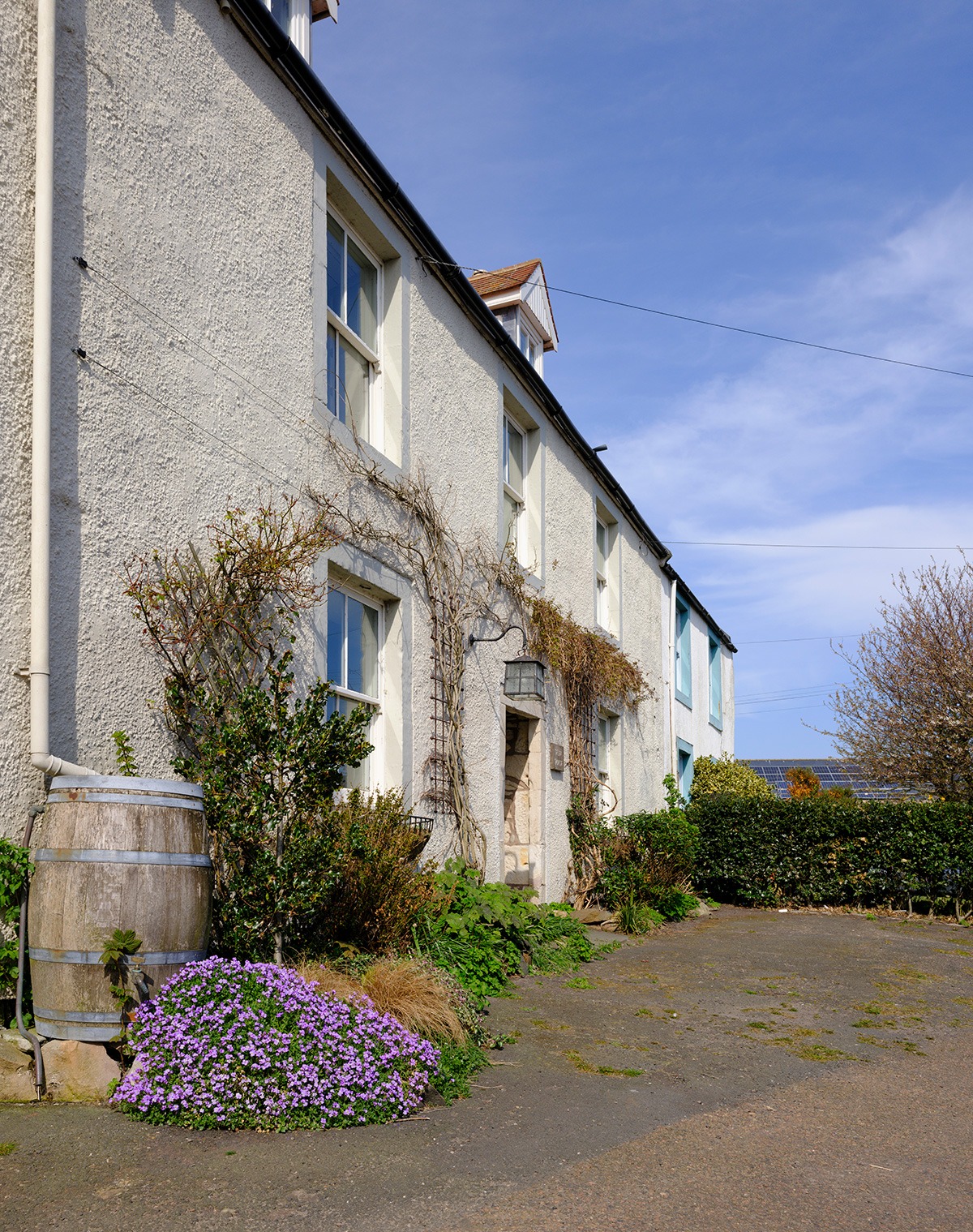
The most common thing was to think – “that’s not a 28mm view!” after moving to the intended shooting position. Church on Lindisfarne, above, is the full 28mm angle with a slight crop to a 35mm shape. The camera was often set by accident to a 35mm view, the first change when moving the toggle switch. Sometimes I failed to realise and took a perfectly good 62MP or 31MP shot, and in a few cases like the house shown in the example dealing with lens distortion and profile I intended a 35mm view (no drainpipe) but used the full 28mm angle when processing from raw. Nothing was ever lost, except perhaps some resolution in a JPEG which I probably did not need.
This example uses Adobe Camera Raw to put a profile-corrected conversion, with straightening and converging vertical correction added, into a larger canvas where the degree of distortion present in the lens can be seen.This is the final crop. Ideally less haze on the sun would have improved this.
GFX100RF: power and storage management
Since startup is not instant, you may leave the camera switched on – but this doesn’t make a huge difference. To wake it up, first pressure on the shutter button is needed, the wake-up time is no faster than switching on from cold. It’s also very easy to take an accidental frame – I got more than a few.
I often found that picking the camera up by its right hand end in my right hand turned it on anyway as that switch also tends to get caught.
There is another point Fujifilm could address – the question of M and S size true raw files. Sony offers this with 26 and 15MP alternatives to 60MP. I don’t often use these, because tests have shown little or no benefit when it might be expected at high ISO settings. Sony raw files are big enough at around 80Mb. However with the 102MP GFX, raw files are over 200Mb and even the Super Fine JPEGs come in around 60Mb, with cropped ratio or digital converter use greatly reducing this, while always leaving raws full size.
If you shoot raw, Bridge/LR will mark frames cropped and/or digitally converted with a symbol identical to the one seen after processing. Only after previewing can you revert to see the whole raw frame and re-crop.
Shake down
The shutter has so little vibration that shots taken at speeds like 1/60s were critically sharp every time (bar subject movement) and those in the 1/8s-1/30s almost always as good. For me the watershed seemed to be anything longer than 1/8s. But ISO 8000 as used below to ensure a shutter speed of 1/50s does not mean high noise, and full aperture doesn’t mean loss of sharpness.
It’s a camera for extremes, with f/22 plus 4XND entering f/64 territory. The sensor doesn’t suffer badly from diffraction loss as it has no AA filter. It can shoot at 6fps (3fps only on electronic shutter) for a burst of nearly 300 JPEGs.
As for the battery life, it’s good that it is over 800 raw captures, twice as many as most full frame high res competitors. I charged in camera as no charger was provided, and never needed to change the battery mid-day. I used the latest Lexar Armor SDXC UHS-II card in slot 1, and a provided standard Lexar in slot 2. Reviewing, deleting, formatting and in-camera operations were fast, as was transferring small JPEGs to my iPhone. Using a new Fujifilm App, geolocation was recorded from the phone reliably with the camera connection renewed.
Although it has been called a ‘compact’ and tipped for street shooting, it’s more of a travel and landscape choice. The level of detail revealed when you zoom in on a 100% view will have you magically erasing gum off paving, crisp bags from hedgerows and bad pointing on brickwork. Sure, it would not distract even on a 20 x 16″ print but this sensor is good for prints 40 x 30″ viewed with a magnifying glass.
If 100 megapixels on a 4:3 ratio format isn’t enough, it’s such a quick and easy camera to used and focus that two handheld shots in rapid succession, one at ISO 160 and the other at ISO 200 by accident, focused on the distant tree and the foreground flowers were easily merged into a slimmer format composite of aorund 140 megapixels! Regular multishot pans do require a good processor and free memory/disc space for Photoshop to handle them automatically. This was a manual composite, no automation involved.
The £4,700 SRP seems high but it’s the lowest cost way to get that 100 million 16-bit pixel look.
You can find the GFX100RF at Clifton Cameras with a 5-year extended warranty.
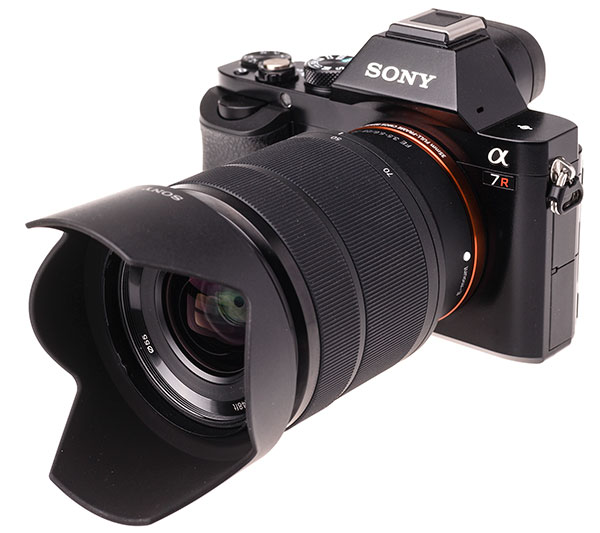
I guess it’s time to publish another field test review of the Alpha 7R despite rarely having used the camera in anger, or in any state other than anger. It arrived in late November and caught me at a time when I was not going anywhere or doing anything, nothing was happening and the weather was just plain ordinary. We didn’t have floods, or snow, or anything else like the rest of the country. It also came with a set of problems to be solved some of which turned out to frustrate any affordable solution.
I started writing this page in February 2014. It may give you some idea of my issues with the whole current Sony system that I’ve taken almost until May to publish it. Additions have been made on December 2nd 2014.
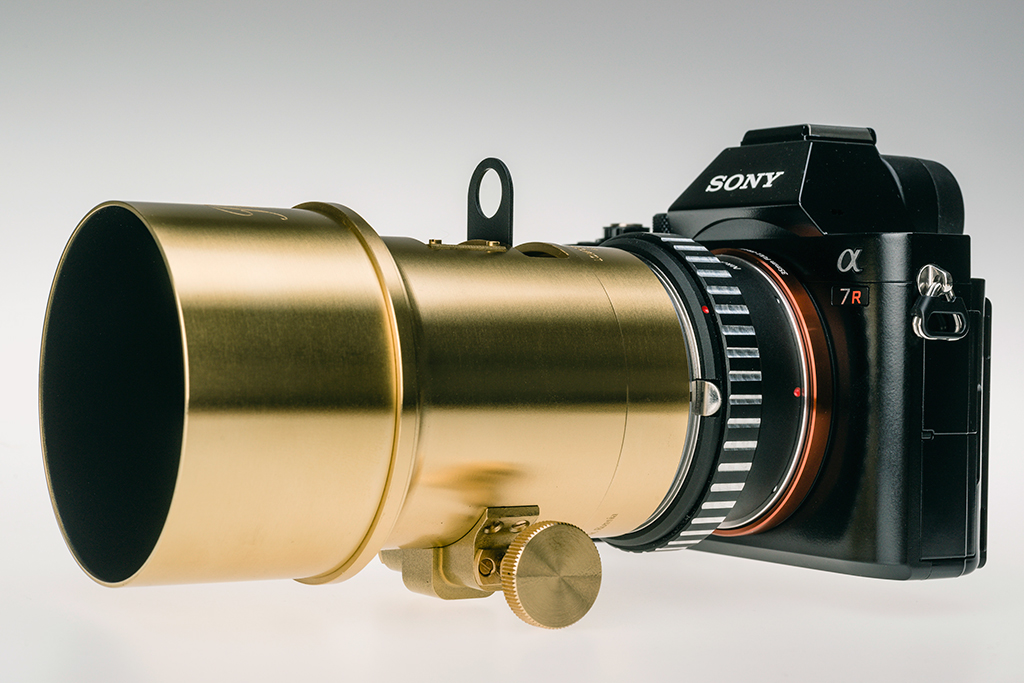
When you’ve got a wonderful new tool to work with, it doesn’t help to have no work to do which requires that tool. This really is the Swiss Army Knife camera, a strapline I used on the first issue of the new-look f2 Freelance Photographer magazine which I took back into ownership at the end of January. The A7R has the potential to fit in my pocket and replace every single other camera I own, to use all the lenses I have bought for all other systems and formats, and to remove stones from horses’ hooves.
But, and here’s the problem, it also replaces nothing at all as well as it could. There are maybe no more than half a dozen reasons why, but they are critical reasons and any one of these reasons will limit the use of the A7R.
No in-body stabilisation and not all lenses are stabilised
No electronic first curtain means the shutter cycle is noisy and causes vibration see later comments
The sensor design prevents optimum use of rangefinder type lenses under 35mm focal length
No native full frame wide-angle lens under 24mm is likely to be available before September 2014
Any Sony FE-mount lens with a performance matched to the sensor is going to cost double its true value
No on-board GPS and (to date) no multi-function shoe GPS module to add
Single card slot only and consumer size lith-ion battery
Very slow start-up and wake up from sleep especially when not using Program, Manual or intelligent fully auto modes
Slow laminar shutter blade transit speed and flash synchronisation limit
Firmware compatibility problems with some existing E-mount OSS lenses
No provision for IPTC copyright information entry
Custom lens app can be used with manual adapted lenses but does not embed metadata in EXIF
User memory settings don’t cover functions from some menus
Apps are charged at additional cost for functions which would reasonably be free or included in a camera body with a price-tag of £1,800
No battery charger is supplied and default charging method is by micro USB cable
The rear LCD screen can only be tilted and is not reversible to face the body
The EVF even at its brightest is not up to tropical or desert viewing conditions
Auto switching EVF to rear screen is unreliable
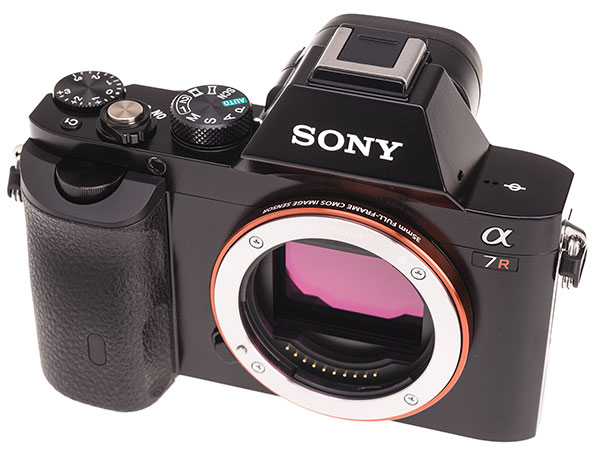
As I have now found after five months’ use, not as durable as it looks (I have repaired the worn metal showing through the sharp edges on the ‘prism’ and body with a black Sharpie pen, but I’m tempted to use a guitar fret polishing sheet to make all the sharp edges into bright silver… just rub that thin black coating off!)
In case you’re thinking this is a completely unfair list of negative points to start a review with, well, you may be right. It’s here to make up for the usual lists of star features which *end* reviews. I’m also going to need to explain all these points. Here, to balance the negatives, are the positives.
The highest resolution full-frame sensor (24 x 36mm) currently made
The smallest full-frame system camera body
No moving mirror, no SLT mirror, and no optical low-pass (anti-aliasing) filter
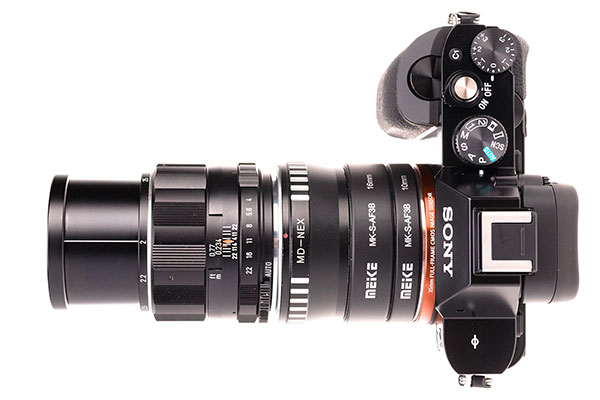
18mm lens mount register allows the use with adaptors of all current and past lenses from all systems designed to cover 24 x 36mm except those which used fixed rear assemblies and front groups
Custom lens app allows corrections for any lens, while built-in function auto corrects E and FE mount lenses
WiFi and Nearfield Connection transfer file to mobile devices or other hosts with automatic small JPEG creation even when full size JPEG or RAW is the selected shooting format
Sony PlayMemories Mobile Apps downloadable to camera and devices add functions such as remote control and intervalometer, lens corrections, sensor shading and colour shift compensation
The shutter is a professional specification speeded to 1/8,000th with motorized actuation
The body is reasonably rugged, very light magnesium with some composite surface panels and is sealed against everyday dust and moisture ingress
Although you can’t hear any sound, it has an Olympus-style ultrasonic vibration dust removal process and it is stunningly effective – no big buzz, no vibrational you can feel, but it really works
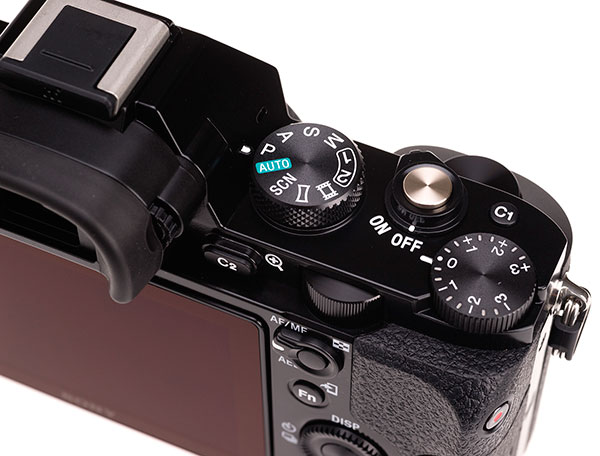
A full set of buttons can be customised for functions, and there are three adjustment controllers plus a dedicated exposure compensation dial
The electronic viewfinder with 2.3 million pixels and a 0.70X virtual view is only beaten by Fuji’s X-T1
Triggered or manual magnified manual focus allows exceptional focusing accuracy when needed
The high cost of Sony dedicated lenses is offset by the quality of many low-cost, older manual lenses and the option of two adaptors for Sony A-mount lenses, SLT mirror type or mirrorless
The interface allows manual selection of most functions, including APS-C format crop or using full frame with non-FF lenses, movie audio gain, finder/screen exposure simulation, and lens corrections
This last point may seem a bit vague but it’s actually what makes the A7R usable at all in many circumstances. The APS-C crop on/off has saved the camera from having zero real wide-angle choice during its first three months of release, as our December 2013 article on the use of the Sony E 10-18mm lens showed.
Although electronic viewfinder cameras are not ideal for studio work, the high resolution of the A7R makes it an alternative to medium format for the highest quality. It can be set to ISO 50 or 100, with 14-bit raw files using a compression method which is comparable to Nikon’s lossless option. If ‘Setting Effect Off’ is selected, the EVF or screen will always show a bright auto white balanced image allowing modelling lights to be used for composing and focusing even when the actual shot will be taken by flash with a fixed preset WB. The professional or advanced user will want to have all the settings for such work stored as a custom memory preset, but Sony puts the ‘Setting Effect’ outside the saved functions. This is most frustrating as getting to it requires menu-diving.
The same applies to stabilisation, which is a function of the lenses not the camera. It is turned on or off through a menu setting or by assigning a Custom button for direct access, making occasional tripod work need an excursion into the menus before and after, unless you are to end up with OSS enabled or disabled inappropriately. The E/FE lenses have no OSS switch, the body has no switch, and there’s no one-press shortcut. Sony’s decision to omit M/AF and OSS on-off switches from the FE lenses makes the system just that little bit harder to work with. Buy a Canon or Nikon and even the cheapest lens has a stabilisation switch you can use easily every time you mount the camera on a tripod, work with flash, or use a fast shutter speed and want the optimum lens performance (achieved, almost invariably, with stabilisation off).
No in-body stabilisation is going to handle this anyway – luck, flash, a tripod or a very fast shutter speed provide the answers
Working speed
How much does ANY of this matter, if you simply fit the appropriate kit lens or prime, and just get out and use the camera? Not a great deal if you use the camera like a point-and-shoot and your objective is a small print or posting on Facebook. Given the remarks I’ve seen on-line from people buying an A7R with a view to catching their ‘toddler running around’, plenty of new owners fall into this category. They are lucky because no matter what camera they buy, from a £50 supermarket offer to a Canon EOS 1DX, they will be happy with the results and only criticise them when the family pet outpaces the autofocus in the ideal photographic conditions of their living room.
The main issue which will hit any user of the A7R is its overall operating response and speed. Acquiring focus, by contrast detection, normally seems to take around 1/4 second with an FE or E lens, but can take half to one second in low light or with a low contrast subject. It can also fail but confirm positive occasionally, and this is a little frustrating as we are not used to getting defocused snaps today. Even one fail in a hundred is a surprise. If you try the LA-EA3 adaptor, which provides a mirror-free light path and supports AF with SAM and SSM lenses, half to one second is normal in good light. You may find it worth disabling the ‘AF with shutter’ option and using only the AF button to set the focus, so the shutter release does not keep resetting it with each shot. However, after doing this I found it more than inconvenient NOT to have the familiar AF on half-pressure.
The shutter cycle
Having acquired focus, you complete the shutter release action. The A7R then executes a pre-exposure shutter action which involves closing the shutter with a movement of both blinds. This takes 250ms, or one-quarter of a second. That is longer than the mirror lift timing of a DSLR. After the exposure is made (a minimum period of about 6ms) there is short blackout dwell and the shutter re-opens to restore live view. The complete cycle is between 375 and 385ms as timed using audio and video recording and analysis.
This is not so very much worse overall than the Alpha 99 full frame SLT used with mechanical first curtain, but more of the cycle happens before the exposure, creating a surprisingly long shutter release lag. The A99, like the A77 and NEX-7, NEX-6, A6000 and indeed most other new Sony models including the A7, can use Electronic First Curtain. This means no mechanical action happens before the exposure at all. By the time you see any blackout or hear any noise, the image has already been captured, silently; the second shutter curtain closes to end the exposure and allow electronic readout. The shutter lag with an Alpha 99 or A7 in this mode is 20ms, or 1/50th. The shutter lag with the A7R can not be reduced to less than 1/4 in single shot mode.
This is also why the regular continuous shooting offers only 1.5fps, with AF and AE supported for each individual frame and 14-bit raw data. If you set Speed Priority mode, you can get between 4 and 5fps at the most with the exposure locked but AF active – however, you don’t get a real time viewfinder display, and you also get 12-bit recording instead of 14. This lowers JPEG quality in-camera as well as the headroom and dynamic range of the raw file. You’ll only get this performance by using the best SD cards. Some which claim 90-95Mbps speed only write are half or less, and are quoting their read speed.
The A7R will often remain in a card-writing state for several seconds (as long as 16 seconds if a raw sequence has been shot and buffering is queuing the images). Playback or review is not always possible without a brief wait. Since turning off auto review (which is not subject to this wait) greatly improves EVF performance for rapid fire shooting, you may have no clear idea of your shots until well after they are captured.
The simple fact is that where many competitors including Sony’s own A7 have fast responses, the A7R has an operating speed closer to a 1970s film SLR with ‘auto winder’ (the slow alternative to a motor drive), or being more charitable, to a Mamiya 645 with a power winder. It’s essentially medium format operating speed. This is in contrast to the Nikon D800/E, which offers the same file quality without a speed penalty.
Sensor shading and lenses
The A7R sensor microlens and coating structure produces not only a strong magenta-purple shading towards the frame ends with short rear focus wide angle rangefinder lenses, it also throws up a yellow-orange discolouration at the top of the (horizontal) frame. It shows some degree of this effect with nearly all lenses under 40mm focal length made for Leica M, screw, Contax G or similar mounts.
A month after releasing the camera, Sony issued a PlayMemories App which can be loaded up and invoked to record and re-use manually adjusted corrections for named lenses. These include distortion (barrel or pincushion), vignetting, and colour shading. The app does not allow the creation of a reference image or mapping mask. You can do this for Lightroom (shading only, saved as data) or Capture One Pro (shading and colour, dust and defects saved as an image). Consequently it actually won’t correct properly as it ignores the yellow-orange patch. Its limits are insufficient to correct full fisheye to normal (as found in the onboard correction which Nikon use for their 10.5mm lens) or handle typical shading from lenses like the Voigtlander 12mm, 15mm and 21mm.
This is typical of a non-retrofocus wide angle shading map produced from the A7R. The slightly magenta vignetting can be cured easily. The piss-yellow patch can not and it’s there, to one degree or another, with more lenses than you would imagine.
A different aspect of the sensor construction produces smearing. I noticed that this was minimal with the 15mm Voigtlander and strong with the 21mm. It seems to depend on the rear group geometry relative to the sensor. I ended up selling both these lenses.
Since then, I have given up on the idea of a super-compact Leica style outfit though I still have a 40mm f/1.4 Voigtlander and an 85mm f/4 Zeiss. Sony’s FE lenses are not very small and not all that attractive in specification. They do little more than return me to the kind of lens choices I had thirty years with the launch of the Minolta AF system – a slight step backwards at the time, losing the 17mm f/4 option, 24mm VFC, 35mm VFC Shift, Varisoft and many other unique bits of glass. I’m using a bunch of vintage Pentax, Minolta, Canon and other lenses in the 17mm to 85mm range. They don’t suffer from sensor shading or smearing problems and have generally proved far better than modern zooms.
My gripe with these solutions is that even if I enter a lens identity in the App, my images show no focal length data in the EXIF info, and certainly no aperture data. At the end of a long day, I have not made notes on every change of lenses. I have no idea what lens or settings may have produced a good or bad result. What I need is for every lens to be a properly dedicated FE mount one whether AF or manual focus. And I don’t want to pay Carl Zeiss a thousand pounds to get a sharp result from the type of lens and aperture specification which has been easy to make to an outstanding performance level, at modest cost, for the last half-century.
There are three lenses made by Sigma – 19mm, 30mm and 60mm f/2.8 designs in E-mount – which prove it is possible to make low cost, lightweight lenses which deliver results almost beyond criticism. Just making the direct translation of these lenses to 28mm, 45mm and 90mm f/2.8 for (say) 50% extra cost would give the A7R exactly the kind of glass it needed from the launch day. Sony’s Carl Zeiss 35mm f/2.8 and 55mm f/1.8 may be wonderful in their own right but they appeal to me as much as 35mm f/2.8 lenses and 55mm f/1.8 lenses did back in the 1970s. Not at all. They are the focal lengths and apertures you used to find on twin-lens film compacts and they’re what you still find in the scruffiest old bag of 1960s worn-out SLR kit at a junk sale. They are what my father’s Pentax kit had (plus the inevitable 135mm).
Fuji’s launch of the X-series with a fast 28mm pancake equivalent (18mm f/2), very fast 50mm equivalent (35mm f/1.4), and good 90mm equivalent macro (60mm f/2.4) paid off well and they followed up with a 14mm f/2.8 (21mm equivalent) and pro portrait 56mm f/1.2. Though not cheap, these lenses are all affordable and have been supplemented by further excellent kit, tele and wide-angle zooms. What the A7/R needs most is a direct counterpart to this Fuji system and it simply doesn’t have it.
As for the long end, I see almost no point in buying any lens made for the FE mount longer than something like 100mm. The 70-200mm f/4 may be attractive, but it’s forever limited to the FE mount while being as long as a regular Alpha lens. Had Sony made a clever two-part SSM lens for FE and Alpha, with a detachable rear tube like a dedicated LA-EA3, they would have had a winner. Instead they have the lens which Alpha A-mount owners have been waiting for – pressing for ever since the digital system arrived – made in the new mirrorless mount only. After seeing the final prices of the CZ 24-70mm f/4 and the Sony 70-200mm f/4 G, I’ve bought an LE-EA4 Alpha SLT adaptor as well as an LE-EA3 mirror-free adaptor.
But longer lenses are still much better on the Alpha mount, with its sensor based stabilisation and the larger bodies with true phase detection AF ideally suited to the wildlife, action, news and sports for which lenses over 200mm are destined. You can add an LA-EA4 SLT type adaptor to the A7/R, but these are still full-frame cameras one of which (the A7) has extremely low resolution for tele work compared to the ultimate telephoto capture machine, the neglected Alpha 77 (or its lesser spec 24 megapixel siblings).
From my point of view I’ve got an amazing camera body with a few limitations, but a menagerie of odd lenses all with even greater limitations or lack of connectivity. If someone came out with a Canon FD lens adaptor with a chip able to tell the camera I was using a 20mm and what aperture was set, that would be great.
What does work is any LA-EA adaptor with Alpha lenses. You get all the EXIF data, and aperture control from the body. What you don’t get is the smooth focusing of a manual lens, or contrast detect AF, though you do have AF calibration to fix the inevitable inaccuracy of phase detect systems. It’s just a pity the 20mm Minolta/Sony AF design isn’t as good as the 1980s Canon last version manual focus FDn.
Timing and shake
The A7R shutter is a full size mechanism. A shutter like this running at 1/8,000th maximum speed should be achieving flash synchronisation at 1/250th. The fact that this camera is restricted to 1/160th shows that the transit speed of the shutter blinds is slower than normal. There must be a reason, and the discovery (by me, and others, despite vehement denials in some quarters) that a shock-induced form of camera shake happens could be it. Sony has also disabled OSS support for many E-mount lenses. I believe this is connected to the typical shake pattern in the hands of the average user. Update: because it occurs less with unstabilised lenses, for example my 70-210mm f/4 Minolta AF used on LA-EA4 shows none of the typical patterns, I now think this is not a ‘shutter shock’ or ‘user shake’ issue but is due either to mistimed communication between the camera and most stabilised lenes, or more likely, to a brief loss of the power needed to maintain moving lens groups or elements in position whether stabilisation is active or not. A need to moderate the drain on the battery is indicated by the slow transit of the curtains (slow motor speed to operate the shutter). Otherwise the A7R would surely have had a full speed 1/8000th shutter with X at 1/250th.
I made recordings using video, audio and motion sensing methods and observed the typical results from repeated exposures with different lenses. I found that shutter speeds from 1/30th to 1/160th could be affected by a shake or double image which occurs 1/250th after the shutter has opened, looking like a reflected or transmitted shock. At speeds longer than 1/60th this jolt occupies less than a quarter of the overall exposure and is not so clearly visible as a double image. It can look worse at 1/160th than 1/80th, because at 1/160th about half the exposure can be in one position and half with the image shifted a tiny degree. A distinct double image is often shown and it’s always in the vertical direction when the camera is held horizontally.
FE 28-70mm handheld 1/80th, OSS switched on (100% detail click to enlarge). Pre-update firmware. It’s very hard to be sure, but I think the April firmware update has made the 28-70mm (originally NOT recommended for the A7R or sold with the body) perform better.
FE 28-70mm handheld 1/80th, OSS switched off.
Sigma 70-300mm OS switched on, on LA-EA3 adaptor. One problem with using any non-Sony lenses is that firmware updates have no effect on them at all. Sony don’t make a stabilised lens going as long as 300mm, yet.
Sigma 70-300mm OS switched off. All images at 70mm (many tests made, these are accurate representations of the results and tend to show that stabilisation is likely to produce no benefit).
Since some stabilised lenses including my Tamron 18-200mm Di III VC also produced this distinctive double exposure, I believe that Sony’s disabling of OSS in the 55-210mm E lens for example was done because their engineers identified the problem before the camera went on sale. I also think it can be fixed by firmware updates to Sony E lenses, but probably not for others. Update: they did not update the new black 55-210mm OSS. I think it just imposes too much battery load without an entirely redesigned OSS mechanism, or perhaps a combination of OSS and focus. Fuji has overcome this problem using very carefully balance triple linear motors in their new large lens for the X-system, the 50-140mm f/2.8 – it’s a stabilised, fast focusing lens with minimum power consumption.
In response to those who say oh, it’s a super-high resolution camera, your technique needs to be (bla bla bla!) it’s actually slightly lower resolution than my NEX-5n and far lower than my Alpha 77 or the NEX-7 I no longer have. It’s also lower than the A3000 I owned briefly, and the NEX-6 I have used as a second camera since early March. 36 megapixels full frame is 15 megapixels APS-C and that’s a lower resolution than any E-mount camera made except the original NEX-5 and NEX-3 14 megapixel bodies. I can enable mechanical first shutter curtain on any other NEX or Alpha SLT body and never see the same ‘jolted exposure’ effect with the same lenses. I can also shoot with our Alpha 700, 900 and 580 bodies and never see this shake fingerprint despite their mirror mechanism and mechanical first curtain combined.
Of course I may get shake with disabled or absent stabilisation, hand-held, with almost any digital body. I use many different cameras through the year and sometimes I get very poor stabilisation, as when using certain Nikon lenses with the earlier VR zooms on their 24 megapixel DX format bodies. This shake is random and variable, and reflects my own instability, body sway, wind chill and so on. It’s not one type of shake visible too often in shots which should not normally be affected.
Reviewers have been incredibly cautious to observe this effect. I don’t know why. I’d spotted it within a few hours of trying the camera out. Others have been fast to defend the A7R and suggest that you just need to avoid that critical shutter speed range of 1/60th-1/160th. If this was not such an extremely useful speed range that would be fine. It’s actually the precise range you most want to be perfectly stabilised and least want to have to avoid. It’s also favoured by Sony when program mode and auto ISO are used.
One way to minimise this shake seems to be to use manual focus, mechanical lenses and to favour short focal lengths. The A7R never feels or handles better than when you’ve got a rangefinder lens in the range from 12mm to 28mm fitted. It becomes like the Leica that never was, the eye-level camera which doesn’t need a separate viewfinder to handle a 12mm, 15mm, 18mm, 21mm or 24mm lens. Leica may have a good rear screen to help with this issue now but no EVF. So the next point has been a big issue for buyers.
For the latest firmware updates, and new Apps and software, see:
While I do miss the dual card slots of most of the Alpha cameras I’m using, I know the NEX and E-mount models have never had this, and with a 32GB card installed I have adapted to using the USB cable to read off new images and let the A7R charge. I do not miss the separate battery charger as I have one, and spare batteries. Nearly all the time, the camera is kept fully charged by its time spent overnight attached to the Mac. Since my RX100, RX10 and NEX-6 all work the same way using the same cable life has been simplified.
My favourite designs remain the A55, A77 and A99 all of which have had GPS on board and rear screens which enable self-filming for video demonstrations, or folding away to face the camera (how I normaly use EVF cameras now). The shared battery across the A55, A7R, NEX and A3000 models and RX10 makes it likely I might travel using a combination of these. I don’t have much use yet for the WiFi functions but I understand their importance to others, and they will really come in useful for remote camera operation in future. That can include skypole or kite work, or having a camera tripod mounted 10 metres away from the main shooting position for a different viewpoint of an event, operated from a phone or tablet.
GPS identified this as a church at Mailadumpara on the highway to Munnar – the 10-18mm lens used on full frame enabled this uncropped 36 megapixel shot at 14mm, f/11 (the shading is due to natural sky polarisation and the vignetting of the lens which I have not corrected).
I found a solution to my GPS problems in the form of a £40 igotU device from Maplin. It’s tiny (I am tempted to put a hot shoe mount on it but so far have just popped it in my shirt pocket). Free igotU2gpx file reading and low-cost PhotoLinker (buggy and unreliable in the extreme with 36 megapixel raw files) let me write GPS data into full day shoots on all cameras used. It’s not as accurate as built-in GPS and the process is tedious; the GPS data also exists in sidecar files until MediaPro is used to embed it into finished JPEGs. I’ll still buy the GPS module for the multi function shoe just as soon as Sony release it.
Top quality files
The appeal for me of the A7R is the sheer quality of the image. Even at ISO 3200, it is completely acceptable when processed carefully with Adobe software from raw. The JPEGs are mediocre with the exception of multi-shot modes and I don’t use them except for panoramas and night shots. The raw file has been criticised but compared directly with competitors, I find it has what I need – excellent highlight recovery from normal exposure levels, very low noise across a wide range of ISO, an ISO 50 setting ideal for studio lit subjects, and extreme pixel level sharpness.
The Lomography Petzval lens used on the A7R with Nikon adaptor. This reproduction lens from an 1840s design is a wonderful tool for portraits.
Richard Kilpatrick as a Victorian portrait subject with our Interfit background as a drape – A7R, ISO 50, Petzval lens at f/5.6 (Waterhouse stop) manually focused, Elinchrom Ranger Quadra RX flash.
Manual focusing with peaking and magnification combined tells you a lot about your lenses. Find a good lens, and the peaking will be present even at Low setting, with a very narrow band of activation. A poor lens (or aperture setting) usually fails to show a peaking line at Low setting, then shows one at Medium or High which has little discrimination. I’ve been able to identify my best manual and A-mount lenses by using the 14.4X magnification and the peaking function to examine targets.
Having done this, the extra performance squeezed out of almost lenses by super-accurate focusing makes AF seem inadequate. The contrast detection AF of the A7R is good, but just invoking magnified manual after it has locked on proves that it rarely hits the perfect mark. It gets to ‘good enough’. Like many new A7R owners, I find myself often using manual focusing without noticing that it is any slower than AF used to be. It’s a quantum leap ahead of any optical finder accuracy.
I find the body shape and size ideal, and have no complaints about the position of anything except the shutter release, which could have been 3mm or so further forward, and also would have been improved by the addition of a manual cable release thread (found on the RX10). I don’t plan to get a vertical grip, as the whole point of the A7R is small size and light weight. The external finish feels secure, the battery and other doors are adequately sealed and I don’t tend to overwork them.
The small body size causes a few problems with tripod mounting. Even the smallest monopod head can restrict the rear screen movement making it impossible to angle the screen down if you want to hold the camera above head height. It doesn’t angle down much to start with. The position of the Menu button, needed to access some adjustments like OSS and Finder Setting Effect, isn’t ideal as the only button on the left end of the camera. The exposure compensation dial is unusual as a solus function using up an entire large mechanical control, and has no lock, so it can be turned a little easily.
The A7/R is so customisable that after a couple of months getting used to it and changing things you’ll have a camera as far removed from its out of the box settings as a typical Canon ends up. Mine, for example, has the AF/MF and AE Lock button/switch control set up to act as Focus when set to AF/MF (with pre-Focus and tracking lock and eye-start focus all disabled), and to act as Focus Magnifier when set to AE; while the shutter release is set not to activate AF, but to lock AE on first pressure (when using the camera in a controlled environment – when travelling, I soon reverted to AF with shutter). This makes the camera anything but point and shoot, as out of focus shots are guaranteed without a separate focus action.
In practice
Like far too many A7R users, I’ve spent half my time testing and experimenting, and not enough time shooting. I’ve had the RX10 as a companion at the same time, and needed to shoot with new flash systems, where that camera’s exceptional high speed sync makes it more versatile – there’s not much point having flash heads which manage 1/5000th duration when your sync speed is 1/160th, unlike the RX10 which can manage between 1/1600th and 1/3200th depending on aperture. I had a concert venue opening to shoot, with video, and once again the silent RX10 with its superb video quality was the obvious choice.
Then, at Easter, we had a nine-day tour of Kerala, an exceptional offer from Citrus Holidays providing us with a private driver and a packed itinerary covering 1000km and five locations. This was our first visit to India for 28 years, and would provide the first library images of India apart from a few scanned transparencies of subjects which do not date. Equipment mattered. Shirley always uses her Alpha 580 with Sigma 18-250mm OS original version; it’s heavy and the lens has been through one factory service already, but it’s been very reliable and survived a short period where a Nikon D600 kit was tried as a replacement (and sold pretty sharply, in favour of returning to the more reliable AF, AE and clean sensor of 580).
Logically, my A77 and A55 would have come along. They share the same battery type, and my basic lens set 8-16mm, 16-80mm and 70-300mm gives both exceptional wide angle and a good tele performance (300mm plus APS-C plus 24 megapixels) for wildlife. It is however a very heavy kit and we wanted to travel light and work light, in high temperature and humidity.
So, the A7R had to be my choice. Apart from anything else, this camera at £1800 had not so far proved ‘better’ for any given job – it was barely used. In the studio our A900 and A700 optical finders just work far better than any EVF camera, and for general PR and social photography the last thing you need is 36 megapixel full frame. It just creates oversized files and tends to have too little depth of field. The A7R had been used for tests, for some winter landscapes, and some architectural shots. We had not travelled at all since early November.
This decision also led me to leave the RX10 behind, and this was a big mistake. I took the RX100 instead because the RX10 is fairly large. Its zoom range and silent operation would both have been valuable. With the A7R and its 28-70mm OSS lens I took the 10-18mm OSS, my Tamron 18-200mm VC DiIII, NEX-6 body and 16-50mm OSS collapsible kit lens. This was really a backup in case any fault developed. In practice the A7R makes a better APS-C camera. I only used the 28-70mm lens once, and used the wide zoom and the Tamron fairly often on the A7R with APS-C crop, occasionally with crop disabled. While it’s possible to get a bit more wide-angle from the 10-18mm by shooting full fame, the 15 megapixel crop is a 100% perfect frame every time with this lens.
Despite the phase-detect focus of the NEX-6, this camera proved less accurate and slower in all conditions. Its main benefit was better timing for shots once the finder image is focused and stable, along with quieter operation. It may be a smaller body nominally but there’s little practical difference. Also, I was wearing a baseball cap, the minimum headgear needed in the sun. The left-end viewfinder eye position prevented a right hand ‘on top’ vertical grip on the NEX-6 while the central eyepiece of the A7R allowed a choice of grip style without having to remove the peaked cap.
The most significant loss my choice involved was telephoto power. Shirley’s 250mm f/6.3 reach on APS-C would have demanded a huge lens, a true 375mm or in practice a 400mm, to get the full benefit of 36 megapixels on full frame. It would also have demanded at least one f-stop more stopping down to match the critical long lens depth of field. I didn’t have an E-mount 24 megapixel body, but if I had one my 18-200mm would have slightly outreached Shirley’s 250mm as used on 16 megapixels.
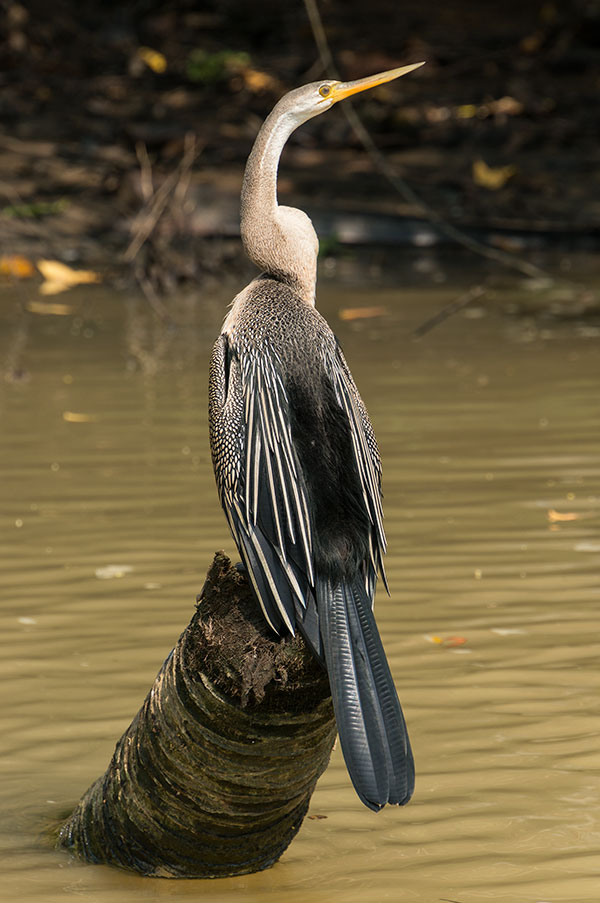
This snake bird (anhinga) was photographed using the NEX-6 and 18-200mm (162mm and f/8), from a moving boat. There is no trace of shake at 1/250th, indicating the VC stabilisation works on this body. I got excellent results from the NEX-6, which I picked up at The Photography Show on March 4th with its 16-50mm collapsible motorized zoom on a special deal. However that deal was not as good as the current B+H of $524 with free accessories.
There are no lenses yet made longer than 200mm for the FE mount. If there are any made other than an obligatory zoom to 300mm they will be expensive and limited to the E-mount system for ever. In contrast a Canon, Nikon or Alpha SSM long lens will always be usable on SLR-form bodies and also on mirrorless – possibly on various mirrorless systems. Canon EF lenses for example can be used on almost all mirrorless bodies, and Nikon teles have the possibility of fitting to their 1 system 2.7X factor bodies with totally successful functions and focusing. I’ve tried this and it works – an 800mm equivalent with outstanding image quality, from a 300mm.
It’s for these reasons I have succumbed to ordering an LA-EA4. I value the LA-EA3 because it allows me to use some lenses with contrast detect focus and a pure image path, but my favourite 70-300mm Sigma OS will not CD focus. Buy the EA4, and I can use all my screw drive Minolta and Sony glass.
This is why I sill feel the A7R can be described as the Swiss Army Knife! It can do APS-C as well as its 16 megapixel APS-C siblings, but switch to use full frame to squeeze extra angle from many lenses. My Tamron 18-200mm is only just compatible with the A7R – its VC stabilisation and general performance indicate that a firmware fix might be needed (see earlier comments) – but it can give me a 19 megapixel image sharp corner to corner with a range of image sizes from square to 35mm, at 18mm and f/11, making it as useful as a 16-200mm lens instead of an 18-200mm.
In March, I needed to write up the Samyang 24mm Tilt-Shift lens, which was only available for review in Nikon mount, and needed a full frame body. The A7R with a low-cost Nikon adaptor did the job perfectly and the magnified focusing function allowed full and successful use of the lens functions. I now have a wide range of lenses and adaptors, and there’s no manual lens I own which the A7R can not use.
The Samyang 24mm Tilt-Shift f/3.5 manual lens has better control over movements (including 30° intervals for independent rotation) than the Canon or Nikon in the same focal length, though it lacks auto iris, EXIF data and focus confirmation. Here it is used with a low-cost manual Nikon adaptor.
Using the 24mm Tilt-Shift – a lesson here in floor/ground and ceiling/roof relationships and camera position. First shot, a typical eye level architectural compromise in which a normal wide angle keeps the verticals straight. The trade-off is that you get a similarly generous view of both the floor and ceiling. Second shot, moving the camera close to ground level. Third shot, applying a full vertical shift; the floor is now seen from an angle giving it much less emphasis, while the vaulted roof is seen from below. For real estate shots, the camera is usually placed close to the ceiling on a tall tripod, and a drop front applied, to show the extent of room interiors better by emphasising their floor area. This is stuff I learned 40 years ago working with 5 x 4.
The A7R stabilisation incompatibilty issue with the Tamron 18-200mm was ‘tested’ at considerable cost in lost shots. During most of the Kerala trip, fortunately including a few chances to get close to wildlife like the anhinger shown above, I used the 18-200mm on the NEX-6 for the slightly higher resolution and faster response. I’m very glad I did this and put the A7R away. No shot shows any sign of stabilisation failure. Finding a dramatic sunset location with rocks and predictable spray from breaking waves, I used the same lens on the A7R, which I had taken to the beach to produce some tests showing full frame coverage.
One of my frame coverage tests of the 18-200mm on the A7R. 175mm, 1/200th at f/9 – conditions which with stabilisation should result in a perfectly sharp result almost every time. Instead, this combination produced a jerked slightly double imaged unsharp shot every single time. Even at 21mm focal length this degradation was visible.
All the images (full frame tests and rock sunset shots) showed the same characteristic stabilisation jerk even at 1/320th, which I had not considered possible as the peak vibration from the A7R shutter occurs 1/250th after the shutter opens. It may not be shutter shock which causes this shake effect, but a firmware incompatibility (in timing signals?) between the A7R body and certain lenses.
Here is my processed image put through the new software Piccure, which I can recommend as the first program to analyse and remove shake effectively – see http://intelligentimagingsolutions.com – and which has significantly improved some of my A7R ‘shaken up’ shots to the point that when reduced to 9 megapixels, they are as sharp as you would have expected from a KM Dimage A2 (ah, the irony… we do make progress, don’t we?). Click the above image for a full size screen shot.
This was my final crop and process from the shot involved, which was an 18.2 megapixel ‘more than APS-C’ crop from the full A7R frame, sharpened using Piccure and reduced to 24MB final image size.
This sunset, and all the similar shots taken with the 18-200mm on the A7R, proved too badly affected by stabilisation malfunction to use at the desired full size.
Again, Sony’s decision to disable OSS with many lenses on the A7R only, and to issue firmware updates to enable this, supports this theory. Whatever the case, I lost all my first night’s sunset shots for anything except web sized use (above – it’s not sharp for printing or library use). We returned two further nights at the right time and tried various combinations. It was a subject not helped by heat haze and blown salt spray (UV filters were fitted, of course, and needed cleaning frequently to avoid the whole picture being softened).
It’s so bad it almost hurts your eyes, but this was the focus point of many shots, and the double image (always in the vertical direction when the A7R was held horizontally) from the 18-200mm Tamron consistently gave a result like this. You might also suspect inaccurate focus and poor lens performance, but plenty of other shots at similar apertures and settings on the NEX-6 were completely OK. Perhaps the only answer with the A7R will be the near-£1,000 70-200mm f/4 G and replacement of the 28-70mm with another £1,000-worth of 24-70mm f/4. All that to get me back to where I was thirty years ago in terms of aperture and focal length range!
Using Piccure had no useful effect on this shot. It created triple outlines of the shake in place of double.
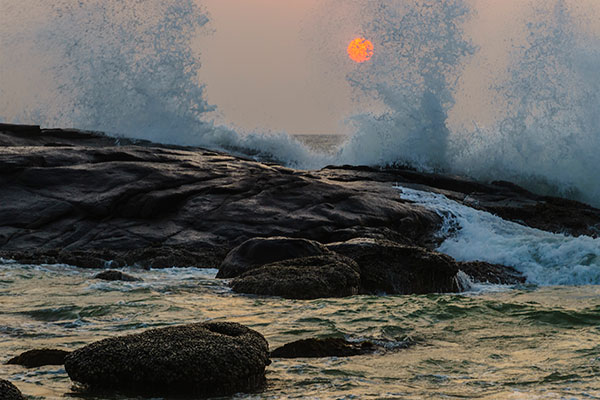
Eventually I got what I wanted but only with the 70mm reach of the 28-70mm OSS lens. The final, third, visit had cloud cover as the sun reached the right position. But, if you want to try this for yourself, visit Light House Beach in Kovalam at around 6.00pm (get a beer and wait) around April 16th-22nd. Like all such sunsets, there are just two times each year where the sun will hit the right position over the horizon.
The 28-70mm really didn’t have the power to give me the sun at the size I wanted, but at least with Photoshop processing this was a more or less acceptable result. For any shot like this, I would far prefer to have a true mirrorless camera – no SLT mirror either – and the A7R should be a perfect choice. Tripod use was not an option because of the crowds (which you can’t see) and combination of incoming tide and wave.
There was one lens which never let me down – the 10-18mm OSS. Whether on the NEX-6, A7R crop or A7R full frame this lens always turned in a perfectly focused and well stabilised result.
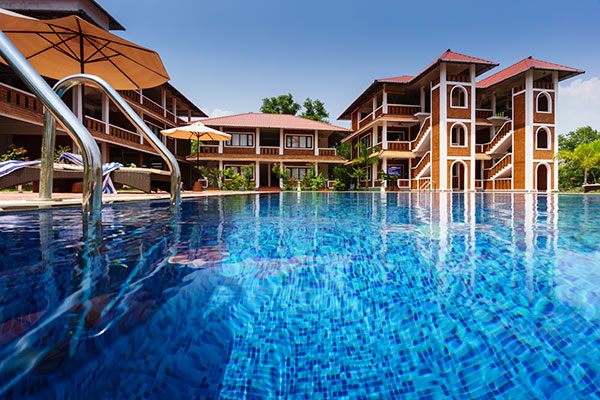
At the end of our Keralan tour, we were invited to have lunch and a short tour of a major ayurvedic resort hotel, Isola di Cocco. The tour only took twenty minutes, seeing some of the rooms, and was at mid-day when the light is not ideal. I took a few shots on the A7R including room interiors, and sent small versions to our hosts afterwards. The outcome was a request for commercial use of the image set in their next brochure. These were not exactly what we would do on a commission – for one thing, we’d normally remove towels from round the pool, pick the best time of day, make fine adjustments to room details and even use lighting.
A pool needs to be very clean to handle a shot from three inches above the water surface (at 10mm).
This is what we we used to do in the 1980s producing brochure pictures for travel operators and it was never a casual thing, more a very long and full working day with many appointments and too much driving. These shots were quick snaps, even if professional snaps, and we agreed to use for a charity donation (all Indian businesses seem to support local charities as a matter of routine).
We’d be more than happy to go back and do it properly though!
Back in the 1980s we had nothing to approach the 15mm equivalent angle of the 10mm used on crop frame A7R, even though a few such lenses did exist for 35mm systems. 35mm was like using a 6 megapixel camera, and our shots had to stand full page to double page use. I used a Pentax 6 x 7 with its widest non-fisheye 45mm lens and that was equal to a 24mm, something you can now find at the wide end of many compacts. It had to go on a tripod, as the exposure times with Fujichrome RF 50 film (for shadow detail) with the f/16 or f/22 apertures needed for sharpness in depth were usually around 1/4 to 1 second. The tripod was one you couldn’t easily take by air today, and the camera kit with two bodies and three lenses was heavy and bulky. Then there was a matter of a hundred or so rolls of film to handle the five bracketed exposures for each frame, lead anti-X-ray bags, and a large Metz flash with an extension head… and our 35mm Minolta kit on top of it all. Each room could take an hour or more to photograph.
Raw conversion controls enable the rich teak wood interior to be shown clearly without losing the highlights of the wall and white sheets.
And here I am today, complaining about aspects of the A7R when I can walk into a room like the one above, without a tripod, find my viewpoint, observe the horizon level display while composing carefully, and make an exposure at ISO 1600 with quality equivalent to ISO 100 35mm film. With a lightweight carbon-fibre tripod, this almost Leica-sized camera can now outperform anything we might have expected from 6 x 7 film and at ISO 50 is good enough for wall-sized prints and poster reproduction.
We have some aspects of A7R technique and performance to ‘fix’ and you’ll realise that I do not approach using any new camera uncritically. But there’s nothing else on the market short of medium format which can match what it does.
I do not address, here, the demands of users wanting to switch from conventional heavy-duty SLR type cameras whose gear includes fast long apo telephotos and zooms, who work frequently with sequence bursts, require to track sports action, shoot news, capture wildlife or want to snap their kids and pets (which requires much the same camera performance as covering sports and news… they may move slower but they are much closer!).
My present thinking is that the new 12 megapixel A7S with its 4K motion picture capture and extreme low-light performance may not be what I want, but I’m considering adding an A7 or changing the NEX-6 for an A6000. I’m not quite ready to sell the A900 or the A77. I’ll see how the A7R performs over the summer and update in due course.
The A7 MkII with full-frame stabilisation, announced in November 2014, tends to put my theory about power drain and lenses into doubt, but only because I might assume the 5-axis sensor stabilisation also puts a heavy load on the battery. It does have the different shutter mechanism found on the A7, and of course, it does not have a 36 megapixel sensor to power.
HD video at 60FPS, used prices around £100 to £175 (18-55 kit)
The Sony A3000 is an E-mount camera which looks like an SLR but takes all your E-mount lenses and has a pretty good 20 megapixel sensor. It even has a metal lens mount. In 2018 five-year old Sony A3000 bodies sold for as little as £100 – and 2026 suggests that they really couldn’t be any cheaper, with most resellers such as CeX asking £150-175 for 18-55mm kits.
So what has been cut back to let Sony sell this pioneering mirrorless system for less than £299 new in 2013? The saving is mainly in the expensive EVF innards – it uses a tiny 0.2″ display and a high power eyepiece, more like a consumer compact with a token EVF.
There’s not much really, in a difference of just three tenths of an inch. There’s even less when the inch isn’t a proper inch, but the sort of inch used to express the size of sensors or display chips. Except, that is, when the difference is between 0.5 inch and 0.2 inch and you’re comparing the electronic viewfinder of cameras like the A6000, NEX-6 or Alpha 77 with the EVF found in the entry-level Alpha 3000 (above and below, from both sides).
Here’s our 2013 review:
I’ve had the Alpha 3000 (ILCE-3000, Sony model reference number) now for a few weeks (writing in 2013), and used it as much as my eyesight and patience would permit, given a wide choice of other cameras to use instead during the same period. I can now say without fear of being shot down in flames that it has the most inadequate electronic viewfinder I can remember using, including finders on various bridge cameras of the distant past.
The viewfinder of the vintage Konica Minolta Dimage A2 used a 0.44 inch 922,000 pixel display chip with a generous eyepiece size and accommodation latitude. That is, anyone able to focus their eyes comfortably between 1m and 3m, with or without specs, would rarely need to touch the dioptre control.
The Alpha 55 used an 0.46 inch and the Alpha 77 (and accessory EVFs) 0.5 inch.
The A3000 eyepiece has a hard plastic surround and small, only slightly recessed ocular. The accessory shoe is over the eyepiece unit not over the camera body, and the eyepiece assembly sticks out well clear of the screen.
The Sony A3000’s EVF has 201,600 pixels, not even equal to one-quarter of the 2004 Dimage A2 bridge camera’s display. Because it is such a small chip – a mere 2.88 x 2.15mm which compares to a match-head or a grain of rice – the viewfinder eyepiece has to be a low powered microscope. Like any cheap microscope, it only looks sharp if your eye is precisely centered and the slightest nudge to the focus (dioptre) blurs the image. I found that the click-stops of the dioptre control on the A3000 were so crude it was possible to have a sharp image between them, yet uncomfortably unsharp when set to the clicked position either side. I can’t put a graphic of the actual size of the display chip here, because different screen resolutions would change its size.
To make it worse, the quality of the ocular lens is very poor, with distortion and smeary blurring together with considerable flare from the brightly illuminated display chip; it does not have the level of multicoating or internal light baffles to present a crisp clear view.
Since the main selling point of the A3000 over any comparable camera is that it has a built-in EVF, the extremely ‘stretched’ design parameters of this EVF will cost it sales in actual stores where it can be tried out.
The A3000 kit box. This unit is made for more than one country’s market.Inside there’s no software CD, and that super fat looking manual is actually a minimal introduction to the camera printed in 12 languages. It is the Rosetta Stone for a future alien civilisation discovering the remains of Earth!The bonus for buying a multi-zone package is that you get stubby cable UK and European mains leads. There is no battery charger, instead you get a 5v USB transformer (as with the RX100 and RX1 models) and a USB cable to charge the battery in-camera. The neckstrap is Sony’s standard chafing and scratching type.
Children, young women and most people under 40 in bright weather will find they can accommodate just enough to use the finder comfortably, though the vague smudge which represents the scene is only to be considered as a composition guide.
If you are male, over 40, have typical Western rather than Japanese eyesight age-related changes and try the camera out in a dimly-lit environment you’ll hand it back to the salesman and buy something which is easy to view through and shows a clear sharp image.
That said, the entire camera and its 18-55mm SEL black metal skinned E-mount lens costs a bit less than the accessory EVF for the RX1/100II. And you read that right, this is an Alpha (so are all NEX cameras, as anyone able to see the Greek letter on them will realise) but it’s not an Alpha A-mount. And though it looks like a DSLR or a DSLT, it is neither.
Sony A3000: great sensor, thick-skinned
The A3000 is nothing more than a rather appealing sensor upgrade to the NEX range, accidentally fitted into a NEX-3 body, dressed in a hollow plastic sumo suit. In Spain you can see parades with impressive giants, twice life size, concealing a very strong young man who can make them dance.
That’s rather what the A3000 is like.
On an iMac 27″ screen you will see the NEX-5n and A3000 precisely life size. The front face of the mounts has been aligned.
My photograph doesn’t just show the relative sizes of the 5-series NEX body and the A3000 together. I have positioned the front face of the lens mounts to coincide. This enables you to see how much space is wasted BEHIND the sensor in the A3000. There should be no cooling problems for extended video shooting with so much air circulation!
The A3000 has a focal plane index mark to show where the sensor actually sits inside the body (hard to see – right hand end above the strap fitting) but it’s ahead of the middle of the 38mm thick body, as the mount to sensor distance is 18mm leaving 20mm behind it.
The A3000 focal plane index mark is hard to see – it’s embossed rather than painted on the right hand grip, with the entire strap fitting comfortably in the space behind it.
The whole body, though it can claim to be small by SLR standards and therefore get a ‘smallest lightest’ accolade, is just a big plastic skin inside which the intestines of a much smaller NEX have been concealed. You get the same 3-inch rear screen, though without any kind of articulation or touch function and only 230,000 pixels like much earlier generation cameras.
You get a genuine metal lens bayonet mount not a cheap plastic version like the A-mount Alpha 58, presumably because the entire NEX system has always been of much higher overall precision than the A-mount range (just as the 1990s Vectis APS cameras were built to finer tolerances).
You also get a metal tripod bush, though this is in an odd position for panorama fans, located close to the focal plane but well centered on the lens axis; a really well-shaped right hand grip taking advantage of the larger body size.
It uses NEX-3 style controls lacking any front or rear wheels and just using the back mounted dial-rocker and unmarked soft-function buttons.
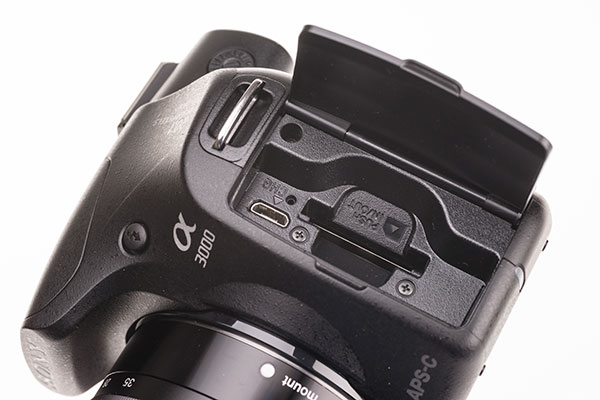
There is a super-simple interface on the left end of the camera with a single SD/MSPro card slot and a versatile USB connector which is remote release compatible.
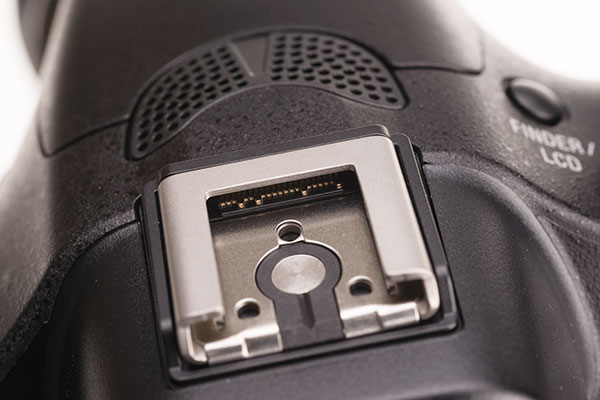
The big bonus is on the camera’s fake prism top (which does have a GN4 flash, unable to control wireless flash, but giving excellent exposure and coverage with the 18-55mm). Here you find the Sony Multi Function Accessory Shoe, reassuringly metal and hiding an array of contacts under its forward edge.
The A3000 has no HDMI port, no microphone input despite pretty good built-in stereo mics, no remote release socket, no wifi, no GPS, no wireless flash, no studio flash sync socket. It can or will have all of these through the Multi Function shoe.
I have not been able to check whether it can also support one of the superior EVFs which would fit (I do know that the Alpha 99, for example, does not support an RX1 EVF mounted in its similar shoe). Perhaps Sony’s expectation is to sell barrowloads of these extremely cheap (£299/$399) entry level interchangeable lens cameras and see the new owners buy two or three lenses, flash, microphones and more.
It’s about time they actually launched the GPS module which this shoe is contact-pinned to accept.
Sony A3000 20.1MP sensor performance
Against all the minimal feature set and basic menu-driven user interface must be set one of the best sensors around, the 20 megapixel APS-C seen earlier in the Alpha 58. It is not a stunning sensor, in that some noise can be seen even at minimum ISO, but that may be because it’s got a very weak AA filter (helps with contrast detect focusing) and decent colour discrimination.
With 2012 processing tools, applying just a little raw conversion NR keeps the images clean up to 1600 and allows usable (professional, on-line library etc) ISO 3200. It can go beyond this right up to 16,000 but if you need this sensitivity, you’ll find the EVF so noisy and dark it’s hard to see anything at all.
In 2026, updated camera profiles and powerful post-processing algorithms can get even better results from the A3000.
At ISO 800 (click these sample images for the full size file) you can see the general focus accuracy and sharpness of the 18-55mm used wide open, f/5.6 at 55mm, and also the quality of the flash for shots like this.This is an ISO 12,800 in-camera JPEG at default settings.This is the same shot carefully processed using Adobe Camera Raw Photoshop CC.Here’s a shot at f/8 and 18mm, at ISO 100 (minimum) processed without any NR or sharpening from raw. The sky blue does show some noise even at this low setting. The sharpness of the focused zone (to the left side) is excellent.Inside the Castle Restaurant, Edinburgh, the light is natural window-light, looking good but fairly low. This is 1/30th at f/9 with ISO 3200, processed from raw with some sharpening and some NR. I’d say nice colour and tones, a little soft because of limited depth of field, but sharp where it can be expected to be.This one is also ISO 3200, but it’s been put through Photoshop CC Noise Reduction filter (NIK Dfine 2.0 looked superficially better but created artificial looking tone breaks) and then downsized to 3600 x 2400 pixels.
There is no phase detect focus on this sensor, and the only focus method is contrast detection, as on earlier NEX models. It carries this out quickly and extremely accurately. Anyone used to the vague calibration of traditional DSLRs will be amazed by the lens quality the A3000 can reveal just through its pinpoint focus ability. No doubt this is helped by the rigid mounting of the sensor, which has no SteadyShot stabilisation and no vibration to clean off dust. The only self-cleaning is an anti static cover glass. A rigidly mounted sensor requires none of the complex carriage supports and adjustments found in Alpha DSLRs and DSLTs right from the Konica Minolta Dynax 7D onwards. It is probably more accurately parallel to the lens mount than an Alpha 900 or 99, let alone any of the lesser models.
Since the camera has an electronic first curtain focal plane shutter speeded 30 seconds to 1/4,000th and full PASM controls (with a little difficulty) with fully auto mode, scene modes and respectable plus-minus override and bracketing/HDR functions there is nothing an Alpha 99 or 77, NEX-7 or any other high end model can do to exceed its abilities except in some cases achieve a 1/8,000th top speed and shoot burst sequences faster and longer.
Contrast and dynamic range from raw as exposed without any adjustment in raw processing.With adjustments for black, highlights, shadows, exposure the sensor shows that it has recorded plenty of detail in all zones.
Used for single exposures, it’s just as much a professional tool as a Nikon D4 even though it might not last a week in the hands of a pressman.
For £299 perhaps that pressman might consider buying a couple of these just to get into the next urban war zone street demonstration, or to cover a Spanish tomato fight. The pictures will probably be just as good and if the camera gets kicked into touch, the light plastic half empty body skin could well survive better than a crackable alloy jam-packed top model NEX.
Without accurate focusing and exposure, the 20 megapixel sensor would be of little value. Since both focus and exposure are read directly from the sensor, they are about as accurate as you can get. The raw files also show a very good dynamic range and as expected it’s just a little better in ISO performance and DR than the Alpha 58, because there is no SLT mirror in the way.
Sony A3000 advanced custom functions
Again, despite being an entry-level camera probably designed for a huge Chinese and Indian potential market but sold worldwide to ensure it’s taken seriously, the A3000 has vital functions which Sony could have omitted in a purely consumer model.
It has a setting for shutter release without lens, which makes it suitable for use with the vast range adaptors and third party lenses for the E-mount (almost every lens ever made for any format larger than half-frame, whether rangefinder or SLR).
Will A3000 buyers want to spend as much again on Novoflex, Kipon or Metabones adaptors and legacy lenses? Maybe not, but they can, and they will work well on this body.
It has a ‘Setting Effect Off’ option – that is for the LCD screen and the EVF, disabling the accurate simulation of exposure/contrast/colour, and permitting use with modelling lights and studio flash. It’s got AF Calibration, usable with the LA-EA2 phase detect Alpha lens adaptor, and the contrast-detect AF is compatible with many SSM and SAM focus motor lenses used on the LA-EA1.
It has focus peaking for manual focus, with magnification, but the low resolution of both the EVF and the rear screen render this less functional than it is in some other models.
A criticism has been made of a very faint click generated, apparently through the audio speaker, when the shutter is pressed. I thought this was a mechanical or electrical relay click connected to the operation of the E-mount aperture, but someone has determined that if the circuit to the speaker is cut (beep off does not work) the click disappears.
Actually, the click indicates the moment of capture for brief exposures and the start of exposure for longer ones (like 1/15th). The first shutter curtain on this camera makes no noise, so you would press the shutter and hear nothing at all. Even ‘silent’ cameras like the RX1 and RX100 do make some noise from leaf shutters. This click is similar in volume or less.
To me this indicates proper concern for the user in a camera where there may be no image displayed on the rear screen and the eye may be away from the viewfinder. You can tell when the exposure is made because the finder blacks out, but if you are not studying the finder, you would have no idea. The shutter button does not have a very obvious point of resistance after first pressure for focusing and you do not have to jab it down. Very gentle pressure will take the shot.
Electronic first curtain shutters are slightly confusing because all the mechanical shutter sound you hear happens AFTER the shot is taken. It is valuable to have this tiny audible clue, which no subject is likely to hear, that you have timed the shot as intended.
Using the Sony A3000
The practical side of the A3000 includes a weight so minimal (281g body only) you can take it on a Thomson package deal flight and still carry your wallet and toothbrush as well. The bulk means you are unlikely to mistake it for your iPhone, and the shape means that some people will take your seriously as a photographer while others who would have ignored a NEX will shy away or physically assault you. However, if you hold it out and use the rear screen to compose, no-one will do either as they will assume you are a beginner and ignore you.
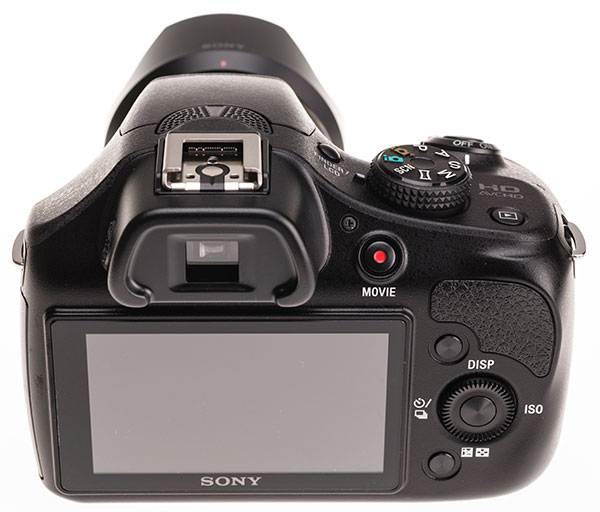
To do this, you must press a button on the top. The camera has no eye sensors (it does not even have a rubber eyepiece surround and its 21mm eyepoint just helps to avoid the regularly clattering on spectacle lenses against hard plastic). This means that you can lift the camera to do a rear screen frame-up and the screen is, of course, dead. You get used to it.
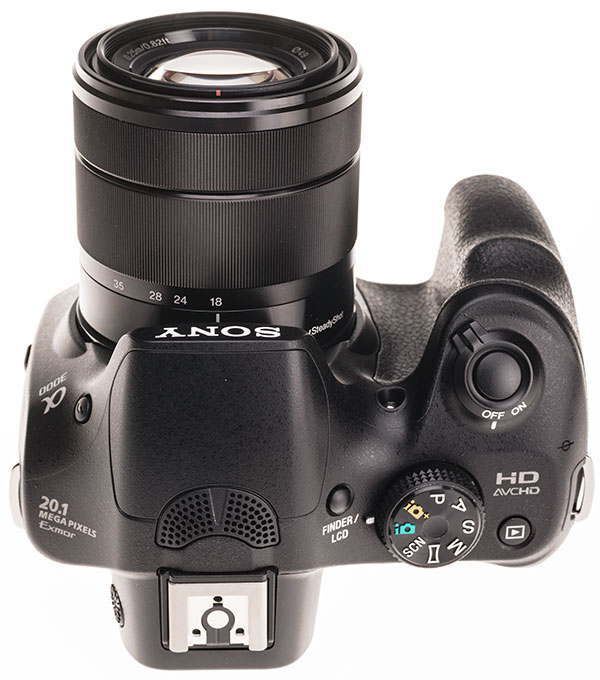
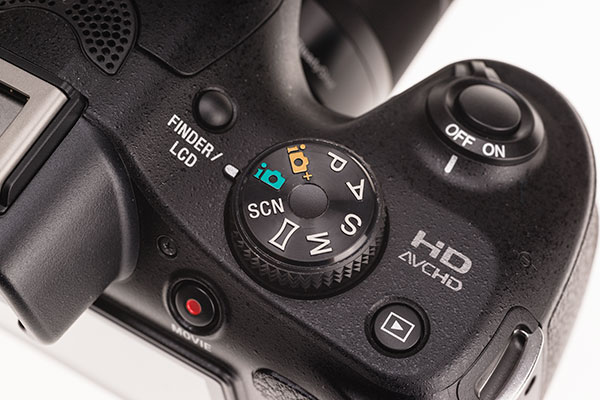
The mode dial appears to be metallic and has raised markings. Note the Finder/LCD manual switching button and the safe position of the Movie button away from accidental pressure (it can also be disabled completely).
The camera lacks any kind of finger or thumb wheel so the adjustments are all made after the fashion of the most basic NEX (3 or 5 series models). This is only a bit of a nuisance when setting shutter speed and aperture manually. It does have a lockout for the movie button, a lesson learned from the notoriously free triggering of video shooting by the badly placed red button on countless previous Sony models. The button is actually placed where you wouldn’t hit it by mistake anyway – belt and braces.
The 3 inch rear screen seems to have a very good quality finish – a better acrylic, or might it even be glass? Mine seems to be remaining unscratched to the same degree as Gorilla Glass protectors do.
The EVF is only just acceptable in bright sunshine, when it is also most useful as the rear screen may become unusable. It does not really show the tones of the scene (take a shot and play it back and the difference is obvious) and it shows very little detail. You can make out all the larger shapes in a composition. In some ways it probably encourages good composition. You can’t really tell if the focus is sharp but green confirmation rectangles or a wide zone will activate, with beep if requested, and the shutter release won’t operate until focus is OK. It has optional grid line display and 25 focus points so the little display can get pretty busy.
I have no interest in medium rate burst sequences personally as there’s hardly any action or subject where I do not prefer to time individual shots. A modest 2.5fps is no different to 3.5fps or even 5fps or 1.5fps for me. Really fast stuff like 8 or 10fps or Nikon’s incredible 60fps on the 1 V2 and AW1 has some appeal as this does give you a chance of optimum timing for sports and general action. The A3000 doesn’t. OK, photograph your toddler stumbling towards the camera, just don’t try to advertise the kid on Facebook. Try eBay instead, it’s a far surer way to get rid of them before they become too much trouble.
The worst experience I’ve had with the A3000 has been EVF use in extremely dim indoor conditions, with or without flash, regardless of ISO set and lens used. The rear screen performs much better so it is not just a matter of the sensor’s live view feed. However, in typical well-lit interiors its only failing is that Auto White Balance doesn’t seem to work even if Setting Effect is enabled – it will look brighter than an optical finder, and reasonably clean and clear, but often show a strong colour cast which is not present in the final shot.
I’ve shot a few video clips with acoustic performers and found the sound to be good but very prone to auto gain ducking and boosting. To make decent videos with sound, you have to buy the shoe fitting accessory microphone or audio preamp unit. This is no great surprise as to date only the Alpha 99 has the right functions to control levels and use a conventional plug-in condensor mic directly.
And back to those small differences
I started out by observing the miniscule size of the EVF display chip. I’m going to end with something unexpected. Snapsort.com’s camera comparer states that the A3000 has a larger than normal APS-C sensor, 25.1 x 16.7mm instead of the normal 23.5 x 15.6mm. If this was the case, the camera would gain a huge bonus point, as 1.6mm in 23.5mm would ‘turn’ your Sigma 8-16mm zoom into 7.5mm-15mm.
But the handbook clearly states the A3000 actually has a smaller than normal sensor, 23.2 x 15.4mm. The Sony website says that it has a 23.5 x 15.6mm sensor. Amazon incorrectly lists the size of the original APS-C film format.
The handbook also claims that the EVF is 0.7X when Snapsort comparison specifications gives 0.49X – without knowing where this figure comes from, I can only confirm that the EVF is visually a fraction smaller than a typical 0.72X APS-C like the Alpha 580 (this is easily established by holding two cameras, one to the left and one to the right eye, and seeing how the finder windows compare). So don’t believe everything you read about the A3000. The 0.70X is true. The specs also show an extreme dioptre range (-4.0 to +3.5) for the eyepiece, which is necessary given the critical viewing conditions produced by such a high powered ocular and small display chip.
Actually the Snapsort comparator is very badly written, as it also claims a normal Sony Alpha body is 3.5 inches deep (it’s actually 2.55, 65mm mount to back, compared to the A3000’s 38mm) and that the A3000 is 4.7X smaller than an Alpha 57. This is based on measuring the A57 including prism and grip, and the A3000 on mount to back body thickness only. The A3000 is volumetrically 1.35X smaller including all external air space – the ‘box’ it can fit in – and in linear terms it’s only about 4mm less tall and 102mm long as opposed to 132mm. It’s small but there is a fair amount of bad measurement and worse measurement floating around the net.
Don’t tell me stabilisation would not be a bonus even for the 16mm. If not, why did they make the 10-18m an OSS lens?The 16mm chrome lens looks rather odd on this body.
Snapsort also lists the lack of in-body stabilisation as an advantage compared to the Alpha 57 because apparently in-lens stabilisation gives ‘less risk of blur’. In my experience the two methods are equally effective and our many Alpha bodies offer the choice between using IBIS and lens IS. The A3000 with IBIS (SS) would have been a great companion for the 16mm, new 20mm f/2.8, Zeiss 24mm f/1.8, SEL 30mm Macro, SEL 35mm f/1.8 and the Zeiss TOUIT 12mm f/2.8 and 32mm f/1.8 – not to mention the Sigma 19mm f/2.8, 30mm f/2.8 and 60mm f/2.8. All these excellent lenses currently must survive with no stabilisation other than pixel-shift electronic processing for video work on some cameras.
The A3000 is very small, but the saving is mostly on width left to right, and on the thickness of the body disregarding the ‘prism’ overhang and the right hand grip. The grip extends nearly as far as any other Alpha, meaning that you actually get a much deeper inside surface so your fingers wrap right round.
It gives the A3000 the most secure right hand grip of any E-mount camera I know, almost 30mm of sculptured rubber-skinned moulding. Like the rear of the body, this appears to be completely empty. It’s just a moulded grip with a few connections in the top for the shutter button and on-off switch. It does not even house the battery (NEX type) which sits well behind it.
Sony A3000 kit lens – 18-55mm F3.5-5.6 SEL OSS
The cheapest kit for the camera includes a black 18-55mm f/3.5-5.6 SEL OSS. Well, I might as well admit I sold the black 18-55mm which came with my original NEX-7 for £200. Previous 18-55mms were chrome, I bought a Tamron VC DiIII 18-200mm, and the black lenses were in high demand. Now, I get one again, but in with an A300 body and the brand new price was only £349 – one month later, cut to £299. So does that mean I really only paid £99 for this body?
I was not over-impressed by the performance of the 18-55mm on NEX-7. Now I find this latest 18-55mm seems much better. It is made in Thailand, not Japan or China, just like the camera body. Sony must have opened a new plant or recovered the factory which was swamped by two metres of floodwater a couple of years ago. Whatever the case, the Thai contractors (whose story started with the Nikon Pronea APS SLR) have a highly skilled workforce now with almost two decades of experience.
The A3000 looks great with the 18-200mm, whether Sony or Tamron branded.
This lens is so good it compares with the Fujinon 16-50mm I was using recently, and Fuji’s lenses are generally a level above Sony in quality as well as cost. I have found the A3000 body to be a great companion for my 18-200mm as well. It just looks much better on this body, handles better with the right-hand grip, and focuses better than on my NEX-5n. The EVF with the VC stabilisation is better to use than any rear LCD screen when a lens can be extended to 200mm on this format.
The final dilemma
As you will gather, I have big problems with the very poor EVF of this camera. I don’t really have any issue with the relatively low resolution rear LCD. The only other thing which causes me any problems is that I’ve been using Olympus OM-D E-M5 for a while alongside my Sony kit, and I have come to value its in-body stabilisation. I felt able to buy a Sigma 60mm f/2.8 for the Olympus – this is a truly wonderful lens, equivalent to a 120mm on the MicroFourThirds format. I don’t feel able to buy one for the NEX as I know the combination of a 90mm equivalent lens and no stabilisation at all will result in poor sharpness from a super-sharp optic, in many of the conditions I like to use such a lens.
Had Sony decided to put SteadyShot into this body, I think it would have made a great difference. The NEX mount market is just waiting for a stabilised-sensor body able to guarantee the best results from the hundreds of adapted lenses around (Olympus, of course, has a menu to let you enter the focal length of any adapted lens and thus ensure correct IS). But the price point would then have been missed and the precision of the assembly might have been compromised without even greater expense in manufacturing.
I have been using the OM-D more often; its 12-50mm standard zoom is a very good lens, I have a 45mm f/1.8 portrait lens and now the Sigma 60mm which is semi-macro with a great working distance for flowers and fungi. The 5-axis stabilisation works well. I have a drawer full of legacy lenses, adaptors and accessories for NEX but all of them are let down by the lack in sensor stabilisation. The only thing stopping me from ditching NEX and shifting to MicroFourThirds is the lack of a decent wide-angle within that system. I have access to 12mm (16mm+ converter) or 8mm (Sigma zoom with LA-EA1) but for the Olympus I really would need a 6mm lens and no such thing is made.
So, do I sell the A3000? I like to buy rather than beg and borrow cameras for test purposes. Borrowed cameras are OK when it’s not possible – there’s a Canon EOS 70D kit about to land for a couple of weeks – but bought cameras don’t half focus the keyboard fingers. It is easy to be too kind to a camera lent to you for a couple of weeks. It is not so easy to be kind to one you have paid for, unless you are dishonest and think that writing it up favourably will make a camera you don’t like easier to sell on!
Take the Nikon D600. We couldn’t lie about the showers of stuff deposited on the sensor by the shutter. We had bought a full kit. My reviews didn’t hestitate to mention the shutter issue. Nikon replaced the shutter in the camera under warranty and we immediately sold it, the buyer getting a considerable bargain (effectively, a 28-300mm Nikon lens, a GPS unit and a Sigma 17-35mm of proven performance thrown in free with a body that included a transferrable warranty). The buyer also knew who was selling it and could read the reviews.
Soon after, the Nikon D610 launched with an entirely new shutter mechanism, though Nikon has never once admitted the problem with the original D600. Reviewers and critics and technicians, 1, Nikon 0. Reviewer’s bank balance, -1.
My inclination is to keep this camera despite no GPS and a poor EVF. It’s so cheap that it is really only a swap for the NEX-3 kit I sold this year. I’ve written one paid review which writes off part of the cost of the camera (we make nothing from this website now unless visitors decide to subscribe to Cameracraft magazine which is not all that directly related).
I can use it alongside my NEX-5n which is so much better with the 16mm f/2.8 – that lens just looks silly on the A3000. I can maybe even fit my optical finder to the 5n for the 16mm now. I have recently bought some extension tubes.
The A3000 has all the contacts – but are they all wired?
If only the A3000 had a tilting rear screen…or the NEX-6 had the 20 megapixel sensor… or the NEX-7 had the new hot shoe… if any one of the them had on-board GPS like my A55, A77 and A99… if the GPS module for the new hot shoe existed…
What a mess! Sony does not offer choice. It offers buyers’ dilemmas and buyers’ remorse, as in ‘did I buy the right model?’ or ‘did I pick the wrong system?’. Sony is doing just the same with the Alpha A-mount system. You have to pick a sensor you trust over a viewfinder which is great or a format and lens kit change or controllable audio input or having GPS or missing your built-in flash. No way can you have it all in one body.
(below – my conclusion written in October 2013 – we now know of course what was launched, and also that there will be an A5000)
Sony must surely follow this up with an A5000, or whatever, adding a few missing refinements to the camera and making it a £499 kit. That is what I would really like. But for the moment, the results from this cheap entry-level ILC are so good I have not touched the NEX-5n or the Alpha 77 since it arrived. And that is maybe the last word.
Except for the full-frame NEX or the interchangeable lens RX1 or the NEX fitted with Olympus-derived 5-axis IBIS – or whatever mid-October brings.
(added below – a comment at the end of 2013)
The A3000 is now sold for as little as £220 including in the UK (£185 before tax) and for $300 US. It is also sold with incentive deals for the 55-210mm E OSS lens, an excellent telephoto option, in addition to the 18-55mm. Am I upset that my camera’s value has been reduced? Well, I often sell cameras I buy to review, eventually.
This one I decided to keep. It’s got the best imaging quality of ALL my APS-C cameras and so far, the 20 megapixel sensor responsible for this has not appeared in anything else except the plastic-bayonet A58. It’s a remarkable bargain now and it’s almost being given away.
(added below – a comment in September 2018)
I’m struck by how Canon’s way of making the new EOS R full frame mirrorless system look rather DSLR-like resembles what Sony did in the A3000!
Although you will never achieve the kind of results seen with your Sony NEX-3, the technologies used in these cameras do filter down and more compact versions may be seen in the future in your Sony Mobile Phone, enabling you to take great images on the move. Continue reading to find out more about the camera system and its capabilities.
THE SONY NEX-3 & NEX-5 cameras are ultra-slim interchangeable lens models, referred to as ‘ultracompact’ or ‘compact system camera’ models by Sony. The lens flange to film distance is only 18mm, compared to 44.5mm for the Alpha system and very similar figures for all popular SLR brands.
The Leica M and screw mounts, with under 1mm difference between them, are 10mm greater than this at around 28mm. Screw mount Leica lenses can be adapted to M even though there is only 1mm difference. With 10mm difference, almost any lens ever made for any camera – even the Robot system, original Contax, maybe even the Pentax 110 SLR – can probably be adapted to fit the E-mount. In fact it will accept 16mm and 35mm (half-frame) ciné, C-mount CCTV lenses, and subminiature camera lenses.
You name it, the NEX will be able to do it. Telescopes, microscopes, endoscopes, whatever. And Alpha lenses, and MD lenses. There is even enough ROOM with over 25mm the spare to fit a true retrofocus format reduction converter – that is, a 0.66X optical unit which condenses the image from a full frame lens to fit the APS-C sensor. It is already done in the video and ciné world, and these converters have a wonderful bonus. Your 24-70mm f/2.8 SSM lens becomes, with a 0.66X reducing converter behind it, a 16-46mm f/2. That’s right – the same way a teleconverter loses you a stop or two, a format reduction converter gains you a stop.
The same converters also increase resolution, much as teleconverters reduce it. Zeiss can achieve 400 line pairs per millimetre from high grade 35mm format movie lenses when rear-converted to reduce on to 16mm or video.
Will Sony ever make such a converter? Do they even know that Zeiss have designs, and make exactly this type of converter for Arriflex and other systems via Angenieux? Do they realise that rear fitting format-reduction converters can also perform an AF function, allowing a manual focus lens from Nikon, Canon, Contax, Minolta or whoever to be mounted on a converter which has an ultrasonic AF mechanism of its own?
Imagine that – your 50mm f/1.2 Rokkor becomes an autofocus 33mm f/1.0 on the NEX. This is not blue sky thinking, it’s an optical practicality not a mere possibility. However, you don’t want to know the price of Zeiss converters, and for a system like NEX a universal converter might never be possible; it might have to be matched to the prime lens.
The NEX mount is almost as wide in the throat as an SLR mount; for some obscure reason, Sony chose to measure the outer diameter of the flange, which is not what matters, and came up with 62.6mm for the Alpha and 58.9mm for the NEX. Inner diameter of the bayonet, the bit which counts, was not stated. But it’s a wide throat and can cope with a huge potential range of adapted lenses.
Less of this ramble, and on to the plain vanilla – the camera.
Inside the camera there is a 14.2 megapixel CMOS sensor, capable of HD video and of course the vital live view and contrast-detection focusing on which the entire camera is based. This is fed to a 3 inch, 920,000 pixel TruBlack articulated rear screen and the user must compose, control and review everything on this screen. There are few buttons, no dials except a single control wheel, and everything is converted to a virtual control or a menu choice using a Sony-Ericsson developed graphical user interface.
The NEX5 camera, by some way the preferable model of the two, has a magnesium alloy body which matches the machined and brushed aluminium barrels of the lenses. It comes complete with a tiny camera-powered flashgun, screwed into an accessory slot on the camera top which has more contacts than a mere flash should need. Three, at least, must be for the stereo microphone audio interface which also draws Electret Condensor Microphone phantom power from the body’s battery.
At the end of less than 24 hours with the camera, I cleaned the white table on the hotel balcony and took a few pictures which will show you the camera in detail.
Here, you can see the 18-55mm f/3.5-5.6 OSS (stabilised) kit lens to the left; the camera body is fitted with the (raised) flash and the 16mm f/2.8 E-mount non stabilised wide angle pancake lens. In front is a 49mm fit lens cap (for either), InfoLithium battery good for around 350 shots, a 4GB MemoryStick Pro Duo MkII, and the lens hood for the 18-55mm.
The NEX baseplate view reveals the steel tripod bush set into the mag alloy casing, the lens release in a slightly unfamiliar position, the size of the grip and the location of the new Sony factory making this system – in Thailand. It was rumoured that these lenses would be branded as Zeiss. Having used these two, I can’t say they would ever have deserved that. Both are very sharp centrally but pretty soft at the edges unless well stopped down, and both have fairly strong CA. The central sharpness is excellent, about as good as you could expect, perhaps aided by the Contrast Detect focusing which is entirely free of back or front focus.
Here’s the body, which is 24.2mm thick at its thinnest point, with the lens removed – the sensor is exposed. But that’s how it normally is, whether switched on or off. Turning the camera off does not closed the focal plane shutter (30s to 1/4000th, X at 1/160th, vertical travel). Dust removal is not going to be all that easy with the sensor cover glass sitting so well shielded and recessed behind the shutter gate. When a lens is fitted, the sun can come in and focus itself on the sensor. What issues will that cause for anyone careless enough to leave a NEX with a 16mm f/2.8 lens on its back, with no lenscap, in tropical mid-day sun? As people sometimes do, dining or drinking outdoors?
The lens will afford some protection when fitted. The well-machined metal mount should not admit dust too easily. There are ten contacts on the E-mount lenses (note the legend ‘E-mount’ etched on the flange). They transfer EXIF information about the lens, power for the ultrasonic focusing motor which is a silent ring type, power for the aperture adjustment via a stepper motor, and command and feedback signals to make these adjustments. Enough of the protocol is shared for the E to A mount adaptor LA-EA1 to have been designed to operate SSM and SAM Alpha lenses.
At the launch conference, Sony admitted their engineers had failed to get reliable focusing, so AF was disabled in firmware. They hoped that a firmware update would restore the planned AF functionality with in-lens motor Alpha glass.
The ability to change aperture during video shooting is only offered with E-mount lenses, and is disabled when A-mount lenses are fitted via the adaptor. Sony does not make it clear whether different apertures can still be preset, before filming.
This is one of the lenses which might have proved interesting on the NEX – the Sony SAM 30mm f/2.8 1:1 Macro. You can see the difference in scale and engineering approach. Note the AF/MF switch on the SAM lens – it’s the only way to over-ride AF on the Alpha bodies. The E-mount lenses are far superior, they have full time manual focus over-ride which is ultra smooth, just turn the focus ring at any time to shift away from the autofocused point. When you do this, the rear screen instantly and automatically switches to an enlarged view to aid manual fine focusing.
Here’s a close-up of the 16mm lens iris. Whatever shape of aperture is claimed, there are only seven blades (probably to keep the action very light) and that minimum f/22 does not look especially circular to me – much like any other lens with a very small iris diaphragm. The blades are oddly asymmetrical too.
Here you have the 18-55mm naked on the body. It’s a really good cosmetic match but you can see how large even this lens is compared to the camera. The 18-200mm f/3.5-6.3 which was not ready to be tried out is even larger. Note the position of the strap lug(s). They are placed down the body and angled so that when neckdangled or shoulderslung, the camera tends to hang with the lens aiming down and the screen facing up. This saves a lot of screen scuffing, gives quick access to the info there presented, and keeps the bigger lenses neatly placed.
Be warned, though, that you can’t expect to grab a shot from hanging position. If the camera is turned off, it takes a short delay to fire up and for the screen to brighten as the gain is adjusted (always from dark). If the camera is sleeping, first touch on the shutter button does the same, with the screen ready for use in a second or so. Then a firmer pressure acquires focus and re-adjusts the screen exposure; AF officially takes 0.3s, but I found you could easily have 2-3 seconds from the moment of raising the camera to being able to fire the shutter in confidence. I actually think my old Konica Minolta Dimage A2 is faster. I missed several candids and moving subjects when testing the NEX5.
This is just a shot with the petal lens hood fitted. You may notice that the 16mm lens, supplied without a hood, does have a bayonet as well as a 49mm filter thread. This is to enable two afocal front lens convertors to be fitted – the VCL-ECU1 is a 0.75X rectilinear converter, turning the 16mm into a 12mm ultrawide, while the VCL-ECF1 is a 0.62X fisheye converter creating a 10mm full frame curved view fisheye. Given that the 16mm is expected to be only around £200 (or much less in effect when bought with a body), and these converters are £100 and £120 respectively, a system will be no great weight on the pocket. There is also an optical finder for the 16mm, which occupies the flash/mic shoe, and will cost £130. Eh?
Like the flash, shown above, it will use the 12-pin gold plated connector and thumbscrew to attach. But it’s not an electronic finder. No-one would answer whether this contact array will support an EVF attachment.
This is how you secure the flash, which stows by folding down flat. Raising it, as in this shot, turns it on.
This runs off the battery, which lives next to the dual-purpose card slot. Previous models have had twin slots. The NEX range uses a dual MSPro/SD slot which auto senses the type of card being used. An AC mains adaptor is available which uses a dummy battery and a cable emerging through a hinged portal in the battery door (above).
The rear screen is articulated very much like the Alpha 550, and does not turn to face forwards, or orient itself in any way to suit vertical compositions. It is very much geared to the landscape format trend created by video shooting, HD, mobile phones and so on. Though the camera has auto orientation sensing for photos, the display does not change like an Alpha and it’s not really designed well for vertical shots.
The downfacing position is pretty odd. It does not fold out in the usual way. I was able to shoot well enough holding the camera overhead. The screen articulation is, like the 550, a very rugged metal mechanism. It does not feel as vulnerable as many other (more versatile) swivel and tilt rear screens.
The GUI is exactly what GUI means – very much a graphical, not textual, user interface. The six main menu icons resemble mobile phone menus. You get to them by rotating the scroll wheel and pushing its centre button. Shortcuts are marked at the compass points of the wheel for outer rim press-clicks taking you to different options or changing the display mode. The LCD has a glass cover but Sony still offers both hard and adhesive protectors. I took photographs using the ‘Sunny’ brightness setting, not Auto. ‘Sunny’ really boosts the backlight well beyond the auto brightness maximum.
The Brightness/Color Menu includes the options for DRO+ and for HDR shooting. HDR is now three frame bracketing, with manual control up to 6EV span (plus/minus 3). The NEX has a very powerful new BIONZ processor and crunches 3 raw files into an HDR JPEG instantly – while also saving, at the same time, the middle bracketed exposure from your rapidfire 7fps burst as a standard choice. So you get two frames from your triple shutterburst, one normal, one HDR. There are also six-shot Night Scene and Anti Motion Blur modes, which synthesise a final low noise or minimum blur JPEG in-camera; I failed to test these, as the presentations made no real mention of them.
Here you can see the second shutter release, marked MOVIE. Press this and there is no waiting – filming starts immediately, so you either need to be in Continuous AF mode, or have pre-focused using the main shutter release. A second press ends the take. Unlike almost every other HD Video 1080p capable model yet made, the NEX5 will shoot continuously without clip length limits, up to around 29 minutes (filesize limit).
Select Shoot Mode, and an image of a virtual mode dial appears concentric with the control wheel. It turns in perfect sync with the wheel. So, without having a physical dial, Sony has given you one. Text information appears as you perform changes. Some more annoying repetitive cyber-advice can be turned off; other ‘tips’ are not optional. They follow you round for life.
The camera includes many functions aimed at happy young exuberant target-market users. I don’t think it is complete, as the Smile Detection menu has not made adequate allowance for Goths, neo-punks, or grumpy old folk with permanently inverted scowls. A future version for the legacy Alpha-owner generation should include ‘Not Frowning’ as a smile mode!
The Display mode change options include a semi-graphical exposure scale exactly along the lines of current Alpha models.
Alternatively, you can opt for a different set of info more aimed at the advanced user. I found that no matter what display mode I used, the screen became so cluttered I sometimes could not see parts of the subject I was keen to check for alignment, cut off or inclusion in the shot. This – a very simple display indeed – was what I found most acceptable. It is interesting to note that with the exposure metered live from the CMOS, there was much less need for the plus-minus over-ride function using NEX. I was shooting raw, but even the JPEGs obtained alongside the raw files were pretty much perfectly exposed every time. For difficult subjects the JPEG-only shooter can use a three-shot HDR in-camera process, and this worked very well.
I have a gallery of 48 full size in-camera JPEGs taken during the photo shoot opportunity organised for the press, which involved two hours in sealed dirty-window ferry and bus plus half an hour wasted on a wine tasting (?!) session, for the sake of maybe an hour of pictures. They would have been better just bussing us into Split old city and telling us to meet later. Escorting a gaggle of journos round Hvar town was singularly unproductive!
48 full size in-camera JPEGs with peculiarly deficient EXIF data. Where it says 16mm, the 16mm was used. Everything else is on the 18-55mm. The NEX5 body was used.
The NEX system and the initial 3 and 5 model cameras needs much more writing about it, with many new functions and features. This has just been a small guided tour of the camera for you to see it in detail. We will be posting further reports as time permits, rush-blogging not being something I intend to do when there is so much detailed information to be digested. My quick reports from Croatia and during transit back home have already appeared on the BJP website:
True to promise, the Nikon D5000 did become available on May 1st in the UK, and my review camera turned up mid-day in time to be photographed and have its battery charged. Taking it out on my walk to the post (regrettably, to send in large sums of VAT and tax…) the sun came out though it was a very cold and windy day. With the sun, the breeze dropped to a reasonable level and on the way back I was struck by the motion of the trees, leaves and flowers.