Category: Guides

  • Thirty keys to stock photography

    Thirty keys to stock photography

    Well, I asked for it. Ten years ago I suggested on one of Alamy‘s forums that stock photography was nothing like art, photo club or personal photography. You might have pictures which have won contests, pictures good enough for a friend or two to have asked for prints and still have them on the wall. You might have pictures from a decade or two during which you have happened on some wonderful sunsets or visited great places at just the right time.

    But you might not have anything which would work in the stock image market for unreleased editorial or released royalty-free, the two big volume markets which exist.

    (more…)

    Pages: 1 2 3 4 5 6 7 8 9 10

  • The best 50mm for A7RII

    After testing the Sony Carl Zeiss 55mm f/1.8 FE in 2014, I was less than impressed. I may have had a decentred example (it happened to dPreview and at least one photographer I trust to know his lens performance expectations). It was, certainly, pin-sharp on a test chart or a brick wall but the moment three-dimensional subjects were involved at wide aperture the defocused detail could be very untidy. The clip below from trees behind a building which was sharply focused is at f/1.8 and 1/2500th (a suggestion that it could be caused by camera shake is easily ruled out). See my additional notes at the end!

    cz55mm1p8distance

    It’s worth saying that when I had this lens I made some tests of the bokeh using very strong defocus which looked good. Many examples I’ve seen, which true believers put forward, show a figure (from full length to portrait) centre of a horizontal frame at f/1.8 with a pleasant enough looking distant background. My gripe has been with what happens when your subject is further away, or the background is not all very distant. This is an expensive lens but it seems to me to have fussy bokeh with too much CA fringe and also more focus-related colour shift than desirable.

    Here is a full size example with EXIF. Honestly, the best standard lens around? //www.pbase.com/davidkilpatrick/image/162847304

    Now I’ve got a fair collection of 50, 55 and 58mm lenses and also the little Canon 40mm f/2.8 STM which is my alternative to having a 35mm and a 55mm. No matter what the lens – Pentax, Minolta, Sony 50mm f/1.4, Helios, Zenitar, Nikon, CZ Jena – the full aperture between f/2 and f/1.4 always proves to be a touch soft. They all have residual aberrations that the CZ 55mm f/1.8 design has eliminated. While they can have a smoother bokeh, they also have marked colour shifts and uncorrected CA. Generally, they also all perform extremely well once stopped down to f/8 and most designs are great by f/4.

    Despite the advantage of full AF functions, the CZ 55mm does not have a particularly good close focus or maximum image scale. In use I often found myself framing up closer than 50cm. That’s half a metre – it’s even further than the old 55 and 58mm lenses of the 1960s, which generally manage 45cm. I find this limitation hard to understand. 50 years ago CZ Jena started to put helicoids on their standard 50mm lenses which enabled focus down to 35cm. We have gone backwards since then.

    And then I realised I’ve already got a lens which is free from all vices, gives me AF and manual focus options using adaptors I already own, which cost me about a third of the price of a CZ 55mm – and I was not being used on my A7RII. We bought a good used example of the Sony SAL 50mm f/2.8 Macro to use with our Alpha DSLR.

    First of all, I compared this with the idea of buying a Zeiss Loxia 50mm f/2, by fitting it to the LA-EA3. Although the focusing ring does not communicate to the camera to invoke magnified manual focus, the lens has a Focus Hold button which can be set to this. The focusing throw is steep but in practice very accurate focus is easily set. At f/2.8, the lens is already perfectly sharp with some contrast improvement at f/4. The lack of vignetting and distortion, the flatness of field and generally very attractive smooth defocusing without CA issues make the lens better than typical fast standard designs.

    On the LA-EA4 with autofocus, a limited set of AF functions ends up activated and there’s always the issue of the slight delay and sound caused by mechanical aperture operation. AF-C is of limited use, along with this video functions. However, I don’t generally use this type of lens for action or for video.

    I made plenty of non-image tests by defocusing bright edges, both ways, and could find no hint of colour problems. I then set up a small food shot using the close focus – exactly the reason I find a lack of close focus restricting – and made tests at f/2.8, f/5.6, f/11 and f/22 to look at the bokeh. My conclusion is that I will be hard pressed to find anything technically better, or with a more pleasant character to the background defocus, in the c.50mm focal length. The series covers all four apertures.

    I am aware that one comment will be that f/2.8 simply isn’t wide enough. There’s no significant differential focus and you’d need 50mm f/1.0 to get what many photographers want. However, this is all to do with viewing size. We all tend to see pictures on smartphone screens, on Facebook, or even on our own camera three-inch screens. In fact, at f/2.8 there isn’t enough depth of field for a typical real-world use of a full page reproduction and f/5.6 is just about right. For a poster, f/11 would be good. At f/22 the whole image is slightly softened as expected and it’s just there to complete the set.

    For the moment – at least until a Batis version of the 50mm f/2 Makro Planar appears and answers all my demands perfectly – I think this Minolta-derived 50mm macro will do fine as my ‘standard’ lens.

    David Kilpatrick, aka ‘some random blogger’ (©SAR comments March 2016)

    Added August 30th 2016: Sony has announced an E-mount 50mm f/2.8 Macro focusing to 1:1 with a stated RRP of $500 – really, they must have read this article in March. In the meantime, during the Brexit fiasco I caved in and bought a 55mm f/1.8 CZ, suspecting the price would be 20% higher soon enough (and sure, it was). My new example is no better than those I originally tested but it has its uses and in a flat plane – no defocused image to screw the results up with an ugly mess – it’s the sharpest 50-55mm I have used. I’m still using the 50mm macro and recently spend a month using the Samyang 50mm f/1.4, which is not as sharp as the CZ but handles blur and bokeh more elegantly. Both lenses don’t really excel at suppressing Longitudinal CA, one of the strengths of the A-mount macro. Hopefully the new SEL FE 50mm macro will also give clean, colour-shift free foreground and background bokeh.

    Added July 29th 2017: I have now bought the 50mm f/2.8 Sony FE Macro, and put my A-mount macro lenses up for sale. The E-mount focuses to 1:1 rather closer than I would like, at 16cm which indicates its internal focusing changes the focal length to something more like 37mm to 1:1 (16cm is a pure 40mm at 1:1 assuming no optical thickness to the lens). It’s an extremely sharp lens with bokeh as good as the A-mount 50mm and no trace of CA.

  • Alamy hits 24m images with added celebrity collection

    Alamy.com has further strengthened its collection with the addition of over a million celebrity images, and now has over 24 million images on line. The company represents over 570 of the world’s leading stock and specialist agencies and over 25,000 photographers worldwide.

    Rachel Wakefield, head of sales at Alamy, said: “We are extremely popular with newspaper and magazine customers and this additional entertainment and sports content cements our appeal. TV and film stars, royals and sporting celebrities will always be sought after”.

    Alamy is well known for its quality and variety of imagery, from the obvious to the obscure. The combination of high profile stock agencies and 25,000 individual photographers gives an extraordinary blend of world class imagery, with a myriad flavours and themes. For these reasons, the company is considered the first, and often only, port-of-call for customers who value this mix.

    Alan Capel, head of content at Alamy added: “Our collection has both freshness and variety and our customers appreciate that much of this imagery is unique to Alamy”.

  • Top ten most photographed buildings

    Independent stock photo agency, Alamy, has the largest collection of images online. Here, the company provides its inaugural list of the top ten most photographed buildings across the world[1]. And, there are some surprising results.

    Eiffel Tower (Paris) – currently 15,536 images on the Alamy website. No visit to Paris is complete without a trip to the world-famous Eiffel Tower and every visual of France is likely to include an image of the monument. The Eiffel Tower also has romantic connotations – from proposals to romantic weekends away. Unsurprisingly it is top of the list.

    Big Ben (London) – currently 14,896 images on the Alamy website. From the world’s most visited city, Big Ben is sure to appear on nearly every London tourist postcard.

    Empire State Building (New York) – currently 13,637 images on the Alamy website. The world’s second most visited city’s famous building, stands at 1454ft. Getting a close up just isn’t possible!

    London Eye (London) – currently 12,734 images on the Alamy website. A surprisingly high entry on the list, which is dominated by traditional buildings. The London Eye opened in 1999, but already its image is embedded in the London skyline.

    Statue of Liberty (New York) – currently 9,573 images on the Alamy website. We can all recall images of this monument standing tall where the East and Hudson rivers converge, with the famous New York skyline as its backdrop.

    Great Wall of China (China) – currently 8,907 images on the Alamy website. Given China’s growing strength as a world economy and an increasingly popular tourist destination, are we going to see this creep up the list again next year?

    Taj Mahal (India) – currently 8,544 images on the Alamy website. The finest example of Mughal architecture, the Taj Mahal became a World Heritage Site in 1983. We suspect it will follow in the footsteps of the Great Wall of China and become an even more popular building to photograph in the years to come.  India is growing as an accessible destination and the structure of the buildings and composition of the landscape  is a godsend to photographers

    Notre Dame Cathedral (Paris) – currently 8,185 images on the Alamy website. Another famous monument of the Paris skyline, and widely considered as one of the finest examples of French Gothic architecture.

    Brooklyn Bridge (New York) – currently 7,990 images on the Alamy website. One of the oldest suspension brides in the United States, which was completed in 1883, and spans the East River. However, a surprising entry on this list.

    Sydney Opera House (Sydney) – currently 7,848 images on the Alamy website. No image of Australia is complete without a picture of its world-famous opera house, which was conceived and built by a Danish architect in 1973. One would have thought this would appear higher on the list.

    Commenting on the top ten most photographed buildings, Alan Capel, Head of Content at Alamy, said: “As you would suspect, many of the buildings listed are predictable, particularly when we look at the world’s most visited cities and tourist destinations. However, there are a number of entries which came as a surprise – The London Eye, for example, is now hot-on-the-heels of Big Ben. Also would your average man in the street be able to name the Brooklyn Bridge, but it’s so popular because almost every image of it has the distinctive New York skyline in the background.

    “And, when it comes to monuments you would expect to be most photographed, I was surprised not to see The Pyramids featuring. On reflection, their desert location and the consistent climate of Egypt may provide the answer to this – there are only a certain number of photographs you can take.

    “This list clearly indicates that photographers should not be afraid of clichés. They are clichés for a good reason; they are iconic and instantly symbolic of a country or city. When photographers visit a tourist destination, it goes without saying they should take a photo of the most photographed monuments – no matter the time of day, or the weather. Today, people are more widely travelled and more adventurous, travel photography has grown in breadth and diversity to reflect that. Remember, next time you take a shot of the Eiffel Tower, why not take one of the ticket guard at the bottom too, or the person selling souvenirs and ice creams. This will capture the essence of Paris without disregarding the world’s most photographed monument.”

    A representative from Lonely Planet Images which supplies Alamy added: “Digital photography and high quality cameras have revolutionised our attitude to taking photographs.  Where once we would send a postcard (with a picture of an iconic building on), now we’re creating our own postcards.

    “The world is becoming more accessible and with it more visual, as we share our photographs with the online communities.  You don’t need to leave your house in order to see exotic landscapes, festivals, and insights into other cultures.

    “Professional travel photographers have had to step up their game, and now work even harder to get unique imagery.”

  • The revealing pixel

    Libraries like Alamy are demanding model releases even for crowd scenes now, if the image is to be sold as Royalty Free or offered with Rights Protection for commercial advertising. Either way, they want signed paper! This restricts all street scenes and many place-shots to Licensed (normal, editorial-only) status. Other libraries or portals will not accept unreleased people shots of any kind at all

    The latest DSLRs – notably the Pentax K20D, Samsung GX20 and Sony Alpha 350 – offer over 14 megapixels in the small 1.5X factor format. Later this year we get 24 megapixels in full frame, but 14 on APS-C is higher density and will reveal more detail in the cropped area of the shot.

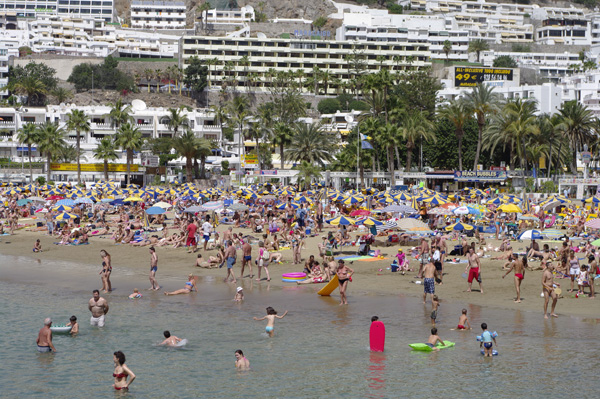
    Puerto Rico beach on a Spanish bank holiday

    Here, snapped with the Pentax K20D (14.6 megapixels) is a crowded beach in Gran Canaria on a Spanish bank holiday Sunday before Easter. At this stage it is relatively empty 🙂 No-one gives a second thought to a camera with an 18-55mm kit lens. It is not as if this overdressed British tourist is waving a big white tele at them.

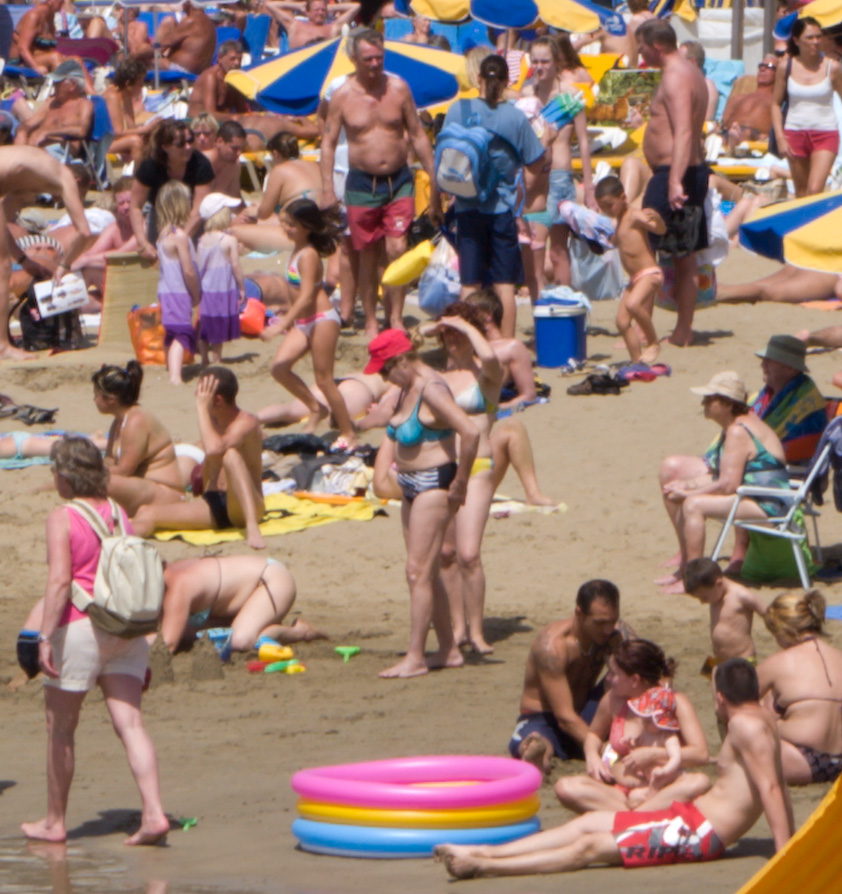
    What they do not realise is that every single person on this beach is identifiable right down to the wrinkles on their cellulite, and worse things. Today’s DSLRs can pull out a section worthy of Breughel (though parts look more like Bosch) and show as much detail as you would once have expected from rollfilm:

    Moving in unfairly on targets

    This is cropped and reduced from an export using Adobe Camera Raw from the original .PEF file up to 6144 pixels wide (75 megabytes file size) – to view the full size crop click the image. It is exported with Sharpening set to 0, NR set to 0, and no post processing is applied to enhance detail. It is, as you would expect, slightly softened by the anti-aliasing filter and de-Bayer process but with a wealth of detail present.

    Ten years ago you would have been happy to see an 640 x 480 digital camera picture looking as sharp as this crop. So, given web use of images, the picture libraries are right. A model release is needed for any commercial use of any scenes with people in, no matter how many people and how far away.

    Today’s and tomorrow’s digital SLRs are going to capture scenes the photographer is not even able to spot when composing the shot, and may cause anything from embarassment to lawsuits because of the clarity of their information.

    Be warned! And remember, too much sunbathing is damaging. Cover up…

    – David Kilpatrick

  • Live view versus the cheating DSLR viewfinder

    CANON may get some stick from their own users who reckon Live View is not much use, and Sony’s decision not to put it in the A700 may well be defended on the same basis. How wrong that is. Here’s one (plus another two) good reasons why Live View is your best friend in the studio. (more…)

  • Microstock analysis

    We have come across this site which presents an exceptional analysis of microstock sales:

     http://www.perrush.be/SYF_micro_E_1.html

    Not that, in your editor’s opinion, the results are all that wonderful – it would be easy enough to secure the same monthly earnings from a single direct sale to any publication, and it’s more interesting by far to try to place work directly with clients, talk to them, deal face to face or by email. But this is the best and most detailed analysis of microstock we have yet seen.

    -DK