Category: Lenses

  • Tamron’s 150-500mm in practice on the Fujifilm X system

    Tamron’s 150-500mm in practice on the Fujifilm X system

    Charles Brooker writes about his experience with the Tamron 150-500mm F5-6.7 X-mount lens, and compares it with the Fujifilm 100-400 plus 1.4x Teleconverter (140-560mm f/6.7-8).

    • Tamron 150-500mm F5-6.7 Di III VC VXD with Fuji X-Mount ~£1,040 (Amazon UK)
    • Low-cost super telephoto zoom with 82mm filter thread, 1.7kg
    • How does it compare with the Fuji 100-400mm plus 1.4x TC at almost twice the price?

    My photographic journey hasn’t seen much need for me to compare lenses especially with the Fujifilm ecosystem being pretty lacking in competition. I had lusted after the Fujifilm 100-400 for a long while and eventually took the plunge about a year ago. Since then I have probably put it to use in over 50,000 images across wildlife, sport and occasionally cityscapes.

    When I got it I adored it. It was the single most expensive purchase I ever made and within a week I had bought the 1.4 extender which for the purpose of the review shall be included as a package. Some dealers offer them bundled – Amazon UK currently lists the Fuji 100-400mm + 1.4x TC for £1,815.

    Including the teleconverter gives the Fuji 60mm more reach than the Tamron, but overall the two packages come out fairly similarly with the Tamron obviously being 150-500 f/5-6.7 and the Fuji being 150-560 f/6.7-8.

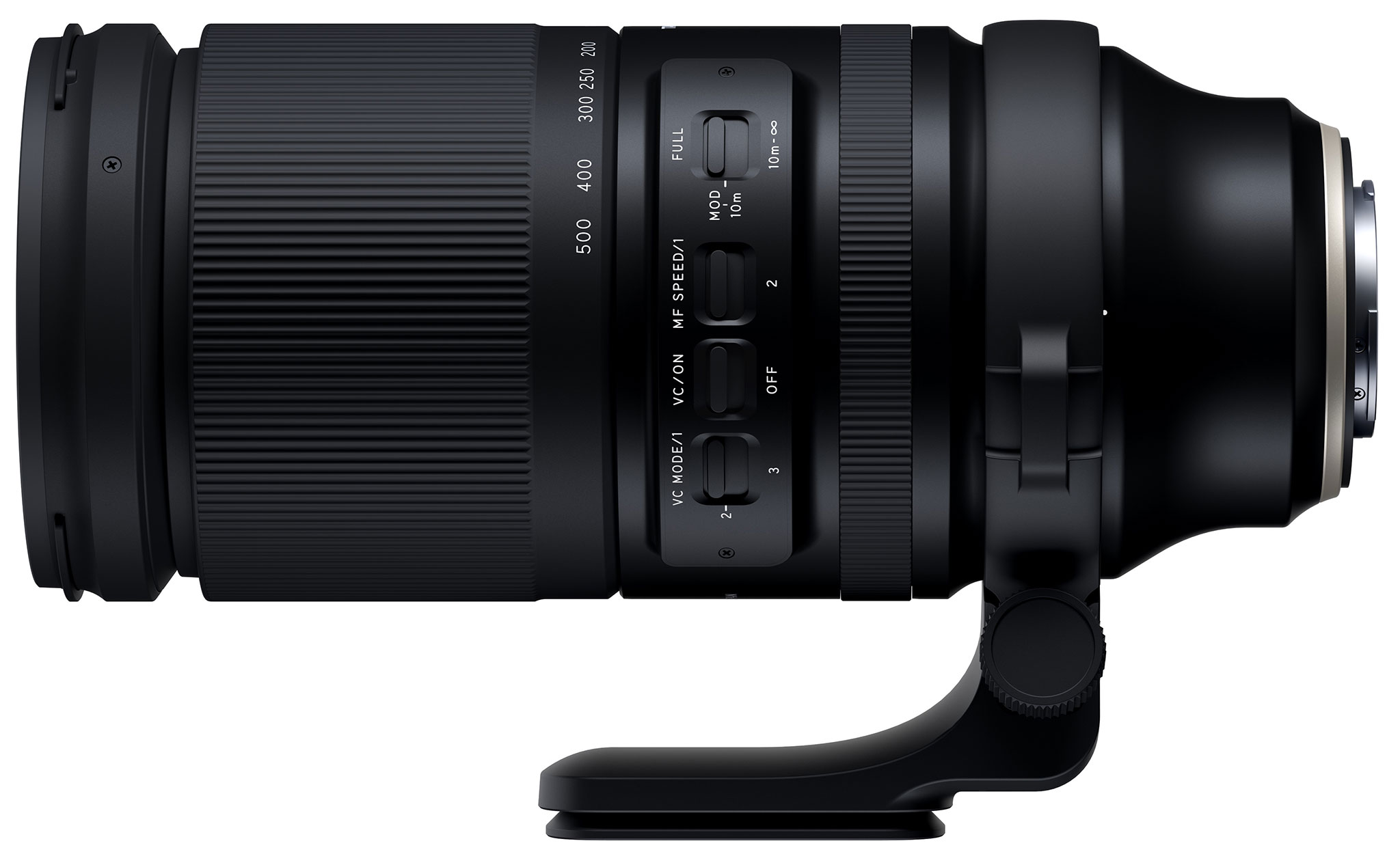
    Profile view of the Tamron 150-500mm Di III VC VXD X-Mount with tripod foot attached.

    Tamron 150-500mm build quality and features

    At 1725g the Tamron is 400 grams heavier than the Fuji and this extra weight is obvious in the hand but also in terms of significantly reassuring build quality. The Tamron 150-500mm Di III VC VXD is built like a tank.

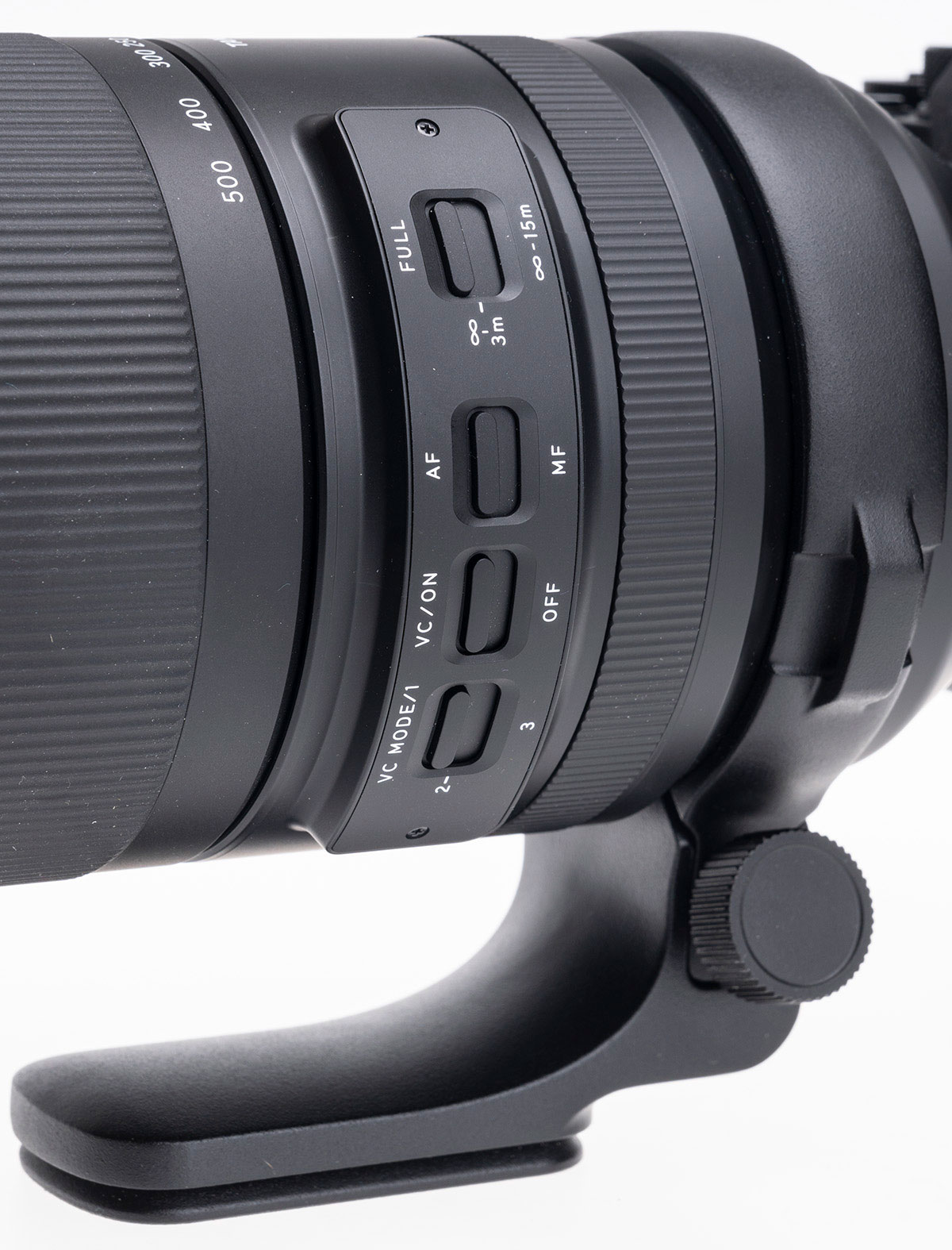
    Those 400 grams take into account additional image stabilisation options, and 3 focus limiting options: 0-10m, 10-infinity and full range. This compares to the unlimited focus or 5m-infinity that Fujifilm offer. The switches on the Tamron are all very firm and you know they have been clicked.

    Unfortunately Tamron have not built this lens for use with Fuji’s 1.4x tele or any other converter. This would have made for a very interesting test.

    Fuji’s build quality for the 100-400 has always been a major weakness in my eyes. It feels plasticky and the tripod mount screws have a habit of loosening (as do the screws holding the lens mount which is enormously off-putting). This screw issue is something that has always perturbed me when it comes to considering the level of weather resistance promised with the lens.

    I didn’t realise how low the standard of the 100-400 I’ve experienced was until I acquired Fujifilm 50-140 and 16-55 f/2.8 lenses – which are of supreme quality.

    Tamron vs. Fuji: AF performance

    I would be inclined to say that the 100-400 feels a little more reassuring in focusing. I would expect that to be the case with a native lens. The focus seems to lock slightly more accurately. However, because the 100-400 only has one option to limit focus range I often have a real issue when trying to focus on small birds close up. The focus will miss and hunt.

    Luckily experience tells me to half hold the shutter and initiate the AF+MF focus option to roughly manually focus then the AF will find it. If a rare bird was to perch for a couple of seconds, I would be more confident of getting a passable shot with the Tamron – but more likely to get something very sharp with the Fujifilm. Action photography was a different story.

    Unfortunately I felt that the Tamron lens was not anywhere near as accurate, to the point where I did not feel I could trust it in the same situations I trust the 100-400. Fujifilm have had seven years to tweak autofocus with firmware updates and Tamron will no doubt work on a fix for this.

    Tamron vs. Fuji superzooms: handling

    The zoom rings on both lenses I would say are missing the sweet spot – the Fuji feels a touch light, turning is easy but always feels slightly lacking in reassurance, the Tamron is slightly too firm, it would be difficult to zoom accurately as you follow the action.

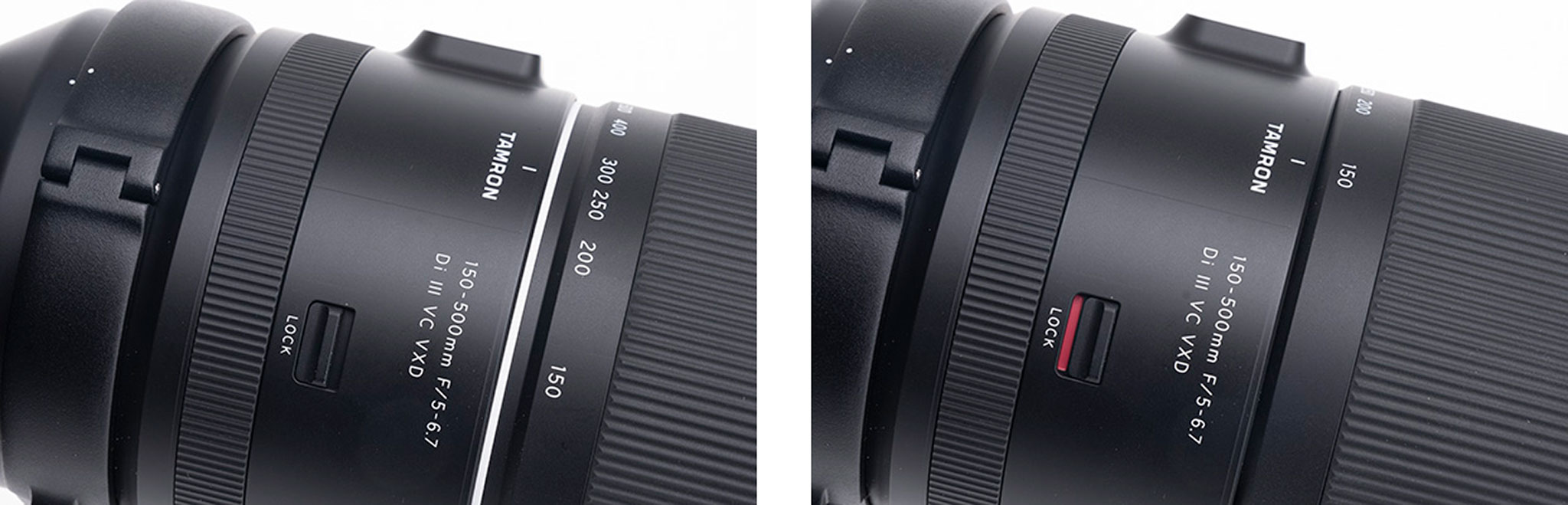
    I think the Fujifilm is slightly better on this. Both have zoom locks to stop the lens extending with gravity. The Tamron has a friction lock which is ideal for holding at a set focal length, however if you are using it in a high octane environment it is very easy to accidentally apply it. This is a nice feature and adds to the premium feel of the lens but I used it much less than I thought I would and much of the time I did use it was by mistake!

    Tamron 150-500mm handling – the zoom ring can be pushed forward to friction-lock it at the chosen focal length. A white ring is revealed to show the locked staus (left). The lock switch (right) works only at 150mm to hold it firmly when carrying.

    The weight is also a big factor here. I have photographed many sports matches with the 100-400 without any fatigue issues, the Tamron was not a problem for me but I am in my mid-30s and pretty strong. If photographers are concerned about weight on the 100-400 the Tamron offering will be too heavy.

    Tamron 150-500mm tripod mount benefits

    A pet peeve of mine is that neither of Fuji’s earlier large zoom lenses 100-400 or 50-140 feature an Arca-Swiss plate on their tripod mount. This lack of attention is downright sloppy, and luckily has been rectified with the Fuji 150-600. It means putting a third party tripod mount on.

    Given these lenses are frequently exclusively used with a battery grip, this then means the camera will not sit flat on a table with the tripod plate added. This also adds a tiny bit more rock into the setup when moving the camera to find a subject and another thing that could come loose in part of the setup.

    The Fuji100-400 with a 1.4x tele has a bit of movement in the mount and it never feels rock solid. This, added to the fact that the tripod mount locking screws have a habit of coming loose, is another issue while using the lens on a tripod.

    My Fuji system comprises tripod, Arca-Swiss Plate, lens mount, lens, 1.4 tele, camera so there are five elements of potential play.

    The Arca-Swiss plate incorporated into the Tamron 150-500mm lens collar
    The Tamron 150-500mm features an Arca-Swiss plate cast into the standard tripod mount collar, a feature Fuji’s 140-400mm lens lacks.

    The Tamron on the other hand feels a lot more like it is the native lens when using on the tripod. When locked into my Peak Design tripod, it feels like one solid unit The Arca-Swiss mount sits snugly and the lens even feels tighter in the X-Mount system.

    The tripod mount is rock solid but it is clumsy and has a habit of getting in the way of the switches which significantly reduces the ability to react quickly to surprising action. Manual focus is also very tricky to get at when looking through the EVF. 

    Tamron vs Fuji superzoom image quality

    My standard workflow with the images is to put them through Lightroom and Topaz Denoise when high ISO is required by Scottish Winter. Given it was December and miserable, the lenses were having to work hard at about 1/250 and ISO of 1600-3200.

    Generally speaking I would say the images from the Fujifilm were a bit sharper, but the images from the Tamron had more pleasing colour and contrast. This is unsurprising, as I feel my Fuji 50-140 f/2.8 is definitely better with colour than the 100-400.

    Personally I feel the thing that makes photographs of birds special is capturing the detail in the feathers – increased contrast can be added in post.

    See: Tamron EU info for the 150-500mm F5-6.7

    Tamron 150-500mm results

    Bird photography

    Sharp head and beak with motion in the wings, 1/125s at f/6.7 full aperture, 500mm, ISO 2000

    I am lucky to have a very active bird feeding station in my garden with an army of finches trying to eat into my camera budget by emptying feeders in moments. I have a tripod set up in by the French doors and snap away indefinitely (electronic shutter is very handy for this as no rolling shutter issues are really noticeable and without this I would be looking at a number of new shutter motors).

    If a rare bird was to perch for a couple of seconds, I would be more confident of getting a passable shot with the Tamron

    Charles Brooker on the Tamron 150-500

    I have been able to photograph the same bird on the same feeder within seconds using both lenses and settings and really image quality is so close to interchangeable. Looking back at the vast array of finished images I took over the month it would be very difficult to judge which lens took them.

    At f/6.7 and 500mm, 1/250s at ISO 1600

    Sports photography: Rugby

    I have photographed a number of rugby matches with the 100-400 and am aware of where it hits the limitations. I know in good light I can use the 1.4x tele. When it’s overcast or dark – I can’t.

    I used the Tamron for the first half and had to change in order to get more light in. Scottish Rugby in January is a real test for a lens and I think the Tamron met its match here, and looking though the hundreds of images I was disappointed by the focus accuracy compared to what I would have expected of the 100-400. What was more odd was that focus was not locking and tracking, so I would maybe get 4 sharp images in a batch of 10.

    This cost me the crucial frame as a Try was scored on one occasion.

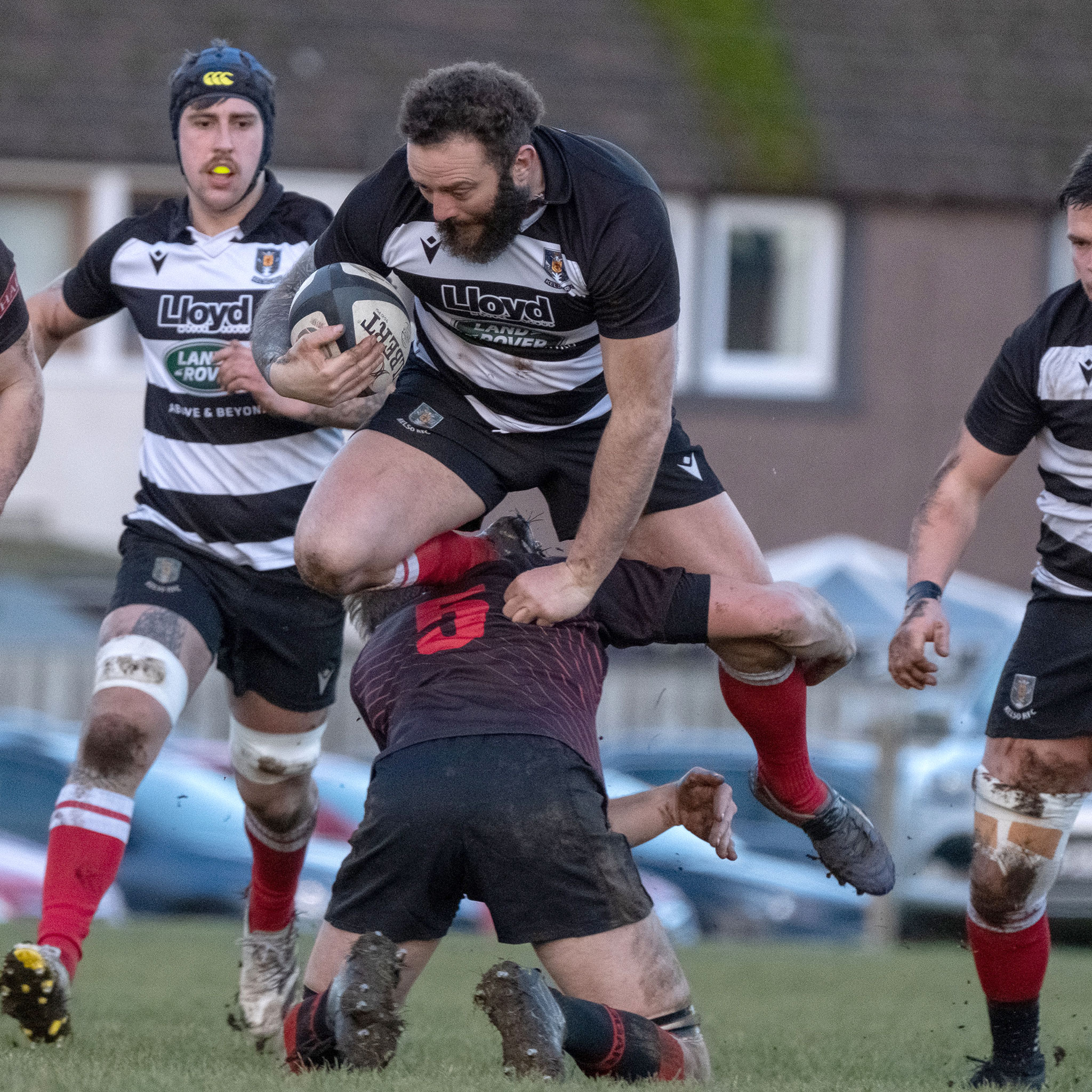
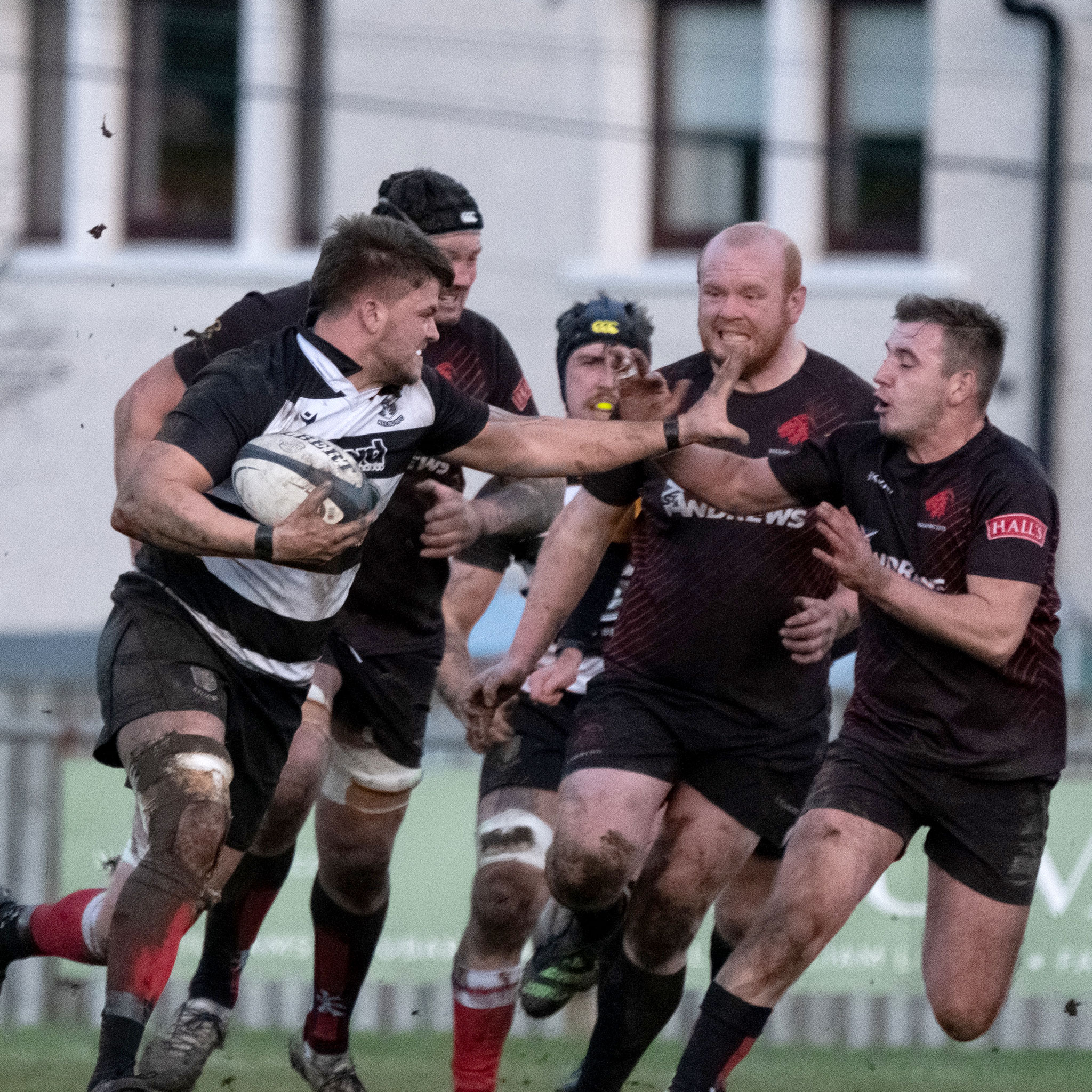
    Rugby players captured colliding with Fuji X-system and Tamron 150-500mm lens
    1/1000s at f/6.3, ISO 3200, 408mm
    Rugby players talk to the hand, with Fuji X-system and Tamron 150-500mm lens
    At 500mm and f/6.7, to get 1/1000s needed ISO 6400

    I am not saying the native glass would have got all 10, but I am confident that when focus locks it will stay on track when using that lens.

    I also discovered that the friction zoom lock became a total pain when using the lens for action photography, the number of times I had unsuspectingly initiated it and then couldn’t work out why the lens wasn’t turning was frustrating when concentrating on following the ball with the subject rapidly increasing in size. 

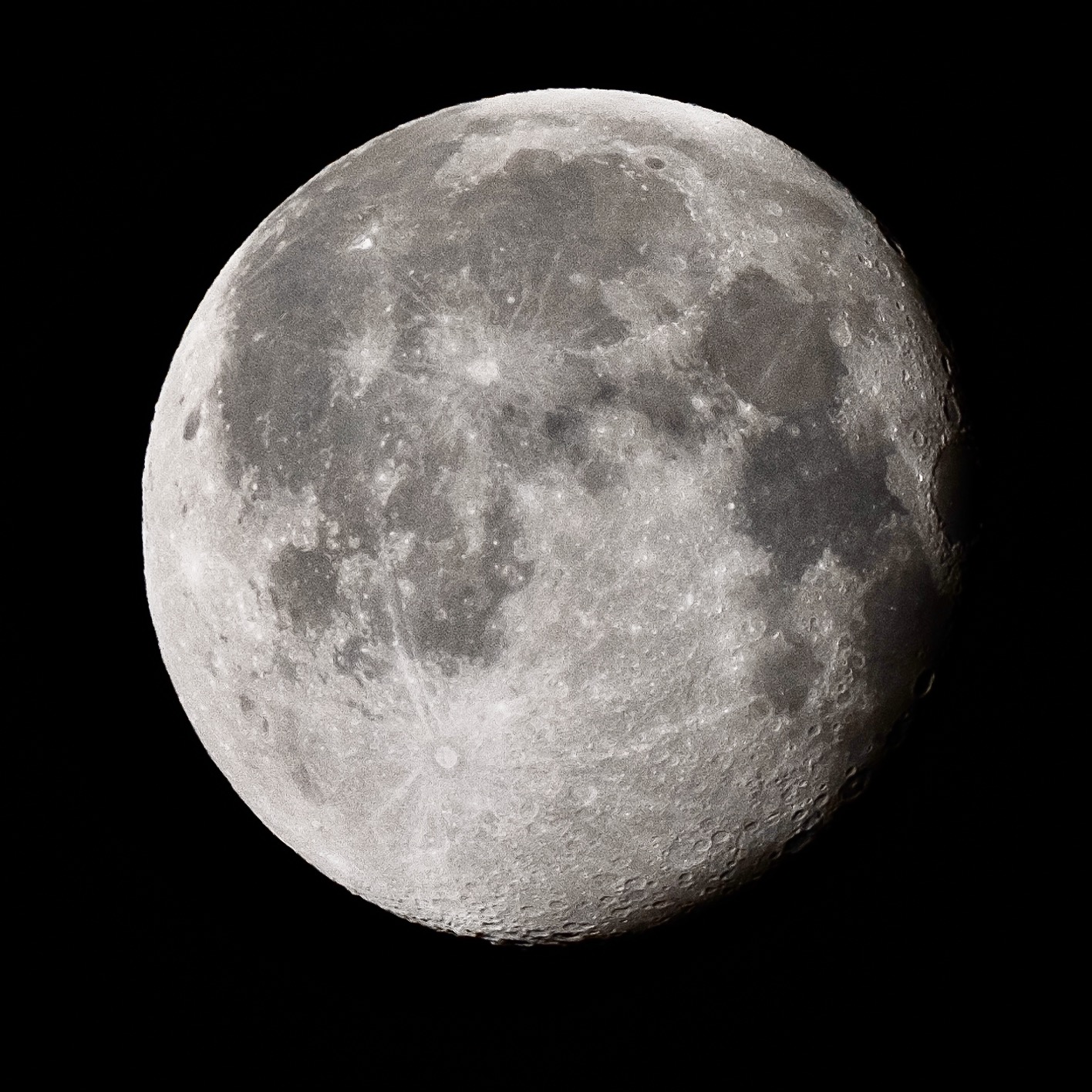
    Photographing the moon with Fuji and Tamron

    The moon, as seen from Earth: 1/250s at f/13, ISO 160, 500mm with Tamron 150-500mm F5-6.7 Di III VC VXD
    1/250s at f/13, ISO 160, 500mm – a bright subject by comparison with earthbound Scottish winter daylight

    It is rude to have a telephoto lens and not have a few goes at photographing the moon. I had the lens for quite a while before December in Scotland gave me a clear(ish) night. The Tamron 150-500mm performed very well, but the location of the manual focus ring is very uncomfortable to use when the camera is on a tripod and trying to use the EVF focus peaking system Fujifilm offer.

    Verdict: Tamron vs Fuji superzooms

    If this was a buying guide I would immediately say to go out and buy the Fujifilm 100-400 from WEX second hand. At time of writing you can pick up an ‘excellent’ condition version of the lens for £850 and the teleconverter for £250 which gives you a year of warranty and peace of mind.

    If you were not willing to buy used paying £1450 for the 100-400 plus £360 for the tele would be negligent. You would be better getting the Tamron for £1400 or the new 150-600 Fuji lens for £1800. Internet forums and Facebook will tell you that there are good copies of the 100-400 and bad but I suspect there are good users and bad!

    What does the Fuji 100-400 do well?

    Picking your priority is the most important thing here. The 100-400 offers you flexibility – when light is tricky you can sacrifice some reach for more light, vital in keeping the fastest shutter possible. It also seemed to have significantly better AF when shooting action and feels slightly better in the hand even if build quality is somewhat lacking.

    The Tamron lens is beautifully made but that comes at a weight cost. Initially I loved the handling but with more use, I found the idiosyncrasies of button location, the bulky tripod mount and zoom lock all left me rather frustrated, I never quite got the muscle memory I thought I would.

    I would like to think any AF issues have been fixed with the recent firmware update (which came as I returned the lens). Some samples – which you may come across if buying used – had problems with infinity focus.

    In order to make a case for buying a third party lens over a native one, I think I need a compelling reason to do so and I don’t think Tamron have given me one.

    Charles Brooker is a freelance photographer and also specialises in picture framing and bespoke leatherwork, including handmade camera and equipment bags. He is based in the village of Kirk Yetholm at the northern extreme of the Pennine Way – see https://www.charlesbrooker.com

  • Tamron 35-150mm f/2.0-2.8 Di III VXD review

    Tamron 35-150mm f/2.0-2.8 Di III VXD review

    The first magazine test of the new Tamron reached Cameracraft readers in our March/April 2022 edition. Now that other magazines have reviewed the lens, it’s time to read David Kilpatrick’s practical user report on-line.

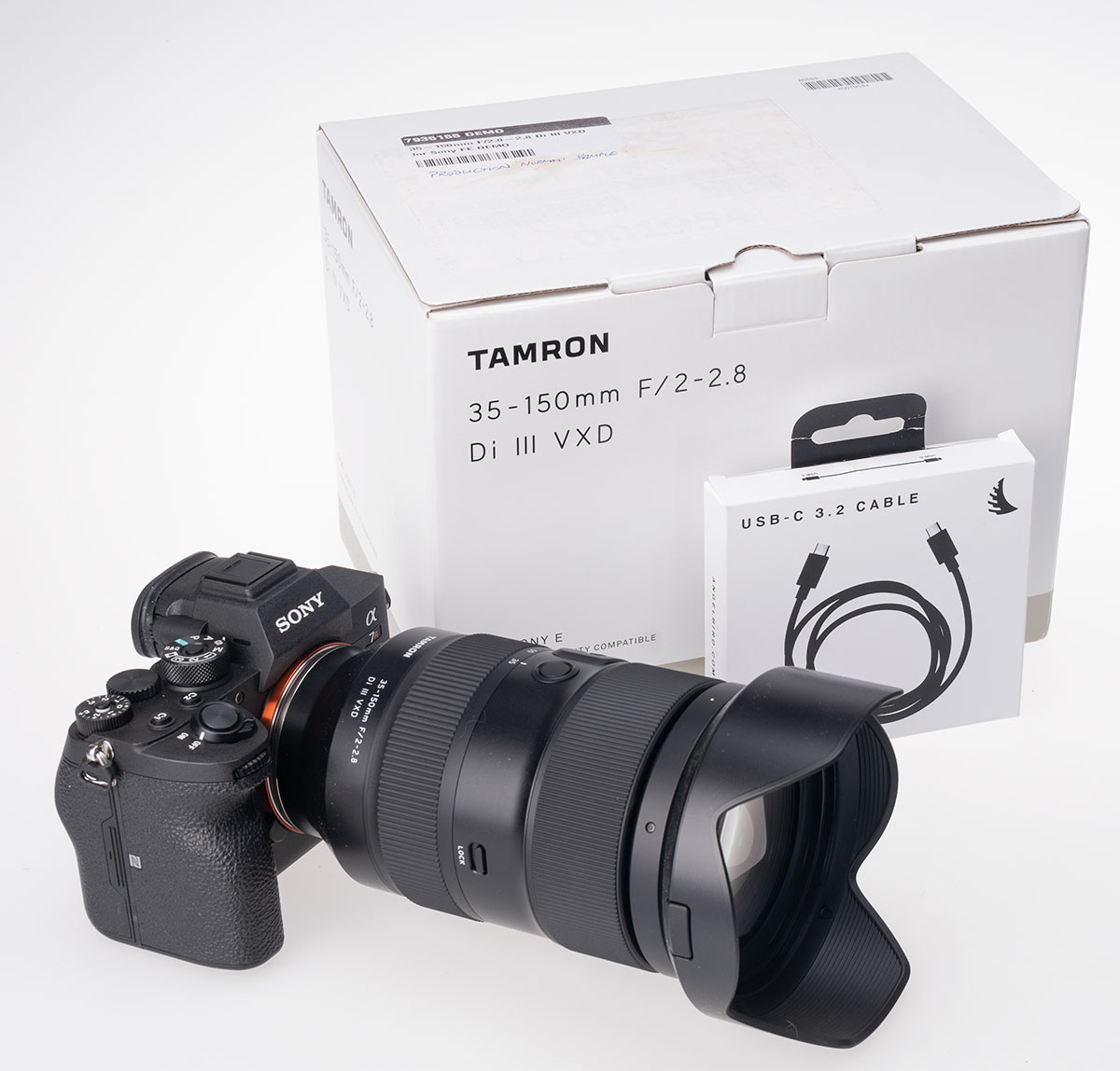
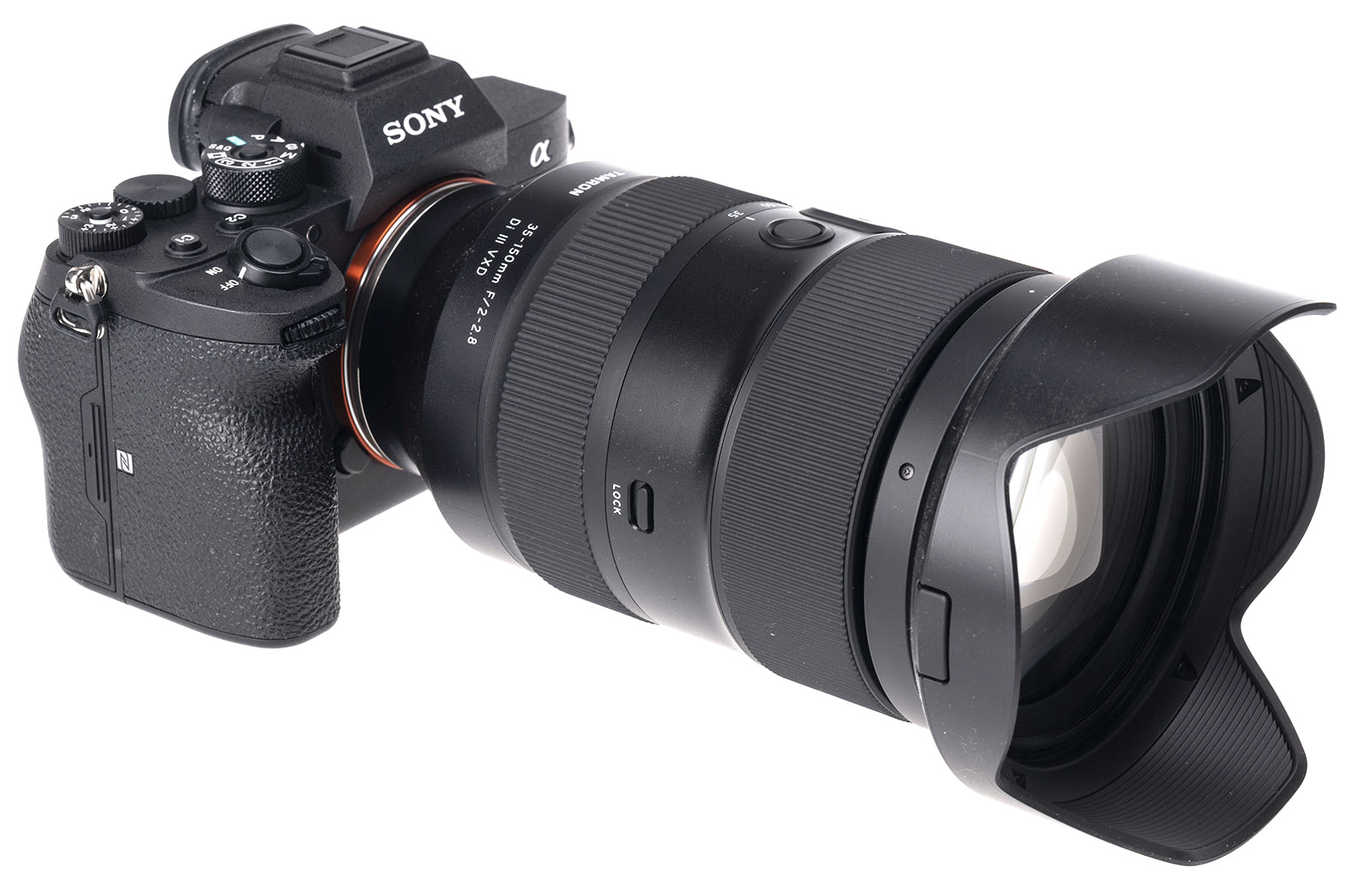
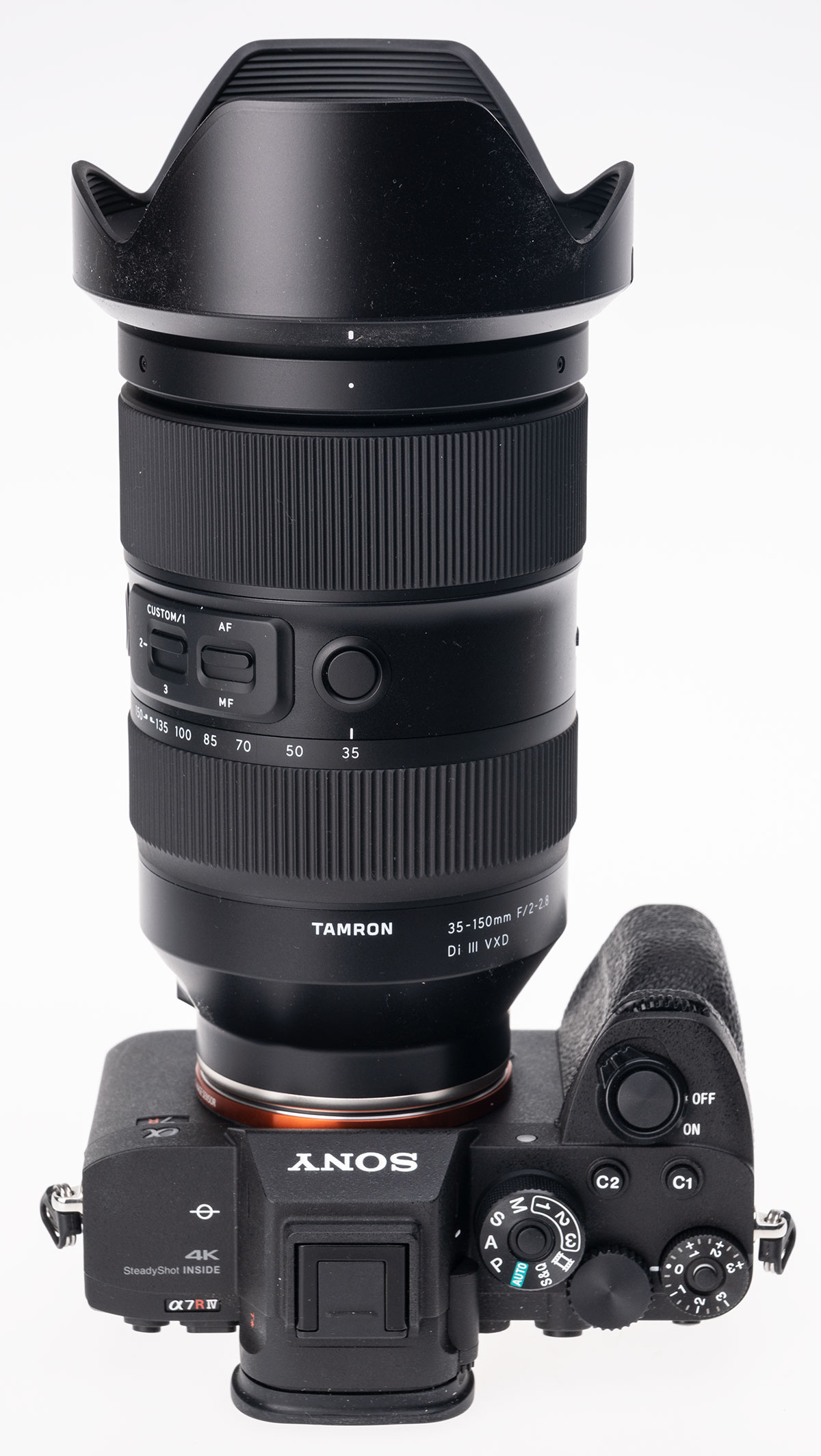
    Tamron 35-150mm on Sony A7RIV body

    IT’S THE MIDDLE of a dark winter and the new Tamron super-fast ‘group to portrait’ zoom has been doing the rounds of dealers, and we get the chance to use the lens for a good test period starting in January just as the days are getting longer. It’s 3pm and it looks like 4pm with heavy cloud. A quick exposure check says why this lens will be a priority purchase, in a hurry, for wedding photographers.  Fortunately the days get brighter and longer during the time trying out this versatile lens.

    So many weddings have been postponed due to earlier Covid venue restrictions. To get 1/125s shutter speed, which is very much needed to ensure expressions and fairly small movements are not motion-blurred, it was ISO 2500 at f/2.8 on the day the lens arrived. Between this and the end of useful daylight that changes rapidly to ISO 6400 and beyond, and eventually to 1/30s. Any sensible wedding photographer would now be digging out the f/1.4 lenses, firing up the battery flash kit and hoping the indoor setting works well.

    However, there’s a zoom now for Sony full frame users which can cover most weddings or outdoor portrait sessions on its own, replacing a fast 35mm and 50mm and most of the range of a 70-200mm f/2.8.

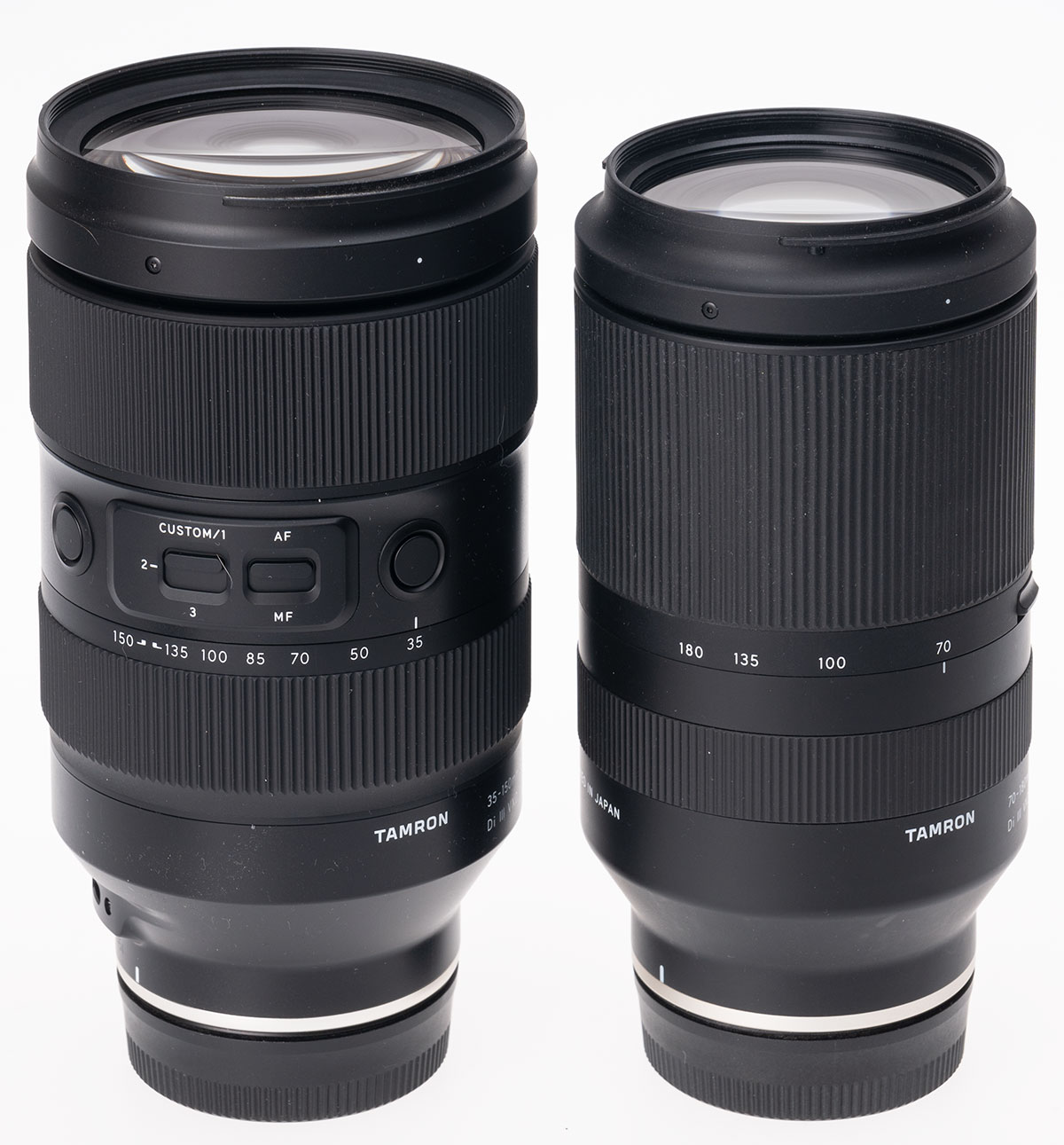
    The Tamron is 155mm long and 90mm in diameter

    The new Tamron 35-150mm manages to hold its widest aperture of f/2 from 35mm to just short of 40mm, and doesn’t drop to f/2.8 until 80mm. 

    f/2 35 to 39mm

    f/2.2 40 to 59mm

    f/2.5 60 to 79mm

    f/2.8 80 to 150mm

    This is good, as so many zooms with a fast minimum focal length lose a third or half a stop with a mere nudge of the ring – those 17-35mm f/2.8-4 lenses made for SLRs were often f/3.2 at 18mm! With studio flash you might set f/2 and start work at the short end of the zoom, but with so many systems studio or location now being TTL and high-speed sync of one kind of another this probably doesn’t matter. Set the lens to f/2.8 or any smaller aperture, and it acts as a constant aperture zoom

    How about the chosen focal length range? I’d argue that 28-135mm, with similar aperture benefits, is more useful because there’s a chance of never needing to change lenses.  There’s a quick way to check what matches 35mm for groups, using just the long side of a landscape frame. It’s almost the same as the 36mm dimension of the sensor, with an angle of 55° covered horizontally. If you’ve got an APS-C sensor it matches 23mm, on MFT 17mm, on Fujifilm GF and other popular 50MP medium format models it’s 44mm, on the biggest like Hasselblad HD6-100C it’s 53mm. 

    35mm is not a bad wide end for practical reasons

    This angle of view works well because many rooms have Golden Ratio dimensions, not unlike an A4 page. Stand near one end of a 5 x 7m room, put a group at a comfortable distance away from the opposite wall, and you’ll cover it well with some of the side walls visible. In a square room, you can just take in the opposite wall with no sides visible. The working distance gives scope for bounced flash, there’s no distortion of body or face width towards the ends of a group even if it’s tightly composed.

    In fact having the wide-angle end limited to 35mm may improve your group photography and weddings in particular by making you keep that little bit of extra distance.

    However, the real world sometimes throws difficult spaces and camera distances at you. This new Tamron is not an all-in-one outfit. It’s almost essential to have a 24mm, or a zoom such as Tamron’s 17-28mm or Sony’s 16-35mm.

    The range

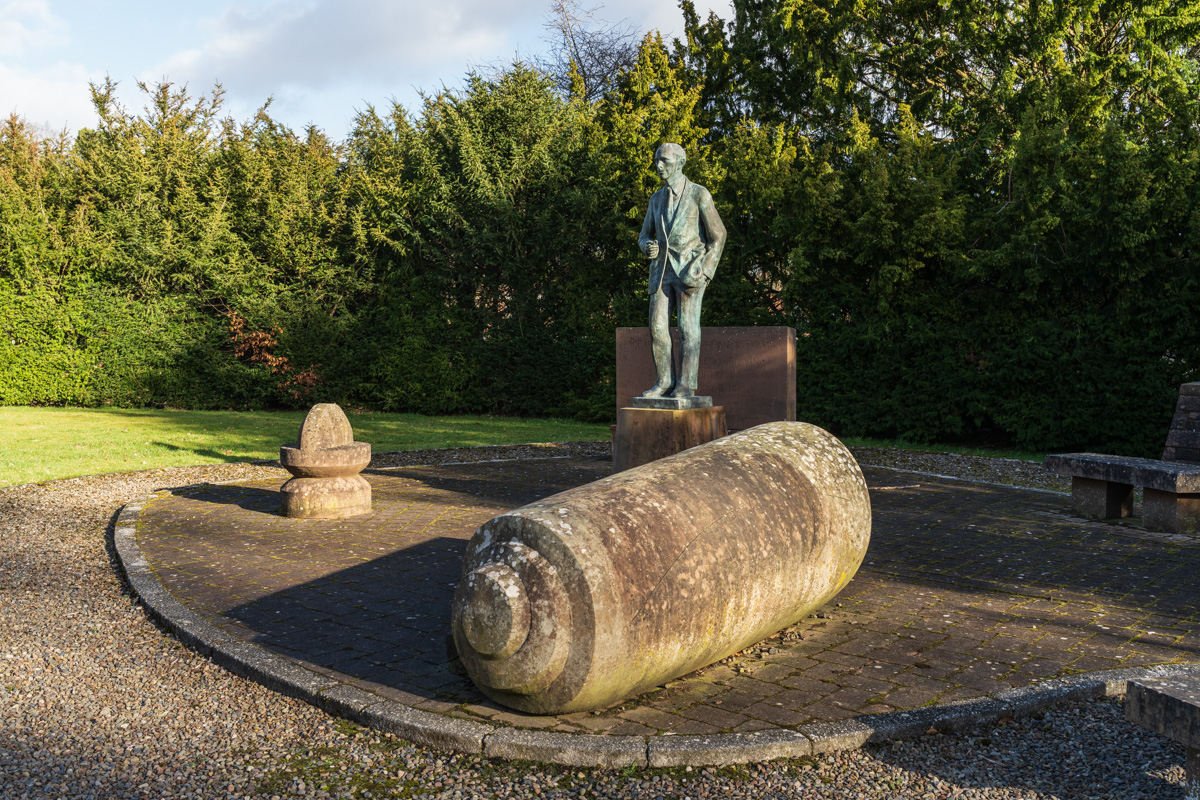
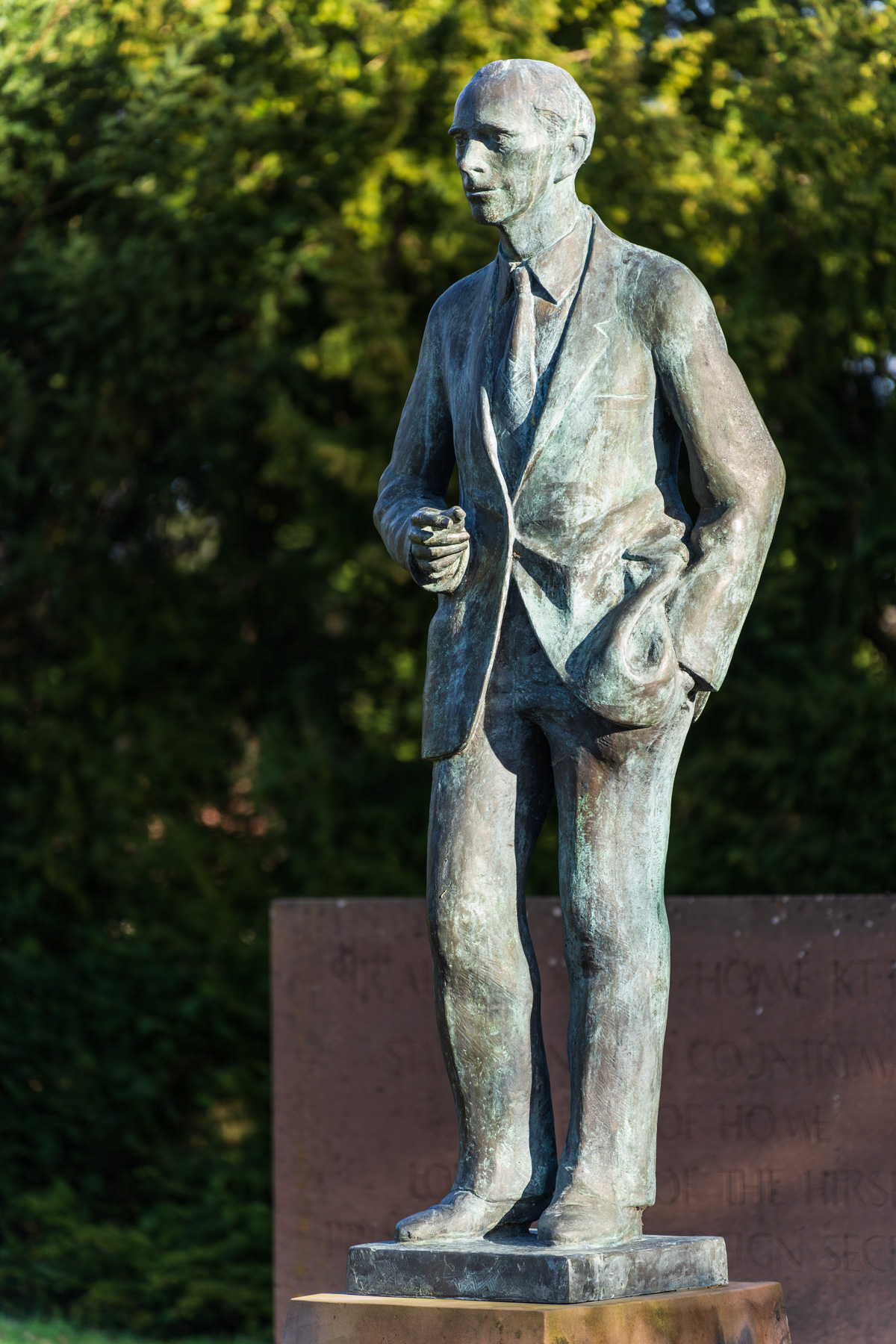
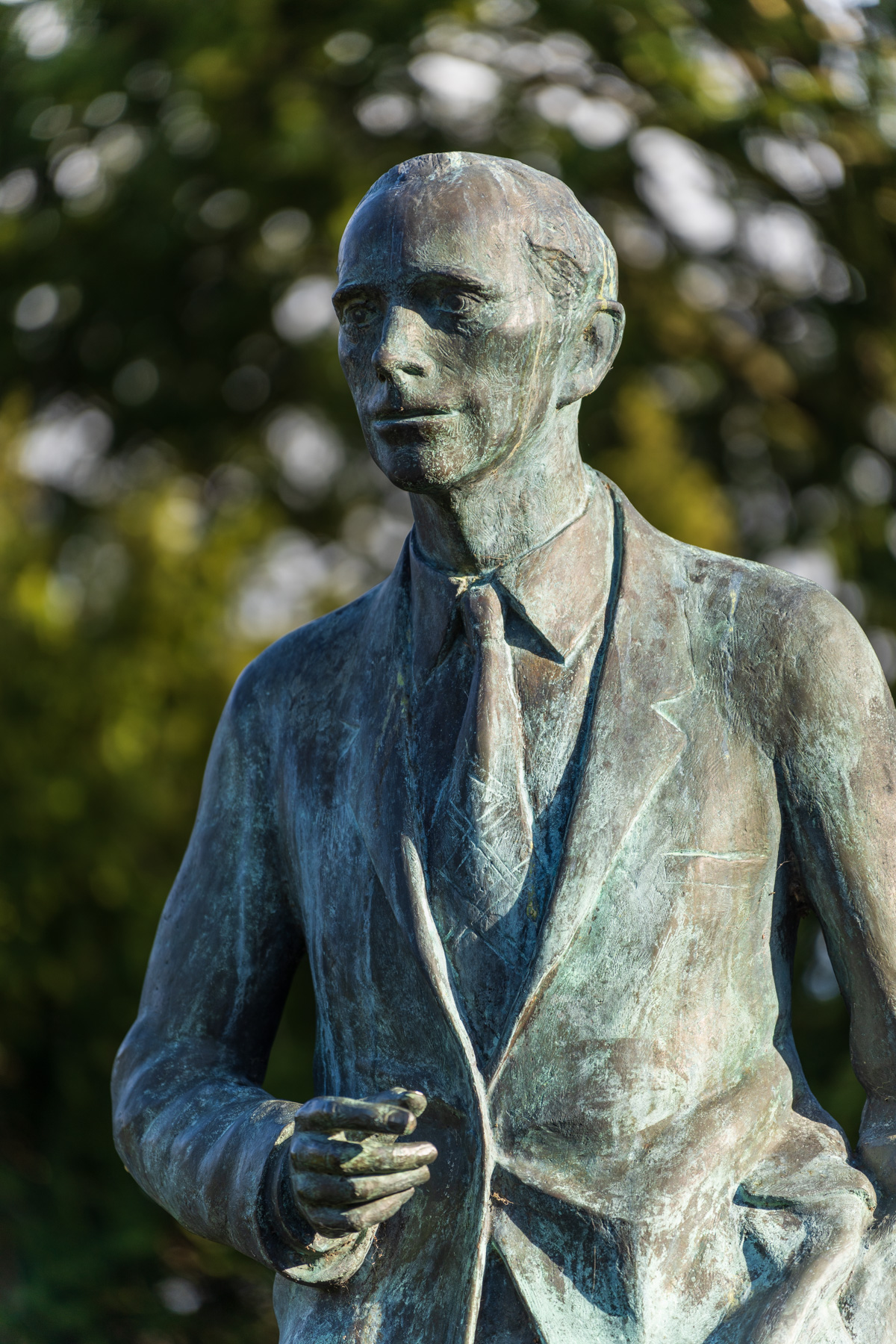
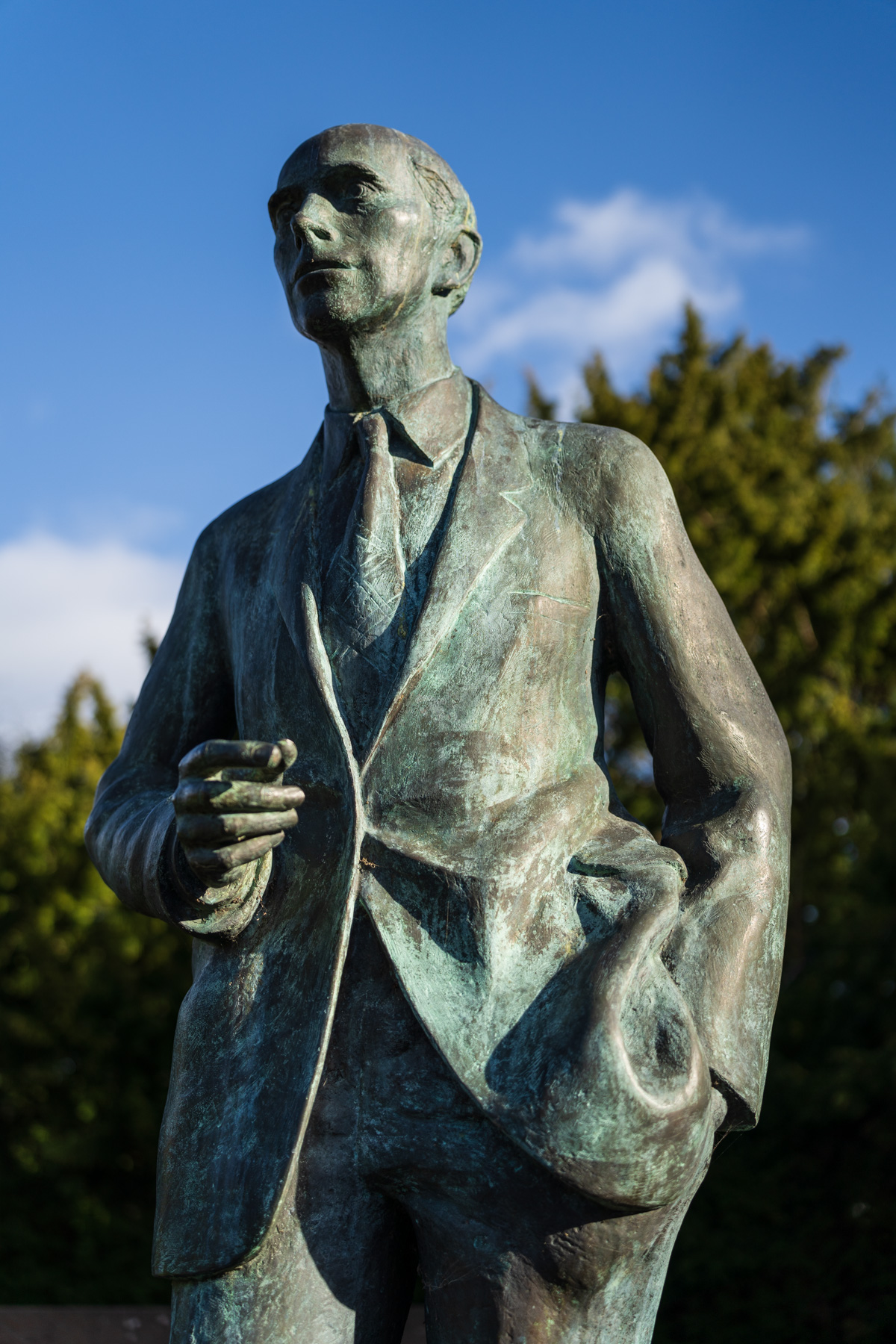
    The statue of Sir Alec Douglas Home at The Hirsel estate, Coldstream, is a rare example of a life-size bronze standing on a soap box height plinth. The versatility of the 35-150mm range and the fast aperture is demonstrated here – above, 35mm and f/9 for the depth of field; below, both at 150mm and f/2.8 from different distances, showing the bokeh pattern.
    At 150mm, from a distance…
    At 150mm again, from closer in. Both at f/2.8.
    Zooming out to 35mm and closing in a bit shows how different a perspective on a figure can be achieved. For test, taken at f/2 full aperture.
    Still at 35mm, moving in close and keeping the aperture wide open at f/2. This can be a versatile lens.

    Tamron 35-150mm performance

    The optical performance of the 35-150mm is well above expectations for an f/2-2.8 design. It’s better than any past attempt at ƒ2.8 on a similar range, and this is down to mirrorless versus SLR body thickness. You can use it wide open at any focal length and be sure of sharpness in the plane of focus, and that is pretty flat corner to corner despite considerable pincushion distortion growing from 50mm to 150mm. The  built-in and Adobe lens profiles are essential but not identical – while in-camera JPEGs are very well balanced across the frame, the default Adobe vignetting correction is much too strong. 

    Without correction this lens loses between one and two stops of light in the outer field when used wide open, with a central zone of around 20mm diameter representing the nominal aperture. The lens profiles boost the gain to compensate and if you set the Sony A7RIV to its ISO invariant optimum of 400, faces at the extreme ends of a group may be recorded as if ISO 1600 was used. For the best results, shoot raw and don’t underexpose (no need to follow the expose to the right mythology though). If you use the Adobe Lens Profile, adjust the vignetting to minus 60 for full aperture shots if you want to remove the effect. If you stop down to ƒ5.6 it’s pretty much gone anyway.

    At 150mm with no Adobe lens profile correction, showing vignetting and pincushion distortion at ƒ2.8.
    The same raw file with Adobe Camera Raw profile corrections applied. In-camera JPEG corrections do much the same.
    Here we have 35mm and f/2 uncorrected.
    This is the same raw f/2 file with profile correction applied.

    There’s a strong case for just letting the wide aperture vignetting be – don’t correct it at all. Many pictures will look better, including landscapes, portraits and most street shots.  The distortion correction, on the other hand, is worth leaving turned on. Because the lens has pincushion rather than barrel distortion over most of its range, the corners don’t get stretched, it’s the centre of the image which is expanded slightly. As this is the sharpest area the correction tends, if anything, to even out the finest detail rendering over the frame unlike barrel distortion correction which degrades the corners visibly in many cases.

    When Sony’s 90mm G macro was constantly being called the best lens ever, I tried three examples and all fell short of the standard expected. Just for interest I set the Tamron 35-150mm to 90mm (actually reported 91…) and shot a series from wide open to smaller apertures, on the same architectural distance subject I’d used for the Sony. Despite being on 60MP not 42MP the Tamron zoom was clearly much sharper across the frame than the Sony.

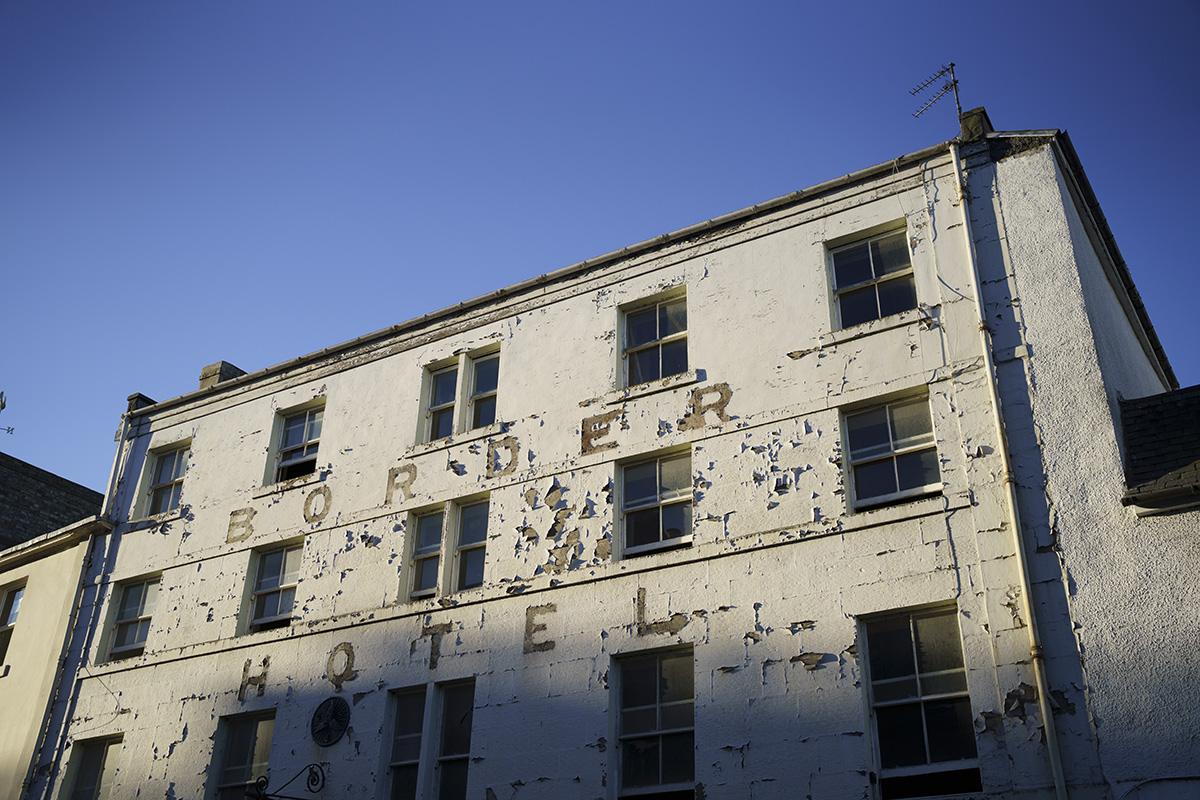
    Here’s what detail enlarged from the 150mm f/2.8 shot looks like.
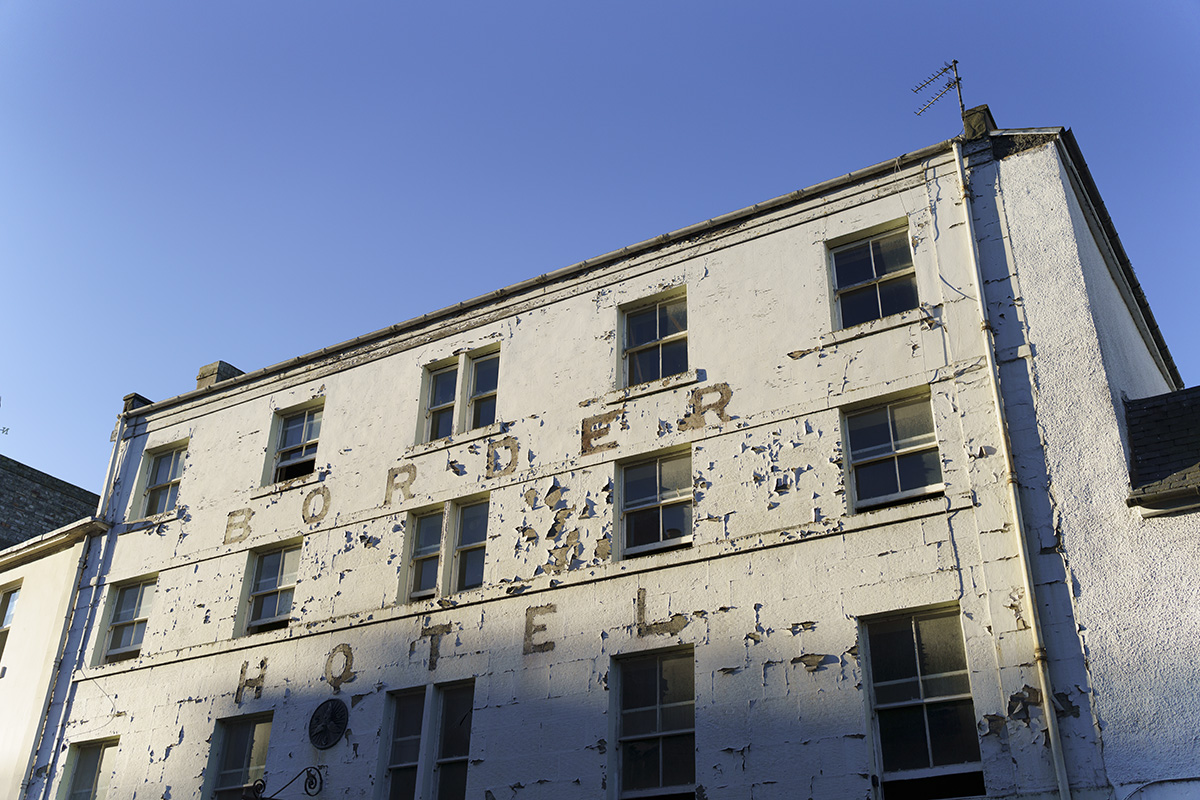
    Here’s 35mm f/2 detail. Sadly The Border Hotel’s delapidated facade will soon be a thing of the past, as it’s been a great test target for several years. The letters of the name fell off one by one but no-one was killed…

    But – it’s a fast superzoom. Plenty of expert voices on Facebook will assure you it can not possibly be as good as a modest range zoom or an acclaimed macro prime.  Don’t take their word for it, try the lens. And now we need to look at the downside of such an ambitious superzoom – it’s a large and heavy lens, it uses an unusual internal and extending hybrid zoom design, and it doesn’t focus into the semi-macro range like most other Tamron and competing lenses now do.

    I regularly walk round with the 70-180mm Tamron f/2.8 on the camera and the 17-28mm and 28-75mm in a small shoulder pouch. All three of those go into the little Vanguard Sydney II 22 bag with the A7RIV. But just the body and this one 35-150mm lens could fit.

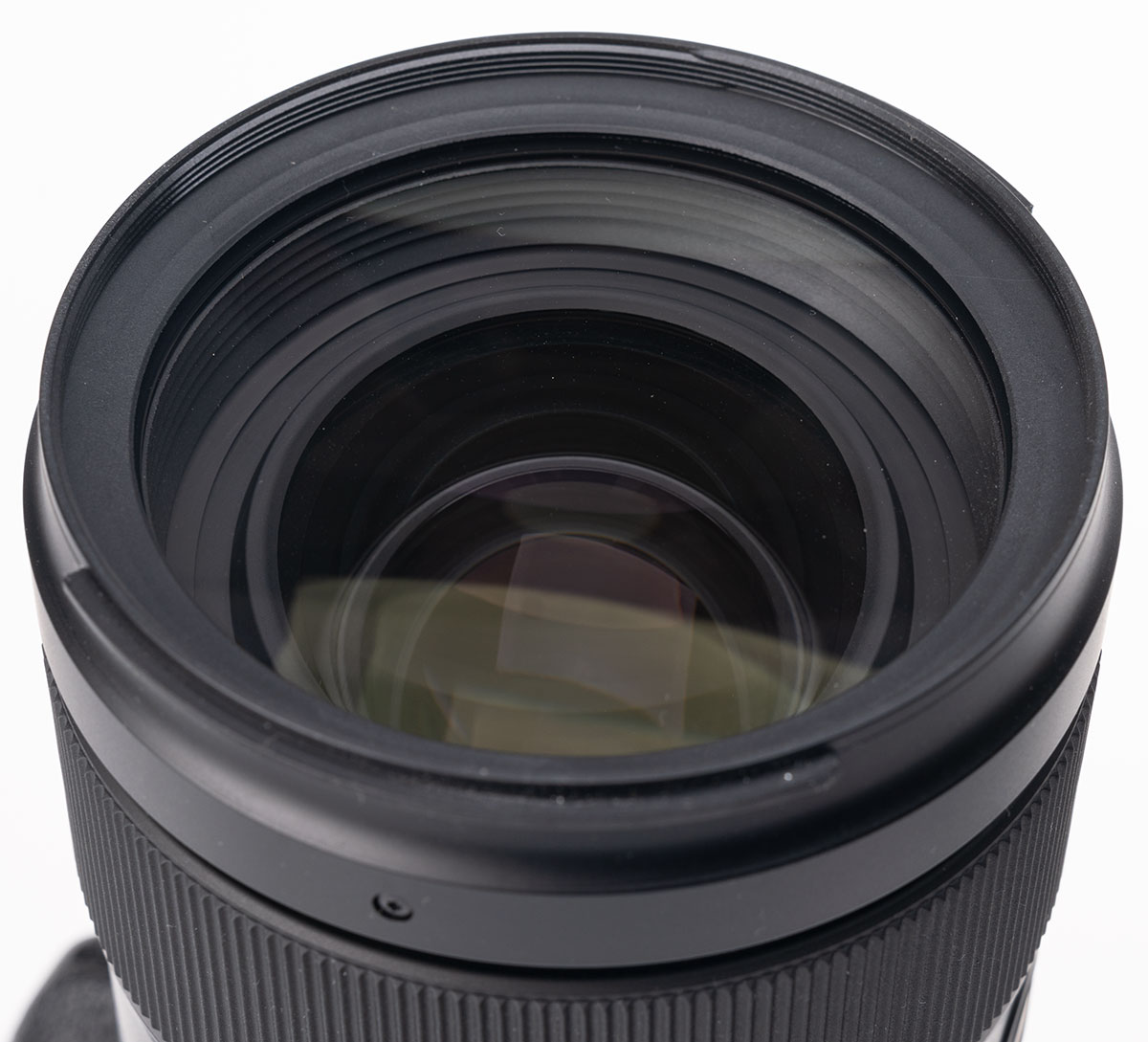
    My first step was to replace my slim camera strap with an extra wide heavy duty neoprene Optek – the springy shock-damping handled almost 1.9kg of combined camera and lens round my neck well enough. Often I hold my camera in my right hand ready to lift to the eye and shoot, and don’t let the weight hang on a strap. It was like having a 70-200mm f/2.8 to handle and many users are happy with that all day. I’m not that keen on the 82mm filter thread, but that’s what it has to be.

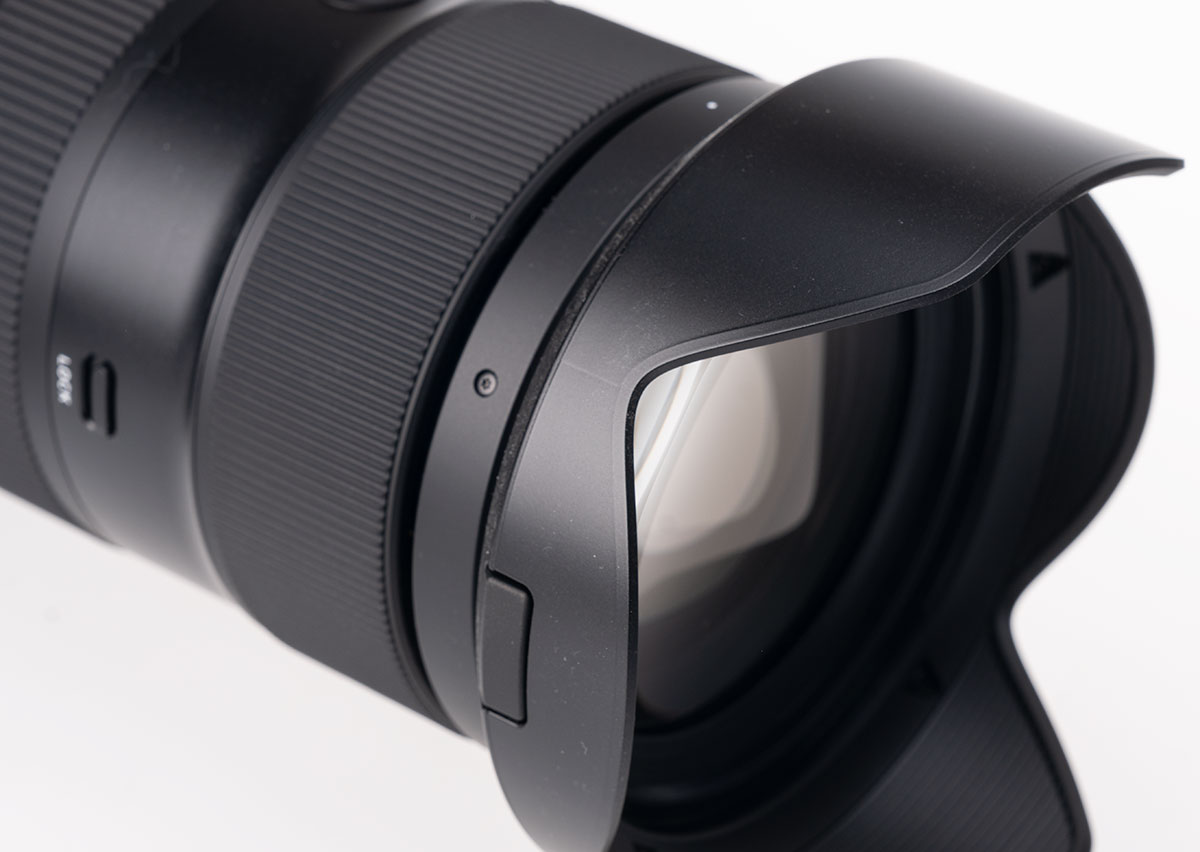
    The lens hood has a single bayonet release button set in its rim, and you need to get it the right way up to fit. It’s very secure once on.

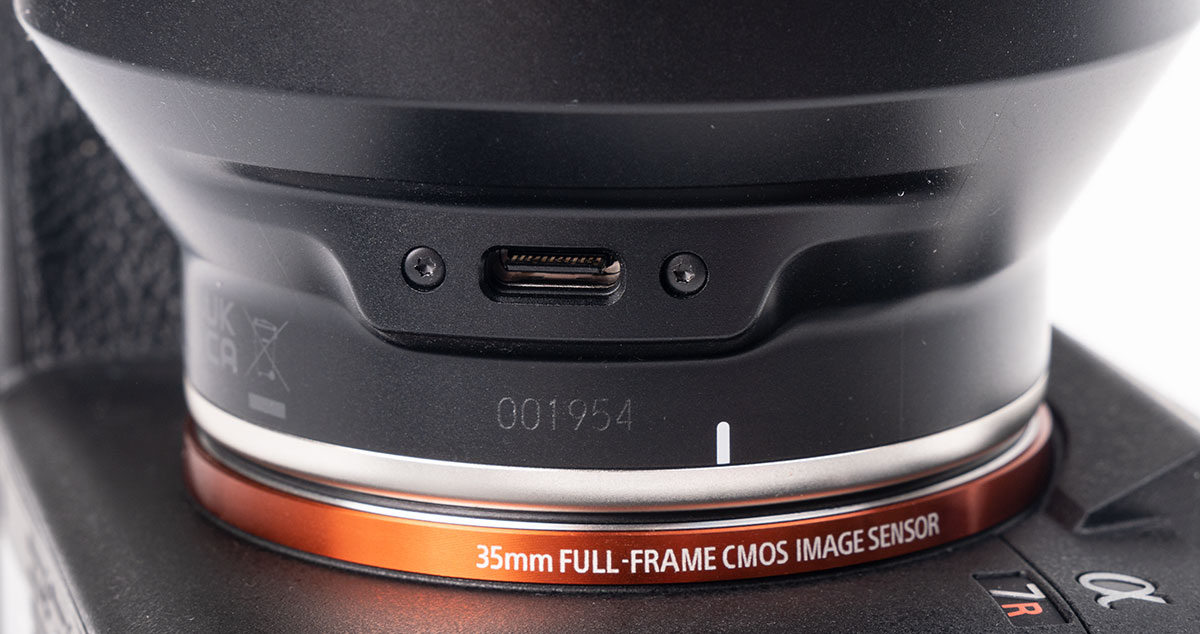
    The USB socket

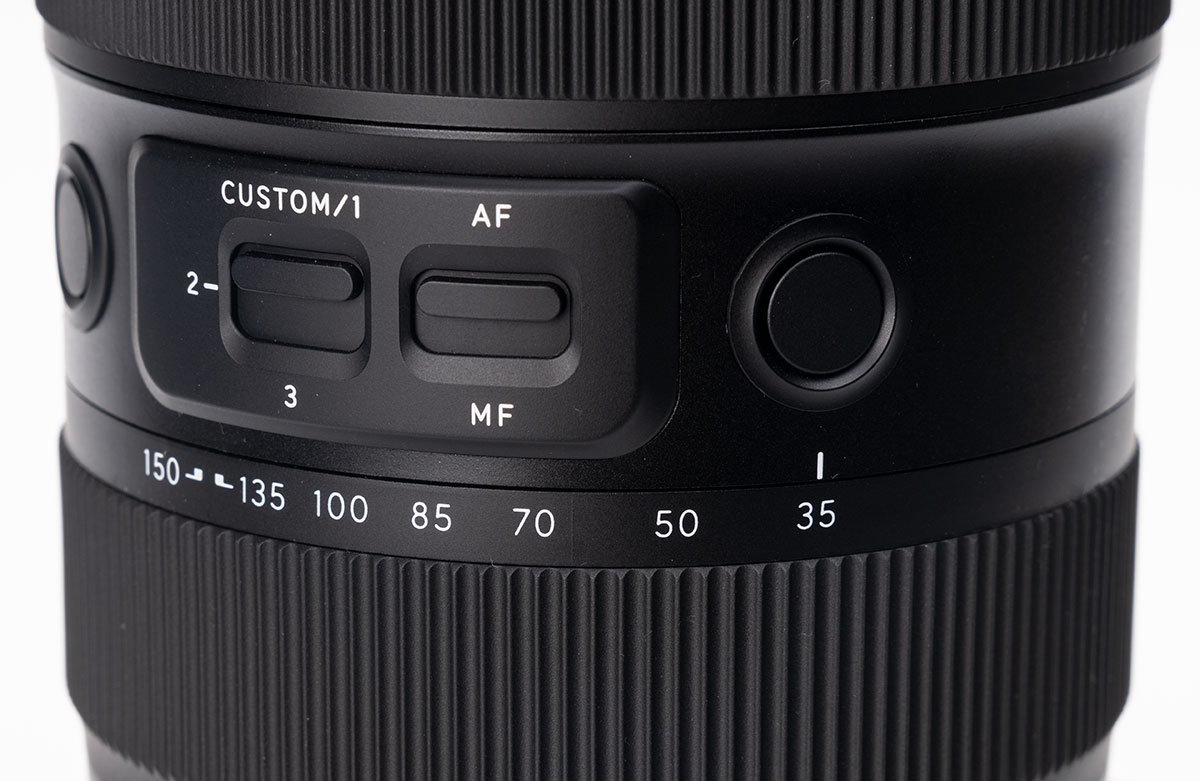
    Then you come to the advanced aspects – this is a very fast focusing near-silent voice coil drive (VXD) design, and has three control buttons plus zoom lock, AF/MF and a three-position Custom function switch. With the aid of USB connected software (no dock needed) the lens can be customised for aspects like focus barrel direction/speed and even function (change to control ƒ-stop), and two preset focus points via the buttons.

    The zoom ring is placed near the body with the focus ring being the main much deeper front barrel. This is the opposite to existing Tamron zooms and takes some getting used to, but it’s practical with the size and weight of the lens.

    More statuary, this time at The Haining, a publicly owned mansion with a loch and grounds entirely free to walk round – not even a parking charge – in Selkirk, Scottish Border. This one is at 150mm and f/2.8.
    Here’s a more likely aperture to use if you had real people in a random group – f/11. But note how obtrusive the background has become.

    With minimum focusing of 85cm at 150mm to 33cm at 35mm, the subject scale is 1:5.9 and 1:5.7 respectively – that’s a field around 9.5 x 14cm, so not in the wedding ring shot class but fine for flowers, hands and many other close-ups. The 9-blade aperture creates a very attractive smooth defocus and if there are lights or candles in the background this lens gives full aperture bokeh discs, not clipped ellipses, at focal lengths from 35 (f/2) to 60mm (f/2.5) and with only a hint of cat’s eye shape at the extremes of the shot at 80mm (ƒ2.8). Longer than this and you’ll see some degree of this effect though using an APS-C or smaller crop cuts out the more visibly ellipsoid highlight bubbles. Depending on the light source you’ll see some ‘orange peel’ texture which is typical of zooms using moulded aspherical elements – there are many ways to remove this from finished edits. There are no ‘onion ring’ effects which are much harder to remove and occur with lenses using older aspherical moulding methods.

    Bokeh Airey discs, f/2.8 and 150mm.
    Zooming back to 107mm still at f/2.8.
    82mm and f/2.8 – a 10 x 8 shape crop from something like a party or wedding shot with lights would lose the cat’s eye shapes at the ends of the frame.
    At 60mm and f/2.5 the chatoyance only affects the extreme corners. Sure, I write elliptically. What less would you expect?

    As for real cat’s eyes, the lens behaves perfectly with Sony’s animal and human face detection and eye AF and even managed to keep up with the most impossible close range movement of chickens – fine for eye sharp focus if not for the shutter speed.

    Sony Animal Eye-AF at 150mm and f/2.8. It’s got that bit more depth of field than a 200mm f/2 or something extreme. However, it’s hardly unique to this lens. Every 70-200mm f/2.8 pot-boiler zoom ever made for an SLR or DSLR or mirrorless can do 150mm f/2.8 much the same. They just can’t do 35mm f/2.

    This lens has a USB-C connection (no cover, it’s a waterproof port) and the Tamron Lens Utility, on 64-bit PC or Mac, can customise functions.  After thinking the utility was not working (on three different systems) because it said Lens Not Connected when it was, I found you ignore this and click on the Start button for the functions you want to modify – like changing the 1, 2 and 3 positions of the Custom switch to alter the behaviour of the focus ring (direction, linearity, use as aperture ring) or lens buttons (AF/MF, A-B Focus, Preset Focus, Assign Function from Camera, or Clear Settings).

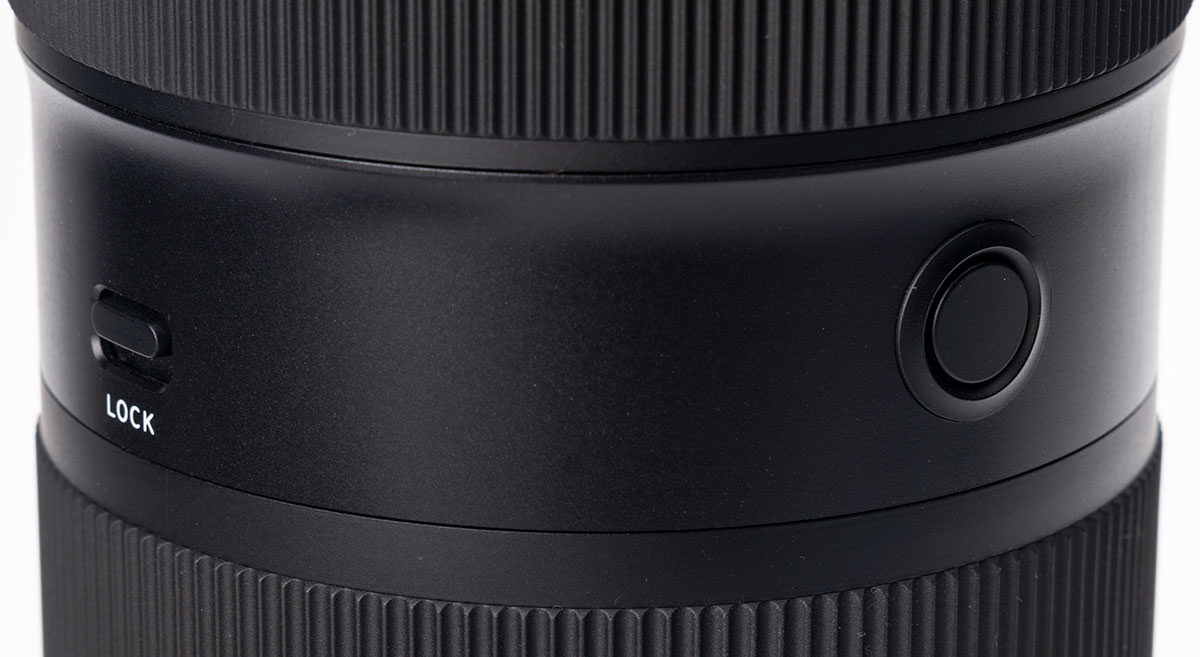
    Lock for zoom (not really much needed) and one of the three lens function buttons which occupy the remaining cardinal points.

    All three lens buttons do the same, which might be missing some useful tricks such as two focus points assigned to different buttons. A-B focus and Preset distance have selectable focus speeds, and are strictly Movie functions (you have to press the Record button in Movie mode to program the distances, then use the lens buttons to activate the focus change during filming). The lens is fairly silent in focusing but an external microphone is desirable. It has almost no focus breathing regardless of the focal length set, though use at full aperture will produce some shifts as the bokeh expands and contracts – the real angle of view remains very constant from close-up to infinity.

    You are advised to get a good USB-C cable to make use of the software to program the lens’s functions (mostly of interest to movie makers who can set the buttons to initiate point-to-point focus transitions).

    This lens costs £1,599 (editor’s note: 2022 price at time of writing) so you need to know you need it to invest. It hardly came off the camera in six weeks partly because of the convenience of not having to change lenses, and just carrying the camera and this one lens.

    The lens now sells for around £1800 new (link to Sony version at WEX) and £1300 used.

    It is also now available (update) for Nikon Z link here to WEX – bundles with bodies are also offered.

    My comment: we have assumed for years that it’s best to wait a year after launch before buying as prices fall rapidly. This is no longer the case as inflation and issues with worldwide shipping costs mean prices are rising and set to rise further. Don’t assume that you can save by delaying, but saving by sensible used market buying is still practical.

    – David Kilpatrick

    For further information, visit:

    https://www.tamron.co.uk

  • Sony E 70-350mm f/4.5-6.3 G OSS

    Sony E 70-350mm f/4.5-6.3 G OSS

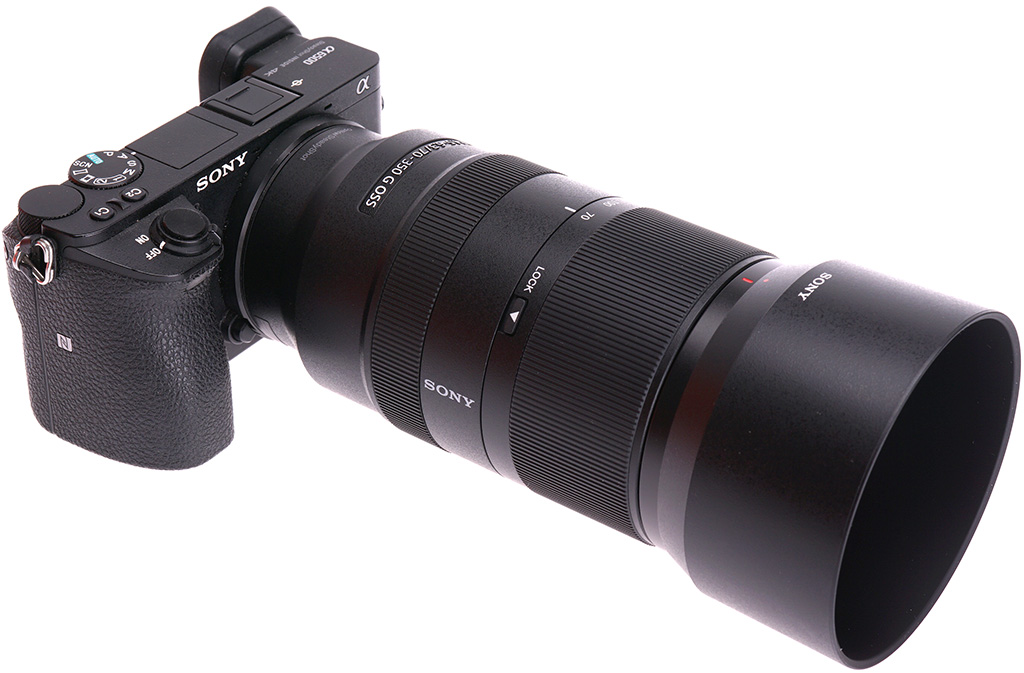
    The neatest solution for sharp long tele shots on Sony A6000 series APS-C

    • Excellent full aperture performance from 70 to 350mm
    • OSS stabilisation works with every Sony Alpha E-mount APS-C body
    • Perfect for movies with A6000, A6300, A6400 without sensor stabilisation
    • Compatible with all NEX and Alpha E-mount models from 2010 on
    • Enhanced OSS with A6500, A6600
    • Compact and light weight
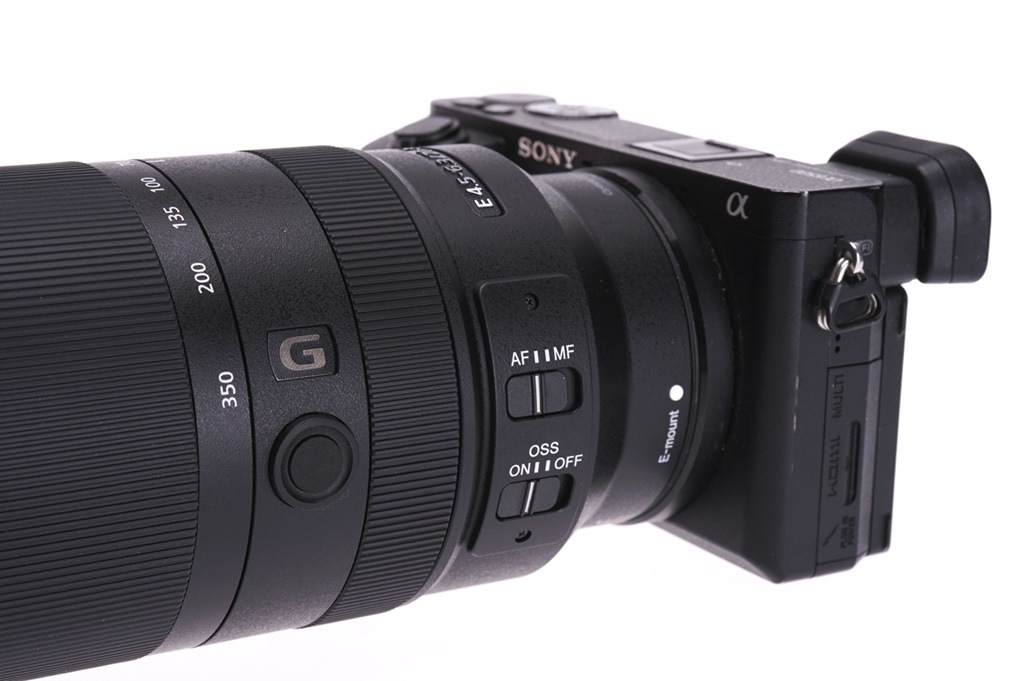
    • G series optical quality, Custom Button on lens, AF/MF and OSS switches on lens
    • Lens lock at 70mm to prevent zoom creep
    • Single extending zoom barrel
    • 67mm non-rotating filter thread
    • Bayonet lens hood included
    • Moisture and dirt resistant multicoating
    • Coverage allows use on full frame bodies with larger than APS-C crop

    This lens was purchased in October 2019 and the review is based on nine months of use on Sony A6500 (ILCE-6500), A6300 (ILCE-6300), A6000 (ILCE-6000) and A7R MkIII (ILCE-7M3). Review by David Kilpatrick.

    A solution for practical photography out and about – worldwide

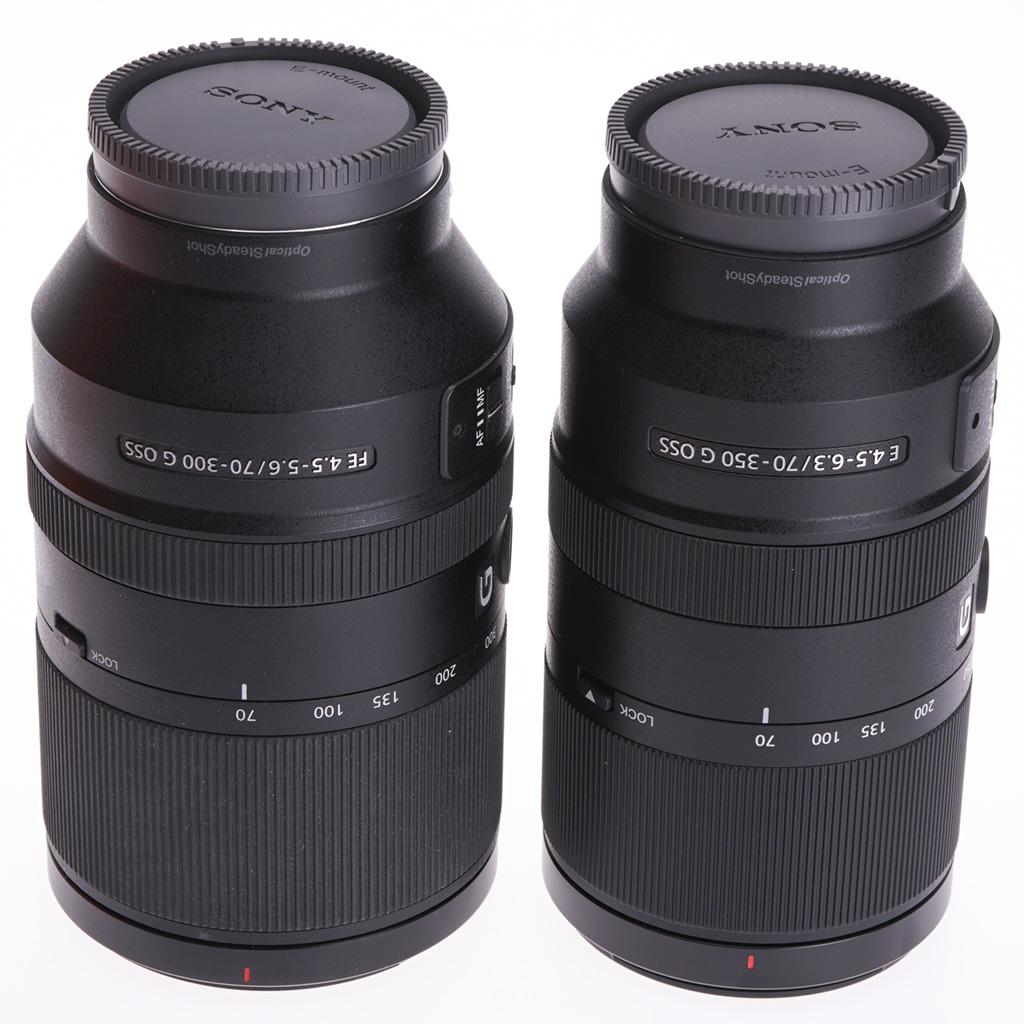
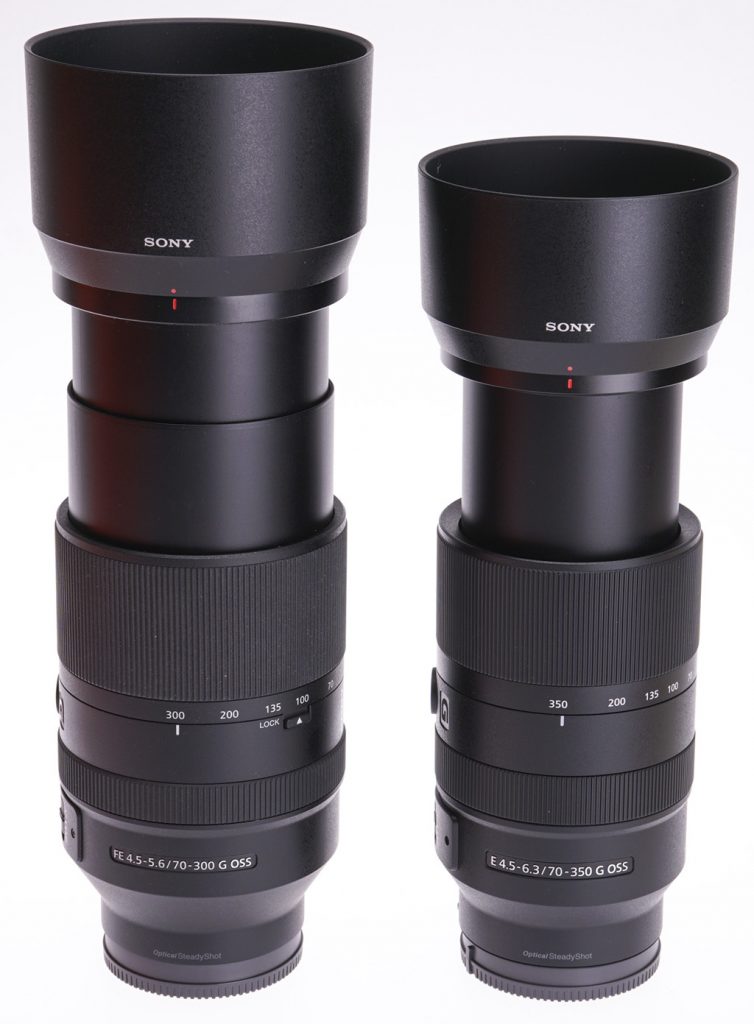
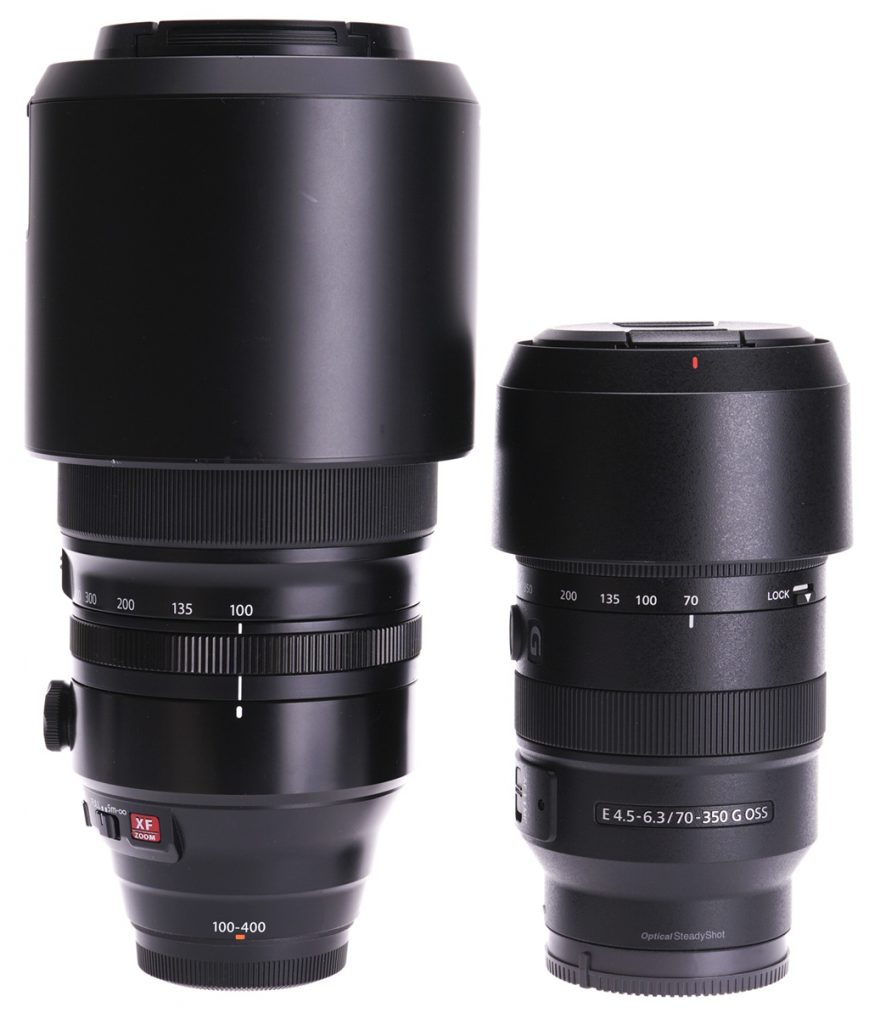
    I had been using the Sony FE 70-300mm f/4.5-5.6 G OSS full frame tele zoom on my A7RIII for over a year. This lens is very sharp wide open and benefits from the best close focusing in its class at 90cm meaning a scale of 0.31X at 300mm. It weighs 854g and has a double tube zoom extension. As you can see above this lens (left) is only a few mm longer physically than the APS-C 70-350mm (right) but the extra barrel heft, 72mm filters and much larger lens hood meant it needed a bigger kit bag, and proved harder to change quickly when swapping lenses.

    The 70-350mm for the smaller image sensor proved if anything even sharper, right to 350mm. Lenses like this often prove soft at maximum focal length and maximum aperture. The 70-300mm at f/5.6 is a third of a stop faster, but to get it as crisp as its newer little brother, it needs to be set f/6.3 – a match in speed. You can see above how much bigger the full frame lens becomes at 300mm. The 70-350mm only weighs 625g but its very fast and silent XD Linear Motor AF can only get as close as 1.5m at 350mm, 1.1m at 70mm. The maximum subject scale is 0.25X.

    I knew the 70-350mm would be my choice for travel and daily use with my A6500, but I was going to miss that closer focus. The full frame lens has an AF range limiter, full range or 3m to infinity but oddly no 0.9m to 3m choice. The APS-C lens has no limiter but I have never missed it and rarely used it on the 70-300mm.

    My big question was – can I do without the 70-300mm and use the 70-350mm on my full frame bodies?

    Cropping power, sensor resolution and coverage

    Tests quickly proved that distortion and vignetting kick in fast beyond the crop format field of view, but sharpness remains good and depending on focal and aperture you get much more than APS-C. You can almost get a full frame at close range.

    This mushroom (about hand sized) is at 350mm and f/11 on the A7RIII, and you can see the mechanical vignetting cut-off left and right. It’s caused by the lens rear baffle not the optical design – the lens could be modified to remove this, but it’s not advised.

    At 70mm on a very demanding subject the distortion without lens profile, on full frame, is extreme (left) but with Lens Profile correction applied at 200% plus -8 Manual, and similar vignetting adjustment, Adobe Camera Raw or Lightroom can almost handle it. On a neutral subject like a portrait with a foliage background the coverage would be fine. More to the point, manual crops much larger than the 16 x 24mm you could expect from an APS-C lens are fully usable.

    But why use a full frame body? Unless you own a Sony A7RIV (61 megapixels) you won’t actually get a more detailed distant animal or bird. The modest 24 megapixels of all the current APS-C bodies beats the 18 megapixel crop format of the A7RII/III. Canon users have much the same position, their smaller APS-C (1.6X not 1.5X) and 28 megapixel resolution matches 60 megapixels on 24 x 36mm. The advantage of full frame is that you may catch more of your subject, your framing and tracking active subjects enjoy more leeway. If your subject stays in position the smaller sensor can capture finer detail – and this is where the 70-350mm excels.

    This is a good example. At 198mm on the 70-350mm on A6500, it’s the same composition I would have had with the A7RIII and 70-300mm at 300mm and that would have produced a larger more detailed image. There’s only a real benefit to the 70-350mm on APS-C when you’re near the 350mm end. Did I keep both? No – I already knew I wanted a much faster but still compact zoom for the full frame kit, and the Tamron 70-180mm f/2.8 was coming in six months’ time. So I sold the 70-300mm and decided to use the A6500 with 70-350mm for all longer tele shooting.

    From the start it proved a very capable combination.

    Fast lenses are not as important now

    Mirrorless cameras with phase detection autofocus, good high iSO performance and better resolution electronic viewfinders have made wide aperture lenses less essential for low light. The linear motor focus of the 70-350mm rarely misses a shot regardless of conditions. One of my first shoots was a music festival, where this lens allowed me to work from the very back of the hall and never get in the way of the audience.

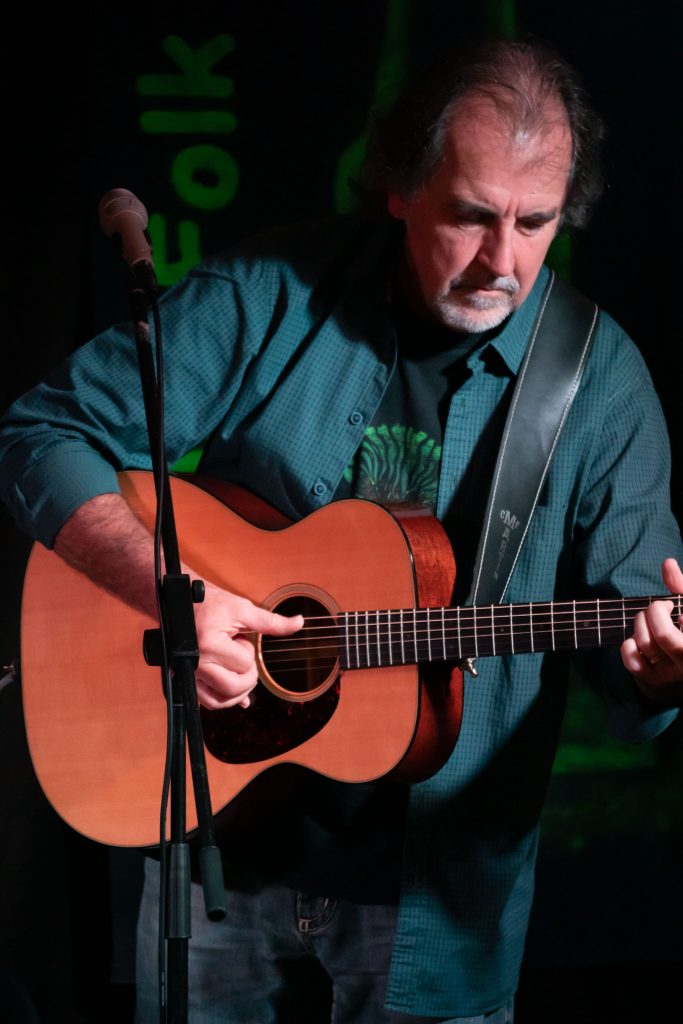
    Processed from a raw file at ISO 6400, this shot of Steve Byrne performing was taken at 350mm wide open at f/6.3. The same on full frame would need a 525mm lens at f/8 and ISO 8000 (a direction Canon is taking with their new 800mm f/11 IS STM for the R mount – the working aperture no longer matters much if the viewfinder stays bright, AF is accurate and there’s not much noise at high ISO settings).

    The long reach in a concert hall is one side of using a 350mm on APS-C. Here’s another – the lens may only achieve a quarter life size and need you to be 1.5m away at 350mm, but 0.25X on a 1.5X factor sensor is 0.375X in ‘old macro’ terms. Not only that, the ISO 2500 used here is about the same in grain or noise terms as an ISO 400 film and the stabilisation of this lens on the A6500 is as good as you get. A 1/125s shutter speed did not prevent tiny hairs on the caterpillar’s head being sharply resolved.

    This lens is far better than the 18-200, 18-300, 18-400 or 16-300mm I’ve used on a variety of DSLRs for long APS-C reach. It’s free from the residual aberration which demands you ‘stop down one’ to clean up the long end image. Combined with Sony’s PDAF it handles a concert or low indoor light as well as an ƒ2.8-4 on a conventional DSLR.

    Compare this with a 100-400mm for the same format

    For the sake of 50mm at the long end – a difference of only 12.5% in image scale – the excellent Fujifilm Fujinon XF 100-400mm f/4.5-5.6 R LM also gives a half to a third of a stop more light transmission in its longer range. But look at the cost! It is twice the price and weight, and you can see the size. Gains – a near-apochromatic performance, matched 1.4X and 2X converters available (not an option for the Sony and never likely to be). Losses – only 0.19X close-up scale. It’s remarkable how much difference there is in the physical aspect of these two lenses. I have used both and in practice they are equally sharp on 24 megapixels.

    The Sony 100-400mm and Sigma 100-400mm are both full frame lenses and much larger. The 70-350mm is unique as far I can tell, no-one else has a lens like it. It also answers one of the major criticisms of the original E-mount APS-C system, the lack of any lens longer than 210mm and that only in a 55-210mm design best described as consumer grade. I’ve actually found it pretty good for the money – but it’s not much money!

    Sony 70-350mm G OSS image gallery

    Rather than write much more, I’ll leave you with this gallery. I have reduced the file size but where you see an enlarged section clip along with the full frame – well, you can judge for yourself.

    Sony 70-350mm G OSS verdict

    If you own any of the APS-C Sony bodies, from the NEX-3 and 5 of 2010 onwards, this lens will not disappoint you. The effective OSS image stabilisation means that even if you prefer to compose and shot using the rear screen and hold the camera away from your body you’ll get sharp stills and steady movies. It’s a big step up from the 55-210mm and much more affordable than, say, a 70-200mm f/4 G with 1.4X or 2X converter.

    You may have to control colour fringes in some strong backlight situations with blur when working from raw files, as it’s not an apochromat just a regular very good tele zoom. However the resolution reflects advances in design over the last decade. It’s also a very handsome looking black lens with its silver G logo and designation contrasting with white markings. It feels robust and the zoom and manual focus (when needed) are smooth. The metal bayonet is a tight precise fit on my A6500 and A7RIII, a little less so on my A6000 with its older four-screw type body mount.

    I can carry this lens all day without even realising it’s there, round neck or shoulder – and there are not many lenses covering this range you would want to hang on a strap round your neck.

    You can support my reviews if you check these links for availability and price:
    Amazon UK – didn’t have any stock at all at the time of writing – https://amzn.to/30ZC4Ck
    Park Cameras UK – https://tidd.ly/3jLHbP7
    WEX UK – https://tidd.ly/3hKRhhA
    B&H USA and Worldwide – https://tinyurl.com/y6cguvpo

  • Sony FE 90mm f/2.8 G OSS Macro lens review

    In the last few weeks I’ve found myself replying to Facebook Sony user group posts where new owners building their systems have asked about the Sony 90mm f/2.8 G OSS Macro FE lens. Over the months before this, I’d seen so many comments saying this was the best ever Sony and perhaps the second best lens ever.

    (more…)
  • Tamron’s super value 70-300mm USD on the A7RII

    SONY DSC

    If you want to get a 70-300mm which works on the Sony A7RII, the A7 series body with the best on-sensor phase detection/contrast detection mix, your first choice should be the new Sony FE 70-300mm f/4-5.6 G OSS. But that demands a wallet opened with £1,150 (UK SRP) in it. In return you get a rare specification mix including focusing down to under one metre and almost a one-third life size image scale, without needing any special macro range.

    For those who own either an LA-EA3 or LA-EA4 Sony adaptor, there’s a choice of A-mount lenses. The older Sony 70-300mm f/4-5.6 SSM G will work OK, but the current SSM II version is tuned for the on-sensor focusing system. Both work on the LA-EA3 with its SLT-mirror free design, and focus to a decent 1.2m. The low-cost Sony body-drive AF f/4.5-5.6 75-300mm will only AF on the LA-EA4 and is probably best ruled out.

    The same goes for Tamron’s body-drive focus Di Macro, about the lowest cost such lens you can buy, and Sigma’s standard and non-APO Macro designs. For the LA-EA4 only, the Sigma 70-300mm f/4-5.6 APO Macro DG is actually worth buying as a good example can usually out-resolve any other lens of this range, but it’s slow and clunky. It focuses to under 1m and half life size scale but like the Tamron Di Macro does this using a separate close-up range you have to switch in to, only usable between 200mm and 300mm zoom setting.

    This leaves two 70-300mm independent lenses with in-lens focus motors. The Sigma 70-300mm f/4-5.6 OS DG is again very good optically (a fair match for the Sony G original) but it doesn’t use an HSM focus motor. Instead it has a motor more like a Sony SAM drive. As a result, it will only focus quickly on the LA-EA4. It can’t handle on-sensor PDAF.

    The Tamron SP 70-300mm f/4-5.6 Di USD can. It has an Ultrasonic Silent Drive, and this is very close in design to the Sony G SSM. Because the lens dates from 2009, most test reports have been based on DSLRs and not many Sony A7 system owners have bothered to consider it. At the current price in the UK – even the official SRP is only £275 but normally discount to a pre-VAT price of under £200, or if you like, $280 – it’s an unprecedented bargain for an advanced lens using low and extra-low dispersion elements.

    SONY DSC

    You should not be surprised at its size, because it’s almost identical to the Sony G. Same weight (within 5g), same 62mm filter thread, same rear internal focus with plastic window for the scale, same forward zoom ring and single barrel extension. It has one more element, being a 17/12 design rather than 16/11 like the Sony, and it lacks the control buttons and focus range limiter controls. It’s also a quarter to a third of the price.

    SONY DSC

    For me its major shortcoming is the 1.5m close focus, just too far away (nearly fell down stairs trying to get far enough away to focus when testing it, I’m just not used to lenses which force you back this way).

    SONY DSC

    What counts I guess is the optical performance, and here the Tamron still does not let you down despite being a seven-year-old design. Like the Sigma OS, it is a step above any of the previous 70-300mms including Nikon’s VR and the Canon IS design and when I tested it back in 2009 it matched the Sony G SSM even wide open at 300m. What it did not do was focus accurately on my DSLR bodies, needing AF calibration adjustment on the A900 and missing the mark on the A700 and A580. It was fine on the A55.

    SONY DSC

    The lens coating is pretty effective and the lens front rim, like Sony’s G, has no lettering to reflect off filters. It also has an effectively black-out inner baffle and zoom mechanism. Combined with the super-deep lens hood (very much like the monster you get with the Sony G) the result is a flare-free optic you can use in almost any light.

    SONY DSC

    The rear mount is a high quality metal A-mount as expected, and on my LA-EA3 the whole assembly was firm and felt unstressed.

    Tamron kindly sent me a lens to update my earlier testing when this design was new. I wanted to see one thing – did the USD drive allow PDAF on the A7RII with the LA-EA3? If it did, this bargain price but advanced lens would be a possible 300mm range solution (and also, though I can’t test this, on the A7II and A7SII – I’m pretty sure it will not play well with pure contrast detection on the A7R, as on my A7 it will focus at all focal lengths and in low light but can take several seconds of hunting and fine tuning in small steps).

    Fitted to the A7RII+LA-EA3 I found it snaps into focus really fast, able to use either wide area or centre AF with much the same speed as native E-mount lenses, and activating the ‘green square’ focus point display. It was very poor using moveable Spot AF (unusable in low light), and the Zone AF option is greyed out. So, it can’t access all areas, but for regular shooting it’s good.

    At focal lengths over 150mm, it can be spooked by starting completely out of focus. However, once the lens is not extremely defocused it acquires and tracks rapidly. The full time manual focus over-ride can help set it up before you use AF. In very low light with low contrast targets, at 200-300mm, even prefocusing manually may not prevent a long searching process or AF failure. However, in normal daylight with regular 3D subject matter it’s useable.

    Since owners report that even Sony’s own lenses encounter similar issues – the 90mm f/2.8 G OSS Macro is known for hunting and taking time to lock on – it’s an issue more to do with the way the on-sensor focus works than anything else. It’s also much better than, for example, the Canon 70-300mm f/4-5.6 L used on the Sigma MC-11 or Commlite adaptors. That just gives up towards 300mm.

    The Tamron has variable bokeh qualities. Foreground bokeh can be untidy and contours just beyond the plane of focus can be harsh. Totally defocused detail in both foreground and background can look very smooth. It has a nine-blade circular aperture, just like the Sony G A-mount, and I’d say overall image look was uncannily similar. The exact look depends on the focal length, working distance, aperture and placing of the foreground and background detail.

    rhododerndron-300mm-6p3

    Purple rhody at f/6.3 and 300mm – not too bad overall!

    colourmatch-300mm-f6p3-300mm

    Matching person in the distance – again, not bad, with a pleasant three-dimensional look. Maybe I should do a version in black and white…

    As for this lens not having VC (Tamron’s OS/OSS) I can only say it doesn’t need it when Sony’s 5-axis sensor stabilisation does so well. Here you can see 1/30s wide open at 300mm indoors at ISO 3200. Note also what CA or fringe occurs. It’s pretty good.

    300mm-iso3200-30th-wideopen-SSI

    As for handling 42 megapixels, which didn’t exist when the Tamron was designed, there doesn’t seem to be a serious problem. Here’s a quick shot of Scotland’s relationship with the USA and Europe…

    saltire-300mm

    And here, frozen by 1/500s shutter speed at the realistic aperture of f/7.1 and ISO of 200, is a detail at 100% size. I’m generally happy with a 70-300mm lens if you can see the weave and the stitching on our town hall flags at 300m, 2/3rds of a stop down from full aperture, reproduced on a 1.5m wide print.

    300mm-detail

    I’ll test the lens further and add a gallery of images and any other comments, but I think that this is the only non-Sony lens of this range which really works well with the LA-EA3 (and of course, extremely well too with the LA-EA4 given AF calibration).

    The only slight incompatibility is that the camera/adaptor gives the lens the identity of the Sony 70-300mm f/4-5.6 G SSM, this is what appears in the EXIF. This also means that the camera will invoke an auto profile for the Sony lens, and handle the focusing as if this was the Sony lens. It also loads the built-in profile for the SSM G lens in Lightroom/Adobe Camera Raw. This seems to work just fine. Without the profile enabled, the flag shot for example shows a stop or more of vignetting which is a relative weakness of the design – exactly as it is with the Sony. The new FE G lens with its 72mm front element as opposed to the 62mm of the Sony G, Sigma OS and Tamron SP designs can be expected to have much less full aperture vignetting.

    Please note that this report refers specifically to the A7RII as a host body – as stated, it’s not useful on the A7 and I also found it’s not good enough to use on the A6000 with LA-EA3 (fine with LA-EA2 or LA-EA4). It will eventually focus but with too much hunting and missing.

    – David Kilpatrick

    If you’d like to check availability or order the lens, here are my affiliate links (may help pay for the site, don’t cost you anything):

    Wex Photographic, UK – £239

    B&H, USA & World – $449 ($100 rebate to June 30th)

    Amazon UK – £239 at time of publication

  • Sony 28-75mm f/2.8 SAM on mirrorless FF

    SONY DSC

    With the 24-70mm f/2.8 new Sony GM FE lens selling for £1799 (UK) and the A-mount version two 24-70mm f/2.8 for a full £100 more, the cost of a basic mid-range zoom to use with a camera like the A7RII remains very high. There are good arguments to be happy with the 24-70mm f/4 FE zoom, or even the 28-70mm f/3.5-5.6 though that is best limited to use on the A7 (24 megapixel) and A7S (12 megapixel) bodies rather than the A7R (36 megapixel) or A7RII (42 megapixel).

    Of course there are good lens adaptors out there and 24-70mm f/2.8 lenses from Canon, Tamron or Sigma with ultrasonic focus drive in Canon EF mount offer one solution. The original 24-70mm f/2.8 for A-mount with its SSM motor of this type can also be found for a fair price. But there’s one lens which I sold after my A7R arrived, mostly because I was parting company with my full-frame A-mount body survivors. It’s the Tamron-based but Sony revised SAL 28-75mm f/2.8 SAM.

    Although I did have an LA-EA3 adaptor to use SSM and SAM drive A-mount lenses on the E-mount bodies, the 28-75mm didn’t really work very well on the A7R so it remained on my A99 or A900. I made a few tests and saw that it was certainly OK on 36 megapixels, though even on the 24 megapixel A99 where it played nicely with the AF system it had slightly soft corners when used wide open. They were not any softer than the 24-70mm f/2.8 Carl Zeiss of that time and in some ways the lens was better behaved.

    SONY DSC

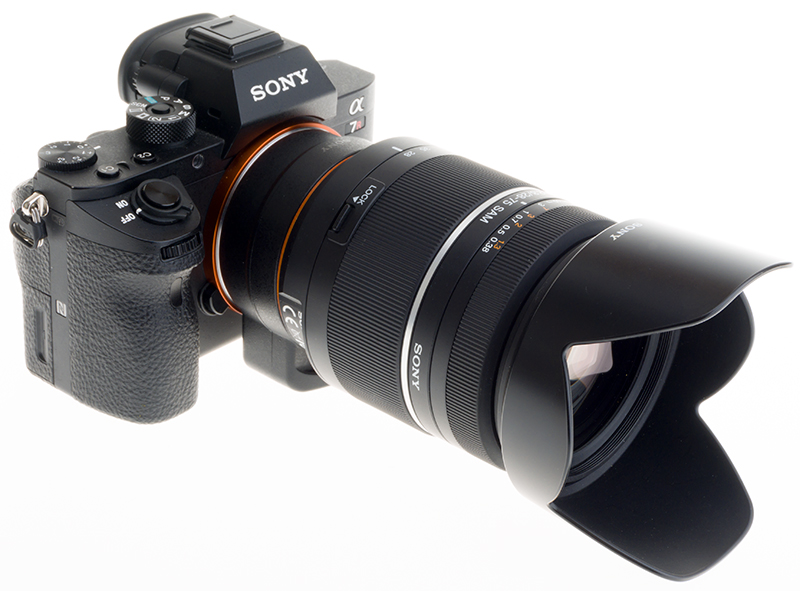
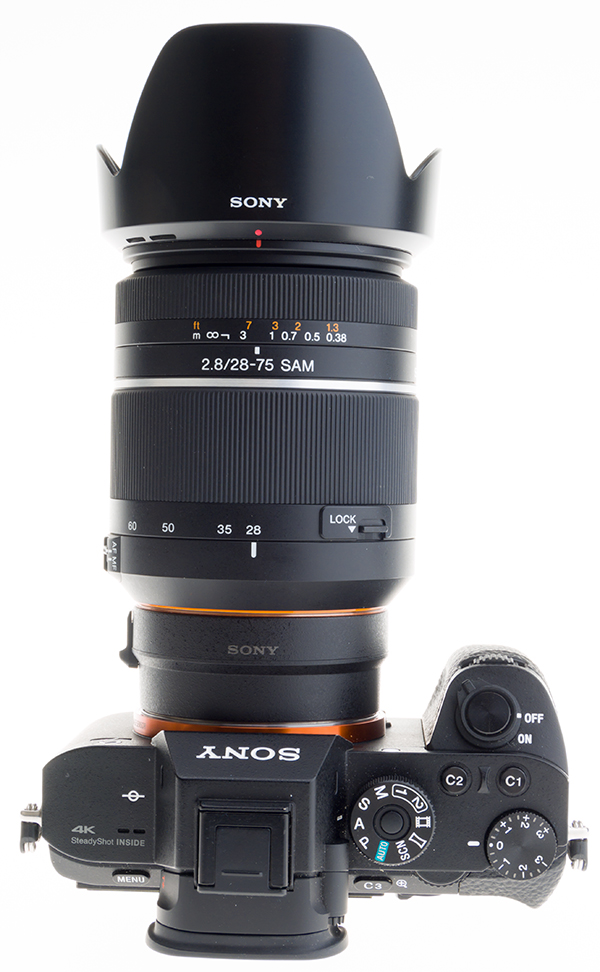
    The first thing to do was to fix this lens to the LA-EA3 creating an FE lens unit. Imagine the adaptor is just part of the lens (that’s pretty much how Sony makes many lenses for E-mount anyway). The total unit measures up at 115mm long including the adaptor, and 75mm diameter taking 67mm filters. The lens itself weighs only 565g, the combo weighs 683g with adaptor and lens hood. That compares with the new GM lens at 136mm long and 88mm diameter using 82mm filters and weighing 886g. As I already have a 16-35mm f/4 CZ which covers the 24mm requirement well, the 28-75mm range is just as useful to me as 24-70mm.

    While the 28-75mm SAM activates PDAF and multiple AF points, it’s not the full works with tracking and Eye-AF. But it’s also not as noisy as some reviews imply. It’s much quieter than the 85mm f/2.8 SAM, and silent compared to the grinding focus of the 30mm DT SAM macro. Startup is fast, with the lens initialising quicker than FE mount stabilised zooms. The aperture actuation is slicker than with body-drive SAL lenses on the LA-EA4, and quieter. Focus is fast and the only downside is the rotating focus ring which does not support DMF or over-ride on the fly, or auto manual focus magnification. Manual focus requires you to set it on the lens and the body, and whatever you are doing, you need to avoid either turning the focus ring when there is any resistance, or blocking it from turning during AF. It’s a bit vulnerable and the direction of focus is the opposite to normal Sony/Minolta design. The zoom ring which locks at 28mm only operates in the normal direction.

    SONY DSC

    So, what you get with the LA-EA3+28-75mm SAM is basic but fully controlled and communicating, EXIF accurate with profile correctly invoked. It will track with continuous focus and during movies, though slightly noisy for in-camera sound recording; it seems to do so when some SSM lenses, like the 24mm f/2 CZ, don’t play.

    As for optical quality, it’s still a 14-year-old Tamron in disguise, but it can match up to 42 megapixels centrally across its full range. The performance over the APS-C image area is superb, even wide open at all focal lengths, with just a hint of misty aberrations slightly masking a super-sharp result on axis. On full frame, a marked ‘cap shape’ deviation from flat field towards the extremes causes strong softening on flat subjects and landscapes at 28mm and is not entirely removed at longer lengths. You would not want to use this at 50mm and f/2.8 if you had a faster 50mm you could fit and stop down to f/2.8. On real three-dimensional subjects at typical working apertures between f/4 and f/11 it can be extremely sharp. The respectable 38cm close focus and 0.22X subject scale (not as good as the new Sony GM 24-70mm) reveal microscopic detail on the A7RII at f/5.6. The shot below is at the closest AF on the large water drop in the centre, at 75mm and f/5.6 – you can see the bokeh is very acceptable, not complex or ‘nervous’ which it tends to be when used wide open for more distant subjects with a slightly defocused background.

    28-75mm@f5p6-75minfoc

    A 100% crop from th A7RII file (converted from raw ISO 500 14-bit, without any sharpening for web and with minimal NR) gives an idea how good this lens is and also just how little depth of field you’re ever going to see from a 42 megapixel full frame image used this way!

    28-75mm@75-f5p6minfoc

    It would hardly be worth buying an LA-EA3 and a new 28-75mm just to save about £1000 over the GM 24-70mm. If you already own an LA-EA3 and you can find a cut price or good used 28-75mm go for it. The way its aperture works means you’ll get very fast low light focus and minimal shutter lag (but you do need a mark II A7 series body to get the best functioning).

    The zoom action is a real pleasure to use, very light but positive, and the overall build and feel of the lens will not disappoint. It also seems to get just the right response from the in-body stabilisation of the A7RII. Sure, 67mm filters may be smaller than many midrange zooms require, but I will either have to use a stepping ring or get a couple of new filters – not cheap, for the quality needed to maintain the lens performance. Also, it’s not weatherproofed.

    Here’s a quick set of three hand held (with SSI) comparisons at 28mm – f/2.8, f/5.6 and f/9. I’ve loaded these up at full size so they should open the original Level 10 sRGB JPEG when clicked. The focus in on the foreground railing spike and the fine spider web gives the best idea of how the resolution and contrast of the lens improve from wide open. It’s clearly resolved at f/2.8 but with a gentle ‘glow’ at pixel level. First image – f/2.8.

    28-75mm28wideopen

    Second image – f/5.6. If you download all three images and load them into Photoshop, it’s interesting to switch between tabs and see the depth of field change.

    28-75mm28at5p6

    The third image is at f/9 and here the ISO is high at 2000. The A7RII can produce great results up to 3200 but I might not choose to have this at 2000. Even so, the sharpness can be judged without problems as the noise doesn’t have much effect on fine detail with current Sony sensors and processing. It always shows more in defocused, smooth areas.

    28-75mm28atf9

    Because I use other lenses – such as the 24-105mm f/3.5-4.5 Sony and 50mm f/2.8 Macro Sony on LA-EA4, 40mm f/2.8 Canon STM, Sony FE 28mm f/2, 16-35mm CZ f/4 and also the unrivalled 24-240mm FE zoom I have many choices overlapping the range of this lens. I remember that for landscape work on the A900 it was hard to beat. Here’s one of my images from that combination, using a 6 second exposure at 40mm focal length, f/8 and ISO 100 with a variable ND filter. With the restrictions on tripod position given by the location, the zoom range of 28-75mm proved just right for a range of studies.

    Roughting Linn, Northumberland - the waterfall.

    With this lens arriving during a period (for my corner of the UK) of sustained white skies and drizzling rain, it’s not been out and about much. One thing it has done is to focus very well in dim room lighting on my sofa companions –

    55mm-2p8-iso3200

    And, for those who don’t think f/4 is wide enough and desperately want 55mm f/1.8 or f/0.95 lenses, this is at 55mm f/2.8 and of course when the iris of the eye is sharp the fur around it is not and Willow’s nose is blurred. Once again, despite correction for tungsten light at the extreme limit of Adobe Camera Raw, and using ISO 3200, it’s pretty amazing what the A7RII can do seen at 100% (below).

    3200-iso-f2p8-55mm-100pc

    But this super-shallow depth of field is what happens at 42 megapixels. Depth of field used to be worked out based on a 10 x 8″ print held in your hand, not a 6 x 4ft image viewed through the ‘window’ of a screen. Of course for social media you do indeed need very wide apertures because when your pictures are mostly viewed on smartphones, it’s like looking at a contact print from a Vest Pocket Kodak…

    To support Photoclubalpha, subscribe to f2 Cameracraft (it’s probably the only photo mag edited by two long-standing Sony system users, myself and Gary Friedman).

    – David Kilpatrick

    You can find deals for the Sony SAL 28-75mm f/2.8 SAM A-mount lens at B&H Photographic, Wex Photographic for the UK, or Amazon Sony SAL2875 Alpha 28-75mm F2.8 Standard Zoom Lens

  • My new Sony 85mm…

    With extremely expensive Sony-fit 85mm lenses in abundance and beyond my (economically sensible) reach, I’ve done good commercial work last year on the Canon 85mm f/1.8 USM and later the Sony 85mm f/2.8 SAM on A7RII. Some of my work relies on showing close-up details with strong differential focus, and hardly any lenses are free from ‘colour bokeh’ issues, so it’s needed some care to process the files and avoid that typical magenta tinge to the background and greenish hue to foreground blur.

    detailshot6

    This is a typical example. It’s on the Canon 85mm f/1.8, and although this is a fairly clean lens, the background at f/4 needed some post-process work to avoid a magenta colour shift.

    longwhitecloud-glass

    In contrast, absolutely no work is ever needed on my Sigma 70mm f/2.8 macro. It shows no chromatic effects in defocused areas. But this is a studio shot at f/10 – and, like many commercial shots, the extreme f/1.4 or f/2 apertures which are so highly valued by the bloggerati simply don’t enter the equation. Differential focus here is precisely balanced against the legibility of the bottle wording at web size (these shots are for a 1440 pixel wide template).

    I like to have a choice of wider aperture and macro lenses for this kind of work as they all produce different effects. My 70-210mm f/4 Minolta AF classic, for example, has about the cleanest foreground blur wide open on 0.25X scale 210mm close ups. My 85mm SAM is ‘dirty’ by comparison (but its 60cm 0.20X minimum focus distance still makes it the best 85mm for close work unless you use a macro or a zoom with good close range). Then, we get the Zeiss Batis 85mm f/1.8 popping up followed now by the costly Sony G-Master 85mm f/1.4 FE. In both cases you get 80cm minimum focus and around 0.12X image scale (rather like the 70-200mm f/4 Sony G FE lens used at 190mm and 1m focus).

    I really like, on a full-frame camera, to reach one quarter life size on the sensor. One-eighth, the 0.12-0.125X type of scale, means a full A4 magazine page fills the frame. One-quarter, 0.25X, means a quarter of that page or a postcard size fills the frame. There are so many things in the world, from a kitten’s face to a lily in bloom or a perfect cup cake, which are about this size. When I photograph food I often want to avoid including the edges of the plate completely. Those lenses which push me back too far prevent that. I know many users will be puzzled by my preference and see no reason to want to get any closer. Well, that’s just me. I have always done well creatively and commercially from surprisingly tightly cropped, close-up work.

    And, being more critical of these new hyper-expensive lenses, we’ve had 80cm focus 85mm lenses for SLR focusing for 70 years now. Really, any new lens in this focal length should focus to 60cm or ideally 50cm without calling itself a macro. That suits the way we live, in our cars, at desks, at home, at tables, in small spaces, giving other people space. I really like to be able to place an item in front of me, or even hold it in my hand, and focus on it. I can’t do that at all with 1m minimum focus (the old rangefinder Leica standard!) and only just with 60cm.

    Then I started seeing some work taken on an interesting old lens. It’s small, taking 49mm filters. It is fast, at f/2. It was originally designed by Carl Zeiss and if you were really lucky you might find an 85mm f/2 Sonnar. But for around £100/$150 or a little more for guaranteed condition you can buy the Russian Jupiter 9 85mm f/2 manual preset lens in M42 screw (Pentax/Praktica). And since it’s a screw mount SLR lens, you can add an extra layer of focus extension for very low cost between the E-mount body and the lens.

    SONY DSC
    Above: my Jupiter-9 with Camdiox helical Pentax screw E-mount adaptor fully extended and with a vital lens hood fitted; top, the mount and lens set for infinity focus, lens hood removed.

    So last week I assembled a relatively low-cost eBay rig to enable even closer focus than the 60cm of the SAM . This is partly just experimental, our of curiosity to see how well a 1930s Sonnar type design made in 1980s Russia with 1950s technology and coatings can peform. The 85mm f/2 Jupiter-9 is often used to get an attractive f/2 soft-focus with core sharpness, gradually cleaning up until around f/3.5 the softness is gone. It is also used to get neat circular bubbles from strongly out of focus light sources beyond the subject, or a generally very attractive focus transition at any aperture since the 19-blade mechanical iris forms an almost perfect circle at all settings. It focuses slightly closer than 80cm.

    With the well-made Camdiox helical adaptor costing under £28 delivered, this is extended in a continuous range to 35cm from the film plane and 0.51X. Obvously, it takes up no more space than my plain M42 adaptor as it is exactly the same thickness at infinity setting – and it does allow true infinity focus. Being solid metal, the combination is not all that light, a dense 490g in its 88mm long by 63mm maximum diameter, 20g more than the Batis. But it feels good. The aperture mechanism is crude and difficult to see and use, but would normally be set first to a chosen aperture such as f/2.8 for the best sharpness with a shallow depth of field, or f/8 for landscapes. It would not be much fun for anyone who likes taking a range of shots from f/2 to f/16, or for anyone wanting accurate half or third stops.

    First of all, is this lens even remotely sharp, and can the Sony A7? bodies use it well? Both answers must be yes. Just set the focal length for normal distances to 85mm and the in-body SSS of the A7SII, A7II and A7RII will give amazingly effective stabilisation. Work between f/4 and f/11 and this simple old lens design outresolves the A7R. I was just checking the focus on some calendar text in very dim room light, using ISO 1600 on my A7RII, when I pressed the shutter with 1/40th hand-held –

    85mmJ9-f4-1600-40thA7RII

    This was never intended to be seen, just a casual target. These pictures open out to Facebook size, by the way, when clicked – 2048 pixels. Here’s a 100% pixel friendly section from this. I was surprised. The lens was at f/4 and focus was done at max magnification, at the taking aperture.

    85mmJ9-f4-1600-40thA7RII-100%

    You need to check this JPEG out by clicking to open/view at 100%. It’s like this right across the frame, corner to corner. There’s a pleasant dimensional quality to the rendering this old lens gives, but it has one massive failing – it flares up dramatically if any light at all reaches the front glass. The only solution is a very deep lens hood indeed.

    Making more considered tests, I headed for a target I had set up to explore colour bokeh, that unpleasant magenta to green shift in defocused areas. With this set-up, my 85mm SAM is not bad at all and does benefit from a proper lens profile. As you can see, the music doesn’t seem to change much in colour from front to back though in the full size 42 megapixel file, especially without lens CA corrections, some funky colours do appear.

    85mmSAMf2p8-corrected

    Here’s how the Jupiter-9 worked out – first of all, it’s one of a number of shots at different distances and angles, not identical to the SAM shots, and this one takes advantage of the closer focus combination of adaptor and lens:

    fiddlemusicJ9f2p8close-facebook

    The colour shifts are different, with a bit of a rainbow including red and cyan fringes as well as magenta and green, and the contrast is lower. However, the detail in the very limited f/2.8 focus zone is very fine and over a range of tests the blurring (from the circular aperture) just looks better. No doubt I need to take many more shots with this lens (once the deep 200mm lens hood I’ve found arrives…) but it seems like a worthwhile creative option alongside a number of older manual lenses.

    What really interests me is that this same design, with a few refinements of modern manufacture, would surely be worth having. Tamron’s forthcoming 85mm f/1.8 will focus close – it is the special feature of this new lens series – and maybe along with the 35mm and 45mm f/1.8 designs will one day appear in native E-mount. I’d love to see a half-price Batis, a Sonnar f/2 variant instead of f/1.8, with a decent close focus limit around 50cm. Until then I’ll use the SAM on LA-EA3 or LA-EA4 (works well with either) and my assortment of manual set-ups including this Jupiter-9.

    Here’s a revision to the post, got some sunshine this morning (day after writing the original post) and with focus peaking and f/5.6 even a little moving target comes out whisker-sharp!

    theexplorer-fb

    – David Kilpatrick

  • Sony’s Zeiss 24mm f/2 Distagon ZA SSM T* reviewed

    The Sony Zeiss 24mm f/2 SSM Distagon ZA T* is probably the best, or equal to the best, in its class. It may perhaps be the best ever 84° angle fast lens ever made for the general SLR system market, and I would happy to pitch it against any of the current equivalent offerings for medium format digital.

    The initial journey with the 24mm f/2 was not one of intensive companionship – I am long past the stage of getting hold of a wonderful lens and then shoehorning all my photographs into that lens’s view just because I love the glass. I’ve been through that phase. I remember when I was 18 and my then fiancée (Shirley – still here!) bought me a brand new 35mm f/3.5 SMC Takumar, my first ever multicoated lens as well as my first new boxed product. I shot almost everything with that lens for a month…
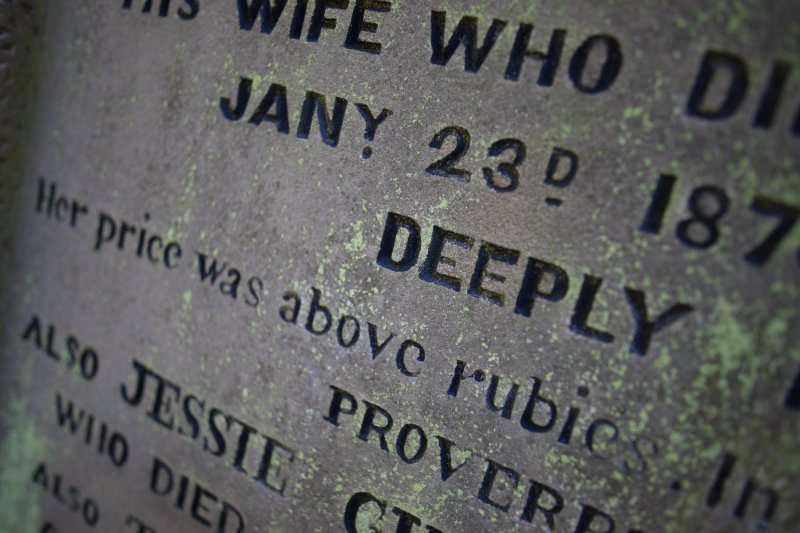
    A full-frame Alpha 900 study at full f/2 aperture. Check the sharpness in the central – very limited – sharp focus zone by clicking the image for a full size version.

    My review of the 24mm appears in the British Journal of Photography for January 2012 but was written in November, and at the end I comment that I do not think I would buy one. Well, between writing that and publication – after returning the test lens loaned to me by Paul Genge of Sony UK – I placed my order. I sold a set of lenses including a 28mm f/2 Minolta RS and a 17-35mm Konica Minolta D to pay for it.

    Check current availability and price at B&H Photo Video (opens in a new window will not lose this page).

    Why?

    It was partly medium format which persuaded me. I’ve been experimenting with MF digital, first using a Hasselblad with a Phase One P20 and then shifting to a Mamiya 645 AFII with a 22 megapixel ZD 37 x 49mm back. Once you put the Zeiss on the Alpha 900, the image quality jumps to match the level of a similar MF pixel count. And without spending into the tens of thousands you can’t match the angle of view at a higher pixel count.

    These two cameras both shoot 22 megapixels over a 16 x 12″ print shape (the Alpha 900 being cropped) and both were current in 2008 – though the Mamiya ZD model was shortly to disappear. And the two lenses have similar coverage.

    I looked at the corners of my MF shots on a 35mm lens (nearly identical angle of view) – to be clean, they demanded f/11. And then I looked at the corners on the Zeiss, which are even cleaner by f/4. Finally, I considered what Sony may have in store – 36 megapixels on full frame. Everything I’ve seen from the 24mm – including its performance on the A77 and A55 – indicates it will not run out of resolution even if full frame goes well over 50 megapixels.

    Then I had the job of looking back over the Alpha 900, Alpha 55 and Alpha 77 pictures taken with the 24mm, and preparing some comparison shots. This was when I realised that my normal line-up of zooms, no matter how good, never got the same from any camera – APS-C or full frame – as this CZ prime. It may be bulky, take large filters, and cost nearly £1,000 but no other solution on any format from NEX through A77 to MF offered the same as the 24mm on Alpha 900. You will, however, be surprised later on to see just how well the tiny NEX 16mm f/2.8 does in comparison when both lenses are stopped down to f/8.

    The 35mm 2:3 format shape offers a bit of vertical composition ‘rise or fall’ potential compared to to 3:4 shape of my Mamiya with 35mm wide–angle. Beyond this, the 24mm offers both CD and PD focus with different adaptors on the NEX system, and smooth near-silent AF during video on the Alpha 65/77 and future models. It’s both future-proof and a future classic.

    Photojournalism or architecture

    Because the 24mm has a fast f/2 maximum aperture, it’s seen as a choice for news, documentary, reportage, sports, and close quarters party or family shooting. Though a little vulnerable because of its size, it does this job well. Unlike tele lenses, any mark on the front glass of a wide-angle like this will show in pictures when the aperture is stopped down. Special care should always be taken of retrofocus and fisheye lenses with vulnerable front elements, my own lens will get a Sigma EX DG 72mm UV filter. Why Sigma? I ran a series of ad hoc tests on filters and these turned out to be just as good as Hoya Pro 1 Digital at half the price, and with better multicoating.

    At f/2, struggling with light for a hand-held shot with 1/40th at ISO 1600 on the Alpha 55, the 24mm showed surprisingly clean imaging from the boat to the lights on the cliff top.

    Here’s a shot taken at f/2.5, 2/3rds of a stop down from wide open – a sensible aperture to give that hint of extra depth of field and improved optical performance. Click the image to view a full size A55 image on pBase.

    When fitted to my A55 or A77, the 35mm-equivalent field of view is also a good general lens for photojournalism (what you get is more or less a Fuji X100 equivalent, but hardly pocketable). The performance over the APS-C field of view is so good that working at full aperture carries little penalty at all except restricted depth of field. The geometry and field flatness over the restricted field mean  you could use the lens for artwork copying and get a better result than the 50mm f/1.4 of 30mm f/2.8 SAM macro will produce.

    Over full frame, this technical excellence makes the lens attractive to the commercial, industrial and architectural photographer. Whenever you need to apply a strong software correction, focal length figures are thrown out of the window. For example, once the on-board lens correction in the A77 is applied to the 16-50mm f/2.8 SSM lens at 16mm the true minimum focal length equivalent becomes close to 17mm not 16mm.

    Hasselblad’s 28mm superwide for its HD series cameras has strong barrel distortion, relying on in-camera and Phocus raw software converter functions to remove it. So while the lens claims to be a 17mm equivalent, that is only true over absolute full-frame 645. On their digital sensors, it’s only equal to a 21mm and the correction means the true crop is more like a 23mm.

    A second effect of applying any in-camera or post-process distortion correction is loss of true image pixels. Either you crop the frame after sampling down, or the image is interpolated upwards to fill the frame. Both solutions are far from satisfactory because unlike a fixed interpolation, the value ranges from 0 to whatever maximum is involved (typically between 3% and 7%) and all of this is never a clean ratio.

    Above: a sea horizon (the top of the crop is the top of the frame, and it is full width). Top, CZ 16-80mm at 16mm 0n Alpha 77, uncorrected, showing complex wave-form distortion as well as vignetting despite stopping down to f/11. Centre: CZ 24mm on Alpha 900, uncorrected, at f/13. Bottom: 24mm after applying a 2% barrel distortion correction. Click image to view a larger version.

    Here the 24mm CZ shines. It really uses all the 24 megapixels of the A900 or indeed the A77, because geometric correction rarely needs to be applied. It has a true 24mm focal length which does not need to be quietly changed to 25mm or 26mm by applying a lens profile. If a 35mm retrofocus AF lens was made for MF digital to this standard, even without the f/2 aperture, it would be hailed as a world-beater. The most that’s needed is a correction of 2% (+, removing barrel distortion) in Adobe Camera Raw and this restores something like a sea horizon near the top of a landscape format frame to a perfect straight line.
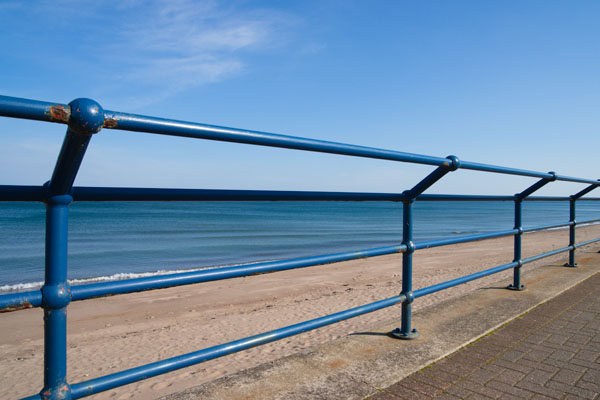
    No correction is applied here to this full frame 24mm Alpha 900 image – a central horizon, and straight lines which are not parallel to the frame edge, make the 2% distortion (similar to many standard 50mm lenses) no issue at all.

    For many subjects, depending on the distance and a ‘rigour’ of the shot (the sea horizon is the most demanding example) no correction at all will be needed. This applies to most interiors, and always to scenes like mountain views or forest landscapes where there is no perfectly flat horizon.

    The Alpha 900 is so close to MF digital quality I should really forget the attractions of MF systems. Nearly everything I see from them which impresses me is down to using prime lenses of first quality like the Zeiss and Mamiya 80mm f/2.8 standards and working in a methodical way often using a tripod, minimum ISO, mirror-up operation. Applying the same parameters to Alpha full frame lifts the end result to match – and the CZ 24mm f/2 is a key to unlock that quality.

    At f/14, the 24mm is not losing detail sharpness on the Alpha 900 as long as the correct raw processing parameters are applied. To secure this depth of field, f/14 was needed – a medium format camera would require f/27. Holding the camera, viewing and composing this shot were all aided by the ergonomics, weight and viewfinder quality of the Alpha 900. Click image for a full size version on pBase.

    This is a dual-purpose or multi-purpose lens. Where the 16mm focal length of the NEX SEL 16mm f/2.8, the Alpha SAL 16-50mm f/2.8, the CZ 16-80mm or SAL 16-105mm all cover the same nominal angle not one of these has the same neutral geometry, even illumination and good corner to corner sharpness at wider apertures. Corrected by software, they don’t have the same true angle and the outer field can become noisy because of extra sensor-mapping gain applied to reduce vignetting.

    The size and SEL comparison!

    But I would like to show you something surprising. I am a great fan of the 16mm NEX f/2.8 pancake, which is one of the few such lenses made to have a positive (pincushion) simple distortion pattern and a cup not cap shaped field of focus. It is a revolutionary inverted telephoto design of great simplicity, with only 5 elements, enabling the lens to be 16mm focal length yet have a rear node position over 20mm from the sensor – thus avoiding all kinds of vignetting and colour shift problems.

    People who don’t understand how to use a focus plane where the corners are focused FURTHER than the centre – the exact opposite of the CZ 24mm f/2 where the corners are focused CLOSER than the centre – do tests like landscapes wide open and wonder why the grass either side of their feet dissolves into blur. Actually all the little 16mm needs is modest stopping down, as would be applied by any professional using a Super Angulon for that matter, to f/8.

    First of all, have a look at some lens sizes. I like this shot, as it shows just how big CZ had to make the 24mm to get what they did. It dwarfs the SEL 16mm for NEX and the classic Minolta 28mm f/2 RS:
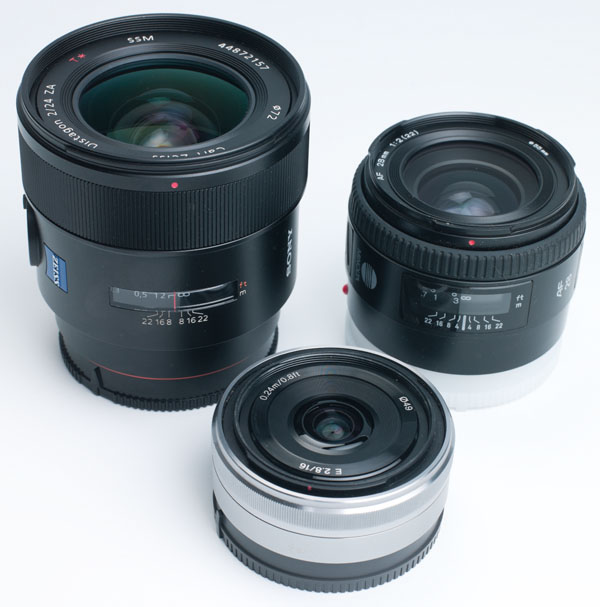
    I’d like you to see the exact comparison between Alpha 900 with 24mm CZ and NEX-5 with SEL 16mm.
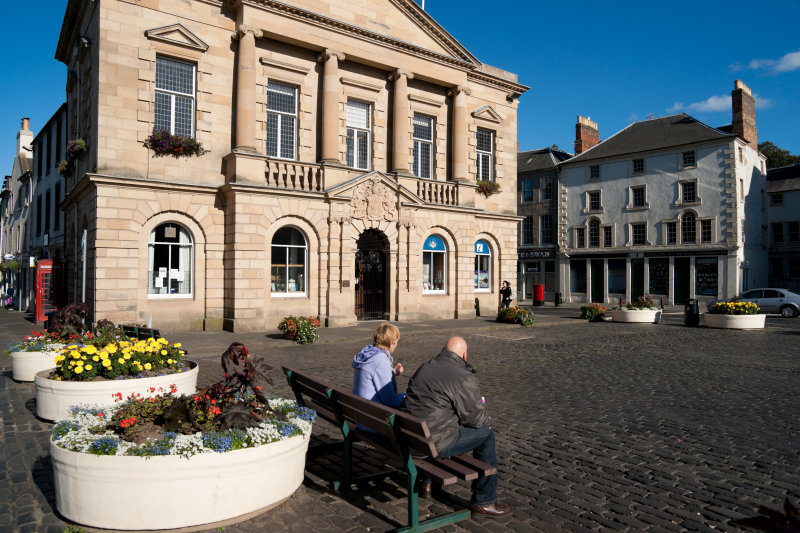
    This is the A900 and 24mm, entirely uncorrected and uncropped – the building on the right actually does not have a straight wall, don’t be fooled into thinking there’s a sudden burst of barrel distortion! Aperture f/8.
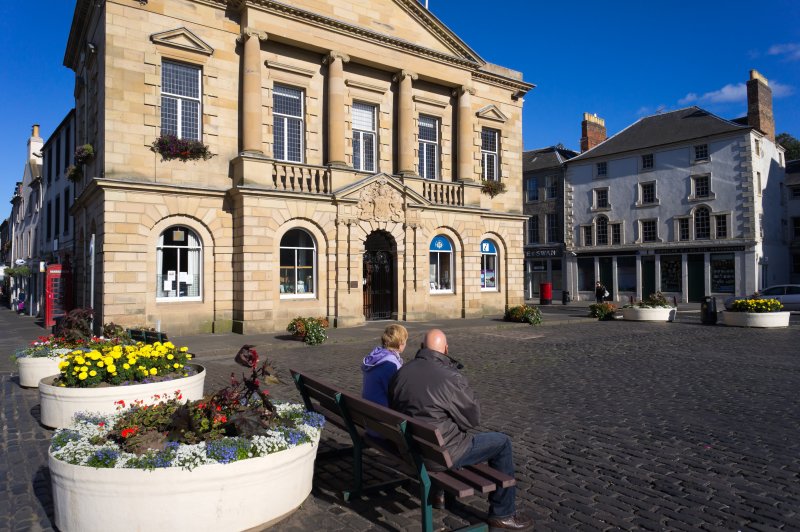
    This the NEX with 16mm, corrected in ACR; I’ve tried to keep the camera positions very close but this was real-time shooting and with viewfinder versus screen composition, not so easy. You can see that the 16mm has slightly less true angle of view when corrected but don’t judge from the foreground flower tub, just check the horizontal angle. This is also at f/8.

    You can click each image and view a full size JPEG. I have made both of them 24 megapixels, exporting from the NEX to the same size file as the Alpha 900. That may be unfair but you can judge. My opinion is that both the NEX 14 megapixel sensor and the SEL 16mm are underestimated by far too many owners; as far as ISO noise handling goes, the 16mm f/2.8 on NEX is actually as ‘fast’ as the 24mm f/2 on Alpha 900 but that comparison may change with future full frame bodies. As for depth of field, the f/8 shot on APS-C would need to be at f/13 on full frame to match, but in practice both are well covered.

    Using the NEX 16mm in different conditions would produce a different result – wide open in a room interior, the corners would be likely to look very blurred. My scene above conforms to the cup-shape focus plane of the NEX lens, and works against the cap-shape focus plane of the CZ 24mm.

    Remember as a general rule: barrel distortion = corners focused close than centre. Pincushion distortion = corners focused further away than centre. Moustache or wave form = a doughnut normally of closer focus between centre and corners, but when a full frame lens with this type of distortion (like the 16-35mm CZf/2.8 – or a more extreme example, Canon’s 24-105mm f/4 L) is used on APS-C, you get this doughnut at the corners and more or less have straight barrel distortion not waveform. No distortion at a given distance usually means a flat focus field, the quality which Carl Zeiss highlighted when naming the Planar lens.

    Alternatives to the 24mm

    The best way to get the 84° coverage with similar near-perfect rendering is to go for the mid-range of a high end zoom. As it happens, Sigma’s 8-16mm is better at 16mm than any of the above-mentioned APS-C options and you can also get a pretty good 16mm from their 10-20mm options and Tamron’s 10-24mm. Tokina’s 11-16mm f/2.8 is weakest at 16mm, best at 11mm. The older Sony 11-18mm is not wonderful at the longer end.

    On full format, 24mm at the bottom end of the 24-70mm CZ is no match, it has more distortion and softer corners; 24mm in the middle of the 16-35mm CZ f/2.8’s range is better but with strong complex distortion, more even than the Konica Minolta 17-35mm f/2.8-4 D lens (which manages f/3.2 wide open at 24mm). You might think Sigma’s 12-24mm full frame zoom could be good at 24mm, and perhaps version II HSM when it finally become available for Alpha will prove to be. The original, which I still use mainly for its superb 12mm results, places its worst extreme of field flatness deviation at the image edge when set to 24mm.

    I have used Canon’s 24mm f/1.4 USMII and this is faster, larger and more expensive than the Sony CZ lens in almost perfect proportion. Like the CZ f/2 it is a nearly perfect lens, with a hint more barrel distortion and slightly soft extreme corners on full frame wide open. The same goes for the Nikon 24mm f/1.4. I’ve also used Canon’s 24mm TSE tilt-shift and this lens betters the CZ for technical and architectural uses, as it should – so does their 17mm f/4 TSE, which has no match in any format. But such lenses can’t also be used for everyday autofocus image grabbing whether professional or family.

    Last question, then. If such a perfect lens can be made at f/2, surely all the affordable 24mm f/2.8 designs could be just as good? We wish! Wouldn’t it be great if the classic Minolta 24mm f/2.8 AF which Sony never transferred to the new Alpha range proved to have the same optical excellence as the CZ? It does not. Nor do the Canon 24mm f/2.8, or the Nikon, or anything made by Pentax or Olympus, or even Leica.
    The 24mm f/2 used at f/2.8 on the Alpha 55. Try this with a classic Minolta 24mm f/2.8 and even on APS-C you won’t get the same corner to corner even illumination. Here the focus is on the distance, not the tourists – they are also showing a surprising amount of movement at 1/40th. Click the image for a full size view.

    This 24mm is the most recent AF 24mm prime lens to have been designed for full format. Zeiss have designed a slightly more complex manual focus 25mm f/2 Distagon for Cosina partnered manufacture, available for Canon and Nikon, since Sony showed the 24mm at photokina 2010. But Sony’s full-frame DSLR rivals, Canon and Nikon, have not gone for this sub-£1,000 RRP ‘moderately fast’ 24mm niche.

    If there’s one competitor, it is Sigma’s excellent 24mm f/1.8 EX DG, which uses a larger 77mm front diameter glass unit to reduce vignetting to the absolute minimum. Distortion is higher, and the lens at present has no HSM version. This makes it less future-proof for Alpha system owners, and also less compatible with NEX and with video shooting in general.

    Features of the 24mm

    Because it’s a fixed focal length, the 24mm is a very plain lens – it has only two controls and one moving ring. There is an AF/MF switch, though unlike SAM lenses this lens can always be controlled from the body. With SAM type lenses (built in non-supersonic focus motor) it is essential to use only the lens switch, and never to use the body switch instead while leaving the lens set to AF. This is because any attempt to focus manually may damage the gears and motor unless the switch on the lens is specifically disengaged.
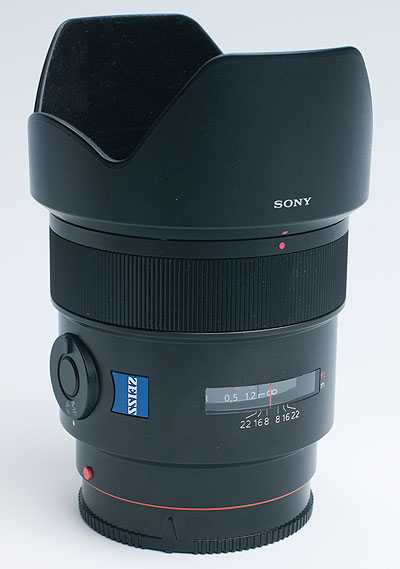
    Manual focus or held focus can be set or toggled using the single on-lens button. New Alpha models like the 77 allow a wider range of functions to be assigned to the lens button, which is described in the menus as a Focus Hold button. Direct Manual Focus is also supported on bodies which offer DMF, meaning that once focus is confirmed and locked by your pressure on the shutter button, you can fine-tune focus by eye before firing.

    The manual focus action is very smooth and well balanced, not too light and not too short in throw (which can be an issue with shorter focal lengths. The focus scale is minimal, behind a traditional Minolta-style clear window, with a depth of field indicator to the minimum f/22 aperture. Really, such markings mean little today as we expect so much from higher resolution sensors. It is time that Sony, and others, built parameter-governed DoF calculation into firmware.

    Here, f/5.6 was judged to be fine for the degree of differential focus wanted – at ISO 400, by tungsten kitchen spotlights and window light mixed, on the Alpha 77 hand-held with SteadyShot and manual ‘peaking’ focus.

    The CZ design is clearly corrected for medium distance work but retains its performance for close-ups. Unlike Sigma’s design which achieves 1:2.7 image scale, or the new manual Zeiss 25mm which focuses down to 18cm and 1:4, the Alpha lens focuses to 19cm (actually, I make it 18cm as the scale goes beyond the 19cm marking) and manages a 1:3.4 image. Don’t be fooled by distances! The front element of the CZ is already 12.2cm from the sensor plane, and the lens hood takes another 3cm or so. The actual clearance when shooting at close range is minimal. For comparison, the SEL 16mm f/2.8 for NEX will only focus down to 24cm, and the front of this lens is only 40mm from the sensor, leaving a clear 20cm between camera and subject. The Nikon and Canon f/1.4 designs are limited to 25cm and are, quite simply, nothing like as useful for close-ups as the CZ.

    You might think that the 16-50mm f/2.8 or the 16-80mm CZ could match the combination of wide angle and close focus found on the 24mm – but not so. To get similar close-ups even at a 24mm setting is not possible – an extra 6 or 7cm in minimum focus distance, when you are talking an 83-84° angle of view, makes a big difference.

    Moving in to minimum focus, the bottom wing of the lens hood was only 1cm away from the subject – under 19cm from bread roll to sensor, but only 6.8cm from bread roll to front element. At f/3.2, a hand-held 1/40th was needed (the closer you get, the less you can rely on SS to handle speeds like 1/15th). Focus peaking again enabled the manual focus point to be precisely judged. Great bokeh too.

    With a non-rotating front thread, 72mm is one of the classic Minolta sizes. It is necessary to use slimline filters, as with the 20mm f/2.8. It’s interesting to compare the revived older lens with the newer one. The 20mm has only five mount contacts, being non-D specification where the 24mm has eight and reports much more accurate focus data. The 20mm has no lens button, uses screw drive focus, and has a close limit of 25cm at which it has a 1:7.7 image scale. There is also a considerable difference in the build and feel of the CZ; I have no doubt it contains some plastic, but it feels like a good solid piece of engineering and is stated by Sony to have a metal lens barrel. Not metal-skinned plastic, like NEX lenses.

    As for coatings, Minolta’s legacy was a use of multiple layer (super achromatic) coatings to rebalance both the contrast and the colour transmission of the entire AF lens range (except designs made by third parties, like the 100-400mm APO). This advantage over other makes was never capitalised on, and made some Minolta designs seem lower in contrast than competitor’s equivalents. No-one ever complained about the colour though! Zeiss’s path from 1975 onwards was to use multicoatings a different way, maximising contrast and light transmission but permitting each lens design to have its own colour transmission quality and variation in contrast. Contax RTS lenses were always praised for their resistance to flare and their extreme macrocontrast.

    Since the advent of digital, both overall contrast and colour transmission have become less critical – no need for packs of filters to balance lenses for repro purposes, no need to test Kodachrome with a clip-test to set this up. Just post process or shoot a WB card to taste. Also, Sony Alpha lenses are made in many places – the old Minolta unit, the new CZ-Sony collaboration, co-developed with Tamron and apparently also with Sigma, built by Shanghai Optical or some other owned and partnership facilities in China, made in Thailand but not apparently any more in Malaysia…

    While distortion associated with viewpoint and perspective perception is always a companion to shorter focal lengths, over the field of the Alpha 77 (equal to a 35mm lens view or so, in full-frame terms) shapes and solids look natural. At f/4, and ISO 1250, I’ve chosen to downsize this 77 file to 3600 x 2400 pixels (click the image to open). This still allows you to see how clean the light sources in-shot are, with absence of colour fringes. Depending on conditions 1 pixel CA cancelling may be needed with the 24mm.

    So, we have here a lens with a Zeiss design and a T* coating which is entirely unlike any Minolta legacy design and will surprise those used to the way ex-Minolta lenses perform. It is fairly immune to flare, not entirely so when confronted with bright sources just outside the image margin, but without the strings of coloured patches associated with 24mms and light sources in the shot. It focuses silently and at a speed which means you may not notice it.

    The lens itself weighs 555g, and at 76mm length and 78mm diameter it’s smaller than the 16-50mm f/2.8 SSM which weighs 22g more. I’m not a big fan of lenses you can not clasp in one hand while also operating the lens release mount of a camera; optics this size and weight are about the safe limit. You can not compared the lens-juggling friendliness of the 28mm f/2, for example, with either the 24mm or 16-50mm and even the 16-80mm zoom is much easier to handle in the field. It’s best to remove or fit the hood before changing the lens, don’t leave it in storage position.

    The hood reverses over the lens neatly. The whole item, when in this configuration, is a bit large to handle for safe and secure lens changing.

    The finish is lustrous, with rubber rib grips that collect dust and dander readily. The supplied lens hood is surprisingly flexible plastic, with a slight spatter finish to the exterior and a kind of semi-flock paint on the inside. It is efficient, but a poor fit with a not very firm bayonet locking action. It’s easy to get the alignment wrong and it’s not as firm or solid as most other Sony hoods. The rear lens cap is still the frustrating one-orientation only design inherited from Minolta, which leaves even those with a quarter of a century of lenscap-fitting experience fumbling for the correct position.

    There is of course a Zeiss front lens cap and you get a free blue badge on the lens itself!

    Format, pixel count and cropping

    For many years when using film I found wide-angle zooms were not essential, standard zooms were useful, and tele zooms were vital. Generally, with any wide-angle you can zoom with your feet or by doing little more than leaning forward or back a bit. Either that or you simply need the widest lens you can get. Whenever I fit my Sigma 8-16mm or 12-24mm on their respective formats it’s the 8mm or 12mm end which is needed. I only end up zooming in if for some reason I decide to leave the lens on, and move to a different situation without time to switch lenses.

    With film, you could crop and enlarge. Small pixel count DSLRs made that difficult or impossible – when you are trying to make 6 megapixels do a full page magazine image, cropping is not an option. Zooming in to fill the frame every time became vital from 2000 to 2008 when the first full frame 24 megapixel models arrived.

    I think that 24 megapixels has finally made cropping an alternative to zooming. You may need 9 or maybe 12 megapixels, or if you are shooting entirely for the web you may need no more than 2 megapixels. Fixed focal lengths of exceptional quality, sharp all over the frame in the plane of focus, start to be useful. It has never been a good option to crop wide-angle zoom shots asymmetrically, using just one corner. With a lens like the 24mm you can crop any composition out of the high resolution frame and it will not look so different from an on-axis shot with a narrow angle lens.

    Lens resolution really does count, as I have found. For three years I used the Alpha 900 with a range of lenses, including the 24-85mm Minolta RS I keep for convenience. When working with medium format lenses on adaptors, I could see that zooms while ‘sharp enough’ usually came nowhere near realising the potential of the 900. Then, using the 24mm, I saw the same pixel-level sharpness pop out. After a month using the 24mm (kindly loaned by Paul Genge) my ordered Alpha 77 finally arrived. I had already seen how the 24mm got the maximum from 16 megapixel APS-C, and this was followed by discovering its power to do the same at 24 megapixel APS-C.
    A standard Sony leather-look lens posing pouch is supplied.

    How far can this go? If Sony’s 24 megapixel APS-C sensor formed the basis for a full-framer, it would be a 60 megapixel monster and match all but the most expensive medium format image sizes. I believe the 24mm CZ could go there if Sony chose to.

    And that, in the end, is why I changed my mind about owning one. The hour or two of useful daylight and howling gales outside have not allowed me to make much use of it yet – but this is a lens for the long term. And for tomorrow’s Alphas as well as today’s.

    – David Kilpatrick

    Footnote: added February 2016 – I’m now selling this lens, as I don’t think Sony is likely to produce an A99 model II with functions that will restore what I want to have (notably, GPS – they are most likely to drop this). I’m looking at a move to native FE-mount lenses and probably the 25mm f/2 CZ Batis, even though it’s weaker for close-ups, vignetting and distortion.

    Here is a recent example of a full aperture shot on the A7RII with LA-EA3 adaptor –

    http://www.pbase.com/davidkilpatrick/image/162677066

  • Tamron 18-270mm – a hero, but no VC…

    After using Sigma’s 18-250mm optically stabilised zoom on Alpha bodies for a year and more, the first thing which strikes about the Tamron 18-270mm for Sony mount is the lack of the VC (Vibration Control) stabiliser found on the same lens made for Canon or Nikon.

    Tamron’s lenses come without a case, but with a custom fit petal lens hood, front and rear caps. Design is clean with a Nikon-like sleeve grip and Canon-ish gold ring. The PiezoDrive focusing is similar to Nikon AF-S/Silent Wave or Canon USM, or Sony SSM, but not identical and on Sony models it can contrast-detect autofocus reliably. Sigma’s HSM hunts.

    With Sigma facing patent claims by Nikon – that parts of their OS technology infringe on Nikon VR – Tamron VC is a mature system not so far challenged in the same way. It is also a very solid kind of stabilisation, free from swimming effects, and in this respect closely matches Sigma’s approach. Both are generally more comfortable than Canon’s IS which often seems to attach the image by a bungee cord to the viewfinder screen.

    For video work, in-lens stabilisation is generally better than in-body as long as there is a good stable view which does not tend to float free when you pan slowly. For long lens work in general – over 200mm – in-lens stabilisation provides a view which is easier to aim and compose. We had already checked the lens out on Canon, with its smaller sensor area missing off the extreme corners (and therefore doing the lens favoured compared to other brands) but to compare with Sigma’s lens, needed to look at it in Sony mount.

    The lack of VC in the Sony version of this lens is regrettable. There is no corresponding reduction in retail price.

    Against this the Tamron has a longer zoom range, and it’s much smaller and lighter than the Sigma, taking regular 62mm filters not the unusual and large 72mm size. It also offers Piezo Drive focusing, which almost as quiet as SSM yet as fast as SAM. Small adjustments make a sort of faint clicking sound and focus travel is unusually fast, but a range of freehand refocusing tests using the Tamron showed that it is just as reliable in locking on to difficult targets as any other lens. Usually fast focusing means lots of overshooting or hunting, but not on the Alpha 580 used for this test.

    Although the size and weight difference between this and the Sigma doesn’t look all that extreme when photographed in the studio, the heft in your hand (volume) is much less for the Tamron. It does not really seem any bigger than the Tamron/Sony 18-250mm design or the earlier 18-200mm.

    The design of the lens follows these, with the LOCK switch for holding the lens at 18mm when walking round positioned for the right hand to operate, a long way from the AF/M switch (which should be used instead of the body switch for changing to manual focus).

    This is a better design than the Sigma which clusters the AF/M, OS on/off and Lock controls together on the left hand side. Even after a year of use, both Shirley and I regularly turn the lens OS off, or turn AF off, instead of operating the Lock. All three controls move in the same way and are intended for the same fingers. Tamron’s location of Lock on the right hand side is ergonomically better.

    However, both lenses fail to do the one simple thing which would improve such zooms – make the Lock control operate at ALL focal lengths not just 18mm. The Tamron is firm as we test it, so was the Sigma when new, but our Sigma can not now be used to pan with a plane or bird flying overhead unless one hand is used to keep the zoom from collapsing to 18mm immediately the lens is aimed upwards. To do the studio shot, the Sigma had to be taped to keep the zoom extended. Otherwise, it can’t even sit on a table set to 250mm.

    You can’t see the sticky tape stopping the year-old Sigma zoom from deflating itself to 18mm every time when placed in the studio for this shot. The new Tamron is still young and firm. But we need locks which work at ALL settings.

    It can not be difficult to devise a zoom lock which works at intermediate settings and it would transform the functionality of lenses like this.

    Apart from ergonomics, there is no significant difference in build quality. Sigma feels more solid but heavier in action, Sigma’s exterior finish is difficult to clean and collects marks and dust easily. Tamron feels more plastic in build but has a high quality metal bayonet just like its rival.

    Performance

    Just studying the lens coatings shows why the Tamron can be more contrasty and less prone to flare in some light – especially if you fit a cheap filter to the Sigma and get contrast-eroding reflection for that front element.

    The Tamron lens has visibly higher detail contrast than the Sigma, and in the centre of its field produces a very sharp image. The edge of the image lets it down, however, rather badly. The detail is soft at longer focal lengths unless stopped well down (ƒ/11 or so) and red-green chromatic fringes are serious enough to spoil JPEGs. They are not even very well corrected by using Adobe Lens Profile to process from raw (there is no Sony profile but Nikon, using similar sensors, can be selected).

    This is a Sony Alpha 55 ISO 400shot, deliberately off centred in composition, with the Tamron set to f/9 (a good compromise between diffraction and stop-down sharpness) and 270mm.

    The focus point is away from the centre of the image, and the lens displays good contrast and sharpness, but even here there is a slightly dirty look to the detail and chromatic fringes hit the white edge. This is NOT by the way anything to do with the Alpha 55 translucent mirror!

    Here’s the edge of the shot at 270mm and f/9. I feel it would be almost unfair to Tamron to publish some of the worst results I got wide open. This is a defocused distance, of course, but this is also real-life imaging. This is why we did not switch from the bulky, heavy Sigma to the neater, lighter travel-friendly Tamron.

    At full aperture and 270mm the performance is markedly inferior to the Sigma at 250mm wide open. The lens has better multicoating but poor field flatness, which creates the softening to the edges and corners.

    The Tamron at 18mm has pretty strong barrel distortion which, when corrected using a lens profile in Adobe Camera Raw or Lightroom, lost some of the wide-angle coverage.

    At wide to medium focal lengths, the difference is less marked and the Tamron is more equal the Sigma or other ‘best’ superzooms. But this is a lens bought for its extra reach at 270mm; given the performance, it’s not all that much use unless your subject is centred and surrounded by out of focus background.

    Tamron at 270mm.

    Sigma 250mm view – at near-infinity, the Tamron is longer the Sigma but not quite as much as 270mm would indicate.

    Another issue is that of focal length, above and below examples. If the Sigma is a true 250mm (which it is not, all such zooms are shorter than their stated figures) then the Tamron is actually 265mm not 270mm at infinity.

    This is unscientific, but the baby owl did not move and both lenses were placed in turn against the wire of its enclosure ensuring the same shooting distance to within a centimetre or so (with lens hoods removed). Tamron at 270mm.

    By this distance, the Sigma at 250mm really is no different in focal length than the Tamron at 270mm, due to internal focusing differences. And it focuses closer than the Tamron for a larger maximum subject scale.

    Although the close focus is good, at 49cm and 1:3.8 scale it’s not as good as the Sigma with 45cm and 1:3.4 scale – the true focal length at closer distances also seems to be shorter than the Sigma, though this is hard to evaluate.

    As for bokeh, that’s not why you buy these lenses:

    How many stumps? Wiry would be a fair bokeh description at medium apertures and longer focal lengths (270mm again, above, at f/9).

    The Tamron PZD focus does work on the LA-EA1 Alpha adaptor for NEX; it’s not fast, but can lock autofocus perfectly even in difficult light. The Sigma can not do this at all and is not AF-compatible with the NEX adaptor. But… manually focused, the Sigma has OS. Vital!

    Most telling is the weight difference when mounted on a light body like the A55. The Tamron is a far better match even if not as ‘good’ a lens – 970g for A55+Tamron, 1400g for A580+Sigma. Check prices, and work out your priorities.

    – David & Shirley Kilpatrick

  • Tokina 11-16mm f/2.8 SD (IF) DX

    TOKINA lenses – the brand name for optical giant Hoya’s interchangeable range – have always been renowned for their tank-like build quality and resistance to plastic trends. They compare so well with Nikon’s own lenses it is hard to tell the difference by feel, and the current design also matches Nikon more than it does Canon.
    The latest news is that Tokina is to introduce the 11-16mm ƒ2.8 in Sony Alpha mount. Tokina stopped making Minolta mount lenses shortly before their parent company Hoya acquired Pentax. On October 28th 2010, Kenro UK announced availability. B&H has the lens in Sony fit here. (more…)