
Tamron’s 18-250mm lens – later adopted by Sony – was so good that it really takes some effort to beat it. Sigma has put that effort in, but the cost is a very much larger and heavier lens. If all you got was some better performance, it might not be all that exciting. But you get potentially superior anti-shake through its built-in OS, and faster focusing with HSM, the Sigma equivalent of SSM. And you can buy it for under $430, and it works fine on the NEX A-mount adaptor for stabilised videos too – with some degree of autofocus tracking during filming.
(more…)
Category: Lenses
-
Sigma 18-250mm f/3.5-6.3 DC OS HSM
-
The Sigma 70-200mm f2.8 EX DG HSM Macro II
SIGMA redesigned their 70-200mm not long ago to change the EX version to DG, introducing new coatings which greatly improved microcontrast and eliminated digital camera sensor reflections. In 2008, this was further upgraded to the Macro II model with HSM sonic motor focusing, a new optical design capable of focusing down to 1 metre distance. In 2009 this became available, along with matched HSM-compatible 2X and 1.4X converters, for the Sony Alpha mount.
(more…) -
Tamron 10-24mm f/3.5-4.5
Tamron’s new ultra wide angle zoom for APS-C/DX is getting a bit of a blasting from reviewers. Now, when I see this happen, I get curious. Lens testing is often badly designed for such zooms, involving test chart targets at distances which are extremely close and result in very bad figures caused mainly by a strong curvature of field (dished, ‘cap’ shape relative to the camera) when gets worse in effect the closer you focus.

(more…) -
Tamron 70-300mm f/4-5.6 Tele-Macro LD Di
Our cover photo for the Spring 2008 issue of Photoworld was taken with a Tamron 70-300mm zoom costing less than £120 from most larger retailers or internet shops. The reputation of the lens meant we had to take a look at it, because the current choice in the Sony range is limited to one ‘kit’ 75-300mm costing £179, and the new 70-300mm G SSM lens costing £600.

The Minolta 100-300mm f/4.5-5.6 APO (D) was one of the well-respected lenses not continued into the Sony line, possibly because it is thought to be a model designed for Minolta by Tokina just as the 100-400mm was. Sony part-owns Tamron, and Tokina is part of Hoya which now owns Pentax. Though all the lens makers source components and special types of glass from each other, the facilities which built the 100-300mm may not have been available when Sony took over.
The big question is why Sony did not opt for the 70-300mm f/4-5.6 Tamron Di lens instead of continuing the lower aperture 75-300mm. It would presumably have sold for about the same price in Sony guise.
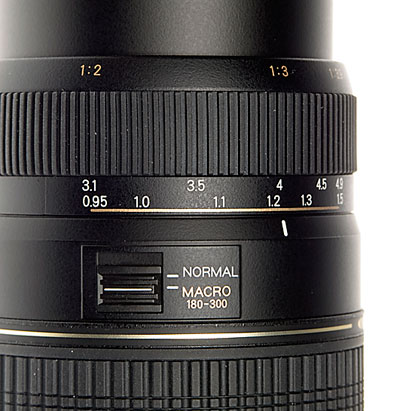
The Tamron is a fairly unique design. It has a separate macro range, accessed by pushing a switch when you are between 180mm and 300mm zoom, and at minimum focus. You can not engage the macro range until you have these conditions met. Once you are in macro mode, the zoom is limited from 180-300mm, but the entire focus range is enabled from 0.95m to infinity with autofocus. It is a slow focusing lens and like other Tamrons with low gearing to drive the AF, appears to be very accurate on all the Dynax bodies.
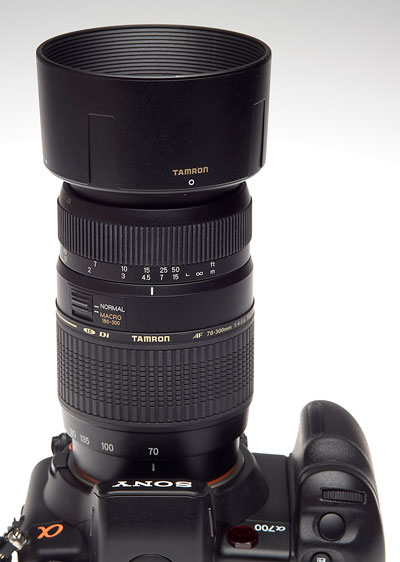
This lens is of course suitable for film bodies, and unlike the new 70-300mm G SSM, it will work on models like the Dynax 9 unmodified, Dynax 800si, 7xi, 7000 and so on. Many owners have functioning film bodies of an older date and the move to SSM locks these out of AF functionality with all bodies prior to the 1999 Dynax 7.

This is a full aperture image detail – the bright reflected spots show how the aberrations surround or flare out from a sharp core image, which contains very fine detail – Alpha 350 original in-camera JPEG clip
The lens uses LD (Low Dispersion) elements, but it is not apochromatic and at full aperture displays some visible aberrations especially surrounding sharply focused light details. The image ‘core’ remains very crisp behind this veil of secondary imaging, and it only takes a little stopping down to tidy up the results. Our Bengal tiger cub (one of triplets born in the crocodile animal rescue park near Ingenio, Gran Canaria) was caught in movement, at full aperture, and despite the overlay of softness you can pick out eyelash-level detail on the 14.2 megapixel Alpha 350 image.

Here is the very next shot on the card – a 100 per cent clip of a zero sharpening, no NR, no processing ACR raw conversion from a shot taken fairly close to an alligator, f/9 and 130mm. The lack of colour fringes on the bright highlights is impressive.
Please remember what a 100 per cent clip from a non-sharpened 14 megapixel file actually is. Yes, I can make a 600 x 400 web image which looks sharper than this but making a 4952 x 3056 image at this sharpness with any USM – a five foot wide overall image at normal screen resolution – really tests any lens.
Zoom and apertures
You may have been reading the last article about kit zooms and note the graph showing that with cheaper lenses the aperture is likely to be cut early on in the zoom range. You might assume that £120-worth of Tamron would prove no different. You would be wrong, and this is one of the unique aspects of the lens.
The Tamron holds its maximum f/4 all the way from 70mm to 135mm, making it a full stop faster in this range than, for example, the 16-105mm SAL. It takes the same filter size and despite extending to 300mm, uses a single barrel tube and weighs only 435g. The aperture drops to f/4.5 between 135mm and 210mm. Even this is impressive; it’s as fast as the CZ 16-80mm at 80mm, all the way to 210mm.

Finally, at 210mm it does get cut to ƒ5 and it only becomes f/5.6 in the last 20mm of focal length, between 280mm and 300mm. The SAL 75-300mm becomes f/5 at 90mm andf/5.6 at just 125mm – the penalty for squeezing into a 55mm filter thread.
Even the SAL 70-300mm SSM G series lens is only f/4.5 from 70 to a mere 85mm, from then on it is f/5, and at 135mm it drops to f/5.6 all the way to 300mm. The Tamron is 2/3rds of a stop faster throughout most of its range on paper. In practice, we found that either f/5.6 on the Sony SSM is as fast as f/5 on the Tamron (due to coatings), or the Tamron is more optimistic in reporting its apertures!
Minimum focus
The Tamron 70-300mm manages a repro ratio of 1:2 – half life size on the sensor. That means a subject just 2″/50mm wide fills the entire frame (3″/75mm wide for full frame or film cameras). In Sony’s terminology, that is a 0.50X magnification at closest focus and 300mm setting. If you shoot macro on film right now, buying a digital body and this lens would give you the equivalent of your 1:1.5 mark on your macro lens.
No Sony or recent Minolta/KM zoom whether standard, tele or superzoom range offers better than 0.29X. It also stops down to a rather staggering f/45 at 300mm, not advised as sharpness suffers but potentially useful for macro work.
A comparison
We found the 70-300mm to be a fair match for our discontinued 100-300mm APO (D) overall. wider in aperture, and much better for small subjects. The 100-300mm’s repro ratio is just 0.25X, at 1.5m. It is f/4.5 as early as 120mm and f/5.6 from 150mm to 300mm.

Both lenses have solid metal mounts; both have eight contacts for full D specification; the 100-300mm doesn’t go down to 70mm, and it weighs 50g more.
The Tamron can be recommended as a bargain performer all round, ideal for anyone on a budget wanting a travel and general tele zoom with a very fast maximum aperture compared to other offerings.
– David Kilpatrick
-
The 70-300mm G SSM sized up
Today I took delivery of a Sony 70-300mm f/4.5-5.6 G SSM lens. There is no doubt this is the best built Sony SAL lens I’ve handled (the CZ 135mm 1.8, 85mm f1.4 are a class above again). It weighs over 800g with its lens-hood, which is one of the most efficient deep tele hoods I’ve seen. (more…)
-
The Lensbaby 3G creative zonal focus tilt-swing lens
- Manual control and quirky design 50mm F2 to 22 tilt/swing lens
- Basic optics on synthetic bellows, glass lens
- Typically available used for £70 to £120
One of the digital photography creative tools that made a splash in the early 2000s, the Lensbaby is a novelty item you can find for very little outlay. A low-cost meniscus lens mounted on a flexible concertina tube with an SLR mount-fitting at the other end, it’s a similar theory to the Diana or Holga cameras sometimes used by professionals to capture a feel of post-modern grunge, it used aberrations creatively.
The third-generation Lensbaby 3G – not to be confused with contemporary mobile phones – launched in 2006, following a second-generation move to glass optics in the original design. Lensbaby 3G provides more sophistication, with controllable focus, tilt or swing that holds position, and screw-thread fine-focus refinement. In 2008 it was updated as the Lensbaby Control Freak.
The Lensbaby 3G and Control Freak cost rather more second hand than the early plastic models, but in good condition has a lot to offer for photographers looking for a funky, retro effect and a hands-on ritual for creating an image. The nearest modern equivalent is the Lensbaby Composer 2, which is around £350 with optics (beware cheap listings without glass).
We reviewed the Lensbaby 3G in 2007 – and have revised the review to keep it relevant for used lens buyers.
Lensbaby 3G (2007) specifications
- 50mm coated achromatic glass doublet
- Three-post tilt/swing and focus from under 30cm to beyond infinity plus fine focus thread
- Waterhouse Stops: f/2 (no disc), f/2.8, f/4, f/5.6, f/8, f/11, f/16, f/22.
- Size: 76mm h x 90mm w
- Filter Thread 37mm (undocumented).
- Weight 161.59g
Lensbaby 3G Compatible mounts (in 2008)
- Canon EF (EOS)
- Nikon F
- Minolta-Sony A
- Pentax K
- 4/3rds system
- Leica R
Automatic exposure is possible in aperture priority mode for most digital and film SLR camera bodies; a fixed correction may be needed. Some Nikon models allow manual exposure only.
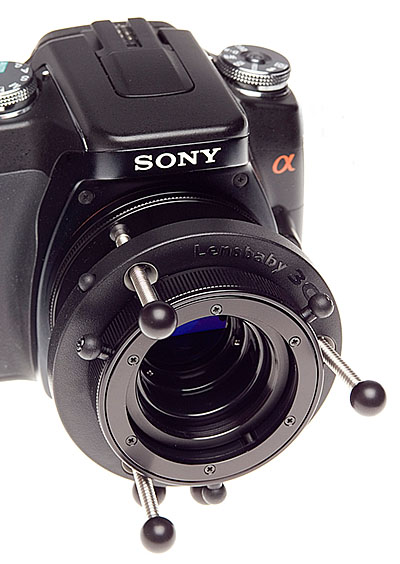
Since then it has gone through two revisions, increasing in price and complexity as well as quality. The third generation uses a low dispersion multi-coated glass achromatic doublet lens, introduced with Lensbaby 2, but adds precision control of three points of tilt and swing on threaded posts plus a fine-focus stage in a helical thread.
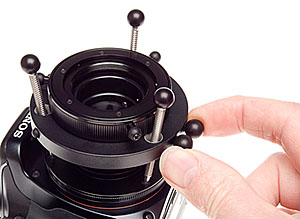
The clever part is the unlock and lock system which grabs all three screw-gear posts simultaneously. Just squeeze the Baby’s balls together, and it releases grip instantly allowing:
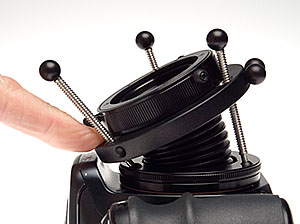
Fingertip adjustment if the camera is being held in both hands (use two fingertips either side to rock the lens angle and press it back for focus).
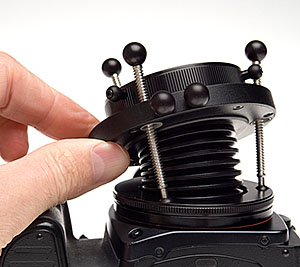
More control with finger and thumb. This is your start point, rough setting, of both focus and skew. It helps to be looking through the finder when doing this.
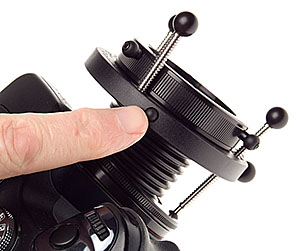
Lightly depress a small button located perfectly for your shutter finger, and the setting is locked. You can usually bring another finger over to do this while two are holding the lens position. It’s rather like playing the ocarina, but not many people play ocarina these days.
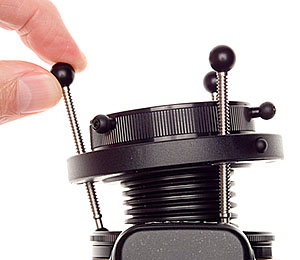
Then, fine tune the skew with the three screw posts (with black ball knobs on their ends).
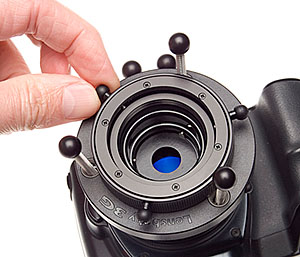
Finally, hone the focus using the focus collar which has three lugs to make handling easier.
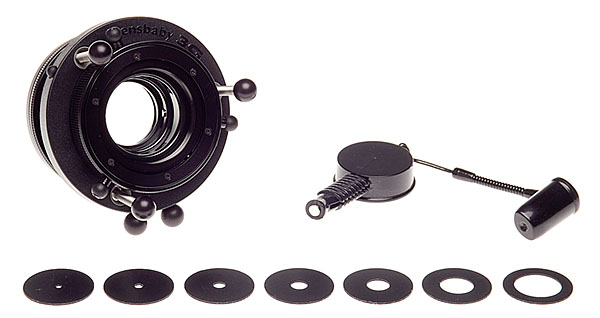
The aperture system is unusual. Small magnetic plastic rings drop into the lens front, and are held firmly by a set of three spring-loaded ball bearings which the ring pops behind. To remove or insert the ring, a probe with a magnetic tip is supplied. It works perfectly. This probe has a small tub on its other end, neatly re-purposing a Kodak film can lid as its cap, to hold the unused aperture discs. It also has a pen-top cap for the probe end to prevent its very limited magnetic field getting anywhere near sensitive components.
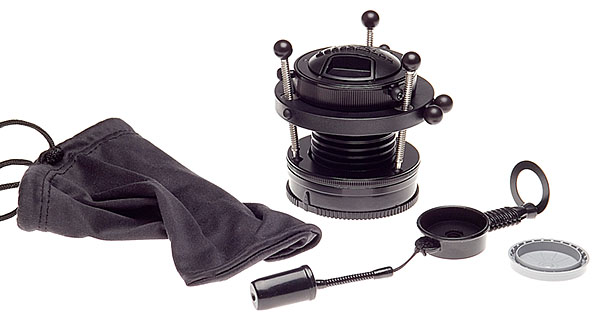
It comes with a good quality rear mount cap properly labelled for the Lensbaby but custom made for M-AF/KM/Alpha, and a good clip-in front lens cap, and a soft pouch. Great to see an independent maker offering full support for the Alpha system with such an unusual product, rather than ignoring the minority and only going for the lowest common denominator brands!
The maximum effects of the Lensbaby 3G are obtained on full frame cameras, but we tested it on an APS-C format using the Sony Alpha 100. It is also sold for 4/3rds format, which will be even more challenging. Some camera systems use a near-60mm lens type, but Alpha uses a 50mm version, which is better all-round. Maybe one day I’ll be able to follow up with a test on the full frame Alpha…

The outer zone of the image field has the most aberration, distortion and vignetting to exploit for effect and much of this is lost in theory on the small digital format. Enough remains within the 15.8 x 23.6mm sensor view (above) to be exploited, generally using wider apertures – full aperture of f/2 was used for the existing light snapshot above which makes a shopping mall and chainstore anonymous though our shoppers remain sharp.
Here the Lensbaby shows a weakness, which can only be solved easily by taping some ND gel filter to a wide aperture, or obtaining an ND4, 8 or 16 filter to fit the (undocumented) 37mm filter thread. Studio flash shots at f/11 or f/16 – pretty much what my 300/300/600 Elinchrom rig demands at minimum power for small still life – show almost no typical Lensbaby effects and can actually come out sharper than many premium grade prime or zoom lenses, even at full bore!
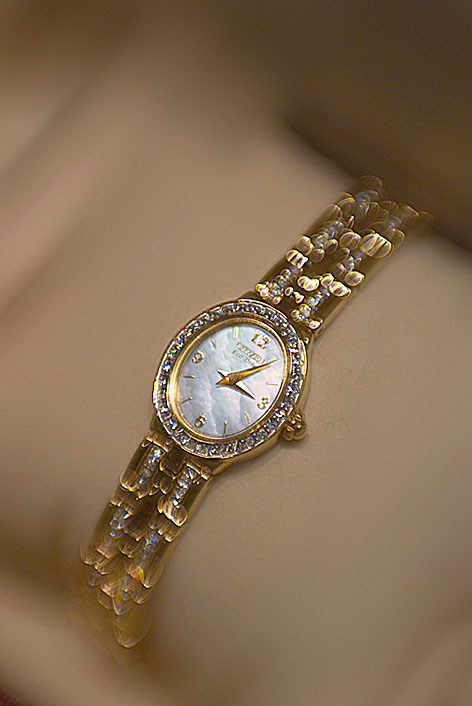
You must work at f/2 to f/4 for maximum visible special effects. Even this is at f/2 – wide open. How about sharpness, shooting through a jewellery shop cabinet at such a wide aperture, hand held, visually focused on the Sony Alpha standard focusing screen? Here’s a 100 per cent section of the shot above:
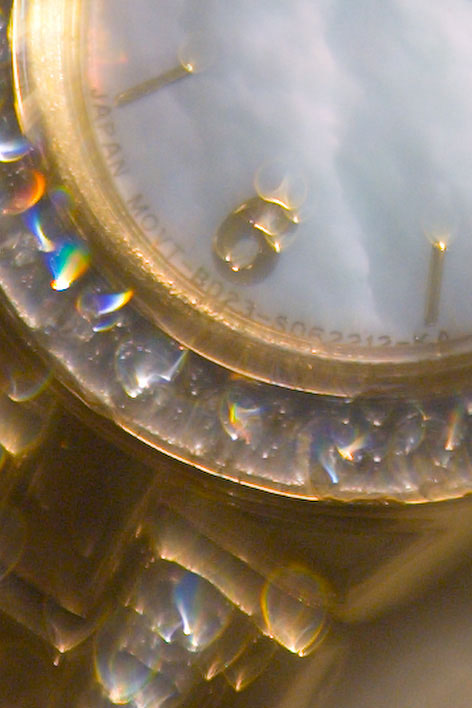
As you can see, there are complex and attractive effects from the aberrations and the tilt/swing, but the core image as shown by the lettering on this tiny ladies’ watch is pin-sharp under the mushy glow.
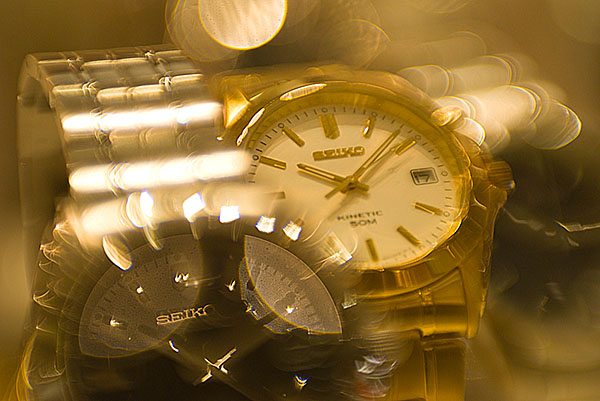
Here’s another example from the same set of quick snaps. This can blow up to 20 x 16″ and still look great. You can get soft focus using Photoshop but you just can’t get the complex blend of optical effects present in this shot.
Lensbaby glass lens performance
At f/5.6, the lens begins to appear rather sharp across its entire field. From f/8 to f/22, you can actually use it as a good quality tilt-swing lens with a fixed degree of rise, cross or fall (it’s all one action). Instead of narrow planes of sharp focus intersecting an image unexpectedly you can get traditional large format style focus in depth. Just set the shot up wider open (the f/2.8 aperture is better for focusing than completely naked f/2), insert the f/11 of f/16 aperture disc, and you’ll be very surprised by the sharpness and lack of chromatic fringes. With digital SLRs you lose some sharpness at apertures smaller than f/11 because of diffraction.

This is not why Lensbaby 3G is bought. Most users will take it into the wide world, using it for fashion, stock, still life or architectural interpretations. They will work with f/2, f/2.8 or f/4 and tilt the lens plane to create a vortex of sharpness with dramatic blur streaming out from it. Atf/4 the shot above uses the lens swung to put the plane of focus through the stamen tips and the petal edge, and blur the further part of the flower more.
Achieving sharp focus with Lensbaby 3G
The instructions for Lensbaby remind you to be very careful with your digital SLR’s dioptric viewfinder correction. They do not tell you why. Most DSLRs are poor for manual focusing as they don’t have old-style ground-glass screens, they have extra bright versions which are nearly transparent.
This makes it possible for the eye, if misfocused by the eyepiece, to see unfocused images as sharp. It may be worth getting a matt screen when someone like Haoda makes a plain one. Focusing the Lensbaby with the split-image/microprism Haoda screen is not so easy.
There is a secondary effect of this which Lensbaby do not mention; these screens don’t give an accurate preview of depth of field. This applies to nearly all modern SLRs. You will see more depth of field than you actually get. The results from Lensbaby may surprise you by appearing more extreme in the final image than you set up for, so it is best to make tests before using the lens on a non-repeatable commission.
It’s worth doing some imaginary assignments. For example, a shot for an illuminated sign supplier. They would want their sign sharp, but want the creative focus of the Lensbaby 3G to obscure the location.
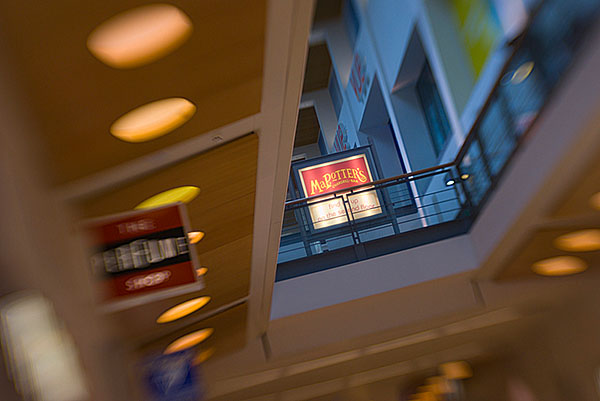
An imaginary assignment: capture a shop’s sign in a shopping centre Full f/2 aperture might be right for the effect, but at 100% magnification it’s clear that a small focusing error has made the sign a little less sharp than the detail in the background. You would, if you did some tests like this, decide that with Lensbaby it’s necessary to take many different shots, tweaking the focus or the swing/tilt screws a tiny amount, maybe fitting different apertures.

A 100% crop of the sign in the overall shot shows the Lensbaby 3G on 2007 tech was hard to focus accurately – modern systems offer sharper screens and magnification. You just can’t rely on a single shot with visual focus preview via a DSLR focus screen. This is at 100 per cent, equal to an A2 print at screen resolution, but that’s how picture get examined these days.
Should it be used for weddings or portraits? Difficult question. Unlike Photoshop effects applied later on, Lensbaby blur is indelibly written into your capture. What is needed for the future is a Lensbaby Plug-In or filter suite for Photoshop which copies the results from this £175+VAT specialised optic for jobs where you just can not afford to sacrifice the original shot to pure effect.
As for value for money, my initial thought was that it was too expensive – you can get a complex zoom for the same. Then I remembered the old Rodenstock Imagon. Really, it was not so very different optically and you paid £600 when £600 was real money for this with a focusing tube and few aperture discs.
Lensbaby 3G creative apertures
Now why Lensbaby currently only supplies plain aperture discs with the lens I have no idea, as for a very small outlay you get a kit of creative aperture shapes such as star and heart or slot, and cut-your-own blanks – a mere $9.95 kit, trivial compared with the cost of the lens which is more than many popular wide range zooms.
Imagon-style perforated, patterned aperture discs would make it wonderful for soft focus portraits and zany shaped apertures – like f/11 hearts, stars, slits, asterisks, triangles and so on – could create brilliant bokeh effects. Of course you can make your own from black paper but it’s not magnetic, and you would have real trouble drilling the multiple holes for a classic soft-focus lens diaphragm. A leather punch can be used with the magnetic material blanks.


Two examples using the star-Creative Aperture (added Dec 2008 revision) They could also make a pinhole aperture and some high definition f/11-f/22 apertures with precision foil edges to the hole, reducing the diffraction issue. The existing apertures are not very precisely cut and the material is very thick by iris diaphragm or Waterhouse stop standards.
So, Lensbaby 3G has plenty of potential for add-on accessory modules or DIY custom apertures. Overall, the clever functionality of the mount makes it worth the money. For further UK regional information, visit www.intro2020.co.uk. For international information, see Lensbabies.com
Update: new LensBaby models (Control Freak, Muse and Composer) have been introduced in December 2008. They have interchangeable lens units, offering a choice of plastic or glass optics, and refined designs. Wide, tele and close up adaptors are also available. The Control Freak is the new 3G update.
– David Kilpatrick
All photographs © David Kilpatrick/Icon Publications Ltd may not be reproduced or copied without express permission. Studio photographs taken on Konica Minolta 7D with 28-105mm Sigma HS UC III zoom, Elinchrom flash, and Tre-D light table. Even at the lowest power on the two 300 and one 600 Ws heads the aperture was f/14. This is also the set-up I use for stock image table top objects. Lensbaby could only reasonably be used with a tripod and the modelling lights as the source.
-
Sony Carl Zeiss SAL 16-80mm f/3.5-4.5 T* ZA DT
A review by David Kilpatrick from Photoworld Spring 2007 with additional updates
MY SONY Carl Zeiss 16-80mm “superzoom” arrived from Warehouseexpress – the best price I could find and one of the very best dealers in terms of service – packed rather minimally for a £465 purchase. (more…)
-
Tamron 18-250mm f/3.5-6.3 XR Di II IF-LD
THE NEW Tamron 18-250mm has some importance to Alpha system users. It is almost certainly the optical basis for the forthcoming Sony SAL 18-250mm version, and as a APS-C 13.7X zoom with an equivalent 27-375mm (in full frame terms) range is uniquely suited to the SSS-enabled Dynax 5D, 7D and Sony Alpha 100 (more…)