
The shape of the NEX-5 and the availability of 180° (fisheye) and 99° (ultrawide) converters for the 16mm pancake lens persuaded us that with a suitable harness or secure housing, we would get permission to make a unique high definition film on the famous Volo dell’Angelo, one of the most dramatic zipwire experiences in Europe.
Category: Opinion
Opinion pieces from our editors and contributors
-
Alpha 55 1080p HD video – snow in Scotland
This video was made on December 23rd using the Alpha 55 (AVCHD recording) hand held, with SS enabled, and the Carl Zeiss 16-80mm zoom. This video has been uploaded in full 1080p HD and can be viewed at high resolution if you have a fast enough connection. The soundtrack is a classical guitar piece I wrote ten years ago, on the last day of the year 2000, when snow was falling by moonlight which I guess the music represents a bit better than mid-day.
Some camera-mic sound has been left in place for two of the takes, and the shot of the stone wall uses active phase detection AF during video. This was not possible for most takes, as the snowflakes falling made the focus constantly change as they passed the focus zones!
Hope you enjoy it! The camera got very wet with snow – you can see where flakes landed on the lens filter – and ended up being wiped down many times. Eventually, after going into a shop for a few minutes, everything steamed up. But it seems fine after letting it dry out and warm up. It was not very cold, around 1°C for snow to be falling like this.
– David -
The Alpha 580 – a three-way view
Once I had a quarterplate hand-and-stand camera, vintage 1920s. Attached to the front standard was a small reflex viewfinder, giving a miniature composition you could use at waist or chest level. On the same standard was a folding wire frame, with a companion eye-sighting window flipping up from the side of the body. This gave a direct view from eye level. But for the most accurate framing and focusing, a groundglass screen at back could be used with the shutter open and a viewing hood folded out.
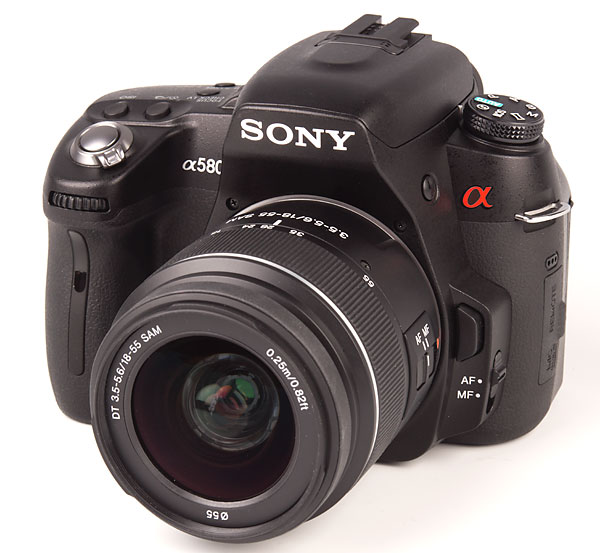
Those three ways of viewing have never been available in a modern SLR. Until now! The Alpha 580 (for which you can also read 560 throughout this review, give or take the sensor) is the first modern SLR to offer three entirely different viewfinder systems, all with their own unique focus and exposure methods. There have been cameras made by Alpa and Praktina which had optical finders tucked in alongside their pentaprism, and Rollei invented a finder which could switch from eye-level to waist level at the flick of a lever. But the Alpha 580 offers three through-the-lens systems and it’s unlikely any DSLR will do so again.
This is a 10-page article – please use the navigation bar at the bottom to move on to the next page, or click the ‘Continue Reading’ link to view as a single long article (this function is not very reliable though and may produce an ‘undefined’ error)
(more…) -
Alpha 55 – in depth pros and cons

It’s taken me a long time to get round to writing a review of the Alpha 55. You don’t get to use a new type of camera very often, and this camera blends elements which have all been used before in a completely new way. This review is pretty from the point of view of the still photographer not the video shooter. This is a multi page report. There’s a lot of it. Please use the navigation for pages 1, 2, 3, 4, 5 and on to keep the pages a reasonable size – even if it’s rather hard to spot it… or click the Read More link to get it as one big scrolling monster.
(more…) -
HD videocast – NEX adaptors and odd lenses
I’ve finally got round to trying a ‘proper’ videocast – perhaps the first of regular short demonstrations – with the Alpha 55 offering me HD filming while demonstrating the NEX-5. And I can use the NEX-5 to film stuff about the Alpha 55. A Canon 60D helped, though its inability to refocus during filming (which the NEX-5 and Alpha 55 can do) proved a small problem. The sound from the Canon was used, mainly because it had been set with a manual level, while the Sony was using an external condensor mic that pickup up some serious interference from the lights.
The lighting is nothing more than one 30W daylight colour energy saver and one 20W – using an angle desk lamp from IKEA and a spare table lamp. The background is a Calumet (Lastolite in disguise) canvas. To do the filming, I ran a 7 inch Lilliput monitor from the HDMI output of the Alpha 55, and mounted it facing me on a bar right next to the camera. The Canon was set up as a second camera and left running from that position. Editing, including cutting and pasting the soundtrack and parts of the Canon video, was in iMovie 11.
This is a full 1080p HD YouTube film – if you can view it (bandwidth is an issue) try the higher resolutions. The Alpha 55 consistently overheated at around 7 minutes, showing me a temperature warning then shutting off. The room was not warm and the camera screen was both not active, and moved away from the camera back. My first attempt at this film was spoiled by the overheating issue, perhaps because SSS was left on in error. However, on a tripod SSS is not active to any extent when shooting video (it does not have the same problems of creating blur, which happen with still images due to the way mirror or shutter vibration are reflected by the tripod). Previous time limited movies I’ve made have been hand held and of course SSS is both used and expected to be very active.
– David Kilpatrick -
A dream of the future – and past
Sometimes earlier this year, early Spring I think, I had a vivid and detailed dream during a slow waking-up hour. It was the kind of dream which feels rational not random. I knew what I was doing in it – in control!
This time, I described the dream to my wife and son; he knows a lot about this stuff, and thought it was an accurate dream. It was possible. Now Sony is about to release the camera I was using in the dream.
Here is the dream.
I am walking across a kind of pier or boardwalk construction at the edge of water. It’s not in Britain. It’s warm and sunny, and it could be in the USA. The boards are raised above what would be the shore, and there are wooden buildings left and right of me. Ahead, I can see the lake water, and boat moorings with a jetty. To the left of me is the largest building, which is a shop or museum; something to visit. There are ornamental shrubs placed on planters or pots, and there are some notices or signs on the building. To the right, the wooden building is functional; it could be a boat house, a yacht club, or something like that. There are pine woods beyond.
My job is to move to the four corners of this scene, and other positions, taking care to make a complete set of images from a range of camera placements and angles. I’m using a wide-angle lens, and my camera is equipped with GPS which records the exact position and orientation of the camera for every shot.
I do not worry about people in the pictures because the software will ignore them, nor about the light, but it is a beautiful day anyway. I am taking the pictures for a project and this is paid work. This is actually what I do for a living (in the dream). I am visiting hundreds of the most frequently-photographed places in the world, and producing a set of pictures of each one.
But it’s not what I am doing which is the interesting bit. It’s what I know about it. In the dream, I have all the knowledge about what I am doing that I would have if it was real.
480 width ad:
Time and space
Here’s how my pictures are being used. Each set of images with its GPS coordinates is fed into a system which constructs a 3D model of the environment. It is capable of recognising identical elements seen from different angles, and uses the GPS data to help identify them. With two 2D views of a building from different positions, it can use the focus distance and lens angle information to compensate for small inaccuracies in the GPS data, and wireframe the exact design and scale of the structure.
It identifies textures and objects like foliage, text on signs, clouds, and people. Once my entire set of images from this place has been processed (I am aware they are being transmitted as I take the pictures) new photographs which never existed can be created. A virtual camera can be positioned anywhere within the area I photographed, and my few dozen still images from fixed positions enable a new view to be constructed with complete accuracy.
I’ve used the result (in my dream) and it has incredibly high resolution because of the correlated image information. It’s a bit like Sony’s multi-shot or HDR or panorama technology, but instead of aligning two very similar images, it maps the coincident key points of entirely different views of the same scene. Where a walk-through VR allows viewing all angles from one position, this allows viewing any angle from any position.
And it goes beyond that to add a timeline.
The system I’m working for gathers millions of photographs from people all over the world. I’m photographing these key locations because they are the most photographed in the world. Camera phone images now record GPS data, and also record the date. So (at this future time) do most digital cameras and video cameras.
The system can find images matching every location by trawling the web; from Flickr, Facebook or whatever is out there. It can analyse the images to see whether they actually match the location they appear to be from. For every location, the system gathers in as many more pictures as it can find.
The first result of this is more detail. The second is that the viewer can change the season or weather conditions in which the location is seen. It can be viewed at night, in snow, in rain, at sunset; whatever. My image-set provides the framework, but seasonal changes can be created from the ‘found’ images of the place.
The second result is the timeline. Old photographs of these places have been fed into the system. For some popular spots, it’s possible to track the environment backwards for over 100 years. Trees change size, buildings appear and disappear. By turning on ‘people’ (which the software can remove) the crowds, groups or individuals who were in the scene at any time can be shown. And the 3D environment is still enabled because all the old photographs are co-ordinate mapped to the new information.
I do not have to work all this out in my dream, because I already know it. I am working with this awareness. The entire thing is known to me, without having to think about it. I also know that future pictures captured from internet will continue to add to the timeline and the ‘people’ function, so in five years’ time the seasons and the visitors to this place can be viewed almost by the minute.
The dark side
Because this is a dream, I do not have to think or rationalise to get this understanding; it was included with the dream. As I wake up, I realise what I have been dreaming and then make an effort to ‘save to memory’. That also kicks in the thinking process.
I start to wonder who was hiring me to do this survey-type photography, because in the dream that is one thing I don’t know. I realise how exciting it is to be able to use this Google-Earth or Google-Street type application to view not only any part and any angle of these tourist locations, but any season or time of day, and many past times in their history.
When I describe it to him, Richard suggests it’s probably Microsoft. He likes the collation of web-sourced images covering seasons, and maybe decades of past time. He thinks it is all possible and the core technology exists right now. I should patent it and give it a name!
But there is one thing which I understood just as I was waking up; the system can recognise people. Not just as people to be ‘removed’ from a scene or turned back on; it can recognise faces. The movements of one individual can be reconstructed within that location, and it can use a ‘cloud’ of gathered pictures taken at the same time to do so. This is not just virtual tourism and virtual history. In other locations – not beautiful waterside boardwalk quays – it is surveillance brought to a new level.
Sony A55 and A580
Sony’s new models with built-in GPS are the first cameras which will record the data my dream required. The GPS is not the typical latitude-longitude only. It also records height above sea level (elevation) and the direction the camera is pointing (orientation). The camera-data information records the focus distance and point of focus, and the angle of view of the lens (focal length), the time, and the measured light level and apparent colour temperature. Maybe in the A55 the spirit level function also records horizon tilt and position.
OK, the camera I was using in the dream was more like a 5 x 4 on a tripod. But that could be just a dream – like the giant fish which leapt on to boards and brought the jetty crashing down into the water a second before I woke up…
– David Kilpatrick
480 width ad:
-
Fitting a Vectis 80-240mm to the NEX
OVER the past few days I’ve been looking at the NEX-5 and a range of lenses and optical systems. I’ve got adaptors for C-mount (16mm/TV/CCTV) lenses, Leica 39mm screw, Minolta MD and the LA-EA1 for Alpha A-mount. The NEX-5 has proved able to provide a surprisingly bright focusing image through a classic German microscope:

It also proved very competent with the Sigma 70-300mm f/4-5.6 OS lens, the adaptor providing power for the OS which is fully functional, and also for auto exposure, leaving only manual magnified focusing to tackle. (more…)
-
Sony NEX generation launched
–
SPLIT, Croatia, breakfast over – Sony Europe presents the new NEX-3 and NEX-5 mirrorless, HD video capable slim interchangeable lens APS-C digital cameras. This has been a launch anticipated by almost complete and accurate leaking of the specifications of the two cameras. Sony UK also provided advance information to all dealers, including pricing, before the press launch – allowing retail websites to have full data up and running as from May 11th.

Toru Katsumoto presents his team’s latest offering (he holds a silver NEX-3)
The entire system with accessories is to be available in June at once, no waiting for anything except the 18-200mm lens which will arrive a month later. Edit: the brochure says ‘October’ for the 18-200mm, at the presentation it was said that it would follow in a month or so. October is four months or so.
(more…) -
The tortoise and the hares?
SONY has shown itself to be lagging behind the competition as we reach the third bend on the second lap of the development of HD-video capable DSLRs. At PMA 2010, nothing ‘real’ was shown and the closest they came to further launches in the Alpha range was an advanced pre-production prototype of a 24mm f/2 Carl Zeiss T* ZA SSM.
But Sony may prove yet to be the tortoise – or perhaps to be Brer Rabbit. They could make the finishing line, the goal of a truly useful video DSLR, before Nikon/Canon/Pentax/OlySamPanny get there.
(more…) -
Alpha's Silver Jubilee

The Alpha System celebrates its Silver Jubilee or 25th Anniversary this month.
We have a full length revision of the article which appears in the latest Photoworld now online as a page here.
Read our 25th birthday review of the Alpha system’s history now!

