Category: Opinion

Opinion pieces from our editors and contributors

  • Using the 10-18mm OSS zoom on full frame

    The Sony E-mount (not FE) 10-18mm f/5 OSS lens can be used effectively on full frame for creative work and within limits for technically more demanding shots. Below, an uncropped A7R shot of the concourse at Abu Dhabi Airport, taken at 13mm setting, f/6.3 with my lens profile as provided below. Check the straight lines in the floor tiling, if you doubt that this lens would be of any use for architecture.

    However, you don’t get this without a lens profile, and without due care to limit the focal length to a range of 13 to 16mm – not the full 10 to 18mm. Below, you could get this if you try 12mm straight out of camera…

    uncorrected12mm

    This is a pretty awful case of vignetting and distortion – as you would expect. It’s from an APS-C format wide angle zoom, the 10-18mm f/4 SEL OSS lens for NEX, used on the Alpha 7R full frame mirrorless body. Early in the launch period of this camera, various far more attractive images appeared on-line using subjects like roads, rail lines, beaches and even shop counters where the lines look straight – rather like that drainpipe – because of where they fall in the shot. As you can see, anything with a horizon near the long edge of the framewould have given a very different impression.

    However, Adobe offers a free utility which enables you to make lens profiles to correct vignetting and distortion.

    I created a lens profile for ACR/LR using full frame and the 10-18mm on the A7R. The vignetting is such that the profile creator really can’t handle it, and overcorrects the extreme corners as a result. I’ve done f/4, f/8, f/16 at 12, 14, 16 and 18mm focal lengths using an A2 chart; for a lens like this, a much greater working distance and an A0 chart would really be desirable. The link below is to a zip file of the Adobe Lens Profiles I produced – for A7 and A7R, with .lcpp files for final use, and .lcp files for different settings of the 10 18mm I found useful.

    10-18AdobeLensProfiles

    corrected-customprofile12mm

    At 12mm you can probably see the vignetting artefacts in the corners, the magenta corner shift and incomplete correction of the horizon line. You’ll also be quick to spot that the 12mm coverage has been reduced to something much less, lens profiles always reduce the field of view (they can not do otherwise).

    The profiler simply can’t handle the degree of sudden fall-off in illumination given by the 10-18mm used on full frame. Manual distortion corrections can actually do a better job. At other focal lengths, the profile I’ve made works well enough, and if the frame is cropped slightly (still exceeding the APS-C area the lens is designed for) it’s possible to get good results and wider angles.

    I have sold my Sigma 12-24mm HSM II which was used with the A99, and also sold a Voigltander 15mm f/4.5 I bought to test (zero cost fortunately, as it made a small profit between Gumtree source and eBay destination). The Sigma was not only very difficult to focus using CD, its HSM motor won’t play with Sony CD.

    My .lcp full-frame file can be downloaded from:

    //www.photoclubalpha.com/AdobeCameraProfiles/ILCE-7R FF (E 10-18mm F4 OSS) – RAW.lcp.zip

    Just for good measure, here is an uncropped A7R 13mm focal length shot of the church of Maila Dumpara in Kerala taken to use dramatic converging verticals – which fail terribly unless the lines are properly corrected, the last thing you want in a strong upward angle is lens distortion. It’s very stiff test of any lens to do this. I have left the vignetting uncorrected. I rather like it. Click either this or the Abu Dhabi photo and you’ll get a larger image, about 1000 x 1500 pixels.

    Samples produced for a dPreview forum question

    There’s been a lot of discussion on dPreview forums of which lenses work on full frame E-mount, as Sony saw fit to put a Disable APS-C crop option in the menus of the A7 and A7R (almost as if they wanted owners to experiment). They have made other welcome changes of a similar kind which I’ll cover in a full review of the camera – which I can not do yet as I have no FE mount lenses for it, and with the current choice and prices, I can see I may never use FE mount lenses on this camera.

    So, to answer some questions on dPreview’s E-mount forum, I posted these images and comments.

    Here is a ‘native’ uncorrected shot of a local building taken on the 10-14mm on A7R at 11mm, f/10, ISO 100:

    View: original size

    Here is the result of using the profile, doing a crop and some straighten of slight rotated tilt, and pulling the scale down (with the profile applied, the roof apex is clipped off at the top as the lens has so much distortion its 11mm probably becomes more like 15mm when corrected):

    View: original size

    I’ve used some clarity and local burn adjustments on the sky to treat the image more or less as I would (except that I wouldn’t actually photograph this building at this time of day, with blinds drawn, etc).

    For me, the 10-18mm on A7R with our without the profile correction offers the same options as using assorted lenses on 5 x 4 sheet film. It never mattered whether a 47mm didn’t cover the entire film, you got an image circle and could use whatever part of it you want. At 10mm the image, with the profile used, has strong corner cut-off but the overall circle of usable image greatly exceeds APS-C provided you stop down (f7.1 seems just OK, f/10 is maybe optimum, I’d certainly try f/16 despite fears of detail loss).

    View: original size

    The red crop mark is square – my ‘Hasselblad SWC killer’, as the classic SWC had just a 38mm wide angle lens. You needed to get an Arcbody with 35mm Rodenstock to go any wider on 56 x 56mm film (6 x 6). With the A7R and 10-18mm at 10mm, you get the equivalent of a 24mm lens. Not a 24mm fisheye on 6 x 4.5 like the widest ever offered by Mamiya… a 24mm rectilinear on 6 x 6.

    The yellow crop mark represents a significantly larger area than APS-C (which is actually just a little under the 24 x 24mm square in width). It is shifted vertically, as if the lens was being used as a shift lens. If only the APS-C area is considered, its approximately 16 x 24mm area can be positioned right to the top of the frame, equalling a 4mm rise, or the equivalent of using a 6mm rise on a full-frame PC lens (most actually go to 11 or 12mm rise). There is only one lens made which can compete with this, and that’s the Canon 17mm f/4 TS. Admittedly this is a superb lens and when stopped down to f/11 and used on the 6D (Canon’s most shift-friendly sensor) will blow this result away for clean rendering of detail toward the frame edges.

    And then, you can still use the 10-18mm in APS-C crop mode as a snapshot wide angle with pretty much perfect correction (Adobe’s own Sony profile for APS-C), for videos too.

    – David Kilpatrick

  • Nikon’s DF finally recaptures the spirit of Dynax 7D

    Sony said, as they took over the Konica Minolta camera division in 2006, that the day of mechanical controls and switches was gone. Economies of production and efficiencies of design meant that from now on, cameras would be controlled by buttons and menus. Anyone who remembers the original Alphas, the 7000 and 5000 from the mid-1980s, will also remember that this is not an original idea.

    Minolta started to return to mechanical dials and visible controls after ten years of experiment with buttons, programs, and automatic functions. The Dynax (Alpha, or Maxxum) 800si and above all the 600si Classic restored traditional camera controls. The acclaimed 9 and 7 models followed, featuring physical switch or dial controls for exposure compensation (separate ambient and flash) and drive modes along with a shutter-dial style mode setting including the vital 1, 2 and 3. The triple custom memory setting enabling users to switch instantly between (say) outdoor action, studio flash and tungsten theatre lighting has survived as a Minolta gene all the way to the latest Sony generation.

    Now Nikon has arrived with the DF, a very much standard autofocus DSLR using the D4’s 16 megapixel full frame sensor and a D610-derived AF and shutter specification, in a moderately compact retro-styled body with about the same number of mechanically switched visible controls as the Dynax 7D. It’s over ten years since the 2002 design of that camera (which finally appeared in 2004 after a change of imager from a planned Foveon sensor to the 6 megapixel Bayer Sony, rumoured to be a decision helped by Sony’s pressure on Konica Minolta as their main supplier for compact digital sensors).

    nikdf-slant Dynax-7D-slant

    Top, you see the Nikon DF in the black finish which very few sites are choosing to highlight – the silver and black looks SO much more retro – with 18-35mm Nikkor lens, 2013; below it, you see the Konica Minolta Dynax 7D with Konica Minolta (aka Tamron) 17-35mm. Note the strap lugs; KM moved one forward for better balance, but carefully kept the right-hand strap behind the shutter finger. Nikon has rather peculiarly chosen to place this strap lug forward as well, putting the strap physically between the index finger and the rest of the fingers.

    The Nikon is hiding a flip-out aperture coupling pin to allow the use of original Nikon F (Photomic metering) or Nikkormat generation F-mount lenses, which have an external non-self-indexing meter coupler on their aperture control. Minolta’s full aperture metering used a self-indexing coupler which, unlike Nikon, did not required a back and forth rotation of the ring to tell the camera the relationship between the full aperture and any stopped down setting. In the 1960s, Minolta’s method enabled the fastest lens changes and also enabled ‘blind’ changing as there was no need to look down at the lens or engage a pin when doing so.

    Nikon kept faith with their old mount when they introduced their AF system, despite the deep body register and narrow throat creating many problems with lens design. Minolta designed a brand new wider throat. At the time it made sense. Who then was to know that precisely the same constraints on lens design imposed by the narrow Nikon mount and deep mount to film register would make Nikon lenses much better, 20 years later, in the age of digital sensors with their need for telecentric designs and small rear exit pupils?

    You’ll see that the old KM has a switched White Balance at the right hand end, more or less where Nikon has put a small PASM selector dial on the DF. Imagine it – a switch to get AWB, your most recent Preset, a Custom reading or to set in Kelvins. Where the D7D has a PASM plus 123 custom memory selector (locking) and hiding below it a mechanical switch for self-timer and sequence drive modes (3fps from the 6.1 megapixel sensor), Nikon has a very granular T (for time) to 1/4,000th shutter speed dial cramming those intervals in.

    nikdf-top

    The actual shutter inside the camera despite being full-frame in the Nikon is really much the same as that of the D7D, a 30 second to 1/4,000th unit with X at 1/200th. And below the Nikon’s dial at the front (the KM has it at the back) is the drive mode selector, which does include the Mirror Up position that the D7D was lacking. There’s a mini LCD display on top to allow the use of the 1/3rd step control-wheel set shutter speeds, and to display the aperture on G type lenses which don’t have a physical setting and must be set from the body.

    On the left end of the Nikon there’s a two-tier wedding cake for ±3EV 1/3rd stop exposure compensation, and below this an ISO control from L1 (50) to H4 (51,200).

    d7dback

    I don’t seem to have a picture of the D7D left hand dial from above, but it offered something unusual – turn the dials a full 180° and the 1/3rd step EV compensation adjustments were exchanged for 1/2 step adjustments. The D7D also had a stack of controls on the back, like the lockable AF point selector control round the four-way selector, an ISO button (bearing in mind this camera was derived from the Dynax/Alpha 7, which used DX coding to read filmspeeds and an LCD menu entry to adjust them), Memory Set and other stuff which now seems rather clever and useful. The AS anti-shake physical switch, last seen on the Alpha 900, is one which would be welcomed back again. And of course this camera had AS. It was the first, and everyone apart from Nikon and Canon has followed the lead.

    nikdf-back

    Where the back of the D7D was criticised for being a bit complex for the everyday user, the Nikon DF in all fairness bears a remarkable similarity right down to five left hand buttons and the metering selector switch, AE and AF buttons. The DF has more stuff on the front, including a control wheel which looks a bit like the battery cover off an early Mamiya SLR and two buttons down to the right of the lens escutcheon which vaguely resemble an ancient two-pin flash connector. Since there can be no actual need for the bulges they are placed on, this is probably deliberate. Same goes for the mechanical cable release screw thread in the shutter button, fun feature, but actually electrical releases can have many more functions and don’t transmit hand movement the same way. The DF has a pretty skinny right hand grip but exceptional battery life at up to 1500 exposures, where the D7D has a lovely big grip partly to accommodate a similar size of battery which rarely managed 400.

    KM’s pioneering DSLR weighs almost 200g more than the Nikon, though both are made from magnesium alloy, despite the smaller format. That’s perhaps because the prism in the Minolta design was not downsized and the actual eyepiece magnification of the 95% view was 0.9X, where the Nikon dealing with a full frame is reduced to 0.7X (and still, of course, looks larger – 0.7X versus 0.9X 0.66X 0.95X, or a cumulative 0.56X scale).

    As for size and fit, the Nikon is said be based on an F2, or maybe they meant an FM2 – but it’s not in any way, the prism can look vaguely FM2-like in the chrome version with leather panels, but the body is a completely different shape some 15mm shorter than an F2 but much fatter and taller. It’s a dumpy sort of chunk, is also shorter fatter and higher than the D7D despite having no built-in flash. D7D = 150mm x 106mm x 65mm (specifications misprinted as 77.5mm in many reviews, no idea why); Nikon DF = 144mm x 110mm x 67mm.

    Now there’s one other way in which Nikon has copied the KM D7D – the DF has no video! It does have live view, and that means you can overcome the shortcomings of the D600-like 39 point AF module (limited to the DX crop area and in my experience with very small AF point areas making it ‘twitchy’). Live view has magnification and focus peaking.

    The new Nikon shoots 16 megapixels not 6 – that’s what a decade of progress has done – and it shoots 5.5fps not an actual 2.8fps like the ‘3fps’ D7D managed. But it’s got just a fixed rear screen, 3.2 inches verses 2.5 (the D7D was ahead of the field in 2004). The Nikon also shoots superb ISO 6400, equal to the old sensor’s 1600 at a pixel level before you consider the benefits of the larger file as well.

    And the pricing is borrowed from KM 2004 too – the D7D came in as a $1599 body only which made it a premium product against competition like the Canon EOS 300D, the Nikon DF arrives at $2749 body only and it’s a comparable level considering the full format, technology and cost changes, and a near ten year interval.

    We’re sure the Nikon will be a success and this article is not trying to knock the concept or the execution. It’s just here to point out that a decade earlier, Minolta had designed and Konica Minolta eventually produced a DSLR with a general philosophy of physical, external, mechanical-feeling controls. As the pictures show, the Nikon DF could almost be a tribute to that design rather than something based on historic Nikon film bodies – which it quite simply isn’t!

    – David Kilpatrick

  • 20/20 vision – Sony Alpha 58 review

    In the last year two cameras have been through my hands and impressed more than any others with the quality of their sensors. Those cameras were as different as they could be – the full frame Canon EOS 6D, and the pocketable Sony Cyber-shot DSC RX100. They have one thing in common, 20 megapixel sensors.

    Of course there is no connection; a 24 x 36mm Canon sensor and a 8.8 x 13mm Sony sensor are very different. But if you shoot at ISO 125 on both cameras, and process from raw with a normally exposed scene, you will be hard pressed to tell the results apart.

    SONY DSC

    So, when Sony – proving a giant-killer with the 1.0” format RX100 sensor – creates a budget DSLT model with an APS-C 20 megapixel sensor it would be reasonable to expect that this would outperform the RX100 and in the process prove superior to the 24 megapixel Alpha 77, 65 and NEX-7. It might even match the Alpha 99.

    The Alpha 58 was announced at the end of February 2013, and some major websites had still not reviewed it by June. This is the first new Sony APS-C silicon for two years. It’s not found in any other body. Why the lack of urgent interest?

    Perhaps, like me, the entry-level grade of the A58 has been responsible. It’s by far the worst Alpha body ever manufactured, and the first to have a plastic lens mount where machined metal is normally used. The whole physical feel of this Thai-made camera is inferior; it even has a slightly rough external texture which picks up handling marks the moment a store customer (or cynical on-line orderer intending to try, but return for a refund) so much as touches it.

    SONY DSC
    It has a relatively low-resolution, small rear screen (2.7 inches and 460,800 pixels) which is in the simplest and most restricted kind of up/down angle hinged mount. Against this economy, though, you need to balance a better OLED electronic viewfinder based on a one-inch 1,440,000 pixel display and a change to the new Sony Multi Function Accessory Shoe (without a protective cap, and without the adaptor for the Minolta/Sony Auto Lock shoe). It also uses the larger FM-500H battery common to all other current Alpha models, not the smaller FM-50H used by the NEX and also by some previous Alphas like the A55.

    What is really new about the A58 is the price. I was not interested in the camera, though curious about the new sensor, because it was $600 US or £499 UK with the most basic lens , a new 18-5mm f/3.5-5.6 SAM II with quieter and improved internal focus motor (delivered, like Canon kit 18-55mms, without a lens hood). Then while helping a professional friend decide how to replace an A350 used for some unique underwater photography where the Quick Live View AF function has no equivalent in other makes, I looked into the A58.

    SONY DSC
    It was on sale, in Britain, including VAT and properly sourced from Sony, for under £350. The actual price of the kit was only £291 before added VAT sales tax. This was £100 cheaper than the lowest price of the RX100, less than any other DSLR on the market with anything like the same specification. Bear in mind what a replacement Sony battery costs (around £50) and what an 18-55mm fetches (officially more, but in practice around £100 new) and this body was coming in at about £150. That’s a point and shoot compact price.
    So I bought one.

    First impressions

    SONY DSC

    The packaging for the A58 cuts down on many things – recent Alphas have been festooned with stickers, this one has a single swingtag and a sticker on the rear LCD promoting connection to Sony’s webserver to obtain PlayMemories Home, the kiddy-friendly name for what is probably quite functional software, if you happen to use a Windows PC.

    SONY DSC

    When you have charged the battery and loaded it, the first time you turn on a similar message fills the rear screen. Everything works as you expect from an Alpha, though some mysterious glitch stepped the entered date back by two days. You can only set to complete minutes, not seconds. Some defaults are set to ‘on’ including Smile Shutter and Auto Object Framing, and for my use these were disabled and the recording mode set to shoot RAW+JPEG, sRGB.

    SONY DSC

    The supplied lens is a cheap product glitzed up by the addition of a metal microskin on the front bezel, behind the rotating rubber rimmed zoom and focus tube, 55mm filter thread. The SAM focus is quieter than the original version. The plastic-on-plastic mounting action is smooth enough, but when changing between the 30mm SAM macro (very noisy and jerky motor in comparison) engagement of the contact array was not always positive and the lens had to be twisted back and forth once with the lock pressed to enable AF.

    SONY DSC

    The A58 is set to use electronic first curtain and SteadyShot Inside sensor-based stabilisation, both switched via the main menus. The Function button, which can access most regularly used settings does not reach these directly (a second menu screen is involved, very easy to use). There are also direct access button-positions round the rear controller for the important Drive, Picture Effect and White Balance settings, and a dedicated ISO button close to the shutter release. These can be customised to a degree, like the stop-down/intelligent preview button on the camera front which can be changed to work as a focus magnifier.

    SONY DSC

    What’s initially surprising is that the shutter sound is noisier than many cameras with flipping mirrors. It’s not a pleasant sound either, mechanical in a clockwork-motor way. It all happens after the shot has been captured, as you can tell if you make a long exposure. Maybe the lightweight mostly plastic construction of the body, with its minimal metal skeleton, fails to damp the sound.

    The viewfinder has the same contrast and dark detail failings as the A77, and in some ways the old A55 finder provides a more useful view. The rear screen is not very bright, and there is no auto brightness setting, just a 5-step manual control. In return, whether you use the LCD or the EVF makes on a tiny 10 shot difference to the 700 frames expected from one battery using the former. This stamina is double that of an EVF camera using the smaller battery type and restores a more than acceptable battery life per charge to Sony’s consumer entry level.

    SONY DSC

    What is excellent about the finder is the ocular. It has been designed to give extreme eye relief – 26.5mm from the eyepiece glass, 23mm from the rubber frame surround. This compares to 19mm/18mm for the same data on the A55 (eyepiece glass not well protected from dust and light ingress, but eye needs to be close) and 27mm/22mm for the A77 (very deeply recessed and shaded ocular, reasonable eye distance). Part of this is down to display module sizes: 1.0 inch for the A58, 1.2 inch for the A55, 1.3 inch for the A77. Matters are further confused by the A55 failing to use all its EVF for the image, so the eye also sees a large near-black surround except when using menus which then expand to fill it.

    Overall, the EVF looks like a view which is A55 size but A77 quality, like using a cropped section of the A77/99 2.4 megapixel EVF module. Sony has made this much easier to use with spectacles, or with the camera held an inch away from your eye. So although it’s not the best finder ever, it may be one of the best choices for anyone who has trouble with eyepoint. I found the EVF very blue at its neutral point, and set two notches of warming up to match the eye’s view.

    SONY DSC

    The controls are no different from any other Alpha, they don’t feel rough or weak, and every button push got a response as expected.

    SONY DSC

    The cover for the single dual purpose SD/MSDuoPro card slot is not a tight seal, and does not need firm action to open. The synthetic rubber single seal door over the microphone jack (no manual level control), Micro USB matching the RX100, and Micro HDMI ports is a good flush fit. There is also a Minolta/Sony unique DC in socket with similar cover.

    SONY DSC

    What’s missing is the old Minolta and later on Sony remote control socket. Instead there’s a pretty clunky wired remote which works via the micro USB port. It looks like a version of a Chinese generic. This connection offers the only way to get wireless remote control, with a suitable device, as the camera lacks the IR receiver and has no Drive Mode for it.

    SONY DSC

    The body shape in the hand is just a little more cramped than the A55, far more so than the A580, both cameras we have and both ‘replaced’ in the Alpha line up by this one model. I’d say it was less of a good fit to my hand than the classic Minolta Dimage series bridge cameras, or the Nikon 1 V2. Both of these were around to compare directly.

    The critical bit

    Then after getting acquainted with the camera, comes the question of the sensor performance. Here, the viewfinder gave the first clue that unlike the ‘sweet sixteen’ CMOS this 20MP newcomer was not going to move any goalposts. In domestic lighting, the level of noise in the EVF is higher than the old A55 and comparable to the A77.

    However, I chose to compare the A58 with the RX100, because of the great advances made in the RX100’s very small 2.7X sensor. The results show an interesting divergence from minimum (100 for A58, 125 native for RX100) ISO to maximum. There is almost no advantage to the A58 up to ISO 400. Both cameras, with similarly adjusted raw conversion, yield clean images and it’s not even easy to tell ISO 400 from 200 or 100. If you click the images below, you’ll access a full size original conversion from raw (ACR).

    A58, ISO 100, full sun, shadow to highlight from raw
    RX, ISO 100, deep shadow to full sun on white, from raw
    A58, ISO 400, full sun on wide tone range, from raw
    RX100, ISO 400, wide tone range in full sun, from raw

    As you increase the speed, the 58 rapidly shows its advantage and by ISO 1600 has both a structure which looks finer in terms of granularity, and with far less chroma noise. Where a carefully processed ISO 800 from the RX100 might match a carelessly handled 800 from the Alpha, at 1600 it’s very difficult indeed to close the gap. By 6400 the RX100 is not really useful but the 58 can still deliver a fairly normal looking shot – it does begin to look like a desperate measure. Then you have 12,800 and the absolutely pointless 160,000 top setting which seems to be there for advertising purposes.

    Taking into account differences in colour rendering, the advantage of the larger sensor is levelled if the RX100 file is reduced to 4500 x 3000 pixels and moderate chroma noise reduction applied. In relative terms, the small sensor is better, because it’s actually only a little over one quarter of the size of APS-C.

    Compared to the 16 megapixel Sony sensor (NEX-5n, A55 and many later models as well as Pentax and Nikon variants) the 20 also fares pretty well. It has higher levels of luminance noise but minimal chroma noise. It’s not easy to reduce the luminance NR without softening detail, when using Adobe Camera Raw or Lightroom. It does not harm sharp detail much if left alone; if this sensor actually has an AA filter, it’s very weak.

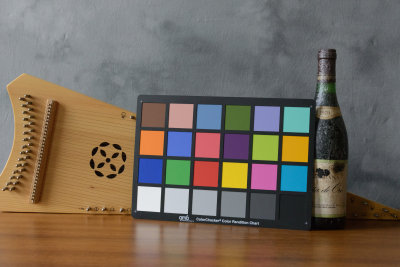
    Macbeth_ColorChecker_RGB

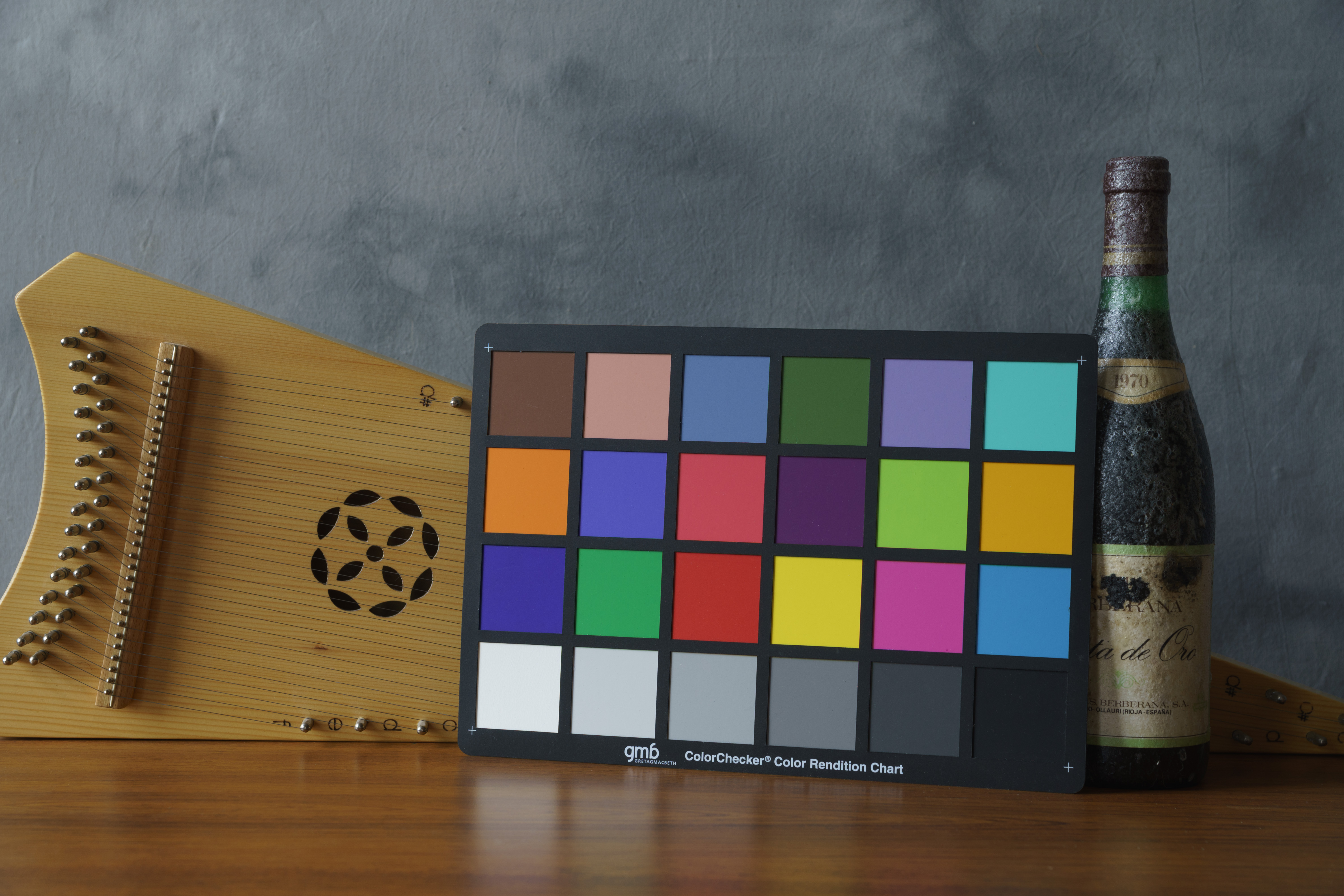
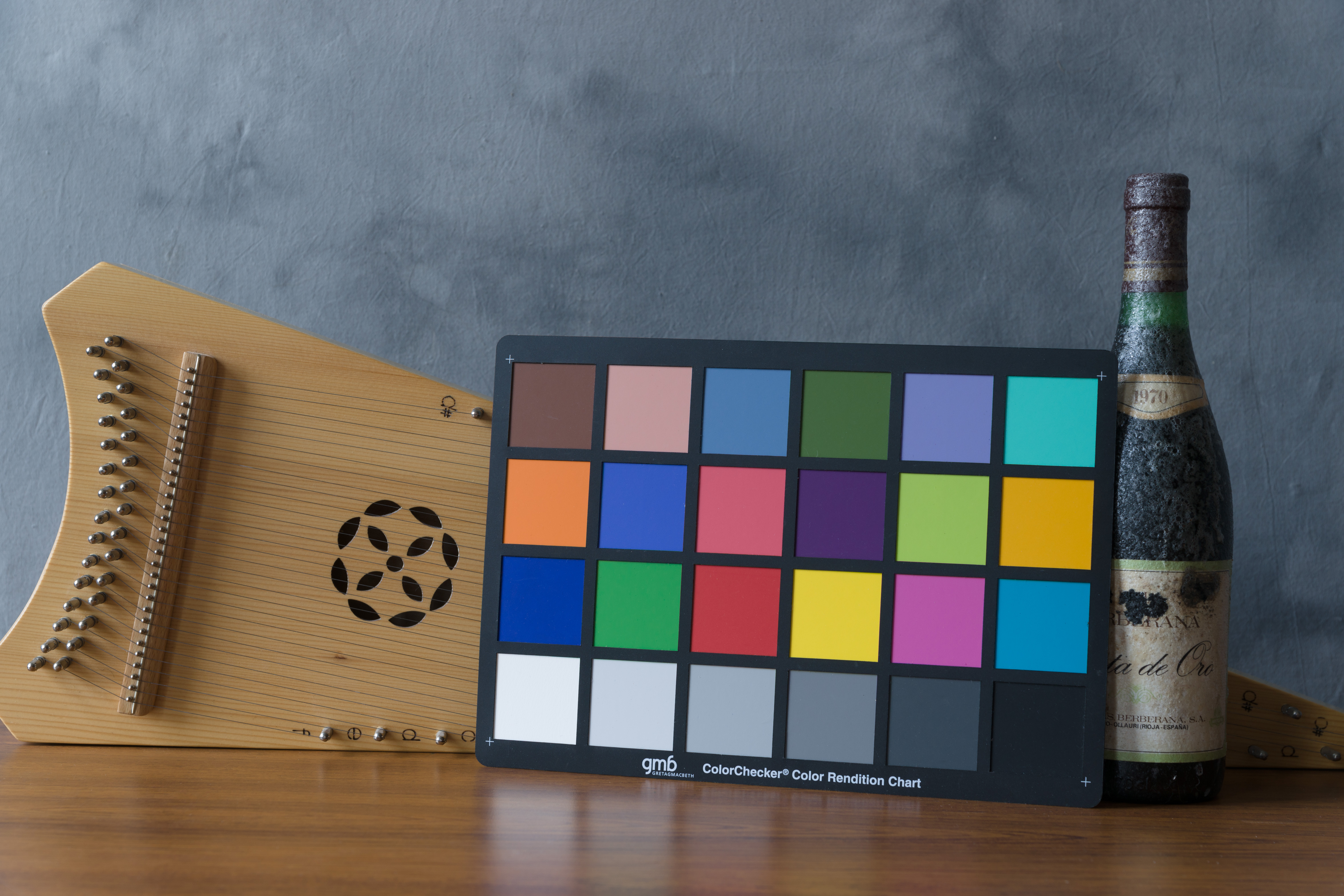
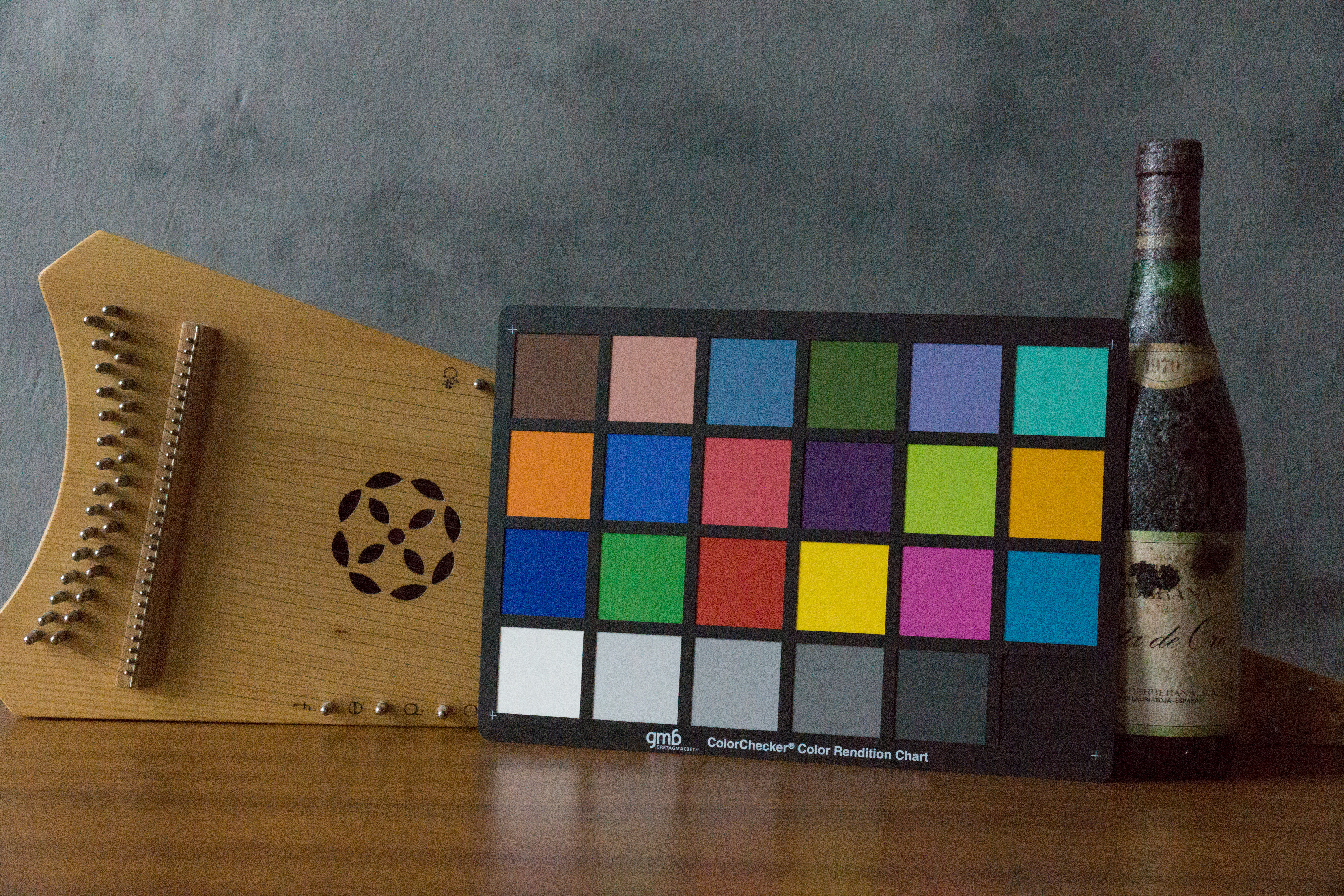
    This a MacBeth ColorChecker rendered using the official sRGB values.

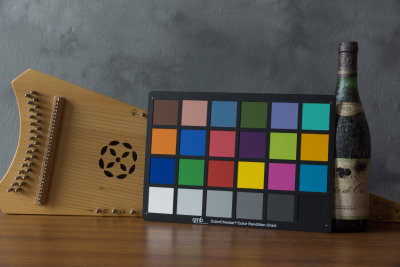
    iso200colourchecker

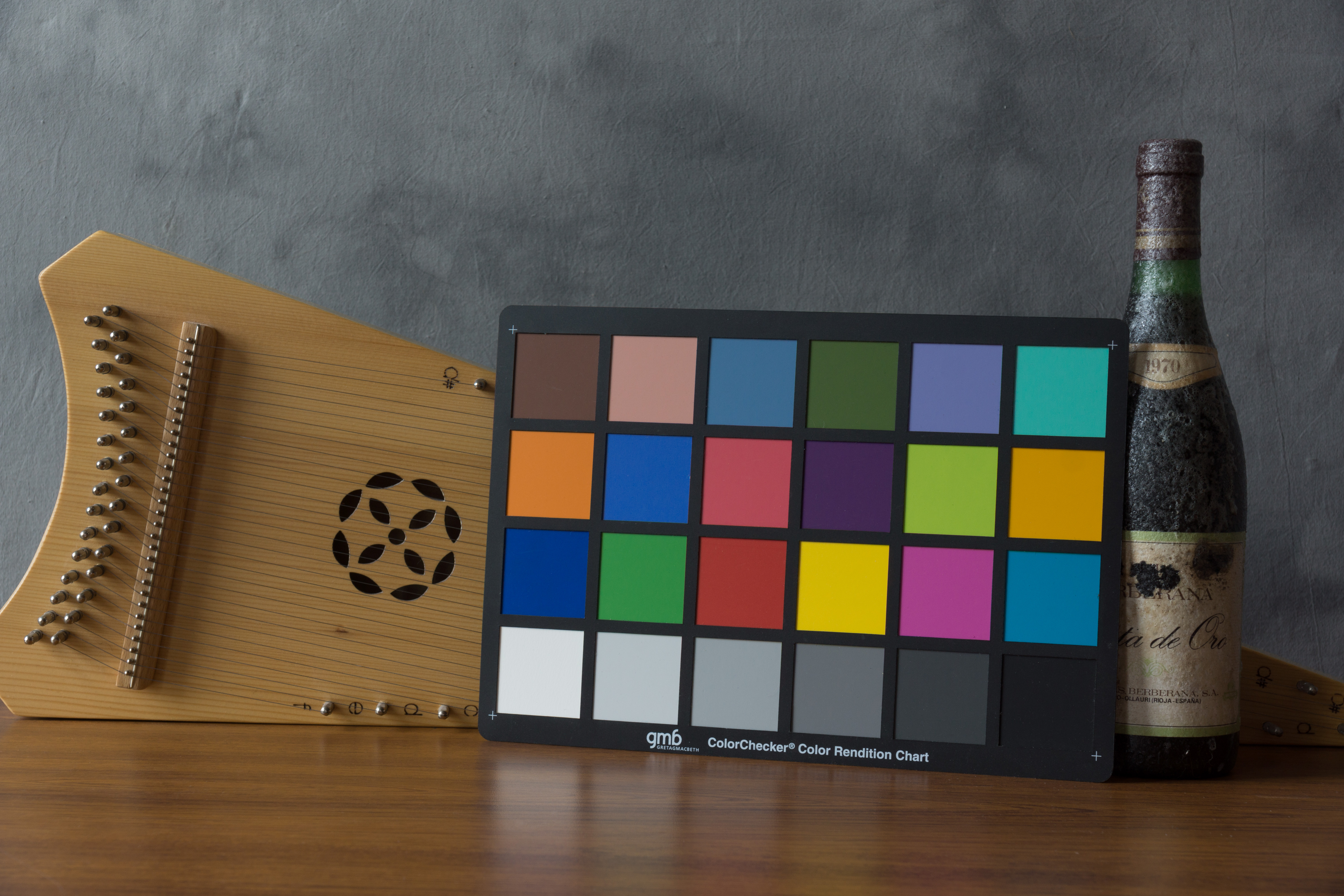
    This is an ISO 200 shot on the A58 with the greyscale white balanced to match the above, Iridient Raw Developer conversion using Iridient’s A58 profile. See later comments on colour and reds.

    As for dynamic range, it falls off as the ISO in increased. At ISO 100 or 400 a typical high contrast sunlit scene is perfectly recorded, with only bright specular highlights clipping to 255-255-255. It can handle everything from shadows on dark areas to direct light on white. A few practical comparison shots show that the RX100 can do exactly the same things – indeed, precisely the same areas clip at the highlight end.

    This simply indicates to me that Sony has matched the processes used in the two cameras against a common exposure and contrast standard. I’d have the rate the JPEG engine of the RX100 a little better than the Alpha, and images seem to need less work. Against the Alpha 99, the 58 gains some significant processing speed in raw converters as it’s producing 20 megapixel 12-bit files compared to 24 megapixel 14-bit.

    Click this for the full size to see detail.
    Compare this RX100 shot. It’s interesting.

    A hidden benefit of the 20 megapixel sensor is that if you use Adobe Camera Raw, this program offers a range of preset optimised output sizes converted directly from raw, which can be previewed at 100% of their actual pixel size before conversion. All 24 megapixel cameras have this as their largest output size, all you can do is downsample. 20 megapixel cameras offer a 25 megapixel output option, as do 16 or 18 megapixel models. The RX100 has already proved to me that it can make a 25 megapixel image that’s hard to tell from a native A77/99 image. The same goes for the Alpha 58. It can be set to export to this larger size, and if you use a top grade lens and low ISO, the result will be better than a native 24 megapixel at higher ISOs with a medium-quality lens.

    Overall, I find it hard to rate the new 20 megapixel sensor as better than either the classic 16 megapixel ‘sweet spot’ sensor or the maximum 24 megapixel APS-C, but it is as competent as either of these in its own right. I guess the truth is that at all these resolutions, superb image quality is possible.

    Other aspects of performance

    Since the A58 uses the 15-point, 3-cross AF sensor which has been proven ever since it first appeared in the A580 and A55 it has identical performance; fast, very accurate AF down to EV -1 (50mm f/1.4). The exposure metering is, again, the familiar 1200-zone Sony system and works down to -2EV.

    The actual focusing mechanism works no better with SAM or SSM lenses than with screw drive. It’s not the best ‘old’ mechanism in there and it lacks fast/slow AF setting, but it’s fast for certain. In low light although AF will lock, it needs a good target. Throughout my use of the camera I found the focus the least accurate and consistent of any Alpha body I’ve used, leading me to question whether I had accidentally set the lens to MF, so many pictures were clearly focused on some other plane than the subject, nearly always a definite back focus. The AF module is officially the same as the A55, A580 and so on. I can’t help thinking it is the same design but perhaps, like the rest of the camera, built to a budget.

    The A58 couldn’t really back focus this shot at f/8 but it took three shots to get one sharp.
    Click the RX100 (f/5.6) example too, to see the real difference.

    Switching between rear screen and EVF using the eye sensors, or if you have the rear screen off just turning on the EVF, is good on this camera. Its balance tends to prevent the eyepiece sitting against your chest, and thus avoids accidental activation, but it’s always brought the EVF into action by the time your eye is close enough to use the finder.

    Regrettably the EVF and rear screen both lack the instantly visible high resolution needed to know whether your image is pin-sharp. Even the far superior finders and screens of the A77 and A99 do not give you the same awareness of this as an optical finder. The good news is that Focus Peaking can be turned on. This really isn’t sensitive or accurate enough unless you magnify the image, and much of the time, you simply don’t have time to do this.

    So, the A58 is capable of pin-sharp images and you can be sure under the right conditions with the right technique that you won’t be short changed out the 20 megapixels you expected. But a lot of the time for everyday shooting it’s not very good at getting AF pin-sharp, and those same 20 megapixels do their best to show any error clearly.
    In practical situations, ISO 400 is as noise-free as ISO 100 and gives you the chance to use a smaller aperture for more depth of field. The 18-55mm SAM II lens is not very sharp at 55mm wide open, and it proved optimistic to expect f/6.3 or f/7.2 to be much better. The old ‘one stop down for zooms’ rule works well enough. The 20 megapixel sensor shows signs of slightly softening at f/11 so the sweet spot for me has to be around f/9 or f/10.

    The A58 has slightly warm tones overall and pinkish flesh colour
    The RX100 on the same scene is more neutral or cool

    You can click the images above for full size versions (same applies to all those shown in link frames like this).

    As for colour, you’ll be happy if you have always like Canon DSLRs. not so happy if you were either a Sony (sunny!) or Minolta (full spectrum) sensor colour fan. This sensor shows every sign of having relatively weak RGB colour filters and a non-linear response, with underexposed shadows on higher ISOs in daylight tending towards magenta. It’s rather too easy to get putty-pink skin tones and a certain lack of subtelty in sky gradations, though blues and greens are not bad. Subjects like red flowers test the colour discrimination of the sensor to the limit.

    Holyrood gardens

    It’s truly intense – but is it realistic? Camera profiles for raw conversion may tame this.

    Let’s just say that every other current Sony Alpha model, and many past ones, will yield more visible difference between close hues. This is what you might expect from the more densely populated 20 megapixel sensor but, as ever, I’m left wondering why the little RX100 seems able to yield better colour (whatever DxOMark.com may say – but they also put the low light ability of the RX100 way below its actual performance).

    At present there are no camera profiles available when converting files using Adobe Camera Raw, and the Adobe Standard colour seems to handle reds from the A58 badly (this is why I refer to Canon – the reds look much the same as problem Canon reds of the past). I don’t believe that red paint, red clothes, red street signs and red flowers are all are one type of red and when clipping warning is turned on, almost all the reds clip.

    Shutter and flash

    The shutter of the A58 is able to synchronise short-duration fast triggered flash, such as a thyristor camera top gun, up to 1/250th on manual without any shutter curtain clipping; at 1/320th, a shadow intrudes slightly on the frame. This is a better performance than indicated in the specifications, but for studio flash (mains powered) I would recommend working at 1/125th and for Sony/Minolta dedicated flash at 1/160th.

    The shutter itself does not operate or make any noise whatsoever until AFTER the picture is captured when you use ‘Electronic First Curtain ON’ setting. The capping shutter blind has a cycle (close and return) of approximately 230ms overall in single frame mode resetting the camera ready for the next shot, or 115ms for continuous shooting which fits in with 8 frames a second fastest (cropped) frame rate. If you use the mechanical first shutter curtain, this adds exactly 50ms or 1/20th of a second to your release lag, which is not as easy to measure but seems to be in the order of only 20ms (1/50th).

    Overall, this makes the A58 one of the most hair-trigger responsive cameras you can possibly own for capturing action – or would if the AF were faster and more reliable. Pre-set focus, use manual exposure, and you can trigger exposures with this camera as fast as you can think – just like the A99.

    With its built-in flash or dedicated Sony flash, there’s the usual small delay caused by preflash. You may think the shot is being delayed more, because the shutter operates after the exposure, and then as the finder returns to life you get about 1/30th of a second of ‘review’ of the shot taken even with the 2s or 5s (etc) image review disabled. This happens all the time with the camera, the first frame or two of the finder refresh is a fleeting glimpse of your captured shot, and it’s useful. With flash you may be viewing a dark scene, the finder itself is blacked out when your flash fires, but this sudden bright image looks almost like a delayed flash through the eyepiece. Of course it is not, this is just an impression.

    The built-in pop up flash becomes a rather aggressive AF illuminator when flash is active and the camera has trouble finding enough light for an AF lock. You certainly do see the effect of this through the finder, a surprisingly long and bright burst of light. It must drain the battery fast.

    Flash exposure, long a problem with Alphas, seems predictable. A pile of black camera bags produces a full exposure (histogram hitting the buffers at the right hand end) while a white paper document in the middle of the frame results in one stop under. No doubt users will find specific flashguns or situations which produce wildcard exposure. That’s why you should always enable DRO+ Automatic or something like level 3 when shooting with flash. This dynamic range contrast optimisation process can produce great flash pictures out of the camera but remember it only works well at lower ISO settings, do not go over 800 and expect DRO+ to keep you smooth noise-free image.

    The A58 appears to allow DRO to be used at higher ISOs, which earlier cameras often lock out because of its effect on shadow noise. However, both the printed manual and the downloadable handbook contain many inaccuracies and ambiguities; even Sony’s specification for the camera on-line has problems, listing standard and magnified views in the finder instead of eyepiece glass and surround against the two eye-point figures.

    Wireless flash operates in the usual way, with the pop-up flash acting as a commander once paired by first fitting the remote flash, turning on, selecting WL Flash mode, and removing the remote. This is now a 20-year old Minolta technology updated – something which took Canon fifteen years to catch up with, after which they progressed further. The Alpha wireless flash works but it’s frozen in time. At least, with the optional adaptor, you can use earlier Minolta and Sony flashguns of the HS(D) generation and later.

    HS is the high speed burst mode (long duration resembling continuous light) and the A58 can use HS flash at all shutter speeds up to 1/4,000th. The A58 has a useful Slow Sync function which delivers and automatic dragged shutter setting according to the available light, and a Rear Curtain sync as well. The camera may, with the built-in flash, switch to a slow longer recycling time even if you load a fresh battery when shooting flash intensively. This is to prevent the camera (not the flash) from overheating.

    Studio compatibility

    One reason I obtained an A58 to look at was because Ian Cartwright, a friend of mine who shoots models and babies underwater, had obtained an Alpha 580 on my advice to replace an A350 only to find that this camera forces a strange blackout delay of almost half a second when using any dedicated flash. The A350’s otherwise similar Quick Live View does not have this peculiar firmware fault. I can confirm that the A58 fires in real time, and unlike either of the other two models, can be used with PocketWizard or an infrared trigger. That’s because the finder view can be switched to ‘Setting Effect OFF’ which defeats exposure simulation and gives you a bright view even in manual with setting like 1/125 and f/11 under dim modelling or ambient light. The A58 can be used in the studio as easily as the A99, because of its ISO hot shot compatibility and this feature.

    Dried roses

    For this studio shot I chose not to use flash, it was lit by my Interfit 3200 tungsten outfit (great for video) instead. The colour rendering matters little because the image is adjusted in processing to give this look.

    As to whether you would ever want to use an EVF camera for studio work, that’s another matter. I have bought a replacement Alpha 900 after three months trying to use EVF for studio set-ups and temporarily reverting to my A700. It’s not just the quality of what you see when composing and adjusting your studio shot (stray hairs over a face or a clothing fibre landing on your still life are just not visible with EVF) it’s the need to have power saving permanently turned off to keep the screen or finder awake as you do all the lighting and reflectors, background and subject adjustments. Nothing is more annoying than having to half-press the shutter to wake up your camera every time you go back to check – and with the A58, the shutter release is so light it’s easy to take a shot instead of waking the finder view.

    The A99 can be used tethered and plugged in to AC, with a USB cable to a remote capture Mac or PC, and a live feed to an HDTV monitor. Do that and the business of setting up and adjusting a studio shoot becomes far easier with live view. I just don’t do enough work of any kind to justify that, it’s quicker to keep using the old familiar glass prism. It looks as if the A58 can be used the same way, joining the A77 and A99 by having PC Remote capability and HDMI previewing, while the A900/850/700 are the only other choices in Alpha history able to use PC Remote.
    This does open the door to using a netbook, for example, as an intervalometer timer or remote release. There is no App for iOS or Android but the PC Remote control panel is well designed to fit a smartphone. There is no Wifi in the camera (it has good compatibility with EyeFi cards, invoking special display icons).

    Video

    Due to the softness and lack of AF sensitivity of the 18-55mm SAM II lens, my couple of quick test videos in real situations were not stunning but also not too bad. The sound quality is reasonable without plugging in my Rode Video Mic, stabilisation of video is very good indeed, and by using the dedicated video setting I was able to set my own shutter and aperture. You can also lock out the movie button except when the mode dial is set to video, preventing accidental video clips.

    If you want the camera for video, either the 18-135mm SAM lens or even better the 16-50mm f/2.8 SSM (quiet fast focus) will do much better than the 18-55mm. The A58 lacks the highest quality video encoding of the A77 and A99, but you can get the vital requirement of 25/30fps at 1080p, the second highest level found on other Alphas. The clip above is at best quality with the 18-55mm; it took some fairly extreme action (the car driving right towards the lens) to persuade the AF to bother to try to track, most of the time it was telling me, hey, that’s good enough, no need to refocus… or even focus to start with.

    Special functions

    Although the A58 has been trimmed down in some ways, other aspects have been improved, compared to past entry-level cameras. There is no wireless remote drive mode, and no 2sec self-timer, so unless you buy the unusual Micro USB wired release you have to use a 10sec timer for shake-free tripod work.

    Bracketing is only three frames, but the range is now large – 0.3EV, 0.7EV, 1EV, 2EV or 3EV steps. HDR Auto can also use a 6EV span (±3EV). You can not control the auto ISO range, but it’s a reasonable 100-3200. If you shoot JPEG and choose multishot noise reduction, an auto 6400 may be selected, and some of the Scene modes may also enter this range. But if you shoot raw, you have to select ISOs from 4000 to 160,000 manually which makes them harder to get by mistake.

    There are many picture effects, both single and multi-shot, in the A58. One of the more interesting is Rich Tone Black and White, which uses three shots to build a gradation resembling a traditional darkroom print.
    The sensor does not appear to support sub-frames, or cropped raw files, in the same way the A99 or Nikon D600 can do. The maximum frame rate for continuous shooting is 5fps for full size raws, but the buffer is minimal and the best I could get was four frames in a burst before a major pause and intermittent resumption, never at 5fps. On raw you get click-click-click, off to make coffee, click, take a walk round the block, click, remember to turn the lights off before going to bed. It’s that bad. JPEG Fine, which delivers 4 frames at 5fps, then becomes intermittent and variable in capture speed but a little faster than raw.

    To get anything better, you must convert the camera into a 5 megapixel 3X factor (2X crop of the 1.5X sensor) by setting it to T8 (Tele 8fps) continuous mode on the main control dial. This delivers about 8.1fps for 24 frames on a 95MB/s SanDisk card, then slows to capture around 5-6fps in a regular pattern of two frames at 8fps, hesitation, two more and so on. On a slower card, Transcend SDHC, I got 12 frames continuous and a slower more regular tail. Memory card speed is clearly critical for getting the best from the A58.

    Since you can’t get a 5MB cropped raw, exactly how this mode functions is a bit of a mystery as JPEG images are produced via an intermediate raw file – that’s how things work. So inside the camera, 24 frames can be processed and cropped in 2 seconds – but it can’t even manage one second of unprocessed raws at 5fps. This indicates the processor is fast and the input buffer big enough, it’s the output buffer and card interface which causes the bottleneck. Card interfaces and drive assemblies are third party products normally bought in by the camera maker, while the main processor is their own (or a dedicated design based on a Fujitsu module or other OEM).

    This camera is extremely low cost and I think this is simply one area where cost savings ended up reducing what could have been a great specifiction and performance.

    Digital and Clear Image Zoom

    The A58 has a Zoom button, like a Cyber-shot DSC RX100’s zoom control that goes beyond the mechanical range of the zoom. Since you can’t go beyond the zoom on the lens itself, you go to the tele extreme, press the zoom button and a bar appears on the displays. Up to 1.4X magnification, you get a cropped shot (JPEG only) but this crop fills the EVF/screen and is enlarged by interpolation to 20MP. Up to 2X, you get Clear Image Zoom which is profiled or custom interpolation, similar to software packages which can enlarge JPEGs better if they have a profile for the camera used. Up to 4X, the rest is ordinary Digital Zoom which means the resulting 20MP image has really been created from a 1.25MP area of the sensor, and it shows.

    Fine JPEG, normal shot
    Interpolated Zoom 1.4X. 18-55mm at 55mm.
    Clear Image at 1.9X (all at f/8)
    Digital zoom to 4X.

    I made some tests with the 18-55mm and its vague focusing and overall modest quality lowered the bar for the digitally zoomed range. Then I tried with my extremely sharp Sigma 70mm macro. I think the 1.4X range is acceptable for all normal uses, the 2X range is almost acceptable, beyond this the softness overpowers any possible reason to want a 20MP output file. There is a mark on the zoom bar showing the change from resized and Clear Image (1.0-2X) to Digital Zoom (2.0-4.0X) but I was unable to get the zoom to fix on 2.0X, instead it insisted on using 1.9X or 2.1X but placed the 2.1X on the ‘safe’ side of the mark.

    70mm macro, raw shot at f/10
    Fine JPEG of same ISO 200 shot.
    1.4X interpolated zoom.
    2X Clear Image zoom
    4X Digital Zoom. Still 20MP…

    As expected, the A58 has Sony’s excellent sweep panorama mode, and just about every other Sony original technology around from face recognition and smile shutter through to auto framing (an intelligent crop which keeps a copy of your uncropped JPEG too) and AF object tracking. Its Intelligent Auto and Super Auto modes will serve the beginner and general family photographer well.

    The A58 has sensor cleaning and does vibrate the sensor on shutdown, not on switch on; this is not listed in the specification, which just mentions the anti-static coating. Manual cleaning is possible and Sony make two notes of interest – they advise blower cleaning the back of the mirror before lowering it (so clean both this and the sensor in one step) and they say that you can not shoot with the mirror raised. My camera had no sensor spots on delivery.

    Future expansion

    The A58 shares with the NEX-6 and Cyber-shot DSC RX1 the new Multi Function Shoe, and some of the accessories for this shoe are futureware. All these cameras lack the GPS found in the A99. The Multi Function Shoe’s interface includes pins to connect a GPS device and record location data as you shoot.

    alpha99-shoe

    Despite my affection for the robust qualities of the little Alpha 55, the Alpha 58 does more and when armed with my 16-80mm CZ lens makes a good travel camera. For that, I want to have GPS. So of all the possible future accessories for the shoe, this is the one I hope Sony will produce soon. Other possible accessories are a Wifi remote shooting module (the interface could allow image preview remotely) and a PocketWizard or similar wireless flash trigger. The shoe interface might even enable uncompressed video streaming to external recording devices, or back up between the camera and an external SD card or USB stick. It can also feed an external larger video monitor or a mic/headphone module which might have auto gain over-ride for sound recording – or perhaps these functions may be combined one day in a video/audio adaptor.

    These are the prospects which this one change in the Alpha system brings, yet there is no sign that Sony is rolling out MFAS accessories. It’s also true that each camera’s own MFAS may have missing pins, or differently assigned pins (that would be seriously bad planning). You can not, for example, use the EVF of the RX1 on the A99 shoe, though both cameras have 24 megapixel sensors and the same EVF display resolution. The camera does not recognise it.

    SONY DSC

    Made in Thailand – not a bad thing, and Thailand has a big camera industry with Nikon, Sony and others. But this does feel like the lowest cost, most pared-down offering ever in the Sony DSLR/SLT lineage.

    Changing the market

    It is a pity that a camera with a brand new sensor and many advanced features and functions should ever have been designed down to the lowest price-level by reducing the specification of far too many components, from the lens mount and body itself to the displays and the buffer and card interface.

    Sony’s manual and general approach to the camera menus and built-in help indicate that it’s targeted at what Americans would call a ‘soccer mom’ market. Well, your own kids are always beautiful even if the rest of the internet community groans inwardly every time another snapshot of infant overfeeding is posted to support how wonderful dad’s new camera is. They are always polite and agree.

    Same goes for this camera – for those who acquire it as a new addition to the family, it will be the best thing ever made. And in some ways they will be right, nothing else comes close for the money. Unlike the sprogs, the Alpha 58 has inherited many desirable genes but suffered from malnutrition during its gestation. It could have been a robust, capable semi-pro camera in the tradition of the A580, the last Sony Alpha to have an optical finder.
    Perhaps the 20 megapixel sensor will appear in a higher level body. How about an A68? For me that would be close to home (look it up on a UK road map!).

    – David Kilpatrick

  • Sony’s Alpha 99 – mastery wrapped in dilemma

    alpha99side

    The launch of and initial reaction to Sony’s Alpha 99 has been spoiled, for many, by the overpricing of the camera generally and to a greater degree in some key markets. The promise of the SLT design, and Sony’s move away from flapping mirrors and optical prisms with their associated collimation and alignment, was one of reduced manufacturing cost and more competitive product.

    Along with this, we should remember Sony’s 2006 statement that external mechanical controls, switches and buttons would be reduced on future models for the same reason. The Alpha 99 has as many external physical controls as any predecessor and will make traditional users happy.

    a900toa99

    Compare the Alpha 900 and the Alpha 99 – despite apparently very different designs, they share many points and clearly come from the same gene pool. There is no longer any need for the largest glass prism of any modern DSLR, the power switch has moved to Nikon position round the shutter release, lines are rounded off. The construction is similar as the strap lugs fitted through the outer skin into the solid magnesium chassis indicate.
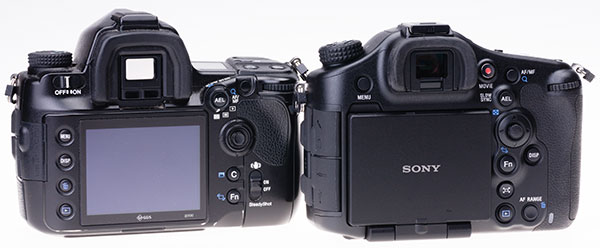
    a900toa99rear

    From the rear, the 900 looks somehow more complex because of the left-hand button array. In fact the A99 has just as many buttons (it is only missing a SteadyShot switch and the selector round the AE lock button for metering method – this is no longer as important with the 99 doing its metering directly from the imaging sensor).

    Out there we find Canon’s lightweight travel-friendly full frame 6D appearing at £900 lower launch street price (UK) with both that essential built-in GPS and the marketable function of WiFi, and Nikon’s almost comparable D600 officially at a £500 lower RRP, and a street price match for the Canon. In practice the UK Sony price of the A99 fell from £2499 to £2299 in the first two months on sale; the D600 fell from £1955 to £1495 in the same period (WEX dealer figures) and on that basis we can expect the see the Canon fall to £1395 in early 2013. By then the A99 may have fallen to £2195.

    Sony lenses are not cheaper, nor wider in range of choice or sources of supply, than Nikon or Canon. There is no collateral benefit when you hand over as much as 50% extra to Sony for their innovative cost-saving technology. In my British Journal review, I concluded that the Alpha 99 was between 30 and 50% over-priced and combined with the cost and limited range of Sony lenses there would be little good reason for any new full-frame entrant to prefer Sony over Nikon or Canon.

    At the same time, the Alpha 77 – so close a sister to the 99 that it shares exactly the same EVF and the same file size, with identifiable advantages in some respects – has been selling for £819 body only in the UK when the 99 in the same store was priced at £2299. That’s 64% less, 36% of the price or just over a third. You could almost buy three A77s for one A99. And it even has that very useful built-in flash.

    a77-a99-topaligned

    You may pause to work out which of these, photographed to exactly the same scale (one shot) and then moved so that their focal plane markings coincide horizontally, is the 99 and which the 77. The 99 is actually bigger but looks smaller.

    a77-a99-sideheight

    This will give you a better idea of the height of the A99, and also the improved eyepiece which puts your eye further away from the camera screen or back than the A77.

    Assault and battery

    In fact, there’s a hidden penalty in addition to the high price of the A99. The Nikon D600 with its single 1900mAh battery as supplied will keep on shooting into four figures where the A99 with GPS enabled manages a couple of hundred on a good day with the wind behind it from 1650mAh. Officially it does over 400 without GPS. That was not my experience, any more than it has been with the Alpha 77.

    Perhaps this is because of the odd conditions Sony uses to measure battery life – only using a MemoryStick PRO Duo card not SD, no card in slot 2, ambient temperature 25°C, shooting Fine quality JPEG only, shooting one frame every 30 seconds and turning the camera on and off every ten shots, and not having GPS active. Needless to say I shoot raw, back up to a second card with JPEG, and have GPS active. That’s why I bought the camera…
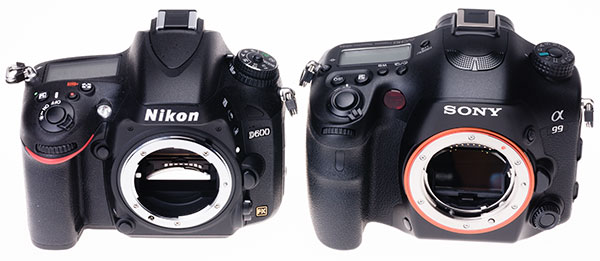
    d600-a99fronttop

    The economical Nikon D600 is a direct competitor, despite rabid claims on internet that the 99 is ‘professional’ and the 600 is ‘consumer’. They are both semi-pro models but the 99 probably has a better shutter mechanism and a higher precision body. The Nikon has better image quality and battery life. Both have similar dual card slots, manual adjustment of audio input for video recording, wireless flash options, grip and so on.
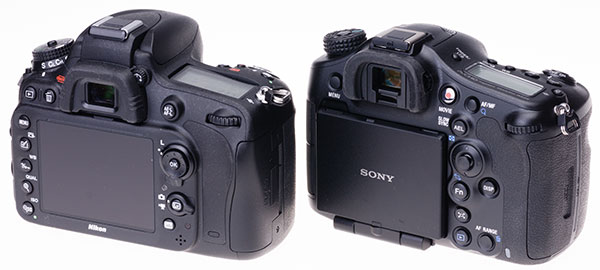
    d600-a99rear

    GPS eats batteries. We’ve got a GPS module for the D600 which runs off the camera’s power, but so far have not had it switched on permanently for a week. Maybe it will reduce the D600 to the same ‘battery every day or two’ as the A99. The Canon 6D is the only other DSLR made with built-in GPS. Unlike the A99, the 6D does not turn off its GPS when you turn the camera off. Result? The 6D drains a battery in four days, flat – dead flat 0% – if you just switch the camera off and leave it in your bag with the GPS symbol showing. You have to go into a menu and turn off Enable. At least the A99 does not draw on its battery at all when switched off, regardless of settings.
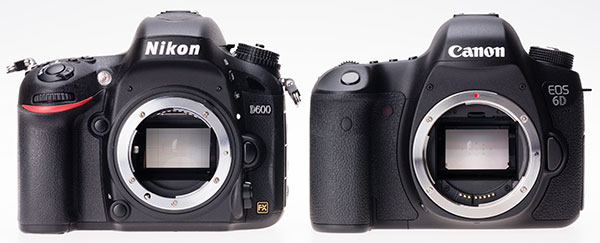
    d600-eos6d

    The EOS 6D compared with the D600 – it’s smaller, lighter, and built to a far more consumer-level standard with minimal controls. But like the 99, the 6D has GPS on board, and as a ‘first’ in this field it includes WiFi, which is not just file transfer. We used a free iPhone app to view, focus, adjust settings and shoot remotely and wirelessly with the 6D (EOS Remote). This is bound to win substantial sales.

    You need deep pockets in two senses for two extra Sony batteries (£136) or the add-on vertical grip at £299 plus two batteries (not included). The first option will keep you going without GPS about as long as the Nikon on one charge. If you are travelling and using GPS, be prepared to change and charge one battery daily.

    Another reason for this short battery life is the electronic viewfinder. Unlike any optical prism finder, it uses as much power as shooting video. Even if you turn the camera off every time it leaves your eye, the typical length of time needed to compose and follow subjects will add up. I do not have review enabled, and I rarely ‘chimp’ because one big plus side of the Alpha 99 – as you will learn – is the near 100 per cent success rate achieved by its metering and focus. If you use the rear screen for composition instead of the eye-level finder, you can extend battery life by 16%.

    Sony must be commended for sticking to the same battery format used by all larger body models from the Alpha 700 onwards. I do have half a dozen spares but of course, many are now getting old and barely manage 150 shots in the 99. What Sony must do is to take the advances made in lith-ion production and create a higher capacity NP-FM500H. Third party makers have been able to boost their clone batteries to 2000mAh (I’ve bought two and they are non-compliant with the chargers and clearly don’t deliver what they claim…). Sony’s battery should match Nikon’s similar size at 1900mAh, even if the EVFs now standard across the Sony range will always eat twice as much power as a regular DSLR.

    The EVF dividend

    Would-be Alpha system professionals and advanced amateur users face a future of electronic viewfinders. The good news is that at photokina 2012 Epson showed a prototype with twice the resolution of the current 2.3 million pixel ceiling, and in five years most current complainers will accept that an EVF can be as accurate as any true groundglass screen ever was.

    We tend to forget that after autofocus arrived focusing screens lost their visible granular or laser-cut structures unless you deliberately specified a type intended for manual focusing. Plain old groundglass has a ‘dot’ all of its own because it does break the image up. Minolta’s Acute Matte screen was like a superfine microprism field. The new Epson developments come so close to being as fine as this kind of screen, visually, that you might be able to fool someone into believing it was not an electronic finder.

    While the A99 finder is excellent, it falls a touch short of this. It is absolutely identical to the Alpha 77 in every parameter including virtual window size (the magnification figure given by Sony of 0.71X compared to the A77 1.09X is all down to using a 50mm lens on both for measurement). Eyepoint is identical despite the slightly different overall design of the eyepieces and the size of the rubber surround. If there’s any improvement, it lies in the illumination range and contrast control of the OLED unit which has been given one additional user control, colour temperature. You can make the finder warmer or cooler in colour independent of any picture style or WB adjustment.

    This is a good example of where the EVF’s great clarity in low light pays off – an ISO 3200 image taken hand-held where a tripod was not appropriate, using the Sigma 12-24mm which has fairly strong vignetting. To see and align the geometry of the shot (bottom cropped off) was much easier on the A99 than it would have been on an OVF camera. Click the image for a full size file.

    In full sun, the finder appears very dim compared to any good optical finder. In overcast light, it’s a good match. As the light fails or you move indoors, the EVF shows substantial benefits over optical systems. After dark, it can make accurate composition easy instead of almost impossible.

    Here, the A99 has the edge over the A77, NEX-7 and all predecessors even including the NEX-5n and presumably the 6 which I haven’t tried. The larger sensor’s better high ISO performance together with its pixel count keep the coloured noise at bay for another stop or two lower light levels. This coincides with an important transition. The kind of indoor artificial light level where the A99 remains very clean using an f/2.8 lens is typical domestic light – brighter than restaurants, not as bright as stores and malls.

    Anyone using the A77 will confirm that the 16-50mm f/2.8 lens brought a real benefit in this sort of lighting despite its other failings, by improving the finder experience. Combine the A99 with a good fast lens like the 50mm f/1.4 and you get a relatively natural view of the world after dark.

    The A99 returns the auto eye start sensor, which switches between rear screen and EVF if you have that function enabled, to below the ocular instead of above it as on the A77. This makes viewfinder attachments work without blackout glitches, including Sony’s 1.15X eyepiece magnifier, which for me enables a full view of the screen and a truly impressive finder size.

    Ergonomics and control

    One of the benefits of the EVF is that you don’t need to use the rear screen at all. The Quick Navi interface developed more or less from A700/900 Quick Navi has to cope with a bewildering number of pictograms and readouts, ranging from a full histogram to digital spirit level, and a complex AF setup. With the help of carefully repositioned buttons, it succeeds. I’d say that the A99 has the best user interface I’ve seen on an Alpha since the 900. The top LCD display panel is much richer than the basic one of the 900, and does not deserve some of the criticism levelled at it for duplicating stuff you can see on the rear screen. I work with the rear screen permanently turned to face the body, unless I am actually employing it for composition or image review. The top LCD provides vital at a glance info about manual or metered exposure settings, ISO, state of ± override, battery power, drive mode, WB, file type and image remaining count.

    It is, however, blank when the camera is asleep. Later in this review I’ll be comparing the A99 with the Nikon D600, which we now also own and use alongside it. Nikon’s top LCD shows some basic info (shots remaining) all the time. But it’s interesting to note that Sony gives you the correct information when Nikon does not! Both cameras have two card slots. You can set both of them to work in overflow mode, fill one card, then the next. Nikon shows you only the shots remaining on the card in use. Sony shows you the total. The Canon 6D LCD also goes blank when the camera is turned off, except for showing a GPS symbol to warn you about leaving this battery-eating function Enabled.
    a99-modedial

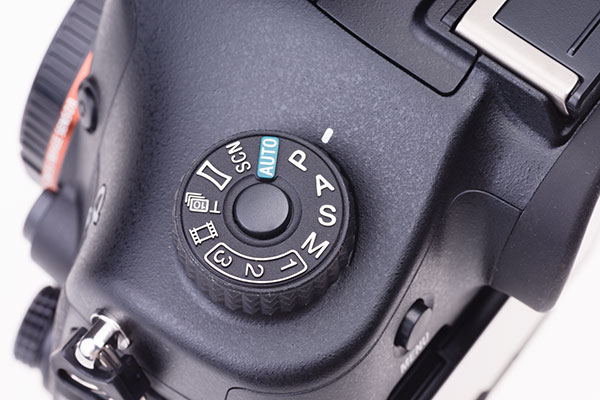
    The Mode dial has three memory positions, a Tele 10fps (1.5X crop) position, panoramic, Scene selection, Intelligent Auto, PASM and a separate Movie position. You can opt to lock the Movie button out except when the dial is set to this.

    Another similarity is the mode dial, locking on all three cameras. Here, Sony goes for a more purposeful central locking action making it a little harder to adjust the dial. They also cram more on to the dial, including the invaluable feature of Memory 1 2 3 positions (as on the 900). There’s a special movie mode which not only prevents accidental movie shooting, but when used allows shutter, aperture and ISO to be set. The range for this is exceptional, you can film at 1/8,000th shutter speed if you really want to break rules.
    a99-mainbuttons

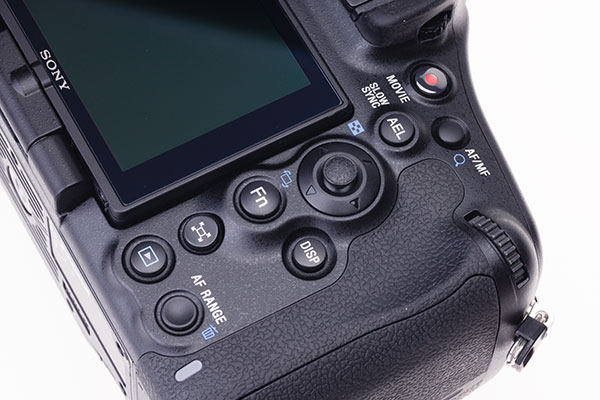
    The right hand buttons include Fn, your access to Quick Navi on the screen or in the EVF. There is a new AF Range button which I simply don’t seem to need – I wish this could be customised to become a SteadyShot On/Off button, something I need to do far more often when working with a tripod.

    The A99 has a total of 19 operating buttons, some of which have only a single use such as LCD illumination or Playback. The manual identifies 18 primary default functions plus the Silent Controller, of which more later. One button, Fn or Function, accesses Quick Navi and its 23 adjustable settings many of which have multiple choices. Fn can direct access 18 functions outside Quick Navi.
    a99-custombutton

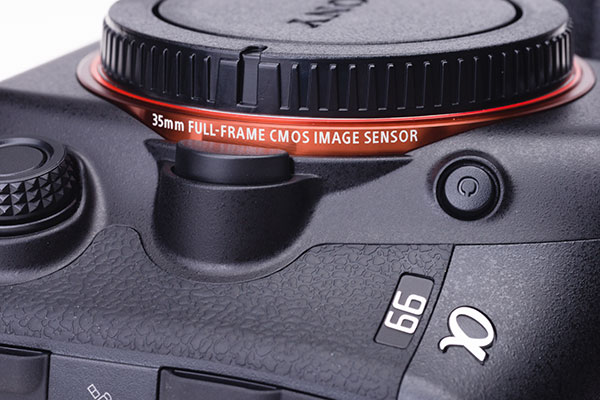
    Here is where the Custom function button has been moved to – under your left index finger, where the flash pop-up button used to be. Slightly pointless wording on the bright orange anodised lens mount bezel lets you know this camera is not actually aimed at working professionals.

    The Menu button accesses six main menu tabs. Still Shooting has four menus covering a total of 20 parameters. Movie Setting has two menus and eleven adjustments. The Custom menu has a huge depth, with six menus covering 33 functions some of which in themselves cover other buttons – five of the dedicated buttons on the body can be assigned any one of 35 functions or behaviours, including their native marked use. The Playback menu has two tabs, with ten parameters. The Memory Card Tool menu also has two tabs and nine functions, needed because you can choose where and how to save raw and JPEG images and movies.

    Only the Clock Setup menu remains its usual two-entry basic form. The main Setup menu has four tabs covering 24 settings or actions. If you want to try adding all this lot up, before even investigating the complexity of settings within some aspects like Picture Style, you’ll realise there are thousands of different exact ways in which an Alpha 99 can be configured.

    Canon has always had a secret weapon whenever anyone failed to get the expected good results from their camera – ‘ah, you didn’t set it up correctly…’. Now Sony has the same rather weak excuse. Not setting the camera up at all should result in successful images. No buyer should experience Default Setting shortcomings out the box. Setting it up expertly should lead to wonderful, perfectly tuned, almost-impossible-to-get-easily images.

    And, I am glad to say, if you get an Alpha 99 out of the box and never touch a single one of these adjustments it is more than likely you will get perfect images. That is because unlike most DSLRs, the Alpha 99 actually works like your eye. It focuses and exposes as effortlessly as you do and you can see far more clearly, through the EVF, what is happening to exposure and focus as you prepare to shoot.

    The EVF looks great in dark conditions – no coloured noise like the A55 and A77 generations, as the sensor is so noise-free. This is an in-camera ISO 1600 JPEG, click to go to the original full size file. It’s not bad at all.

    Real-world performance

    As I’ve said, we have been using the Alpha 99, Nikon D600 and Canon 6D side by side before I started writing this review. I did not have the 6D present when making colour-checker tests on the A99, A900 and D600.

    Shirley has used Minolta/Sony since 1980, when we first took over the Minolta Club. Before that she used Praktica (as many students did), Pentax and then Olympus. The OM system was her preferred camera for its size and weight, and the exceptional viewfinder.

    Well, after over 30 years using Minolta then Alpha, she’s finally departed from the system because of the change to EVF. Unlike me, she finds EVF view uncomfortable. The Alpha 700 was a great camera but sensor technology moves on, and she happens to be a regular abuser of long focal lengths and low light. The A580 has proved good but the very small optical finder has been an issue from the start. The Nikon D600 with 28-300mm VR lens may not be her ultimate ideal camera – we’re planning to try the Pentax K5IIs with 18-250mm, as that has a very good large optical prism finder. But Sony is now out of the picture and we suspect that she’s not alone. However good EVF technology becomes, some users will never feel comfortable with it.

    One reason is the need for perfect accuracy in adjusting the dioptre. Optical finder cameras have a certain latitude, always best with exact adjustment, but remaining sharp over a small range of error. The A99 EVF does not have any latitude. The dioptre is set in clicks, and one click either way puts the OLED display visibly out of focus. If your eyesight changes a lot or you move between spectacles and the naked eye frequently, you will need to make constant adjustments to the dioptre.

    The first thing we noticed when reviewing a few hundred raw files taken in  similar conditions with the two cameras is that Nikon’s auto-ISO implementation on the D600 behaves very differently from that on the A99. The Sony metering, especially in Program mode with Auto ISO and wide potential range set, prefers the lowest ISO acceptable for the focal length in use and the available light. Nikon’s system will select higher ISO settings, and smaller lens apertures, very readily.

    The Nikon meter is also calibrated out of the box to be generous in exposure, possible because the separate metering system is more influenced by light sources or high contrast and prone to big shifts in auto exposure with minor adustments to composition. At any given ISO, the D600 was often giving double the actual exposure – half of this doubling due to overexposing a bit, half of it due to Nikon’s different calibration of ISO.

    dynamicrange-a99

    Not only does the A99 have strikingly accurate auto exposure when confronted with very difficult conditions (Sigma 12-24mm shot above covering from deep shade to a white waterfall in sun), it also has 14-bit raw files with generous shadow detail and highlight recovery headroom. Click image to open a larger (not 100%) view.

    dynamicrange-histogram

    Here is the histogram and totally neutral adjustment set shown in Adobe Camera Raw before fine tuning the shot above to improve the brightness and clarity of the shaded areas. Note the excellent shape of the histo without top or tail clipping.

    The A99 meters exposure off the actual shooting sensor, using a 1200-zone colour sensitive matrix and intelligent bias towards single or multiple active AF points. In practice, it proved almost bullet-proof. Anyone who can remember the consistent off-sensor exposure of the old Konica Minolta A2 will appreciate the new Sony EVF and NEX models alike. They simply meter with far better consistency than any camera which uses a separate metering sensor. Of course this can also be said of Olympus, Panasonic and all mirrorless cameras. But they don’t all have the amazing 14-bit raw files and 12 EV normal ISO step dynamic range of the Alpha 99.

    When we processed the raw files, Nikon’s ISO 6400 was less noisy than Sony’s despite the very similar (not identical) Sony manuactured 24 megapixel FF sensors. The difference is a little more than we would expect from the 2/3rds EV light loss caused by the trans-flective SLT mirror. The remaining difference seems to be down to Nikon treating a gain which Sony would call ISO 4000 as one labelled 6400, but giving exactly the same exposure Sony would give at 4000. This is not very accurate, as depending on the actual ISO setting the discrepancy ranged from less than 1/3rd of a stop to around 2/3rds, but seems to increase at higher ISO settings. Thus Sony has an apparently clear disadvantage at 6400 or 12,800, but the camera is actually giving half the exposure.

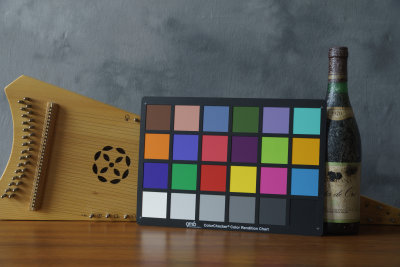
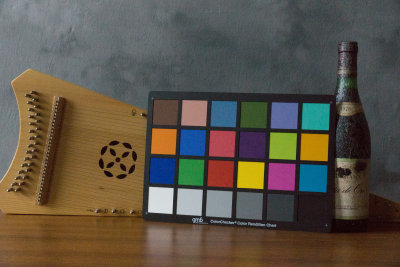
    Here are some small samples which, when clicked on, will lead you to our full size set of JPEGs which can be pretty large. These files compare the A99, A77, A900 and D600 at two ISO settings only – 100 and 6400. All are auto exposed under identical conditions using matrix metering, so the cameras have been allowed to give whatever exposure and apparent ISO they would do in comparison. All have been processed using identical settings with Adobe Camera Raw 7.3 – Camera Standard profile (Sony Alpha 900 profile for A900), Linear, default sharpening 25/1/25/0 and no noise reduction at all.
    A99 at 100
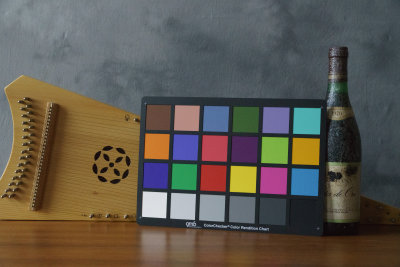
    A99 at 6400
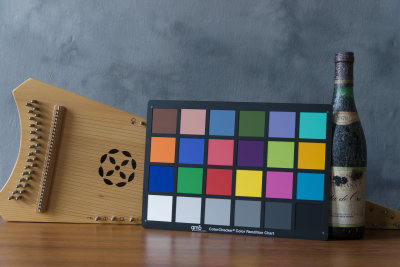
    A900 at 100
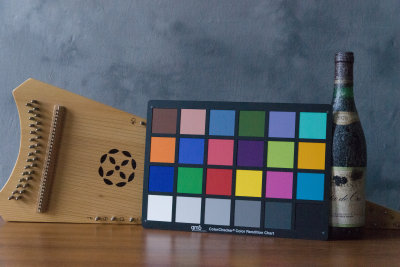
    A900 at 6400
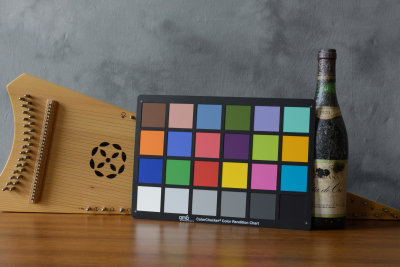
    D600 at 100
    D600 at 6400
    A77 at 100
    A77 at 6400

    anglescreen-85mm-100th6p3-640

    The Minolta 24-85mm at 85mm and f/6.3, 1/100th at ISO 640. A perfectly clean file, critically sharp though only one third of a stop down from wide open. Click image to view a larger (not 100%) version. The quiet shutter and articulating live view screen enabled this natural study.

    Although the Nikon lens used was a consumer grade optic the £800 28-300mm VR, when it managed not to misfocus or produce a strange reverse-VR blurring due to Shirley’s initial failure to delay shooting by a tiny amount to allow the lens to settle, often produced slightly sharper results than the 1999 Minolta 24-85mm I chose to use on the A99. Subsequent tests show that the Nikon sensor seems to have a slight fine detail advantage over the Sony at ISO settings around 200-800 with Adobe Camera Raw 7.3. While Canon’s 20 megapixel 6D sensor has a similar high ISO performance, detail sharpness was generally similar to the A99 rather than the D600. Cumulative issues with AF performance, lens field flatness and sensor planarity also led to some Canon images having zones of unexpected defocusing. The A99 has no such problems and I believe it has the same very high standards of sensor flatness and body precision as the A900.

    Comparing the A99 with the A900, there is a clear one stop gain in ISO related performance above 1600. But at 100 to 400, the A900 from raw has a kind of fluid quality – the pixels seem to merge and give a luminous yet crisp image. The A99 never really produces this special quality at low ISO, though at the expanded 50 setting it’s impressive. Perhaps there’s an element of illusion in this, that the exceptional optical image through the A900 finder conditions me to see the final picture differently.

    The A99 has the same generous 30-lens AF Micro Adjustment calibration as the A77, though I found no need to calibrate except a very small adjustment of -2 for my 28-75mm f/2.8 SAM. I’ve not yet used every lens I own. It also corrects geometry and CA in-camera unlike the A900, for JPEGs. One benefit over the Nikon D600 which does the same is that the EVF shows the true geometry and composition after the corrections are applied. Optical finders can’t do that. This does impose a small extra load on processing and if you are after the fastest overall response should be turned off.

    The A99 has one of the best 1080/50(60)p HD video functions on the market. For the bitrate involved, it captures detail three times as good as you would expect. It tends towards a soft compression like the Canon 5D MkII, not a highly detailed frame level image like Nikon’s video. You can stream pure HD video to external recorders without compression, monitor live sound with headphones including provision for lip-sync or echoless real time latency, control the stereo mic/line input with manual gain, and use the Silent Controller during filming for various functions.
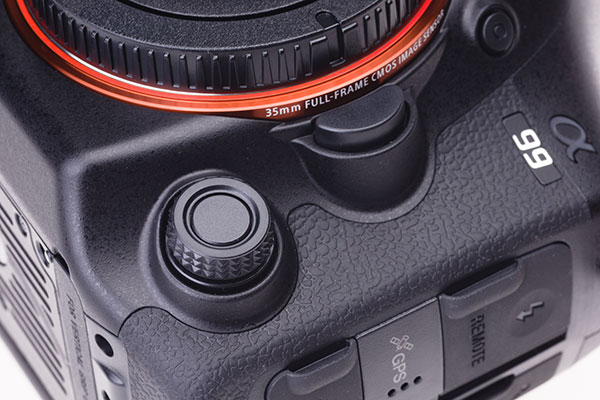
    silentcontroller-a99

    The Silent Controller is a free rotating dial with a push button in the centre allowing you to set its function before each use if you want. The default use is AF-C, AF-S, AF-A, MF, AF-D and there are no clicks. It is silent, for use during movie shooting to change exposure or audio volume (etc).

    This controller is placed where the former C/A/S/M focus mode switch was on the 900. It has a central button you can press to reassign a function to it before use. The external knurled collar is turned with one finger, without click stops. By default it changes focus mode. A typical assignment for this during video would be audio volume.

    The 99 can auto-crop to APS-C 10 megapixel files when DT lenses are fitted, or if this is set by menu (needed for non-Sony lenses like Sigma DC or Tamron DiII). It can do this for raw files, resulting in a smaller raw, for raw+JPEG, JPEG only and for video. The Smart Teleconverter works in JPEG-only or video modes, giving 1.4X or 2X (4.6 megapixel) stills. In conjunction with the rear controller you get a further continuous zoom range to 4X for movies (native resolution to 3X, interpolated between 3X and 4X, with a very smooth electronic zoom effect). The EVF remains pixel-sharp at 1.4 or 1.5X, but anything more and you can see that the sensor image is being enlarged and is softer.

    The 1.5X crop is also enabled if you select the 8fps or 10fps higher speed continuous mode, using the mode dial, rather than the 6fps full resolution mode using Drive settings. The actual sequence burst rates are effectively identical to the A77 and not any better in practical terms than the 4-year-old A900, which unlike the 99 can shoot 5fps Fine JPEGs without a break until the card is full or the sensor overheats. The 99 can only manage 18 frames before slowing. The use of a single Bionz processor with SD storage in the A77 and 99 seems to have been a backwards step, the dual processor of the A900 was better able to sustain a data flow to the fast UDMA CF cards accepted by that camera.
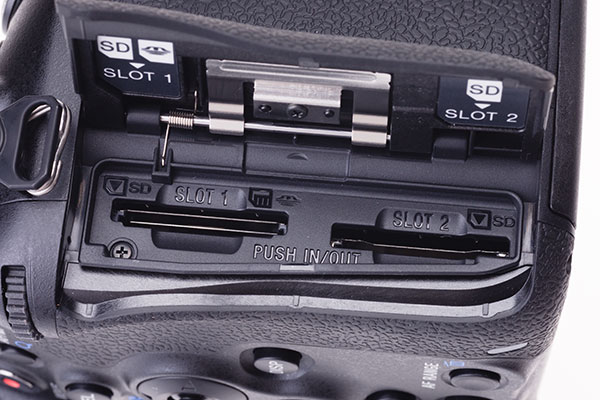
    a99-carddoor

    The dual card slots – SD and MS Pro Duo upper, SD only lower. The lip surrounding the card slot area is an effective waterproofing channel and the metal spring plate gives the card door a firm, unstressed action.

    The 99 does away with CF despite its 900-like body size. Instead, a dual SD drive very similar to that in the Nikon D600 is fitted. Even the spacing of the two slots, and the way the upper card sticks out a little more than the lower, is the same. But the Sony has the ability to accept Memory Stick PRO Duo cards in Slot 1 as well as SD. I find this convenient, as I use a classic Dynax camera strap with a card wallet fixed to it. This can hold spare MS Pro Duo cards, and by chance, the slots for these cards also fit the plastic cover for the new hot shoe exactly – there’s nowhere else to put it, and it matters. The latest MS Pro Duo HX cards offer maximum performance, better than SD UHS-1.

    But in the end, despite all its problems, the Alpha 99 simply turns in a better success rate on my sort of subjects – landscapes, street scenes, people, events – than its rivals. The metering is more accurate, the AF is either as good or better, the image quality at high ISOs is a touch lower, the GPS works well, and of course the sensor-based stabilisation is a total winner. Sigma sent a 35mm f/1.4 in Canon fit to test. This lens is quite incredible, and transforms the Sigma offering. It’s so sharp even wide open that the smallest degree of camera shake makes a shot look inferior. I forgot that with the A99, there’s hardly any situation I can not tackle hand held and get pixel-sharp results. I used speeds like the 1/30th or 1/60th on the Canon 6D and lost the exquisite jewel-like edge sharpness of the Sigma. I’m just so used to getting every single shot usable and not thinking about whether a lens is stabilised or not.

    This scene didn’t work well with the un-stabilised Canon 6D – I was too cold, and hanging on to a support with one hand while standing half way up a steep muddy slope, with two cameras. SteadyShot worked well on the A99. Click the image for a full size link. ISO 1600.

    The new shoe

    The new Sony Multi Function Accessory Shoe looks a bit like a rather crude old single contact hot shoe, and its central contact does indeed work to sync with any plain ISO unit. It can be used with Skyport and PocketWizard or generic flash wireless triggers, and I’ve also checked it with Wein infra-red. The three holes round the main contact are locking-pin holes, so beware third party generic adaptor makers. This is a good candidate for getting adaptors stuck.
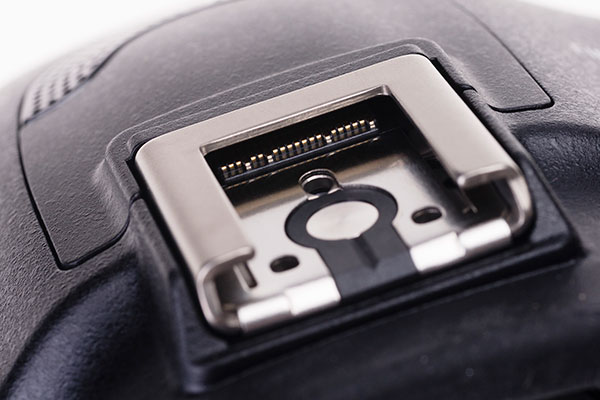
    alpha99-shoe

    Under the leading edge of the ‘old’ shoe there is a recess, a horizontal slot not unlike the accessory slot fitted to the first generation NEX cameras. Its gold plated contact strips are very fine, and if this slot was left exposed by failing to replace the cover, it’s easy to see that dirt of moisture could get in. Unlike the NEX slot, there is no built-in spring loaded cover to shield it.

    This interface provides the flash connection – duplicating the entire contact set for the iISO or Minolta i-shoe known as the Auto Lock Accessory Shoe by Sony, which is now gone. A small adaptor ADP-MAA is provided with the camera to convert from the new ‘old’ shoe to the Minolta standard. It is as slim and firmly fitting as they can make it, but still felt a little vulnerable with an HVL-F58AM mounted on top, especially when the camera was held vertically. A new flash unit, the HVL-F60AM, has been released for the A99 and in line with current trends it incorporates an LED video/modeling light. This aims forward to double as an AF illuminator, and can not be bounced.

    flashadaptor-base

    The adaptor ADP-MAA shown with its connectors and the small spring loaded pins and ‘ball bearing’ centre contact to fit the new Multi Function Accessory Shoe.

    Audio input is also handled by the shoe for microphone units compatible with the Cyber-Shot/HandyCam/NEX models using the new shoe. Since this shoe also appears on the NEX-6 and the DSC RX1 where it is the only way to input audio, there is some hope for a line/mic module. It is not needed by the A99 as this has a 3.5mm phantom powered stereo jack input, under one cover with a similar headphone output. Both input and output volume levels can be controlled on screen.
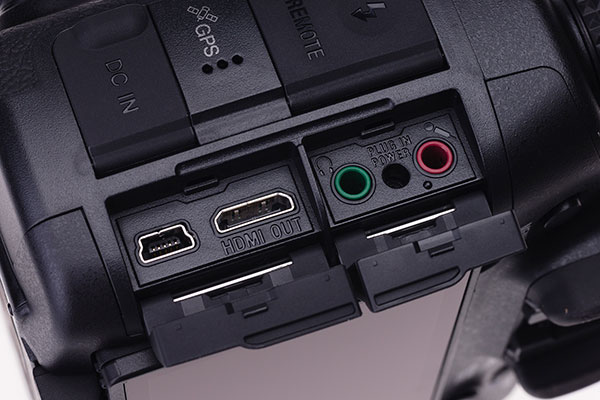
    alpha99interfaces

    This change means that there are now three generations of hot shoe in the Alpha system, and five different shoe or accessory mounts in the Sony still camera systems of the last few years – there’s the Sony CyberShot shoe in two generations used by DSC F series and the R1, the inherited Minolta Auto Lock shoe, the NEX Smart Accessory Terminal and this new Multi Interface Shoe. To say this is unwelcome would be an understatement, but the shoe provides a long-term solution for future development and if you want to create a Christmas tree, it’s still backwardly compatible.

    Its 24 contacts cover two different levels of power supply to accessories, audio in and out, flash or wireless flash control and connection, add-on GPS unit (the 99V includes an internal GPS, the plain 99 does not), add-on WiFi module, and EVF or HD monitor feed. We should expect to see a WiFi module and a monitor screen option, while the regular HDMI output can simultaneously send uncompressed video to a recorder. What we don’t know yet is whether the future WiFi module will be as clever as Canon’s built-in WiFi and do more than just send files from the camera. If it has an Android/iOS app for remote viewing and shooting it will be a winner.

    The flash system remains with the original Minolta digital wireless TTL protocol as found from the HS(D) guns onwards. There is no built-in flash on the A99 and thus no built-in wireless control. The HVL-F20AM fold-down mini flash made for the A900 as a wireless trigger works perfectly on the 99 with the ADP-MAA but it’s no way as neat. The one benefit is that for direct use, it’s raised a little higher and casts less lens hood shadow while causing less risk of red-eye. We would guess that a new version will appear soon enough. I’ve tested it both directly and bounced, and as a wireless controller.

    Flash exposure with the A99 has been exactly as expected – not a wildcard – but short of testing every flash in every configuration, I can’t guarantee against the kind of overexposure found in the A77. All I can say is that my tests, made within the expected range of units using appropriate ISO settings and apertures, have worked well. I do not use flash often outside the studio, and given the performance of the A99 at high ISO settings I doubt I will ever want to.

    Any reverse adaptor for the shoe – to allow the HVL-F60AM to be used on Auto Lock shoe cameras – will not of course provide functions other than flash. The Auto Lock shoe doesn’t have any of the other contacts.

    My reservations about the Multi Interface Shoe are only that its connector strip looks delicate and each contact has a very small physical contact area. Even the Auto Lock shoe has had its problems with occasional contact failure due to wear and tear or foreign matter.

    a99-connectors

    There is, of course, also a studio flash PC sync cord connector, threaded, under the same cover as the DC Power Supply connector. Below these is the Remote Cord connector, and between them, a GPS symbol marked next to the loudspeaker. Sony does not give advice which way up to hold the the camera for the best GPS reception. With the Canon 6D, lying on its back face up is the recommended position.

    The focus system

    Because of the Smart Teleconverter, APS-C auto crop and video crop/zoom functions the A99 needs an AF module perfectly suited to the APS-C or smaller areas. It gets exactly that – the same module as the A77 uses, and that one starts off with leeway to work in Smart Teleconverter mode.

    It’s a rather staggeringly tiny 6 x 12mm AF array, one-ninth of the frame area. Imagine the frame divided into thirds both ways and the entire 19-point, 11-cross point phase detect array fits within that modest central rectangle, but forms more of a horizontal ellipse shape within it. No AF points reach into the corners of that central patch.

    The manual is deceptive because it frequently shows the AF area and points out of true scale to the overall frame.
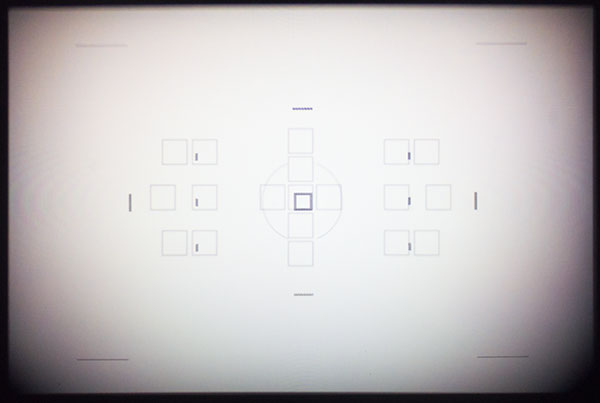
    a77-AFarea-ona700

    This is why you come to photoclubalpha – we do the stuff the others don’t notice! Above, though rather crudely taken due to needing to hold an A55 with 30mm macro up to the eyepiece of an A700 aimed at the rear screen of the A77, is the actual AF module of the 77 (faint squares) overlaid on the AF markings of the A700 finder. This may be out by enough to make the overall AF zones similar , but it looks to me as if the A77 doesn’t quite cover the same extent as the A700, even after allowing for the 96% A700 finder view.
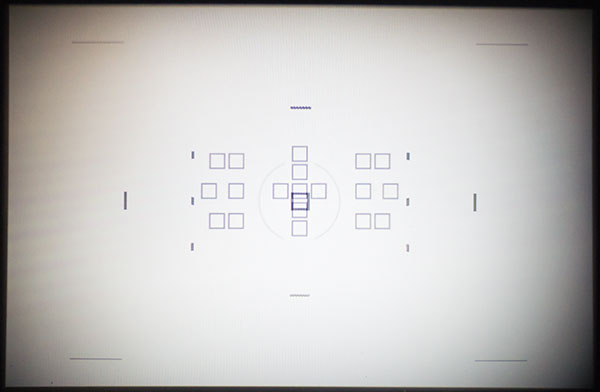
    a99-AFarea-ona700

    This is the same technique applied to showing the AF zone of the A99. As you can see, it’s the same module as the A77, floating in the middle of full frame. It doesn’t come anywhere near to the extent of the old A700 module, or the A77 in its cropped format frame. It does not even reach the ‘rule of thirds’ favoured points for composition. Coindidentally, the Phase Detect AF-D zone with its 102 tiny sensor spots occupies almost exactly the same area as the square formed by the A700’s top and  bottom horizontal line sensors and triple vertical groups.

    sonyafrepresentation

    Here is how Sony generally represents the AF zone within manuals. This is not a graphic dealing with AF, and there is no need to show the AF zone larger than it actually is relative to the rest of the display. From the A99 manual.

    Sony may have saved some money by using exactly the same module as the A77 but it’s just not adequate. You can compose shots where not a single part of the subject you want to have in focus touches an AF point, and moving subjects can move beyond the active zone all too easily. What was needed was twice the AF area – 1.4X the linear dimensions at least – even if that meant adding further non-cross points.

    This module works with all Alpha lenses, from the earliest Minolta screw drive to the latest SSM and SAM. It works down the EV-1 (minus one), the same as Nikon’s 39-point D600 module and four times less sensitive than Pentax’s latest SAFOX design or Canon’s equally tiny central AF cluster in the 6D. It’s still better than AF used to be considering its ability to work optimally with relatively small apertures.

    The marked AF-D area is a larger 12 x 12mm square, and when one of the compatible lenses is used and the appropriate AF-D mode invoked with subject tracking, a square array of 102 on-sensor PDAF focus assist points becomes active. I’ve described the result as a fireworks display, though that depends on the lens and subject. Groups of these points can light up, alongside the main focus points, in brief recognition of the subject.

    As to whether it works, I can’t say. It turns on and become visible. Does it make any difference? I use both incompatible and compatible lenses. I can’t say that I have been able to spot any real difference in performance, certainly nothing I can observe or measure. All I see is the points light up after the focus has been acquired; they seem often enough just to confirm what area surrounding the chosen focus point is also within depth of field at focusing aperture.

    300mm-500f9-iso800-APSC

    To get this shot, the surfer had to be kept within the AF area of the A99. I was using a Sigma 70-300mm f/4-5.6 Apo Macro DG lens (which has replaced my Sony 70-300mm f/4.5-5.6 SSM G – reasons of superior sharpness, light weight, size and close focusing prevailed over the superior colour rendering and bokeh of the big G lens). Click picture for a larger, but not 100%, size.

    surferfullframe300mm500thf9iso800

    Here’s the full frame, 300mm, 1/500th at f/9, ISO 800. You can see I was keeping the central AF point on target because in this case, there was going to be plenty of spare megapixel estate to crop away. I took 115 shots of surfers, mostly single frames but some short maximum speed bursts between 2 and 5 frames, in nine minutes. Not one is out of focus even when the surfers came in closer to the camera at speed. But… they are all within that small one-ninth area of the frame which features the AF grid.

    This 102-point zone is also too small, and the wrong shape. It’s a cut-cornered square. I am shooting 2:3 or 16:9 ratio stills or movies. I am not shooting square images. There is a reason, and it is also the reason more lenses do not work with this on-sensor phase detect focus assist. The pixel pairs on the sensor with their differentially angled microlenses use the image forming ray cone in a specific way to detect front or back focused phase shift. To do so, they demand a specific exit pupil geometry and need to be placed relatively close to the lens axis. This on-sensor array can not be extended to cover the entire sensor, or even to extend to a echo the image format more accurately.

    In theory, on-sensor PDAF should be extremely accurate, and should be able to work with contrast detection (as it does on other sensors using this technology). But on the A99, they don’t have that function. You can not opt for hybrid contrast detection with on-sensor PDAF; the system is designed to augment the SLT-fed main PDAF module only.

    I’ve already observed that the perceived maximum resolution (microcontrast and detail sharpness) of the A99 does seem to be lower than the D600, despite Sony’s zonally graded low-pass filter which I can confirm does improve the performance to the edges and corners for wider angle lenses. The on-sensor PDAF zone is sufficiently populated and large to have some effect.

    In case you think I’m talking up Nikon’s AF module over Sony, don’t… the D600 certainly did not focus any more accurately, quickly or reliably than the A99. Both AF modules are small in coverage, and both cameras do have an APS-C crop function including raw file saving and faster burst capture. The thinking has been alike. Ditto for the Canon 6D. That’s got a pitiful APS-C area module with only 11 AF points, ten of them plain old linear f/5.6 the centre one a mere f/5.6 cross with vertical linear f/2.8 (slightly inferior to the Alpha 700 of 2007 in all respects except low-light sensitivity). Canon doesn’t even have the excuse of APS-C or 2X capture modes, you can’t fit any Canon APS-C (EF-S) lens to the body let alone get the optional crop functions enjoyed by the D600 and A99.

    So, here’s a new bunch of full-frame choices, and all three turn out to have small-area AF modules. It is Hobson’s Choice.

    The A99 can never be rescued from its tiny principal AF zone by firmware updates and owners will just have to live with it. Things could have been designed differently; they were not. The same module is just about right in the A77. It’s lost in the big image of the A99.

    Shutter response

    One of the more surprising things about comparing the humble Nikon D600/Canon 6D with the advanced Sony A99 is the sound and feel of the shutter action. Both rivals have a low 1/4,000th maximum speed shutter, but are still capable of flash sync similar to the A99 (1/200th for Canon, 1/250th for Nikon, 1/250th for A99) which means curtain travel speed is similar and they simply chose not to permit a narrow enough slot to achieve 1/8,000th.

    The D600 with its complete mirror up and down, twin shutter blind and recock action feels and sounds sweeter than the A99 which has no mirror to move and no first shutter blind. In fact, it’s louder and the dB peak for a very brief spike is about twice the volume of the A99 or the A77. But some recording with sound analysis reveals that the A99 sounds ‘louder’ because the actual duration of the sound is almost twice as long, and divided into two distinct clunks.

    d600-a77-a99-200th

    The D600, like the A77, has a normal single-shot shutter sound of around one sixth of a second, as you would expect from cameras which can achieve 6fps or something close. The Alpha 99 has double that. I timed it at over 300ms, and if first curtain mechanical mode was used, well over 400ms.

    It took me a few days and some digging to find out that the 14-bit readout on the A99 only applies one shooting mode – single shot. Any other mode you select, including Lo 2.5fps continuous and all multishot or JPEG only modes, uses 12-bit readout from the sensor. This was already documented in the literature about the A99, but what Sony omit to say is that the 14-bit mode causes a noticeable pause between the shot being captured and the restoration of EVF viewing. This pause is around 1/10th of a second longer in single shot mode than the blackout which happens during 2.5fps or the first frame of any faster sequence, and totals 200ms or 1/5th of a second.
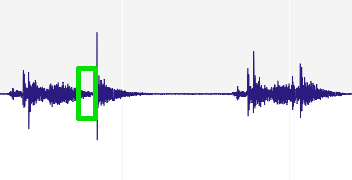
    single-versus-lo

    single versus lo

    Above is an .mp3 link of single frame 14-bit capture compared to 12-bit capture in a Lo sequence setting. The green rectangle on the graphic indicates the extra time used for 14-bit processing; the overall time of the longest sound is over 400 milliseconds – nearly half a second is a fairly long duration for the audible cycle of any modern camera’s shutter actuation.

    Thanks to the detailed analysis of audio recording using Amadeus Pro, followed by frame by frame time analysis of an iMac movie clip showing the actual LCD screen blackout period, I have been able to see this ‘dead period’ of blackout and image processing is longer than the entire shutter action of the A77 or D600; indeed, the shutter actions of the A99 surround this hiatus. The card writing light comes on a millisecond or two after the live view blacks out. The action of the shutter curtain being recocked, which accounts for a substantial part of the overall shutter noise, only happens at the end of the 1/5th second pause.

    Short of a firmware upgrade, there’s nothing you can do about the extremely slow single-shot shutter cycle or the interrupted finder view if you want the extra quality which comes from 14-bit raw capture. Nikon offer you a choice of 12 or 14 bit, compressed or uncompressed raws. Sony does not offer a choice and makes the bit depth specific to the way you shoot. There is no doubt at all that both raws in single-shot mode, and Extra Fine Quality JPEGs created in this mode, show less noise when adjusted to an extreme. 12-bit capture is fine for lower ISOs, in good light, with correct exposure.
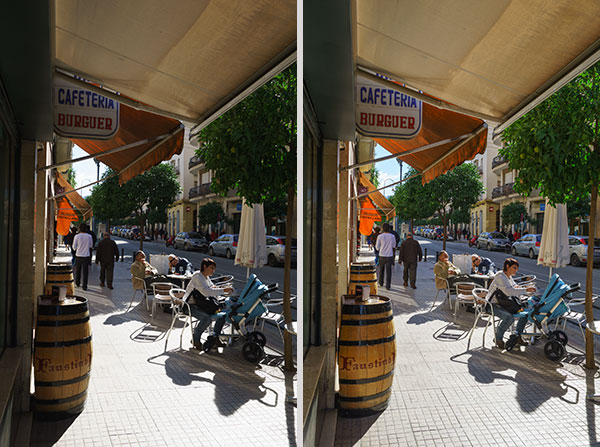
    a99-14bitprocessing

    The 14-bit raw file has great flexibility for shadow and highlight adjustment from raw without losing colour values or subtle tones. I’d rate it as one of the best raw file formats I have worked with, at normal (100-800) ISO settings. No local dodging has been used above to enhance the backlit scene – just what amount to curve adjustments.

    The 3fps Lo motordrive setting was easy to use for single frames, with a light touch. This caused half the finder blackout duration and no more than a 290ms total sound envelope (including all reverberation – the main sound is not unlike the 180ms of the D600 or A77). It didn’t matter what file size and type I recorded or what card was used. This setting always produced the shutter cycle, and sound, I would have expected the A99 to have.

    Having observed the way the camera works, I’m afraid I am now rather too aware of it. It makes me appreciate the Alpha 77’s much faster, sweeter action and even consider the A900’s noisy clack with affection. One effect of the longer shutter cycle is to make the relatively quiet sound – 4dB quieter at peak than the Nikon D600 which also has a higher and more intrusive pitch – seem ‘louder’ than it actually is.

    What is interesting to me is just how few users, when I asked for information or tests of their own cameras, were really able to hear the differences or see the blackout period. I can thank Gary Friedman for being able to confirm my findings – he could understand exactly what I was looking for. And thanks to several posters on Dyxum forums, whose concerns were with the image quality of 14-bit versus 12-bit, for providing the information I need to put the facts together and realise that no amount of adjusting settings was ever going to make the A99 share the brief blackout and sweet shutter sound of the 12-bit A77.

    Gary uses wireless flash a lot. I don’t generally use flash at all except in the studio. Gary has observed delay in wireless flash triggering which is just as long as the entire shutter cycle, and made a great short video which explains this problem:

    http://youtu.be/eHrBcT51oE8

    I’m not sure if this is a definitive test – there are other trigger flashes which can be used and I’d like to see the times from the HVL-F60AM, F58AM, F42AM and so on. But it indicates that it’s not just me who does not use wireless flash. Nor do Sony’s systems designers and technical team!

    The LV dilemma

    Sony’s camera line is now totally committed to using the sensor as the viewfinder. This means that whatever performance they can pull from that sensor, it will always be a quantum drop lower than the same sensor used in an optical viewfinder camera. The level of read noise is heavily influenced by the sensor temperature, and continuous live view makes the sensor heat up.

    Sorry, I can’t measure it. No doubt someone equipped with the right tools could measure the temperature of the silicon after 15 seconds, a minute, ten minutes or any other period and also allow for ambient conditions. Sony’s handbook reveals that most performance figures and presumably most pre-production tests assume an ambient temperature of 25°C. By my standards, that’s extremely warm, even as an indoor temperature.

    There are warnings that the camera may shut down if video or continuous shooting result in an internal overheat. I’m just not going to be testing the A99 to that degree. The best I could do was to set it to ISO 6400 and the highest video bitrate, and leave the camera running in low light, to ensure the highest gain levels.

    I’m fairly sure all of the Nikon D600 noise level advantage can be put down to not using full-time live view, and the effect of the SLT mirror. The Sony sensor is almost certainly just as good overall, give or take whatever effect the phase detection pixels may have.
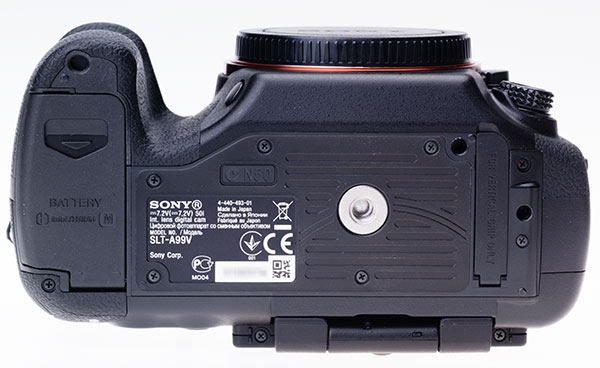
    a99-base

    Battery – left hand as seen (right hand grip). To the other end, a narrow covered port allows connection of a vertical grip without cannibalising the battery already fitted. The resulting three-battery configuration is the only way to get real stamina for a busy day’s uninterrupted shoot, especially if you use GPS.

    LV and EVF lead to very short battery life, and this may be exaggerated if you want to do very long exposures.

    So there is the ultimate dilemma – the Alpha 99 is a master of all the functions and features you could want just so long as you want EVF with it. If you don’t, then the Nikon and Canon alternatives will not only be better choices for you, they will save you into the higher hundreds of pounds or into four figures in dollars.

    My choice

    The Alpha 99 is currently the full-frame camera I’m working with and will stick with until the next generation arrives.

    I sold my Alpha 900 shortly after the Alpha 99 arrived. I regretted it straight away, but that is just down to an attachment after four years of familiarity, and a false reassurance that this is such a solid and simple camera it would have lasted me for life. I do not make videos often, but when I do in future I want full control over direct audio input as audio overdubbing from a separate recorder is something I have found very tricky to handle (at least in iMovie, which is what I use).

    I didn’t sell my Alpha 77 despite the poor performance in low light, and the lack of the audio level control. It’s far too useful, having 24 megapixels in an APS-C crop, rather than the 11 produced by the A99 crop format. Also, the general colour and grading of video matches the A99 well enough for the 77 to be a second camera. After we bought the Nikon D600, I found the colour and contrast sufficiently different to mean mixing video from Alpha and Nikon was not an option. It also has manual audio input gain – but we can’t team them up. For much the same reasons I have kept my NEX-5n and my Alpha 55.

    Could I work professionally with the Alpha 99? Yes. I’m confident it would not let me down in any situation I’m likely to encounter or set up – I do not shoot sports or hard news, events or conferences. Future professional use would be likely to be public relations, corporate brochure, annual report, advertising, industrial and environmental, executive portraiture, products, architectural, building works, stock travel and landscape. Frankly, anything I could once have shot on a Hasselblad can easily be tackled with an Alpha 99.

    Despite this, I would be very happy if Sony revived the highest end optical prism DSLR in future. An Alpha 900 quality version of the D600 would have been perfect. And I do not think I am alone in showing some regret for the apparent end of the single-lens reflex Alpha.

    – David Kilpatrick

    Footnote: elsewhere, the usual comment has been made that I’m wrong to compare this with the 6D and D600 because the A99 is competing with the 5D MkIII and D800. We have a D800E and may acquire a second one. It’s not competing with that; the D800, and especially the 800E, appeal to a different market where using 36 megapixels counts more than several other factors. It is also not competing with the 5D MkIII, which is locked into a huge Canon professional userbase as the one undisputed mainstream body. Nikon has a fragmented position; the D600 isn’t on the right level, the D800 offers benefits many users do not need and loses advantages they want to keep, the D700 is low resolution, the D3s the same and the D3X is priced beyond its specification. Nikon professionals I know all say what they want is a D700 body (and shutter, etc) with a D600 sensor – they would then have a camera at precisely the same level as the 5D MkIII. They would have the one easy no-doubts choice to make the same way Canon users have.

    Like it or not, the Alpha 99 is actually competing with the 6D and D600, and it does not matter to the market that some aspects of its construction and specification are closer to 5D MkIII ‘build’. Sony is doing something in enthusiast-level photography right now that it has done well in the past in television and audio, positioning its pricing as a premium consumer brand. The DSC-RX1 specification and pricing tells you everything you need to know about how Sony sees the market.
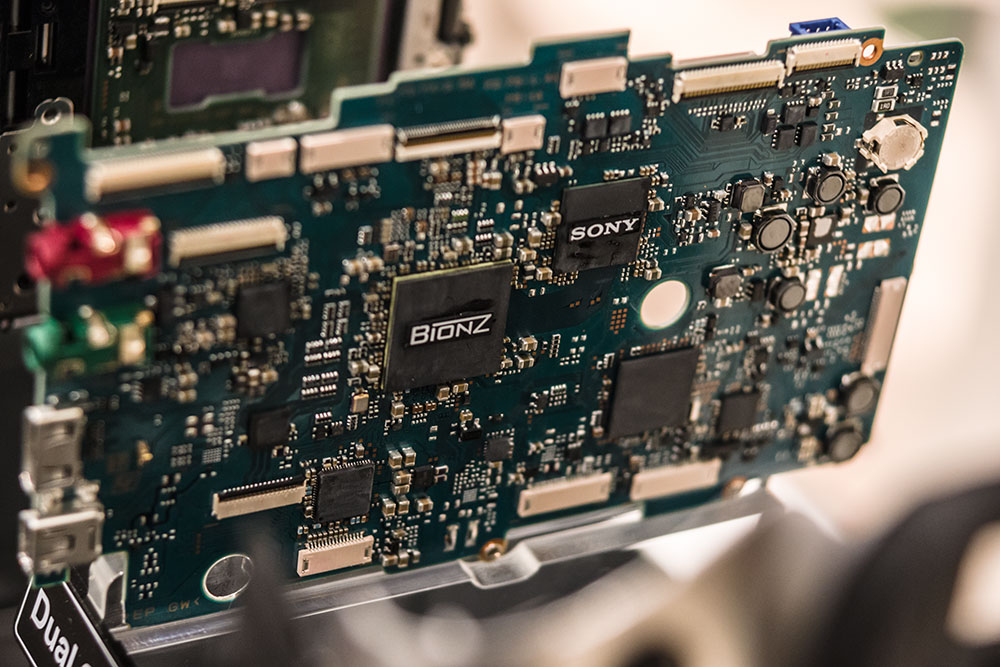
    a99processor


    This is why the A99 doesn’t even really compete with the older A900. Single Bionz processor (that word saying ‘Dual’ refers to the memory card slot) where the 900 had two – and 14-bit data to process. The SD cards, even Class 10 UHS-1, also represent a bottleneck in data transfer. Using the highest end MemoryStick PRO Duo overcomes this. Photographed on the Sony stand at photokina.

  • Sigma’s system revolution

    Sigma Imaging, already one of our favourite lens makers, has announced upgrades and new functions for their entire system which will transform the way it works with all the major camera systems.

    The new DC 17-70mm f/2.8-4 – DC (APS-C format) lenses have never been given the EX designation, even when they clearly matched the EX specifications. Now the EX name and its exterior finish are both going, replaced by one standard for all formats, and one finish.

    The entire Sigma range is being restyled, with a new finish, and the old distinctions between EX DG and other lens ‘grades’ are disappearing. “All our lenses have become what we once called EX”, said Graham Armitage of Sigma UK, at photokina. “The demands made by digital systems with higher resolutions mean we have to produce perfect lenses for all the formats from MicroFourThirds to APS-C and full frame.

    “Our greatest breakthrough is in MTF testing. We have designed new MTF equipment, which will be used on the production of new lenses from now on. The MTF testing system we use for development is too slow to be used in production, and we have had our own Bayer sensor based system for this purpose. But it was not proving high enough resolution for new camera sensors like the D800.

    “Now we have built our own MTF testing system, based on the 46 megapixel Foveon Merrill sensor used in the latest cameras. This allows a much better MTF tests. It will be used to test the sharpness of every new lens that Sigma manufacturers.”

    We asked Graham if this would only apply to expensive professional teles, zooms and specialist lenses. “No, it will apply to all lens types”, he said. “We have been able to use the data from the Foveon sensor based tests to improve the performance of all our lenses.” Because the sensor is true RGB not Bayer much better information about chromatic aberration has been gathered and Sigma is feeding this back into the design and manufacture process.

    The new lenses have a robust feel, with machined metal barrel and mount components (a current trend for many lens makers) and a slightly soft-looking matt or silk finish. All Sigma lenses are assembled by hand, in Japan, using traditional construction methods.

    But the most exceptional advance has been made inside the new lenses – sadly, it can’t be retro fitted to older ones.

    The USB ‘dock in a cap’ has an LED activity indicator and we handled the real thing. This photo looks a bit over-retouched.

    All new Sigma lenses will be compatible with a USB-connected dock allowing firmware updates to be made by the user. Sigma has honoured its relationship with users for decades by upgrading the chips inside lenses free of charge whenever the protocols used by camera makers created an incompatibility. Now they have developed a way in which users can do this themselves without the lens having to be returned or ‘operated on’ in a workshop.

    “The USB dock will cost about the same as a filter”, Graham told us. I suggested this could mean £50. He indicated I was on the high side. This dock device, which resembles a thick rear lens cap, might be £30 or so.

    “It does more than just upgrade the chip”, he continued. “With a PC program, you will be able to change the focusing speed of the lens. All AF systems are a compromise, a balance between speed and accuracy. You will be able to set the lens to suit your working style, increasing the focus speed if you shoot action or improving accuracy if you take subjects like landscapes and portraits.

    “All DSLRs have problems with front and back focus. Some cameras offer AF calibration, but not all allow you to have different corrections for each focal length of the zoom lens and for different focusing distances. Using our program, you will be able to calibrate new Sigma lenses for the full range of settings so you don’t get front or back focus at any distance or focal length.

    “Not only that, with new telephoto and macro lenses you will also be able to change the distance ranges used by focus limiter switches.”

    The new-style 120-300mm f/2.8 – one of the first lenses compatible with the USB programming system, allowing perfect tuning of front and back focus corrections across the zoom and focus distance range.

    This function sounds familiar, indeed it’s almost what the new Sony Alpha 99 offers with a restricted range of Sony lenses – on-camera setting of focus range limits. The difference with the Sigma option is that future lenses with a range setting switch can each have their individual far, middle and near limits set and there will be no need to go into camera menus to change the setting when shooting.

    Along with Sigma’s recently introduction of nano-type hard coatings which resist water and dirt, their improvements in environmental and dust sealing of lenses, we look forward to testing Sigma products in future and finding them close to the blueprint for the optical design. These innovations draw a line between existing generations of Sigma lenses and the future, as they can’t be fitted to older models. They also take Sigma yet one more step ahead of the camera makers’ own aspirations.

    Sigma has always shown the industry what can be done in terms of advanced optical design – often unmatched for many years, with such specifications as the 8-16mm and 12-24mm zooms, the 300mm-800mm and many others remaining unchallenged even by Nikon and Canon. Now they have set out to show what can be done by harnessing a simple standard interface and allowing communication to the lens IC through the contact-pin array.

    Finally, Graham showed us the new 35mm f/1.4. “Nikon has done really well with their 35mm f/1.4”, he said. “We thought we would try to beat them with this one. We are hoping it turns out to be the best 35m f/1.4 on the market”. The new MTF testing may yet be proved! I mentioned that Samyang had also done pretty well with a 35mm f/1.4. To that there was no comment…

    And then there’s the obligatory picture from any trade show – the man who can’t resist trying to find out what the butler saw, courtesy of the Sigmonster!

    – David Kilpatrick

    This post has been edited with Sigma’s help on October 3rd. The original reference to Zeiss MTF equipment was incorrect; this is used in design and prototype development, and will continue to be used. Sigma’s own production-line testing system is what’s been updated with new high speed Foveon-based MTF bench.

  • Swedish NEX from Hasselblad

    Perhaps the strangest news from photokina, which I have not rushed to post here because I reckon every single website in the world will have treated it as urgent breaking unparalleled wonder – is that Sony and Hasselblad have signed a deal under which Hasselblad will make an APS-C (or perhaps full-frame NEX mount) mirrorless camera in Sweden.

    Without any images other than a Hasselblad H logo to accompany the revelation, the world is left wondering what exactly Fujifilm has done wrong. A drawing of what might be an A-mount mopdel was shown at photokina but looks as if it could have been done by a teenager on the back of a school jotter; a prototype or mock-up NEX revision called the Lunar was little better. Clearly, Sony already announced its intention to allow approved partners to use the E-mount, and we can assume that the Hasselnex will come thus equipped. Carl Zeiss has announced a roadmap for E-mount lenses, and of course that would fit Hasselblad down to the ground. No need for a new lens range, their bodies (NEX-7/6 type?) would be sold with blueprinted Zeiss glass. Surely? Not just with relabelled Sony zooms?

    And the bodies would be made in Sweden. That means less than you might assume, since all the internal component parts would presumably be sourced from Sony as a CKD kit. CKD is motor industry speak for ‘Completely Knocked Down’ – a car shipped as parts to a factory, to be assembled there. Hasselblad Sweden used once to be very good at assembling cameras, they recently moved all Danish production back to Gothenburg and re-established Swedish manufacture.

    The BJP has been told the body would be aluminium. The NEX-7 is magnesium alloy. And the 7/6 body already looks really classy. The Lunar simply does not.

    Image from the BJP

    From the BJP report on this €5-6,000 version of the NEX-7 – click image to see their interview.

    So, what of the H-series blads – made in Japan by Fuji, Hasselblad’s long-term partner in the H-range project?

    And, when Hasselblad was quite willing to work with Rittreck/Norita/Fuji on rangefinder type cameras (the XPan was not their idea, it was a Rittreck/Norita concept) what has changed?

    After all, Fuji’s XPro-1 and XF are staggeringly good cameras with a ridiculously ambitious and excellent range of lenses, not just superfast primes abut extending into popular zooms. They are built and styled to fit Hasselblad ambitions. Fuji optics have proved good enough for Hasselblad H.

    Something has shifted. Maybe Hasselblad is no longer tied to Fujifilm and the announcement of manufacture returning to Gothenburg, made earlier this year, relates to a shift not from Denmark only but also from Japan. Perhaps Sony has demonstrated that superior medium-format size CMOS can be fabbed, saving costs for future generations of yet unimagined H-series bodies/backs where six 24 megapixel APS-C sensors will be stitched to create a 144 megapixel sensor measuring 47mm square!

    Or perhaps Hasselblad realises that mirrorless need not mean hand-waved. They used to build waist-level cameras. How about a mirrorless waist-level, styled like a mini ‘blad and with the screen on top with a flip-up hood and magnifier?

    Too much kölsch and imagination, I fear. But this certainly is strange news. A scoop for Sony – but exactly what for Hasselblad remains to be seen.

    – DK

  • A divided path for Sony

    Most Japanese camera companies have divisions, groups, and teams right down to the very last individual product. Even a single lens design may have its own small team, from R&D and design down to final assembly. What we are seeing happen in Sony right now is the result of complex competition and collaboration between several teams.

    Take, for example, the new Sony 300mm f/2.8 G SSM II. You might assume this lens was mainly an Alpha division product from the former Minolta heritage, but in fact it’s been redesigned to work better with NEX and also with both consumer and professional HD video cameras from APS-C through Super-35 to full frame 35mm.

    SLT/SLR system users gain with improvements like Nano AR coating (similar to new coatings introduced by Sigma, Nikon, Pentax and Canon), better MF control, and a better degree of weathersealing. It’s the complete update of the SSM motor (is it SSM II, or entire lens version II?) which provides compatibility with on-sensor PDAF and enhances CDAF, to offer the prospect of object-tracking AF during video. At £6,700 UK it needs to show major benefits to compete in the still field, but may have a market all to itself when fitted to the new NEX-VG900E full frame video camera.

    It’s easy to think – ‘the first ever full frame video cam!’ but that is not the case. The Canon 5D MkII established the DSLR form as an acceptable professional video camera, and in the last three years a vast industry of shooting rigs, grips, follow focus devices, monitor screens and accessories has grown up all based on turning this video-unfriendly camera into something movie and TV crews are comfortable with.

    Sony has implemented the sought-after 24 frames per second rate in all the new models just announced, not going for the European excuse of 25fps being close enough. This is to allow a so-called cinematic look, despite the fact that the movie industry has been trying to get away from 24fps just the same way as it threw off the shackles of 16 or 18fps many years before. Users want it, so they have at last provided it.

    From the very start of reviewing HD capable cameras, we have emphasised the issues with audio – the *absolute* not optional need for audio fixed or adjustable manual gain control. I’ve done this for years in printed magazines. So has any other writer who ever had to use a camera with auto gain and nothing else. First Nikon (basic) then Canon (full control) and now Sony show they listened, if slowly and relunctantly, to something their own audio engineers would have told them was vital not a luxury.

    End result – Sony enters the mainstream for HD video shooting with the Alpha and NEX systems.

    The same technologies, in terms of sensor use and implementation of optical advances linked to Phase-Detection On Sensor (which I’ll call PDOS), now apply across the entire range of Sony digital imaging products from Handycam, through Cyber-Shot, through NEX, to Alpha. The Cyber-shot range is only missing an APS-C model.

    What is particularly interesting is that this divided path is a parallel path now and not a divergent one. There’s no question of one straight and narrow path leading to heaven, one broad and easy road to hell, and winding ferny way to faery. Instead we get a four-lane highway joining Sony present to Sony future, with every option to change lane if you want to overtake.

    Legacy and inheritance planning

    Sony acquired a lot of old Minolta tech as a dowry in the 206 marriage to the Alpha system. Now having invested that legacy they have to make sure it still has value for future generations.

    And example of what this really means can be found in the PDOS restrictions of the A99. The AF-D mode won’t work with some lenses, yet. For example – the 16mm f/2.8 fisheye, the 20mm f/2.8, the 16-35mm CZ f/2.8 zoom, any Konica Minolta zoom, any old Minolta AF system lens, the 35mm f/1.4, the 85mm f/1.4 CZ and G, the 135mm f/1.8 CZ and f/2.8 STF, the 200mm f/4 Apo G Macro, the 24-105mm D, any macro lens, the 400mm f/4.5, 600mm f/4, 200mm f/2.8 or the 300mm f/2.8 G SSM (pre-II). It is not even flagged as working with the 30mm f/2.8 SAM macro, 35mm f/1.8, 50mm f/1.8, 85mm f/1.8 or the 24mm f/2 Carl Zeiss SSM ZA. Or the 70-300mm G SSM, let alone the basic 75-300mm SAL.

    It will only work with the 24-70mm f/2.8 CZ, the 28-75mm f/2.8 SAM, the 50mm f/1.4 current design, the 70-200mm f/2.8 SSM, the new 300mm f/2.8 G SSM II, 70-400mm f/4-5.6 G SSM and the new 500mm f/4 G SSM. Sony’s firmware requires that the user enter the focusing range involved. This is put forward as an advantage – making the system less likely to focus on a fence instead of the view through it – but in fact it’s an integral part of PDOS. Each of the 102 focus points spread across the sensor* is not a single pixel-pair, it’s a cluster of several pixel pairs tightly grouped. There may be the minimum of three differently pitched PDOS points per location, or perhaps more, to cope with the wide range of exit pupil conditions encountered when using Alpha-mount lenes.

    For any one lens, the camera will need to know the broad focus range involved (hopefully the main PDAF array will normally provide this), the aperture at which focusing is taking place, and some further information about how the zoom or lens design influences the exit ray cone. From this, it will select the correct PDOS configuration and I think that for some lenses only a central zone will be active.

    Sony states that firmware updates will add further lenses, but this technology only requires some relatively simple information based on the optical design. If they could have added more lenses from the start, they would have. Watch this space, because it may remain more of an empty space than you hope for.

    * Sony imply that the PDOS area is large – actually it’s about 13mm square, within the APS-C zone, and does not extend towards the ends of the full frame much further than the cluster of regular PDAF points. These seem to be the same module as the A77, giving the A99 an AF ‘zone’ much smaller relative to its frame.

    Zones and maps

    The Alpha 99 also introduces something which almost has to happen if any of the above is going to work at all. Anti-aliasing filters do not have an even effect on sensors, especially full frame with wider angle lenses where the rear nodal point of the lens is relatively close. Geometry means that light passes through them at more of an angle towards the edges and corners, and there is therefore more distance between AA filter and sensor surface. With an AA filter having a single value diffraction-created diffusion of the image-forming light (aka blurring), the effect gets stronger as you move away from the centre (axis).

    Since most lenses are also sharper in the centre and typical sensor microlenses are not ‘tuned’ from centre to edge, the overall result is to emphasise fall-off from centre to edge. Secondary results include a dramatic tendency for bright sources imaged in the extreme corners to have a strong, directional, surrounding glare. This is boosted by internal multiple reflection between the sensor surface and the inner face of the AA filter, especially if the incident rays are at 40° or less to the focal plane (where on-axis rays are described as being at 90°).

    The best solution to this is the classic one – what Olympus called telecentric lens design, where you do your best to project the image on to the sensor from a relatively distant position keeping all rays, centre to edge, as close to 90° as possible. But that calls for new lens designs and also restricts the optical formulae, tending to produce much larger heavier lenses. It’s very practical on one-inch or smaller sensors, OK on MicroFourThirds, feasible for NEX but not much an option for a full-frame coverage.

    So, Sony has introduced an AA filter which they describe as ‘multi-segment lo-pass’. It’s not one strength across the entire frame, but divided or graded to optimise performance towards the corners. At the same time, they have introduced a similar zoning to noise reduction, which we assume to mean the NR applies to the raw output before a raw file is saved. Combined with the usual sensor mapping, and lens profile based vignetting compensation, the overall effect of these refinements should be to:

    • Even out the apparent resolution and image acutance across the frame
    • Reduce the mapped peripheral gain effect, under which images appear to be noisier at the edges unless natural vignetting is allowed to be present
    • Remove artefacts such as corner streaking or softening, and fringes or flare from light sources towards the extremes

    No doubt this is also combined with the detailed ‘repair’ function used to deal with PDOS. More on this later, as there’s an implication that the PDOS on the A99 is not the same as that on the NEX-5R or NEX-6, and may use a second layer of pixels leaving all 24.3 megapixels of the imaging layer untouched.

    The area-specific NR is probably essential to achieve the high ISO range at 14-bit conversion, though it’s not unusual for cameras at this level which claim 14-bit conversion to have a variable true bit depth depending on ISO, image style and exposure conditions. We can assume that 14-bit will only be fully utilised under ideal conditions at ISO 100.

    Exactly how Sony has managed to adjust AA values in ‘segments’ without visible transitions, we’ll have to find out. The same goes for NR.

    The missing NEX-9

    There is one camera absent from the September 12th launch – the 24 megapixel full frame NEX-9. The appearance of the HD video Handycam, NEX-VG900E, indicates that the model name for the full frame 24 megapixel NEX will be NEX-9. Images of the VG900 show it using an Alpha via the standard LA-EA2 adaptor, and we can be sure that this and not a special range of E-mount full frame lenses (almost pointless) will be how the NEX-9 takes A-mount glass.

    In the meantime, the NEX-6 appears to be perfectly pitched in price, but see my comment below about GPS.

    The missing GPS

    While the A99 has GPS, we’re still left with no NEX model yet featuring GPS despite these being the ideal travel and walking companion. Nor is there a current SLT model with 16 megapixels and GPS, as the Alpha 55 replacement doesn’t have it and the ‘baby’ A77, the A65, is a 24 megapixel again. The Cyber-shot RX100 and RX1 models also don’t have GPS. Whether or not the new hot shoe will allow an add-on GPS remains to be seen.

    The new 50mm f/1.4 SSM Carl Zeiss T* Planar

    Whatever you think of Minolta glass, or new Sony glass, the Carl Zeiss name on a lens is a huge draw. Reactions to the otherwise rather pedestrian DSC-RX1 prove this. People will put up with being back in 1972 – the era of cameras like the Minolta Hi-Matics with fixed 40mm f/1.7 and similar Gauss design lenses of very high quality – if only it means getting rid of poor quality digital images. There was a time when you couldn’t sell a 50mm standard lens with a camera, and there was a time before that when every system was judged initially on the quality of its 50mm choices. We may be returning to that way of thinking.

    Edit – at the 2006 launch of the Alpha 100, a 50mm f/1.4 CZ was briefly shown in Paul Genge’s presentation to UK/English language journalists. I did not report on this as none of the literature confirmed what we saw on the Powerpoint screen. I believe this lens has been planned for six years.

    Flash

    The new HVL-F60AM flash with rather weak video light and new hot shoe might seem an annoying departure, but remember, the A99 has no built-in flash and thus can not control wireless remotes without a commander. No HVL-F20AM style mini flash has been previewed, so the F60AM is the only commander. But your old flash will work fine off-camera controlled by your new one.

    Parked on the hard shoulder

    So, having looked at the four way road map for Sony, I must confess that I’m pulling into a rest area for a while. I did not sell my Alpha 900 or Alpha 77, and I’m glad I didn’t. Nor did I sell my 24mm f/2 even though it has been little used for a few months. It has been waiting for a 36 megapixel full-framer, which makes a 24mm a much better all-round lens because of the croppable image size.

    I’m not one of those photographers obsessed by bokeh or the need to throw parts of my picture into extreme defocus. At 24 megapixels, APS-C is already seriously short of depth of field even at optimum apertures like f/9. I’m more likely to spend my money on a Samyang 24mm f/3.5 full frame tilt-shift lens to use with both the A900 and A77 than to invest in an A99. I have no use for a revised 300mm f/2.8, especially on full frame where it seems to me now to be a very conservative focal length, and though I’m sure a 50mm CZ will be wonderful I have no complaints about my Minolta-design Sony 50mm f/1.4. I do shoot video, but rarely in conditions which demand that I use full frame, and if Sony don’t put manual audio control into older models via a firmware fix, I’ll just buy a Canon 600D.

    The price of the Alpha 99 is not as bad as people suggest, with UK stories launching it at £2082+VAT, or $3200. But I’ve got a very good quality pure still camera in the Alpha 900, with effectively noise-free imaging from ISO 100 to 320, excellent battery life and exactly the same maximum image size offered by the 99.

    I think I’m in the market for the NEX-6 body but I do not care in the slightest about the WiFi aspect, or the downloadable apps. If the new remote control can actually trigger and end video shooting with the A77, NEX-5n (etc) I’ll definitely buy one. The RX1 is not for me either – had it been fitted with a 17mm, 20mm or even a conservative 24mm then it would have followed in the footsteps of the great wide-angle cameras I have worked with over the years from the Brooks Veriwide through the Plaubel 55W to Hasselblad SWC and Fujfilm G645SW. I would not even mind a separate optical finder for that, much; I was used to it!

    Things we forget

    The industry has put a huge effort into autofocus solutions ideal for interchangeable lenses and zooms, and apparently set aside the idea of external AF modules for good. With a fixed lens like the RX1, an AF module not working through the camera lens itself is a practical idea and could be far faster. We have also forgotten about those twin-lens compacts, with a switch to go from 35mm to 65mm (or whatever). Small sensor sizes, new lens design and ideas could make that concept work again.

    The story of development for all types of camera is not over as there are old ideas to be revisited, and new ideas yet to come.

    See B&H news on all the latest Sony stuff

    – David Kilpatrick

  • No AA filter for future Sony models?

    Pentax’s new K5 IIs – a 16 megapixel DSLR with a proper glass prism giving nearly 100% view and 92% scale – is a variant of the improved K5 announced overnight (British time) without an AA filter.

    You might be interested in Pentax when you learn that their new SAFOX AF assembly goes down to EV -3 sensitivity, which is twice the low light sensitivity of any Sony AF unit so far made – and to date, no company has bettered the low light ability of Sony AF modules. You don’t get anything better than Sony even from Canon and Nikon, when it comes to operating in low light.

    But now you do, you get Pentax at twice the sensitivity. You also get the entire SAFOX module offering f/2.8 accuracy, not just the centre spot. Bear in mind that the latest 15-zone and similar assemblies used by Nikon, Sony and others actually only offer a fixed f/5.6 accuracy. Pentax has just leapfrogged AF technology, moving (in theory) from a rather conservative SAFOX to a new design we’d say was more SAWOLF than mere FOX…

    And then, from a company famous for softish images (the 645D is the softest medium format camera around) we get a Sony 16 megapixel sensor stripped of its AA filter.

    Will there be a Nikon D7oooE or more likely D7100E? Will we get an A37E or – in our dreams – an Alpha 580E?

    Got to say that if I was jumping ship Pentax would be the first rope this rat would look to be running up!

    – DK

  • Canon USA – extreme price competition

    You may well ask how any other maker can compete when Canon USA is offering – througn a reputable dealer like B&H – a bargain like this. Photoclubalpha has not covered other camera brands much in the past, but this is such an extreme price deal we feel obliged to let readers know, and also to speculate on exactly what Canon is up to.

    First, it’s photokina next week (from the 18th for the public). The big Cologne biennial show is always a time when the old makes way for the new. And we know that just as Sony is about to be forced to revise many lenses to handle on-sensor PDAF, Canon is about to convert most of its basic lens range to ‘STM’ – a stepper motor silent focusing mechanism which is compatible with contrast-detect, PDAF-on-sensor, and live AF during video. The present micromotor and original USM lenses won’t cut it with the EOS-M and adaptor even if they ‘work’ just as Minolta and early Sony lenses will with tomorrow’s bodies. Both companies now need to update the focus mechanism, exit pupil geometry, and protocols of their lens ranges.

    Secondly, if you see the number of Sony models now on sale in major stores in the UK, the displays are for the first time matching Canon. We don’t have the figures but by the end of the year Sony will be showing significant market share gains in various regional markets. Canon may still be riding way above Sony sales, but they must also be worried.

    That’s why you can get – now – a Canon EOS Rebel T3i (known as the EOS 600D outside the USA) complete with an 18-55mm f/3.5-5.6 EF-S IS II kit lens, a 55-250mm f/4-5.6 EF-S IS II tele (correction to original post – B&H’s email gave the impression it was not stabilised), a spare third party Pearstone battery pack, a SanDisk 30Mb/s Ultra SDHC 16GB card, and the substantial PIXMA Pro9000 Mark II A3+ printer with 50 sheets of its biggest paper size – Canon’s own 13 x 19″ Photo Paper Plus semigloss…

    For $599.

    That’s ridiculous to anyone in Europe. The equivalent for the UK, bar the horrible taxes we have to discourage our economy here, of £375.99. This price depends on some sharp reductions, bundling, an instant in-store saving of $250 and a write-in cashback claim of $400. It’s a bit of hassle but this is a seriously good DSLR, even if it does have the name Canon on the front, with two useful stabilised lenses covering 18 to 250mm without a gap, plus a professional quality inkjet.

    We’ve been testing the PIXMA Pro1 here, and it’s hard to fault, working well with Canon’s DPP software (take notice, Sony, that Canon users often actually USE their bundled software!) or Photoshop through two different printing methods, one of which offers full job management and lots of options for batches or runs or smaller prints on large paper. The Pro9000 MkII is a product at the end of life’s retail journey so you can consider this a kind of clearance offer, and the $400 payback is dependent on buying the printer. Guess that ink will make a big profit back over the next few years…

    Here is the link to B&H’s offer with the rebate details. However long this lasts, whether you are a Canon user just visiting Photoclubalpha, an Alpha user looking for a complete second outfit to give to the dog to use with that new litter of puppies, or maybe a college student on a really strapped budget looking for a kit ideal to take you through to graduation – we would say grab it now.

    And Sony, please do something like this for your user community and the unconverted yet-to-buy masses!

    – DK

  • Cameracraft – a new quality photo quarterly

    THIS ARTICLE IS RETAINED AS AN ARCHIVE ITEM BUT READERS SHOULD NOTE THAT THE SUB OFFER NO LONGER EXISTS

    STOP PRESS update: Cameracraft issue 1, Q4 2012, will mail out on Tuesday  September 11th. Subscriptions placed by the end of Sunday  9th will be included in the mailout. Subscriptions placed after this date may be mailed before September 14th if possible, but the week after that is photokina – and we will be unable to mail out between September 15th and 21st.

    One year ago we took the difficult decision to end the publication of Photoworld, though Photoclubalpha continues as an active and well supported site. Thank you for visitng here to see our news posts, reviews of equipment and forum.

    I’ve been missing making magazines with true editorial freedom for some time. So, a new quarterly – like Photoworld in quality, starting out with 44 pages and no advertising – is about to appear. The name is Cameracraft, harking back to the West Coast American title  (written as two words) which was published in the first half of the 20th century.

    Cameracraft is an international magazine. Gary Friedman in Los Angeles is our US Associate Editor with a regular feature article. We’re looking for work of international interest, we have a small open picture gallery in each issue, and we are printing portfolios in classic style as an 8-page central section on heavier silk paper.

    The first issue is scheduled for mailing before September 14th and has now gone to press. We will have a subscriber card, we plan a passworded private forum, and we offer optional magazine binders (fitting three years each). We plan to develop exclusive benefits for our readers in future. The subscriber card will be issued late 2012 and sent out with Issue 2 in December, once we’ve worked out a good way to ensure the right cards go to the right people…


    Please take a look at the subscription page here:

    http://www.iconpublications.com/cameracraft

    On this page you will find a link to a downloadable PDF application form if you are interesting in subscribing and prefer not to use the Paypal payment method. At present the 3-year, 12-issue Cordex bookshelf binder is only offered on the webpage, but the address carrier sheet for the first issue has a form on the reverse for ordering. We expect to ship the binders mid to late October.

    I hope you can join me on this new journey. It started over 30 years ago, in 1980, when Minolta Camera Co. of Osaka asked us to run the Minolta Club of Great Britain and upgrade their Photoworld magazine to a high quality colour title which became known as Minolta Image. When Minolta merged with Konica, we changed the name back. After Sony took over the camera brand, they asked us to stop publishing but didn’t offer to refund thousands of club members, so of course, we kept going independently. In Summer 2011 we printed the last copy of Photoworld.

    At the time, we promised our remaining readers an Alpha Annual in 2012. For many reasons that has not been possible, and a return to publishing a magazine in quarterly form for a like-minded group of readers proves a more flexible offering. We do have Alpha content, of course, but from now on we can balance this. We’ve had comments along the lines that a 44-page magazine is too slim for a quarterly. Photoworld/Image was 36 pages, and in the last year or two, only 28. I have counted the editorial pages in magazines with 76 or 84 overall and find that most only have 44 (or so) with all the rest being advertising. We think it’s good value and if the readership grows we will take it as far as the printing and postage costs allow.

    Best wishes – 

    David Kilpatrick
    Publisher and Editor, Icon Publications Ltd and Photoclubalpha