
You can read Thom Hogan, you can not read Michael Reichmann (because he tells you to read Thom Hogan instead!) and you can muse for hours on the unexpected price bombshell which accompanied the Nikon D3X launch. Then you can watch in surprise as the camera sells.
Why? Read on.
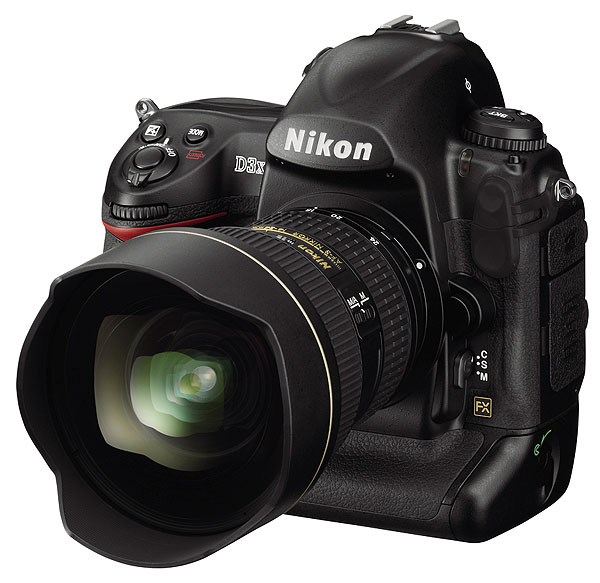
First of all, Nikon already has the two key lenses required to make 24.5 megapixels work on full frame. The 14-24mm and 24-70mm f2.8 G AF-S designs (more so the 14-24 than the 24-70) deliver something which neither the Canon full-frame system nor the medium-format alternatives can offer. Plenty of DX rather than FX format owners have bought these lenses, they are not the exclusive territory of the D3/D700 and I was first sent both to test with the D300. They were launched with that camera before FX was more than a rumour.
With Canon 1Ds MkIII owners taking peculiar measures (semi-dumb lens adaptors) to get the Nikon glass on to their bodies, and Carl Zeiss Oberkochen launching an entire series of Canon-chipped manual focus lenses on the back of the growing legend of Canon optical shortcomings, Nikon arrives with more pixels and the glass is sitting there waiting. Sony did not even manage that; the 16-35mm f2.8 Zeiss is yet to appear.
Why is a 24 megapixel camera with a 14-24mm lens so useful?
Taking a rise out of the opposition!
Here’s why. It is as useful as a 12 megapixel full frame DSLR equipped with a 20mm PC shift lens offering 8mm of vertical rise/fall plus 5mm either way of cross-front assuming you stick with a vertical shape crop from a vertical composition. The 12 megapixel crop of out of the 24 megapixel full frame (approximately 17 x 25.5mm) allows this equivalence.
But, of course, you are not limited to a vertical crop; you can lift a horizontal 16 x 24mm, almost 12 megapixels, from the very top of a vertically composed 24 x 36. You can make a square crop from the top of the image, cutting off wasted foreground. Do this and you still have 16 megapixels left – that’s exactly the same as the original, and surviving, Hasselblad V-series digital backs. They only offered 37mm square on a camera intended for 56mm square, with the widest lens a 40mm and no possibility of a rising front movement (though alternatives, in the Flexbody and Arcbody with 35mm lens, did once exist).
In short – given its exceptional rectilinear geometry, even illumination, and corner to corner sharpness at normal working apertures, the 14-24mm Nikon becomes more powerful for architectural work at 12-16 megapixel final images sizes than any hand-holdable medium format rig on the planet.
I’m using a Sigma 12-24mm on my Sony Alpha 900. I know the score! I can do stuff on this combination, stopped down to a sensible f11, which no current medium format digital can even fit in the viewfinder. I did it years ago with the same lens on film, now I can do it again with digital. And Nikon D3X buyers will be able to do much the same with a far more versatile fast wide zoom.
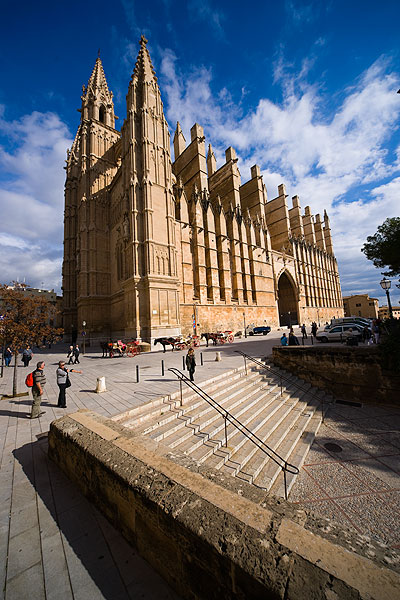
This is an uncorrected 12mm Sigma view on full-frame 24.6 megapixel Alpha 900
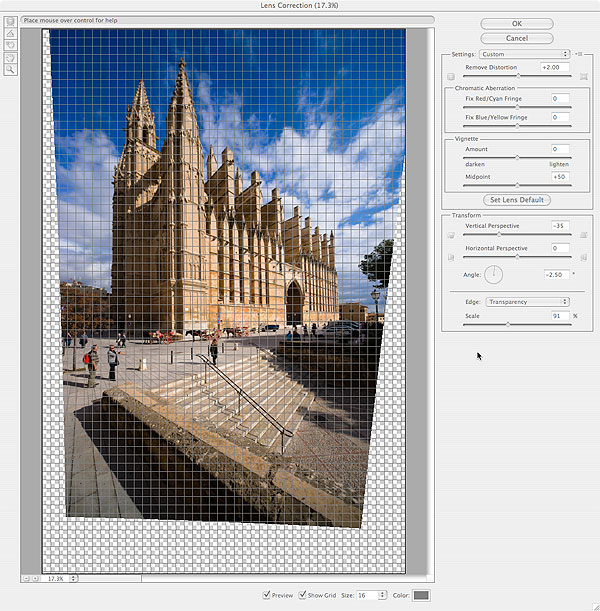
This is how much data must be lost to add further correction using Photoshop CS4 Lens Distortion – though by sacrificing some sky area, a more correct original version would gave been possible.
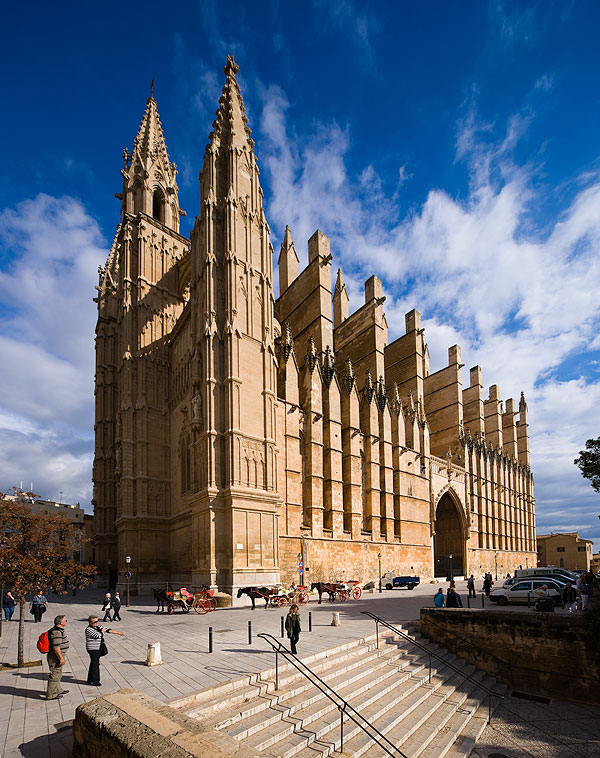
This a final crop – 42.5MB of image, or approximately 14 megapixels. That’s enough for most professional uses including full page height publication. To get to this point required not only a 12mm full frame wide angle (Nikon’s 14mm will do just as well in most situations) but 24 megapixels of uncorrected image, otherwise the crop would yield a much smaller filesize. This why the combination of full frame, a high pixel count, and good ultra wide lenses really matters. NB: a small amount of perspective convergence is left in this version. Architectural view camera users know that an absolutely parallel ‘upward’ view looks as if it’s diverging to the eye; you should always ‘undershoot’ the correction a slightly.
You have to be an experienced shooter with a specific demand for a certain type of image before any of this matters to you. Consumer-level buyers will rarely even understand why it counts. Any architectural, interiors, real estate, industrial or commercial photographer will need no further persuasion.
Fast fashion
So, why else would the D3X sell? I interviewed Hasselblad’s CEO Christian Poulsen at photokina 2008. He told me it was unlikely Hasselblad would ever aim for faster than 3 frames a second even though the H-series body and lenses were theoretically capable. As they advance to 60 megapixels plus on the back end, the front end is slowed down to modest potential. One shot a second… one shot every 1.5 seconds… maybe 1.5 shots a second. Spending a day with Phase One shortly afterwards, they had much the same message. ‘Auto-winder’ speeds were going to have to be enough for medium format users.
The D3X shoots at 5 fps. That’s a magic figure for studio and location fashion work. Five frames a second catches action at the speed of typical catwalk moves, studio jumps and poses, pretty well. It doesn’t cut for sports action. I tested the Alpha 900 at 5 fps on racehorses, and Olaf Ulrich pointed out that the horses were all hitting the ground at 2.5 paces per second so my 5 fps only ever got two positions. 9 or 11 fps would have caught those critical in between phases of the gallop. The same goes for any fast action or sport.
Fashion and action portraiture don’t move at those speeds, but they do move faster than 1 frame every 1.5 seconds, or indeed 2 shots a second. New flash systems like the Profoto Pro Acute AIR series can deliver hyper-fast durations and recycling times, but 5 fps is nothing new to studio flash. Both Morris Industries and Jessop (through the purchase of the Powerflash company) offered this 25 years ago. Balcar did the same when not having fun electrocuting careless photographers.
Fashion location shooters use location battery-pack versions of the studio generator strobe kits. They also use natural light for action sequences. Most love the change in differential focus and lens angle of view brought by a return to full frame, after working with the DX format. Many already use Canon 1Ds MkIII, but Canon has some peculiar limitations – for example, not even the MkIII supports second-curtain flash sync with PC-coax or PocketWizard (etc) triggered studio flash. The D3X does.
Right now, second curtain sync is not a deal breaker in the big megapixel count DSLR market. Why? Because you can’t do it with Canon except by using their own camera-top battery guns (not with ANY Canon, and you couldn’t do it with film either). So you won’t find many examples of second-curtain short bulb exposure or slow speed synch technique. But the Sony Alpha 900 does support it with studio flash, so does the D3X, and through the larger Nikon user-base we can expect to see good creative applications.
Framing generosity
Pundits, with whom I opened this article, like to think that sports and wildlife photographers really don’t need 24 megapixels full frame and that only landscape, studio and similarly static shooters will be queuing at the cash till.
They are wrong. From the first days of Leicas equipped with wire-frame sports finders, action photographers have struggled with framing, composition and timing. Whether panning or setting up a camera to catch static action, anything crossing the field of view has been subject to the delays of the camera’s action plus the even greater eye-brain-hand lag of the human operator. One reason for the popularity of the machine-gun motordrive technique is that a continuous burst of two dozen frames gives you a fair chance of catching one with the moving target both a decent size in a tight frame, and well placed.
The Leica M cameras were popular for action despite the rangefinder limitations, because with longer lenses a frame remained visible beyond the image area. Sigma’s original SD9 and SD10 were also very good to use as they had a full 35mm frame, with a grey-tinted outer zone surrounding their 1.7X crop factor image. Nikon’s implementation of DX cropping on the D3X is similar, and much better than Sony’s token marks in the viewfinder. I can promise you, when you are shooting in haste and tracking a subject, those tiny corner markings just disappear!
However, unless you desperately need that 7-9fps in place of 5fps, the full 24 megapixel frame offers something invaluable for the action and sports shooter – extra image all round! Don’t think you need a longer lens to fill the frame. Of course you don’t. You were happy with a 300mm f2.8 on DX? Welcome to your 300mm f2.8 on FX.
What do you get? You get the same 12 megapixels in the centre of your shot, plus another 12 surrounding it. Remember those shots with a foot cut off, a ball just out of the frame, a brilliant expression from another player missed because you were homed in on a tight crop? 24 megapixel action shooting recovers better compositions, missed details and adds cropping potential for different shapes.
Take an extreme example. Suppose you had a 24 gigapixel camera with a 300mm lens covering a 240 x 360mm sensor, and you just set it up to cover an entire football pitch. You wouldn’t need to move the camera, just fire the shutter while sitting watching for the right moment, then pick any part of the action out.
This is fantasy but covering action sports with the extra image area of the D3X is not fantasy, it’s a step forward. The same goes of course for the Canon 1Ds MkIII though Nikon’s 3 million extra pixels will add a touch more detail to a crop from any given focal length of lens. Canon sports shooters have adopted full frame, and so have wildlife shooters, where the movement of a subject even using a IR trip sensor can be so fast you get a shot of a tail. Now Nikon specialists get the same option.
But they already had full frame – sure. They had 12 megapixels, and 12 very good megapixels with amazing high ISO performance. The point with 24 megapixels is that a tight crop, even a very small crop, can make a better half page or full page.
Why is 24 better than 21?
Although there’s nothing in it really, we work with certain paper sizes in Europe and the US. A typical European magazine measures 210 x 297mm (8.25 x 11.7″) while many US publications are 8.5 x 11″. When 6 megapixel cameras appeared, the 2000 pixel width translated to 6.6 inches at 300dpi, the industry standard for litho printing at 150-200 line screen. To fill a page, an image needs extra ‘bleed’ (usually 3mm or 1/8th all round) and may also need some leeway to move it around for layout design purposes.
Clearly, the 6.6 x 10 inch 300dpi image is really perfect for a half page of either US Letter or A4 format. Even 8 megapixels, and then 10 megapixels, was not really enough to allow alignments, crops and bleeds at uncompromised resolution for full page repro. When we got to 12 megapixels, we finally had perfect full page shooting with leeway for cropping and bleed.
Now I’ve printed excellent double page spreads from 6 megapixels. It can be done, with the bleed. Not every shot will make it, and perfect low ISO technique with excellent glass is needed. What I’m talking about here is the worst case – the high ISO shot, poor light, ordinary lens performance. Generally, any properly shot 12 megapixel DSLR image is good enough for a full page and much easier to work up for a spread.
21 megapixels, currently Canon’s largest image size, just squeezes in to an ideal double page spread pixel count. It is 18.6 inches by 12.48, plenty of leeway on the length but just a bit tight on the height for A3 (12.2 inches is needed for A3 with bleed). It is better on American paper sizes, where a spread is 11 x 17, but most of the world is now based on A-size printing. It’s also just perfect (assuming the shot needs no crop or straighten-up work) for best possible quality 12 x 16 or 12 x 18 art prints.
24 megapixels (in whatever exact variation) makes a 20 x 13.3 inch 300dpi size (both Nikon and Sony are slightly over this). That little bit extra doesn’t appear to count for much until you start straightening horizons or verticals, making minor crops, tidying up. And, if you have a perfect shot with not a wasted pixel in sight, it is a very small step away from making the standard size exhibition print of 20 x 16″.
Of course, the 21 megapixel image will do so and I’ve made plenty of 20 x 16s and the larger A2 size from much smaller files. But those extra pixels genuinely do count. I provide images to Alamy, the on-line picture library, and after working with both the Canon 5D MkII and the Alpha 900 side by side I found that the small increase in filesize made a difference to the squarer or more panoramic crops I could apply to the images while staying above Alamy’s 17 megapixel (48MB) minimum filesize. I would really like around 28 megapixels, to be able to make a precise square crop…
Which is almost back to where I started – the benefits of extra pixel real estate.
The DX3 price
In Britain, the DX3 is priced at £5495 which is £500 less than the official retail price of the Canon 1Ds MkIII. Commentators have looked at that £4500-4800 average street price of the Canon today, and assume the Nikon will be more expensive when in fact it’s likely to be less. Initially it will probably be discounted to match the Canon.
Has the D3 sold badly? No doubt it has since the D700 was launched! We purchased a D3 only one month before the D700 appeared. That certainly caused some deep thought. Will Nikon repeat a mistake, or repeat a triumph? Perhaps the D700 has been such a resounding success they are bound to bring out the putative D700X – or perhaps the D700 put such a sharp end to demand for the D3, they won’t produce a D700X because it would devalue the D3X.
One thing is certain. The D3X is the first camera to be priced AFTER the major readjustments which have hit currency values, interest rates, disposable income, credit availability and other vital aspects of the international market for such items. Canon’s announcements of relatively small (5-10%) price rises earlier in 2008 were reactions to the fledgling financial crisis. Existing stock is not a problem as far as keeping current prices goes; future production is another matter.
The D3X may seem overpriced now but the truth is that all such cameras – including consumer level DSLRs – have been underpriced for several years. When I bought a house in 1972 it cost £4,400 and a Hasselblad 500C which was the pro workhorse equivalent of a Nikon DX3 or Canon 1Ds MkII at the time was £480. I checked the same houses today and they sell for £140,000. By those standards, a basic pro camera with lens should be over £15,000. My salary in 1972 was £100 a month, in case you think modern house prices have gone up out beyond recognition – the same junior reporter’s job today is paid at £1,500 a month. So by that standard the pro camera+lens should be around £6,500.
And indeed, it is!
– David Kilpatrick FBIPP Hon FMPA


Leave a Reply
You must be logged in to post a comment.