Category: Uncategorized

  • Sigma I-series 90mm f/2.8 and 24mm f/2

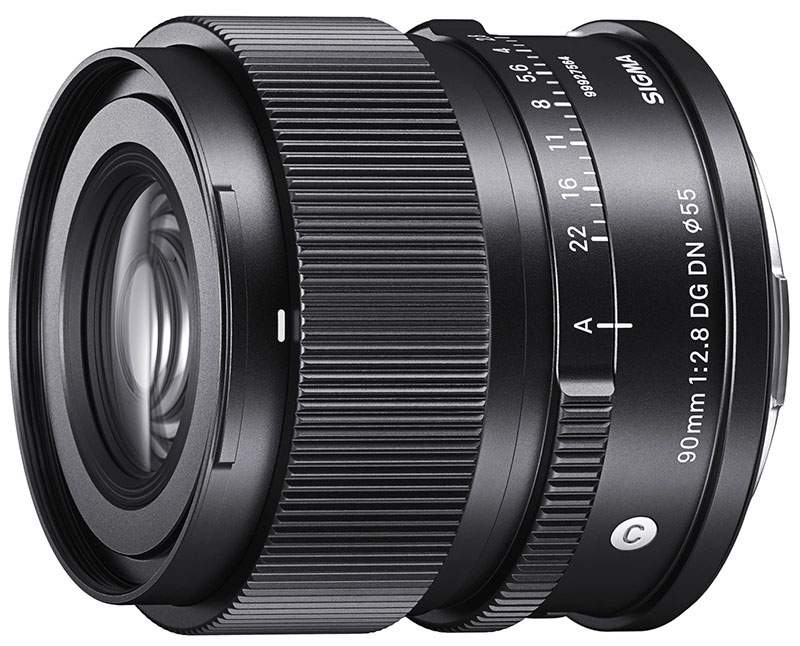
    With the introduction of a super-compact 90mm f/2.8, Sigma has made the I-series of high performance full frame mirrorless system lenses match the very best classic kits of the rangefinder era.

    The I-series lenses are all fixed focal length (primes) and feature aperture control rings as well as fast autofocus with MF/DMF via the lens focusing barrel. The construction is solid metal, not a thin skin of metal over plastics as found in some earlier primes from makers like Zeiss, Samyang, Tamron and the Sony and Panasonic camera brands themselves. Every component in the lens is metal down to the stepper motor focusing carriage and the mounting of the glass elements.

    It’s a return to the standard of Leica rangefinder – or Contax G autofocus – lenses updated for users of the Sony E (FE) and Sigma, Leica and Panasonic L mounts.

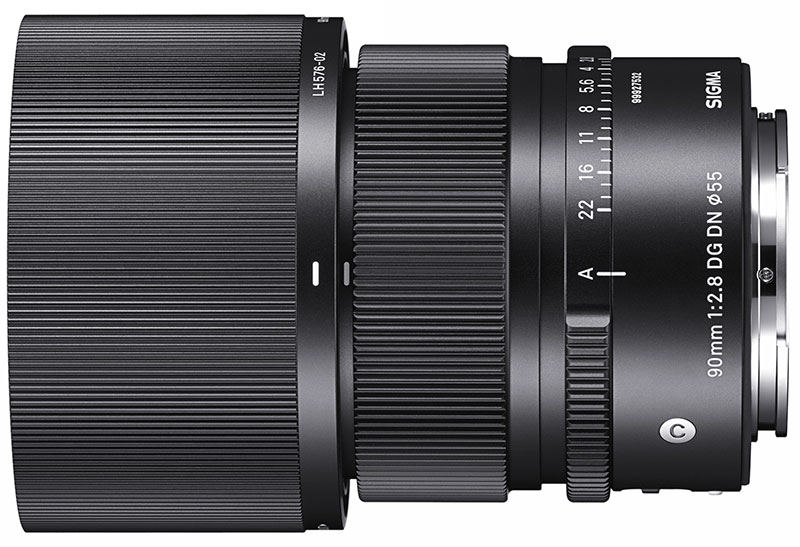
    We’ve only tried the 60mm f/2 in this series so far, but the performance supported the company’s claim to be delivering very high resolution suitable for 60 megapixel or higher sensors. The 90mm f/2.8 has special attention to chromatic aberration in its design which uses no fewer than five SLD (super low dispersion) elements. We expect to see foreground and background blur unaffected by colour-bokeh shifts, made very smooth by a nine-bladed aperture and aided by third-stop f-stop setting on the lens or via the camera. The closest focus of 50cm compares with a typical figure around 85cm for most 90mm lenses, and yields a 0.2X (1:5) close-up.

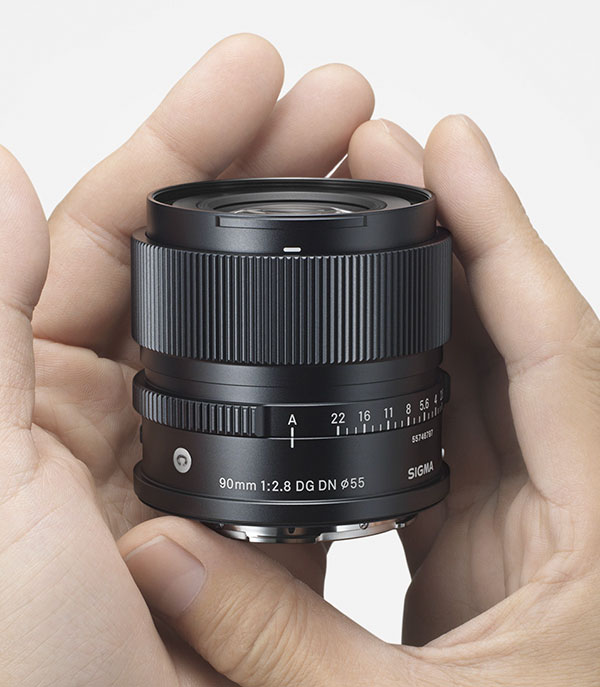
    This lens accepts 55mm filters and weighs only 295g – you can see the size ‘in hand’. It can be teamed up with the 24mm f/3.5 and 45mm f/2.8 in the same range weighing in at less than 750g overall. Combined with a lightweight smaller body like the Sony A7C it’s the closest a digital shooter can get to have a Leica with autofocus.

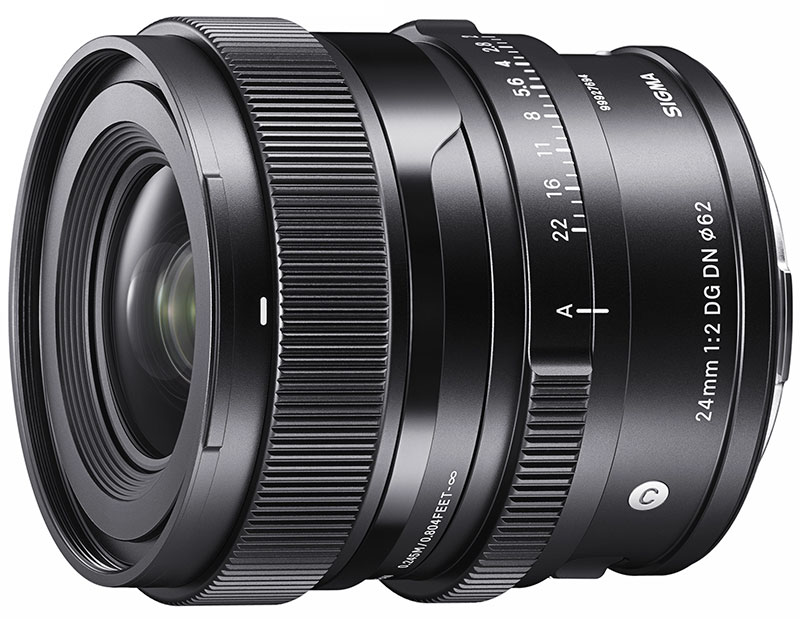
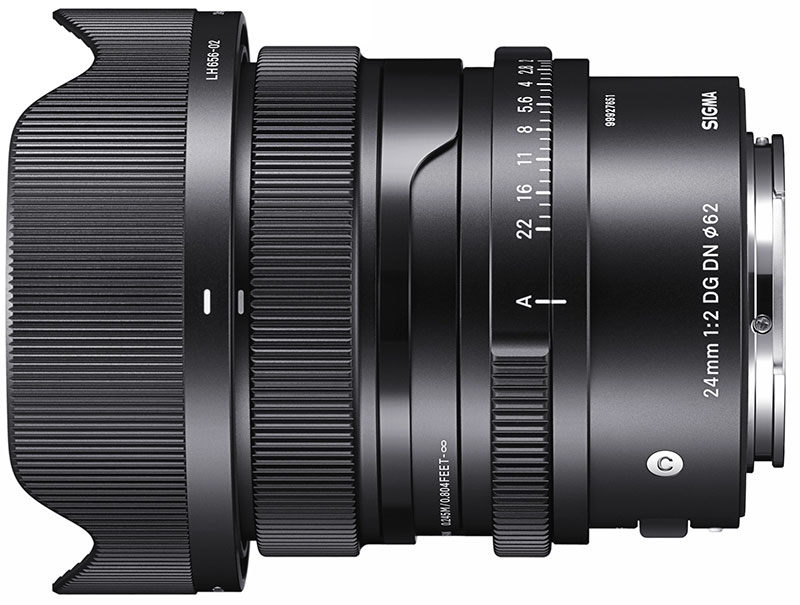
    Alongside the 90mm, also available from September 24th will be a faster version of the 24mm at f/2. It’s sure to attract buyers at the same £549.99 RRP UK ($669 USA) as the 90mm and although it takes 62mm filters and is a little bigger, weighing in at 365g, but it’s really part of the f/2 I-series which now includes the 35mm and 65mm so well matched there. Focus is down to 24.5cm, 1:6.7 scale, which is not exceptional when some 24mms achieve 1:2 but entirely practical.

    As for cost, it’s less than Sony’s 24mm f/2.8 G as well as a stop faster and much less than the Zeiss Batis 25mm f/2 or the APS-C only Sony Zeiss 24mm f/1.8.

    Both these lenses, and the whole I-series, are compatible with Sony’s high-speed autofocus and they’re all made in Japan. The standard now set by Sigma are well-known and they seem to be the only maker left producing new lenses with dust and splash resistant all-metal barrel and mechanical design, brass mounts, and resolution to match the most demanding sensors.

    To see Sigma lenses available at WEX: https://tidd.ly/3z0F00u

    To see Sigma lenses available at Park Cameras: https://tidd.ly/3BUWf5f

  • Sony’s precision aspherics

    In interviews about the new micron-accurate aspheric lens element moulding process used to increase the resolution of the latest Sony G Master lenses, a visual has appeared which shows the ‘onion ring’ effect that coarser mould machining causes in lens elements.

    Working independently, I’ve been aware of this for years – and I have used a point-source photography technique to study lenses. I’m not an optical engineer or scientist, indeed I don’t even have a degree in anything. I came into photography through Victorian books and teenage years experimenting with lenses, developer formulae, building my own equipment and using observation, corollary and deduction to understand how things work. It’s helped me explain difficult technical stuff to many thousands of readers through books and magazines, without using maths or formulae, and very few diagrams.

    In the Cameracraft back in 2013 I published a home-brewed rendering of aspheric moulding visual analysis.

    Here’s Sony’s visual showing the difference between traditional aspheric moulding (pressed glass aspheric, as pioneered by Leica and Sigma) and their new refined pressing with better engineering.

    onion

    And here is my home-brewed visual from Cameracraft when I explained the bokeh and resolution issues created by pressed elements (and also, some other aspects of bokeh, which I’ll refer to below the image):

    onion-ours

    This is the clip from a 2013 article in Cameracraft dealing with broader aspects of bokeh, depth of field, aberrations and how images are rendered. You can download the two-page article here. Nine years after we launched Cameracraft the magazine is going strong, it’s a bit thicker and does have the occasional advert unlike our original, but it is still one of the best ‘never knew that before’ reads a photographer can have drop through the letterbox. You can arrange that easily enough here!

    Here is the full article as a downloadable PDF.

    Sony’s new superlens was not any better than the Sigma 70mm f/2.8 macro which I still use. My reasons for choosing this macro are simple – it is optically excellent and traditionally made without any aspheric or other special elements, and it uses simple focal extension for focusing, not rear or internal group movement. This means it’s a true 70mm lens even when used at 1:1 and gives the maximum lens to subject distance, for its focal length.

    However, it’s MUCH better than the Voigtländer 50mm f/1.4 used for the colour bokeh shift example at the top. Sony’s information makes it clear that the new more precise aspheric moulding allows new surface profiles and the elimination of chromatic aberrations which cause this magenta-green foreground to background shift in so many otherwise excellent lenses. I’ve said that to do so, the new lenses must be what would once have been called Apochromatic, though that term has only ever meant that all wavelengths focused to the same plane and at the same scale. Even past Apo lenses can show poor colour bokeh. It’s interesting that Sigma, after years of plugging the APO (capitals not actually needed, folks!) label chose not to label some new lenses this way even through their performance matched or exceeded earlier APO models. Sony seems to be taking the same view – G Master will be sufficient label to imply very high resolution, elimination of bad colour bokeh shifts, and by implication an apochromatic performance on RGB sensors.

    So will I be buying these amazingly expensive, large, E-mount dedicated lenses? Probably not. My unscientific observations tell me there are smaller, lighter, far less expensive lenses which will serve me better. Mirrorless digital camera bodies with high quality EVF and high magnification focusing allow me to  do things I could never have done over 40 years ago when I took my first position as a Technical Editor (of the UK monthly Photography published by Fountain Press and edited by John Sanders). Geoffrey Crawley, editor of the British Journal of Photography, showed me how to evaluate any lens quickly with the help of a light bulb, a darkened studio, a roll of background paper and a sharp pencil. Back then you had to expose film, now you can just look through the finder. In a photo store, any LED spotlight will do for a quick check. Focus centre, magnified to max, at full aperture. Move to all corners in turn without refocusing, magnify each time. Refocus each corner in turn when magnified, examine change in rendering of point source. Buy the lens which shows symmetrical, balanced results and the best sharpness of the corners when the centre is correctly focused. Do this with a light source at least 3m/10ft away and if you can, even further. Repeat one stop down, two stops down, with zooms repeat at three or four focal lengths across the range. Never do it at close distance (hint: lens test chart results are only good for the distance you photograph the chart from, which is why Imatest, DxO and other labs have test targets the size of a wall and industrial sized space to work in).

    And, if you have a single LED bulb or miniature LED torch, you can examine any of your lenses in a darkened room and produce a ‘bump map’ which will reveal its moulding defects, scratches or fungus, blemishes, and population of dust and microfauna.

    – David Kilpatrick

    dk-cameracraft-bokeh

    For our PDF and App editions, go to Pocketmags where you’ll find Apple iOS, Android and all the usual choices to subscribe or buy individual editions.

    And if you really want a trip back in time – there were huge changes between 2012 and 2015. Cameracraft documents the rise of mirrorless, the growth of hipster retro, and the discovery of older manual lenses as it happened. You can read a full set of the 12 issues via this one-off YUDU subscription:

    Click to view the full digital publication online
    Read Cameracraft 2012-15
    Self Publishing with YUDU

  • NEX-7 close cousin reaches astronomical value

    A crowd at a charity auction in Florida couldn’t believe their eyes as two brand new Hasselblad Lunar cameras with a joint retail value of around $14,000 suddenly rocketed in value to $54,500 (from Hasselblad press release this afternoon).

    Two photo enthusiasts at the world-famous three day-long annual Amelia Island Concours d’Elegance exotic car festival began bidding against each other for the chance to own an ‘ultimate luxury’ olive wood-handled Lunar camera, crafted by the iconic camera brand.

    Lunar Olive Wood 18-55 Hood_b

    When the bid reached $28,000 neither party wanted to lose out on a Lunar, so a deal was struck for an extra camera to be auctioned – for a joint record-busting price that raised a total of $54,500 for a spina bifida charity.

    The deal also included a unique set of classic motorsport photographs shot over decades with a Hasselblad camera by Concours Show founder and chairman, Bill Warner.

    Warner said: “Hasselblad is simply the ultimate camera. It’s the Mercedes-Benz, the Porsche and the Ferrari of cameras, all in one.”

    The Amelia Island classic car and automotive art festival, which is billed as ‘three days of automotive passion at the International Historic Motoring Awards, Motoring Event of the year (2013)’, draws classic car enthusiasts from across the globe each year and raises millions of dollars for charity.

    Michael Hejtmanek, President of Hasselblad Bron Inc. said: “We knew our new, retro-look Lunar range was compelling – especially the rich-veined olive wood edition with its advanced technology and supreme ergonomics – but for a pair of them to raise $54,500 for Spina Bifida Jacksonville at this auction is just outstanding.”

    Further information:

    http://www.hasselblad-lunar.com/
    http://www.spinabifidajax.org/
    https://www.ameliaconcours.org/

    Our comment: fortunately, charity auctions are always about the charity not about the real value of the items. These are still only worth a little compared to the actual lunar-landing Hasselblads, of which four are thought to be surviving in the wild and surfacing at auctions from time to time.

  • Using the 10-18mm OSS zoom on full frame

    The Sony E-mount (not FE) 10-18mm f/5 OSS lens can be used effectively on full frame for creative work and within limits for technically more demanding shots. Below, an uncropped A7R shot of the concourse at Abu Dhabi Airport, taken at 13mm setting, f/6.3 with my lens profile as provided below. Check the straight lines in the floor tiling, if you doubt that this lens would be of any use for architecture.

    However, you don’t get this without a lens profile, and without due care to limit the focal length to a range of 13 to 16mm – not the full 10 to 18mm. Below, you could get this if you try 12mm straight out of camera…

    uncorrected12mm

    This is a pretty awful case of vignetting and distortion – as you would expect. It’s from an APS-C format wide angle zoom, the 10-18mm f/4 SEL OSS lens for NEX, used on the Alpha 7R full frame mirrorless body. Early in the launch period of this camera, various far more attractive images appeared on-line using subjects like roads, rail lines, beaches and even shop counters where the lines look straight – rather like that drainpipe – because of where they fall in the shot. As you can see, anything with a horizon near the long edge of the framewould have given a very different impression.

    However, Adobe offers a free utility which enables you to make lens profiles to correct vignetting and distortion.

    I created a lens profile for ACR/LR using full frame and the 10-18mm on the A7R. The vignetting is such that the profile creator really can’t handle it, and overcorrects the extreme corners as a result. I’ve done f/4, f/8, f/16 at 12, 14, 16 and 18mm focal lengths using an A2 chart; for a lens like this, a much greater working distance and an A0 chart would really be desirable. The link below is to a zip file of the Adobe Lens Profiles I produced – for A7 and A7R, with .lcpp files for final use, and .lcp files for different settings of the 10 18mm I found useful.

    10-18AdobeLensProfiles

    corrected-customprofile12mm

    At 12mm you can probably see the vignetting artefacts in the corners, the magenta corner shift and incomplete correction of the horizon line. You’ll also be quick to spot that the 12mm coverage has been reduced to something much less, lens profiles always reduce the field of view (they can not do otherwise).

    The profiler simply can’t handle the degree of sudden fall-off in illumination given by the 10-18mm used on full frame. Manual distortion corrections can actually do a better job. At other focal lengths, the profile I’ve made works well enough, and if the frame is cropped slightly (still exceeding the APS-C area the lens is designed for) it’s possible to get good results and wider angles.

    I have sold my Sigma 12-24mm HSM II which was used with the A99, and also sold a Voigltander 15mm f/4.5 I bought to test (zero cost fortunately, as it made a small profit between Gumtree source and eBay destination). The Sigma was not only very difficult to focus using CD, its HSM motor won’t play with Sony CD.

    My .lcp full-frame file can be downloaded from:

    //www.photoclubalpha.com/AdobeCameraProfiles/ILCE-7R FF (E 10-18mm F4 OSS) – RAW.lcp.zip

    Just for good measure, here is an uncropped A7R 13mm focal length shot of the church of Maila Dumpara in Kerala taken to use dramatic converging verticals – which fail terribly unless the lines are properly corrected, the last thing you want in a strong upward angle is lens distortion. It’s very stiff test of any lens to do this. I have left the vignetting uncorrected. I rather like it. Click either this or the Abu Dhabi photo and you’ll get a larger image, about 1000 x 1500 pixels.

    Samples produced for a dPreview forum question

    There’s been a lot of discussion on dPreview forums of which lenses work on full frame E-mount, as Sony saw fit to put a Disable APS-C crop option in the menus of the A7 and A7R (almost as if they wanted owners to experiment). They have made other welcome changes of a similar kind which I’ll cover in a full review of the camera – which I can not do yet as I have no FE mount lenses for it, and with the current choice and prices, I can see I may never use FE mount lenses on this camera.

    So, to answer some questions on dPreview’s E-mount forum, I posted these images and comments.

    Here is a ‘native’ uncorrected shot of a local building taken on the 10-14mm on A7R at 11mm, f/10, ISO 100:

    View: original size

    Here is the result of using the profile, doing a crop and some straighten of slight rotated tilt, and pulling the scale down (with the profile applied, the roof apex is clipped off at the top as the lens has so much distortion its 11mm probably becomes more like 15mm when corrected):

    View: original size

    I’ve used some clarity and local burn adjustments on the sky to treat the image more or less as I would (except that I wouldn’t actually photograph this building at this time of day, with blinds drawn, etc).

    For me, the 10-18mm on A7R with our without the profile correction offers the same options as using assorted lenses on 5 x 4 sheet film. It never mattered whether a 47mm didn’t cover the entire film, you got an image circle and could use whatever part of it you want. At 10mm the image, with the profile used, has strong corner cut-off but the overall circle of usable image greatly exceeds APS-C provided you stop down (f7.1 seems just OK, f/10 is maybe optimum, I’d certainly try f/16 despite fears of detail loss).

    View: original size

    The red crop mark is square – my ‘Hasselblad SWC killer’, as the classic SWC had just a 38mm wide angle lens. You needed to get an Arcbody with 35mm Rodenstock to go any wider on 56 x 56mm film (6 x 6). With the A7R and 10-18mm at 10mm, you get the equivalent of a 24mm lens. Not a 24mm fisheye on 6 x 4.5 like the widest ever offered by Mamiya… a 24mm rectilinear on 6 x 6.

    The yellow crop mark represents a significantly larger area than APS-C (which is actually just a little under the 24 x 24mm square in width). It is shifted vertically, as if the lens was being used as a shift lens. If only the APS-C area is considered, its approximately 16 x 24mm area can be positioned right to the top of the frame, equalling a 4mm rise, or the equivalent of using a 6mm rise on a full-frame PC lens (most actually go to 11 or 12mm rise). There is only one lens made which can compete with this, and that’s the Canon 17mm f/4 TS. Admittedly this is a superb lens and when stopped down to f/11 and used on the 6D (Canon’s most shift-friendly sensor) will blow this result away for clean rendering of detail toward the frame edges.

    And then, you can still use the 10-18mm in APS-C crop mode as a snapshot wide angle with pretty much perfect correction (Adobe’s own Sony profile for APS-C), for videos too.

    – David Kilpatrick

  • ACR 7.2 and Lightroom 4.2 RC – RX100 compatible

    The good news is that you can now download, free, the Release Candidate versions (expire October 31st) of Adobe’s Lightroom 4.2 and Camera Raw 7.2, as well as DNG Converter 7.2, which will give you raw conversions for the Sony Cyber-shot DSC RX-100.

    The bad news is that no camera lens profile is included, and until someone creates one, the distortions and CA of the RX-100 lens are not corrected by these programs. Also, we can confirm that no further highlight recovery is possible, beyond that already enabled in Sony Image Data Converter. This has not always been the case with ACR/LR. They have often enabled clipped highlights to be recovered with useful detail from KM and Sony raw files. The RX-100 raw files are right on the edge of overexposure and you just can’t pull burned out highlights back in.

    But against this, the high ISO performance of the RX-100 is superior to, for example, the NEX-5n. That’s surprising and worrying, as the 5n is better than the NEX-7. ISO 3200 images from the RX-100, processed through ACR 7.2RC, are about as good as any APS-C camera currently manages and not far off what can be expected from a full framer.

    Shot at f/1.8 on the RX-100, 1/30th, ISO 3200 – about as dark as it gets for hand held shots.

    100% ACR 7.2 clip with NO noise reduction at all and no sharpening

    On the Canon 5D MkIII, 1/3oth at f/2.8 using the 40mm pancake lens – twice as much light as the pub scene above, gold Olympic letterbox in Edinburgh seen by night time street lighting

    Sure, at 100% under the same process conditions it is better – but once you apply NR to the Sony image, the difference is levelled considerably. And this is the world’s best full framer for low light, right now, over 20 megapixels.

    Here is your download link for Adobe Lightroom ACR 4.2 RC:

    http://labs.adobe.com/downloads/lightroom4-2.html

    And here is your link for ACR and DNG Converter:

    http://labs.adobe.com/downloads/cameraraw7-2.html

    The results at speeds from ISO 80 to 400 are a match for any DSLR, with the exception of the issue of dynamic range above highlight clipping. There is no significant margin for highlight recovery. This is a marked contrast to the early KM Sony sensor such as the 8 megapixel used in the Dimage A2, which had almost two stops of clipping-free highlight recovery using the metered exposure in high contrast situations.

    – DK


  • Nikon D4 and Canon 5D MkIII video test clip

    These short clips are not intended to test all aspects of the cameras, of course. They are taken from a number of tests made with the cameras, and show some reasonable comparisons of quality.

  • 41Mp compact – from Nokia!

    Once, Nokia were the largest camera manufacturer in the world. Pioneering the combined camera and smartphone market with for the time, sophisticated Symbian-based phones with Zeiss lenses. Such a short time ago, relatively, is an epoch in the technology industry and Android, combined with the sales success of Apple’s iPhone, has eroded the early gains made by Nokia and Sony with their camera-focused models. As such, in recent years Nokia has struggled to find a clear identity and sales – losing the iconic Communicator ranges, seemingly sidelining their own Symbian OS, and diversifying to the point where selecting a clear Nokia device can be hard.

    This is set to change, with a pioneering new cameraphone. The 808 PureView carries a digital-camera threatening 41Mp sensor.

    (more…)

  • EISA Awards 2011-2012

    So far three photographic products have been announced for EISA Awards – as announcements continue to come in, we’ll update this post.

    (more…)

  • Mapping the planes

    Samsung has a patent and a plan for using two lenses with triangulation (image offset) depth detection between two images in what is roughly a stereo pair. Here’s a link:

    http://www.photographybay.com/2011/07/19/samsung-working-on-dslr-like-bokeh-for-compact-cameras/

    Pentax also have a system on the new Q range which takes more than one exposure, changes the focus point between them, and uses this to evaluate the focus map and create bokeh-like effects. Or so the pre-launch claims for this system indicate, though the process is not described. It’s almost certain to be a rapid multishot method, and it could equally well involve blending a sharp image with a defocused one.

    In theory, the sweep panorama function of Sony and some other cameras can be used to do exactly the same thing – instead of creating a 3D 16:9 shot it could create a depth mapped focus effect in a single shot. 3D is possible with sweep pans by simply taking two frames from the multi-shot pan separated by a certain amount, so the lens positions for the frames are separated enough to be stereographic. 3D ‘moving’ pans (scrolling on the TV screen) can be compared to delaying the playback of the left eye view and shifting the position of subject detail to match the right. But like 16:9 pans, they are just two JPEGs.

    All these methods including the Samsung concept can do something else which is not yet common – they can alter any other parameter, not just focus blur. They could for example change the colour balance or saturation so that the focused subject stands out against a monochrome scene, or so the background to a shot is made darker or lighter than the focused plane, or warmer in tone or cooler – etc. Blur is just a filter, in digital image terms. Think of all the filters available from watercolour or scraperboard effects to noise reduction, sharpening, blurring, tone mapping, masking – digital camera makers have already shown that the processors in their tiny cameras can handle such things pretty well.

    Once a depth map exists there’s almost no limit to the manipulation possible. Samsung only scratches the surface by proposing this is used for the esoteric and popular bokeh enhancement (a peculiarly Japanese obsession which ended up going viral and infecting the entire world of images). I can easily image a distance-mapped filter turning your background scene into a Monet or a van Gogh, while applying a portrait skin smoothing process to your subjects.

    Any camera with two lenses in stereo configuration should also, in theory, be able to focus using a completely different method to existing off-sensor AF – using the two lenses exactly like a rangefinder with two windows. So far this has not been implemented.

    Way back – 40 years ago – I devised a rangefinder optical design under which you can see nothing at all at the focus point unless the lens was correctly focused. It works well enough for a single spot, the image detail being the usual double coincident effect when widely out of focus, but blacking out when nearly in focus and suddenly becoming visible only when focus is perfect. I had the idea of making a chequerboard pattern covering an entire image, so that the viewfinder would reveal the focused subject and blank out the rest of the scene, but a little work with a pencil and paper quickly shows why it wouldn’t work like that. The subject plane would have integrity, other planes would not all black out, they’d create an interestingly chaotic mess with phase-related black holes.

    Samsung’s concept, in contrast, could isolate the subject entirely – almost as effectively as green screen techniques. It would be able to map the outline of a foreground subject like a newsreader by distance, instead of relying on the colour matte effect of green or blue screen technology. This would free film makers and TV studios from the restraints of chroma-keyed matting (not that you really want the newsreader wearing a green tie).

    The sensitivity of the masking could be controlled by detecting the degree of matched image detail offset and its direction (the basic principle of stereographic 3D) – or perhaps more easily by detecting exactly coincident detail, in the focused plane. Photoshop’s snap-to for layers works by detecting a match and so do the stitching functions used for sweep and multi shot in-camera panorama assembly. Snap-to alignment of image data is a very mature function.

    Just when you think digital photography has rung all the bells and blown all the whistles, the tones of an approaching caliope can be heard rolling down the river…

    – David Kilpatrick


  • Pentax 645D Japan announced

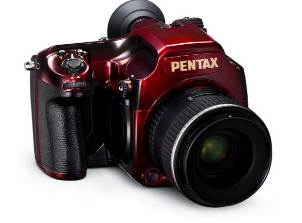
    Hasselblad has their Ferrari edition, Leica has the Ti and other special editions – and now Pentax, already making a veritable rainbow of K-r colours, are adorning their flagship 645D Medium Format system with a classical Japanese finish. The 645D is pretty much what happens when you approach medium format without any preconceptions and with a lot of experience in the consumer digital market; get a K DSLR and a medium-format digital sensor, and you get DSLR usability and medium-format images.

    Produced to celebrate Pentax’s win of the 2011 Camera GP – with the 645D crowned “Camera of the Year” – the 645D has a hand finished lacquer body treatment and is available strictly to order for a two month period; delivery could take four months.

    The release also confirms support for the O-GPS1 module, though the star tracking will not be applicable to this fixed sensor camera.

    Official release after the break.

    (more…)