With their 645D offering a revolutionary balance of cost, features and usability for the medium format world, and the K-5 16Mp DSLR offering a flexible blend of enthusiast and professional features, Pentax is already blurring the distinctions between the genres traditional camera manufacturers exploit. The new Q system announced today further moves the boundaries, by offering that rare package of a compact sensor with interchangeable lenses. The new Q mount is served by a range of five lenses at launch, and this initial camera sports a 1/2.33″ Backlit CMOS sensor delivering 12.4Mp resolution and specced for a maximum ISO 6400. At 200g it’s undoubtedly a light body, yet that small sensor could well be offputting in a camera that’s likely to exceed a £500 list price.
Category: Uncategorized
-
Alamy hits 24m images with added celebrity collection
Alamy.com has further strengthened its collection with the addition of over a million celebrity images, and now has over 24 million images on line. The company represents over 570 of the world’s leading stock and specialist agencies and over 25,000 photographers worldwide.
Rachel Wakefield, head of sales at Alamy, said: “We are extremely popular with newspaper and magazine customers and this additional entertainment and sports content cements our appeal. TV and film stars, royals and sporting celebrities will always be sought after”.
Alamy is well known for its quality and variety of imagery, from the obvious to the obscure. The combination of high profile stock agencies and 25,000 individual photographers gives an extraordinary blend of world class imagery, with a myriad flavours and themes. For these reasons, the company is considered the first, and often only, port-of-call for customers who value this mix.
Alan Capel, head of content at Alamy added: “Our collection has both freshness and variety and our customers appreciate that much of this imagery is unique to Alamy”.
-
Fuji use Backlit CMOS in raw G12-beater
The FujiFilm FinePix F550 EXR is the first serious competitor to the Canon G-series for professional backup shooting and travel, with 16 megapixels of back-illuminated (Sony but Fujifilm diagonally aligned matrix?) CMOS and raw shooting along with a massive zoom range, stabilisation, high ISO sensitivity, full HD at 30fps in a user-friendly .MOV format, GPS data recording, and various multishot modes including HDR. It’s also very favourably priced.
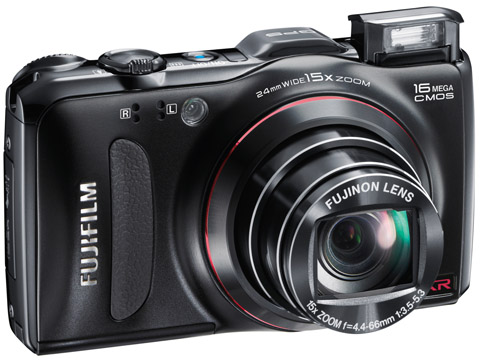
The FinePix F550 is available today from leading photographic retailers nationwide, with a list price of £329. Note to readers: our links to B&H lead to far more detailed specifications and feature lists than Fuji’s own press info.
New Backside Illuminated CMOS
Thanks to the hybrid sensor, the FinePix F550 EXR delivers fast, high-quality results in a wide range of lighting conditions. The EXR processing engine uses a combination of a bespoke 16-megapixel Back Side Illuminated CMOS sensor (BSI-CMOS) and Fujifilm’s new triple-core EXR processor, to deliver superior results, particularly in low light conditions – plus high-speed shooting facilities and Full HD movie capture. The sensitivity range is from 100-3200 EI, and the filesize options include 4:3, 3:2 and 16:9 aspect ratios in three pixel densities.
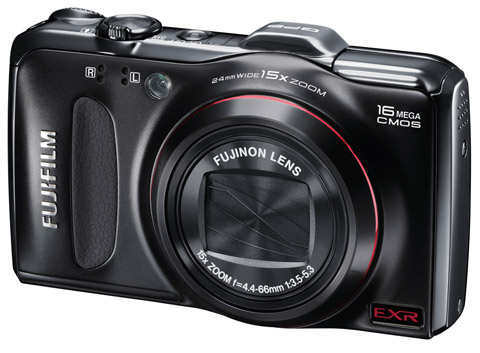
Users can still select from three different EXR shooting modes, or can allow the FinePix F550 EXR to choose the best option by selecting Auto EXR (it’s an orange setting not green on that dial, too).- EXR High Resolution mode utilises the full 16-megapixel resolution of the sensor for high quality results that can be printed out at A3-size, and without the need for any re-sizing by software.
- EXR Dynamic Range mode employs dual capture-technology to provide a dynamic range of up to 1600% – almost a full stop wider than any other camera. Two images are captured at different exposures and are then merged to produce superb results on high-contrast scenes.
- EXR Signal to Noise mode utilises Pixel Fusion, pairing pixels to increase sensitivity. Coupled with the BSI sensor technology, this mode delivers superb images in low lighting conditions.
RAW image capture
With the ability to shoot in RAW or JPEG format (or both simultaneously), the F550 EXR has appeal for stock photography, wedding candids and professional backup generally. It remains to be seen whether Alamy puts it on the approved or rejected list – bear in mind the Canon S90 type models are blacklisted when nearly identical G-series models are accepted. Both shoot raw and have similar sensors. Will the Fuji lens be up to the mark?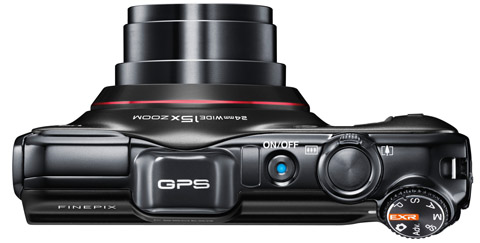
GPS embedding
Regardless of where you are in the world, the FinePix F550 EXR will recognise your location and display it either as longitude and latitude co-ordinates or by place name – thanks to the camera’s embedded list of locations. A tag is placed on the image which can then be easily searched for, allowing shots of a specific location or point of interest to be found quickly and by name.Additional functionality is also provided by the Photo Navigation mode, allowing users to find their way back to where a particular photo was taken. The FinePix F550 EXR can store location data every 10 minutes* and, once the images are downloaded to a PC, a map of the route along with the pictures taken along the way can be created using Google Maps.
* Anytime On or Only Power On must be selected for data to be logged.Keep up with the action
At the full 16-megapixel resolution, the FinePix F550 EXR is capable of delivering up to 8 frames per second for up to 8 frames – and without compromising picture quality (note: some websites state 3 frames and 3 fps). Select the Best Frame Capture mode and the FinePix F550 EXR automatically starts recording images the moment the shutter release is half-pressed and focus locked. Once the picture has been taken, the F550 EXR records the seven frames before or after the shutter was fully released to allow the choice of at least one shot that’s (hopefully, as in our experience both rarely coincide) pin sharp and perfectly framed.Huge zoom range, tiny camera
Despite having a body that measures only 22.9mm deep, the f/3.5-5.3 zoom lens range extends from a wide-angle setting of 24mm through to 360mm (35mm equivalents) giving users a huge range of shooting options. Image quality and sharpness is also assured thanks to the combination of a high quality Fujinon lens and the new triple core EXR processing engine that automatically reduces colour fringing and boosts corner resolution for uniform image sharpness.Triple Stabilisation tactics
Using longer focal lengths can cause camera shake, but the FinePix F550 EXR has its bases covered on three fronts. First, the sensor moves to counter any hand movements. Second, sensitivity is boosted using Pixel Fusion to allow faster shutter speeds, and third, users can select Advanced Anti-blur when in EXR Auto mode giving a sequence of four images which are then combined to provide one, shake-free result.Full HD video
The FinePix F550 EXR records videos in Full HD (1080p) at 30 frames per second, with stereo sound, and outputs the files in H.264 (MOV) format. Fuji’s EXR Signal to Noise mode is now also available when shooting Full HD videos, using Pixel Fusion Movie technology to fuse pixels together for extra sensitivity, and therefore much crisper low-light videos with lower levels of noise.The F550 EXR also offers a class-leading selection of high-speed video capture options including a class-leading 320 frames per second capture at 320 x 100 pixels.
Fujifilm also offers a second model, the F500 EXR with a similar specification – excluding the GPS and RAW capture capabilities – and in the same super slim design but in a range of five stylish colours.
The Fujifilm FinePix F550 is available now for £329 in black.
The Fujifilm FinePix F500 is available now in a choice of five colours for £279.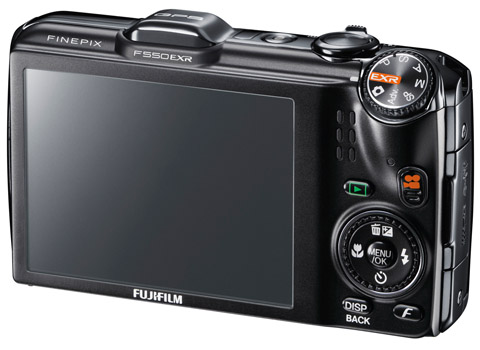
Fujifilm FinePix F550 EXR key features:
• All-new 16 megapixel EXR CMOS sensor
• 15x optical zoom covering 24-360mm (35mm equivalent)
• 3.0 inch rear LCD with 460,000 pixel and new Rich User Interface using Vector fonts and graphics
• GPS functionality
• RAW shooting
• Advanced Anti-blur technologies
• 1600% wide dynamic range
• Full resolution high speed shooting at 8fps
• Full HD movie capture (H.264 MOV file format)
• Advanced 27 scene mode EXR Auto
• Film simulation modes
• 360° Motion Panorama mode
• Photobook Assist function -
60 millionth Nikon lens made
Nikon celebrates a significant milestone this month, with the production of its 60 millionth NIKKOR interchangeable lens. The landmark figure is the culmination of over 50 years of Nikon’s commitment to supplying professional and amateur photographers alike with the best possible equipment.
Five million lenses have been produced in the last seven months alone, after total production of NIKKOR lenses reached 55 million in August 2010. Since then (more…)
-
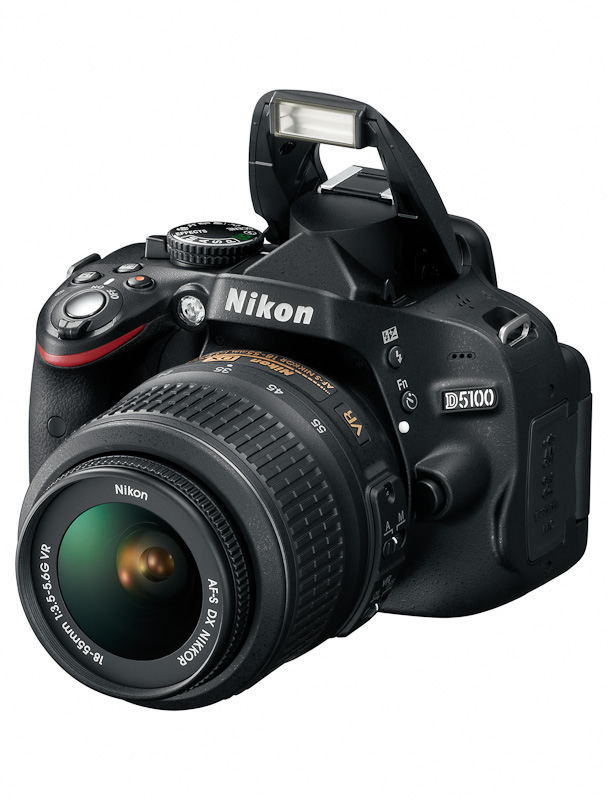
Nikon's Consumer Range expands – D5100 & ME-1
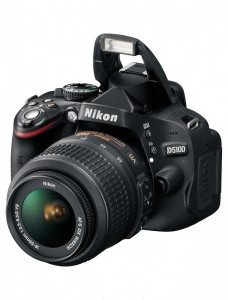 April 5th sees the announcement of the fourth Nikon “thousand” model, the D5100. Following on from the D7000 and D3100 launches last year – both excellent cameras that introduced new sensors to Nikon’s range and left the D5000 mid-ranger looking a bit orphaned, the D5100 takes the logical step of bringing the larger 16.2Mp sensor from the D7000 into a cheaper, more consumer-oriented camera. Nikon have sensibly retained the swivel screen of the 5000, albeit with a more conventional side-hinged layout rather than the quirky (and tripod-unfriendly) base hinge of the original, and introduced a new body design with a slightly aggressive edge to the top plate. All of this is very predictable – with an older 12Mp sensor the D5000 was looking increasingly uncompetitive (despite the fantastic results it’s capable of delivering) whilst the D3100 introduced 1080p video – 14.2Mp and 1080p in the model below the former consumer video star couldn’t last!
So with the D5100, priced at £669, rising to £779 for lens kits, Nikon have given the sensor of the D7000 and the size and flexibility of the D5000. It makes for a comprehensive lineup. What else has Nikon brought along to the party…
-
Four new Alphas – and two 'translucent'
It’s a funny word to use, because the mirrors involved are transparent and not translucent (which implies passing light but not in an image-forming manner). Translucent means semi-opaque, letting light through in the way that an opal perspex sheet or Kodatrace foil does. Transparent means something you can see through.
But now, thanks to the wonder of changing language, translucent is also going to have to mean transparent, or semi-transparent. Pellicle, semi-silvered, whatever term you wish to use.
Unfortunately, for this writer the misuse of the word translucent stands as one of the biggest schoolboy howlers ever imposed on the entire world by the ignorance of a corporation. It’s such a glaring error I can hardly bring myself to use the term – others, like Dave Etchells, have happily assimilated the new meaning into their technical lexicon. And as the video above shows, they’ve made it into a trademark, a permanent part of the future of this technology.
Wiki, and pretty well every dictionary ever published, disagree with Sony’s imaginative use of a word from which they have now removed its exact meaning:
Wikipedia: “Transparent materials are clear, while translucent ones cannot be seen through clearly.”
Merriam-Webster:trans·lu·cent/transˈlo͞osnt/
Adjective: (of a substance) Allowing light, but not detailed images, to pass through; semitransparent.
(the semi bit of semitransparent cited here seems to mean semi-detailed, vaguely delineated – not slightly darker; otherwise the primary definition of the word is diluted).
There has been some heated argument on dPreview forums about this post of mine (my view is shared by many). No-one has made the point that words evolve to have useful exact meanings. Transparent and translucent are words which may once have shared a common poetic meaning in 18th century descriptive writing, but whose meanings were refined with the progress of science and technology. This process in the course of over 200 years resulted in a useful distinction between the meanings of transparent and translucent. Sony’s commercial misuse of the word Translucent is damaging to the English language and to the scientific and technical lexicon; it predisposes future confusion about the meaning of the words.
It is also a fait accompli; there is no turning back, since Sony’s corporate stance is much like that of Mrs Thatcher; no u-turns and never admit to be being wrong. They have also no doubt invested hundreds of thousands of dollars in the consultancy involved, and the registration of the term as a trademark, the creation of branding artwork.
They could have branded the mirror TransLumina® or, more usefully, just called it a transflecting mirror – transmitting-reflecting. That term is already used to describe the sort of mirrors used in ‘Big Brother’ with cameras behind them.

As to whether it’s a true pellicle mirror (a thin stretched film of vacuum coated Mylar or a similar polymer) no-one seems to be clear. It moves out of the way to allow sensor cleaning but could be relatively fragile. It certainly does not need to move to allow 10fps (Alpha 55) or 7fps (Alpha 33) continuous shooting. Sensor dust is often created within the camera by wear and tear on the shutter mechanism, so access for cleaning is essential and the mirror can not be designed to seal the sensor chamber. The Alpha models still have a shutter, that’s the next thing we shall see eliminated. That old rumour of the 15fps silent shooting Alpha DSLR seems to be more than a rumour; we are almost there.
For many users, the critical advantage of all four new Sony models will be HD Video with sensor-based in body image stabilisation. This will enable all kinds of lenses from macro to ultrawide or soft focus, manual adaptations and Minolta AF legacy glass to be used for video with confidence.
Welcome back the circular polariser, unlike mirrorless ILC cameras these new models will not allow the use of linear polarisers without AF efficiency reductions, but exposure should be unaffected as the sensor itself provides the metering with 1200 zones.
This will be one of the tests reviewers need to carry out on the new pellicle mirror Sony Alpha 33 and 55 models – to confront them with not only polarising filters, but conditions in which light is naturally polarised. How will they render sky gradations or reflections off water?
Two further Alpha models are being released, which are essentially updates for the 500/550 – the Alpha 580 which will hit the shops before the winter buying season, adding 16.2 megapixels and a 15-zone AF module, HD 1080p video and (non-video) Contrast Detect AF with all Alpha mount lenses. The 560 will not arrive until some time in 2011, using a 14.2 megapixel sensor.
Versatile features
More of a landmark than a benchmark, the inclusion of 10fps continuous shooting with active phase detect AF and 16.2 megapixel file size in the Alpha 55 is unprecedented and possibly unforeseen by competitors, in this class of sub-$1000 consumer DSLR (let’s continue to use the term, since they are clothed as DSLRs). The dual format card drive supports the 30Mb/s transfer rate of the latest Class 10 SDHC cards and Sony’s fastest MemoryStick Pro Duo generation. The HD video also has a reasonable 17mbps bitrate.
The new technology has been well documented before the launch, but the fine detail of the new cameras is now clearer. The Alpha 55 is some markets will incorporate GPS geo-tagging for stills and videos (we wait to see whether raw files are tagged, and how accurate this is – the accessory Sony geo-tagging system available to date has only permitted JPEG tagging, and has not been accurate enough to know which street in a town the picture was taken in).

Rumours that the 33 and 55 bodies would be SSM/SAM only, with no internal focus drive, were unfounded as Sony states clearly that both are compatible with ‘the full range’ of over 30 Alpha lenses (indeed, the product shots of the 33 and 55 alone show the 18-200mm SAL DT lens fitted). The 55/33 1080i/60p (1080p in AVCHD camera archive format) video claims ‘smooth, precise’ phase detect auto focus during video shooting, but makes no reference to this being limited to in-lens motor lenses. Therefore we can assume it works with in-body AF drive lenses as well, and you just have to edit the soundtrack.
The new ISO 25,600 mode does not imply a radical sensor change as it is only available using Multi-Shot Noise Reduction, which requires a burst of 6 frames at the 10fps/7fps native maximum speed of the camera, and can not save raw files. The ISO range of the sensors is 100 to 12,800. Is this range quoted as absolute, or after accounting for the semi-silvered mirror light losses? If it’s the range before allowing for the mirror, then the 14.2 megapixel sensor of the Alpha 33 may be more like the Nikon 3100’s sensor than the NEX (ISO 200-12,800) is.
Thom Hogan has shown pixel dimensions and size data which support Nikon’s claim to have an entirely different sensor fab line of their own, compared to the A550/NEX sensor. But how about compared to the A33/560 sensor?
The 55’s new 16.2 megapixel CMOS will probably appear in the forthcoming Alpha 700 successor, which it is believed will form the main Sony exhibit at photokina (Cologne, September 21st-27th). Both models have a new 15-zone AF sensor with three cross sensors, but not f/2.8 sensors – all are designed to operate at f/5.6 virtual aperture. However, there is a hidden clue that the cross sensors may be f/3.5 capable, as the high-speed shooting modes with continuous AF set f/3.5 by default on any lens capable of this (if the lens is, say, only f/5.6 then the largest aperture is always set). Setting f/3.5 implies that this confers an advantage in focus sensitivity over f/5.6, f/4 or any other particular aperture – and that f/3.2, f/2.8 or wider would bring no benefit. That points to some of the sensors having an f/3.5 virtual aperture.
The new cameras are known as SLTs – Single Lens Translucent – instead of SLR. See my intro. Did they have no English speaking staff on their team? I’m sure there is a German word which describes their mirror correctly. I’d rather have the right German word than the wrong English one. Ah well, as the bloke leaning on the pub bar says, durchsprung vor technik…
Confusing aspects – Auto HDR is said to be available in P/A/S/M modes. I guess in M mode it must leave the aperture alone and change just the shutter speed. Regular bracketing is still limited to a disappointing 3 exposures at 0.7 EV intervals, maximum.
But you’ll love the direct D-Range button which gives access to D-Range and HDR options directly, and the direct Finder/Screen button which toggles between using the very high resolution EVF with its ‘virtual 1.1X’ 100% view of the subject – effective visual scale, larger than the Alpha 700 and larger than any previous Alpha digital model except the Alpha 900 and 850. That’s one of the benefits of the EVF, a relatively tiny display is viewed through a high magnification ocular and ends up with a ‘window’ on the world which beats the tiny tunnel vision of optical finders. Technically it is very similar to the last EVF produced by Konica Minolta on the Dimage A200, with the benefit of five years’ further development. It has the same 60Hz refresh rate and visually almost raster-free RGB.
Where the A550 and its earlier stablemates vary slightly around a viewfinder with an effective 0.50X scale (relative to a full frame 100% view using a 50mm lens), the A55 and A33 provide an effective 0.73X and that’s impressive. The ocular is set well back (remember the Konica Minolta A2, and the Sony Cybershot DSC R-1?) because it is a telescope design. This also gives it a very narrow range of possible eye positions, a common feature of EVFs. The eyepoint is close, and you must position your eye precisely.
The rear screen uses the same type of (Schott?) reinforced glass with (3M?) resin gel adhesive as Canon’s 7D – this totally seals to the LCD module itself eliminating air gaps, and improves contrast. It is a technology first seen in the 7D and becoming standard across the industry though the NEX has shown Sony to have the best implementation so far. It is scratch proof, by the way, and it can be cracked by impact like any other screen.
The tilt-swivel action is borrowed directly from the Nikon D5000. In fact, it’s so identical in articulation it even included the amazingly silly front facing mode where the screen is obscured by your tripod, hanging under the camera and preventing it from being placed on a flat surface for self-portraits or videos. But it has the same benefit as the Nikon, the screen can be flipped to face the camera and protected completely while you use the EVF.
Functions familiar from the NEX including Sweep Panorama and Sweep 3D Panorama are built-in and accessed from the main mode dial, which also provides physical settings for all the main modes. Depth of field preview is restored – with the usual button – because is can now actually work. It was always useless in real terms on optical viewfinder cameras, as the focusing screen never represented wide apertures correctly.
Now, with an EVF, for the first time ever an eye-level Alpha gives absolutely perfect and precise previewing of depth of field and bokeh effects whatever aperture you are working at – even at f/1.4, which was never possible and still isn’t with the A850 or A900 for that matter (which is why their Preview mode is useful).
You can also preview the exact image appearance. By pressing the AE lock button, the auto gain of the EVF or rear screen are turned off and replaced by an exposure-compensated view. So if you dial in -1 EV (using the adjacent dedicated button), and change the WB, and use a different picture style with more saturation and contrast just pressing AE-Lock will immediately preview your image with these adjustments applied. And you can enlarge in the usual two steps to check auto or manual focus.
The finder and screen also have a Nikon-style two axis spirit level (flight simulator horizon) display to help you get your horizontals straight and your verticals parallel. It can be activated on either, and does not have to appear on both simultaneously.
For movie makers, the binaural stereo microphones are a great move. Even on the NEX, the two small top aperture mics give excellent stereo. The 33/55 mics are placed either side of the ‘prism’ housing, rather like the ears on your head. This will give the stereo image created by these cameras a really natural quality. Natural, that is, to a pygmy marmoset monkey… but still, I will wager, the best stereo image of any DSLR/HybriD. And Sony provide a stereo 3.5mm mic jack socket, though without any manual control of gain levels.

I’m sure we will have to buy the A780 to get that. Click the picture above for a big version. Who says Sony does not have a range to match Nikon or Canon, whether or lenses or of cameras? From the left, the cameras show the current range before we even see the magnesium-bodied Alpha 700 replacement arrive. A900, A850, A580, A560, A55, A33, A390, A290.
– David Kilpatrick
Read Sony Press releases and full technical data:
Alpha 33 and 55 Press Release
Alpha 560 and 580 Press Release
-
UK court makes website operators liable for linked content
LONDON, ENGLAND – Newzbin Ltd., a website that helps subscribers to
illegally download movies and other entertainment, has been held liable for
copyright infringement by the High Court of Justice in London today. -
First wide-angle Nikkor with VR
Nikon has announced the first full frame wide-angle zoom Nikkor to feature VR stabilisation – a light weight (though not especially compact) 16-35mm f/4 design. They have also confirmed after a long wait the arrival of the new 24mm f/1.4 Nikkor, one of the first fast primes other than standard 50mm to appear from the company for some time. (more…)
-
Nikon D3S video: dark, rain and wind 400mm f/2.8
As part of my tests of the Nikon D3S (British Journal, report in December, with additional material by Richard Kilpatrick who is shooting with Nikon on November 25th at a press event) I dragged the £6,000 400mm f/2.8 AF-S IF ED G supertele into the rain as darkness gradually forced the ISO up from a mere 10,000 to the maximum 102,400. The object was make a short video showing rising floodwaters, no threat in our town but still dramatic to watch.
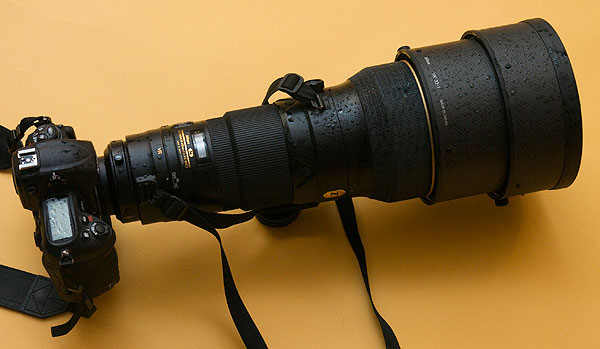
Here’s how it came back from the hour in the rain, a quick wipe down with an oily rag and it was all as good as new. Actually, it needed a thorough drying with the towel then a clean up with a lint free microfibre cloth to remove dust and towelly stuff. The very deep lens shade kept the exposed front element totally dry despite the wind and rain; I just made sure it was never aiming into the wind.
During the shoot, wind noise was a major problem. I locked the microphone to level 2 manual gain, not automatic which would have been a disaster. Many clips had to be shortened, some discarded due to violent wind noise I could not mask. The sheer weight of this combo made lugging it with a decent Slik tripod (pan and tilt head for video) difficult; I drove to the evening location with the rig laid flat on the back seat of the car, but still had to walk several hundred yards for some shots. I wore a Tog24 parka and found that by pulling the fur-lined hood over the camera body I could cut out nearly all the wind noise. I must have looked like a view camera operator with a dark cloth, or something out of Monty Python with my jacket pulled up and the hood over the Nikon!
But, this seemed such a good solution to the wind noise I would consider unzipping the hood from the parka and using it as a baffle in finer weather.
My favourite part of the video is the one with the worst noise, where I was not able to keep the wind away from the direction of shooting – the sequence of the road (flooded by the morning) with headlights, tail lights and cars in rain. This consists of three takes blended with long crossfades. During each take, the manual focus of the 400mm used at near wide open f/3.2 aperture was pulled to bring the moving traffic in and out of focus, and create huge bokeh circles from the lights. This would be impossible with a camcorder and not all that easy with a conventional high-end video kit. The combination of full frame 35mm format and the fast 400mm has enabled a highly effective cinematic technique to succeed on the first time of trying. With some markers on the focus ring, some practice and many more takes the result could have been refined further.
But I was getting very wet and so was the camera!
The first part of the video is all on the 400mm with tripod, with High ISO video enabled. The ‘next morning’ stuff is on the 24-70mm, hand held, locked down to ISO 200 at f/8.
I’m not sure when our final review of the camera will appear in the British Journal, it should be early December.
The video is encoded to best quality 720p from iMovie09, and can be best be downloaded and viewed without any YouTube jerkiness at full res if your connection is not good.
– David Kilpatrick
-
Ricoh seal the future of interchangeable lenses
Tokyo, Japan, November 10, 2009—Ricoh Co., Ltd. (president and CEO: Shiro Kondo) today announced the development and release of the GXR interchangeable unit camera system featuring the world’s smallest and lightest* digital camera with the ability to change lenses.
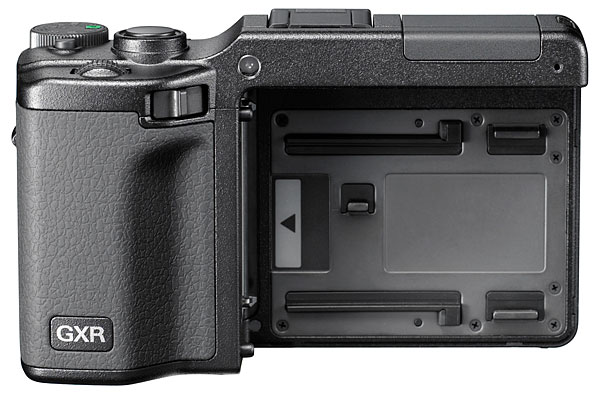
The new GXR is an interchangeable unit camera system in which lenses are changed by using a slide-in mount system to attach camera units to the body. The lens, image sensor, and image processing engine are integrated into the camera units so the body itself does not contain an image sensor.
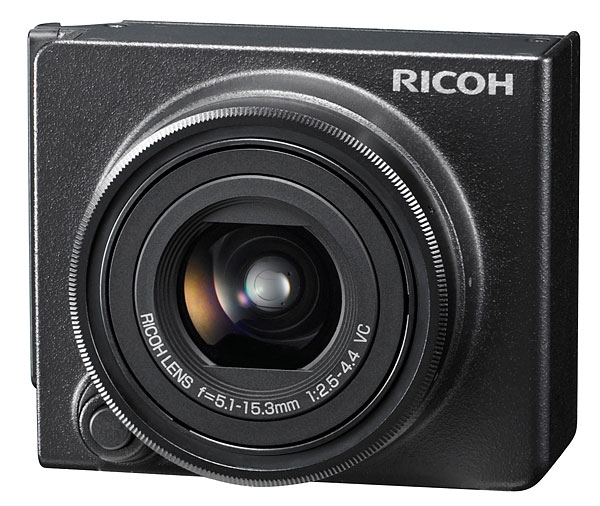
With world-leading small size and low weight* enabling easy carrying, the GXR interchangeable unit camera system features a highly rigid magnesium alloy body and multiple camera units that can be changed to best fit the scene to be photographed. You can enjoy easy lens changes as well as amazing image quality and shooting flexibility. Concealing infinite possibilities in its small body, the GXR is a revolutionary camera system that pioneers a new realm of photography.
Distinctive characteristics:
1. Lens, image sensor, and image processing engine comprise an integrated unit which can be changed to match the scene being photographed.
2. World’s smallest and lightest* digital camera with interchangeable lenses
3. System potential expanded through use of interchangeable unitsComment from David Kilpatrick:
Though the Ricoh system as revealed through this press release appears to show only a GR-size body with a zoom lens module suitable for a 2/3rds or slightly smaller imaging sensor, Ricoh has said that sensors right up to the size of APS-C will be built in to further lens modules. The ultra-wide angle version would have an APS-C sensor making similar to the Sigma DP-1. For similar reasons, high ISO and fast lens may be combined with a different size of sensor.
This is not the first time a digital camera has been designed with lens-sensor modules that could be changed. The Minolta Dimage EX 1500 accepted either a standard zoom module, or a wide-angle module. These included viewfinders (missing from the Ricoh concept, which relies entirely on the rear screen or electronic viewfinders) and had the unique ability to be removed from the camera on a 1.5m long Cable EX. This allowed users to position the wide-angle module inside scale models, doll’s houses and similar subjects to obtain realistic human-scale perspectives. It was only a 1.5 megapixel camera, and Minolta abandoned the concept before they had a chance to develop it further, whatever dPreview said ten years ago:
http://www.dpreview.com/reviews/minolta1500/
The technology behind the Ricoh is not all that different from the way consumer digital cameras are constructed anyway. Lenses are already sold sealed to CCD/CMOS sensors, as a single unit. That is how the OEM sources of the lens-sensor modules market them. At photokina, you can see (every two years) a new crop of such modules with both the technical resolution specs of the optical unit and the megapixel count of the sensor, identifiable to this non-Chinese/Japanese reader in the middle of a description which is usually inb Chinese. In 2006, I tracked such a module from its maker to the first camera I could find which used it – a compact branded as Vivitar. The customisation consisted of building any body the maker chose to design, and putting a ring on the lens front labelling it is a high resolution Vivitar lens; actually, it was just a generic lens-sensor assembly from China.
Ricoh has also pioneered unusual digital designs in the past, including rotatable or detachable lens modules and one of the first viewfinder-less designs, where the viewing screen was intended to be used at waist-level rather than today’s habit of waving the camera in front of your face.
This differs from anything previously done in the power of the CPU unit in each lens, and control module with screen display and card interface in the host body. It should allow any reasonable pixel count and sensor size to be built in to future optical modules. If the accessories do eventually include dedicated APS-C lens-sensor sealed modules, ‘dust on sensor’ will be one clear benefit (or the lack of it will). A supertelephoto module is also planned which will use a sensor smaller than APS-C.