Tag: raw

  • Sony A7RII versus Nikon D850 – noise

    There’s a lot of noise about the Nikon D850 right now but few direct comparisons. One problem I have with some early reports is that new D850 owners are most likely to be existing D810 or perhaps D750 or D5 owners. Any comparisons are therefore being made with earlier Nikon sensors.

    Recently a Nikon ambassador whom I respect greatly placed some .NEF raw files into a Dropbox for fellow professionals to examine. Since this article effectively criticises Nikon, I will not reproduce anything recognisable. I naturally grabbed the files and processed them with my usual care in Adobe Camera Raw. This includes making adjustments to the Sharpness and Noise Reduction settings depending on the ISO used. My standard with Sony, Nikon and most other files is to reduce the radius for sharpening to the minimum (0.5) leaving the basic settings of 25 for sharpness and 25 for detail untouched, with no masking. I also don’t touch the Colour Noise controls at all, and usually only adjust the first Luminance control leaving Luminance Contrast and Luminance Detail at default. This first Luminance control tends to set to zero for ISO 100 (or the minimum for a given camera), 10 to 15 around 400 to 800, 25 at 1000 to 2000, 30 to 35 at 2500 to 4000, 50 at 6400 and never above this level.

    In practice these settings make raw files from the Sony A7RII (and presumably A99II, which I do not own) fully useful to ISO 3200 regardless of conditions and intent. Blue skies do not have grain, shadows are smooth and clean, detail is fine, skin tones are not marred by noise. ISO 6400 is slightly grainy but only to the degree we used to expect from ISO 800 in cameras of the first CMOS period (2007-2008, the A700 and A900).

    So, given the glowing reports on the new Nikon sensor, I was expecting to see something at least matching the A7RII. There’s not a huge difference between 45 megapixels (Nikon) and the earlier 42 megapixel Sony BSI CMOS. I have already seen that the Canon 51 megapixel sensor in the 5DS/R offers no benefit at all, just a steep fall-off in shadow detail and loss of dynamic range combined with more noise.

    Here, then, is a 100% section from a raw .NEF at ISO 1000 on the D850, with the Adobe Camera Raw settings I would expect to turn in a clean result. It has been saved at JPEG 12 but WordPress’s image engine causes some quality loss:

    The NR was set as described above, to Luminance 25.

    Then I looked back through my files to locate some ISO 1000 raws from the A7RII and try to find something with broadly comparable tone (surprisingly difficult!). Here is the result, with exactly the same process and settings:

    You will note that the grainy noise is much finer. Both are taken from regions away from the image centre where the camera’s firmware will be adding some gain to combat sensor-created vignetting. On-axis areas are slightly less noisy in both cameras. This may also depend on the lens. You probably think this looks noisy for the A7RII, and this light colour and exposure level does indeed tend to increase noise.

    Here is another A7RII ISO 1000 clip in better light, brighter subject matter, closer to the frame centre – this is more typical of the noise level you should see (or not see) in Sony 42 megapixel images:
    I’ver chosen blurred neutral areas beyond the point of critical focus because these emphasise noise. If the same settings are used with sharply focused detail, with strong colours or contrast and textures, you simply won’t see noise at all at ISO 1000 and NR 25.

    I will also say that while the Nikon community seemed impressed by the sharpness of sample images, I was not. I have to reconsider my critical opinions of Sony’s lenses. I have been judging zooms against Carl Zeiss and Voigtländer primes, and used to seeing a level of detail in images at 100% which I guess regular DSLR users simply don’t expect. Part of this is down to the quality of the A7RII sensor, part down to the lenses, and a whole lot is down to the zero-error focusing of the mirrorless system. I am part of another community, where most photographers use Canon or Nikon and prefer to have fast zooms and primes (the usual 16-35mm f/2.8 or 14-24mm f/2.8, 24-70mm f/2.8, 70-200mm f/2.8, 35mm f/1.4, 50mm f/1.4 and 85mm f/1.4 kit). In this group, many are having their cameras and lenses custom matched and reporting improvements in sharpness which transform their autofocus work.

    Those who use Sony, Fujifilm, Olympus or Panasonic mirrorless systems don’t tend to make any comment as they have been getting critically sharp focus ever since they made the switch from DSLRs.

    Conclusion? My A7RII is now two years old. It’s a 2015 model which is certainly not surpassed by 2017 rivals at least in the ‘core competence’ of its sensor. Other Sony models may offer different levels of special features, like the blistering shooting speed and focus tracking of the A9, but the A7RII continues to do its job as a great all-rounder and this quick comparison shows why.

    – David KIlpatrick

    To support Photoclubalpha, buy through our Affiliate links… or subscribe to David’s premium-quality photographic bi-monthly Cameracraft which includes regular Sony-related editorial, with system expert Gary Friedman as Associate Editor – see www.iconpublications.com

  • ACR 7.2 and Lightroom 4.2 RC – RX100 compatible

    The good news is that you can now download, free, the Release Candidate versions (expire October 31st) of Adobe’s Lightroom 4.2 and Camera Raw 7.2, as well as DNG Converter 7.2, which will give you raw conversions for the Sony Cyber-shot DSC RX-100.

    The bad news is that no camera lens profile is included, and until someone creates one, the distortions and CA of the RX-100 lens are not corrected by these programs. Also, we can confirm that no further highlight recovery is possible, beyond that already enabled in Sony Image Data Converter. This has not always been the case with ACR/LR. They have often enabled clipped highlights to be recovered with useful detail from KM and Sony raw files. The RX-100 raw files are right on the edge of overexposure and you just can’t pull burned out highlights back in.

    But against this, the high ISO performance of the RX-100 is superior to, for example, the NEX-5n. That’s surprising and worrying, as the 5n is better than the NEX-7. ISO 3200 images from the RX-100, processed through ACR 7.2RC, are about as good as any APS-C camera currently manages and not far off what can be expected from a full framer.

    Shot at f/1.8 on the RX-100, 1/30th, ISO 3200 – about as dark as it gets for hand held shots.

    100% ACR 7.2 clip with NO noise reduction at all and no sharpening

    On the Canon 5D MkIII, 1/3oth at f/2.8 using the 40mm pancake lens – twice as much light as the pub scene above, gold Olympic letterbox in Edinburgh seen by night time street lighting

    Sure, at 100% under the same process conditions it is better – but once you apply NR to the Sony image, the difference is levelled considerably. And this is the world’s best full framer for low light, right now, over 20 megapixels.

    Here is your download link for Adobe Lightroom ACR 4.2 RC:

    http://labs.adobe.com/downloads/lightroom4-2.html

    And here is your link for ACR and DNG Converter:

    http://labs.adobe.com/downloads/cameraraw7-2.html

    The results at speeds from ISO 80 to 400 are a match for any DSLR, with the exception of the issue of dynamic range above highlight clipping. There is no significant margin for highlight recovery. This is a marked contrast to the early KM Sony sensor such as the 8 megapixel used in the Dimage A2, which had almost two stops of clipping-free highlight recovery using the metered exposure in high contrast situations.

    – DK


  • High ISO Noise fix for Image Data Converter

    SONY has released a new alogrithm for raw conversion (deBayer) which offers improve high ISO noise. IDC (Image Data Converter) is the program issued with all Sony DSLRs. Up to now, no maker has ever revised their ‘house’ converter to offer high ISO improvement as a specific feature. The new version can be downloaded free by existing users (download link is provided at end of story). We have direct download links now for Windows and Mac OSX versions.
    (more…)

  • Alpha 550: sky noise, exposure and Auto ISO

    My review of the Alpha 550 has caused controversy because of the blue sky noise. I might as well say that over the last week, I’ve used the 550 in a wide range of conditions – some very bad conditions included – and its failure to match ISO 100 finesse would not worry me at all. The performance at higher ISO settings is so much improved it’s worth putting up with the minimum of ISO 200, and a touch more noise than the best ISO 100 results from the Sony CCD sensors.
    Even so, something was clearly happening during the period of sunnier weather used for my earlier A550 tests. I used Auto ISO initially, because I had not realised how readily the camera will select settings right up to 1600. Auto ISO has thrown up some surprises. Here’s something to consider:
    autoISO0-200variations
    Please note that although ‘process’ symbols are shown with these Adobe Bridge/ACR images, the defaults were restored and then each picture was set back to defaults. They are all shown relative to each other in density, the image preview built by ACR. There is no question of DRO or any other tonal setting interfering with the apparent exposure – DRO does not affect the .ARW file, ACR discards any DRO generated embedded preview in my setup prefs, and DRO was not being used anyway.
    It has already been noted by other reviewers that the A550 has considerably more headroom without clipping, even compared to the A350 which was already a top-ranking camera for dynamic range. This is what I meant when I compared its default images to Canon with Highlight Tone Preservation switched on, or KM/Sony older models using the Hi200 setting. This can mean that the A550 is really ISO 100 at its lowest on-sensor gain setting, but the exposure system is programmed to underexpose by a stop and the post-processing (BIONZ) is set up to boost the gain.
    Why would Sony do this? Perhaps they read the many posts referring to the Alpha 900 and 700 ISO settings. The on-sensor gain controls the main ISO steps, but a rather cleaner post-process gain adds the 1/3rd step intervals. Experienced Alpha 900 users set ISO 320 manually because the sensor is at its optimum at roughly ISO 160 (DxO tests bear this out). The standard ISO 200 setting can produce more noise than ISO 320 because two different digital stages are used to produce the gain.
    In search of superior high ISOs, they may have realised that the early gain stage (on the chip assembly) is inferior to the later BIONZ processor, and you can indeed get better high ISO by underexposing a lower ISO setting, then processing it with clipped blacks. That’s a Nikon technique, which has served them well. It’s also a technique used by experienced DSLR owners.
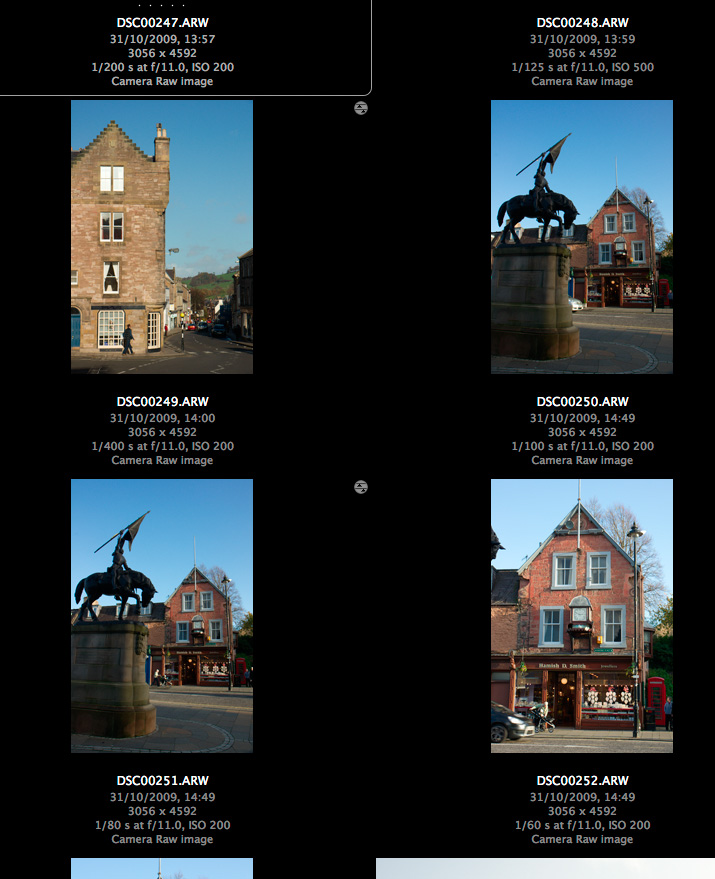
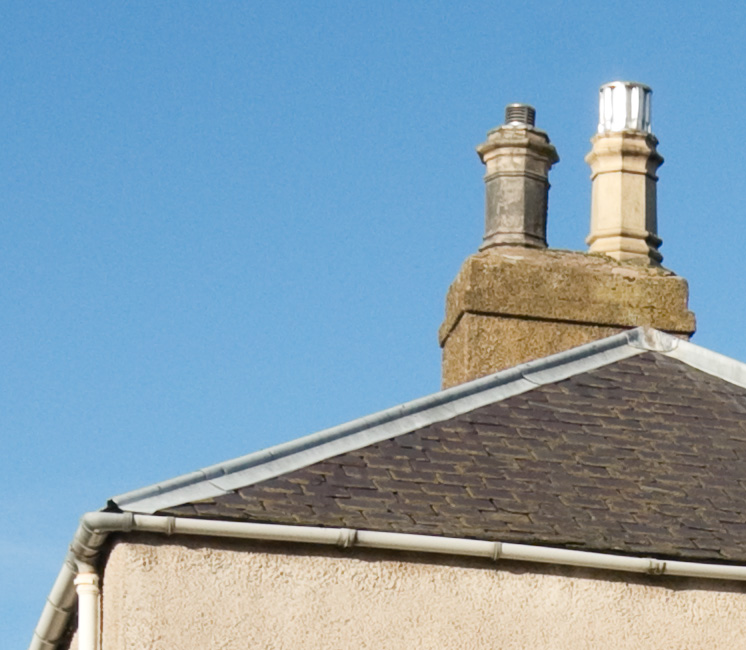
    Now consider the four shots above. They are all taken at ‘ISO 200’ but the camera was set to auto ISO. Other shots in the same set show ISO 250, 500 etc confirming the auto ISO was in operation. They are taken in the afternoon in Scotland, so it is fairly near to the end of the day for sunshine by 14:49hrs, around an hour away. But the two locations at 50 minutes apart, 14:00hrs and 14:49hrs, should not have the extreme variation in exposure shown here.
    Just what is going on for an exposure of 1/400th at f/11 to look correct at ISO 200, with the dark sandstone buildings of Jedburgh at the end of October? 1/400th at f/11 is the ISO 200 exposure for full sunshine in midsummer (aka f/16 light). You hardly ever find f/16 light in Britain unless you are on the beach, surrounded by pale concrete, in a field of golden corn or out on a lake.
    50 minutes later, exposures range from 1/60th at f/11 to 1/100th at f/11 – that is, more or less, from two to three stops more. In fact these exposures are in line with what I would expect, it’s the 1/400th at f/11 which is the odd one out. I have no evidence to suggest that my CZ 16-80mm has an aperture which fails to stop down consistently.
    Now look at some sky samples:
    Here is an in-camera JPEG version which shows less noise – the in-camera process is equal to using much stronger NR in raw conversion than I would normally choose for ISO 200:
    incameraJPEG-iso200clip
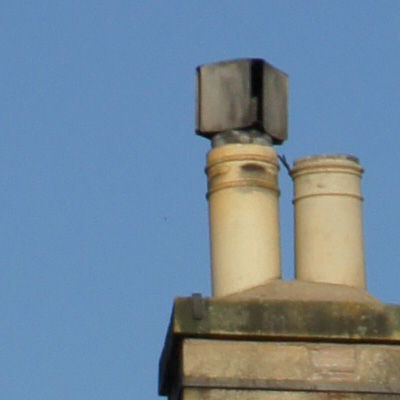
    Now for the same processed from raw – notice that despite the noise, it is slightly more detailed or sharper:
    skyiso200-400th-f11-acr5p6-default
    This is a reprocessed second version of the original noisy sky instance. Here, I have used Adobe Camera Raw 5.6r1 defaults, which include some basic sharpening and also 25 on the chroma NR scale. No exposure adjustment is made at all. This view, by the way, looks more or less due north and it is not a case of a brighter sky underexposed; also, the stone and the chimney pots look normally exposed.
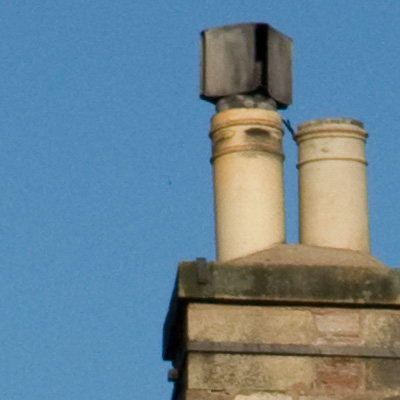
    skyiso200-100th-f11-acr5p6-default
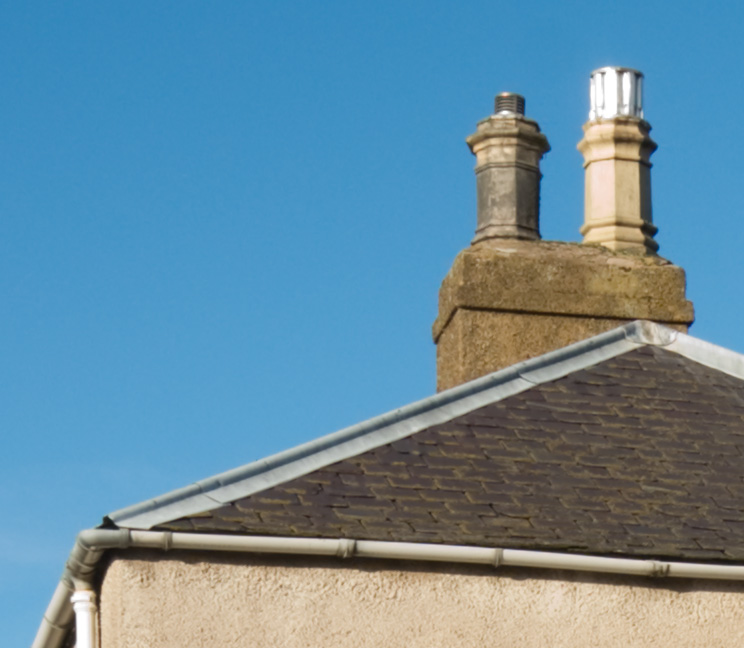
    This is the 1/100th at f/11 shot, processed exactly the same way. It’s interesting in that I expected to see much lower noise, but in fact it’s much the same. The sky density is similar as well. The view is slightly more towards the east. While my Alpha 380, 200, 100 and even 700 shots are capable of showing blue sky noise at ISO 100 and as much as this as 200 it’s not as obtrusive.
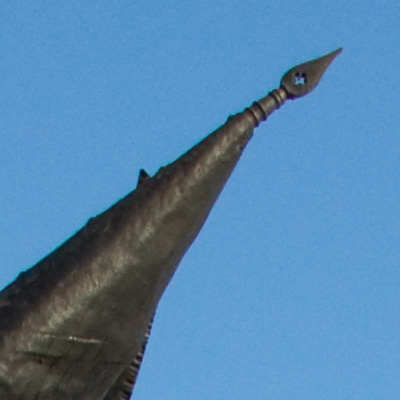
    skyiso200-60th-f11-acr5p6-minus1evcorr
    Finally, this is the 1/60th exposure – perhaps more what would be expected at ISO 100 in this light with f/11. Here, I have set -1 EV exposure reduction in Adobe Camera Raw to get much the same final sky tone density. The noise is lower.
    Checking other images I’ve taken since, I am now suspicious about the Auto ISO function in the Alpha 550, and whether it reports the gain applied to each shot accurately. It’s hard to reconcile the same ISO 200 setting shown in EXIF with the range of exposures encountered, and the actual exposure of the raw file. Yet ISO 250 was also selected for this shot taken a few minutes before the chimney shot:

    This is also included in the main report (click image to view full size on pBase). If I darken the sky as much as the other examples, I get noise similar to the 1/60th ISO 200 clip, or better.
    Since making these tests, I’ve started using the Alpha 550 only on fixed ISO settings, with some misgivings as intermediate gain like ISO 250 or 320 might possibly be yielding better results. I just feel something is happening in the BIONZ stage, perhaps involving analysis of the Auto ISO images and compensation for deviations from the reported EXIF Auto ISO setting. This is just a hunch. Fixed settings seem to be equal to the worst case from Auto ISO. Here’s a textbook example, 1/125th at f/16 for a blue sky on November 3rd, facing due north, at 14:19hrs, ISO 200 fixed setting, ACR 5.6 defaults as above:
    iso200fixed-125th-f15-acr5p6default
    The answer seems to be to overexpose your manual ISO 200 shots by not simply one stop, but as much as two stops when shooting raw. At least if Adobe Camera Raw is used, recovery of normal tones (not burned out highlights) will fully restore the exposure from 1 or 2 stops over depending on the subject.
    Here is an overexposed image, taken at 1/80th at f/10, ISO 200, in mid-day sunshine:
    1p7stopsover
    Below is what the sky looks like in a normally exposed image (1/250th at f/10), processed using Adobe Camera Raw defaults (including sharpening at 25/1/25/0 and NR at 0/25), looks like:
    iso200-normalexp-250th-f10-acr5p6defaults
    And here, finally, is what an adjusted ACR process from the overexposed image looks like with sharpening turned off, NR set to 25/50, exposure and brightness determined by the simple process of using Auto (which can be set as a default in ACR if you want to consistently make generous – over – exposures ‘to the right’):
    plus1p7exposure-iso200-80th-f10-acr5p6adjust-nosharp-NR2550
    This is much more how I expect to see a sky looking from the base ISO of a 2009 DSLR release, viewed at 100 per cent. From this stage, different types of sharpening can be applied to suit resized versions for different purposes.
    Results with other raw converters, as more become available for the Alpha 550, may be finer in noise structure than ACR or may offer less scope for overexposing – ACR is well known for its ability to recover highlights. I do not intend to go much further into this with tests of converters, but I hope I have shown how the ‘true ISO’ of the A550 is difficult to pin down especially in Auto ISO mode, and how it is possible to benefit from the great high ISO performance of the camera (just use it!) and at the same time secure good low ISO results for travel and landscape shots where a clean blue sky is important.
    It’s important to note that in-camera JPEGs will not necessarily show similar noise levels. If they do it’s not so easy to fix without using NR software. I prefer to shoot raw for many reasons.
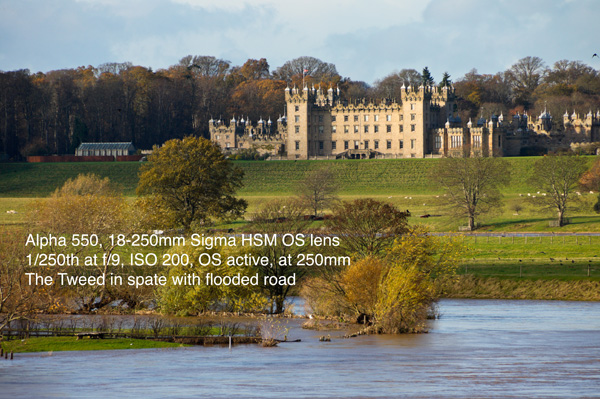
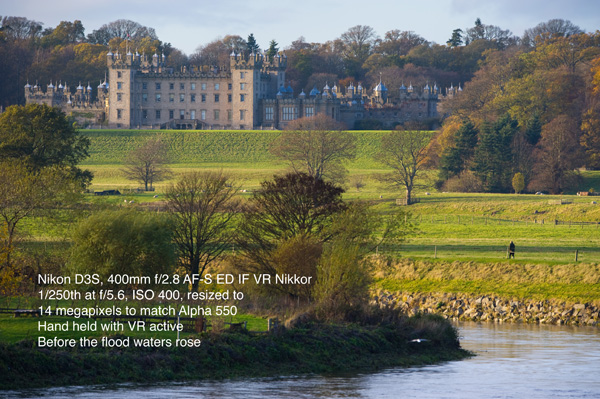
    So, why not be very happy with the Alpha 550 as a choice? Here are two pictures. You can view the full size Alpha image, and the Nikon D3S image resized to match 14 megapixels, by clicking on the smaller size here. Of course the Nikon image is better, though 1/250th at f/5.6 and ISO 400 is more of a step away from 1/250th at f/9 and ISO 200, and I’m not sure the light was SO different on the two occasions:
    Alpha 550-250Sigma-iso200-web
    Nikon D3S-400mmf2p8Nikkor-iso400-web
    – DK

  • Sony Alpha 900 and Nikon D3X raw file noise comparison

    Like Mike Johnston writing in The On-Line Photographer, I’m aware that any attempt to line up one or more cameras and show comparison images or make judgements is on to a loser from the start. And any webmaster who puts an external link in the first half dozen words of a new post is losing the plot too! But here, for what it’s worth, is the first line-up of results processed using the same software from A900 and D3X uncompressed raw files converted without sharpening or noise reduction.

    (more…)

  • Alpha 700 Firmware v4 + IDC update official

    SONY has, one week after the leak of a final version of Firmare v4 for the Alpha 700, placed authorised download links on their support websites along with an updated Image Data Suite 3 which can handle Alpha 900 raw files. Quick download links are given here with key features.

    (more…)

  • Alpha 900 HDR bracketing

    The Alpha 900 – and indeed the Alpha 700 with new firmware v4 – offer a three-bracket sequence at a 2 stop interval to enable HDR blending, usually from static tripod-mounted views. At the Edinburgh Alpha 900 launch, I braced myself firmly against an open window, leaning out over the street, and tried an example hand held.

    (more…)

  • Faking a polarizer using RAW

    Here’s a question which came in to my email just now:

    “Could I process a RAW file in Photoshop to achieve a similar effect as if I had used a Polaroid lens filter?
    Or would I be better just using the Polaroid filter?”

    The answer is that you can never imitate the effect of polarizing light (which changes the way reflective surfaces look, and deepens or lightens the sky blue according to the zone of the sky relative to the sun’s position. But you can use Adobe Camera Raw (CS3 versions) to deepen skies you never thought could be rescued.

    (more…)

  • A700, 6400 ISO, seven raw processors

    There’s a lot of controversy right now about whether or not the image structure of the Alpha 700 files at very high ISO – mainly 3200 and 6400 – is as clean as raw processed results from other comparable cameras like the Canon 40D (does not offer ISO 6400), the Olympus E-3 (does not offer ISO 6400) or the Nikon D300. At the heart of this is the way different raw processors handle file conversion, and most specifically, the current performance of Adobe Camera Raw 4.3.1. (more…)