
Canon has announced a consumer level EOS 500D camera, with 1080p resolution video limited to 20 frames per second, and 15.1 megapixels but a maximum shooting rate of 3.4 frames per second:
http://www.cameracraft.online/2009/03/25/canon-eos-500d-151-mp-plus-hd-video/
This continues the trend for all new DSLRs to have HD movie shooting in addition to live view modes, something which Sony to date shows no sign of catching up on. However, the obvious compromises present in the 500D would be criticised harshly if they were to have appeared first in a Sony model, so this is good news. Canon has made it acceptable for others to follow with 20fps instead of the required 24fps, and still claim true 1080p video.
– DK
Author: David Kilpatrick
-
Canon EOS 500D – video plus 15.1 megapixels
-
Tamron's new 60mm f/2 1:1 macro
Tamron Co., Ltd (Mr. Morio Ono, President), a comprehensive manufacturer of optical products with its head office in Saitama City, has announced the development of the SP AF60mm F/2.0 Di II LD (IF) MACRO 1:1 (Model G005), a life-size macro lens designed exclusively for digital SLR cameras with APS-C size image sensors* that offers a fast maximum aperture of F/2.0. (Text here is directly from their press announcement).
(more…) -
Sigma classic 400mm tele quick rechip
There is no need to dismantle the mount of the original series Sigma AF TELE 400mm f/5.6 lens, to bring non-functional versions (old chip) up to speed with later film and current digital SLRs. The whole process takes under five minutes, and requires two tools – a small Philips screwdriver, and a precision end cutter.

The appeal of the original AF TELE and the later, identically sized, AF APO TELE should be obvious. They weigh in at less than 900g in the first non-apochromatic version, which like the later apo (1053g) will only focus to around 4 metres. The cost and weight penalty for the later, much larger, Apo Tele Macro focusing down to 1.5m is considerable.
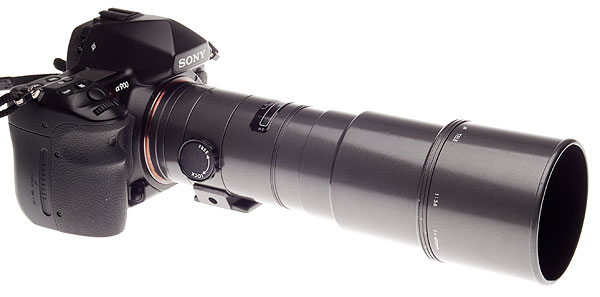
This lens – an original version in gunmetal finish – is impressively solid, a real metal barrel with a precision made extending hood, lined like the rear lens tube with flock anti-reflection black. The mount is well made, the tripod collar is ultra-neat though fitted with only a 1/4 inch thread:

The dilemma is that inside this lens is a chip which means it won’t function at all on digital SLRs and many later film SLRs (almost anything which actually says Dynax or Maxxum on it won’t work, this lens was made for the original 5000-9000 Minolta AF series). It will not even work in a manual focus mode, as the chip reports an error, not just ‘no lens fitted’.
The answer is to rechip the lens using a new contact plate array fitted with a new chip, provided for around $60 including post by James Lao in China:
http://eadpt.cn.webz.datasir.com/eadpen.htm
This service is absolutely reliable, James emails to check the lens type you want to rechip, sends using signed-for post and I had my new chip in just four days to the UK.
Some reports on how to rechip the lens advise dismantling the entire rear mount. This is not needed, nor is any sanding or cutting with a hacksaw. A pair of miniature end cutters as used in the electronics industry for trimming wire exactly will do the job – so will luthier’s fret end cutters, and many pliers with high precision wire cutters.
The original contact array looks like this:

Note that the board does allow the countersunk head screws to lie fairly flat. Removing the screws over a suitable tray, with the lens held sideways, requires a No 1 jeweller’s screwdriver – 1mm or 1.5mm will do well. I used a screwdriver set with an illuminator in the handle.
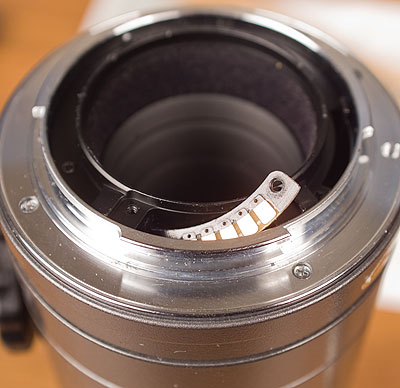
With the old board still attached to its ribbon cable, just ease it up, twist it and push it into the void the left as viewed here. If badly placed, it can inferfere with the aperture mechanism, so after fitting your new chip and testing the lens, I suggest opening up again, pulling the old board out and cutting it off for good. It will never be needed again. Check the aperture lever operation anyway to make sure the board, when pushed into the lens, is not jamming the action.

Here’s the contact side of the James Lao board. Note that it has excess substrate on the ends, which will need shaping down to fit, and that the screw holes are brass lined. This will result in the screws being very slightly raised when it is fitted, but this is not an issue, just a cosmetic difference.

On the back is the new chip, connected by small wires instead of a ribbon cable. It is not as fragile as this shot indicates, nor are you likely to damage it through static unless you groom the cat first then rub a balloon, stick it to your 8ft 6 regulation height ceiling and walk across a nylon shag pile carpet wearing crimplene trousers. But it is not 1975, so no worries there…

This is a pair of fine end cutters (so called because the clipping edge is right at the front, not set back by angled grinding/sharpening). It can be used to clip off the excess, then nibble the correct shape at each end, with minimal effort and no risk. No dust is created but little bits of board do fly off and land in watching eyes, so wear glasses or protective goggles if you do this. I wear off-the-shelf reading glasses, it makes this sort of small work much easier.

The trimmed new board will fit easily and firmly into the space left by the old one.
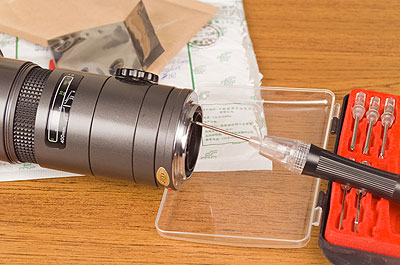
Here’s how I replaced the screws. My screwdriver is a good enough fit to hold the screw and introduce it to the hole with the lens safely over the lid of the screwdriver kit. Do not stand the lens upright and do it from above, you risk losing a screw inside the lens. This way is safe.

Once fitted, it is perfectly functional though the trimmed ends and non-recessed screws make it look a touch agricultural. You could black-pen the ends I guess, but this is not going to affect flare or any other aspect of the final picture quality. Note the flock-lined rear lens tube – these optics were well made, 20 years ago.

Taking the lens out on the A900, not a very good day, ISO 400 and really wide-open are the defaults, I found that it absolutely must be stopped down to f/8 to be useful. This quick snap of a blackbird on the roof actually shows very fine detail:

This is un-sharpened, with some NR, and is at +1.3 plus brightness boost in processing – in other words, really ISO 1600 on the A900, not ISO 400 as set. The tiny hair-like feathers are resolved at f/8. Not all my first attempts to autofocus the lens were as accurate, it’s easily confused and dithers even if it does not hunt. Into the light, it’s pretty awful on anything which shows the serious level of CA present in an original version at f/8, click the image for the full size view:

Colour bokeh? Yup, red and green, your own Christmas decorations provided free for every tree. It can be improved in ACR from raw, but really, this sort of subject (edge of full frame shown) is best avoided.

Here’s another quick snap in the garden, not much sun but not totally dull, again managing f/8 with a reasonable shutter speed (1/200th I think on this one). The 100 per cent clip from the A900 shows a decent level of detail, without adding any sharpening:
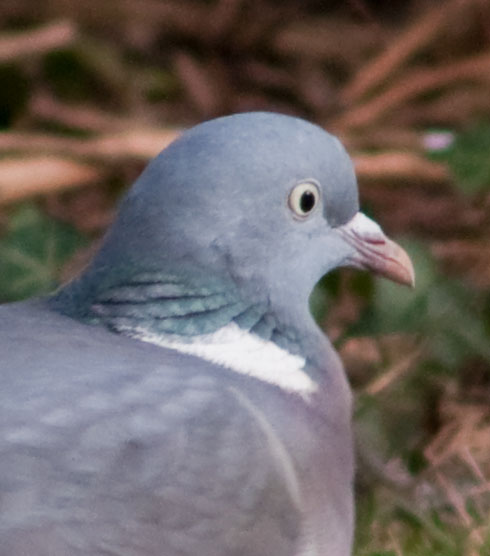
It’s soft but remember this is part of a five to six foot wide image. At f/11, which I may get to try in better weather, and at ISO 100 on the A700 cutting off the rather CA-prone outer field and getting that valuable effective 600mm-angle view – well, it’s probably worth it. I do not get much better than this, and often get worse, from the Minolta 500mm f/8 mirror lens on the A900 at ISO 400.
The rechipping operation is so fast and hassle-free there is no great risk in buying one of these lenses at a bargain price, against the risk it will not work on your digital SLR. You can make it work. For 7D/5D owners where the resolution is less challenging, it would be a great buy. Do not expect fast focus – it is not – but the handling more than makes up for that. Balance and feel are just great, and the sliding collar which covers the moving focusing ring is a great design feature.
– David Kilpatrick -
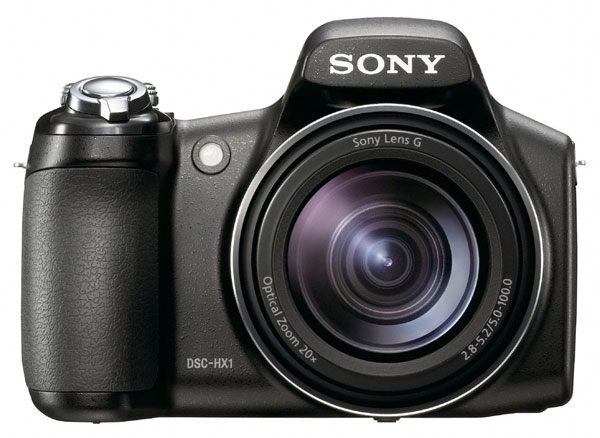
HX1 Cyber-shot with EXMOR CMOS and G Lens
Press release from Sony, March 3rd 2009 – important bits highlighted in bold, uncalled-for comments in italics:
The Cyber-shot HX1 by Sony, teams stunning picture quality, lightning-fast shooting and powerful creative features in a stylish, supremely easy to use camera. The new flagship of the Cyber-shot range showcases a range of sophisticated image sensing, optical and processing technologies that offer unrivalled creative possibilities.
(more…) -
Tamron 10-24mm f/3.5-4.5
Tamron’s new ultra wide angle zoom for APS-C/DX is getting a bit of a blasting from reviewers. Now, when I see this happen, I get curious. Lens testing is often badly designed for such zooms, involving test chart targets at distances which are extremely close and result in very bad figures caused mainly by a strong curvature of field (dished, ‘cap’ shape relative to the camera) when gets worse in effect the closer you focus.

(more…) -
Sony at Focus on Imaging (report)
SONY’s stand was a real brightener for Focus. Gone were the black and orange colours I criticised at photokina, which for two successive years created a black hole compared to Canon’s oasis of light. Instead, huge white silks extended to the roof with bright spots and floods creating an inviting zone of pure light. White and orange rules!

(more…) -
Canon launch full-frame 17mm tilt-shift
Canon today announced the launch of two new tilt and shift lenses, the Ultra-Wide angle
TS-E 17mm f/4L and the TS-E 24mm f/3.5L II, an upgrade to the popular TS-E 24mm f/3.5L.
-
Changing the Alpha 900 focusing screen
This is not a step by step, since the instructions for this operation are very clear and the procedure is simple and nearly foolproof. It is simply a reassurance for those worried about changing their screen, with some tips.
(more…) -
Equal among firsts for high resolution
Here is an article which is mainly a test review of the Sigma 50mm f/1.4 EX DG HSM for Sony Alpha, and also Nikon, fit (both were tested). It also deals with the Alpha 900 and D3X, the two 24 megapixel full frame cameras used to test the lenses and two comparison 50mm f1.4s.
(more…) -
Nikon buck price trend with £199 35mm f/1.8
Nikon fans may be surprised that a 35mm f/1.8 has been launched at just £199, when prices are spiralling upwards in the UK. What a perfect lens for the D3, D700 or D3X! But wait – read the small print! Or, read the press release very carefully indeed.
(more…)