
It’s not going to be long before we see the Alpha 900, and some cameras are known to be out there on trial in the hands of Sony staff and pre-release testers. I am not one, so rest assured, this is not a leak! What can you expect from the Alpha 900’s full-frame prism finder?
(Note: this post was written in early August – it is now 100% certain that the finder is 100%, and at 0.74X magnification will be – as had been hinted – the largest of all current DSLR finders in apparent visual terms except the EOS 1Ds Mk III which is 0.76X. Comparisons: EOS 5D 0.68X, Nikon D3 0.70X).
Well, I’m going to risk being shot down and say that I think it will be 95% coverage, like the Nikon D700, but could even be slightly less than 95%. Why?
The Alpha 900 has full-frame SSS, in-body image stabilisation. Photographs of the inside mechanisms indicate that it does have an oversize ‘film gate’ and shutter assembly, to allow for the movement of the 24 x 36mm sensor. There is some possibility that optical vignetting may occur when strong SSS correction happens during an exposure, but I would hope no mechanical vignetting is allowed.
Optical vignetting happens if the sensor moves to the edge of the lens image circle. Mechanical happens if the sensor moves beyond the rectangular frame created by the shutter opening.
Why should this affect the viewfinder? If the finder was a 100% view, it would only be accurate when the sensor was parked – SSS turned off. It’s difficult enough to make a 100% viewfinder match up perfectly to a static sensor, as Canon and Nikon have both found. SSS would have to park the sensor assembly dead centre to make it match a 100% viewfinder.
Therefore, a 95% view through the large prism seems far more likely. 95% is not a big trim round the edges of the field of view, but it’s enough to ensure that the sensor more than covers everything when SSS is turned off. It also makes it less likely that a displacement of the sensor, with SSS on or not precisely parked, could produce a composition significantly different from the viewfinder view.

Of course the Alpha 700 is a 95% finder. In theory it is possible to have SSS shift the sensor so far, at the moment of exposure, that you might fail to get exactly what you saw through the finder on your final shot. (See comments to this post – ‘in theory’ you should always get what you composed! – I have now run tests and the variations in sensor position or parking are very small, between 10 and 20 pixels, with just the occasional shift big enough to be noticed).
In practice, the movement of the SSS mechanism is tiny – measured in a few pixels at the most, and as each pixel is only around 1/100th-200th of a millimetre, displacements of 2.5mm or 5mm are very rare. So on the whole, we get in our image what we composed in the finder. The 95% view provides a good margin of safety.
Would Sony dare put a 100% viewfinder in a camera with SSS? It’s just possible they might do so. They might print a small warning in the user manual to state that for accurate use of the 100% viewfinder, SSS should be turned off. But a 95% finder would be safer for the user and Sony alike.
(Update Aug 22 – several sources insist that the Alpha 900 finder is not only the largest and brightest of any DSLR now on the market, but definitely 100%. My view is that this is good for marketing, but we can expect some reports of sensor misalignment; those have happened with all the KM/Sony DSLRs so far, and every other make I know of except Olympus.)
Windowed readout
This section has been amended – the Alpha 700 doesn’t window 16:9 ratio files. The final release of ACR 4.5 treats 16:9 raws from 700, 200, 300, and 350 identically – locking out the full raw file size which is actualy present. The earlier beta release cropped A700 files but did not crop the latest model files.
The Alpha 900 sensor is said to feature ‘windowed’ readout, a function also found on the Nikon D2X and D700, and on the Nikon D2X models. Windowed readout allows different crops or aspect ratios to be selected. The Alpha 350 does not feature it for the 1.5X and 2X crops when in Live View mode, but the 16:9 mode results in a visually cropped raw file in correctly aware raw processors (as on the 700/200/300).
What is the difference? If you own an Alpha later than the 100, you can try it out. If you shoot RAW and set 16:9 image ratio (HDTV format) you will discover that not only your JPEG is cropped – your .ARW file appears as cropped too. But it’s not. Examination using a non-aware raw converter like Raw Photo Processor or Capture One Pro shows the full 3:2 raw. ACR 4.5 and Sony IDC show the cropped area only. Sony Image Data Lightbox shows the cropped thumbnail, but if you double click to preview, reveals the rest of the image slightly greyed out top and bottom.
In theory it could improve continuous sequence shooting rates in a model where the raw file was genuinely cropped. In the Alpha 350/300, the sensor readout is NOT ‘windowed’ to get the 1.5X and 2X ‘Smart Teleconverter’ crops – a full size raw file is captured and processed (whether saved or not) to create whatever resolution and digital crop you select, and there is never any boost to sequence shooting rate. And you can’t use the Smart Teleconverter in raw-only shooting mode, as it only affects in-camera JPEGs.
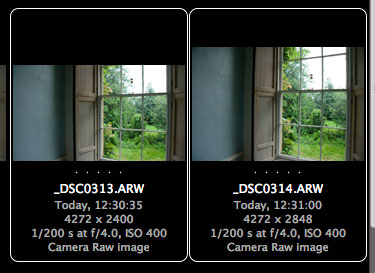
The Alpha 900 will feature at the very least a 16:9 crop and a 1.5X crop, to allow the use of DT (APS-C format) lenses such as the Carl Zeiss 16-80mm with a 10 megapixel file size. The viewfinder will have frame markings for the 1.5X crop, and the usual top and bottom lines to indicate 16:9. I’d like to hope it will have a 2X mode, a still-useful 6 megapixel image. The 16:9 and 1.5X are not optional choices for Sony. They must include these and the sensor is equipped to provide them. Anything else, like 2X or 5:4 ratios would be optional.

Windowed readout can create cropped RAW as on the Nikon models, so if Sony provides the option to use it with full frame lenses – again I do not know whether they have done so – caution would be needed in using the finder. You get genuinely cropped raws.
The benefit is possibly blistering motordrive speeds. Assuming the Alpha 900 has been configured to manage at least 3fps at full 24 megapixel resolution when shooting raw, it should be able to achieve 7fps at windowed 1.5X 10 megapixel resolution. We might well see 5fps full frame and better than 10fps APS-C – now that would put the Alpha 900 in an interesting market position!
It’s all down the how the raw saving is implemented. If it is genuinely cropped – for 1.5X if not for 16:9 – faster sequences may be on the menu. If the raw file is always saved at full size, and just includes metadata cropping information, it may be possible to use DT lenses like the 11-18mm and get a useful full-frame wide angle at 14mm with a forced crop.
Because the Alpha 900 is designed to use APS-C lenses as well as full frame, it will be interesting to see what area the AF sensors cover. Will they be clustered centrally within the 1.5X image zone, or scaled up to work optimally with full frame movement tracking?
Electronic shuttering
The final possibility offered by the new sensor is an electronic shutter. I think there is a 50% chance the Alpha 900 will have one. Why?
The 900 has the largest focal plane shutter assembly of any 35mm-format camera (DSLR or otherwise). I don’t know the exact gate size, but it must be around 40 x 30mm. So far, even with a fast 1/8,000th shutter fitted to the Alpha 700, Sony has not achieved particularly fast flash synch speeds. The A700 can be used safely in the studio at 1/250th with zero vignetting but the autoset speed with the dedicated flash system is 1/60th-1/200th (in most conditions it sets 1/125th or 1/160th).

The extra size, and transit opening, of the Alpha 900 shutter gate could mean a sync speed slower than 1/160th unless the shutter itself has been speeded up to a 1/12,000th specification – something very difficult to get in a unit bigger than that used for the 9xi and Dynax 9. My gut feeling is that to avoid reduced shutter life and a loud shutter sound Sony will restrict the Alpha 900 to 1/4,000th like the Dynax 7D (a camera it closely resembles in many ways, including the return of the 1-2-3 memory registers).
This would mean a flash sync speed no better than 1/90th with SSS active, perhaps 1/125th for PC sync connections or non-SSS, non-wireless operation.
The provision of electronic shutter mode on the full-frame sensor would make it possible for Sony to offer faster ‘virtual’ flash sync speeds. The Nikon D70 did this, enabling synchro sun at 1/500th. Flash timing latency, inevitable in an electronically triggered system, may prevent anything faster. Having options of 1/250th or 1/500th would make the Alpha 900 appeal to fashion, portrait, press-PR and wedding photographers as all regularly use synchro-sun fill in.
(Update August 22 – it seems that Sony has taken the first option – though the highest shutter speed is 1/8,000th like the Alpha 700 and the ‘gate’ is much larger, they’ve achieved a faster flash sync speed than the Alpha 700 without electronic shuttering- there’s no question of it being restricted to slower speeds. What this means for shutter noise/life will depend on the construction of the shutter. I think we are going to be given details of a very advanced shutter design using lightweight materials. How can they do this, and keep the price down to the low figure hoped for by so many? – DK).
If Sony has implemented electronic shuttering, the ultimate bonus would be burst mode ‘open once, capture sequence’ shooting – where the shutter opens for a short time and a sequence is recorded at a higher than normal frame rate, perhaps with reduced resolution. This is a CMOS technology Sony has been working on for the last few years.
(Further update – I do not think, if my latest information about the focal plane shutter is correct, that the electronic shutter with very fast burst shooting will appear in the Alpha 900. I am certain that it will appear in a future Alpha DSLR. – DK)
You’ll have to wait until mid-September to learn whether the Alpha 900 will be more than just a moderately priced full frame DSLR. I don’t think you will be disappointed.
– DK