
It’s not going to be long before we see the Alpha 900, and some cameras are known to be out there on trial in the hands of Sony staff and pre-release testers. I am not one, so rest assured, this is not a leak! What can you expect from the Alpha 900’s full-frame prism finder?
(Note: this post was written in early August – it is now 100% certain that the finder is 100%, and at 0.74X magnification will be – as had been hinted – the largest of all current DSLR finders in apparent visual terms except the EOS 1Ds Mk III which is 0.76X. Comparisons: EOS 5D 0.68X, Nikon D3 0.70X).
Tag: A700
-
Alpha 900 – finder and frames
-
Field Guide for Alpha 700
Alan Hess is the author of a new field guide to using the Sony Alpha 700, published by Wileys, with 281 pages and the usual contents covering basic photographic techniques as well as the camera’s operation.
The cost of the guide is 16 Euros by mail order from Research & Markets of Dublin website; the title is ‘Sony Alpha DSLR A700 Digital Field Guide‘.
-
Which Sony Alpha?
Now that there are five Sony Alpha DSLR bodies in circulation, with many owners of the original 2006 Alpha 100 considering a replacement, the differences between this ur-Alpha and the 2007-8 generation of Alpha 700, 200, 300 and 350 need examining. (more…)
-
A quick vertical bracket for DSLRs
Moving a DSLR – preferably without vertical grip because of the further imbalance created – to portrait format shooting on a small tripod ballhead produces an unstable arrangement where the head is stressed. The camera may sag unless the head is tightened, and if the lens is heavy, it may also unscrew itself from the normal tripod bush tightening. A L-bracket is the ideal solution for mounting your camera for a portrait session or any other situation where most of the images will be vertical.
The best solution is a rotating camera cradle, but these are expensive and often add too much bulk. They will keep the lens centered around its axis, so compositions don’t need radical changes to camera position. Flip-over L brackets which move the lens axis but provide a swift change from vertical to horizontal composition are OK, but usually place the camera off the centre of the ball head action, again stressing it unduly.
Here is a really cheap DIY solution, a binocular tripod bracket retailing in the UK for £14.99 under the brand Viking:
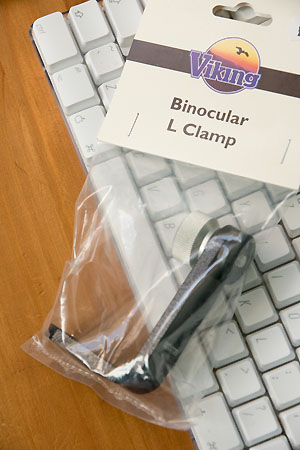
As you can see, the binocs are intended to sit outside the L, not inside. A black hard plastic washer/spacer is glued to the outside of the threaded clamp, which has two threads to attach to tripods depending on the position you want (these are on the short arm of the L), and the single one for the binoculars. The plastic washer is easily removed by sliding a craft knife into the glue, it pops off instantly. You could just reverse it, but the shiny washer would have no grip on the camera baseplate.
Instead, I glued a layer of IKEA tacky thick vinyl drawer lining textured sheet to the inside upright of the L. Some rubber sole from a shoe repair shop would be equally good, or any suitable plastic, rubber or foam of the right thickness. It should be more than 1/16th thick, otherwise the tripod screw will hit the base of the Alpha tripod socket and not tighten (a washer can be used on the other side, it has a slim one already).
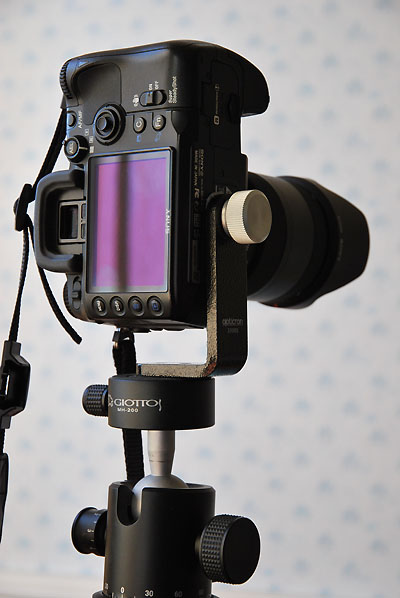
Here is the result. It is shown on a Giottos ball head (as ever, missing some of its rubber knob grips, which come off in a matter of days when working). The head is fitted with the Giottos quick release top unit, replacing its normal head. A quick release insert is fitted to the L base permanently, so it’s very easy to remove the rig. It would be possible to make a longer tripod screw for the camera and mount a further quick release insert on the long arm – the screw going through the insert, the arm and then into the camera. This would make rapid switching from vertical to horizontal mounting easy. I have Giottos heads on several of my tripods and monopods, and a bunch of these quick release tops, so I may convert it this way but would need to locate or cut exactly the right length of 1/4 Whitworth screw.
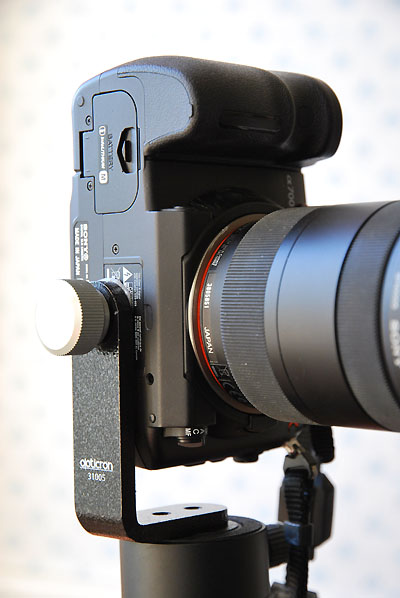
You can see here that the original name of the clamp is Opticron 31005. It should be easy to locate, and cost around US $25 in other markets – or less. It has just the right amount of space for the Alpha 700, and the IKEA sheeting provides almost enough grip – there is probably a better alternative industrial sheeting, floor tile, old mousemat or similar material. The further to the end of the two tripod threads places the lens axis neatly over the centre of the tripod. This will not work with a vertical grip fitted, but I’m not a fan of vertical grips and with the A700 any tripod shooting is normally triggered using the free wireless remote control supplied.
– David Kilpatrick
-
A700, 6400 ISO, seven raw processors
There’s a lot of controversy right now about whether or not the image structure of the Alpha 700 files at very high ISO – mainly 3200 and 6400 – is as clean as raw processed results from other comparable cameras like the Canon 40D (does not offer ISO 6400), the Olympus E-3 (does not offer ISO 6400) or the Nikon D300. At the heart of this is the way different raw processors handle file conversion, and most specifically, the current performance of Adobe Camera Raw 4.3.1. (more…)