
One-minute sequence of the Moon and clouds at its closest point and largest size, shot using the A55 with 500mm Minolta AF reflex lens and 2X Teleplus converter.
Tag: Sony
-
Zeiss, Cosina, Sigma and Tamron – NEX E-mount future
Sony Corporation announced today it will disclose the basic specifications of its “E-mount” for interchangeable single lens cameras, without fee, to manufacturers of lenses and mount adaptors, starting April 1st, 2011. This was previously confirmed at the photokina press conference – now they have revealed that Carl Zeiss AG, Cosina, Sigma and Tamron will all be working on the E-mount system as independent lens makers.
“This opens the way for manufacturers of various lenses and mount adaptors to effectively develop products conforming to “E-mount” specifications”, say Sony.

The NEX E-mount revealed – ten contacts, three flanges and a mere 18mm of register distance…
“Users of the Sony’s NEX-3, NEX-5, NEX-VG10 and other E-mount compatible Sony digital imaging products to be launched in the future will now be able to use interchangeable lenses from both Sony and various other manufactures, while they will also be able to attach non-Sony lenses to their Sony digital imaging products via a mount adapter. Sony believes the growth of digital imaging products employing the “E-mount” will further increase the enjoyment of photography and video shooting among an even wider range of users.
“These basic specifications will be disclosed to manufactures of lenses and mount adaptors following a predefined process of approval and the signing a license agreement with Sony.
“As of today, the decision to disclose basic specifications of the E-mount has been endorsed by the following companies.”
(there follow these manufacturer statements)
Carl Zeiss AG
As an independent lens provider, Carl Zeiss welcomes the disclosure of the E-mount specifications by Sony. It helps manufacturer’s product development, benefits customers and therefore assists in establishing E-mount as a new, healthy and strong system on the market.Cosina Co., Ltd.
Cosina Co., Ltd is excited by the potential of Sony’s E-mount which enables to a large-size image sensor to be incorporated in a compact, interchangeable lens camera. We have high expectations for the E-mount with its aims to create a new photography culture, and express its assent to Sony’s decision to provide information related to E-mount.Sigma Corporation
Sigma Corporation fully supports Sony’s decision to disclose basic E-mount specifications. We believe this move will spur the further growth and diversification of camera system across the industry, provide photo enthusiasts with a wealth of choice and enrich in their photographic lifestyles.Tamron Co., Ltd.
Tamron Co., Ltd endorses Sony’s decision to disclose basic E-mount specifications. We aim to offer our customers new solutions and unprecedented photo-shooting enjoyment through the manufacture and sale of E-mount lenses.Editorial comment: at the photokina conference, the wording used seemed to imply that independent E-mount camera bodies were also a possibility. Of the makers above, three already have a history of making rangefinder or compact style large sensor bodies – Zeiss (to date, film only); Cosina (digital, in the form of the Epson Leica mount bodies with 6 megapixel Sony sensors) and Sigma (the DP-1 and 2 series have fixed lenses, but would be a natural candidate for conversion to E-mount form). If this was to be the case, in a future announcement, the E-mount would be established as an alternative to the Micro FourThirds system with a capacity to use sensors in formats between 2X and 1.5X with existing lenses, and possibly up to full frame in a secondary configuration with a different range of lenses (backwardly compatible with smaller sensors).
Is this the same Sony people rant about being protective and exploiting their customers? No. It is Sony listening to their customers. It’s Alpha becoming the 21st century equivalent of Leica.
-
Alpha and NEX overtake Nikon UK DSLR sales
Chris Cheeseman writes in Amateur Photographer, reporting on figures released by photo industry analysts GfK, that Sony interchangeable lens camera sales in the UK have overtaken Nikon, moving the company into second position behind Canon.
In the Japanese home market, Canon remains top, Nikon second and Sony is third with over 15% of the market share. No attempt is made by AP to analyse the importance of Sony having a market share which is roughly half that of Nikon and Cano respectively, in that market.
The figures relate to the year 2010 – a calendar year – and it needs to be considered that Sony’s NEX system effectively went on sale slightly before midway during that term, and the SLT system one quarter later. Some Sony models were only introduced after photokina, in the final three months of the year.
In fact, it’s almost impossible to judge Sony’s impact when 2010 is viewed as a year rather than in terms of monthly or quarterly figures. If a graph was to be drawn with four lines on it – Nikon, Canon, Sony and ‘everything else’ – it looks as if the 11% overall decline in Nikon and Canon would contrast with a steep late year climb from Sony.
-
Sony 5″ video monitor for DSLRs
For some time, I have been using a 7″ Lilliput external monitor for my Alpha and other HDMI output cameras. This is fairly bulky, with its external battery pack, and is mounted on a flash bracket holding it to the side of the camera. The main use of the monitor is for interview-style filming with it facing the subject (self filming) but it also has uses making location shooting simpler. Such monitors are usually mounted within video rigs, off camera, often at waist or chest level even when the camera is held above and forward of them.
The cost of the Lilliput is around £150-£200 depending on supplier and battery/mains power choices. Similar monitors from Marshall and other makers typically cost two to three times this, because they are sold for the photo market – the Lilliput is sold to the in-car entertainment sector, and therefore is not marked up by 300% to allow for the deep pockets of camera owners relative to car owners.
Sony’s new 5″ monitor is much lighter, and comes with mounts for hot shoe and Alpha shoe, and a neat lightweight HDMI-miniHDMI cable (oddly enough, that’s about the hardest thing to find – a short, skinny cable). It costs $395, but for that you do get a folding hood which is neat. They have many photos of it and not one shows it facing forwards, but the use is mentioned in the publicity.
It does not draw power from the HDMI, but requires either a mains adaptor or a battery pack, which is not shown in any of the photos. Sony have done the same as LED-video-light makers – provided a bay for fitting the regular Alpha camera battery as a power source. The press release implies that the battery pack is a separate item (‘optional’) instead of making the point that you use any large Alpha battery (including old ones left over from the A100). I find it very convenient that my video light accepts the same batteries as my camera system, and not very convenient to have a bulky rechargeable pack for my 7″ monitor. (NB: all that white space is part of Sony’s image we have linked to – nothing like wasting a bit of bandwidth by not cropping pix, is there?).
Here’s the press release:
—————————————————-
A new clip-on LCD monitor from Sony gives DSLR camera owners a bigger, better view of their footage while shooting HD video.
The CLM-V55 is a portable video monitor featuring a high-resolution WVGA (800 x 480) (5”) LCD panel. Attaching easily to most Interchangeable Lens Digital cameras and compatible HD camcorders via the supplied adaptor, it displays video footage during shooting/playback with excellent clarity and a wide viewing angle.
The clip-on screen tilts and swivels to any angle for comfortable framing in any position – even self-shooting when you’re in the picture.
The CLM-V55 is loaded with pro-style features to help photo enthusiasts and videographers shoot high-quality HD video footage with their Interchangeable Lens Digital camera.
Pixel magnification mode assists with accurate focus confirmation, giving an enlarged pixel-perfect view of a selected portion of the Full HD image. It’s complemented by a colour peaking function that highlights the edges of accurately-focused areas of the video image.
An intuitive control wheel allows quick, positive adjustment of a wide range of monitor settings without interrupting shooting. Adjustable parameters include aspect ratio (16:9/4:3), volume, brightness, contrast, colour tone (phase), colour temp and auto dimmer. On-screen markers aid precise framing by giving precise indication of a TV’s 16:9 or 4:3 actual display area. The LCD monitor’s on-board mono speaker is complemented by a headphone jack for accurate audio monitoring during shooting.
The CLM-V55 attaches easily to a wide range of Interchangeable Lens Digital cameras from Sony and other manufacturers that support HD video shooting. The supplied adaptor simplifies mounting on any camera or HD camcorder that features an auto-lock accessory shoe or ISO shoe. Signal connection from camera to monitor is via the supplied HDMI cable, while power can be supplied using a battery pack or AC adaptor (both optional). The CLM-V55 comes with a detachable LCD hood for more comfortable viewing when shooting outdoors in bright sunlight.
The CLM-V55 LCD video monitor by Sony is available from March 2011.
-
The Alpha 580 – a three-way view
Once I had a quarterplate hand-and-stand camera, vintage 1920s. Attached to the front standard was a small reflex viewfinder, giving a miniature composition you could use at waist or chest level. On the same standard was a folding wire frame, with a companion eye-sighting window flipping up from the side of the body. This gave a direct view from eye level. But for the most accurate framing and focusing, a groundglass screen at back could be used with the shutter open and a viewing hood folded out.
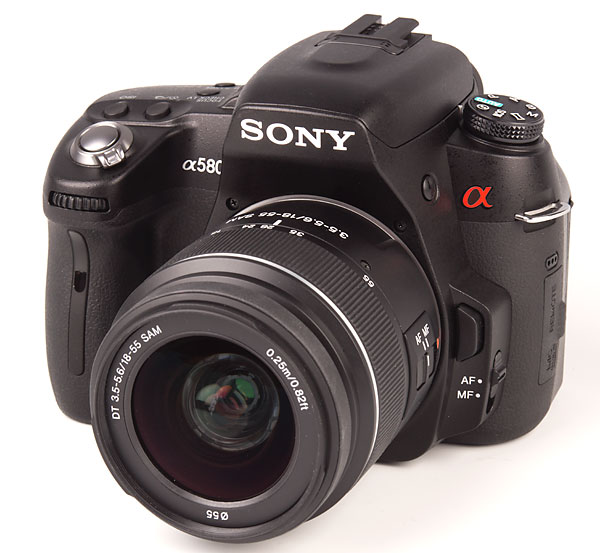
Those three ways of viewing have never been available in a modern SLR. Until now! The Alpha 580 (for which you can also read 560 throughout this review, give or take the sensor) is the first modern SLR to offer three entirely different viewfinder systems, all with their own unique focus and exposure methods. There have been cameras made by Alpa and Praktina which had optical finders tucked in alongside their pentaprism, and Rollei invented a finder which could switch from eye-level to waist level at the flick of a lever. But the Alpha 580 offers three through-the-lens systems and it’s unlikely any DSLR will do so again.
This is a 10-page article – please use the navigation bar at the bottom to move on to the next page, or click the ‘Continue Reading’ link to view as a single long article (this function is not very reliable though and may produce an ‘undefined’ error)
(more…) -
Alpha 55 – in depth pros and cons

It’s taken me a long time to get round to writing a review of the Alpha 55. You don’t get to use a new type of camera very often, and this camera blends elements which have all been used before in a completely new way. This review is pretty from the point of view of the still photographer not the video shooter. This is a multi page report. There’s a lot of it. Please use the navigation for pages 1, 2, 3, 4, 5 and on to keep the pages a reasonable size – even if it’s rather hard to spot it… or click the Read More link to get it as one big scrolling monster.
(more…) -
HD videocast – NEX adaptors and odd lenses
I’ve finally got round to trying a ‘proper’ videocast – perhaps the first of regular short demonstrations – with the Alpha 55 offering me HD filming while demonstrating the NEX-5. And I can use the NEX-5 to film stuff about the Alpha 55. A Canon 60D helped, though its inability to refocus during filming (which the NEX-5 and Alpha 55 can do) proved a small problem. The sound from the Canon was used, mainly because it had been set with a manual level, while the Sony was using an external condensor mic that pickup up some serious interference from the lights.
The lighting is nothing more than one 30W daylight colour energy saver and one 20W – using an angle desk lamp from IKEA and a spare table lamp. The background is a Calumet (Lastolite in disguise) canvas. To do the filming, I ran a 7 inch Lilliput monitor from the HDMI output of the Alpha 55, and mounted it facing me on a bar right next to the camera. The Canon was set up as a second camera and left running from that position. Editing, including cutting and pasting the soundtrack and parts of the Canon video, was in iMovie 11.
This is a full 1080p HD YouTube film – if you can view it (bandwidth is an issue) try the higher resolutions. The Alpha 55 consistently overheated at around 7 minutes, showing me a temperature warning then shutting off. The room was not warm and the camera screen was both not active, and moved away from the camera back. My first attempt at this film was spoiled by the overheating issue, perhaps because SSS was left on in error. However, on a tripod SSS is not active to any extent when shooting video (it does not have the same problems of creating blur, which happen with still images due to the way mirror or shutter vibration are reflected by the tripod). Previous time limited movies I’ve made have been hand held and of course SSS is both used and expected to be very active.
– David Kilpatrick -
Tokina 11-16mm f/2.8 SD (IF) DX
TOKINA lenses – the brand name for optical giant Hoya’s interchangeable range – have always been renowned for their tank-like build quality and resistance to plastic trends. They compare so well with Nikon’s own lenses it is hard to tell the difference by feel, and the current design also matches Nikon more than it does Canon.
The latest news is that Tokina is to introduce the 11-16mm ƒ2.8 in Sony Alpha mount. Tokina stopped making Minolta mount lenses shortly before their parent company Hoya acquired Pentax. On October 28th 2010, Kenro UK announced availability. B&H has the lens in Sony fit here. (more…) -
NEX-5 live sound
I’ve been using the NEX-5 with accessory mic – and sometimes, by forgetting to bring it, without. Today we had the Ripon City Morris side in town, and I was taking still shots using the Nikon D3X with the new Nikkor 85mm f/1.4 AF-S G lens. The NEX was grabbed as an afterthought for video.
Well, the wind noise with the built-in mics was just too much; most of my ‘footage’ ended up on the cutting room floor. After I’d got the portraits and other shots I need for the Nikon test, I nipped back to the studio and got a 4.5m high Manfrotto lighting stand fitted with a ball head. The NEX got its accessory stereo mic (set to 90° coverage) and the 16mm lens, and despite the wind level, was hoisted aloft for the last couple of dances in the square. The 30 minutes recording time really helps. My framing was not perfect, so two of the video clips were cropped down from the original 1080p, in iMovie. It is an instant process, just select the clip, select the crop tool and trim.
Despite very definite winds blowing around the pole-mounted camera and mic, there were no wind noise issues at all. So: for outdoor shooting, the accessory mic is essential.
Here is a video made the week before, entirely using the ECM-SST1 microphone, which has no wind noise at all – see this post: ECM-SST1 microphone handheld clips.
– DK
-
Four new Alphas – and two 'translucent'
It’s a funny word to use, because the mirrors involved are transparent and not translucent (which implies passing light but not in an image-forming manner). Translucent means semi-opaque, letting light through in the way that an opal perspex sheet or Kodatrace foil does. Transparent means something you can see through.
But now, thanks to the wonder of changing language, translucent is also going to have to mean transparent, or semi-transparent. Pellicle, semi-silvered, whatever term you wish to use.
Unfortunately, for this writer the misuse of the word translucent stands as one of the biggest schoolboy howlers ever imposed on the entire world by the ignorance of a corporation. It’s such a glaring error I can hardly bring myself to use the term – others, like Dave Etchells, have happily assimilated the new meaning into their technical lexicon. And as the video above shows, they’ve made it into a trademark, a permanent part of the future of this technology.
Wiki, and pretty well every dictionary ever published, disagree with Sony’s imaginative use of a word from which they have now removed its exact meaning:
Wikipedia: “Transparent materials are clear, while translucent ones cannot be seen through clearly.”
Merriam-Webster:trans·lu·cent/transˈlo͞osnt/
Adjective: (of a substance) Allowing light, but not detailed images, to pass through; semitransparent.
(the semi bit of semitransparent cited here seems to mean semi-detailed, vaguely delineated – not slightly darker; otherwise the primary definition of the word is diluted).
There has been some heated argument on dPreview forums about this post of mine (my view is shared by many). No-one has made the point that words evolve to have useful exact meanings. Transparent and translucent are words which may once have shared a common poetic meaning in 18th century descriptive writing, but whose meanings were refined with the progress of science and technology. This process in the course of over 200 years resulted in a useful distinction between the meanings of transparent and translucent. Sony’s commercial misuse of the word Translucent is damaging to the English language and to the scientific and technical lexicon; it predisposes future confusion about the meaning of the words.
It is also a fait accompli; there is no turning back, since Sony’s corporate stance is much like that of Mrs Thatcher; no u-turns and never admit to be being wrong. They have also no doubt invested hundreds of thousands of dollars in the consultancy involved, and the registration of the term as a trademark, the creation of branding artwork.
They could have branded the mirror TransLumina® or, more usefully, just called it a transflecting mirror – transmitting-reflecting. That term is already used to describe the sort of mirrors used in ‘Big Brother’ with cameras behind them.

As to whether it’s a true pellicle mirror (a thin stretched film of vacuum coated Mylar or a similar polymer) no-one seems to be clear. It moves out of the way to allow sensor cleaning but could be relatively fragile. It certainly does not need to move to allow 10fps (Alpha 55) or 7fps (Alpha 33) continuous shooting. Sensor dust is often created within the camera by wear and tear on the shutter mechanism, so access for cleaning is essential and the mirror can not be designed to seal the sensor chamber. The Alpha models still have a shutter, that’s the next thing we shall see eliminated. That old rumour of the 15fps silent shooting Alpha DSLR seems to be more than a rumour; we are almost there.
For many users, the critical advantage of all four new Sony models will be HD Video with sensor-based in body image stabilisation. This will enable all kinds of lenses from macro to ultrawide or soft focus, manual adaptations and Minolta AF legacy glass to be used for video with confidence.
Welcome back the circular polariser, unlike mirrorless ILC cameras these new models will not allow the use of linear polarisers without AF efficiency reductions, but exposure should be unaffected as the sensor itself provides the metering with 1200 zones.
This will be one of the tests reviewers need to carry out on the new pellicle mirror Sony Alpha 33 and 55 models – to confront them with not only polarising filters, but conditions in which light is naturally polarised. How will they render sky gradations or reflections off water?
Two further Alpha models are being released, which are essentially updates for the 500/550 – the Alpha 580 which will hit the shops before the winter buying season, adding 16.2 megapixels and a 15-zone AF module, HD 1080p video and (non-video) Contrast Detect AF with all Alpha mount lenses. The 560 will not arrive until some time in 2011, using a 14.2 megapixel sensor.
Versatile features
More of a landmark than a benchmark, the inclusion of 10fps continuous shooting with active phase detect AF and 16.2 megapixel file size in the Alpha 55 is unprecedented and possibly unforeseen by competitors, in this class of sub-$1000 consumer DSLR (let’s continue to use the term, since they are clothed as DSLRs). The dual format card drive supports the 30Mb/s transfer rate of the latest Class 10 SDHC cards and Sony’s fastest MemoryStick Pro Duo generation. The HD video also has a reasonable 17mbps bitrate.
The new technology has been well documented before the launch, but the fine detail of the new cameras is now clearer. The Alpha 55 is some markets will incorporate GPS geo-tagging for stills and videos (we wait to see whether raw files are tagged, and how accurate this is – the accessory Sony geo-tagging system available to date has only permitted JPEG tagging, and has not been accurate enough to know which street in a town the picture was taken in).

Rumours that the 33 and 55 bodies would be SSM/SAM only, with no internal focus drive, were unfounded as Sony states clearly that both are compatible with ‘the full range’ of over 30 Alpha lenses (indeed, the product shots of the 33 and 55 alone show the 18-200mm SAL DT lens fitted). The 55/33 1080i/60p (1080p in AVCHD camera archive format) video claims ‘smooth, precise’ phase detect auto focus during video shooting, but makes no reference to this being limited to in-lens motor lenses. Therefore we can assume it works with in-body AF drive lenses as well, and you just have to edit the soundtrack.
The new ISO 25,600 mode does not imply a radical sensor change as it is only available using Multi-Shot Noise Reduction, which requires a burst of 6 frames at the 10fps/7fps native maximum speed of the camera, and can not save raw files. The ISO range of the sensors is 100 to 12,800. Is this range quoted as absolute, or after accounting for the semi-silvered mirror light losses? If it’s the range before allowing for the mirror, then the 14.2 megapixel sensor of the Alpha 33 may be more like the Nikon 3100’s sensor than the NEX (ISO 200-12,800) is.
Thom Hogan has shown pixel dimensions and size data which support Nikon’s claim to have an entirely different sensor fab line of their own, compared to the A550/NEX sensor. But how about compared to the A33/560 sensor?
The 55’s new 16.2 megapixel CMOS will probably appear in the forthcoming Alpha 700 successor, which it is believed will form the main Sony exhibit at photokina (Cologne, September 21st-27th). Both models have a new 15-zone AF sensor with three cross sensors, but not f/2.8 sensors – all are designed to operate at f/5.6 virtual aperture. However, there is a hidden clue that the cross sensors may be f/3.5 capable, as the high-speed shooting modes with continuous AF set f/3.5 by default on any lens capable of this (if the lens is, say, only f/5.6 then the largest aperture is always set). Setting f/3.5 implies that this confers an advantage in focus sensitivity over f/5.6, f/4 or any other particular aperture – and that f/3.2, f/2.8 or wider would bring no benefit. That points to some of the sensors having an f/3.5 virtual aperture.
The new cameras are known as SLTs – Single Lens Translucent – instead of SLR. See my intro. Did they have no English speaking staff on their team? I’m sure there is a German word which describes their mirror correctly. I’d rather have the right German word than the wrong English one. Ah well, as the bloke leaning on the pub bar says, durchsprung vor technik…
Confusing aspects – Auto HDR is said to be available in P/A/S/M modes. I guess in M mode it must leave the aperture alone and change just the shutter speed. Regular bracketing is still limited to a disappointing 3 exposures at 0.7 EV intervals, maximum.
But you’ll love the direct D-Range button which gives access to D-Range and HDR options directly, and the direct Finder/Screen button which toggles between using the very high resolution EVF with its ‘virtual 1.1X’ 100% view of the subject – effective visual scale, larger than the Alpha 700 and larger than any previous Alpha digital model except the Alpha 900 and 850. That’s one of the benefits of the EVF, a relatively tiny display is viewed through a high magnification ocular and ends up with a ‘window’ on the world which beats the tiny tunnel vision of optical finders. Technically it is very similar to the last EVF produced by Konica Minolta on the Dimage A200, with the benefit of five years’ further development. It has the same 60Hz refresh rate and visually almost raster-free RGB.
Where the A550 and its earlier stablemates vary slightly around a viewfinder with an effective 0.50X scale (relative to a full frame 100% view using a 50mm lens), the A55 and A33 provide an effective 0.73X and that’s impressive. The ocular is set well back (remember the Konica Minolta A2, and the Sony Cybershot DSC R-1?) because it is a telescope design. This also gives it a very narrow range of possible eye positions, a common feature of EVFs. The eyepoint is close, and you must position your eye precisely.
The rear screen uses the same type of (Schott?) reinforced glass with (3M?) resin gel adhesive as Canon’s 7D – this totally seals to the LCD module itself eliminating air gaps, and improves contrast. It is a technology first seen in the 7D and becoming standard across the industry though the NEX has shown Sony to have the best implementation so far. It is scratch proof, by the way, and it can be cracked by impact like any other screen.
The tilt-swivel action is borrowed directly from the Nikon D5000. In fact, it’s so identical in articulation it even included the amazingly silly front facing mode where the screen is obscured by your tripod, hanging under the camera and preventing it from being placed on a flat surface for self-portraits or videos. But it has the same benefit as the Nikon, the screen can be flipped to face the camera and protected completely while you use the EVF.
Functions familiar from the NEX including Sweep Panorama and Sweep 3D Panorama are built-in and accessed from the main mode dial, which also provides physical settings for all the main modes. Depth of field preview is restored – with the usual button – because is can now actually work. It was always useless in real terms on optical viewfinder cameras, as the focusing screen never represented wide apertures correctly.
Now, with an EVF, for the first time ever an eye-level Alpha gives absolutely perfect and precise previewing of depth of field and bokeh effects whatever aperture you are working at – even at f/1.4, which was never possible and still isn’t with the A850 or A900 for that matter (which is why their Preview mode is useful).
You can also preview the exact image appearance. By pressing the AE lock button, the auto gain of the EVF or rear screen are turned off and replaced by an exposure-compensated view. So if you dial in -1 EV (using the adjacent dedicated button), and change the WB, and use a different picture style with more saturation and contrast just pressing AE-Lock will immediately preview your image with these adjustments applied. And you can enlarge in the usual two steps to check auto or manual focus.
The finder and screen also have a Nikon-style two axis spirit level (flight simulator horizon) display to help you get your horizontals straight and your verticals parallel. It can be activated on either, and does not have to appear on both simultaneously.
For movie makers, the binaural stereo microphones are a great move. Even on the NEX, the two small top aperture mics give excellent stereo. The 33/55 mics are placed either side of the ‘prism’ housing, rather like the ears on your head. This will give the stereo image created by these cameras a really natural quality. Natural, that is, to a pygmy marmoset monkey… but still, I will wager, the best stereo image of any DSLR/HybriD. And Sony provide a stereo 3.5mm mic jack socket, though without any manual control of gain levels.

I’m sure we will have to buy the A780 to get that. Click the picture above for a big version. Who says Sony does not have a range to match Nikon or Canon, whether or lenses or of cameras? From the left, the cameras show the current range before we even see the magnesium-bodied Alpha 700 replacement arrive. A900, A850, A580, A560, A55, A33, A390, A290.
– David Kilpatrick
Read Sony Press releases and full technical data:
Alpha 33 and 55 Press Release
Alpha 560 and 580 Press Release
