OBERKOCHEN/Germany, 15.04.2009.
Carl Zeiss today announced that its Camera Lens Division will extend their successful collaboration with Sony Corporation for a further 5 years. Taking full advantages of their competence both companies agreed to cooperate even closer in developing and commercializing new imaging devices in the future.
(more…)
Tag: DSLR
-
Sony and Zeiss renew co-operation agreement
-
Nikon D5000 – HDvid, articulated screen
Nikon has announced a May 1st launch for a competitor to the Canon EOS 500D, in their D5000. This camera has the first articulated screen (only 230,000 pixels) to be designed by Nikon. See:
http://www.cameracraft.online/2009/04/14/nikon-d5000-live-view-hdv-articulated-screen/
(more…) -
Canon EOS 500D – video plus 15.1 megapixels
Canon has announced a consumer level EOS 500D camera, with 1080p resolution video limited to 20 frames per second, and 15.1 megapixels but a maximum shooting rate of 3.4 frames per second:
http://www.cameracraft.online/2009/03/25/canon-eos-500d-151-mp-plus-hd-video/
This continues the trend for all new DSLRs to have HD movie shooting in addition to live view modes, something which Sony to date shows no sign of catching up on. However, the obvious compromises present in the 500D would be criticised harshly if they were to have appeared first in a Sony model, so this is good news. Canon has made it acceptable for others to follow with 20fps instead of the required 24fps, and still claim true 1080p video.
– DK
-
Japan issues forecast for next 3 years' sales
The Japanese camera and photo product manufacturing association CIPA has issued a press release PDF, containing a table of predicted figures, relating to 2009-2011 projections. Here we reproduce the text and the table (as a JPEG).
(more…) -
Sekonic's camera calibration
The Sekonic Digitalmaster L-758D meter offers the solution to variable ISO/EI ratings, and apparent sensitivity and contrast curves variations found in DSLRs. With a USB interface to link it up to a PC/Mac calibration program, the L-758D can remember three different cameras, two types of lighting (ambient or flash) and two measuring methods (incident or reflected) plus a range of ISO values for each of the cameras. There are twelve basic ‘profiles’ that can be stored, and within each profile a range from ISO 3 to ISO 8000.
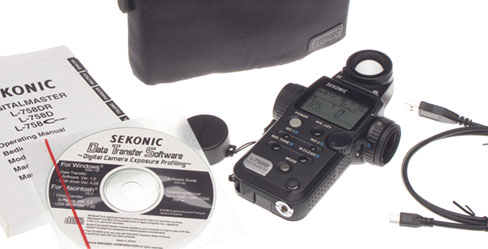
The three cameras can include settings on a single camera such as Landscape+sRGB+High Contrast, or Portrait+AdobeRGB+Low Saturation+Low Contrast. More likely, they will be three different generations or even different makes of digital SLR, as many studios keep their last models when buying new ones. They can equally well be films used in a particular film camera, though you need a scanner or a densitometer for calibrating film.
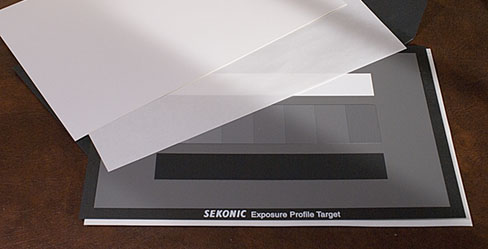
You might think a meter costing over £300 and coming with a USB cable and a program to do the calibration would include the necessary calibration target. But it’s incapable of actually doing the calibration until you spend another £99.99 on a special A4 grey scale card. Since this report was written, a new more accurate target card has been introduced.
My sample test target arrived packed in a carton large enough to contain a camera. It is quite fragile, and obviously hand-made using special papers and perhaps a type of inkjet printing for the black patches. You could not just shove this in a camera bag and use it as a grey card. It should be kept in its envelope and stored away from light, like an archival print.
Sekonic Digitalmaster L-758D basic functions
The Sekonic appeared to agree with power adjustments made to my Elinchrom flash units, which claim a 1/10th of a stop accuracy.
I found it to agree with my Minolta Flashmeter IV (which can be user calibrated with a small potentiometer in the back, but only for overall sensitivity). The L-758D should never need to go back to base as a default calibration can be programmed in to it, and this can cope with non-linear responses.
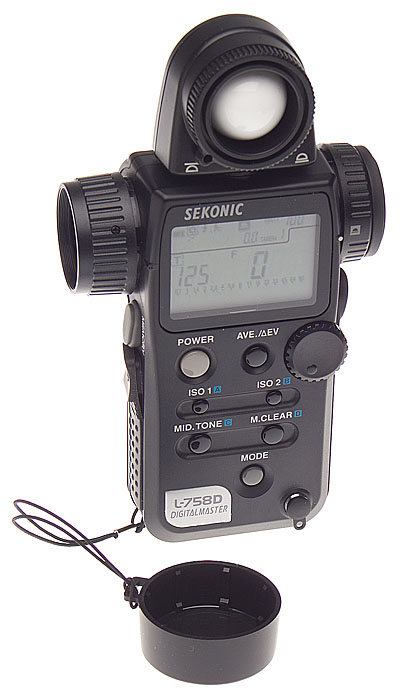
The L-758D will measure flash versus ambient, compare light source contrasts, or compare incident and digital much like any other modern digital meter. You can take up to nine spot or local measurements, pressing the M memory button after each one, then pressing the Average button for a calculated average exposure. Contrast (they recommend you turn each light off and only measure one at a time) is shown in EV values.
The reflected light metering via a semi-spot type viewfinder replaces any other type of reflected reading. Unlike the Gossen Spotmaster F you don’t get information shown in the finder, you just use the sighting to make the reading and must then examine the Sekonic’s LCD.
I found the L-758D to be large, complex and to have too many simultaneous potential functions and too much going on the LCD display with too-small graphics and symbols. It is no doubt versatile but I would be happy with one of the simpler models in the range for the routine metering I need to do.
Sekonic Digitalmaster L-758D calibration
If you shoot raw and habitually use a program like Adobe Camera Raw with auto adjustments set you can not use the meter calibration function. It only works if a fixed conversion is used for all files, or you shoot in-camera JPEGs and do not change the contrast or colour space and scene type settings.
The plain 18% grey back of the test card is ideal for white balancing and spot metering. The front side has an 18% grey field plus a central array of seven grey patches in 1/6th stop increments, plus and minus 0.5EV either side of 18% grey. Above this is a white strip 2.33 EV brighter than 18%, and below it a black strip 2.33EV darker.
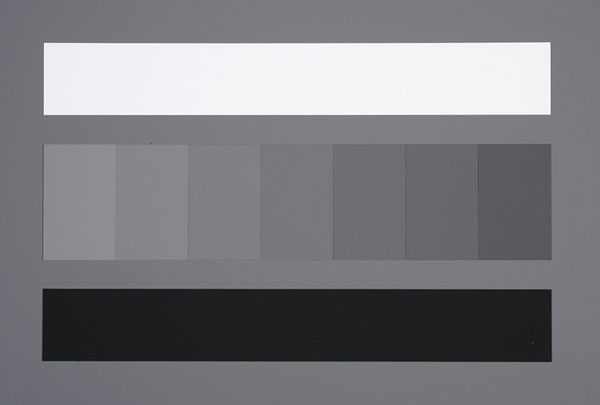
Sekonic Digitalmaster test file from the Konica Minolta Dynax 5D While Sekonic issue LAB values and densities for their £99.99 card (it goes from 3.6% to 90.7% reflectance, densities 0.04 to 1.44 LogD), they disclaim accuracy and say ‘not guaranteed as the performance of exposure profile target’.
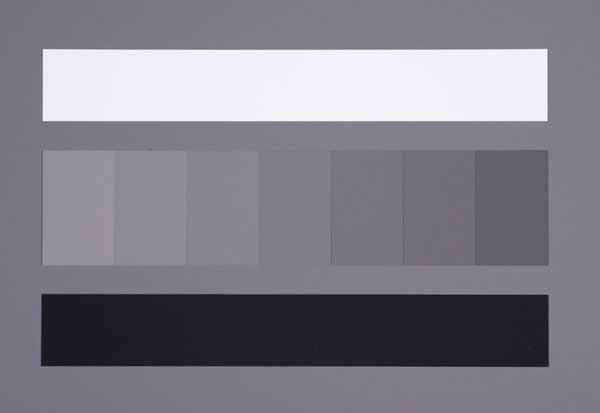
Test file from the Sony Alpha 100 under identical lighting and lens conditions In the CD-only user instructions you learn that you can equally well use a Kodak Greyscale and enter the data manually. The software, however, operates only with the Sekonic target for automatic entry. Even this is mainly manual; you must use Photoshop to read off the RGB values from each patch. It will not read a JPEG in the way that camera ICC profiling software reads a target image.
Light and lens problems
The recommendation is 45° copy lighting, but the total range of exposures needed to calibrate one DSLR fully is too great for most flash systems at such close range. You need to give plus three to minus three stops either side of a metered exposure, at each ISO speed you want to measure. You should also compare incident and reflected readings, and make tests using both flash and ambient light.
Even at ISO 400 my Elinchrom 300S heads, turned down to 1/16th power, need a neutral density filter fitting to make a complete set of exposures with ISO 400 and a lens which stops down to ƒ32, when placed five feet either side of the target.
The biggest speed deviations with DSLRs occur at even higher ISOs. Doing a full calibration is going to be difficult – I did not attempt it because I’m not keeping the meter, and it would have occupied a full half-day or maybe most of a day. But I would have needed some special type of light source to calibrate ISO 1600 or 3200.
It was useful to find out that two of our DSLRs used with twin wireless flash heads and auto exposure agreed with the Sekonic to within 1/10th of a stop, and one gave 1/3rd of a stop overexposure.
For quick operation, without a camera calibration for dynamic range and clipping point data, you don’t need the ±3 stops business. You don’t really need the Sekonic card, a good 18% grey card will do fine. Take a shot at each ISO setting, as measured by the Sekonic meter, using a medium lens aperture (least likely to have errors) and medium flashpower if possible (ditto). Open the JPEG in Photoshop, check the Green channel RGB levels in ‘Info’ and this should be within the range 116 to 120 (118 is the target figure). The 1/6th stop steps either side of G=118 are roughly in intervals of 8 on the lighter side and 7 on the darker side but cameras do not have linear response, and Sekonic only work within +/-2 units of the 256 value G scale.
Once you have completed all your entries, the meter is connected to the computer by its supplied USB cable, and the program recognises its presence. You can then upload the new calibration to the meter. Each calibration is recalled using a memory menu on the L-758D, and you must of course remember which storage register applies to which camera.
If you think any of this is slightly complicated, don’t buy the Sekonic L-758D for its programmable camera customisation. Buy it for its excellent performance as a multifunction flash/ambient meter with wireless Pocket Wizard compatible triggering upgrade option, and all the features you’ll find in the best meters of the last decade rolled into one.
The Sekonic L-758D meter is imported to UK by JP Distribution, and has a retail price (without the calibration target or the Pocket Wizard adaptor) of £398.99 including VAT.
– David Kilpatrick FBIPP Hon FMPA
-
Studio comparison A900, 5DMkII, D3X
This set of full size shots was taken with the still life left set up, because the Nikon and Canon cameras were not here at the same time. It compares the A900, 5DMkII and D3X using the converters supplied by the makers – Image Data Converter SR2, Digital Photo Professional, and Capture NX2. Each small image in the article can be clicked to open a Level 10 quality full size JPEG – beware, the largest is over 13MB of data.
-
Nikon D3X announced at last!
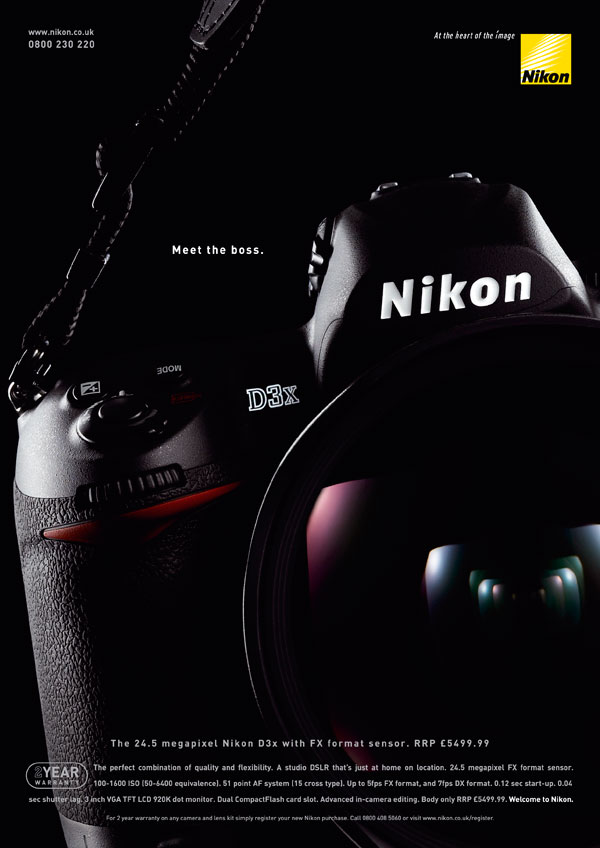
RRP: £5499.99 / €7728.00
Availability: Late December 2008Nikon UK is pleased to introduce its new top-of-the-range premium D-SLR – the D3X. Building on the reliability, handling and durability of the award-winning D3, the D3X offers an imaging sensor with over twice the resolution* of the revolutionary D3, breaking new ground in image quality.
(*Nikon’s own words – actually, it’s twice the pixel count, and approximately 1.42 times the linear resolution, as resolution is normally understood, though the visual information density is more than doubled).
The all-new 24.5MP CMOS* sensor makes the new model eminently suitable for the broadest range of shooting situations, both in the studio and on location – ideal for photographers seeking unrivalled detail.
(*Nikon’s own words again – we must wait to find out whether it is really all-new, or is a derivative of the Sony 24.x megapixel sensor. See features below of gapless microlens array and 12-channel readout, which are not claimed by Sony. Samsung pioneered gapless microlenses in the 14.6 megapixel sensor for the Pentax K20D/Samsung GX20).
“This is the camera that many professional photographers have been waiting for,” said Robert Cristina, Professional Products and NPS Manager at Nikon Europe. “Just as the D3 has become the professionals’ camera of choice in sports photography, the D3X’s extremely high imaging resolution will raise the bar for commercial, fashion and stock photography. The results speak for themselves: this is without doubt our highest-quality camera to date.”
The World is Your Studio
The D3X boasts a specially-developed FX-format CMOS image sensor with 12-channel readout, gapless micro lens array and on-chip noise reduction. It delivers class-leading levels of continuous shooting speed and noise management at higher sensitivities without sacrificing detail.
The D3X supports a broad ISO range from ISO 100-1600, extendable down to ISO 50 and up to 6400 equivalent with up to 5 fps continuous shooting at full resolution, or 7 fps in the 10MP DX-crop mode. The acclaimed MultiCAM3500FX 51-point autofocus system enables extreme accuracy with outstanding dynamic tracking for fast moving subjects in low light.
The camera’s LiveView function offers a smooth workflow option, perfect for studio work or other situations where the use of the viewfinder is impractical. The camera also delivers a superb response rate, with a start-up of just 12 milliseconds and 40ms shutter lag. The Kevlar/carbon fibre composite shutter has been designed for intensive professional needs and tested to 300,000 cycles.
Images with the X factor
The D3X reaps the benefits of the very latest developments in sensor design and image processing technology. Designed to produce files suitable to meet the demands of tomorrow’s commercial and stock requirements, the camera produces 50MB 14-bit NEF (Raw) files. Using Capture NX2 software, NEF files can be processed into medium format terrain; 140MB (16-bit TIFF-RGB). Fine details are reproduced with incredible clarity, whilst shadows and highlights contain tonal gradation with minimal clipping for pictures with a unique look and feel.
Intuitive control
The D3X shares the same ergonomics and handling as the D3, which have been designed to enable anyone to get to work quickly and efficiently. The bright, uncluttered viewfinder features 100% coverage and comprehensive illuminated displays, while the high-definition, 3-inch, 920,000-dot VGA TFT monitor enables outstanding playback quality for on-the-spot image assessment. The D3X’s magnesium body, which is sealed for moisture and dust resistance, also supports Nikon’s wireless system (the WT-4), HDMI output, offers a dual slot for CF cards and is compatible with the new GP-1 GPS unit.
See: http://www.europe-nikon.com/product/en_GB/products/broad/1726/overview.html
-
Alpha 900 launch: Press Conference Part 4
Duncan McEwan spoke, in his usual very steady and friendly manner, about his experience of using the Alpha 900. He showed a selection of images taken – remarkably – over a period of just 10 days preceding the event, using a 24-70mm CZ and his own 70-200mm Minolta SSM. Here is his own ‘script’ for the presentation, with a small selection of the images.
-
Alpha 900 and photokina: Part 1
OUR final production Alpha 900 body arrived on Saturday September 20th, and went along to photokina 2008 on Monday 22nd where it was used in a routine way – without flash – to take whatever pictures were needed for magazine reports. Sometimes it can be better just to use a camera on whatever difficult or poor subjects the world throws at you, than to devise impressive test situations.

We arrived in time to register with the press office, discover that our hotel had sold our room (and have a complimentary beer while they unsold it!), and head off into the woods beyond Cologne’s suburbs for a dinner organised by Nikon UK. The presence of an Alpha 900 was not an embarrassment and Nikon execs were interested to see it; they all visit each other stands and have a thorough look at the opposition offerings during photokina anyway!

At ISO 800 the A900 isn’t even having to struggle with strange lighting conditions like this (bright enough to see your food) but later on, when the UK press party had thanked Miwa-san and his colleagues for an enjoyable evening, we hit Papa Joe’s in the Alter Markt. This bar is famous as the meeting place for the international photo press during photokina – but it’s also very dark, crowded and full of musical automata and illuminated signs. If there’s any place which would be destroyed by on-camera flash, impossible with bounce flash, it’s Papa Joe’s at night – short of filmset style multiple head lighting, ambient light is the only way to get a record. So the Alpha 900 had to be set to ISO 3200 and +1 over-ride to cope with the bright parts of the extremely contrasty scene fooling the meter.
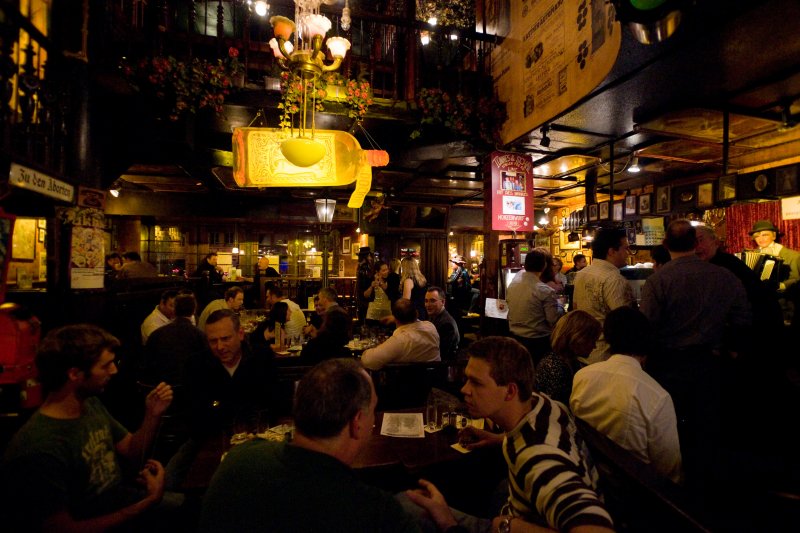
An 11.2 megapixel version of this shot can be opened by clicking the picture. Why 11.2 megapixels? It is processed from a cRAW file using ACR 4.6 RC, and this is one of the downsized options you get. The Alpha 900 native resolution is the maximum size in the list of exported sizes now. While ISO 3200 is not going to beat a Nikon D3 (etc) when viewed pixel for pixel, 24.5 megapixels versus 12.2, when you reduce the size of the A900 image to closely match the D3 size results in similar conditions give the A900 an edge in detail resolution – and slightly less mushy noise.
So, what I’ve done to make real comparison possible with the A700/D300/D3/D700 and similar +/-12 megapixel models is to resize all the photokina shots on the A900 to 11.2 megapixels export.
Here is one of Papa Joe’s musical automata during playing. If you think the skin looks a bit plastic – it is!
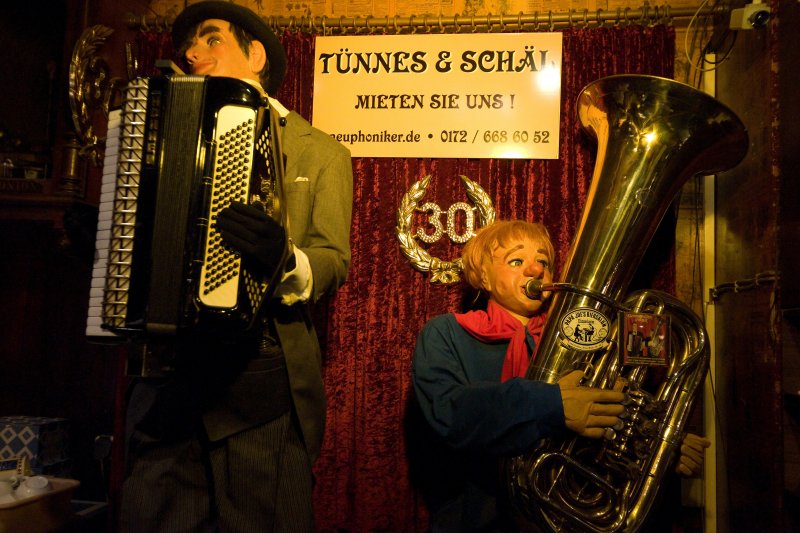
For the full sized image (again, accessible by clicking the in-line image) some sharpening, some luminance and chroma NR were all applied because it could take this without getting rough. Here is a section of the image seen at 100% (of the 11.2 megapixel export) with no sharpening, and no luminance NR – just a colour NR setting of 50 in ACR. Check out the eyelashes:

Is this good for an ISO 3200 image processed using these parameters? I believe it is. I have used the Nikon D3 and D700 in similarly low light conditions, but mainly the D3. I know what the noise of the D3 looks like, and have praised its high ISO performance particularly at 6400 and above – at the time of its launch, nothing else went above 6400 or did 6400 as well. But that the D3 is ‘noise free’ is a myth even at ISO 400.
Here is a similar 100% section of a D3 ISO 3200 shot taken in a very similar level and quality of light, with some similar colours, and at the same aperture – though my photokina shot used an inexpensive KM 17-35mm D lens at f5.6 and 30mm, while the D3 shot uses a very expensive 24-70mm Nikkor at f5.6 and 24mm:

Now in my book, at the very similar 11/12 megapixel size the D3 has a much softer resolution and shows a more distinct (but film-like, and evenly distributed) noise grain. I think the A900 downsized to 12 megapixels will display higher detail resolution, and less noise before post-processing, than a similar Nikon D3 processed from raw. JPEGs are a different matter; the Alpha 900 ‘Fine’ JPEGs are not pleasant, and get worse as you increase the ISO setting. That is why, after experimenting with Extra Fine JPEG (much bigger than a cRAW!) and RAW+JPEG, I shot everything using cRAW.
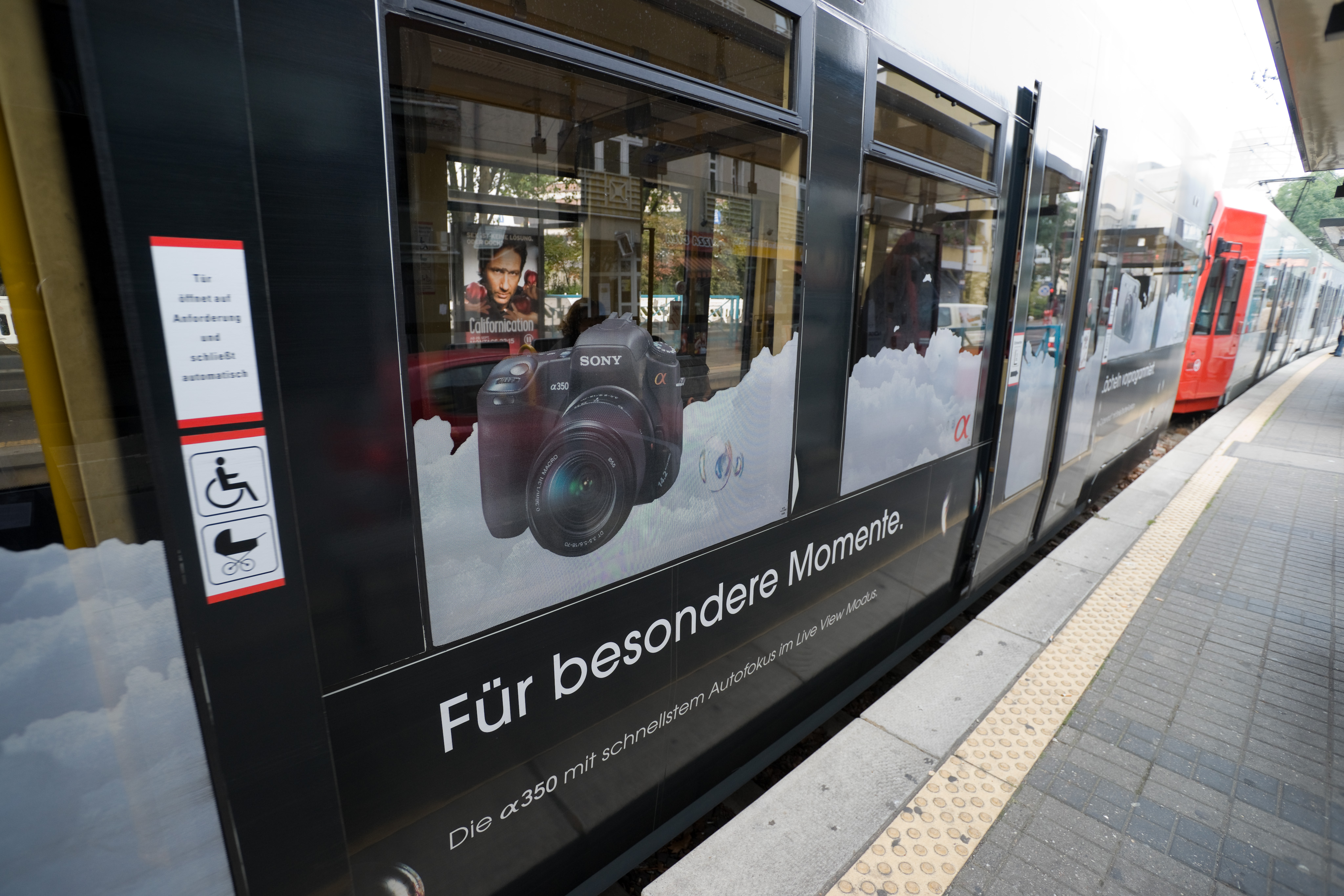
In the morning – with just a single day to spend at the show – I found myself on the wrong S-Bahn train, and had to return from the next stop to get the right one. Travel is free throughout Cologne public transport when you buy a Messe fair ticket (or at least, a photokina ticket) or have a press card. By luck, the train which arrived to return me was branded Sony Alpha!
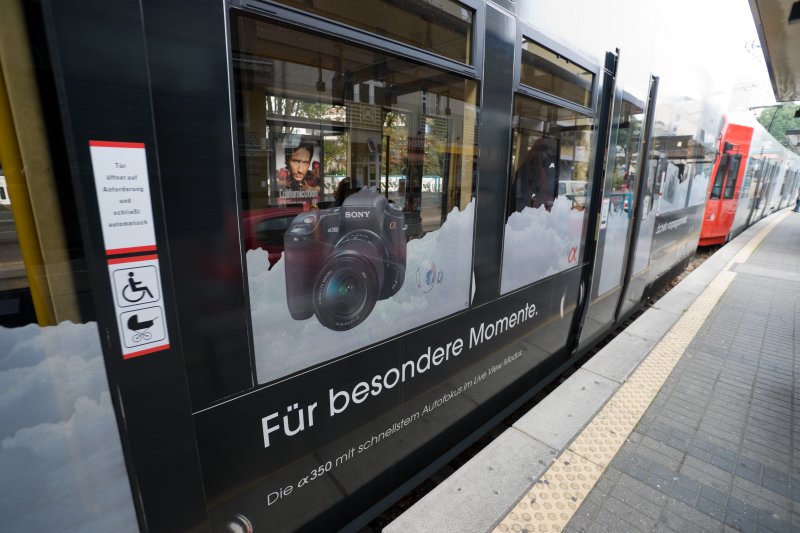
Now if you doubt just how extremely sharp the Alpha 900 gets using normal ISO speeds, and exporting to 11.2 megapixel size, click this one and view full size. Look at the structure of the ‘foam’ below the Alpha camera and you’ll see moiré patterns. The camera, here, is outresolving the subject. The Alpha 900 has a unique AA filter, which is positioned well to the front of the CMOS imaging sensor. There is a big gap. This has two effects – first, it places all dust further from the image plane, meaning that most minor sensor dust will never be seen at all.
Secondly (though Sony do not say this) when you move an AA filter further from the sensor, it must be weaker. The diffraction pattern which softens the image has a strength linked to the distance between sensor and filter – try putting a soft focus filter on a printed page, then lifting it up slowly, to see why this is so. The weaker filter, further from the sensor, has a much less destructive effect on micro detail contrast and is especially friendly to wide angle lenses.
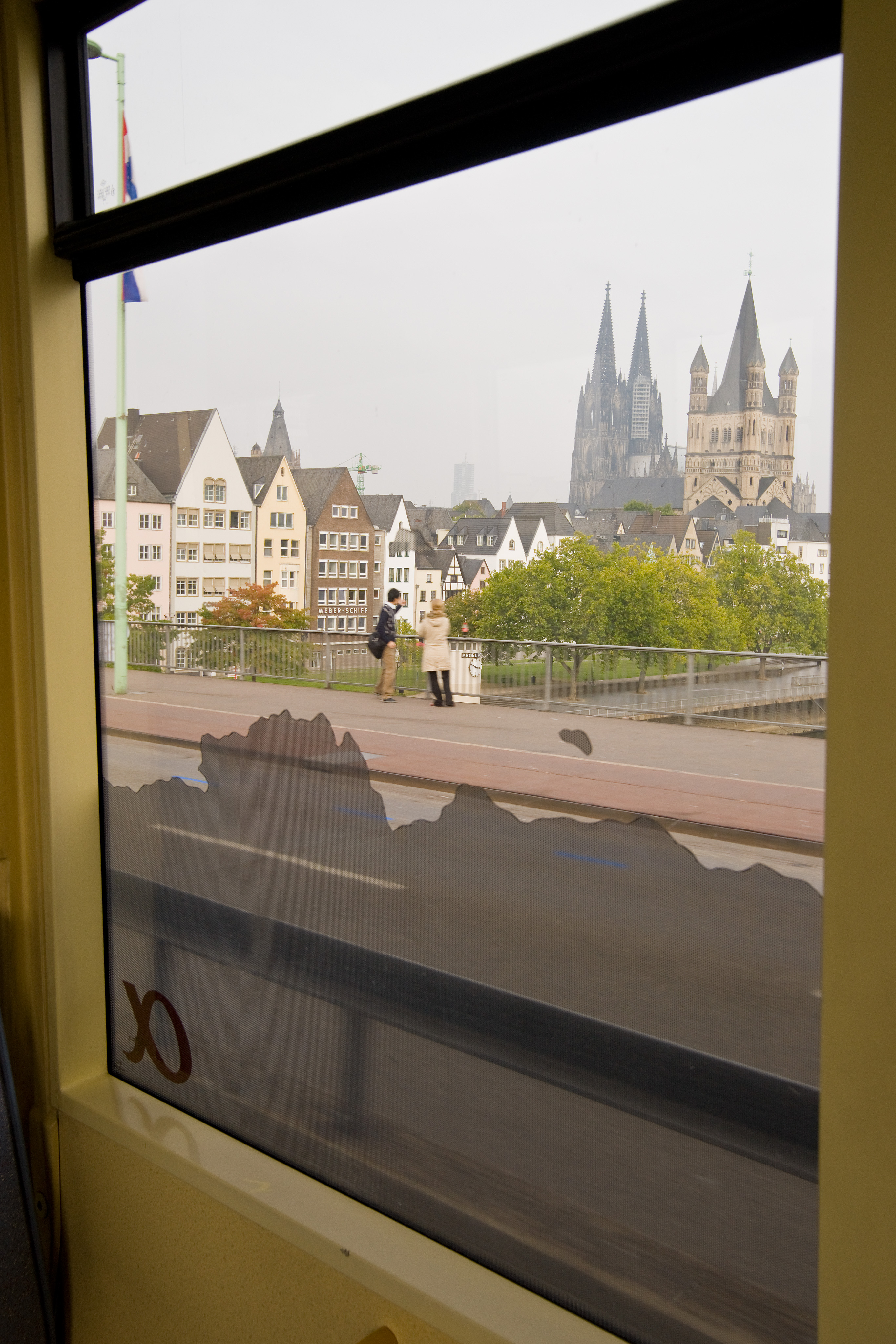
I was shooting very quickly – these were barely planned, I just had time to register the Sony branding, shoot, and jump on the train. Inside, I had to lean over between people to get the right angle for a Cologne view – no time to alter the camera settings, or do anything except focus-lock on the Alpha symbol and recompose:
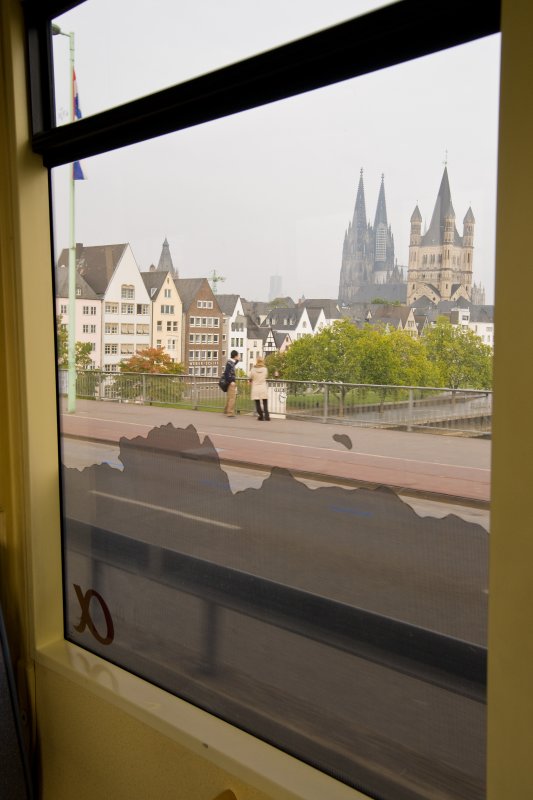
The man whose arm can be seen near the Alpha was surprised by my sudden invasion of his space but spotted the camera and the symbol and realised what I was doing. Again, click the pic to blow it up!
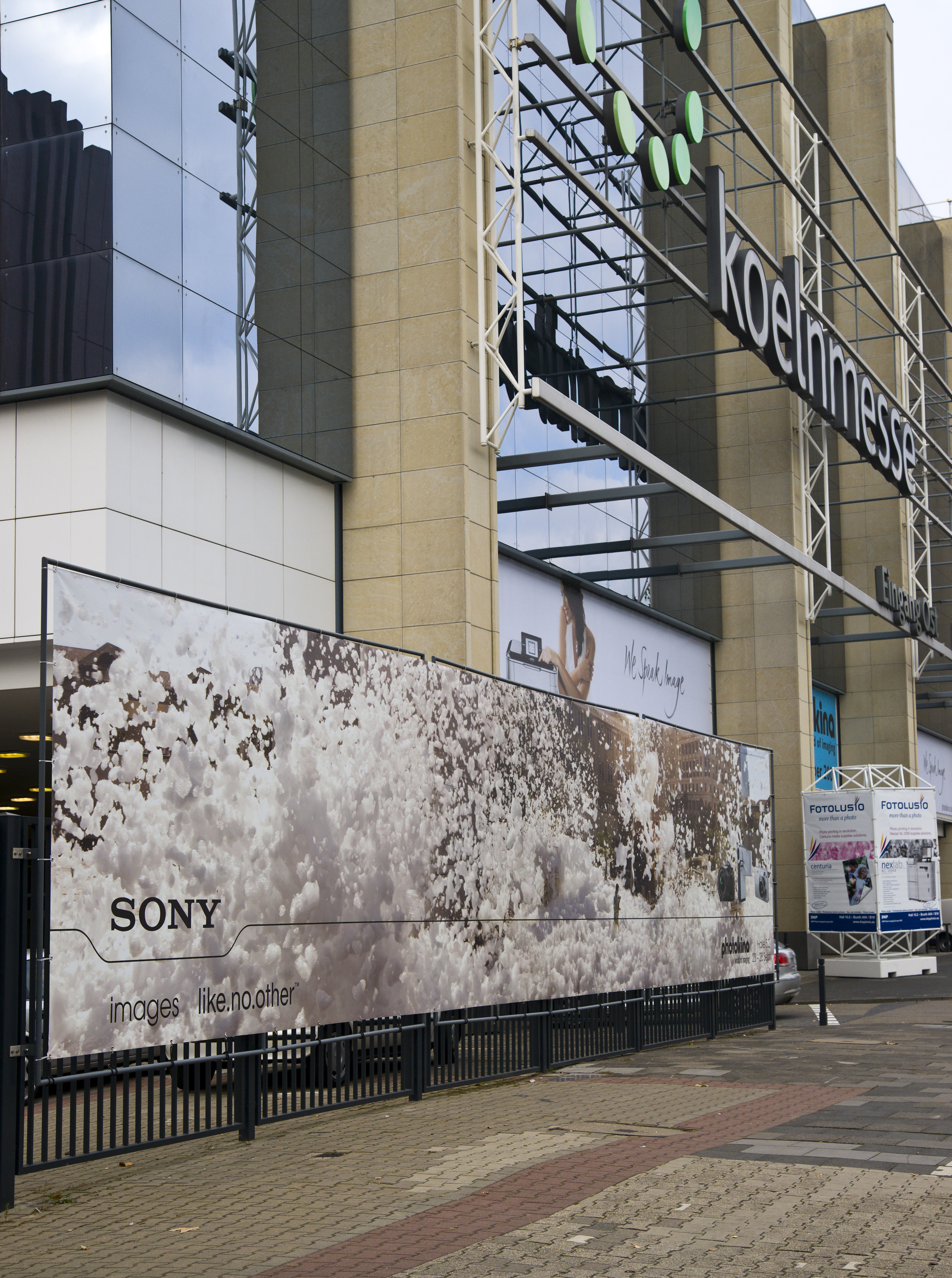
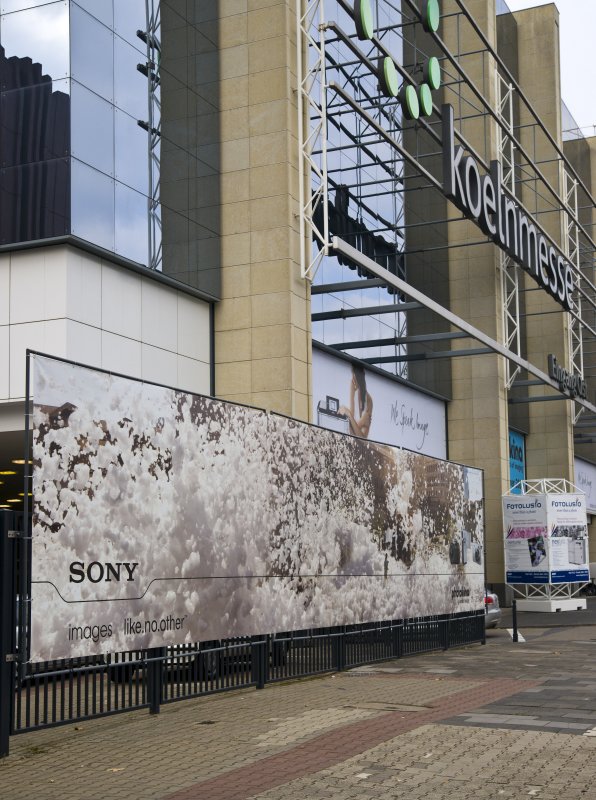
Approaching the Messe halls, Sony had large posters up:
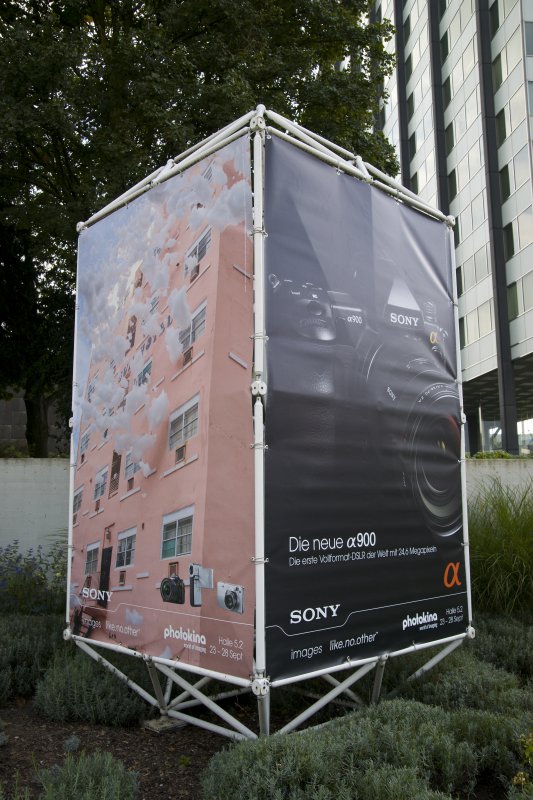
And in the flowerbeds beside walkways and roads, more flexible displays:
During the day, it began to rain heavily meaning we didn’t even do our usual walking back over the bridge into the city centre, and finding our way back to the attractive Heumarkt square ‘Albergo XII Apostel’ hotel through the old town. A taxi was the only way to keep dry. So, I have no idea if Sony ‘owned’ Cologne the way Nikon and Canon (and others) have in past years.
Shirley and I have been visiting photokina now for 35 years – our first was in 1973, as guests of Praktica staying in their chartered Rhine hotel boat. From 1974 onwards, photokina became biennial in even years only. We started with an ‘odd one’!
In the next part of this report, I’ll show some of the stands and products and visit the Sony stand itself. Don’t worry, they didn’t launch anything new – it was all unveiled two weeks before and on sale, like my own Alpha 900, before the event started.
– David Kilpatrick