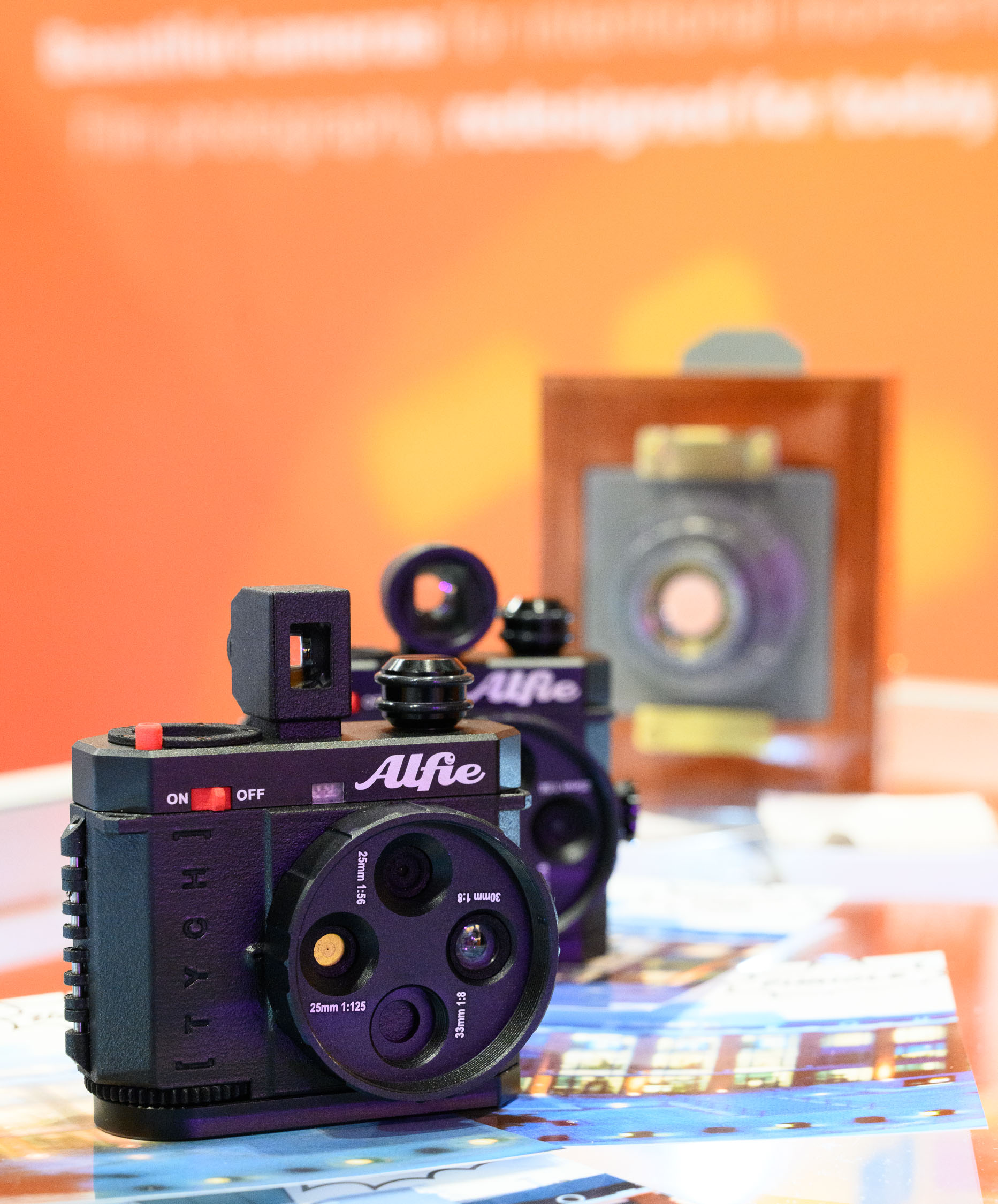
A new model from Alfie Cameras gives a new twist on instant photography
View camera with pinhole or custom optics shoots straight to paper
Develop on location – without the Impossible challenge of integral chemistry
Showcased at The Photography Show in Birmingham, the new [ B O X X ] camera from Alfie Cameras is a very different proposition to their current, innovative turret-lensed half-frame 35mm offering. Launching with a Kickstarter campaign that opens on 17 May 2026, early access and VIP benefits are offered for those who sign up as an Alfie VIP.
Built around a traditional wooden case with lens plates, Waterhouse stops and a ground glass focusing screen the [ B O X X ] camera is small and lightweight. A choice of three optics is available: 100mm portrait lens, 55mm wide-angle lens, and a 65mm pinhole lens – though the design allows the scope of adapting your own view camera, bellows or other systems.
Using cut sheet media and environmentally friendly darkroom chemistry, the DIY approach to solving the problem of instant photography offers immense scope for experimentation and technique, while also returning to the one-off, unique quality of every capture and the shared experience of taking images together if you choose to share your creativity.
We got to play with the prototype a little in Birmingham and can’t wait to see the finished product – and we hope to bring you some more information on Alfie’s existing TYCH half-frame camera – you’ll want to check it out before grabbing that Pentax 17…
You can see the [ B O X X ] camera at Photographica in London on the launch day, where the fascinating system of miniaturised, portable darkroom in the form of a film back may be just the start of a flexible camera for enthusiasts.
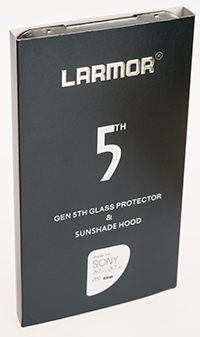
We’ve fitted GGS or similar toughened laminated glass screen protectors to our Sony bodies ever since way back in 2011, we were the first Alpha web resource to publish information about NEX screen delamination and how to repair a deteriorated LCD using one of these great products.
Of course it wasn’t a cover glass, just a plastic surface layer. But if you fit a GGS, Larmor or similar ultrathin glass protector the moment you get your new Sony Alpha body (whether mirrorless or SLT, compact or bridge) you don’t need to mess with the original, risk your warranty, or risk anything at all. The new Generation 5 Larmor has a silicon adhesive which clings instantly, bubble-free, yet peels off safely using just a fingernail under a corner. It permits all touch screen operations, all screen folding including A99/77 and RX10 series reverse foldaway, and for around £10/$15 is an essential for your new camera.
Now there’s a new version which comes with a magnetic black surround and accepts a folding screen shade which just pops on to this. We paid £15.95 from ukhighland photographic on eBay, post free, VAT receipt given.
Cameracraft January/February started the A7RIII test report, and March/April 2018 continued it. Both are free to read here. In the second issue you’ll also find the review of the 24-105mm f/4 FE G OSS lens. In the first issue, Gary Friedman looks at the RX10 series and one-inch sensor quality as well – and David tests the Voigtländer Nokton 40mm f/1.2 Aspherical FE manual focus lens, Sigma 16mm f/1.4 DN DC, and Samyang 35mm f/2.8 AF FE.
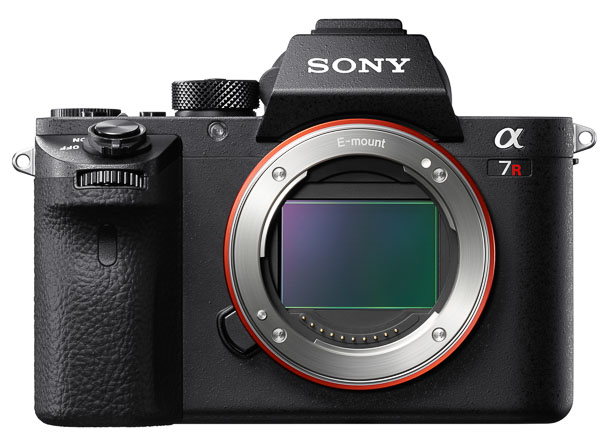
With a body-only price of £3,199/$3,198, the third generation of the A7R came as a surprise to Sony’s own photo studio, who labelled most of the product pictures release on Wednesday as ‘A7RM2’ instead of ‘A7RIII’. We’ve changed the filenames on our system, but countless mediafolk of the future will be confused. They do after all look similar.
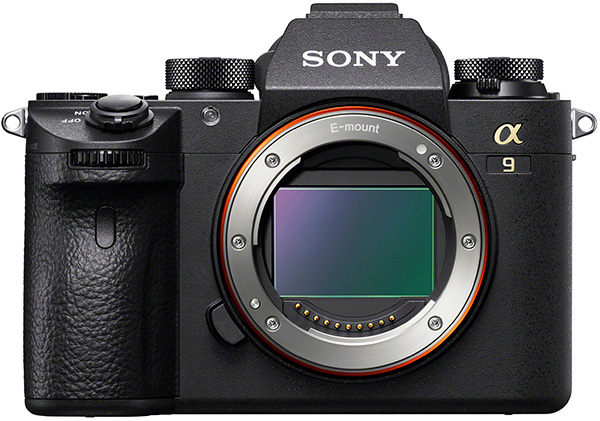
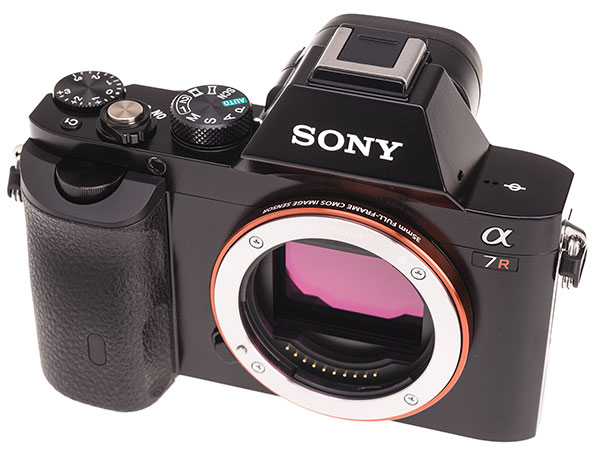
In fact the new 24-105mm f/4 G OSS lens was released with pictures of it on the A7RIII, above, and also on the A9 below. With the A7RIII having a 10fps 42 megapixel motordrive capability, thanks to an improved LSI and new processing engine reading off much faster from the 42 megapixel back-illuminated CMOS sensor, you might have expected economies of scale to have given it the same Dynax 7D-like left hand end drive mode physical dial like the A9, below – especially as the A7RIII has an additional drive-type mode, a four-shot sensor shift to capture 169 megapixels of image data.
This involves shifting by one pixel in four positions, and does not create a 4X size, 2X linear pixel count file. You can only get that by shifting half a pixel as Olympus do. The Pentax sensor shift high-res mode shifts by one pixel, and it does not increase the image dimensions, only the sharpness and colour information for each pixel location (making the image similar to a Sigma dp Quattro file in fine detail resolution). The Sony implementation also appears to need almost half a second between each of the four subframes, requiring a tripod and roughly 2 seconds of capture time. Sony’s proven multishot processing will certainly be able to remove any problems with movement of parts of the subject during this time, but it has to be done in the computer, using the new software suite.
Some commentators have assumed that the 169 megapixel four-shot file means large dimensions, effectively a 169 megapixel resolution full frame, the same way Olympus gets high megapixel files. But the pre-release information clearly indicates it’s a Pentax-type mode – here’s from the wording provided to dealers by Sony:
“You can then stitch the images together to create an image with fewer artifacts and a truer range of colours”.
I tested that on the Pentax K-1 and concluded it was not worth the effort. Regular normal 42 megapixel AA-free shots on a top grade lens are all you need. I’ll repeat that bit about top grade lens.
The A7RIII also has a new shutter mechanism which reduces shock, improving the SteadyShot performance, though still 30s to 1/8,000s as before. The sensor gains a new anti-reflective coating and there will be many ‘under the hood’ improvements because that’s what happens. There may also be teething troubles and newly introduced problems, because that also happens. However I’d say early buyers run less risk with this third generation A7R than they did with the predecessors, or indeed with the A6500.
But we’ll leave you with the 9 for comparison. Most else that matters is the same, like for example the Memory registers – only two on the A7RII, but three on the A7RIII. It will remember more things, like Setting Effect OFF/ON, and that is just as well because the III puts a DSLR-like feature on its left hand end, a threaded coaxial Prontor-Compur (PC) flash synchronisation terminal (below). Let’s just hope that the circuitry inside is well isolated, as one of my vintage flash units destroyed the Godox X1-T which I use both to get Setting Effect OFF and isolation from high trigger voltages on my A7RII.
Study this left end for a bit. It does have phantom power for the 2.5mm mic jack, but the earphone output has been moved so that two doors must now be opened at once to use both together. And there’s something missing.
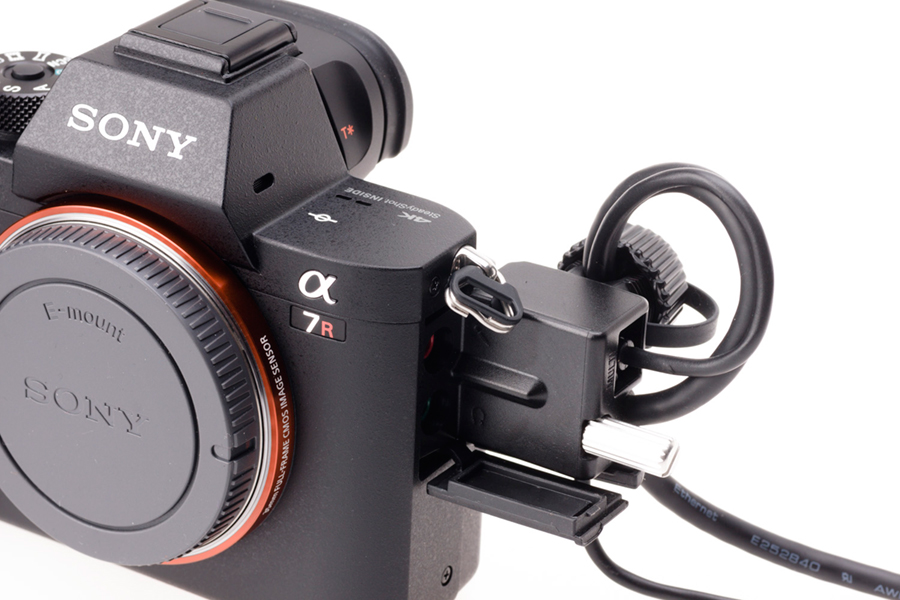
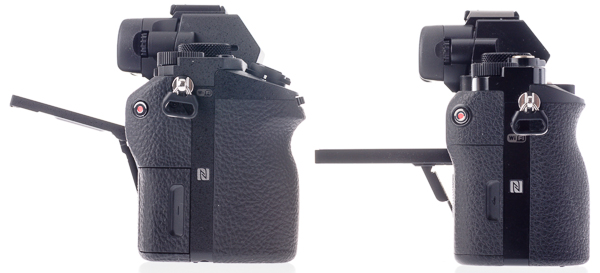
The A7RII has a screw socket next to the neatly paired mic/headphone jacks, which allows a custom made tether clamp assembly (supplied with the camera, seen above) to hold HDMI and USB cables with clamped protection looping. You’ll need some extra Tether Tools kit to safeguard the connectors on the MkIII. There is now a USB-C/3 Super Speed connector as well as a USB-Micro Multifunction, and Micro HDMI. But no provided security of a tether clamp.
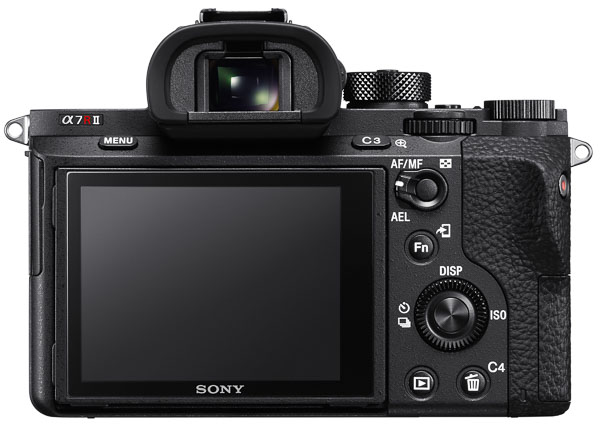
The back of the camera has much the same screen, but with improvements to resolution and daylight visibility – still no twist and turn, or reversing to face the camera back and protect the LCD. The rear button layout is revised, with movie button located near the viewfinder (well, if Canon does it, it can’t be wrong, can it?) and the switching AF/AE Lock/Toggle/Hold button replaced by an AF-ON and separate AEL, with C3 moved to the left end. Where the movie button used to be you’ll notice a catch for the weathersealed door which covers TWO SD card slots, one UHS-II enabled (more broken bits of card contact septum to lose inside your slot!). Changes to the movie mode using the main shutter release make the use of the red button less essential.
You can assign those cards the usual ways, to make copies on card 2 of card 1 as you shoot, just in case one fails (the most important use for wedding photographers) and also to use sequentially (overflow into card 2, liked by action photographers), or split RAW and JPEG, or still and video.
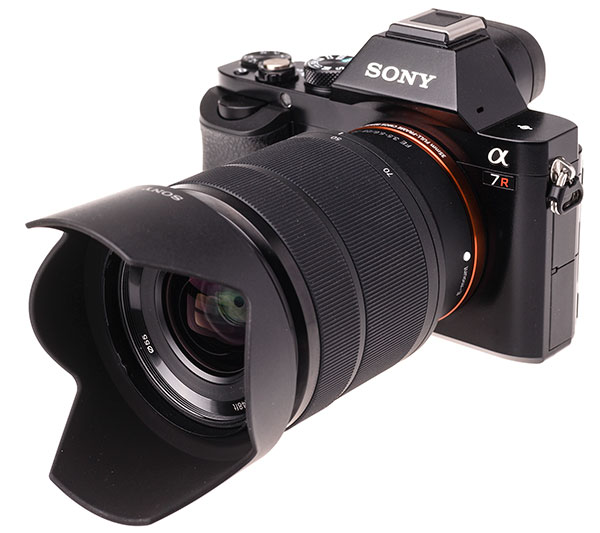
This is the new lens, 24-105mm f/4, and it will probably be very good. It has 77mm filters so I think I’ll stick with the A6500 for travelling, as the little CZ 16-70mm f/4 which is the direct equivalent of this is tiny by comparison and uses neat 55mm filters. Despite some reports to the contrary, I’ve found it to be a good lens, sharp across the frame at 70mm wide open, though prone to flare.
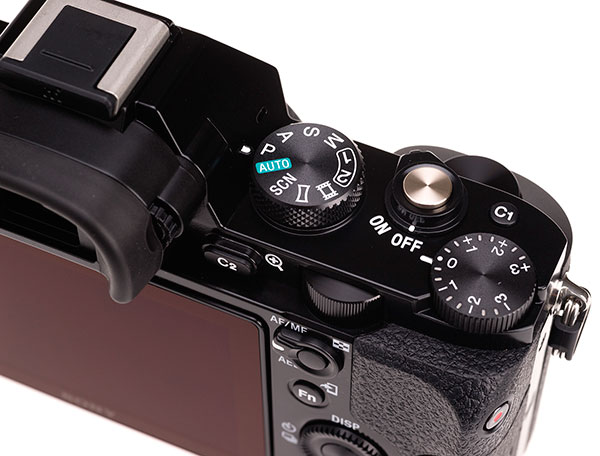
The top shows that the strictly amateur ‘SCENE’ position of the mode dial has been replaced by S&Q. I look forward to finding out what this means – probably much the same* *Gary Friedman has provided the answer in Comments – it’s a slo-mo/fast-mo video mode which is of no interest to me personally, but might fascinate messers around with short video clips for YouTube, even if their smartphones do it better. Green auto survives, as not all owners will be experienced photographers, some will just be wealthy camera buyers and this setting will be where they leave it.
The published specs were vague about Bluetooth, used for GPS tagging from a smartphone – I’m told US Sony Store specifications clearly state it does have. The A6500 and A9 both do, and can therefore use the Sony mobile phone function for live geotagging of pictures as you take them, using information read at the moment of capture from your nearby smartphone. We’ve also seen reports saying the A7RIII does not use Apps but that seems very unlikely.
There are also improvements claimed for dynamic range, with the figure of 15 stops mentioned. This would actually need a 16-bit A to D conversion internally followed by compression to a virtual 15-bit range (via a tone curve) saved in the 14-bit uncompressed raw .ARW format. A 14-bit raw format is now offered for all shooting modes including high speed continuous, which on the A7RII means automatic stepdown to 12-bit. The ISO range is extended to 32,000 before Hi expansion up to 104,200 and goes down to 100 native with Lo down to 50. One benefit of an effective 15-stop range will be that ISO 50 should have 14 stops, or as much highlight data as ISO 100 on the MkII.
The extra effective bit depth also pays off when using the S-Log3 and Hybrid-Gamma HDR video settings. This brings Sony professional video camera standards into a primarily still camera for the first time (better than the video-targeted A7SII, and the A9).
Sony claim improved skin tones too, though compared to what is a bit of a worry. Many people like Canon skin tones, I think they are like a 1970s USA colour portrait and that Sony’s skin colours have always been more natural. Others disagree and want the pinker, less yellow, face tones.
The A7RIII uses the new larger battery with its 2.7X capacity, introduced in the A9. I rather like the way my current Sony cameras share one rather underpowered battery type, but at least a bagful of batteries covers A56500, A7RII, RX10. There are not many different battery types, as we could find with our Olympus kit (check E-M1, E-M1 MkII, E-M5, E-M5MkII, E-M10, E-M10MkII and E-M10MkIII batteries if you want a nightmare). You can also charge Sony batteries in-camera.
Will I buy it? Probably not. I use the A7RII for relatively static, large image size, low ISO, controlled shooting of landscapes, architecture, products and so on. I have sold my full frame zooms except for the 70-300mm G OSS and now only use primes on the A7RII (10mm, 18mm, 28mm, 50mm macro, 55mm, 85mm). I don’t travel with it. We’ve bought an Olympus OM-D E-M1 MkII for its Pro Capture (60fps, 18-20fps with pre-shot buffering) and macro auto focus stacking. I’m sticking with the A6500 kit for travel (10-18mm, 16-70mm, 55-210mm) but it’s got to go head to head with the Olympus including the use of the two different smartphone GPS methods.
The front view below of the Sony Alpha A9 body, introduced today, gives a subtle clue about changes under the hood. For some time we’ve been nagging Sony about the weak, potentially tilting, 4-screw mount on the mirrorless bodies. Now they have at least added two more screws, to match Fujifilm X or the A-mount, even if the distribution is a bit odd with all the extra strength concentrated at the sides not the top and bottom where heavy lenses normally cause most stress.
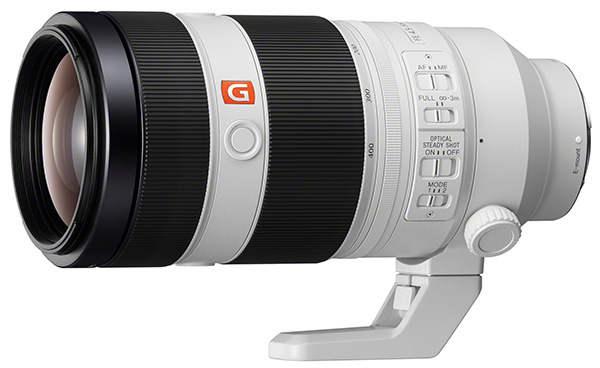
It’s a clue to a different internal construction, probably stronger all round, to make it possible to support the new 100-400mm G Master lens, a native E-mount new design which should come as a relief to those struggling with the A-mount 70-400mm varieties on adaptors:
But the lenses still have four-screw mount fitting (as do most A-mount lenses), and fairly weak sacrificial assemblies to prevent damage to the camera if knocked. See this video (it’s a bit long but makes a point): //www.youtube.com/watch?v=qGvlX9BtiTQ
The EVF of the A9 is around twice as bright as the A7RII and also runs at twice the refresh rate, while offering 50% more pixels. Part of this is down to the new stacked-CMOS 24.2 megapixel full frame sensor, which has a readout some twenty times faster than the A7II and previous generation 24 megapixel models. That, of course, is linked to the 6K native live feed from the full frame (used to create very high quality 4K video as well as an excellent live view) which in turn enables a distortion-free purely electronic silent shutter running to 1/32,000s plus 20 frames per second sequence shooting.
AF is claimed to be 25% faster than the A7RII and when the shutter speed is faster than 1/125s there is no visible blackout in the finder when shooting. Personally, a single frame (1/120s or 1/60s) blip would never be unwelcome as it helps tell you when you’ve shot. As for the low-light capability, not too much is being said; it’s in the usual up to 56,200 range with extension of two more stops. (Edit: April 20, we have noticed that at least one ‘reviewer’ – Sony Artisan paid to promote – completely wrongly claims 2,048,000 ISO not the actual 204,800, when comparing the A9 with the Nikon D5’s listed 3,276,800). The high speed sequences, movie frame rate and EVF refresh all tend to limit ultimate low-light clean imaging and we would guess that the A7SII and A7RII will not be made redundant.
That can not be said for the old weeny weedy weaky batteries of the E-mount range. The stripling NP-FW50 used in all the NEX to A7 series models gets kicked aside by a slightly larger variant with 2.2X the capacity. Frankly, it’s overdue but it creates a split system. I’m happy to travel with my A6000, RX10, and A7RII all sharing a pool of batteries even if those do run down alarmingly fast.
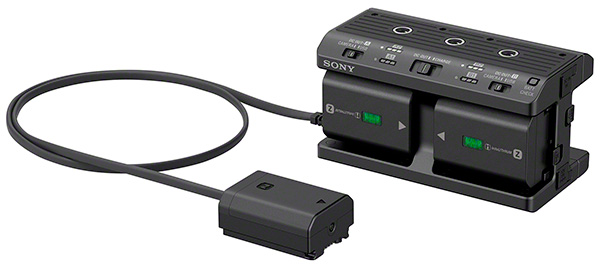
If it means carrying a new dual charger too, to get the necessary 2.5 hour recharge time instead of a leisurely overnight in-camera top up, I can only hope the charger (cum mains adaptor with clumsy dummy battery connection) also accepts the older batteries. It’s carrying multiple chargers that increases my travel bag weight not carrying extra batteries.
But… I see that the charger ‘cradle’ can mount four of the new cells, and charge the lot in 480 minutes. This cradle has a dummy battery on a lead, and 1/4″ tripod thread mounting points to add it to a video rig (which this camera is not specially made for, indicating an A9S is on the way with S-Log and direct 4K top quality encoding). The dummy battery then powers the camera for roughly 10X the life of the current A7 series batteries. So what if you have an A7 model? Easy – the outer shell of the battery simply slides off, revealing a SMALLER dummy inside, which fits the entire NEX/A7 mirrorless range or indeed the RX10 series. So your existing Sony mirrorless kit can be powered using this ‘battery bank’.
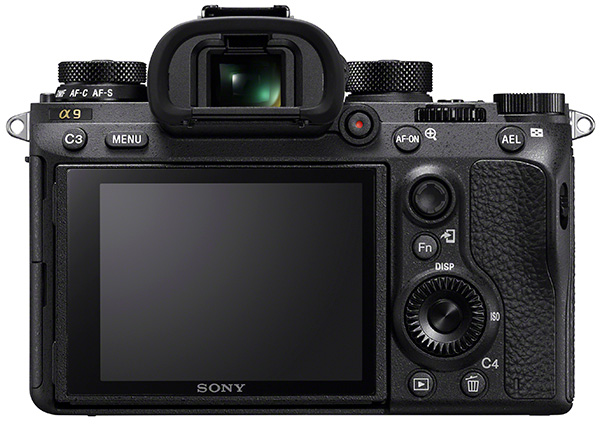
The top plate reveals that some input has been listen to. As a regular M1-M2-M3 user on my A99, the drop to only two memory registers on the A7RII is unwelcome but survivable. A return to three, plus a a custom button memory recall function, will make the a9 better. Having the drive modes on a physical control is good too. But I’ll leave any verdict on all this until the actual operation is better known – whether, for example, the memory registers now cover more than just the primary camera settings and thus enable one-step tripod setup.
I’ll have to say that after using the Olympus OM-D E-M1 MkII, which offers many of the advantages being claimed by the A9 as major selling points, the non-reversible simple tilt rear screen remains a negative compared to a fully articulated reversible screen. Sony does now offer a real glass protector, but I like the A55 to A99 style screen which can be turned to face the wall permanently if you want (and has never arrived on the E-mount models).
The new joystick controller takes something from the A99/II controls and adds it to the wheel of the A7 series, while the upper thumb button becomes a native back-button AF. In addition to being able to move the focus points faster (it’s a pain with the A7RII design) there is a memory for AF point selection and a horizontal-vertical switch function. Combined with a larger number of AF points covering 93% of the sensor, the action/sports performance of the A9 should be a long way ahead of any earlier mirrorless (though the A6500 is pretty good).
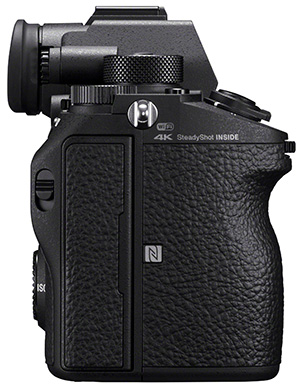
Though not visible here, there are two SDXC (one UHS-II) card slots with the usual recording options similar to the A99/II, and also an Ethernet port which is almost a requirement for some major sports events. You will notice that the Drive control has a Focus control below it, giving direct access to the kind of AF/MF/DMF choices found on the dedicated controller of A-mount bodies – no more need for menu or Function/Custom button operations.
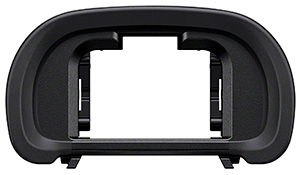
The eyepiece, shown here, may perhaps be a little less prone to detachment and we are promised the least squiffy finder view with new optics.
There is one minor fly in the ointment, a price-tag of £4,500 (UK) body only; the 100-400mm will be £2,500. While the team of assembled ambassadors made much of praising the silent shutter mode and small size of the camera at Sony’s vidcast press conference, none of this is new and pretty much anything the A9 can do is also within the reach of the A7RII and A7SII even if it does it faster and perhaps better. There was some praise for the durability of the system – what? I don’t know about others, but I find the Sony/Zeiss lenses are the worst I’ve ever owned for showing almost immediate signs of wear from the lightest contact with clothing and bags. Silver appears through the molecule-thin black coating instantly and neither the regular lenses nor the bodies have ever struck me as being suitable to knock around in a busy press kit or travel bag. Where old Leicas survived years of abuse elegantly, gradually brassing at the edges, my Sony kit generally just looks a bit scruffy and used despite minimal handling. The A9 looks about the same in this respect as the mark II lesser models.
Full official press information and specifications can be seen here:
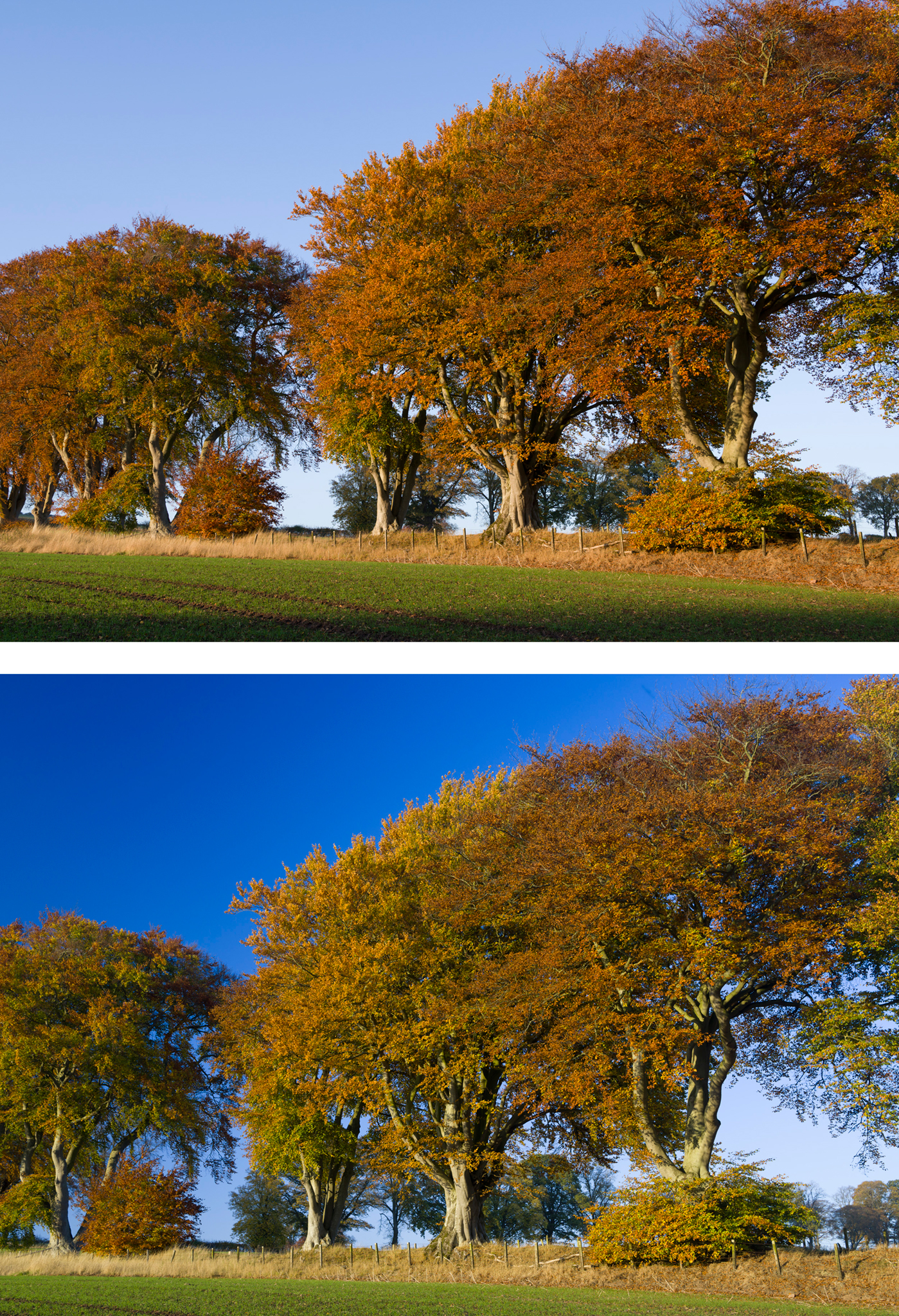
Upper: unprofiled (Standard) raw conversion. Lower: using a tunsgten-light generated custom camera profile, combined with a polarising filter, gives a more vivid impression.
Most Alpha system users know that some – not all – cameras have a special JPEG mode for Autumn Colours. They’ll also know that if you shoot raw, with no JPEG in camera, only Sony software replicates this. The choice of picture looks or camera profiles in Lightroom and other programs ranges from none (one default) to good (a full basic range similar to Canon settings). However, you can go way beyond the default look your camera will produce from the Autumn colours we are seeing right now (UK) if you profile your camera using the X-Rite Color Checker Passport and the free downloadable software which goes with it. You can also use this software with any standard MacBeth Color Checker card.
You still need to create a .dng file from your original raw, as you also do for Adobe’s free camera profile generator. The X-Rite software creates much smaller profile files but they are no less effective.
Here’s my tip – normally, you calibrate by daylight and the Adobe Camera Profile (.dcp) includes automatic adjustment for tungsten. You can also take two test shots, one under each lighting condition. Experimenting with the X-Rite software, I found that if you only use tungsten to create your profile, all the daylight ‘landscape’ colours (especially green foliage and the sky) really pop out. The greatest change is in the sky blue, which can be very disappointing if you use Adobe Standard as your camera profile for raw conversion.
The zip file you can download from above contains some .dcp profiles for the A7R II which I’ve produced (the names are more or less self-explanatory). They should be unzipped and placed in the CameraProfiles folder of Camera Raw in Application Support>Adobe. You can find the software, instructions for PC and Mac, at:
Using the stock Lightroom/ACR A7RII camera profiles you’ll find that the Landscape flavour tends, if anything, to make sky blue lighter. My tungsten-generated profile has most of the overall ‘snap’ of Landscape plus very much richer sky tones.
The second tip with Autumn/Fall colours is, of course, to use a polariser. I’d say this makes the single greatest difference to all Autumn colours even if you can’t see it clearly when composing. The individual leaves reflect light, and the polariser cuts through this to reveal the full colour. Because it also darkens the sky, the often fairly dark colours of Autumn trees come to life better. You don’t need to study the trees, just set the polariser for the best results with the sky. The leaves are at such random angles all positions tend to work equally well. It can however be worth trying a few different rotated positions of the polariser especially if there is also water in the shot. What deepens the sky may also reduce the strength of reflections in water. Experiment!
United Kingdom, Republic of Ireland, 7 September 2015 – Canon Europe, a leader in imaging solutions, today announces that its parent company, Canon Inc., is developing an APS-H-size (approx. 29.2 x 20.2 mm) CMOS sensor incorporating approximately 250 million pixels (19,580 x 12,600 pixels), the world’s highest number of pixels for a CMOS sensor smaller than the size of a 35 mm full-frame sensor.
When installed in a camera, the newly developed sensor was able to capture images enabling the distinguishing of lettering on the side of an airplane flying at a distance of approximately 18 km from the shooting location
Well, this is great for the Guinness Book of Records, but you need to put it in context. Sony’s little HX60 – like many other 1/2.3 inch sensor compacts offering 20 megapixel resolution – records 705,000 pixels per square millimetre, 840 pixels per linear millimetre. And where Canon shows a 35mm f/1.4 lens on their prototype camera, the wee Sony goes to 129mm…
The new Canon sensor records about 450,000 pixels per square millimetre, or 670 pixels per linear millimetre. It’s actually just a little bit higher in resolution than the Sony one-inch sensor used in the Cyber-Shot DSC RX10 and RX100 series (414,000 pixels per square millimetre).
In theory, given the same lens and the ability to aim the camera, a pocket Sony Cyber-shot with backside illuminated CMOS 20.2 megapixel 1/2.3″ sensor can distinguish the lettering on that airplane (or if you’re in Britain, aircraft or aeroplane…) from 22.5 kilometres – and if the Sony G zoom on that HX60 is sharp enough, make that 82km. Unless of course Canon was actually testing with a 600mm f/4 attached. Saying what focal length of lens is used gets rather important when chucking around statistic-examples like this.
It is very easy to use facts and figures without reference or benchmarks for comparison.
This is no reason to rain on Canon’s parade, as the video achievement is a major one. Here’s the rest of their tech info, and the important bit is in the last paragraph – Big Brother is droning you… and across that city square, he’ll be able to recognise your eyes and put a bullet in your head with surgical precision.
With CMOS sensors, increases in pixel counts result in increased signal volume, which can cause such problems as signal delays and slight discrepancies in timing. The new Canon-developed CMOS sensor, however, despite its exceptionally high pixel count, achieves an ultra-high signal readout speed of 1.25 billion pixels per second, made possible through such advancements as circuit miniaturisation and enhanced signal-processing technology. Accordingly, the sensor enables the capture of ultra-high-pixel-count video at a speed of five frames per second. Additionally, despite the exceptionally high pixel count, Canon applied its sensor technologies cultivated over many years to realise an architecture adapted for miniaturised pixels that delivers high-sensitivity, low-noise imaging performance.
Video footage captured by the camera outfitted with the approximately 250-megapixel CMOS sensor achieved a level of resolution that was approximately 125 times that of Full HD (1,920 x 1,080 pixels) video and approximately 30 times that of 4K (3,840 x 2,160 pixels) video. The exceptionally high definition made possible by the sensor lets users crop and magnify video images without sacrificing image resolution and clarity.
Canon is considering the application of this technology in specialised surveillance and crime prevention tools, ultra-high-resolution measuring instruments and other industrial equipment, and the field of visual expression.
Actually, I see a better use. With the camera set up to cover an entire playing field, licenced from Sony the latest ‘Ball-AF’ ball recognition technology will keep focus on the ball and Minolta’s auto zoom framing patent will compose the crop. TV crews will no longer be needed and Rupert Murdoch will be able to install a full system in every stadium!
I’m under pressure to take endless pictures with the A7R II which arrived from WEX (Warehouse Express) on Thursday superbly packed. I am also finishing off f2 Freelance Photographer magazine to go to print over the weekend and have many hours of work to do – and despite having the camera, I won’t be removing some other article to rush a scoop into print.
It’s actually pointless to attempt to review any camera until you have used it for a few days at the minimum, with deliberate testing in mind, or several weeks with normal unplanned uses to confront it. Nothing tests a camera (and photographer) quite like real world pictures which are not hunted down as test subjects.
But of course I have gone out and taken a few shots during a brief period of sunshine which has returned after days of rain, and replicated a set-up I shot few weeks ago on the A7R, also to test a new type of combined LED and flash lighting head (Bowens IC12).
First of all, the £2695 UK price has to be compared against the A7S, A7II, or A7R with due accounting for its useful bonus – this camera body comes with the usual USB charger block and a battery, and then a further Sony external battery charger (remember them?) and a second battery. At Sony RRP this is £76 (battery) and unavailable (charger) but surprisingly expensive when it was. It’s definitely £100-worth of extras. There is also a screw in, not clip in, screw clamp grip twin USB/HDMI tethering lock device which could also securely grip mic and headphone leads.
Unboxing should hold no surprises now, but firing up the A7R II was a familiar experience as so many of setting customisations turned out to be factory preset to my own preferences. It still needed the image size and filetype setting up, AdobeRGB, Date Form folders and a few other things I used. And then, at last, the entry of copyright and byline information to be embedded into every image!
The A7R II takes the same GGS screen protector as the A7II and the RX100 series, not the same as the A7. First job was to stick a temporary protector on, and order one of these. All my cameras have GGS glass on them from day 1.
I used the CZ 16-35mm f/4 lens for a few outdoor shots and also for a test or two I will not release (too many tripods, cat trays and empty boxes in shot!) indoors at up to ISO 6400. Basically… you can use Auto 100 to 6400 and as long as you set Luminance NR to 25 from 400 up and increase it gradually to 50 at 6400 (LR/ACR) the images will be smooth and noise free as well as sharp. I also enter NR 10 even at 100, because it helps keep sky blues smooth.
You can view at ‘large’ which is really small… select ‘Original’ to see the original, of course. Or a tiny corner of it! If you think the 16-35mm is at the edge of its performance at f/9 in this shot, you are right. Anything wider and the corners and ends of the shot become visibly soft at 16mm. This test shows me that where f/9 was fine for 24 megapixels, I’m probably going to go for f/11 or even f/13 as a standard setting with the A7R II.
This is not a fair test even yet, but it says a few things. It’s taken on a late 1960s Asahi Pentax SMC Macro Takumar 50mm lens (I enter 75mm in the App data on the camera to ensure correct SSS) set to f/11, which is actually around f/14 at this working distance/extension. The camera is hand-held, with a Sony mini flashgun on top bounced to trigger two Bowens IC12 heads set to flash mode, after first doing the lighting and subject adjustments in LED Video mode. With these unique heads, the flash and the video modes are 100% identical in terms of how they cast shadows. The flash was set to 1/1 power at 1/1000th for a bare fresnel spot on the left, and 1/2 power at 1/1000th in a small Apollo softbox above and to the right. Focusing was done using the magnify function by moving the camera (or head and hands, in effect) over the subject.
Because this is very low power LED burst flash I need to set the ISO to 800, which would never be chosen for detail. NR is at Luminance 25 in Adobe Camera Raw (adjusting only that top slider). There is a full dynamic range with deep shadows and brightly caught surfaces. No adjustments have been made to the raw file in conversion for contrast, colour or exposure. I think it represents a very highly quality for ISO 800 and to see the level of microcontrast and detail, you need to examine the lowest contrast surfaces – the rounded bodies of the poppy heads. Throughout the image you will find areas of sharp focus and softer focus and it’s easy to tell the maximum sharpness zones. I also made an exposure at f/16 and this is significant softened by diffraction as you would expect. At f/8 this macro lens is likely to be sharper but with a file size like this, depth of field rules go out of the window. You need to use the same technique as would be employed when planning to make a 20 x 30″ print from a 35mm negative!
I will have more images soon enough. My initial impression is that the A7II really fixed the ergonomics of this camera type, the A7R II is identical; its functions cover all the functions found on every different A7 series body sufficiently well to make it one camera for all purposes.
– David Kilpatrick
The link to Warehouse Express is an affiliate link and purchases made through this link benefit the publisher
The new Sony A7R II is the camera I’ve been waiting for, which everyone has predicted, and which seems to tick every box without having a huge price label on its own. I find the $3,200 (UK coinfirmed £2,600) matches its stated specifications well. Others may disagree, but they’re probably influenced by the price collapse of the original A7R, now occasionally found for under £1k.
Even so, at $3,200 the A7R II commands a $1,500 premium over the A7 II and much of that must be what you pay the new sensor – which does not seem to be licensed or sold to any other brand. Not even to Nikon, yet. The A7S remains the most expensive model despite the minimal 12 megapixel capture and lack of in-body stabilisation (SS in Sony terms, or IBIS generically).
On Monday June 15th I flew to London to have a look at the A7R II and the new RX10 II (£1,200) and RX100 IV (£850). This was a bit like a motoring journalist going to a car launch and being told, you can sit in the seat, waggle the gearstick but don’t start the engine as no photography was allowed with any of the demonstraton cameras. I was surprised to find it was a European conference, as this normally means journalists from across the Channel have a facility trip to be present, and that seems very extravagant just to look at cameras which can not be tried out. I wish I lived in France not Scotland – it might not have cost me almost £300 to be there, eight miles from Heathrow (but an eight miles which might as well be a fifty Scots miles!).
Don’t expect to get one on June 17th, as B&H’s information and too many bloggers have repeated. We are told by B&H it won’t arrive until August even though pre-orders open on June 17th in the USA. It may be later arriving in some regions. Demand is going to be so high that if you want one, you’ll need to crash into that queue…
In brief, the A7R II consists of an A7 II body with a new 42.4 megapixel backside-illuminated CMOS sensor, same Bionz X processor allowing 5fps at full resolution, new 399-point Phase Detection AF on the sensor covering most of the field (up from 117 points), a similar EVF with improved eyepiece giving a genuinely impressive 0.78X instead of 0.71X virtual magnification, the same rearRGBW bright LCD, plus silent shutter and HD 4K movie functions improving on the offering of the A7S. The new shutter mechanism is claimed to have a 500,000 actuation life expectancy which puts it ahead of almost every pro DSLR yet made. The back of the camera body is magnesium, where it’s solid composite plastic in the A7II. And it has, unlike the A7R, five-axis sensor stabilisation which talks to Sony OSS lenses for the best blend of anti-shake methods ever devised.
The new EVF size, to the eye – compared with the old (A7II, A7R, A7) 0.71X view below (A7R, Sigma 12-24mm at 12mm, Canon EF fit, on Commlite EF-FE adaptor).
You will read in the specifications and promo blurb that it has a new LCD double the brightness, new tough body and strengthened mount, new shutter release and controls but all these ‘improvements’ are listed by Sony over the A7R and already existed in the A7 II. Instead of making comparisons with the A7 II – which this is really a development from – Sony has listed many advances made relative to the A7R. It is not an A7R II. It’s really an A7 II R.
The eyepiece surround is much improved, wider and softer still than the A7II which in turn is softer on specs then the earlier models. Eyepoint and position flexibility both improve and there are no unsharp zones at all even if you shift your eye around.
It’s important to understand that many of the improvements already exist in the A7 II partly as a result of criticisms of the original A7R made by objective reviewers, not Sony artisans or staff or sponsored bloggers. You don’t owe this camera to the success of its predecessors or the daily Facebook sermons of awestruck evangelists – you owe its features to corrections made to the shortcomings of the models so far. And to those who have had no vested interest (other than ownership) persuading them to weaken critical appraisal. The further improvements in the A7R II are either extremely technical – serious core improvements in the sensor and focusing – or minor refinements and carries-over from the A7II.
42.4 versus 36 point anything
If you really think 42.4 megapixels is going to take you to realms far beyond your 36 megapixel sensor, think again. It is the same step up as from 18 megapixels to 21 megapixels, a move Canon made without absolutely transforming the images created, or about the same as from 10mp to 12mp. There’s one big difference – it does not make the jump to any larger common print or repro size. Remember going from 6 to 8? That was from sub-full-page to a decent full page resolution, for US or A-size documents at a touch under 300dpi. 24 megapixels took us to a really sharp A2, 36 megapixels takes us to a acceptable A1, and all that 42 does is to make a slightly better A1 but not 300dpi.
Above you can see the actual, real size difference (in proportion) between a 36 megapixel shot and a 42 megapixel shot. If you click on the bigger version, it will take you to my pBase page with a full A7R II sized version of this A7R shot. Zeiss? No – a 45 year old Asahi Pentax Super-Multi-Coated Macro Takumar 50mm f/4, used at f/11, and a 30 second exposure at ISO 50 lit using the ICE Light 2 moved round the subject in horseshoe shaped path for 15 seconds, laid flat, and then moved under the perspex for the remaining 15.
In practical terms, it’s 7980 x 5320 pixels (or very close – Sony has been extremely coy about releasing full specifications, even at the conference I could not find this out) versus 7360 x 4912 for the A7R. In perspective, make a big print from the A7R and it’s 24.5 inches long at optimum resolution; use the A7R II and you get one inch extra each end on the long side, 2/3rds of a inch extra top and bottom. The A7R makes a 16.3 x 24.5 inch print to perfection; the A7R II makes a 17.7 x 26.6 inch print.
Anything smaller than A4 printed, it’s got no great advantage over the 12 megapixel A7S – but you are getting close to enabling a 2X crop (one quarter of the frame) to look as good as the A7S full frame. Sony showed A3 prints. They could, honestly, all have been shot on the Sony A100 from 2006 and no-one would have been any the wiser. One enlarged section was the only real test of the camera. I’m sure the model’s dermatologist loves it.
Where it does count most is when using crop frame mode. In APS-C crop mode, the A7R II file is large enough for a 300dpi double page fine art magazine spread, just under 18 megapixels. I’d say that where 42.4mp is not a critical size, 18mp actually is. You can get away with 16, and for Nikon, Panasonic, and Olympus this had been an important baseline. Cropped frame FF from Sony now rises above that baseline instead of sitting just below it.
What I’d like to see would be 1:1, 4:3, 5:4 ratios implemented with the EVF and LCD screens cropped to match – and ideally the raw files reduced in size the same way. A square 1:1 would be 28 megapixels and that crop allows so many APS-C lenses (like the Zeiss Touit 12mm) to be used without vignetting or limits of coverage distortion issues. The example above is from the A7R and it’s a square crop 24 x 24mm from a frame taken with the 10-18mm f/4 Sony OSS, at 11mm; the lens would have allowed a 4:5 crop equally well.
Important edit: just read another ‘Sony artisan’ blog post asking the (redundant) question as to whether Sony lenses will be up to this new resolution. Anyone who owns an A6000, NEX-7, or A77 is already shooting at well above this resolution (full frame will need to match the Canon 5DS 50 megapixels to beat them). The resolution of the A7R II is slightly lower than that of the base level entry A3000. Don’t panic. Plenty of old legacy lenses will match it well, let alone any new Sony FE and A-mount designs.
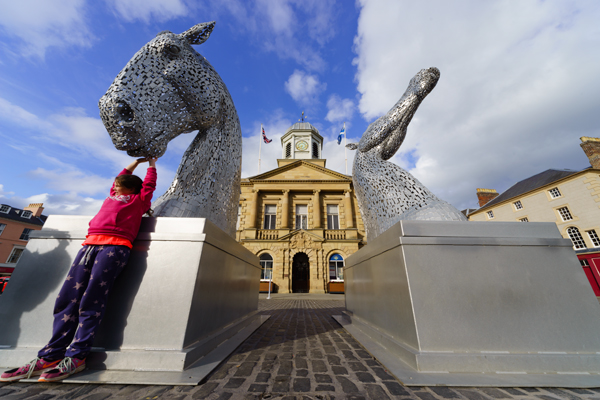
I checked out the 20mm f/2.8 SEL lens with the new version 2 wide and fisheye black converters on full frame at the Sony event. Really, this lens comes so close to doing a good full frame and the converters even leave much of the area intact for a much bigger crop than APS-C.
And that’s all without removing rear baffles or doctoring the built-in lens hoods of the converters!
Detailed points
When we get a chance to use the camera, the following points will be of interest:
Has the mount been upgraded again? It still has only four attachment screws, compared to Fujfilm X system’s six screws (and the A-mount uses six too). My two camera bodies and two changes of mount on the A7R, to Tough E mount and then 2nd generation Tough E mount, all produce unpredictable degrees of slop, smoothness or jam-on tightness from various adaptors showing that no matter what, tolerances are broad. Comment: can’t tell from changing lenses at the event, it feels much the same as the A7 II.
Has the Memory position, 1 and 2 on the mode dial, been improved to remember MORE of the important settings – notable, Setting Effect ON and OFF, for saving a studio flash preset mode with the EVF/LCD setting effect disabled? Answer: No.
Is the hot shoe part of the Multi Function Accessory Shoe hampered by paint, or tolerances in fit, or does it readily accept all standard ISO hot shoe simple flash devices and triggers? Looks clear.
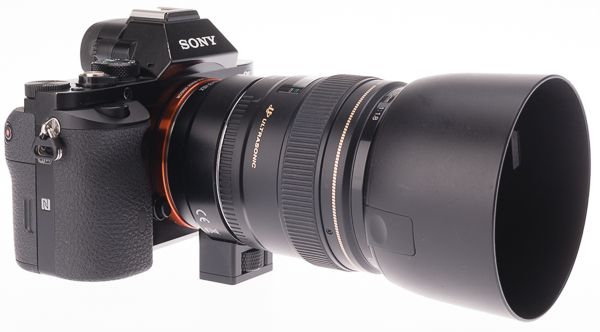
Canon 85mm f/1.8 USM on Focus EF-FE adaptor (also works perfectly with Commlite) on A7R. The 40mm f/2.8, and Sigma 12-24mm in EF mount work well on my A7R with these two sub-Metabones price adaptors. At the press event we found the 85mm just didn’t focus at all with any adaptor on any of the pre-production A7R II bodies, but the 40mm was fine.
Will the promised ability to use PD-on-sensor AF with Canon and other lenses rely on Metabones as the only adaptor, or is it generic? The microlenses on a backside illuminated sensor have a large effective aperture than traditional design, and this means the PD-lenses (a special variant of the microlenses used on sensel pairs) will be similarly improved. This may make some difference, but it’s actually the focus motor control via lens to body data communication which will enable fast and sure operation with Sony SSM on LA-EA3, Canon USM on EF-adaptor, and so on. Remember, this does not make screw drive or SAM, or micromotor Canon AF pre-USM lenses, function any better. It will only apply to ultrasonic, piezo, linear motor and similar finely controllable AF mechanisms with close to zero play and accurate (8 contacts, not 5) distance and ‘state’ reporting. Note, too, that Sony’s revised lenses (SSM II) are not just optical and weatherproofing reworks – the new SSM is designed to work with contrast detection, as found on the A7R, much better.
Comment: we found that the Canon 85mm f/1.8 USMdidn’t work on any adaptor on the A7R II, while the 40mm f/2.8 activated the PDAF points and focused very rapidly, and a 24mm f/2.8 USMf/2.8 focused fast – and that various different demo A7R II bodies responded differently and one malfunctioned a lot of the time even with Metabones. Sony said this was known and the final retail stock should at least work OK with Metabones IV and probable firmware updates, but other cheaper adaptors will not be tested.
The new camera’s mode dial has a central lock button, and a slightly lighter click action without risk of being turned by mistake. We’d had liked to have seen a lock on the +/- EV compensation dial too, but this just has slightly strengthened clicks.
Wish list
The same small battery has been used yet again despite the II body design having what looks like enough room for a full sized Alpha battery (see below – carefully positioned batteries with A7 II body). Let’s hope for upgraded batteries from Sony.
Please, Sony, you provided a GPS pinout in the new shoe – you have never rolled out a GPS module or firmware. It’s three years now and no news. Hell, I nearly bought a brand new boxed A99 at Dixons Heathrow Terminal 2 shop for £1075 inc VAT maanger’s special, I miss GPS so much!
Please let the Lens Data entered into the menu for SS of manual lenses, without data communication, be embedded into EXIF so if I enter 50mm, my files say so. And ideally, please make it possible to enter the focused distance (this would improve stabilisation) and the aperture in use (just to complete the EXIF data).
Sony pointed out that the latest version of the lens correction App will record the focal length and aperture as you enter them, in EXIF. It has its own SS on/off setting and automatically recognises whatever focal length you have entered. You can name and recall each different lens, and if for example you normally use your 24mm f/3.5 Samyang shift lens at f/16 for architecture, you can enter f/16 as the lens’s aperture and that will be corrected embedded in your EXIF. But to get this you must run the app, not just shoot with a manually set focal length for SS.
Please change the Memory 1 and 2 registers to save and recall ALL the camera settings and not just those in the first bank of the menu system (but see the vital point above about Setting Effect On/Off). Until I test the camera, no more to say – but Sony does not usually keep quiet about changes, and has not mentioned this aspect.
The existing rear screen – the II design, left, improves on the original A7R but this is still a basic, amateur level screen to be working with and a fully articulated design would be better.
Though you’ve missed the boat with this camera, the crudely hinged and angled rear screen needs to be replaced with a fully articulated screen that can be reversed to the camera for protection and to prevent distracting light when working in the dark.
Out of the loop
I’ve been out of reviewing new Sony gear for some time, as it has not proved possible to get hold of it early enough or for long enough to give any meaningful assessment which Joe Photographer anywhere in the world couldn’t appear to do themselves. For six or seven years I have bought and sold new Alpha gear to fill the gaps between the occasional availability of review kit, but recently that has become so expensive it exceeds any margins available from the three magazines I publish, or any fees I can obtain from other media. Like politicians, people who write about gear either need an independent mind or independent means – without one of these, you’re always in someone’s corporate pocket or feeding from crumbs under the main table.
The result, as we see all the time, is that many early users or reviewers of Sony kit are no longer all that independent and much of the first wave of information now comes through the channel of ‘artisans’ (as it does with ‘ambassadors’ for all makes). And we see plenty of others who are clearly of independent means, whose main purpose in life is to be the first to post pictures taken with new item X regardless of the cost.
So maybe I don’t need to push to get hold of an A7R II for the too-short two week period of any review loan, after a six month wait while other consumer-orientated magazines and blogs take priority – or indeed rush to buy one.
But… like the RX10 which I use all the time… like the A6000 kit which is co affordable and compact it’s essential… like the RX100 MkIII which goes where even the RX10 is not welcome… like my A7 II with stabilisation which has transformed a box of assorted lenses into a solid outfit… this one’s possibly something to buy because I actually need it and will use it.
I may not even cosy anything as it will make both the A7R and A7II redundant, because it does both jobs and also covers the A7S I did manage to borrow but never bought. And it does more.
So, thinking whether or not to bother with this upgrade is a bit irrelevant. Even if it was still ‘just’ 36mp the other improvements would mean it still replaced the need for a handful of A7 models, all in one.
Small miracles
My one doubt is that the A7R II may be beaten in practical terms by the RX10 II. Please note that so many incorrect snippets of info have gone around about the ‘stacked’ sensor design, I thought it referred to RGB stacking. It does not, the sensor is a conventional Bayer pattern, and what is stacked is the electronic substructure. This does not affect the top side of the sensor and the performance in image quality should be similar to the existing models. What it does is greatly speed data transfer and enables over 1000 (lower resolution) frames per second to be clocked through from photon received to movie frame recorded.
The RX10 and 100 new versions offer ridiculous levels of high speed slow motion capture, clean 4K video and other technical benefits which come with a very small chance of dust on sensor, unlike the A7R II which is almost guaranteed to be a dust devil. Why do I say that? Because a backside illuminated sensor renders dust on its cover glass even more sharply than a conventional one! We know the RX models are not dustproof and if you are unlucky enough to get a spot on the sensor it’s a service visit to get it removed, but in my experience with five or them so far I have never had a single dust spot.
So what? Just retouch? Not when making movies! Admittedly most movie makers will open up the lenses to max or only a stop down on these 1″ sensor cameras, and would open up lenses just the same on the A7R II and never see dust even if it was there. But what about the time you want that ‘American take’ – f/22 at 20mm? Traditionally they were taken in dusty settings for the spaghetti westerns!
All I can say is that the RX10 has come very close indeed to removing the need for any other camera and it’s been a pleasure to work with the raw files. The RX10 MkII might be so much better that I forget about DSLRs or mirrorless systems and just get on with capturing great images. Or then again…
I guess it’s time to publish another field test review of the Alpha 7R despite rarely having used the camera in anger, or in any state other than anger. It arrived in late November and caught me at a time when I was not going anywhere or doing anything, nothing was happening and the weather was just plain ordinary. We didn’t have floods, or snow, or anything else like the rest of the country. It also came with a set of problems to be solved some of which turned out to frustrate any affordable solution.
I started writing this page in February 2014. It may give you some idea of my issues with the whole current Sony system that I’ve taken almost until May to publish it. Additions have been made on December 2nd 2014.
When you’ve got a wonderful new tool to work with, it doesn’t help to have no work to do which requires that tool. This really is the Swiss Army Knife camera, a strapline I used on the first issue of the new-look f2 Freelance Photographer magazine which I took back into ownership at the end of January. The A7R has the potential to fit in my pocket and replace every single other camera I own, to use all the lenses I have bought for all other systems and formats, and to remove stones from horses’ hooves.
But, and here’s the problem, it also replaces nothing at all as well as it could. There are maybe no more than half a dozen reasons why, but they are critical reasons and any one of these reasons will limit the use of the A7R.
No in-body stabilisation and not all lenses are stabilised
No electronic first curtain means the shutter cycle is noisy and causes vibration see later comments
The sensor design prevents optimum use of rangefinder type lenses under 35mm focal length
No native full frame wide-angle lens under 24mm is likely to be available before September 2014
Any Sony FE-mount lens with a performance matched to the sensor is going to cost double its true value
No on-board GPS and (to date) no multi-function shoe GPS module to add
Single card slot only and consumer size lith-ion battery
Very slow start-up and wake up from sleep especially when not using Program, Manual or intelligent fully auto modes
Slow laminar shutter blade transit speed and flash synchronisation limit
Firmware compatibility problems with some existing E-mount OSS lenses
No provision for IPTC copyright information entry
Custom lens app can be used with manual adapted lenses but does not embed metadata in EXIF
User memory settings don’t cover functions from some menus
Apps are charged at additional cost for functions which would reasonably be free or included in a camera body with a price-tag of £1,800
No battery charger is supplied and default charging method is by micro USB cable
The rear LCD screen can only be tilted and is not reversible to face the body
The EVF even at its brightest is not up to tropical or desert viewing conditions
Auto switching EVF to rear screen is unreliable
As I have now found after five months’ use, not as durable as it looks (I have repaired the worn metal showing through the sharp edges on the ‘prism’ and body with a black Sharpie pen, but I’m tempted to use a guitar fret polishing sheet to make all the sharp edges into bright silver… just rub that thin black coating off!)
In case you’re thinking this is a completely unfair list of negative points to start a review with, well, you may be right. It’s here to make up for the usual lists of star features which *end* reviews. I’m also going to need to explain all these points. Here, to balance the negatives, are the positives.
The highest resolution full-frame sensor (24 x 36mm) currently made
The smallest full-frame system camera body
No moving mirror, no SLT mirror, and no optical low-pass (anti-aliasing) filter
18mm lens mount register allows the use with adaptors of all current and past lenses from all systems designed to cover 24 x 36mm except those which used fixed rear assemblies and front groups
Custom lens app allows corrections for any lens, while built-in function auto corrects E and FE mount lenses
WiFi and Nearfield Connection transfer file to mobile devices or other hosts with automatic small JPEG creation even when full size JPEG or RAW is the selected shooting format
Sony PlayMemories Mobile Apps downloadable to camera and devices add functions such as remote control and intervalometer, lens corrections, sensor shading and colour shift compensation
The shutter is a professional specification speeded to 1/8,000th with motorized actuation
The body is reasonably rugged, very light magnesium with some composite surface panels and is sealed against everyday dust and moisture ingress
Although you can’t hear any sound, it has an Olympus-style ultrasonic vibration dust removal process and it is stunningly effective – no big buzz, no vibrational you can feel, but it really works
A full set of buttons can be customised for functions, and there are three adjustment controllers plus a dedicated exposure compensation dial
The electronic viewfinder with 2.3 million pixels and a 0.70X virtual view is only beaten by Fuji’s X-T1
Triggered or manual magnified manual focus allows exceptional focusing accuracy when needed
The high cost of Sony dedicated lenses is offset by the quality of many low-cost, older manual lenses and the option of two adaptors for Sony A-mount lenses, SLT mirror type or mirrorless
The interface allows manual selection of most functions, including APS-C format crop or using full frame with non-FF lenses, movie audio gain, finder/screen exposure simulation, and lens corrections
This last point may seem a bit vague but it’s actually what makes the A7R usable at all in many circumstances. The APS-C crop on/off has saved the camera from having zero real wide-angle choice during its first three months of release, as our December 2013 article on the use of the Sony E 10-18mm lens showed.
Although electronic viewfinder cameras are not ideal for studio work, the high resolution of the A7R makes it an alternative to medium format for the highest quality. It can be set to ISO 50 or 100, with 14-bit raw files using a compression method which is comparable to Nikon’s lossless option. If ‘Setting Effect Off’ is selected, the EVF or screen will always show a bright auto white balanced image allowing modelling lights to be used for composing and focusing even when the actual shot will be taken by flash with a fixed preset WB. The professional or advanced user will want to have all the settings for such work stored as a custom memory preset, but Sony puts the ‘Setting Effect’ outside the saved functions. This is most frustrating as getting to it requires menu-diving.
The same applies to stabilisation, which is a function of the lenses not the camera. It is turned on or off through a menu setting or by assigning a Custom button for direct access, making occasional tripod work need an excursion into the menus before and after, unless you are to end up with OSS enabled or disabled inappropriately. The E/FE lenses have no OSS switch, the body has no switch, and there’s no one-press shortcut. Sony’s decision to omit M/AF and OSS on-off switches from the FE lenses makes the system just that little bit harder to work with. Buy a Canon or Nikon and even the cheapest lens has a stabilisation switch you can use easily every time you mount the camera on a tripod, work with flash, or use a fast shutter speed and want the optimum lens performance (achieved, almost invariably, with stabilisation off).
No in-body stabilisation is going to handle this anyway – luck, flash, a tripod or a very fast shutter speed provide the answers
Working speed
How much does ANY of this matter, if you simply fit the appropriate kit lens or prime, and just get out and use the camera? Not a great deal if you use the camera like a point-and-shoot and your objective is a small print or posting on Facebook. Given the remarks I’ve seen on-line from people buying an A7R with a view to catching their ‘toddler running around’, plenty of new owners fall into this category. They are lucky because no matter what camera they buy, from a £50 supermarket offer to a Canon EOS 1DX, they will be happy with the results and only criticise them when the family pet outpaces the autofocus in the ideal photographic conditions of their living room.
The main issue which will hit any user of the A7R is its overall operating response and speed. Acquiring focus, by contrast detection, normally seems to take around 1/4 second with an FE or E lens, but can take half to one second in low light or with a low contrast subject. It can also fail but confirm positive occasionally, and this is a little frustrating as we are not used to getting defocused snaps today. Even one fail in a hundred is a surprise. If you try the LA-EA3 adaptor, which provides a mirror-free light path and supports AF with SAM and SSM lenses, half to one second is normal in good light. You may find it worth disabling the ‘AF with shutter’ option and using only the AF button to set the focus, so the shutter release does not keep resetting it with each shot. However, after doing this I found it more than inconvenient NOT to have the familiar AF on half-pressure.
The shutter cycle
Having acquired focus, you complete the shutter release action. The A7R then executes a pre-exposure shutter action which involves closing the shutter with a movement of both blinds. This takes 250ms, or one-quarter of a second. That is longer than the mirror lift timing of a DSLR. After the exposure is made (a minimum period of about 6ms) there is short blackout dwell and the shutter re-opens to restore live view. The complete cycle is between 375 and 385ms as timed using audio and video recording and analysis.
This is not so very much worse overall than the Alpha 99 full frame SLT used with mechanical first curtain, but more of the cycle happens before the exposure, creating a surprisingly long shutter release lag. The A99, like the A77 and NEX-7, NEX-6, A6000 and indeed most other new Sony models including the A7, can use Electronic First Curtain. This means no mechanical action happens before the exposure at all. By the time you see any blackout or hear any noise, the image has already been captured, silently; the second shutter curtain closes to end the exposure and allow electronic readout. The shutter lag with an Alpha 99 or A7 in this mode is 20ms, or 1/50th. The shutter lag with the A7R can not be reduced to less than 1/4 in single shot mode.
This is also why the regular continuous shooting offers only 1.5fps, with AF and AE supported for each individual frame and 14-bit raw data. If you set Speed Priority mode, you can get between 4 and 5fps at the most with the exposure locked but AF active – however, you don’t get a real time viewfinder display, and you also get 12-bit recording instead of 14. This lowers JPEG quality in-camera as well as the headroom and dynamic range of the raw file. You’ll only get this performance by using the best SD cards. Some which claim 90-95Mbps speed only write are half or less, and are quoting their read speed.
The A7R will often remain in a card-writing state for several seconds (as long as 16 seconds if a raw sequence has been shot and buffering is queuing the images). Playback or review is not always possible without a brief wait. Since turning off auto review (which is not subject to this wait) greatly improves EVF performance for rapid fire shooting, you may have no clear idea of your shots until well after they are captured.
The simple fact is that where many competitors including Sony’s own A7 have fast responses, the A7R has an operating speed closer to a 1970s film SLR with ‘auto winder’ (the slow alternative to a motor drive), or being more charitable, to a Mamiya 645 with a power winder. It’s essentially medium format operating speed. This is in contrast to the Nikon D800/E, which offers the same file quality without a speed penalty.
Sensor shading and lenses
The A7R sensor microlens and coating structure produces not only a strong magenta-purple shading towards the frame ends with short rear focus wide angle rangefinder lenses, it also throws up a yellow-orange discolouration at the top of the (horizontal) frame. It shows some degree of this effect with nearly all lenses under 40mm focal length made for Leica M, screw, Contax G or similar mounts.
A month after releasing the camera, Sony issued a PlayMemories App which can be loaded up and invoked to record and re-use manually adjusted corrections for named lenses. These include distortion (barrel or pincushion), vignetting, and colour shading. The app does not allow the creation of a reference image or mapping mask. You can do this for Lightroom (shading only, saved as data) or Capture One Pro (shading and colour, dust and defects saved as an image). Consequently it actually won’t correct properly as it ignores the yellow-orange patch. Its limits are insufficient to correct full fisheye to normal (as found in the onboard correction which Nikon use for their 10.5mm lens) or handle typical shading from lenses like the Voigtlander 12mm, 15mm and 21mm.
This is typical of a non-retrofocus wide angle shading map produced from the A7R. The slightly magenta vignetting can be cured easily. The piss-yellow patch can not and it’s there, to one degree or another, with more lenses than you would imagine.
A different aspect of the sensor construction produces smearing. I noticed that this was minimal with the 15mm Voigtlander and strong with the 21mm. It seems to depend on the rear group geometry relative to the sensor. I ended up selling both these lenses.
Since then, I have given up on the idea of a super-compact Leica style outfit though I still have a 40mm f/1.4 Voigtlander and an 85mm f/4 Zeiss. Sony’s FE lenses are not very small and not all that attractive in specification. They do little more than return me to the kind of lens choices I had thirty years with the launch of the Minolta AF system – a slight step backwards at the time, losing the 17mm f/4 option, 24mm VFC, 35mm VFC Shift, Varisoft and many other unique bits of glass. I’m using a bunch of vintage Pentax, Minolta, Canon and other lenses in the 17mm to 85mm range. They don’t suffer from sensor shading or smearing problems and have generally proved far better than modern zooms.
My gripe with these solutions is that even if I enter a lens identity in the App, my images show no focal length data in the EXIF info, and certainly no aperture data. At the end of a long day, I have not made notes on every change of lenses. I have no idea what lens or settings may have produced a good or bad result. What I need is for every lens to be a properly dedicated FE mount one whether AF or manual focus. And I don’t want to pay Carl Zeiss a thousand pounds to get a sharp result from the type of lens and aperture specification which has been easy to make to an outstanding performance level, at modest cost, for the last half-century.
There are three lenses made by Sigma – 19mm, 30mm and 60mm f/2.8 designs in E-mount – which prove it is possible to make low cost, lightweight lenses which deliver results almost beyond criticism. Just making the direct translation of these lenses to 28mm, 45mm and 90mm f/2.8 for (say) 50% extra cost would give the A7R exactly the kind of glass it needed from the launch day. Sony’s Carl Zeiss 35mm f/2.8 and 55mm f/1.8 may be wonderful in their own right but they appeal to me as much as 35mm f/2.8 lenses and 55mm f/1.8 lenses did back in the 1970s. Not at all. They are the focal lengths and apertures you used to find on twin-lens film compacts and they’re what you still find in the scruffiest old bag of 1960s worn-out SLR kit at a junk sale. They are what my father’s Pentax kit had (plus the inevitable 135mm).
Fuji’s launch of the X-series with a fast 28mm pancake equivalent (18mm f/2), very fast 50mm equivalent (35mm f/1.4), and good 90mm equivalent macro (60mm f/2.4) paid off well and they followed up with a 14mm f/2.8 (21mm equivalent) and pro portrait 56mm f/1.2. Though not cheap, these lenses are all affordable and have been supplemented by further excellent kit, tele and wide-angle zooms. What the A7/R needs most is a direct counterpart to this Fuji system and it simply doesn’t have it.
As for the long end, I see almost no point in buying any lens made for the FE mount longer than something like 100mm. The 70-200mm f/4 may be attractive, but it’s forever limited to the FE mount while being as long as a regular Alpha lens. Had Sony made a clever two-part SSM lens for FE and Alpha, with a detachable rear tube like a dedicated LA-EA3, they would have had a winner. Instead they have the lens which Alpha A-mount owners have been waiting for – pressing for ever since the digital system arrived – made in the new mirrorless mount only. After seeing the final prices of the CZ 24-70mm f/4 and the Sony 70-200mm f/4 G, I’ve bought an LE-EA4 Alpha SLT adaptor as well as an LE-EA3 mirror-free adaptor.
But longer lenses are still much better on the Alpha mount, with its sensor based stabilisation and the larger bodies with true phase detection AF ideally suited to the wildlife, action, news and sports for which lenses over 200mm are destined. You can add an LA-EA4 SLT type adaptor to the A7/R, but these are still full-frame cameras one of which (the A7) has extremely low resolution for tele work compared to the ultimate telephoto capture machine, the neglected Alpha 77 (or its lesser spec 24 megapixel siblings).
From my point of view I’ve got an amazing camera body with a few limitations, but a menagerie of odd lenses all with even greater limitations or lack of connectivity. If someone came out with a Canon FD lens adaptor with a chip able to tell the camera I was using a 20mm and what aperture was set, that would be great.
What does work is any LA-EA adaptor with Alpha lenses. You get all the EXIF data, and aperture control from the body. What you don’t get is the smooth focusing of a manual lens, or contrast detect AF, though you do have AF calibration to fix the inevitable inaccuracy of phase detect systems. It’s just a pity the 20mm Minolta/Sony AF design isn’t as good as the 1980s Canon last version manual focus FDn.
Timing and shake
The A7R shutter is a full size mechanism. A shutter like this running at 1/8,000th maximum speed should be achieving flash synchronisation at 1/250th. The fact that this camera is restricted to 1/160th shows that the transit speed of the shutter blinds is slower than normal. There must be a reason, and the discovery (by me, and others, despite vehement denials in some quarters) that a shock-induced form of camera shake happens could be it. Sony has also disabled OSS support for many E-mount lenses. I believe this is connected to the typical shake pattern in the hands of the average user. Update: because it occurs less with unstabilised lenses, for example my 70-210mm f/4 Minolta AF used on LA-EA4 shows none of the typical patterns, I now think this is not a ‘shutter shock’ or ‘user shake’ issue but is due either to mistimed communication between the camera and most stabilised lenes, or more likely, to a brief loss of the power needed to maintain moving lens groups or elements in position whether stabilisation is active or not. A need to moderate the drain on the battery is indicated by the slow transit of the curtains (slow motor speed to operate the shutter). Otherwise the A7R would surely have had a full speed 1/8000th shutter with X at 1/250th.
I made recordings using video, audio and motion sensing methods and observed the typical results from repeated exposures with different lenses. I found that shutter speeds from 1/30th to 1/160th could be affected by a shake or double image which occurs 1/250th after the shutter has opened, looking like a reflected or transmitted shock. At speeds longer than 1/60th this jolt occupies less than a quarter of the overall exposure and is not so clearly visible as a double image. It can look worse at 1/160th than 1/80th, because at 1/160th about half the exposure can be in one position and half with the image shifted a tiny degree. A distinct double image is often shown and it’s always in the vertical direction when the camera is held horizontally.
FE 28-70mm handheld 1/80th, OSS switched on (100% detail click to enlarge). Pre-update firmware. It’s very hard to be sure, but I think the April firmware update has made the 28-70mm (originally NOT recommended for the A7R or sold with the body) perform better.
FE 28-70mm handheld 1/80th, OSS switched off.
Sigma 70-300mm OS switched on, on LA-EA3 adaptor. One problem with using any non-Sony lenses is that firmware updates have no effect on them at all. Sony don’t make a stabilised lens going as long as 300mm, yet.
Sigma 70-300mm OS switched off. All images at 70mm (many tests made, these are accurate representations of the results and tend to show that stabilisation is likely to produce no benefit).
Since some stabilised lenses including my Tamron 18-200mm Di III VC also produced this distinctive double exposure, I believe that Sony’s disabling of OSS in the 55-210mm E lens for example was done because their engineers identified the problem before the camera went on sale. I also think it can be fixed by firmware updates to Sony E lenses, but probably not for others. Update: they did not update the new black 55-210mm OSS. I think it just imposes too much battery load without an entirely redesigned OSS mechanism, or perhaps a combination of OSS and focus. Fuji has overcome this problem using very carefully balance triple linear motors in their new large lens for the X-system, the 50-140mm f/2.8 – it’s a stabilised, fast focusing lens with minimum power consumption.
In response to those who say oh, it’s a super-high resolution camera, your technique needs to be (bla bla bla!) it’s actually slightly lower resolution than my NEX-5n and far lower than my Alpha 77 or the NEX-7 I no longer have. It’s also lower than the A3000 I owned briefly, and the NEX-6 I have used as a second camera since early March. 36 megapixels full frame is 15 megapixels APS-C and that’s a lower resolution than any E-mount camera made except the original NEX-5 and NEX-3 14 megapixel bodies. I can enable mechanical first shutter curtain on any other NEX or Alpha SLT body and never see the same ‘jolted exposure’ effect with the same lenses. I can also shoot with our Alpha 700, 900 and 580 bodies and never see this shake fingerprint despite their mirror mechanism and mechanical first curtain combined.
Of course I may get shake with disabled or absent stabilisation, hand-held, with almost any digital body. I use many different cameras through the year and sometimes I get very poor stabilisation, as when using certain Nikon lenses with the earlier VR zooms on their 24 megapixel DX format bodies. This shake is random and variable, and reflects my own instability, body sway, wind chill and so on. It’s not one type of shake visible too often in shots which should not normally be affected.
Reviewers have been incredibly cautious to observe this effect. I don’t know why. I’d spotted it within a few hours of trying the camera out. Others have been fast to defend the A7R and suggest that you just need to avoid that critical shutter speed range of 1/60th-1/160th. If this was not such an extremely useful speed range that would be fine. It’s actually the precise range you most want to be perfectly stabilised and least want to have to avoid. It’s also favoured by Sony when program mode and auto ISO are used.
One way to minimise this shake seems to be to use manual focus, mechanical lenses and to favour short focal lengths. The A7R never feels or handles better than when you’ve got a rangefinder lens in the range from 12mm to 28mm fitted. It becomes like the Leica that never was, the eye-level camera which doesn’t need a separate viewfinder to handle a 12mm, 15mm, 18mm, 21mm or 24mm lens. Leica may have a good rear screen to help with this issue now but no EVF. So the next point has been a big issue for buyers.
For the latest firmware updates, and new Apps and software, see:
While I do miss the dual card slots of most of the Alpha cameras I’m using, I know the NEX and E-mount models have never had this, and with a 32GB card installed I have adapted to using the USB cable to read off new images and let the A7R charge. I do not miss the separate battery charger as I have one, and spare batteries. Nearly all the time, the camera is kept fully charged by its time spent overnight attached to the Mac. Since my RX100, RX10 and NEX-6 all work the same way using the same cable life has been simplified.
My favourite designs remain the A55, A77 and A99 all of which have had GPS on board and rear screens which enable self-filming for video demonstrations, or folding away to face the camera (how I normaly use EVF cameras now). The shared battery across the A55, A7R, NEX and A3000 models and RX10 makes it likely I might travel using a combination of these. I don’t have much use yet for the WiFi functions but I understand their importance to others, and they will really come in useful for remote camera operation in future. That can include skypole or kite work, or having a camera tripod mounted 10 metres away from the main shooting position for a different viewpoint of an event, operated from a phone or tablet.
GPS identified this as a church at Mailadumpara on the highway to Munnar – the 10-18mm lens used on full frame enabled this uncropped 36 megapixel shot at 14mm, f/11 (the shading is due to natural sky polarisation and the vignetting of the lens which I have not corrected).
I found a solution to my GPS problems in the form of a £40 igotU device from Maplin. It’s tiny (I am tempted to put a hot shoe mount on it but so far have just popped it in my shirt pocket). Free igotU2gpx file reading and low-cost PhotoLinker (buggy and unreliable in the extreme with 36 megapixel raw files) let me write GPS data into full day shoots on all cameras used. It’s not as accurate as built-in GPS and the process is tedious; the GPS data also exists in sidecar files until MediaPro is used to embed it into finished JPEGs. I’ll still buy the GPS module for the multi function shoe just as soon as Sony release it.
Top quality files
The appeal for me of the A7R is the sheer quality of the image. Even at ISO 3200, it is completely acceptable when processed carefully with Adobe software from raw. The JPEGs are mediocre with the exception of multi-shot modes and I don’t use them except for panoramas and night shots. The raw file has been criticised but compared directly with competitors, I find it has what I need – excellent highlight recovery from normal exposure levels, very low noise across a wide range of ISO, an ISO 50 setting ideal for studio lit subjects, and extreme pixel level sharpness.
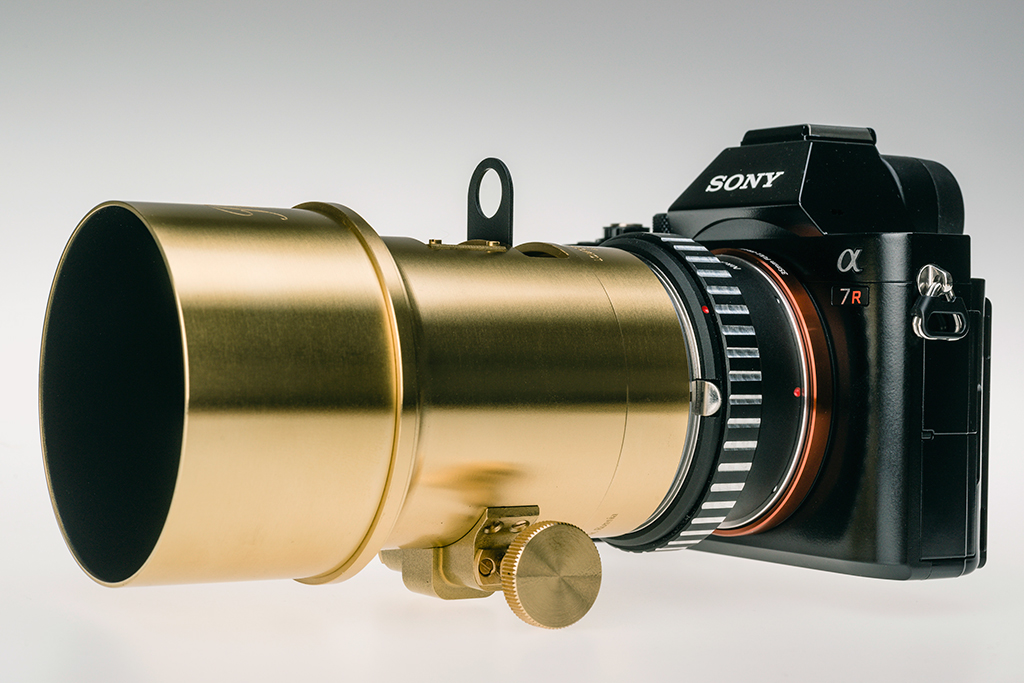
The Lomography Petzval lens used on the A7R with Nikon adaptor. This reproduction lens from an 1840s design is a wonderful tool for portraits.
Richard Kilpatrick as a Victorian portrait subject with our Interfit background as a drape – A7R, ISO 50, Petzval lens at f/5.6 (Waterhouse stop) manually focused, Elinchrom Ranger Quadra RX flash.
Manual focusing with peaking and magnification combined tells you a lot about your lenses. Find a good lens, and the peaking will be present even at Low setting, with a very narrow band of activation. A poor lens (or aperture setting) usually fails to show a peaking line at Low setting, then shows one at Medium or High which has little discrimination. I’ve been able to identify my best manual and A-mount lenses by using the 14.4X magnification and the peaking function to examine targets.
Having done this, the extra performance squeezed out of almost lenses by super-accurate focusing makes AF seem inadequate. The contrast detection AF of the A7R is good, but just invoking magnified manual after it has locked on proves that it rarely hits the perfect mark. It gets to ‘good enough’. Like many new A7R owners, I find myself often using manual focusing without noticing that it is any slower than AF used to be. It’s a quantum leap ahead of any optical finder accuracy.
I find the body shape and size ideal, and have no complaints about the position of anything except the shutter release, which could have been 3mm or so further forward, and also would have been improved by the addition of a manual cable release thread (found on the RX10). I don’t plan to get a vertical grip, as the whole point of the A7R is small size and light weight. The external finish feels secure, the battery and other doors are adequately sealed and I don’t tend to overwork them.
The small body size causes a few problems with tripod mounting. Even the smallest monopod head can restrict the rear screen movement making it impossible to angle the screen down if you want to hold the camera above head height. It doesn’t angle down much to start with. The position of the Menu button, needed to access some adjustments like OSS and Finder Setting Effect, isn’t ideal as the only button on the left end of the camera. The exposure compensation dial is unusual as a solus function using up an entire large mechanical control, and has no lock, so it can be turned a little easily.
The A7/R is so customisable that after a couple of months getting used to it and changing things you’ll have a camera as far removed from its out of the box settings as a typical Canon ends up. Mine, for example, has the AF/MF and AE Lock button/switch control set up to act as Focus when set to AF/MF (with pre-Focus and tracking lock and eye-start focus all disabled), and to act as Focus Magnifier when set to AE; while the shutter release is set not to activate AF, but to lock AE on first pressure (when using the camera in a controlled environment – when travelling, I soon reverted to AF with shutter). This makes the camera anything but point and shoot, as out of focus shots are guaranteed without a separate focus action.
In practice
Like far too many A7R users, I’ve spent half my time testing and experimenting, and not enough time shooting. I’ve had the RX10 as a companion at the same time, and needed to shoot with new flash systems, where that camera’s exceptional high speed sync makes it more versatile – there’s not much point having flash heads which manage 1/5000th duration when your sync speed is 1/160th, unlike the RX10 which can manage between 1/1600th and 1/3200th depending on aperture. I had a concert venue opening to shoot, with video, and once again the silent RX10 with its superb video quality was the obvious choice.
Then, at Easter, we had a nine-day tour of Kerala, an exceptional offer from Citrus Holidays providing us with a private driver and a packed itinerary covering 1000km and five locations. This was our first visit to India for 28 years, and would provide the first library images of India apart from a few scanned transparencies of subjects which do not date. Equipment mattered. Shirley always uses her Alpha 580 with Sigma 18-250mm OS original version; it’s heavy and the lens has been through one factory service already, but it’s been very reliable and survived a short period where a Nikon D600 kit was tried as a replacement (and sold pretty sharply, in favour of returning to the more reliable AF, AE and clean sensor of 580).
Logically, my A77 and A55 would have come along. They share the same battery type, and my basic lens set 8-16mm, 16-80mm and 70-300mm gives both exceptional wide angle and a good tele performance (300mm plus APS-C plus 24 megapixels) for wildlife. It is however a very heavy kit and we wanted to travel light and work light, in high temperature and humidity.
So, the A7R had to be my choice. Apart from anything else, this camera at £1800 had not so far proved ‘better’ for any given job – it was barely used. In the studio our A900 and A700 optical finders just work far better than any EVF camera, and for general PR and social photography the last thing you need is 36 megapixel full frame. It just creates oversized files and tends to have too little depth of field. The A7R had been used for tests, for some winter landscapes, and some architectural shots. We had not travelled at all since early November.
This decision also led me to leave the RX10 behind, and this was a big mistake. I took the RX100 instead because the RX10 is fairly large. Its zoom range and silent operation would both have been valuable. With the A7R and its 28-70mm OSS lens I took the 10-18mm OSS, my Tamron 18-200mm VC DiIII, NEX-6 body and 16-50mm OSS collapsible kit lens. This was really a backup in case any fault developed. In practice the A7R makes a better APS-C camera. I only used the 28-70mm lens once, and used the wide zoom and the Tamron fairly often on the A7R with APS-C crop, occasionally with crop disabled. While it’s possible to get a bit more wide-angle from the 10-18mm by shooting full fame, the 15 megapixel crop is a 100% perfect frame every time with this lens.
Despite the phase-detect focus of the NEX-6, this camera proved less accurate and slower in all conditions. Its main benefit was better timing for shots once the finder image is focused and stable, along with quieter operation. It may be a smaller body nominally but there’s little practical difference. Also, I was wearing a baseball cap, the minimum headgear needed in the sun. The left-end viewfinder eye position prevented a right hand ‘on top’ vertical grip on the NEX-6 while the central eyepiece of the A7R allowed a choice of grip style without having to remove the peaked cap.
The most significant loss my choice involved was telephoto power. Shirley’s 250mm f/6.3 reach on APS-C would have demanded a huge lens, a true 375mm or in practice a 400mm, to get the full benefit of 36 megapixels on full frame. It would also have demanded at least one f-stop more stopping down to match the critical long lens depth of field. I didn’t have an E-mount 24 megapixel body, but if I had one my 18-200mm would have slightly outreached Shirley’s 250mm as used on 16 megapixels.
This snake bird (anhinga) was photographed using the NEX-6 and 18-200mm (162mm and f/8), from a moving boat. There is no trace of shake at 1/250th, indicating the VC stabilisation works on this body. I got excellent results from the NEX-6, which I picked up at The Photography Show on March 4th with its 16-50mm collapsible motorized zoom on a special deal. However that deal was not as good as the current B+H of $524 with free accessories.
There are no lenses yet made longer than 200mm for the FE mount. If there are any made other than an obligatory zoom to 300mm they will be expensive and limited to the E-mount system for ever. In contrast a Canon, Nikon or Alpha SSM long lens will always be usable on SLR-form bodies and also on mirrorless – possibly on various mirrorless systems. Canon EF lenses for example can be used on almost all mirrorless bodies, and Nikon teles have the possibility of fitting to their 1 system 2.7X factor bodies with totally successful functions and focusing. I’ve tried this and it works – an 800mm equivalent with outstanding image quality, from a 300mm.
It’s for these reasons I have succumbed to ordering an LA-EA4. I value the LA-EA3 because it allows me to use some lenses with contrast detect focus and a pure image path, but my favourite 70-300mm Sigma OS will not CD focus. Buy the EA4, and I can use all my screw drive Minolta and Sony glass.
This is why I sill feel the A7R can be described as the Swiss Army Knife! It can do APS-C as well as its 16 megapixel APS-C siblings, but switch to use full frame to squeeze extra angle from many lenses. My Tamron 18-200mm is only just compatible with the A7R – its VC stabilisation and general performance indicate that a firmware fix might be needed (see earlier comments) – but it can give me a 19 megapixel image sharp corner to corner with a range of image sizes from square to 35mm, at 18mm and f/11, making it as useful as a 16-200mm lens instead of an 18-200mm.
In March, I needed to write up the Samyang 24mm Tilt-Shift lens, which was only available for review in Nikon mount, and needed a full frame body. The A7R with a low-cost Nikon adaptor did the job perfectly and the magnified focusing function allowed full and successful use of the lens functions. I now have a wide range of lenses and adaptors, and there’s no manual lens I own which the A7R can not use.
The Samyang 24mm Tilt-Shift f/3.5 manual lens has better control over movements (including 30° intervals for independent rotation) than the Canon or Nikon in the same focal length, though it lacks auto iris, EXIF data and focus confirmation. Here it is used with a low-cost manual Nikon adaptor.
Using the 24mm Tilt-Shift – a lesson here in floor/ground and ceiling/roof relationships and camera position. First shot, a typical eye level architectural compromise in which a normal wide angle keeps the verticals straight. The trade-off is that you get a similarly generous view of both the floor and ceiling. Second shot, moving the camera close to ground level. Third shot, applying a full vertical shift; the floor is now seen from an angle giving it much less emphasis, while the vaulted roof is seen from below. For real estate shots, the camera is usually placed close to the ceiling on a tall tripod, and a drop front applied, to show the extent of room interiors better by emphasising their floor area. This is stuff I learned 40 years ago working with 5 x 4.
The A7R stabilisation incompatibilty issue with the Tamron 18-200mm was ‘tested’ at considerable cost in lost shots. During most of the Kerala trip, fortunately including a few chances to get close to wildlife like the anhinger shown above, I used the 18-200mm on the NEX-6 for the slightly higher resolution and faster response. I’m very glad I did this and put the A7R away. No shot shows any sign of stabilisation failure. Finding a dramatic sunset location with rocks and predictable spray from breaking waves, I used the same lens on the A7R, which I had taken to the beach to produce some tests showing full frame coverage.
One of my frame coverage tests of the 18-200mm on the A7R. 175mm, 1/200th at f/9 – conditions which with stabilisation should result in a perfectly sharp result almost every time. Instead, this combination produced a jerked slightly double imaged unsharp shot every single time. Even at 21mm focal length this degradation was visible.
All the images (full frame tests and rock sunset shots) showed the same characteristic stabilisation jerk even at 1/320th, which I had not considered possible as the peak vibration from the A7R shutter occurs 1/250th after the shutter opens. It may not be shutter shock which causes this shake effect, but a firmware incompatibility (in timing signals?) between the A7R body and certain lenses.
Here is my processed image put through the new software Piccure, which I can recommend as the first program to analyse and remove shake effectively – see http://intelligentimagingsolutions.com – and which has significantly improved some of my A7R ‘shaken up’ shots to the point that when reduced to 9 megapixels, they are as sharp as you would have expected from a KM Dimage A2 (ah, the irony… we do make progress, don’t we?). Click the above image for a full size screen shot.
This was my final crop and process from the shot involved, which was an 18.2 megapixel ‘more than APS-C’ crop from the full A7R frame, sharpened using Piccure and reduced to 24MB final image size.
This sunset, and all the similar shots taken with the 18-200mm on the A7R, proved too badly affected by stabilisation malfunction to use at the desired full size.
Again, Sony’s decision to disable OSS with many lenses on the A7R only, and to issue firmware updates to enable this, supports this theory. Whatever the case, I lost all my first night’s sunset shots for anything except web sized use (above – it’s not sharp for printing or library use). We returned two further nights at the right time and tried various combinations. It was a subject not helped by heat haze and blown salt spray (UV filters were fitted, of course, and needed cleaning frequently to avoid the whole picture being softened).
It’s so bad it almost hurts your eyes, but this was the focus point of many shots, and the double image (always in the vertical direction when the A7R was held horizontally) from the 18-200mm Tamron consistently gave a result like this. You might also suspect inaccurate focus and poor lens performance, but plenty of other shots at similar apertures and settings on the NEX-6 were completely OK. Perhaps the only answer with the A7R will be the near-£1,000 70-200mm f/4 G and replacement of the 28-70mm with another £1,000-worth of 24-70mm f/4. All that to get me back to where I was thirty years ago in terms of aperture and focal length range!
Using Piccure had no useful effect on this shot. It created triple outlines of the shake in place of double.
Eventually I got what I wanted but only with the 70mm reach of the 28-70mm OSS lens. The final, third, visit had cloud cover as the sun reached the right position. But, if you want to try this for yourself, visit Light House Beach in Kovalam at around 6.00pm (get a beer and wait) around April 16th-22nd. Like all such sunsets, there are just two times each year where the sun will hit the right position over the horizon.
The 28-70mm really didn’t have the power to give me the sun at the size I wanted, but at least with Photoshop processing this was a more or less acceptable result. For any shot like this, I would far prefer to have a true mirrorless camera – no SLT mirror either – and the A7R should be a perfect choice. Tripod use was not an option because of the crowds (which you can’t see) and combination of incoming tide and wave.
There was one lens which never let me down – the 10-18mm OSS. Whether on the NEX-6, A7R crop or A7R full frame this lens always turned in a perfectly focused and well stabilised result.
At the end of our Keralan tour, we were invited to have lunch and a short tour of a major ayurvedic resort hotel, Isola di Cocco. The tour only took twenty minutes, seeing some of the rooms, and was at mid-day when the light is not ideal. I took a few shots on the A7R including room interiors, and sent small versions to our hosts afterwards. The outcome was a request for commercial use of the image set in their next brochure. These were not exactly what we would do on a commission – for one thing, we’d normally remove towels from round the pool, pick the best time of day, make fine adjustments to room details and even use lighting.
A pool needs to be very clean to handle a shot from three inches above the water surface (at 10mm).
This is what we we used to do in the 1980s producing brochure pictures for travel operators and it was never a casual thing, more a very long and full working day with many appointments and too much driving. These shots were quick snaps, even if professional snaps, and we agreed to use for a charity donation (all Indian businesses seem to support local charities as a matter of routine).
We’d be more than happy to go back and do it properly though!
Back in the 1980s we had nothing to approach the 15mm equivalent angle of the 10mm used on crop frame A7R, even though a few such lenses did exist for 35mm systems. 35mm was like using a 6 megapixel camera, and our shots had to stand full page to double page use. I used a Pentax 6 x 7 with its widest non-fisheye 45mm lens and that was equal to a 24mm, something you can now find at the wide end of many compacts. It had to go on a tripod, as the exposure times with Fujichrome RF 50 film (for shadow detail) with the f/16 or f/22 apertures needed for sharpness in depth were usually around 1/4 to 1 second. The tripod was one you couldn’t easily take by air today, and the camera kit with two bodies and three lenses was heavy and bulky. Then there was a matter of a hundred or so rolls of film to handle the five bracketed exposures for each frame, lead anti-X-ray bags, and a large Metz flash with an extension head… and our 35mm Minolta kit on top of it all. Each room could take an hour or more to photograph.
Raw conversion controls enable the rich teak wood interior to be shown clearly without losing the highlights of the wall and white sheets.
And here I am today, complaining about aspects of the A7R when I can walk into a room like the one above, without a tripod, find my viewpoint, observe the horizon level display while composing carefully, and make an exposure at ISO 1600 with quality equivalent to ISO 100 35mm film. With a lightweight carbon-fibre tripod, this almost Leica-sized camera can now outperform anything we might have expected from 6 x 7 film and at ISO 50 is good enough for wall-sized prints and poster reproduction.
We have some aspects of A7R technique and performance to ‘fix’ and you’ll realise that I do not approach using any new camera uncritically. But there’s nothing else on the market short of medium format which can match what it does.
I do not address, here, the demands of users wanting to switch from conventional heavy-duty SLR type cameras whose gear includes fast long apo telephotos and zooms, who work frequently with sequence bursts, require to track sports action, shoot news, capture wildlife or want to snap their kids and pets (which requires much the same camera performance as covering sports and news… they may move slower but they are much closer!).
My present thinking is that the new 12 megapixel A7S with its 4K motion picture capture and extreme low-light performance may not be what I want, but I’m considering adding an A7 or changing the NEX-6 for an A6000. I’m not quite ready to sell the A900 or the A77. I’ll see how the A7R performs over the summer and update in due course.
The A7 MkII with full-frame stabilisation, announced in November 2014, tends to put my theory about power drain and lenses into doubt, but only because I might assume the 5-axis sensor stabilisation also puts a heavy load on the battery. It does have the different shutter mechanism found on the A7, and of course, it does not have a 36 megapixel sensor to power.

![The Alfie Cameras [ B O X X ] instant analogue film camera, a wooden box camera with lens plate and ground glass in a traditional form with a novel solution for avoiding the darkroom!](https://cameracraft.online/wp-content/uploads/2026/04/Alfie-cameras-boxx.jpg)
![The darkslide, developing film back and two black-and-white prints from the [ B O X X ] camera prototype](https://cameracraft.online/wp-content/uploads/2026/04/Afie-cameras-boxx-prints.jpg)