The Sony E-mount (not FE) 10-18mm f/5 OSS lens can be used effectively on full frame for creative work and within limits for technically more demanding shots. Below, an uncropped A7R shot of the concourse at Abu Dhabi Airport, taken at 13mm setting, f/6.3 with my lens profile as provided below. Check the straight lines in the floor tiling, if you doubt that this lens would be of any use for architecture.
However, you don’t get this without a lens profile, and without due care to limit the focal length to a range of 13 to 16mm – not the full 10 to 18mm. Below, you could get this if you try 12mm straight out of camera…
This is a pretty awful case of vignetting and distortion – as you would expect. It’s from an APS-C format wide angle zoom, the 10-18mm f/4 SEL OSS lens for NEX, used on the Alpha 7R full frame mirrorless body. Early in the launch period of this camera, various far more attractive images appeared on-line using subjects like roads, rail lines, beaches and even shop counters where the lines look straight – rather like that drainpipe – because of where they fall in the shot. As you can see, anything with a horizon near the long edge of the framewould have given a very different impression.
However, Adobe offers a free utility which enables you to make lens profiles to correct vignetting and distortion.
I created a lens profile for ACR/LR using full frame and the 10-18mm on the A7R. The vignetting is such that the profile creator really can’t handle it, and overcorrects the extreme corners as a result. I’ve done f/4, f/8, f/16 at 12, 14, 16 and 18mm focal lengths using an A2 chart; for a lens like this, a much greater working distance and an A0 chart would really be desirable. The link below is to a zip file of the Adobe Lens Profiles I produced – for A7 and A7R, with .lcpp files for final use, and .lcp files for different settings of the 10 18mm I found useful.
At 12mm you can probably see the vignetting artefacts in the corners, the magenta corner shift and incomplete correction of the horizon line. You’ll also be quick to spot that the 12mm coverage has been reduced to something much less, lens profiles always reduce the field of view (they can not do otherwise).
The profiler simply can’t handle the degree of sudden fall-off in illumination given by the 10-18mm used on full frame. Manual distortion corrections can actually do a better job. At other focal lengths, the profile I’ve made works well enough, and if the frame is cropped slightly (still exceeding the APS-C area the lens is designed for) it’s possible to get good results and wider angles.
I have sold my Sigma 12-24mm HSM II which was used with the A99, and also sold a Voigltander 15mm f/4.5 I bought to test (zero cost fortunately, as it made a small profit between Gumtree source and eBay destination). The Sigma was not only very difficult to focus using CD, its HSM motor won’t play with Sony CD.
Just for good measure, here is an uncropped A7R 13mm focal length shot of the church of Maila Dumpara in Kerala taken to use dramatic converging verticals – which fail terribly unless the lines are properly corrected, the last thing you want in a strong upward angle is lens distortion. It’s very stiff test of any lens to do this. I have left the vignetting uncorrected. I rather like it. Click either this or the Abu Dhabi photo and you’ll get a larger image, about 1000 x 1500 pixels.
Samples produced for a dPreview forum question
There’s been a lot of discussion on dPreview forums of which lenses work on full frame E-mount, as Sony saw fit to put a Disable APS-C crop option in the menus of the A7 and A7R (almost as if they wanted owners to experiment). They have made other welcome changes of a similar kind which I’ll cover in a full review of the camera – which I can not do yet as I have no FE mount lenses for it, and with the current choice and prices, I can see I may never use FE mount lenses on this camera.
So, to answer some questions on dPreview’s E-mount forum, I posted these images and comments.
Here is a ‘native’ uncorrected shot of a local building taken on the 10-14mm on A7R at 11mm, f/10, ISO 100:
Here is the result of using the profile, doing a crop and some straighten of slight rotated tilt, and pulling the scale down (with the profile applied, the roof apex is clipped off at the top as the lens has so much distortion its 11mm probably becomes more like 15mm when corrected):
I’ve used some clarity and local burn adjustments on the sky to treat the image more or less as I would (except that I wouldn’t actually photograph this building at this time of day, with blinds drawn, etc).
For me, the 10-18mm on A7R with our without the profile correction offers the same options as using assorted lenses on 5 x 4 sheet film. It never mattered whether a 47mm didn’t cover the entire film, you got an image circle and could use whatever part of it you want. At 10mm the image, with the profile used, has strong corner cut-off but the overall circle of usable image greatly exceeds APS-C provided you stop down (f7.1 seems just OK, f/10 is maybe optimum, I’d certainly try f/16 despite fears of detail loss).
The red crop mark is square – my ‘Hasselblad SWC killer’, as the classic SWC had just a 38mm wide angle lens. You needed to get an Arcbody with 35mm Rodenstock to go any wider on 56 x 56mm film (6 x 6). With the A7R and 10-18mm at 10mm, you get the equivalent of a 24mm lens. Not a 24mm fisheye on 6 x 4.5 like the widest ever offered by Mamiya… a 24mm rectilinear on 6 x 6.
The yellow crop mark represents a significantly larger area than APS-C (which is actually just a little under the 24 x 24mm square in width). It is shifted vertically, as if the lens was being used as a shift lens. If only the APS-C area is considered, its approximately 16 x 24mm area can be positioned right to the top of the frame, equalling a 4mm rise, or the equivalent of using a 6mm rise on a full-frame PC lens (most actually go to 11 or 12mm rise). There is only one lens made which can compete with this, and that’s the Canon 17mm f/4 TS. Admittedly this is a superb lens and when stopped down to f/11 and used on the 6D (Canon’s most shift-friendly sensor) will blow this result away for clean rendering of detail toward the frame edges.
And then, you can still use the 10-18mm in APS-C crop mode as a snapshot wide angle with pretty much perfect correction (Adobe’s own Sony profile for APS-C), for videos too.
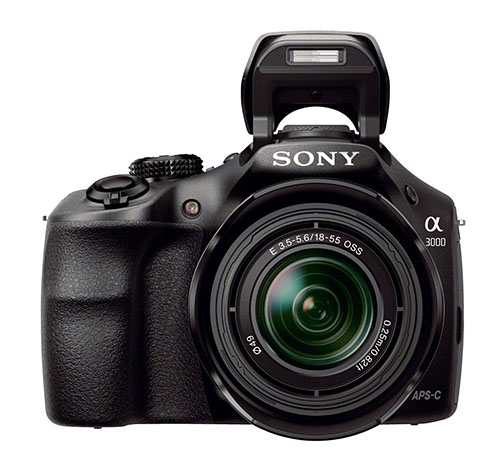
The long-rumoured Alpha 3000 was announced earlier in August but placed under a n embargo until August 27th. At the same time, the Press was given an insight into new smartphone related products (also widely rumoured) but again, not allowed to print anything officially.
The A3000 is a DSLR-like body with an electronic 1.44MP viewfinder in a prism-style top bulge, but the body is much slimmer at the lens mount and built to the smallest Alpha form factor as the 3 series indicates (smaller than the A57). Indeed, it’s not so different from the relationship of the very first Alpha 3000 series cameras back at the end of the 1980s. The mount is a regular NEX E-mount and the camera lacks any form of Phase Detection AF, depending on Contrast Detection matched to both existing (18-55mm SEL, etc) and new E-mount lenses. The rear screen is a 230KP fixed type.
Along with this first Alpha E-mount body, Sony announced three new E-mount lenses – a 50mm f/1.8 E OSS (£249) in black, CZ Vario-Tessar T* SEL 16-70mm f/4 ZA OSS (£800) and a Sony SEL Power Zoom 18-105mm f/4 G OSS (£500, and also destined to be matched to the next generation of NEX camcorders, with its friendly left hand operated PZ switch and quiet, controllable action). There may also be another power zoom, probably 16-50mm f/2.8 or a similar short wide aperture range, maybe even the 10-18mm in a power zoom housing. The reason these new lenses are made with constant apertures has nothing to do with the ‘Canon f/4 L’ obsession; it’s entirely to do with video work, to enable zooming without brightness change. The power zoom function is also there for video.
Caveat: the 18-105mm has a close focus of 45cm at 18mm, 95cm at 105mm. This indicates that the lens is not a true zoom but a varifocal. Varifocals are not of much use for zooming during a take in video, which goes against the constant aperture and power zoom features. So either the lens has an automatic compensation system which can refocus intelligently during power zoom, or a physical limiter on focus travel (unlikely – what would happen if you focused on 45cm at 18mm, then zoomed to 105mm?). The 16-70mm focuses to 35cm over its zoom range, and is actually capable of close-ups with better than double the image scale (less than a quarter of the frame enlarged) relative to the best the 18-105mm can offer, at 0.23X.
The relatively high level specification of the 16-70mm ZA does not necessarily indicate that there is a higher level of Alpha E-mount body on the way quite yet; at 20.1 megapixels (the same size sensor as the Alpha 58, with some improvements) the performance in terms of imaging may be optimal for a while. photokina 2014 should be when any professional body appears. But this is no way professional – it’s a mere £370 kit with 18-55mm f/3.5-5.6 E OSS, ISO range 100-16000, full HD video, A58-like viewfinder and general performance. You’ll see it in the shops before the end of September.
Sony’s agenda
Much has been made of Sony’s relationship with Olympus and the possible inclusion of OM-style 5-axis sensor stabilisation in E-mount bodies. Though the A3000 seems to have SteadyShot Inside (not confirmed by our man at the press conference, and not one of the features shown on the swingtags of the first cameras photographed by others) Carl Zeiss, traditionally wary of stabilised lens design, would not be issuing the 16-70mm with OSS unless fixed sensors were going to around in NEX and Alpha E-mount bodies for some time.
Whatever type of in-body stabilisation it has, the A3000 with SS looks like a good companion for existing un-stabilised lenses such as the Sigma 60mm, 30mm and 19mm f/2.8 designs or specialities like the Voigtlander Nokton 42.5mm f/0.95. However, I’m writing this prior to the big release of information this morning. Despite many statements that the camera does have IBIS, I see no rock-solid evidence that it does and I’m very aware that Sony staff if asked whether it has stabilisation could well say ‘yes’ on the basis of the OSS present in the kit 18-55mm lens. So, I treat this information with caution. It would not be the first time an expected feature has not materialised. Check the Sony site if you are reading soon after 5am GMT, I’ll amend this article later in the day.
In the meantime, we know that Sony has been increasingly close to Sigma (a company which also works with Zeiss) and that some ideas may be shared between the two companies. One of the most important ideas promises to end the way your camera system choice locks you in to one company’s products. Sigma has taken the first visible step with its mount switching service. Future Sigma DSLR lenses can be returned to the workshop and their entire rear mount changed, at a cost, to another mount. So you will be able to own your 300-800mm (2014 version…) and if you switch from Canon to Nikon, the lens can switch with you. Now that many regular lenses cost £1000 or more and Sigma’s quality is so highly regarded (35mm f/1.4, MFT and E-mount lenses, DP series) it will make sense to keep the glass for longer. The new USB-interfaced lens calibration kit will also enable such lenses to be user tuned to work with their new host bodies.
The second idea is the switch to E-mount for more products by Sony. There is already a full frame E-mount Sony, the NEX VG-900E, and it’s actually a 24 megapixel still camera shooting raw, as well as a high-end full frame camcorder. It just gets very little attention because it does not look like an SLR or a NEX. This camera has adaptors for other systems of full-frame DSLR lens, as well as a specialised full-frame version of the Alpha mount plain adaptor (LA-EA3 without APS-C internal baffles found in the LA-EA1). However, third party makers have not yet gone the distance. Prime lenses from Samyang and Carl Zeiss are the main E-mount full frame offerings, made for video.
With the Alpha 3000 we see the introduction of an idea I sketched out for film cameras in the 1970s based on discovering the Contarex with its interchangeable 35mm backs. My concept was a camera body with a shutter unit, and a mechanical linkage for slot-in modules including a rangefinder mount, an SLR mirror-box with prism, and a pro mirror-box with interchangeable finders, plus several further front components to switch between Pentax, Minolta, Nikon, Canon and other lenses. Alpa came close to managing this with their very slim bodies and mount adaptors, plus a combination of optical direct finder and prism.
Sony’s future, like Sigma’s, lies in crossing all boundaries. The eventual full-frame, E-mount DSLR-style camera may well have the rumoured 36-50 megapixel sensor, 4K electronic viewfinder, and five-axis sensor stabilisation. It will also have an Alpha lens adaptor and firmware lens recognition good enough to let SSM and SAM in-lens focus motor lenses function adequately with on-sensor focusing. But what it will also have, for certain, is a range of adaptors for other mounts including Canon EF and Nikon G with translated control of AF and aperture (exactly what Sigma has now built in to the front ends of its ‘switchable mount’ new lens series). These will likely be third party products, but Sony has already shown (in 2010, at photokina and other shows) that it has no difficulty welcoming makers such as Metabones and Novoflex on board as co-operative vendors.
What’s more, in theory there will room to build a phase-detect mirror system (SLT) into some adaptors and even to add a focus drive motor. With the right chipset to translate the protocols from body to lenses, or to mechanical functions in the adaptor, almost any lens ever made for any SLR or rangefinder from the last century of miniature camera development will find a home on Alpha E-mount bodies.
Then you will have the ‘DSLR-CSC’ hybrid to end all – the body which can be sold with a Nikon mount, or a Canon mount, or an A-mount – or use its highly optimised future full-frame E-mount optics. To some degree the NEX has already done this but the real impact of the 18mm thick body, compatible with full frame lenses, has yet to be seen.
Caveat – if a full frame model does use sensor stabilisation, mechanical obstructions could mean that a crop factor of somewhere around 1.2X was needed. Sony already has pixel-shifting electronic stabilisation for video, not stills, and this also needs a crop factor to work. It would be easy to imagine the full-frame NEX accepting this limitation, and providing electronic stabilisation on-sensor only, removing moving parts and improving precision/calibration.
The NEX-5T
The NEX-5T has the same forward flippable rear screen mechanism as the 5R, one of the advanced over the earlier 5 and 5N designs.
The NEX-5T is the successor to the NEX-5R (5n, 5 etc), available as a black or white body. The 16.1 MP APS-C CMOS sensor NEX-5T will sell for around £600 and adds Near Field Connectivity technology to WiFi. Fifteen of Sony’s PlayMemories ‘apps’ are now available. Features include Hybrid AF (CD-PD on sensor), 180° tilting LCD, and maximum sensitivity of ISO 25600.
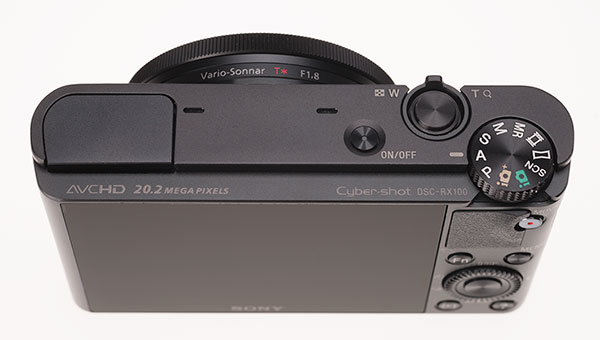
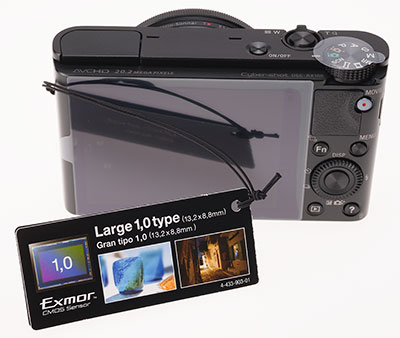
In the last year two cameras have been through my hands and impressed more than any others with the quality of their sensors. Those cameras were as different as they could be – the full frame Canon EOS 6D, and the pocketable Sony Cyber-shot DSC RX100. They have one thing in common, 20 megapixel sensors.
Of course there is no connection; a 24 x 36mm Canon sensor and a 8.8 x 13mm Sony sensor are very different. But if you shoot at ISO 125 on both cameras, and process from raw with a normally exposed scene, you will be hard pressed to tell the results apart.
So, when Sony – proving a giant-killer with the 1.0” format RX100 sensor – creates a budget DSLT model with an APS-C 20 megapixel sensor it would be reasonable to expect that this would outperform the RX100 and in the process prove superior to the 24 megapixel Alpha 77, 65 and NEX-7. It might even match the Alpha 99.
The Alpha 58 was announced at the end of February 2013, and some major websites had still not reviewed it by June. This is the first new Sony APS-C silicon for two years. It’s not found in any other body. Why the lack of urgent interest?
Perhaps, like me, the entry-level grade of the A58 has been responsible. It’s by far the worst Alpha body ever manufactured, and the first to have a plastic lens mount where machined metal is normally used. The whole physical feel of this Thai-made camera is inferior; it even has a slightly rough external texture which picks up handling marks the moment a store customer (or cynical on-line orderer intending to try, but return for a refund) so much as touches it.
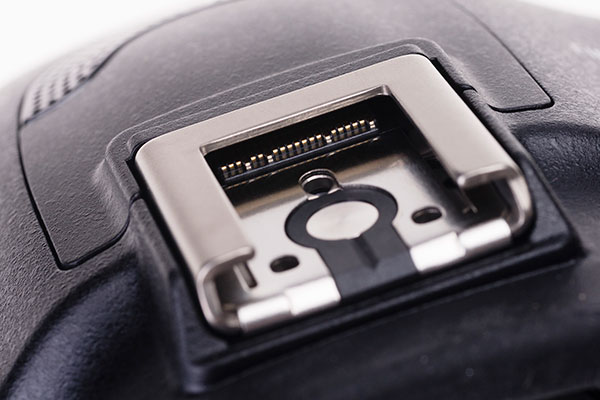
It has a relatively low-resolution, small rear screen (2.7 inches and 460,800 pixels) which is in the simplest and most restricted kind of up/down angle hinged mount. Against this economy, though, you need to balance a better OLED electronic viewfinder based on a one-inch 1,440,000 pixel display and a change to the new Sony Multi Function Accessory Shoe (without a protective cap, and without the adaptor for the Minolta/Sony Auto Lock shoe). It also uses the larger FM-500H battery common to all other current Alpha models, not the smaller FM-50H used by the NEX and also by some previous Alphas like the A55.
What is really new about the A58 is the price. I was not interested in the camera, though curious about the new sensor, because it was $600 US or £499 UK with the most basic lens , a new 18-5mm f/3.5-5.6 SAM II with quieter and improved internal focus motor (delivered, like Canon kit 18-55mms, without a lens hood). Then while helping a professional friend decide how to replace an A350 used for some unique underwater photography where the Quick Live View AF function has no equivalent in other makes, I looked into the A58.
It was on sale, in Britain, including VAT and properly sourced from Sony, for under £350. The actual price of the kit was only £291 before added VAT sales tax. This was £100 cheaper than the lowest price of the RX100, less than any other DSLR on the market with anything like the same specification. Bear in mind what a replacement Sony battery costs (around £50) and what an 18-55mm fetches (officially more, but in practice around £100 new) and this body was coming in at about £150. That’s a point and shoot compact price.
So I bought one.
First impressions
The packaging for the A58 cuts down on many things – recent Alphas have been festooned with stickers, this one has a single swingtag and a sticker on the rear LCD promoting connection to Sony’s webserver to obtain PlayMemories Home, the kiddy-friendly name for what is probably quite functional software, if you happen to use a Windows PC.
When you have charged the battery and loaded it, the first time you turn on a similar message fills the rear screen. Everything works as you expect from an Alpha, though some mysterious glitch stepped the entered date back by two days. You can only set to complete minutes, not seconds. Some defaults are set to ‘on’ including Smile Shutter and Auto Object Framing, and for my use these were disabled and the recording mode set to shoot RAW+JPEG, sRGB.
The supplied lens is a cheap product glitzed up by the addition of a metal microskin on the front bezel, behind the rotating rubber rimmed zoom and focus tube, 55mm filter thread. The SAM focus is quieter than the original version. The plastic-on-plastic mounting action is smooth enough, but when changing between the 30mm SAM macro (very noisy and jerky motor in comparison) engagement of the contact array was not always positive and the lens had to be twisted back and forth once with the lock pressed to enable AF.
The A58 is set to use electronic first curtain and SteadyShot Inside sensor-based stabilisation, both switched via the main menus. The Function button, which can access most regularly used settings does not reach these directly (a second menu screen is involved, very easy to use). There are also direct access button-positions round the rear controller for the important Drive, Picture Effect and White Balance settings, and a dedicated ISO button close to the shutter release. These can be customised to a degree, like the stop-down/intelligent preview button on the camera front which can be changed to work as a focus magnifier.
What’s initially surprising is that the shutter sound is noisier than many cameras with flipping mirrors. It’s not a pleasant sound either, mechanical in a clockwork-motor way. It all happens after the shot has been captured, as you can tell if you make a long exposure. Maybe the lightweight mostly plastic construction of the body, with its minimal metal skeleton, fails to damp the sound.
The viewfinder has the same contrast and dark detail failings as the A77, and in some ways the old A55 finder provides a more useful view. The rear screen is not very bright, and there is no auto brightness setting, just a 5-step manual control. In return, whether you use the LCD or the EVF makes on a tiny 10 shot difference to the 700 frames expected from one battery using the former. This stamina is double that of an EVF camera using the smaller battery type and restores a more than acceptable battery life per charge to Sony’s consumer entry level.
What is excellent about the finder is the ocular. It has been designed to give extreme eye relief – 26.5mm from the eyepiece glass, 23mm from the rubber frame surround. This compares to 19mm/18mm for the same data on the A55 (eyepiece glass not well protected from dust and light ingress, but eye needs to be close) and 27mm/22mm for the A77 (very deeply recessed and shaded ocular, reasonable eye distance). Part of this is down to display module sizes: 1.0 inch for the A58, 1.2 inch for the A55, 1.3 inch for the A77. Matters are further confused by the A55 failing to use all its EVF for the image, so the eye also sees a large near-black surround except when using menus which then expand to fill it.
Overall, the EVF looks like a view which is A55 size but A77 quality, like using a cropped section of the A77/99 2.4 megapixel EVF module. Sony has made this much easier to use with spectacles, or with the camera held an inch away from your eye. So although it’s not the best finder ever, it may be one of the best choices for anyone who has trouble with eyepoint. I found the EVF very blue at its neutral point, and set two notches of warming up to match the eye’s view.
The controls are no different from any other Alpha, they don’t feel rough or weak, and every button push got a response as expected.
The cover for the single dual purpose SD/MSDuoPro card slot is not a tight seal, and does not need firm action to open. The synthetic rubber single seal door over the microphone jack (no manual level control), Micro USB matching the RX100, and Micro HDMI ports is a good flush fit. There is also a Minolta/Sony unique DC in socket with similar cover.
What’s missing is the old Minolta and later on Sony remote control socket. Instead there’s a pretty clunky wired remote which works via the micro USB port. It looks like a version of a Chinese generic. This connection offers the only way to get wireless remote control, with a suitable device, as the camera lacks the IR receiver and has no Drive Mode for it.
The body shape in the hand is just a little more cramped than the A55, far more so than the A580, both cameras we have and both ‘replaced’ in the Alpha line up by this one model. I’d say it was less of a good fit to my hand than the classic Minolta Dimage series bridge cameras, or the Nikon 1 V2. Both of these were around to compare directly.
The critical bit
Then after getting acquainted with the camera, comes the question of the sensor performance. Here, the viewfinder gave the first clue that unlike the ‘sweet sixteen’ CMOS this 20MP newcomer was not going to move any goalposts. In domestic lighting, the level of noise in the EVF is higher than the old A55 and comparable to the A77.
However, I chose to compare the A58 with the RX100, because of the great advances made in the RX100’s very small 2.7X sensor. The results show an interesting divergence from minimum (100 for A58, 125 native for RX100) ISO to maximum. There is almost no advantage to the A58 up to ISO 400. Both cameras, with similarly adjusted raw conversion, yield clean images and it’s not even easy to tell ISO 400 from 200 or 100. If you click the images below, you’ll access a full size original conversion from raw (ACR).
A58, ISO 100, full sun, shadow to highlight from rawRX, ISO 100, deep shadow to full sun on white, from rawA58, ISO 400, full sun on wide tone range, from rawRX100, ISO 400, wide tone range in full sun, from raw
As you increase the speed, the 58 rapidly shows its advantage and by ISO 1600 has both a structure which looks finer in terms of granularity, and with far less chroma noise. Where a carefully processed ISO 800 from the RX100 might match a carelessly handled 800 from the Alpha, at 1600 it’s very difficult indeed to close the gap. By 6400 the RX100 is not really useful but the 58 can still deliver a fairly normal looking shot – it does begin to look like a desperate measure. Then you have 12,800 and the absolutely pointless 160,000 top setting which seems to be there for advertising purposes.
Taking into account differences in colour rendering, the advantage of the larger sensor is levelled if the RX100 file is reduced to 4500 x 3000 pixels and moderate chroma noise reduction applied. In relative terms, the small sensor is better, because it’s actually only a little over one quarter of the size of APS-C.
Compared to the 16 megapixel Sony sensor (NEX-5n, A55 and many later models as well as Pentax and Nikon variants) the 20 also fares pretty well. It has higher levels of luminance noise but minimal chroma noise. It’s not easy to reduce the luminance NR without softening detail, when using Adobe Camera Raw or Lightroom. It does not harm sharp detail much if left alone; if this sensor actually has an AA filter, it’s very weak.
This a MacBeth ColorChecker rendered using the official sRGB values.
This is an ISO 200 shot on the A58 with the greyscale white balanced to match the above, Iridient Raw Developer conversion using Iridient’s A58 profile. See later comments on colour and reds.
As for dynamic range, it falls off as the ISO in increased. At ISO 100 or 400 a typical high contrast sunlit scene is perfectly recorded, with only bright specular highlights clipping to 255-255-255. It can handle everything from shadows on dark areas to direct light on white. A few practical comparison shots show that the RX100 can do exactly the same things – indeed, precisely the same areas clip at the highlight end.
This simply indicates to me that Sony has matched the processes used in the two cameras against a common exposure and contrast standard. I’d have the rate the JPEG engine of the RX100 a little better than the Alpha, and images seem to need less work. Against the Alpha 99, the 58 gains some significant processing speed in raw converters as it’s producing 20 megapixel 12-bit files compared to 24 megapixel 14-bit.
Click this for the full size to see detail.Compare this RX100 shot. It’s interesting.
A hidden benefit of the 20 megapixel sensor is that if you use Adobe Camera Raw, this program offers a range of preset optimised output sizes converted directly from raw, which can be previewed at 100% of their actual pixel size before conversion. All 24 megapixel cameras have this as their largest output size, all you can do is downsample. 20 megapixel cameras offer a 25 megapixel output option, as do 16 or 18 megapixel models. The RX100 has already proved to me that it can make a 25 megapixel image that’s hard to tell from a native A77/99 image. The same goes for the Alpha 58. It can be set to export to this larger size, and if you use a top grade lens and low ISO, the result will be better than a native 24 megapixel at higher ISOs with a medium-quality lens.
Overall, I find it hard to rate the new 20 megapixel sensor as better than either the classic 16 megapixel ‘sweet spot’ sensor or the maximum 24 megapixel APS-C, but it is as competent as either of these in its own right. I guess the truth is that at all these resolutions, superb image quality is possible.
Other aspects of performance
Since the A58 uses the 15-point, 3-cross AF sensor which has been proven ever since it first appeared in the A580 and A55 it has identical performance; fast, very accurate AF down to EV -1 (50mm f/1.4). The exposure metering is, again, the familiar 1200-zone Sony system and works down to -2EV.
The actual focusing mechanism works no better with SAM or SSM lenses than with screw drive. It’s not the best ‘old’ mechanism in there and it lacks fast/slow AF setting, but it’s fast for certain. In low light although AF will lock, it needs a good target. Throughout my use of the camera I found the focus the least accurate and consistent of any Alpha body I’ve used, leading me to question whether I had accidentally set the lens to MF, so many pictures were clearly focused on some other plane than the subject, nearly always a definite back focus. The AF module is officially the same as the A55, A580 and so on. I can’t help thinking it is the same design but perhaps, like the rest of the camera, built to a budget.
The A58 couldn’t really back focus this shot at f/8 but it took three shots to get one sharp.Click the RX100 (f/5.6) example too, to see the real difference.
Switching between rear screen and EVF using the eye sensors, or if you have the rear screen off just turning on the EVF, is good on this camera. Its balance tends to prevent the eyepiece sitting against your chest, and thus avoids accidental activation, but it’s always brought the EVF into action by the time your eye is close enough to use the finder.
Regrettably the EVF and rear screen both lack the instantly visible high resolution needed to know whether your image is pin-sharp. Even the far superior finders and screens of the A77 and A99 do not give you the same awareness of this as an optical finder. The good news is that Focus Peaking can be turned on. This really isn’t sensitive or accurate enough unless you magnify the image, and much of the time, you simply don’t have time to do this.
So, the A58 is capable of pin-sharp images and you can be sure under the right conditions with the right technique that you won’t be short changed out the 20 megapixels you expected. But a lot of the time for everyday shooting it’s not very good at getting AF pin-sharp, and those same 20 megapixels do their best to show any error clearly.
In practical situations, ISO 400 is as noise-free as ISO 100 and gives you the chance to use a smaller aperture for more depth of field. The 18-55mm SAM II lens is not very sharp at 55mm wide open, and it proved optimistic to expect f/6.3 or f/7.2 to be much better. The old ‘one stop down for zooms’ rule works well enough. The 20 megapixel sensor shows signs of slightly softening at f/11 so the sweet spot for me has to be around f/9 or f/10.
The A58 has slightly warm tones overall and pinkish flesh colourThe RX100 on the same scene is more neutral or cool
You can click the images above for full size versions (same applies to all those shown in link frames like this).
As for colour, you’ll be happy if you have always like Canon DSLRs. not so happy if you were either a Sony (sunny!) or Minolta (full spectrum) sensor colour fan. This sensor shows every sign of having relatively weak RGB colour filters and a non-linear response, with underexposed shadows on higher ISOs in daylight tending towards magenta. It’s rather too easy to get putty-pink skin tones and a certain lack of subtelty in sky gradations, though blues and greens are not bad. Subjects like red flowers test the colour discrimination of the sensor to the limit.
It’s truly intense – but is it realistic? Camera profiles for raw conversion may tame this.
Let’s just say that every other current Sony Alpha model, and many past ones, will yield more visible difference between close hues. This is what you might expect from the more densely populated 20 megapixel sensor but, as ever, I’m left wondering why the little RX100 seems able to yield better colour (whatever DxOMark.com may say – but they also put the low light ability of the RX100 way below its actual performance).
At present there are no camera profiles available when converting files using Adobe Camera Raw, and the Adobe Standard colour seems to handle reds from the A58 badly (this is why I refer to Canon – the reds look much the same as problem Canon reds of the past). I don’t believe that red paint, red clothes, red street signs and red flowers are all are one type of red and when clipping warning is turned on, almost all the reds clip.
Shutter and flash
The shutter of the A58 is able to synchronise short-duration fast triggered flash, such as a thyristor camera top gun, up to 1/250th on manual without any shutter curtain clipping; at 1/320th, a shadow intrudes slightly on the frame. This is a better performance than indicated in the specifications, but for studio flash (mains powered) I would recommend working at 1/125th and for Sony/Minolta dedicated flash at 1/160th.
The shutter itself does not operate or make any noise whatsoever until AFTER the picture is captured when you use ‘Electronic First Curtain ON’ setting. The capping shutter blind has a cycle (close and return) of approximately 230ms overall in single frame mode resetting the camera ready for the next shot, or 115ms for continuous shooting which fits in with 8 frames a second fastest (cropped) frame rate. If you use the mechanical first shutter curtain, this adds exactly 50ms or 1/20th of a second to your release lag, which is not as easy to measure but seems to be in the order of only 20ms (1/50th).
Overall, this makes the A58 one of the most hair-trigger responsive cameras you can possibly own for capturing action – or would if the AF were faster and more reliable. Pre-set focus, use manual exposure, and you can trigger exposures with this camera as fast as you can think – just like the A99.
With its built-in flash or dedicated Sony flash, there’s the usual small delay caused by preflash. You may think the shot is being delayed more, because the shutter operates after the exposure, and then as the finder returns to life you get about 1/30th of a second of ‘review’ of the shot taken even with the 2s or 5s (etc) image review disabled. This happens all the time with the camera, the first frame or two of the finder refresh is a fleeting glimpse of your captured shot, and it’s useful. With flash you may be viewing a dark scene, the finder itself is blacked out when your flash fires, but this sudden bright image looks almost like a delayed flash through the eyepiece. Of course it is not, this is just an impression.
The built-in pop up flash becomes a rather aggressive AF illuminator when flash is active and the camera has trouble finding enough light for an AF lock. You certainly do see the effect of this through the finder, a surprisingly long and bright burst of light. It must drain the battery fast.
Flash exposure, long a problem with Alphas, seems predictable. A pile of black camera bags produces a full exposure (histogram hitting the buffers at the right hand end) while a white paper document in the middle of the frame results in one stop under. No doubt users will find specific flashguns or situations which produce wildcard exposure. That’s why you should always enable DRO+ Automatic or something like level 3 when shooting with flash. This dynamic range contrast optimisation process can produce great flash pictures out of the camera but remember it only works well at lower ISO settings, do not go over 800 and expect DRO+ to keep you smooth noise-free image.
The A58 appears to allow DRO to be used at higher ISOs, which earlier cameras often lock out because of its effect on shadow noise. However, both the printed manual and the downloadable handbook contain many inaccuracies and ambiguities; even Sony’s specification for the camera on-line has problems, listing standard and magnified views in the finder instead of eyepiece glass and surround against the two eye-point figures.
Wireless flash operates in the usual way, with the pop-up flash acting as a commander once paired by first fitting the remote flash, turning on, selecting WL Flash mode, and removing the remote. This is now a 20-year old Minolta technology updated – something which took Canon fifteen years to catch up with, after which they progressed further. The Alpha wireless flash works but it’s frozen in time. At least, with the optional adaptor, you can use earlier Minolta and Sony flashguns of the HS(D) generation and later.
HS is the high speed burst mode (long duration resembling continuous light) and the A58 can use HS flash at all shutter speeds up to 1/4,000th. The A58 has a useful Slow Sync function which delivers and automatic dragged shutter setting according to the available light, and a Rear Curtain sync as well. The camera may, with the built-in flash, switch to a slow longer recycling time even if you load a fresh battery when shooting flash intensively. This is to prevent the camera (not the flash) from overheating.
Studio compatibility
One reason I obtained an A58 to look at was because Ian Cartwright, a friend of mine who shoots models and babies underwater, had obtained an Alpha 580 on my advice to replace an A350 only to find that this camera forces a strange blackout delay of almost half a second when using any dedicated flash. The A350’s otherwise similar Quick Live View does not have this peculiar firmware fault. I can confirm that the A58 fires in real time, and unlike either of the other two models, can be used with PocketWizard or an infrared trigger. That’s because the finder view can be switched to ‘Setting Effect OFF’ which defeats exposure simulation and gives you a bright view even in manual with setting like 1/125 and f/11 under dim modelling or ambient light. The A58 can be used in the studio as easily as the A99, because of its ISO hot shot compatibility and this feature.
For this studio shot I chose not to use flash, it was lit by my Interfit 3200 tungsten outfit (great for video) instead. The colour rendering matters little because the image is adjusted in processing to give this look.
As to whether you would ever want to use an EVF camera for studio work, that’s another matter. I have bought a replacement Alpha 900 after three months trying to use EVF for studio set-ups and temporarily reverting to my A700. It’s not just the quality of what you see when composing and adjusting your studio shot (stray hairs over a face or a clothing fibre landing on your still life are just not visible with EVF) it’s the need to have power saving permanently turned off to keep the screen or finder awake as you do all the lighting and reflectors, background and subject adjustments. Nothing is more annoying than having to half-press the shutter to wake up your camera every time you go back to check – and with the A58, the shutter release is so light it’s easy to take a shot instead of waking the finder view.
The A99 can be used tethered and plugged in to AC, with a USB cable to a remote capture Mac or PC, and a live feed to an HDTV monitor. Do that and the business of setting up and adjusting a studio shoot becomes far easier with live view. I just don’t do enough work of any kind to justify that, it’s quicker to keep using the old familiar glass prism. It looks as if the A58 can be used the same way, joining the A77 and A99 by having PC Remote capability and HDMI previewing, while the A900/850/700 are the only other choices in Alpha history able to use PC Remote.
This does open the door to using a netbook, for example, as an intervalometer timer or remote release. There is no App for iOS or Android but the PC Remote control panel is well designed to fit a smartphone. There is no Wifi in the camera (it has good compatibility with EyeFi cards, invoking special display icons).
Video
Due to the softness and lack of AF sensitivity of the 18-55mm SAM II lens, my couple of quick test videos in real situations were not stunning but also not too bad. The sound quality is reasonable without plugging in my Rode Video Mic, stabilisation of video is very good indeed, and by using the dedicated video setting I was able to set my own shutter and aperture. You can also lock out the movie button except when the mode dial is set to video, preventing accidental video clips.
If you want the camera for video, either the 18-135mm SAM lens or even better the 16-50mm f/2.8 SSM (quiet fast focus) will do much better than the 18-55mm. The A58 lacks the highest quality video encoding of the A77 and A99, but you can get the vital requirement of 25/30fps at 1080p, the second highest level found on other Alphas. The clip above is at best quality with the 18-55mm; it took some fairly extreme action (the car driving right towards the lens) to persuade the AF to bother to try to track, most of the time it was telling me, hey, that’s good enough, no need to refocus… or even focus to start with.
Special functions
Although the A58 has been trimmed down in some ways, other aspects have been improved, compared to past entry-level cameras. There is no wireless remote drive mode, and no 2sec self-timer, so unless you buy the unusual Micro USB wired release you have to use a 10sec timer for shake-free tripod work.
Bracketing is only three frames, but the range is now large – 0.3EV, 0.7EV, 1EV, 2EV or 3EV steps. HDR Auto can also use a 6EV span (±3EV). You can not control the auto ISO range, but it’s a reasonable 100-3200. If you shoot JPEG and choose multishot noise reduction, an auto 6400 may be selected, and some of the Scene modes may also enter this range. But if you shoot raw, you have to select ISOs from 4000 to 160,000 manually which makes them harder to get by mistake.
There are many picture effects, both single and multi-shot, in the A58. One of the more interesting is Rich Tone Black and White, which uses three shots to build a gradation resembling a traditional darkroom print.
The sensor does not appear to support sub-frames, or cropped raw files, in the same way the A99 or Nikon D600 can do. The maximum frame rate for continuous shooting is 5fps for full size raws, but the buffer is minimal and the best I could get was four frames in a burst before a major pause and intermittent resumption, never at 5fps. On raw you get click-click-click, off to make coffee, click, take a walk round the block, click, remember to turn the lights off before going to bed. It’s that bad. JPEG Fine, which delivers 4 frames at 5fps, then becomes intermittent and variable in capture speed but a little faster than raw.
To get anything better, you must convert the camera into a 5 megapixel 3X factor (2X crop of the 1.5X sensor) by setting it to T8 (Tele 8fps) continuous mode on the main control dial. This delivers about 8.1fps for 24 frames on a 95MB/s SanDisk card, then slows to capture around 5-6fps in a regular pattern of two frames at 8fps, hesitation, two more and so on. On a slower card, Transcend SDHC, I got 12 frames continuous and a slower more regular tail. Memory card speed is clearly critical for getting the best from the A58.
Since you can’t get a 5MB cropped raw, exactly how this mode functions is a bit of a mystery as JPEG images are produced via an intermediate raw file – that’s how things work. So inside the camera, 24 frames can be processed and cropped in 2 seconds – but it can’t even manage one second of unprocessed raws at 5fps. This indicates the processor is fast and the input buffer big enough, it’s the output buffer and card interface which causes the bottleneck. Card interfaces and drive assemblies are third party products normally bought in by the camera maker, while the main processor is their own (or a dedicated design based on a Fujitsu module or other OEM).
This camera is extremely low cost and I think this is simply one area where cost savings ended up reducing what could have been a great specifiction and performance.
Digital and Clear Image Zoom
The A58 has a Zoom button, like a Cyber-shot DSC RX100’s zoom control that goes beyond the mechanical range of the zoom. Since you can’t go beyond the zoom on the lens itself, you go to the tele extreme, press the zoom button and a bar appears on the displays. Up to 1.4X magnification, you get a cropped shot (JPEG only) but this crop fills the EVF/screen and is enlarged by interpolation to 20MP. Up to 2X, you get Clear Image Zoom which is profiled or custom interpolation, similar to software packages which can enlarge JPEGs better if they have a profile for the camera used. Up to 4X, the rest is ordinary Digital Zoom which means the resulting 20MP image has really been created from a 1.25MP area of the sensor, and it shows.
Fine JPEG, normal shotInterpolated Zoom 1.4X. 18-55mm at 55mm.Clear Image at 1.9X (all at f/8)Digital zoom to 4X.
I made some tests with the 18-55mm and its vague focusing and overall modest quality lowered the bar for the digitally zoomed range. Then I tried with my extremely sharp Sigma 70mm macro. I think the 1.4X range is acceptable for all normal uses, the 2X range is almost acceptable, beyond this the softness overpowers any possible reason to want a 20MP output file. There is a mark on the zoom bar showing the change from resized and Clear Image (1.0-2X) to Digital Zoom (2.0-4.0X) but I was unable to get the zoom to fix on 2.0X, instead it insisted on using 1.9X or 2.1X but placed the 2.1X on the ‘safe’ side of the mark.
70mm macro, raw shot at f/10Fine JPEG of same ISO 200 shot.1.4X interpolated zoom.2X Clear Image zoom4X Digital Zoom. Still 20MP…
As expected, the A58 has Sony’s excellent sweep panorama mode, and just about every other Sony original technology around from face recognition and smile shutter through to auto framing (an intelligent crop which keeps a copy of your uncropped JPEG too) and AF object tracking. Its Intelligent Auto and Super Auto modes will serve the beginner and general family photographer well.
The A58 has sensor cleaning and does vibrate the sensor on shutdown, not on switch on; this is not listed in the specification, which just mentions the anti-static coating. Manual cleaning is possible and Sony make two notes of interest – they advise blower cleaning the back of the mirror before lowering it (so clean both this and the sensor in one step) and they say that you can not shoot with the mirror raised. My camera had no sensor spots on delivery.
Future expansion
The A58 shares with the NEX-6 and Cyber-shot DSC RX1 the new Multi Function Shoe, and some of the accessories for this shoe are futureware. All these cameras lack the GPS found in the A99. The Multi Function Shoe’s interface includes pins to connect a GPS device and record location data as you shoot.
Despite my affection for the robust qualities of the little Alpha 55, the Alpha 58 does more and when armed with my 16-80mm CZ lens makes a good travel camera. For that, I want to have GPS. So of all the possible future accessories for the shoe, this is the one I hope Sony will produce soon. Other possible accessories are a Wifi remote shooting module (the interface could allow image preview remotely) and a PocketWizard or similar wireless flash trigger. The shoe interface might even enable uncompressed video streaming to external recording devices, or back up between the camera and an external SD card or USB stick. It can also feed an external larger video monitor or a mic/headphone module which might have auto gain over-ride for sound recording – or perhaps these functions may be combined one day in a video/audio adaptor.
These are the prospects which this one change in the Alpha system brings, yet there is no sign that Sony is rolling out MFAS accessories. It’s also true that each camera’s own MFAS may have missing pins, or differently assigned pins (that would be seriously bad planning). You can not, for example, use the EVF of the RX1 on the A99 shoe, though both cameras have 24 megapixel sensors and the same EVF display resolution. The camera does not recognise it.
Made in Thailand – not a bad thing, and Thailand has a big camera industry with Nikon, Sony and others. But this does feel like the lowest cost, most pared-down offering ever in the Sony DSLR/SLT lineage.
Changing the market
It is a pity that a camera with a brand new sensor and many advanced features and functions should ever have been designed down to the lowest price-level by reducing the specification of far too many components, from the lens mount and body itself to the displays and the buffer and card interface.
Sony’s manual and general approach to the camera menus and built-in help indicate that it’s targeted at what Americans would call a ‘soccer mom’ market. Well, your own kids are always beautiful even if the rest of the internet community groans inwardly every time another snapshot of infant overfeeding is posted to support how wonderful dad’s new camera is. They are always polite and agree.
Same goes for this camera – for those who acquire it as a new addition to the family, it will be the best thing ever made. And in some ways they will be right, nothing else comes close for the money. Unlike the sprogs, the Alpha 58 has inherited many desirable genes but suffered from malnutrition during its gestation. It could have been a robust, capable semi-pro camera in the tradition of the A580, the last Sony Alpha to have an optical finder.
Perhaps the 20 megapixel sensor will appear in a higher level body. How about an A68? For me that would be close to home (look it up on a UK road map!).
Perhaps the strangest news from photokina, which I have not rushed to post here because I reckon every single website in the world will have treated it as urgent breaking unparalleled wonder – is that Sony and Hasselblad have signed a deal under which Hasselblad will make an APS-C (or perhaps full-frame NEX mount) mirrorless camera in Sweden.
Without any images other than a Hasselblad H logo to accompany the revelation, the world is left wondering what exactly Fujifilm has done wrong. A drawing of what might be an A-mount mopdel was shown at photokina but looks as if it could have been done by a teenager on the back of a school jotter; a prototype or mock-up NEX revision called the Lunar was little better. Clearly, Sony already announced its intention to allow approved partners to use the E-mount, and we can assume that the Hasselnex will come thus equipped. Carl Zeiss has announced a roadmap for E-mount lenses, and of course that would fit Hasselblad down to the ground. No need for a new lens range, their bodies (NEX-7/6 type?) would be sold with blueprinted Zeiss glass. Surely? Not just with relabelled Sony zooms?
And the bodies would be made in Sweden. That means less than you might assume, since all the internal component parts would presumably be sourced from Sony as a CKD kit. CKD is motor industry speak for ‘Completely Knocked Down’ – a car shipped as parts to a factory, to be assembled there. Hasselblad Sweden used once to be very good at assembling cameras, they recently moved all Danish production back to Gothenburg and re-established Swedish manufacture.
The BJP has been told the body would be aluminium. The NEX-7 is magnesium alloy. And the 7/6 body already looks really classy. The Lunar simply does not.
From the BJP report on this €5-6,000 version of the NEX-7 – click image to see their interview.
So, what of the H-series blads – made in Japan by Fuji, Hasselblad’s long-term partner in the H-range project?
And, when Hasselblad was quite willing to work with Rittreck/Norita/Fuji on rangefinder type cameras (the XPan was not their idea, it was a Rittreck/Norita concept) what has changed?
After all, Fuji’s XPro-1 and XF are staggeringly good cameras with a ridiculously ambitious and excellent range of lenses, not just superfast primes abut extending into popular zooms. They are built and styled to fit Hasselblad ambitions. Fuji optics have proved good enough for Hasselblad H.
Something has shifted. Maybe Hasselblad is no longer tied to Fujifilm and the announcement of manufacture returning to Gothenburg, made earlier this year, relates to a shift not from Denmark only but also from Japan. Perhaps Sony has demonstrated that superior medium-format size CMOS can be fabbed, saving costs for future generations of yet unimagined H-series bodies/backs where six 24 megapixel APS-C sensors will be stitched to create a 144 megapixel sensor measuring 47mm square!
Or perhaps Hasselblad realises that mirrorless need not mean hand-waved. They used to build waist-level cameras. How about a mirrorless waist-level, styled like a mini ‘blad and with the screen on top with a flip-up hood and magnifier?
Too much kölsch and imagination, I fear. But this certainly is strange news. A scoop for Sony – but exactly what for Hasselblad remains to be seen.
Most Japanese camera companies have divisions, groups, and teams right down to the very last individual product. Even a single lens design may have its own small team, from R&D and design down to final assembly. What we are seeing happen in Sony right now is the result of complex competition and collaboration between several teams.
Take, for example, the new Sony 300mm f/2.8 G SSM II. You might assume this lens was mainly an Alpha division product from the former Minolta heritage, but in fact it’s been redesigned to work better with NEX and also with both consumer and professional HD video cameras from APS-C through Super-35 to full frame 35mm.
SLT/SLR system users gain with improvements like Nano AR coating (similar to new coatings introduced by Sigma, Nikon, Pentax and Canon), better MF control, and a better degree of weathersealing. It’s the complete update of the SSM motor (is it SSM II, or entire lens version II?) which provides compatibility with on-sensor PDAF and enhances CDAF, to offer the prospect of object-tracking AF during video. At £6,700 UK it needs to show major benefits to compete in the still field, but may have a market all to itself when fitted to the new NEX-VG900E full frame video camera.
It’s easy to think – ‘the first ever full frame video cam!’ but that is not the case. The Canon 5D MkII established the DSLR form as an acceptable professional video camera, and in the last three years a vast industry of shooting rigs, grips, follow focus devices, monitor screens and accessories has grown up all based on turning this video-unfriendly camera into something movie and TV crews are comfortable with.
Sony has implemented the sought-after 24 frames per second rate in all the new models just announced, not going for the European excuse of 25fps being close enough. This is to allow a so-called cinematic look, despite the fact that the movie industry has been trying to get away from 24fps just the same way as it threw off the shackles of 16 or 18fps many years before. Users want it, so they have at last provided it.
From the very start of reviewing HD capable cameras, we have emphasised the issues with audio – the *absolute* not optional need for audio fixed or adjustable manual gain control. I’ve done this for years in printed magazines. So has any other writer who ever had to use a camera with auto gain and nothing else. First Nikon (basic) then Canon (full control) and now Sony show they listened, if slowly and relunctantly, to something their own audio engineers would have told them was vital not a luxury.
End result – Sony enters the mainstream for HD video shooting with the Alpha and NEX systems.
The same technologies, in terms of sensor use and implementation of optical advances linked to Phase-Detection On Sensor (which I’ll call PDOS), now apply across the entire range of Sony digital imaging products from Handycam, through Cyber-Shot, through NEX, to Alpha. The Cyber-shot range is only missing an APS-C model.
What is particularly interesting is that this divided path is a parallel path now and not a divergent one. There’s no question of one straight and narrow path leading to heaven, one broad and easy road to hell, and winding ferny way to faery. Instead we get a four-lane highway joining Sony present to Sony future, with every option to change lane if you want to overtake.
Legacy and inheritance planning
Sony acquired a lot of old Minolta tech as a dowry in the 206 marriage to the Alpha system. Now having invested that legacy they have to make sure it still has value for future generations.
And example of what this really means can be found in the PDOS restrictions of the A99. The AF-D mode won’t work with some lenses, yet. For example – the 16mm f/2.8 fisheye, the 20mm f/2.8, the 16-35mm CZ f/2.8 zoom, any Konica Minolta zoom, any old Minolta AF system lens, the 35mm f/1.4, the 85mm f/1.4 CZ and G, the 135mm f/1.8 CZ and f/2.8 STF, the 200mm f/4 Apo G Macro, the 24-105mm D, any macro lens, the 400mm f/4.5, 600mm f/4, 200mm f/2.8 or the 300mm f/2.8 G SSM (pre-II). It is not even flagged as working with the 30mm f/2.8 SAM macro, 35mm f/1.8, 50mm f/1.8, 85mm f/1.8 or the 24mm f/2 Carl Zeiss SSM ZA. Or the 70-300mm G SSM, let alone the basic 75-300mm SAL.
It will only work with the 24-70mm f/2.8 CZ, the 28-75mm f/2.8 SAM, the 50mm f/1.4 current design, the 70-200mm f/2.8 SSM, the new 300mm f/2.8 G SSM II, 70-400mm f/4-5.6 G SSM and the new 500mm f/4 G SSM. Sony’s firmware requires that the user enter the focusing range involved. This is put forward as an advantage – making the system less likely to focus on a fence instead of the view through it – but in fact it’s an integral part of PDOS. Each of the 102 focus points spread across the sensor* is not a single pixel-pair, it’s a cluster of several pixel pairs tightly grouped. There may be the minimum of three differently pitched PDOS points per location, or perhaps more, to cope with the wide range of exit pupil conditions encountered when using Alpha-mount lenes.
For any one lens, the camera will need to know the broad focus range involved (hopefully the main PDAF array will normally provide this), the aperture at which focusing is taking place, and some further information about how the zoom or lens design influences the exit ray cone. From this, it will select the correct PDOS configuration and I think that for some lenses only a central zone will be active.
Sony states that firmware updates will add further lenses, but this technology only requires some relatively simple information based on the optical design. If they could have added more lenses from the start, they would have. Watch this space, because it may remain more of an empty space than you hope for.
* Sony imply that the PDOS area is large – actually it’s about 13mm square, within the APS-C zone, and does not extend towards the ends of the full frame much further than the cluster of regular PDAF points. These seem to be the same module as the A77, giving the A99 an AF ‘zone’ much smaller relative to its frame.
Zones and maps
The Alpha 99 also introduces something which almost has to happen if any of the above is going to work at all. Anti-aliasing filters do not have an even effect on sensors, especially full frame with wider angle lenses where the rear nodal point of the lens is relatively close. Geometry means that light passes through them at more of an angle towards the edges and corners, and there is therefore more distance between AA filter and sensor surface. With an AA filter having a single value diffraction-created diffusion of the image-forming light (aka blurring), the effect gets stronger as you move away from the centre (axis).
Since most lenses are also sharper in the centre and typical sensor microlenses are not ‘tuned’ from centre to edge, the overall result is to emphasise fall-off from centre to edge. Secondary results include a dramatic tendency for bright sources imaged in the extreme corners to have a strong, directional, surrounding glare. This is boosted by internal multiple reflection between the sensor surface and the inner face of the AA filter, especially if the incident rays are at 40° or less to the focal plane (where on-axis rays are described as being at 90°).
The best solution to this is the classic one – what Olympus called telecentric lens design, where you do your best to project the image on to the sensor from a relatively distant position keeping all rays, centre to edge, as close to 90° as possible. But that calls for new lens designs and also restricts the optical formulae, tending to produce much larger heavier lenses. It’s very practical on one-inch or smaller sensors, OK on MicroFourThirds, feasible for NEX but not much an option for a full-frame coverage.
So, Sony has introduced an AA filter which they describe as ‘multi-segment lo-pass’. It’s not one strength across the entire frame, but divided or graded to optimise performance towards the corners. At the same time, they have introduced a similar zoning to noise reduction, which we assume to mean the NR applies to the raw output before a raw file is saved. Combined with the usual sensor mapping, and lens profile based vignetting compensation, the overall effect of these refinements should be to:
Even out the apparent resolution and image acutance across the frame
Reduce the mapped peripheral gain effect, under which images appear to be noisier at the edges unless natural vignetting is allowed to be present
Remove artefacts such as corner streaking or softening, and fringes or flare from light sources towards the extremes
No doubt this is also combined with the detailed ‘repair’ function used to deal with PDOS. More on this later, as there’s an implication that the PDOS on the A99 is not the same as that on the NEX-5R or NEX-6, and may use a second layer of pixels leaving all 24.3 megapixels of the imaging layer untouched.
The area-specific NR is probably essential to achieve the high ISO range at 14-bit conversion, though it’s not unusual for cameras at this level which claim 14-bit conversion to have a variable true bit depth depending on ISO, image style and exposure conditions. We can assume that 14-bit will only be fully utilised under ideal conditions at ISO 100.
Exactly how Sony has managed to adjust AA values in ‘segments’ without visible transitions, we’ll have to find out. The same goes for NR.
The missing NEX-9
There is one camera absent from the September 12th launch – the 24 megapixel full frame NEX-9. The appearance of the HD video Handycam, NEX-VG900E, indicates that the model name for the full frame 24 megapixel NEX will be NEX-9. Images of the VG900 show it using an Alpha via the standard LA-EA2 adaptor, and we can be sure that this and not a special range of E-mount full frame lenses (almost pointless) will be how the NEX-9 takes A-mount glass.
In the meantime, the NEX-6 appears to be perfectly pitched in price, but see my comment below about GPS.
The missing GPS
While the A99 has GPS, we’re still left with no NEX model yet featuring GPS despite these being the ideal travel and walking companion. Nor is there a current SLT model with 16 megapixels and GPS, as the Alpha 55 replacement doesn’t have it and the ‘baby’ A77, the A65, is a 24 megapixel again. The Cyber-shot RX100 and RX1 models also don’t have GPS. Whether or not the new hot shoe will allow an add-on GPS remains to be seen.
The new 50mm f/1.4 SSM Carl Zeiss T* Planar
Whatever you think of Minolta glass, or new Sony glass, the Carl Zeiss name on a lens is a huge draw. Reactions to the otherwise rather pedestrian DSC-RX1 prove this. People will put up with being back in 1972 – the era of cameras like the Minolta Hi-Matics with fixed 40mm f/1.7 and similar Gauss design lenses of very high quality – if only it means getting rid of poor quality digital images. There was a time when you couldn’t sell a 50mm standard lens with a camera, and there was a time before that when every system was judged initially on the quality of its 50mm choices. We may be returning to that way of thinking.
Edit – at the 2006 launch of the Alpha 100, a 50mm f/1.4 CZ was briefly shown in Paul Genge’s presentation to UK/English language journalists. I did not report on this as none of the literature confirmed what we saw on the Powerpoint screen. I believe this lens has been planned for six years.
Flash
The new HVL-F60AM flash with rather weak video light and new hot shoe might seem an annoying departure, but remember, the A99 has no built-in flash and thus can not control wireless remotes without a commander. No HVL-F20AM style mini flash has been previewed, so the F60AM is the only commander. But your old flash will work fine off-camera controlled by your new one.
Parked on the hard shoulder
So, having looked at the four way road map for Sony, I must confess that I’m pulling into a rest area for a while. I did not sell my Alpha 900 or Alpha 77, and I’m glad I didn’t. Nor did I sell my 24mm f/2 even though it has been little used for a few months. It has been waiting for a 36 megapixel full-framer, which makes a 24mm a much better all-round lens because of the croppable image size.
I’m not one of those photographers obsessed by bokeh or the need to throw parts of my picture into extreme defocus. At 24 megapixels, APS-C is already seriously short of depth of field even at optimum apertures like f/9. I’m more likely to spend my money on a Samyang 24mm f/3.5 full frame tilt-shift lens to use with both the A900 and A77 than to invest in an A99. I have no use for a revised 300mm f/2.8, especially on full frame where it seems to me now to be a very conservative focal length, and though I’m sure a 50mm CZ will be wonderful I have no complaints about my Minolta-design Sony 50mm f/1.4. I do shoot video, but rarely in conditions which demand that I use full frame, and if Sony don’t put manual audio control into older models via a firmware fix, I’ll just buy a Canon 600D.
The price of the Alpha 99 is not as bad as people suggest, with UK stories launching it at £2082+VAT, or $3200. But I’ve got a very good quality pure still camera in the Alpha 900, with effectively noise-free imaging from ISO 100 to 320, excellent battery life and exactly the same maximum image size offered by the 99.
I think I’m in the market for the NEX-6 body but I do not care in the slightest about the WiFi aspect, or the downloadable apps. If the new remote control can actually trigger and end video shooting with the A77, NEX-5n (etc) I’ll definitely buy one. The RX1 is not for me either – had it been fitted with a 17mm, 20mm or even a conservative 24mm then it would have followed in the footsteps of the great wide-angle cameras I have worked with over the years from the Brooks Veriwide through the Plaubel 55W to Hasselblad SWC and Fujfilm G645SW. I would not even mind a separate optical finder for that, much; I was used to it!
Things we forget
The industry has put a huge effort into autofocus solutions ideal for interchangeable lenses and zooms, and apparently set aside the idea of external AF modules for good. With a fixed lens like the RX1, an AF module not working through the camera lens itself is a practical idea and could be far faster. We have also forgotten about those twin-lens compacts, with a switch to go from 35mm to 65mm (or whatever). Small sensor sizes, new lens design and ideas could make that concept work again.
The story of development for all types of camera is not over as there are old ideas to be revisited, and new ideas yet to come.
A-mount flagship 35mm full-frame camera debuts Dual AF System and pro-style video features
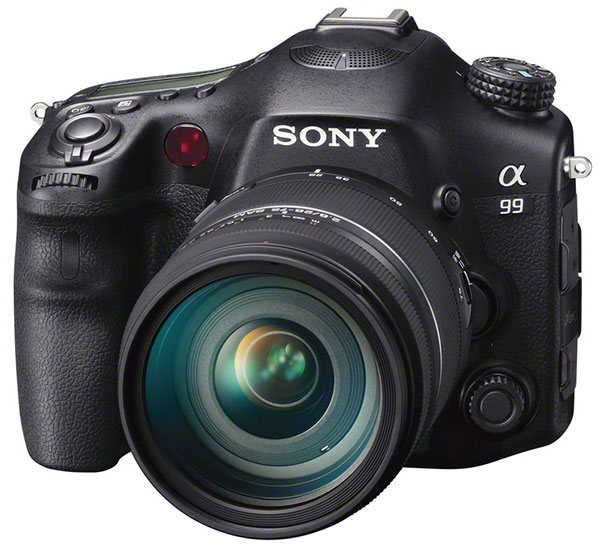
Flagship camera with Translucent Mirror Technology and newly developed 24.3 effective megapixel full-frame Exmor CMOS sensor
World’s first full-frame camera1 with Dual AF System with 19 sensors (including 11 cross sensors) + 102 AF point system (focal plane) and a new AF range control function to set the distance range recognised by the AF system
Very wide sensitivity range ISO 50-25600 (at expanded sensitivity setting) with extremely low noise
Advanced Full HD 50p progressive movie shooting with non-stop Continuous AF and pro-style audio features
XGA OLED Tru-Finder with 100% frame coverage
Enthusiast-class handling with tough, light magnesium alloy body, weather seals and revised Quick Navi Pro interface
Ruggedly built to cope effortlessly with tough assignments, the α99 sets new standards of imaging performance, creative options, user-focused ergonomics and reliability to satisfy demanding enthusiasts.
Unsurpassed imaging performance and responses
Unique to the α99, a newly developed full-frame Exmor CMOS sensor with 24.3 effective megapixels is teamed with a highly advanced BIONZ image processing engine. This powerful sensor/processor combination guarantees unprecedented levels of imaging performance with still and video shooting.
Now advanced photographers can explore the creative possibilities of full-frame imaging plus the responsiveness of Translucent Mirror Technology.
The eagerly awaited successor to the flagship α900 DSLR, the new α99 is the first Translucent Mirror camera from Sony to feature a full-frame 35mm image sensor.
The full-frame sensor’s resolving power is enhanced by a newly developed separate multi-segment optical low-pass filter. Assisted by an all-new front-end LSI, the BIONZ engine processes massive amounts of image signal data from the Exmor CMOS Sensor at very high speeds. Together with a powerful new area-specific noise reduction (NR) algorithm, this achieves a 14-bit RAW output, rich gradation and low noise.
The evolved BIONZ processor boosts maximum sensitivity range (in expanded sensitivity mode) as wide as ISO 50-25600 – a range of 9 stops. Its unprecedented processing power also enables the α99 to shoot a burst of full-resolution images at up to 6 frames per second or 10 fps in Tele-zoom high speed shooting mode.
For the first time ever, the 19-point AF system with 11 cross sensors is complemented by a multi-point focal plane phase-detection AF sensor. With no less than 102 AF points, this additional AF sensor overlays the main image sensor. Harnessing the power of Translucent Mirror Technology, this unique Dual AF System permits ultra-fast, accurate autofocusing that maintains tracking focus even if the subject leaves the 19-point AF frame.
The α99 also debuts an advanced new AF-D continuous autofocus mode that’s supremely effective with moving subjects. The 19-point AF system provides reliable depth focusing information. It’s complemented by the 102-point multi-point focal plane phase-detection AF sensor that copes effortlessly with subjects traversing the focal plane.
From launch, new AF-D mode is supported by the SAL2470Z, SAL2875, SAL50F14, SAL300F28G2, SAL70400G and SAL500F4G lenses. More lenses will be supported via future firmware updates.
As a further focusing refinement, a new AF range control function allows users to set the distance range recognised by the AF system. This smart feature significantly aids operability if you’re focusing on distant sports action through a nearby wire mesh fence.
Crafted for videographers and movie-makers
The α99 inherits the world-leading ‘cinematic DNA’ from professional movie cameras and high-end camcorders by Sony. The unmatched resolving power and sensitivity of the full-frame sensor is complemented by advanced features optimised for professional video production.
The α99 supports the needs of professional movie-makers, offering full-frame Full HD 50p/25p (switchable to 60p/24p) progressive video recording to meet AVCHD Version 2.0 specifications. As introduced on the α77, Full-time Continuous AF Movie allows smooth, non-stop tracking of moving subjects. Other movie-oriented enhancements include real-time Full HD video output via HDMI, and uninterrupted ‘dual-card’ recording using both of the camera’s media slots.
For extra convenience during movie shooting, a silent new multi-controller is easily accessible via a dial on the front of the camera body. This allows smooth, silent adjustment of exposure compensation, ISO sensitivity and metering method, shutter speed, aperture and audio record levels during Full HD video capture. Shooting stamina is tripled by partnering the camera with the new VG-C99AM Vertical Grip that houses up to three batteries in total (see below). It’s even possible to exchange batteries ‘on the fly’ without interrupting movie recording.
Audio features have also been significantly enhanced to meet the exacting needs of serious videographers. An audio level display and adjustable audio record levels are joined by a headphone jack for accurate in-the-field monitoring. The optional XLR-K1M adaptor kit adds a high-quality mono shotgun mic and pro-standard XLR connections for dependable audio acquisition.
Uncompromised handing for serious photographers
The XGA OLED Tru-Finder gives a detail-packed view of your subject, offering 100% frame coverage with exceptional brightness, contrast, clarity and resolution.
You’ll enjoy a full 100% view on the Tru-Finder screen, even if you’re shooting with a DT lens that’s optimised for cameras with an APS-C sensor. Angle of view is converted automatically for image recording and display. This viewfinder is completely compatible with the APS-C format and displays scenes using the entire finder screen.
Complementing the Tru-Finder, there’s also a three-way tiltable 1229k-dot (VGA equivalent) XtraFine LCD with WhiteMagic™ technology to boost screen brightness in outdoor conditions.
Despite its uncompromising pro-class credentials, the α99 is the world’s lightest1 35mm full-frame interchangeable-lens digital camera. A weight of just 733g (without lens and battery) is made possible by Translucent Mirror Technology, while high-rigidity magnesium alloy panels contribute to an extremely tough yet light design.
Weather-resistant seals protect against dust and moisture, while controls and buttons are ruggedized for years of unflinching operation on virtually any assignment. The camera’s stamina and reliability is underlined by a redesigned shutter block that’s tested to approximately 200,000 release cycles.
Ergonomics have been refined for a smooth, seamless workflow that doesn’t interrupt your creative focus. Enhancements include a re-designed grip, while switches and button shapes are differentiated for intuitive fingertip operation without taking an eye off your composition. There’s also a new exposure mode dial lock that prevents accidental rotation.
Further evolved from the acclaimed α700 and α900, the newly-developed Quick Navi Pro interface gives quick, intuitive one-handed access to shooting parameters.
The camera can also be operated via remote PC connection. Supported functions include switching between still/movie shooting, plus automatic transfer of still images from camera to PC for enhanced studio workflow. *Editor’s note: betcha there’s no Mac app given Sony’s historic attitude to Apple!
Designed for professionals: new lens and accessories
The full-frame imaging capabilities of the α99 make an ideal complement for the new 300mm F2.8 G SSM II (SAL300F28G2) lens. Designed for demanding sports and wildlife applications, this bright super-telephoto offers a significantly uprated optical design and improved handling compared with its predecessor. The Sony-developed Nano AR Coating on optical surfaces assures flawless still images and HD video with reduced flare and ghosting, offering enhanced contrast with crisp black, while a new LSI drive circuit offers faster, more accurate autofocus with enhanced tracking AF. The dust- and moisture-resistant design makes the lens ideal for the toughest outdoor shooting assignments.
In addition, a new wide-aperture Carl Zeiss A-mount prime lens is now under development. Optimised for superb results with the camera’s 35mm full frame image sensor, the Planar T* 50mm F1.4 ZA SSM will be available in Spring 2013.
Offered exclusively as an option for the α99, the brand-new VG-C99AM vertical grip can house and manage three batteries in total (including the camera’s own on-board battery). Resistant to dust and moisture, the grip is ideal for lengthy shooting sessions in the studio or outdoors.
The range-leading HVL-F60M is a powerful flash (GN60, in metres at ISO 100) with built-in LED light that’s ideal for creative applications with stills or movie shooting. Smart functions include wireless multi-flash ratio control and Sony’s unique Quick Shift Bounce adjustment, while operation can be controlled quickly via the flash’s intuitive Quick Navi system. Resistant to dust and moisture, the HVL-F60M comes supplied with a bounce adaptor for flash, and a colour conversion filter for use with LED lighting. Ideal for the α99 and other cameras featuring the new Multi Interface Shoe, the HVL-F60M can also be used with Auto-lock Accessory Shoe cameras via the supplied ADP-AMA Shoe Adaptor.
Compatible with 49mm and 55mm diameter lenses, the HVL-RL1 Ring Light offers highly effective LED illumination of small subjects that’s ideal for macro shooting. Its high output level (approx. 700 lx/0.3m) is approximately four times brighter than the previous model. Brightness can be adjusted steplessly for precise control of creative lighting effects. Operation can also be switched between full-ring illumination for shadowless lighting and half-ring illumination to create shadow effects. The optional FA-MA1AM Macro Light Adaptor is required when using the Ring Light with SAL30M28 or SAL50F18 lenses. Compatible with the Multi Interface Shoe of the α99, the HVL-RL1 can also be used with cameras that have an Auto-lock Accessory Shoe via the supplied ADP-AMA Shoe Adaptor.
The new XLR-K1M XLR Adaptor Kit meets the demanding audio needs of professional movie production. It provides two pro-standard XLR terminals for connecting the α99 with professional microphones and mixing consoles. Operating flexibility is maximised by MIC/LINE input selection and separate adjustment of two channel levels. The adaptor kit comes supplied with the ECM-XM1 monaural shotgun microphone, but may also be used with a wide range of professional microphones. An optional bracket is required when using the XLR-K1M with the α99.
The RMT-DSLR2 Remote Commander allows wireless shutter release for still images and start/stop control of video shooting. As well as the α99, it’s also compatible with other α A-mount and E-mount cameras that include a remote control receiver. (Our highlighting in red – this may NOT mean that it can operate video on other cameras, just that it will operate their existing remote functions – dependent perhaps on firmware updates)
Styled to reduce carrying fatigue, the LCS-BP3 Backpack is designed to meet the stringent demands of professional photographers. Its generous capacity can hold the α99 camera body plus Vertical Grip and attached telephoto zoom lens, together with 3-4 spare lenses, accessories and a 15.5” laptop.
The ADP-MAA is a new shoe adaptor that allows Multi Interface Shoe2 cameras to be used with Auto-lock Accessory Shoe accessories. Conversely, the ADP-AMA she adaptor allows Auto-lock Accessory Shoe cameras to be used with Multi Interface Shoe accessories.
The PCK-LM14 Screen Protector Semi Hard Sheet safeguards the camera’s LCD screen against dust, scratches. It’s supplied with a separate protector sheet for the top display panel.
Sony’s new SDXC UHS-I memory card, SF-64UX(64GB) with ultra-high speed interface (UHS-I) compatibility, offers significantly higher transfer speeds up to 94MB/s (read) and 43MB/s (write). The SF-64UX is ideal for burst shooting with the α99, without missing the moment. It also enables rapid data rates when transferring content including large RAW images or video files to your PC.
The new cards have been subjected to rigorous Sony testing, in order to achieve high levels of reliability and data integrity. Additionally, the new cards are water-resistant, and are designed to perform under a wide range of operating temperatures. Users can also shoot with ease knowing their photos and videos are protected thanks to Sony’s File Rescue Software* which can help recover photos and videos that may have been accidentally deleted.
(*This software is available for Sony memory media products customers through free download at www.sony.net/memorycard)
The new α99 full-frame Translucent Mirror camera from Sony is available in the UK from early November 2012.
1 Among interchangeable-lens digital cameras with a full-frame image sensor (as of 12th September 2012). According to Sony internal survey.
2 The α99 is equipped with Sony’s newly-developed Multi Interface Shoe. This is capable of accommodating various accessories for photo and movie shooting such as flash and microphones, while drawing power from the camera. It’s also compatible with Sony accessories that use the standard ISO 518 accessory shoe. The Multi Interface Shoe was developed as a common shoe for imaging products by Sony – such as digital still cameras, digital video cameras and interchangeable lens cameras – promoting compatibility among accessories and offering an enhanced shooting experience for users.
Cyber-shot™ DSC-RX1 from Sony is world’s first1 compact camera with 35mm full-frame 24.3 effective megapixel sensor
Full-frame imaging from a compact camera that’s drastically smaller and lighter than any full-frame DSLR
Exmor™ CMOS sensor with approximately 24.3 effective megapixels for flawless, detail-packed photos and Full HD video
Carl Zeiss Sonnar T* 35mm F2 prime lens; with Macro mode for 20cm minimum focusing distance
Extremely wide sensitivity range from ISO 100 – 25600
Intuitive manual controls with aperture and focus rings
New Multi Interface Shoe compatible with optional flash, electronic viewfinder, optical viewfinder etc.
The extraordinary new Cyber-shot™ DSC-RX1 from Sony offers photo enthusiasts the chance to explore the creative possibilities of full-frame imaging with a compact digital camera that fits easily in the palm of your hand.
At just 482g (with battery and memory card), it packs a 35mm full-frame sensor and wide aperture F2 fixed-focal lens into a camera body that’s perfectly proportioned for travel and street photography as well as portraits and day-to-day shooting.
Far smaller and lighter than any full-frame DSLR, the Cyber-shot™ RX1 offers superb imaging quality that’s previously been the domain of high-end professional DSLR cameras. The unified lens/body design assures razor-sharp alignment of the sensor and optical components, bringing out the full potential of the lens to deliver unprecedented image quality, right to the very edges of each frame. Full manual control options are complemented by effortlessly intuitive operation, making it easy for enthusiasts to realise their creative vision without sacrificing portability or operating comfort.
In a world first1 for digital compact cameras, the Cyber-shot™ RX1 features a 35mm full-frame Exmor CMOS sensor. With a resolution of 24.3 effective megapixels, it’s over twice the area of the APS-C sensor inside much bulkier DSLR cameras. Capable of resolving the finest image details and subtle textures, the full-frame sensor assures absolute fidelity, rich colours and an impressively broad dynamic range.
The large sensor size also helps boost the camera’s sensitivity range to a generous ISO 100 – 25600. Sensitivity can be adjusted as low as ISO 50 in expanded mode2. Similarly, ISO settings as high as 102400 can be achieved using Multi Frame Noise Reduction, allowing the Cyber-shot™ RX1 to capture natural, low noise handheld images in near-dark conditions without needing flash.
Complementing the full-frame sensor is a fast, bright Carl Zeiss Sonnar T* lens with a fixed focal length of 35mm – a versatile choice for portraits, street photography and everyday shooting. Derived from the German word “Sonne” (“sun”), the Sonnar name reflects the ability of the lens to capture as much light as possible. This premium lens features newly designed optics including an Advanced Aspherical (AA) glass element which contributes to the camera’s extremely compact palm-sized dimensions without sacrificing optical performance.
The lens’s wide F2 maximum aperture and 9-bladed circular aperture enable beautiful ‘bokeh’ (defocus) effects to rival professional-class DSLR camera lenses. A Macro switching ring on the lens barrel instantly shortens minimum focusing distance to just 20cm (from image plane), making the Cyber-shot™ RX1 ideal for capturing small close-up subjects with exquisite detail.
Data from the Exmor CMOS sensor is handled by the evolved BIONZ engine that also powers full-resolution burst shooting at up to 5 frames per second. The BIONZ processor can output image data in 14-bit RAW format, giving advanced users immense freedom over developing, post-processing and managing RAW files to match their personal creative vision.
Despite the camera’s extraordinarily compact dimensions, photographers are offered a virtually limitless palette of options for creative expression. The Cyber-shot™ RX1 also offers a full range of manual control modes, just as you’d expect from a no-compromise DSLR camera.
Dedicated lens rings allow fingertip control of focus and aperture, while a DSLR-style Focus mode dial on the front of the camera allows easy switching between focus modes. Top-mounted exposure compensation and mode dials are ergonomically placed for easy operation, while custom function and AEL buttons fall comfortably to hand without interrupting your creative flow.
Accessed via the camera’s pro-style control dial and cross keys, Quick Navi mode allows fast, intuitive adjustment of camera settings which is ideal when using the camera with an optional viewfinder. In addition, the camera also features a memory recall (MR) mode that allows storage and instant recall of up to 3 sets of camera settings.
Other refinements include a MF Assist function that magnifies a portion of your image to simplify fine focus adjustments. There’s also a pro-style peaking function that highlights sharply-focused areas of the image on screen – adding the optional FDA-EV1MK electronic viewfinder kit allows even greater manual focusing precision.
Pixel Super Resolution Technology allows magnification of image size without sacrificing pixel count, maintaining far higher quality than achievable with conventional digital zoom. The camera also features a Smart Teleconverter function that crops a central portion of the image sensor, boosting effective magnification by 1.4x or 2x. Thanks to the full-frame sensor’s extremely high pixel count, even zoomed and cropped images maintain generous amounts of fine detail when blown up at large print sizes.
In addition to flawless stills, the Cyber-shot™ RX1 can capture high-quality, low-noise Full HD movie footage at a choice of 50p/60p or 25p/24p (progressive) frame rates. 24p recording enables the Cyber-shot RX1 to transform everyday scenes into film-like movies, making it easy to record beautifully atmospheric video in very low lighting. The camera also provides a full complement of PASM exposure modes to give photographers absolute creative flexibility during video shooting.
Artistically ambitious photographers can even fine-tune images with a choice of 13 Creative Styles, plus a wide range of inspiring ‘PC-free’ Picture Effect treatments. Furthermore, wider compositional possibilities are offered by Auto HDR and D-Range Optimiser, bracket shooting (Exposure, DRO or White Balance) and Auto HDR shooting modes. The camera even offers a Digital Level Gauge that indicates camera pitch and camera roll on the LCD screen for straight, even horizons and architectural shots.
Shooting possibilities for stills and video are broadened by the camera’s Multi Interface Shoe3 that accepts a growing range of accessories. Options include a powerful flash, electronic viewfinder, optical viewfinder, clip-on LCD monitor. Also available are a high-quality jacket case, lens hood and thumb grip for sure, comfortable handling.
Learn more about official accessories by Sony for the Cyber-shot™ RX1 here:
The Cyber-shot™ RX1 also comes preinstalled with PlayMemories Home (Lite Edition) software, allowing easy image transfers to a PC for managing, editing and printing. Available for free download, a full version of PlayMemories Home adds movie editing and disc burning.
Also available as a free download, PlayMemories Studio allows game-like editing of photos and videos on PlayStation®3. Images can be shared easily via PlayMemories Online, the cloud-based sharing service from Sony that simplifies ‘any time, any place’ viewing on a wide range of connected devices.
The new Cyber-shot™ RX1 full-frame digital compact camera from Sony is available in Europe from December 2012.
1 Among compact digital still cameras. According to Sony research, as of September 12, 2012.
2 Recordable dynamic range is reduced at sensitivity levels below ISO100.
3 The Cyber-shot™ RX1 is equipped with Sony’s newly-developed Multi Interface Shoe. This is capable of accommodating various accessories for photo and movie shooting such as flash and microphones, while drawing power from the camera. It is also compatible with Sony accessories that use the standard ISO 518 accessory shoe. The Multi Interface Shoe was developed as a common shoe for imaging products by Sony – such as digital still cameras, digital video cameras and interchangeable lens cameras – promoting compatibility among accessories and offering an enhanced shooting experience for users.
Whether you like it or not – and some aspects are going to be useful – Sony is rolling out a whole new generation of gear including advances in digital imaging. This is a long statement made at a press conference. It would take a long time to edit it, so here’s their text in full.
Sony Accelerates Revitalisation of Electronics Business by Enhancing User Experiences with New Product Offensive
Sony Corporation’s President and Chief Executive Officer Kazuo Hirai unveils an array of Xperia smartphones, a new Xperia-branded Tablet, VAIO PC, Wi-Fi camera, NFC-enabled audio devices, new applications, new musical partnership, a Book of Spells and a showstopping 84-inch BRAVIA 4KTV at IFA 2012
Sony Corporation (“Sony”) today unveiled a portfolio of advanced next-generation products which will help accelerate the revitalisation of the electronics business.
Kazuo Hirai, Sony Corporation’s new President and Chief Executive Officer, speaking at Sony Europe’s press conference at the IFA electronics show in Berlin, launched a range of compelling products – each emphasising Sony’s stated strategic focus on Mobile, Digital Imaging and Gaming.
“This is an extraordinary company going through extraordinary times. It forces us to confront difficult realities and make hard business decisions. We must look at ourselves honestly and hold true to the values and purpose of Sony. I am determined to do this with a laser-like focus, speed and execution,” said Hirai. “The products I unveil today will show Sony’s long-standing ambition to deliver what customers value – a simpler, easier, more entertaining and user-friendly experience.”
The range of new products announced in Berlin includes three new Xperia smartphones – one featured in the forthcoming James Bond movie ‘Skyfall’ – a new splash proof Tablet, a new hybrid slate/laptop VAIO PC, a new NEX camera with built in Wi-Fi enabling feature-adds post purchase, and enhanced NFC enabled headphones and audio devices.
Sony also unveiled a stunning 84-inch BRAVIA 4K TV, promising a totally immersive experience and building on Sony’s acknowledged professional expertise in 4K with acclaimed broadcast camera the CineAlta F65 and 4K cinema projection system.
Hirai vowed that each product would reflect the ‘One Sony’ ambition, the organisation’s drive to deliver technically-advanced products and compelling consumer experiences through greater synergies across all Sony’s businesses from electronics to games, movies and music.
“As “One Sony” we are joined together by a single vision, which I define with one particular Japanese word – Kando. It means to move people emotionally. Sony will bring a smile to the faces of a global audience” said Hirai.
MOBILE
Mobile devices are the gateway to Sony’s user experience. Adding to our acclaimed Xperia smartphones for providing premium entertainment experiences, Sony Tablets will be brought to market under the Xperia brand as of September 2012 to expand these great mobile experiences to the tablet arena.
The latest Sony mobile devices, including Xperia smartphones, Tablets and VAIO PCs, will boast Sony’s media applications, with the new interface designed to enhance the user experience in high picture and sound quality. It will enable users to enjoy and share music, photos, and movies in a simple and intuitive way. These features will be available across new Xperia smartphones, Xperia Tablet and selected VAIO PCs.
Furthermore, the new Xperia smartphones and VAIO PCs promise to bring consumers the ultimate cross-device connectivity. Through Sony’s One Touch function, which incorporates NFC (Near Field Communication) technology, users can easily and instantly enjoy their music and photos across an array of NFC enabled Sony devices by simply touching one device to the other without the need for Bluetooth or Wi-Fi set-up.
Introducing the new products, Hirai added: “Individual Sony products will entice and inspire people. But what’s also important is that by connecting and combining hardware, network services and applications, we will provide a truly remarkable and compelling experience.”
DIGITAL IMAGING
Sony’s mobile products are pioneering new ways to capture great digital pictures, whilst delivering an enhanced user experience through further, deeper convergence of hardware, content and services. The new NEX-5R model is the latest Digital Imaging product to deliver enhanced usability.
The NEX-5R compact system camera – with built in Wi-Fi – allows users to check the image, adjust camera exposure and control the shutter wirelessly from their smartphone. This makes it ideal for taking posed family pictures via the timer, where the image can be checked on the smartphone before the pose is broken. It also boasts “Fast Hybrid AF” giving DSLR-like focussing responses when capturing fast-moving action.
The NEX-5R is the first camera compatible with PlayMemories Camera Apps, a service for downloading new apps such as “Time-Lapse” and “Cinematic Photo” directly to the Wi-Fi enabled camera.
Sony is also introducing the new ‘wearable’ video camera, the HDR-AS15 with ‘ExmorR’ CMOS Image Sensor and SteadyShot image, great for skydiving or mountain biking.
GAMING
This autumn, Sony Computer Entertainment is due to launch Wonderbook, creating a multi-dimensional world using PlayStation Eye and augmented reality technology. It’s an experience like nothing else. The first Wonderbook title will be Wonderbook: Book of Spells, created in collaboration with J.K Rowling.
IN DETAIL
Detailing the product offensive at IFA, the Sony President and CEO highlighted the following innovations:
Xperia Smartphones
The integration of Sony Mobile Communications earlier this year was an important step for Sony. The company launched the first Sony smartphones to market earlier this year – the Xperia NXT (NEXT) series.
The next introduction is the Xperia T, Xperia V and Xperia J, building on the acclaimed arc design. They will be brought to the market over the next few months.
Xperia T is the new global flagship model that delivers the best high definition experience in a smartphone to date. It has a 4.6inch display powered by Sony’s Mobile BRAVIA Engine. Consumers can watch videos shot in Full 1080-pixel HD. The 13 mega-pixel fast-capture camera goes from sleep to snap in an instant with a single key press. The most amazing feature is how easily consumers can connect Xperia T to other devices to enjoy their content – with just one touch.
Xperia V is LTE enabled for super-fast network performance. It also comes with the highest level of water resistance in a smartphone, so users can continue using their Xperia V, come rain or come sunshine.
Xperia J is an eye-catching combination of stylish design and a stand-out screen size at a competitive price point.
Xperia Tablet S
The new Xperia Tablet combines a splash-proof body with high quality sound and a thinner, lighter design than its predecessor. It also offers a new app called ‘Socialife’ which enables users to enjoy SNS and news feeds in one viewer with a magazine-like layout. Together with new covers, stands and dock speaker, it is a communications device that will bring new style and fun into your life and appeal to customers of all ages and lifestyles. Running a NVIDIA® Tegra® 3 quad-core processor and Android 4.0.3 platform, it’s got all the power consumers will need to enjoy their favourite media, apps and games.
VAIO™ Duo 11
VAIO Duo 11 is a unique, Surf-Slider design hybrid PC which allows smooth sliding between slate mode and keyboard mode, ideal for being on the move. It features a thin, compact body with high performance, and a sophisticated stylus for the easy capture of handwritten digital notes, maximising the touch capability of Windows 8.
VAIO™ Tap 20
VAIO Tap 20, designed to leverage Windows 8, is a 20-inch, tabletop PC which tilts from desktop to lay-flat style. It can be a conventional desk top PC for personal use or a multi-media device – if used flat – for family use, for everything from playing board games to music editing or reading.
Audio Visual: ‘One Sony’ brings professional know-how and greater connectivity to consumer experiences
TV has always been part of Sony’s DNA, a symbol of constant innovation. It is the one product that still connects family and friends through shared experiences, more than any other.
Sony’s first 84-inch BRAVIA 4KTV
The new Sony 84-inch BRAVIA 4KTV boasts a 4K (3840 x 2160) LCD panel in the industry’s largest inch class (*1) and incorporates Sony’s ‘4K X-Reality PRO’ super-resolution high picture quality engine, meaning users will be able to reproduce a variety of content – including movies, TV programs, photos and games – to beautiful 4K picture quality ready to enjoy on the stunning 84-inch screen. This formidable combination seamlessly delivers a high-resolution large-screen picture with high-quality powerful sound to provide consumers with an immersive experience, unlike anything offered by existing televisions. The new BRAVIA 4K TV will be available worldwide, from the end of 2012.
*1: As of August 29, 2012.
Sony continues to take a lead role in advancing 4K technologies and is playing a leading role in professional 4K content creation through the CineAlta ‘F65’ camera, capable of shooting 4K content and beloved by leading film makers, and also the 4K digital cinema system used in the professional field. In the world of consumer electronics, the 4K home theatre projector for family use has been extremely well received since its launch last year.
The launch of the 84-inch 4K BRAVIA TV demonstrates the new and exciting consumer home-experiences made possible through professional technologies, advanced through the company’s ‘One Sony’ approach to hardware and content innovation.
HMZ-T2 Personal 3D Viewer
Lighter and more comfortable than its predecessor, the all-new Personal 3D Viewer from Sony is a head-mounted, High Definition 2D and 3D personal display with virtual 5.1 surround sound. It’s perfect for movies and gaming, with twin OLED screens that display vivid, super-sharp images (with zero cross-talk interference) to absorb consumers in a truly personal experience.
MDR-1 headphones
The new MDR-1 headphones are the result of collaboration between Sony Music artists and Sony engineers to deliver sound quality that accurately reproduces the original intentions of the musicians. The MDR-1 RBT is NFC enabled, and carries Sony’s One-touch function making it easy to share music across a range of NFC enabled devices by instantly setting up a wireless connection between devices, with just one touch. There is no need for any Bluetooth or Wi-Fi set up.
SRS-BTM8 wireless NFC Bluetooth speaker
The SRS-BTM8 portable NFC Bluetooth wireless speaker from Sony lets you enjoy music from your smartphone or tablet in high quality audio, anywhere in the house. With its built in One-touch function from Sony, with just one touch to the top of the speaker with any NFC-enabled Xperia smartphone – including Xperia T and Xperia V smartphones from Sony – music will be streamed instantly. There is no need for Bluetooth set-up.
Partnership with Berliner Philharmoniker and Berlin Phil Media
Sony has extended its partnership with the world renowned Berliner Philharmoniker, and Berlin Phil Media, which offers the “Digital Concert Hall” streaming service. For the past two years, Sony has video-streamed Berliner Philharmoniker’s musical performances for customers worldwide to enjoy on Sony’s home entertainment products. Under this new partnership, Sony will also supply professional products, which incorporate its key technologies, whilst also providing technical support for the creation and streaming of Berliner Philharmoniker content through the service. This partnership will further enhance collaboration and innovation around audio development, and produce feedback which will be invaluable for Sony.
Sony HDR-AS15 action-cam
Ideal for sports lovers, the HDR-AS15 is a new type of camera; a ‘wearable’ video camera. It features Sony’s SteadyShot image stabilisation technology to deliver stunningly smooth footage which is ideal for filming sports scenes such as sky diving, mountain biking or snowboarding.
Equipped with built-in Wi-Fi, consumers can remotely control this video camera from smartphones and upload the recorded data online immediately. It also features a 170° wide angle Carl Zeiss lens.
List of all products and services launched at IFA 2012 for the UK market
BRAVIA 84” 4K TV
Head Mounted Display HMZ-T2
AV Receiver STR-DA5800ES
Speaker System SS-NA2ES, SS-NA5ES, SS-NA8ES, SA-NA9ES
VPL-HW50ES Home Cinema 3D projector
Wireless NFC Bluetooth speaker SRS-BTM8, SRS-BTV5
Headphones MDR-1 (MDR-1R/1RBT/1RNC)
NEX-5R – Wi-Fi enabled camera
Action Cam HDR-AS15– personal camera
PlayMemories Series (new Camera Apps functionality)
Xperia Splash/Water-proof Smartphone
Xperia Tablet S
Music Unlimited – New Subscription Tier, “Access” for PCs and PlayStation(R)3
VAIO™ Duo 11 (Slider hybrid PC)
VAIO™ Tap 20 (Tabletop PC)
VAIO touch range (VAIO™ Duo 11, VAIO™ Tap 20, VAIO T Series 13, VAIO L Series)
The first thing that is likely to strike you about Sony’s one-inch sensor Cyber-shot DSC-RX100 is size. It’s tiny, slightly smaller in body than the Nikon 1 series interchangeable lens mirrorless cameras using an identical size 2.7X factor, one-inch or 13.2 x 8.8mm sensor.
This just a fraction over half the area of a standard APS-C sensor, and where Nikon has chosen to have 10 megapixels of active imaging plus others unused or devoted to phase-detect focus on the silicon, Sony has opted for 20 megapixels.
At first this seems excessive, until the performance of other new smaller sensor cameras is considered. The Fuji X-10, for example, has a 12 megapixel sensor measuring 8.8 x 6.6mm and achieves a respectable balance of sharpness and noise-levels. The RX100 has a slightly lower pixel density. Compared to the Canon G12 it’s four times the sensor size and twice the sensel size.
The 1.0 type sensor also gives just that little bit more creative control over depth of field. With the usual third to two-thirds inch standard sensors in pocketable compacts, the lens must be used wide open at any given focal length to provide a degree of differential focus. To avoid sharpness loss, most such cameras can not be stopped down to settings like f/11 and sometimes have a choice between two apertures only, wide open and something moderate like f/8.
The Fuji X10 zoom only stops down to f/11 but offers a full continuous range of settings. So does the RX100, its 10.4-37.1mm lens ranging from f/1.8 to f/4.9 wide open but limited to f/11 minimum regardless of zoom setting. Since even f/11 can produce some diffraction-limit related softening, its performance around f/5.6 is critical. This would be the setting I would choose for routine Aperture-priority shooting.
At such a setting, the low ISO quality of the RX100 can be exploited. Unlike any of the Sony NEX models, the little RX100 has been given user control of maximum and minimum Auto ISO limits. The full auto range is from 125 to 6400. Manually set ISO can be extended downwards to either 80 or 100 (but these settings just overexpose the image and compensate in conversion). The camera seems to have been developed as well as manufactured in Japan, and the firmware and menu system resembles the mainstream Alpha DSLR/SLT camera line rather than the mirrorless NEX. Editor’s note: having sold my original RX100 I bought another, the second although made at the same date, is made in China. It seems either better or no worse.
The shutter is speeded to 1/2000th which is not a very fast high speed for a camera capable of 10 frames a second action bursts (or 2.5fps normal continuous shooting). The longest exposure possible is 30 seconds. By whatever means, aperture or shutter, Sony allow control to within 1/3rd EV step and compensation to ±3EV, but AE Bracketing is limited to three frames at either ±0.3 or ±0.6EV.
Control over settings is handled by a single top mode dial, a shutter release with power zoom lever to the front, a rear Control Wheel with four cardinal point click functions, four further surrounding buttons, and a Control Ring set round the lens bezel. This can be silent or make click sounds to mark setting changes but lacks physical resistance or detents. It doubles as a fine focus ring when the camera is set to manual focus, aided by focus peaking and on-screen magnification. Its action is very smooth indeed, and it can be operated easily by a single finger from either hand.
Real photo – the film and lens are entirely hidden behind the RX100 but imaged by its close focus ability at 10.4mm
Considering the 101 x 58mm footprint of the body, everything is designed efficiently to allow a 3 inch rear screen using 1.2k dots and an additional white-light augmenting RGB to improve sunny day use. It’s not a touch screen, nor is it articulated or hinged. But you will touch it, for sure… a cloth to wipe off your thumbprints is an essential accessory. It appears to be glass, but may just be a hard coated plastic layer, something with which Sony has a bad history.
Actual size next to a CF card, which this camera of course does not use – it takes SD or Memory Stick Pro Duo.
The new small battery type NP-BX1 allows 330 shots – better than many high pixel count consumer DSLRs and mirrorless models now – and can only be charged in the camera itself, via any USB 5v source and the supplied Micro USB connector cable. This is not a standard Mini USB, just as the Micro HDMI (cable not supplied) is not a commonly found fitting.
Against the disadvantage of in-camera charging you can set in-car charging, laptop or phone supply charging, and the camera’s ability to run without a battery installed when connected to its supplied AC charger. Both third party lith-ion cells and third party external chargers can be found on eBay. Anything which offers a standard, powered USB connection can charge the RX100.
The British charger is an old warhorse. The US charger is a neat monobloc transformer half this size with folding AC mains pins. This kludge is bigger and heavier than the camera…
A full charge takes 155 minutes using the charger with its high level USB-power output, but may take longer through a PC USB port or devices providing minimal USB power. You can leave it plugged in to USB all the time as the charge cycle is cut off when an orange charging light in the on/off switch extinguishes. When the camera is switched on to connect to the computer as Mass Storage (etc), this light turns green. It is possible to use the RX100 without the battery installed, connected to the charger.
In the box, you get no software, only an instruction manual which covers the bare bones. It seems to be assumed that what Sony call the best ‘professional’s compact’ ever will be bought by experienced digital camera users. Nearly all the functions on the RX100 from sweep panorama to HDR and noise reducing multishot modes are found on other cameras, and the location and nomenclature of all functions is at least familiar. Download links are given for a PDF identical to the bare manual, or a web-page based version with colour illustrations which is far better but can’t be downloaded.
A wrist strap is supplied, along with two neat cord and leatherette toggles to attach a regular camera neckstrap, as the body has two almost microscopic strap lugs. Nothing other than the very fine cords of Sony’s strap or strapholders would be likely to fit.
The body is solidly made and all access doors seal well, but it’s not resistant to anything wet, dusty or involving hard surfaces and heights. The lens’s rear glass is located very close to the sensor, and zooming appears to move only the middle and front groups. This should make it dust-free for life. Time will tell, and if any dust ever does get on the sensor, it will need a factory repair. But it looks to be designed so that will never happen.
For the professional user, the big appeal of this camera is its invisibility. Only 36mm thick with the lens collapsed, it’s just a fraction fatter and smaller than an iPhone, and with focusing down to under two inches there’s hardly anything it can’t capture. Users may criticise the 28-100mm equivalent focal length range, preferring 24mm if possible, but the focal length of the zoom is stated after allowing for some strong in-camera distortion corrections at the wide end.
To achieve a 28mm field of view (73°) for an in-camera JPEG, the corrections must deal with a very high level of barrel distortion. The raw file is uncorrected, and shows a diagonal field of view closer to that of a 24mm (85°). This may explain why Sony’s own information has claimed both 24mm and 28mm as the widest angle, when the stated focal length and sensor size clearly equate to 28mm. My measurements from the two image versions below indicate that if the correct equivalent is 28mm, the uncorrected diagonal angle is equivalent to a 24.8mm. Either way the RX100 should not be criticised if you could be happy with a new Canon EOS M – 1.6X sensor, 18-55mm lens, that’s a 28.8mm widest limit before applying Adobe Lens Profile corrections which will probably reduce the true angle to a 31mm.
And that of course applies to almost all wide angle lenses except the Sony NEX E 16mm f/2.8, which has pincushion not barrel distortion and therefore does not lose any of its diagonal angle (for that is how lens angles are measured) when corrected. There is an inbuilt profile for the latest ACR and Lightroom, but unlike other Adobe Lens Profiles, you can not adjust or turn off the disortion control. Apply the profile does not move any pixels, it simply corrects vignetting and CA. These programs are reading metadata in the raw file to apply the geometric correction automatically and you can’t disable it. To see the full field of view of the lens at its 10.4mm focal length, you must use a processor like Iridient Raw Developer (Mac only) which ignores the instructions.
Above: in-camera fully corrected JPEG at 10.4mm, and uncorrected raw conversion (by Iridient Raw Developer) showing full view angle of the lens before removing the high level of barrel distortion. Just move your cursor over the image to see the change. Adobe programs prevent the removal of the camera’s automatic correction – you can’t get to the ‘wide’ version.
When shooting video in 16:9 format with stabilisation set to Standard (optical) or Off, the lens range is trimmed to 29-105mm equivalent, and the image is cropped only slightly on pressing the Movie button. If you set Active stabilisation for video, optical stabilisation is replaced by pixel shift electronic stabilisation on the sensor. The crop is to 0.87X of the normal video field (measured here), meaning that the effective focal length range for Active video is 33-120mm. This 0.87X factor is exactly the same as the NEX-7 video crop factor.
The RX100 can be concealed in your hand and when used, with no eye-level viewfinder and composition on the rear screen instead, you look like any cameraphone user or tourist. In fact you are capturing what could be a highly detailed 20 megapixel image suitable for double page magazine or newspaper repro.
This is, of course, also a camera which won’t get you thrown out of sports stadiums or concert venues despite its ability to capture 50/60p HD1080 video with good quality stereo sound, and to capture full resolution JPEG still frames during video (17 or 24Mbps, not 28Mbps) without interruption. Writing the JPEG takes some time, parallel to video writing, and a faster SDHC or MS Pro Duo card is recommended. It can record AVCHD-2 format movies at up to 28 megabits per second, with AF during video and a good degree of setting control including manual exposure. It can not capture raw still files during filming. There is a faint click sound only during the video.
Output
As for the quality of results, the lens may be letting the sensor down slightly; although very high in resolution even wide open, corners can lose detail because the focus plane is far from flat. Bright lights or overexposed details can produce a visible flare or glow, it’s possible to get purple fringes. Against this you must set pixel-crisp sharpness wide open, at any focal length, in many shots.
The exposure over-ride is excellent, and the screen really gives an exact view of what you are doing. Here, minus 2 stops was needed. This is at ISO 125, 1/25th at f/5.0 at 17mm (45mm equivalent) focal length. The original file has perfect detail corner to corner – every leaf sharp.
At the best – ISO 80 to 125, stopped down just one full step from full aperture – the RX100 can match or better the typical output of a 21 megapixel full frame DSLR with 24-105mm lens. At the worst it’s better than any smaller sensor compact, especially if the 10 megapixel JPEG shooting option is chosen or the file size is reduced to match a typical 12-16 megapixel 2/3rds inch sensor image.
One of my first tests, wide open at f/4.9 at 37.1mm and auto set to ISO 500, in camera JPEG. Just lovely colour and tone, perfect WB, perfect auto exposure. An early fallen leaf.
High ISO results are encouraging – using ISO 800 or 1600 should be no barrier to large clean reproductions, 3200 and 6400 remain clean in good light with detailed subjects but show coarse mottled grain in defocused areas with low light. Multishot modes are similar to NEX and can greatly improve results, but for my tests I stuck to raw files (though all the examples shown here are from in-camera JPEG) and single shot modes. Also, with f/1.8 apparently as sharp as most lenses well stopped down and having plenty of depth of field, I have tended to use low ISO settings in conditions where I’d set my Alpha 77 to ISO 800.
This shot was taken at 1/100th at f/1.8 at ISO 125, just because with this camera you CAN – no need for high ISO when you have f/1.8 at 10.4mm. But how about lens quality, how about depth of field? Take a look – all clips from the in-camera JPEG:
You can see the tendency to flare around light sources, and remember – this is an optically corrected image. Look at this in raw, and the purple fringes on those lights are the most colourful thing in the shot. This is from the middle of the frame.
Here’s the extreme right hand up to the very edge. Remember, it’s a 28mm f/1.8 equivalent.
Here’s the left hand, further away, a little bit in from the edge to catch the best detailed target.
And here is the bit you expect to be awful, more distant trees against the sky. Not bad for f/1.8?
Active video stabilisation is pixel-shift electronic, still stabilisation and standard video are in-lens optical. Both work well and the electronic variety is particularly good at dealing with small movements of your hand when holding such a small device for filming. Video quality is a match for any HD1080 DSLR, with a true 50p or 60p (USA) frame rate. The RX100 also has full user control over ISO, shutter speed, aperture and manual focus during video; the shutter-release zoom lever provides a smooth slow fixed speed zoom during filming. Beyond the 3.6X optical range, further digital zooming drops sharpness and can not be recommended. The point where digital takes over is well defined by a pause in zoom travel but you can not disable digital zoom to 14X maximum.
ISO 3200, 1/30th at f/1.8, 10.4mm, very low yellow pub light.
100% clip of in-camera 3200 JPEG – maybe a bit rough, but not bad at all…
White balance is generally well optimised, exposure is less predictable in difficult conditions. The multi-zone metering and focusing settings can produce unexpected results, spot and single point choices may not do any better as they will favour just the targeted tone. Access to +/- compensation is rapid. It can be assigned to the ring round the lens. This control ring is smooth in action and works well for adjusting exposure while viewing the rear screen.
Faults or flaws
The uncorrected image has fairly strong CA, which in defocused zones (especially that critical phase between sharp and truly out of focus) can create purple fringes on a large scale. The camera software turns these into white glow. Slightly defocused detail, especially if brightly lit beyond the clipping range of the sensor, can produce unpleasant bright fringes which are impossible to remove. Very bright areas even when well focused tend to flare into their surroundings.
I don’t really want to show what the fully lit bits of lichen at minimum focus look like – the highlights flare a fair amount.
Dynamic range is good, but not exceptional. Highlights clip readily, and recovery in either Raw Developer or IDC v4 did not pull in missing detail, it just darkened the value of a sharply clipped high bit. Though ISO 80 and 100 provide finer grain, they are less use than ISO 125 or 200 in contrasty light or with flash, as they clip more. Highlight colour recovery and use of DRO can produce some very odd effects. Editor’s note: since this original review, ACR/LR has been updated to process the raw files, and this is one reason I’ve bought an RX100 for the second time. I can now tames some of the lens and dynamic range issues very effectively.
At minimum focus, the aberrations get worse and overall sharpness is reduced, especially around the wide angle and two or three inches working distance with the lens wide open. It is easy enough to get know the lens, and its substantial sweet spot (almost anything not close-up, not contrasty or with patches of extreme overexposure). Having said that, you can also obtain stunning close ups at 10.4mm:
Click on this, and you can download the full size (probably crunched a bit from Level 10 JPEG by WordPress) image file. You will see a world of detail to amaze you and some fascinating aberrations and artefacts as well – perfect in a way, imperfect no doubt, but a wonderful thing to be able to do with a camera so small you can get it down into the a subject like grass. f/11, 10.4mm, hand-held, 1/40th at ISO 125, ACR processing.
High ISO JPEGs look clean in good light with hard detail. They look very mottled and mushy in darker softly focus areas of smooth tone. You may want to avoid using 3200 or 6400, but remember – the lens is f/1.8 to f/4.9, covering a range which is typically represented by an f/3.5 to f/5.6. At the wider to middle end, there is a two-stop advantage fading to a third-stop at the tele setting. If you stick to the wide angle end, you can use ISO 800 with as much success as 3200 would achieve in a DSLR, and pretty well the same depth of field too.
Design – the most annoying single thing is the pop-up flash which sits exactly where you are likely to hold the camera body at the left hand end. You will just have to learn not to hold it that way! That’s a penalty paid for such a small body. The tripod bush is also off centre to the lens. This only matters for specialised multi shot assembly or macro stepping.
Does it work?
Yes! The RX100 is actually a great little companion camera, and after getting it, I stopped using my NEX-5n kit for casual everyday snaps. The RX100 lives in my wallet beltpack or a carefully emptied and cleaned-out pocket, wrapped in a microfibre cloth. I may shoot a few pix or a video clip, and every day, I just connect the camera to my iMac and use iMovie to Archive the entire media contents. This copies all movies and also all stills. I then format the card before the next use, and the camera is always fully charged when I pick it up off the desk.
My best pictures are every bit as a good as a typical NEX-5n with 18-55mm shot, my worst results are better than most consumer pocket cameras and no worse than the worst NEX shots. You can take bad pictures with any camera! My videos are as good as any of the NEX or Alpha models so far, and streets ahead of Canon, even including Canon DSLRs used by professionals. I would give the Nikon D800 videos the edge over RX100, and NEX-7 or Alpha 77 videos equal status. All are far more detailed and crisp than Canon’s HD1080, yet that is now a bit of an industry standard. I predict that the RX100 will gain a bit of a cult following for video making. Its movie setting on the mode dial allows user-set aperture and shutter speed, full control once you add manual focus.
Suggestions that it may supplant NEX are groundless. You can fit wonderful glass on NEX, and get 24 megapixels to the highest standard. You can’t fit wonderful glass on the RX100 and the zoom it comes with, Carl Zeiss or not, has clearly visible distortion and aberration issues that depend on firmware or software for correction.
Is it worth the money?
Maybe. I think the RX100 has been overpriced by around £100 in the UK but I see that many retailers are already dropping the price by that amount. Around £400-450 seems a fair price, the official £550-580 is high. Update: we sold our (Japan, June 2012) RX100 for £400 in August 2012. A replacement (China, July 2012) was found as new for £385, eBay used, in February 2013. New prices are now more of less where we suggested they should be, mid £400s UK, cheaper USA.
Shortly before the June 6th 2006 worldwide launch of the Sony Alpha digital SLR system the European press learned that major title editors would meet in Marrakesh for the unveiling of the Alpha 100. No-one anticipated being driven miles into the desert-like countryside of Oued Nfis for the experience of a night under canvas after witnessing feats of Berber horsemanship and a massive pyrotechnic intro! Read David Kilpatrick’s original report from the Summer 2006 edition of Photoworld magazine. Please note this is a long, fully detailed and illustrated article split across several pages. Be sure to click the next page at the end of each one to continue reading.(more…)