Category: Location

  • Bluebells, bokeh and OM-1 macro

    Bluebells, bokeh and OM-1 macro

    • Classic 2012-on OM-system M4:3 60mm F2.8 Macro on OM-1, £449 street price
    • Less than 200g, 8cm 1:1 reproduction (from lens front)
    • Make the most of the micro four-thirds system’s size advantage

    Can a smaller sensor deliver the artistic and creative potential for narrow depth of field and use of bokeh? Absolutely. The Olympus family of mirrorless cameras has evolved into the OM system – we look at the 2012 60mm f/2.8 M.Zuiko Macro for creative close-up photography and explore the opportunities made available by cutting the size of your system.
    What is the 60mm f/2.8 M.Zuiko Macro lens?

    The OM-Systems 60mm f/2.8 M.Zuiko Macro is one the best lenses for close-up nature photography. Introduced in 2012, after 14 years it’s still an essential in any Olympus OM kit. True 1:1 focus at 8cm from the lens front is thanks to an internal focus system with no change in the barrel length. It weighs just 186g, takes 46mm filters and is only 82mm long. This makes it ideal as a field companion.

    Although it was introduced 14 years ago at the time of writing, it has remained part of the OM-System lineup and is available new for £449 from Clifton Cameras (this link supports Cameracraft), from Amazon UK, or used from around £250 from reputable secondhand dealers such as London Camera Exchange or CeX.

    Here’s a shot of with it next to the full frame Sigma 105mm f/2.8 macro – the 60mm is equivalent to a 120mm – which says it all.
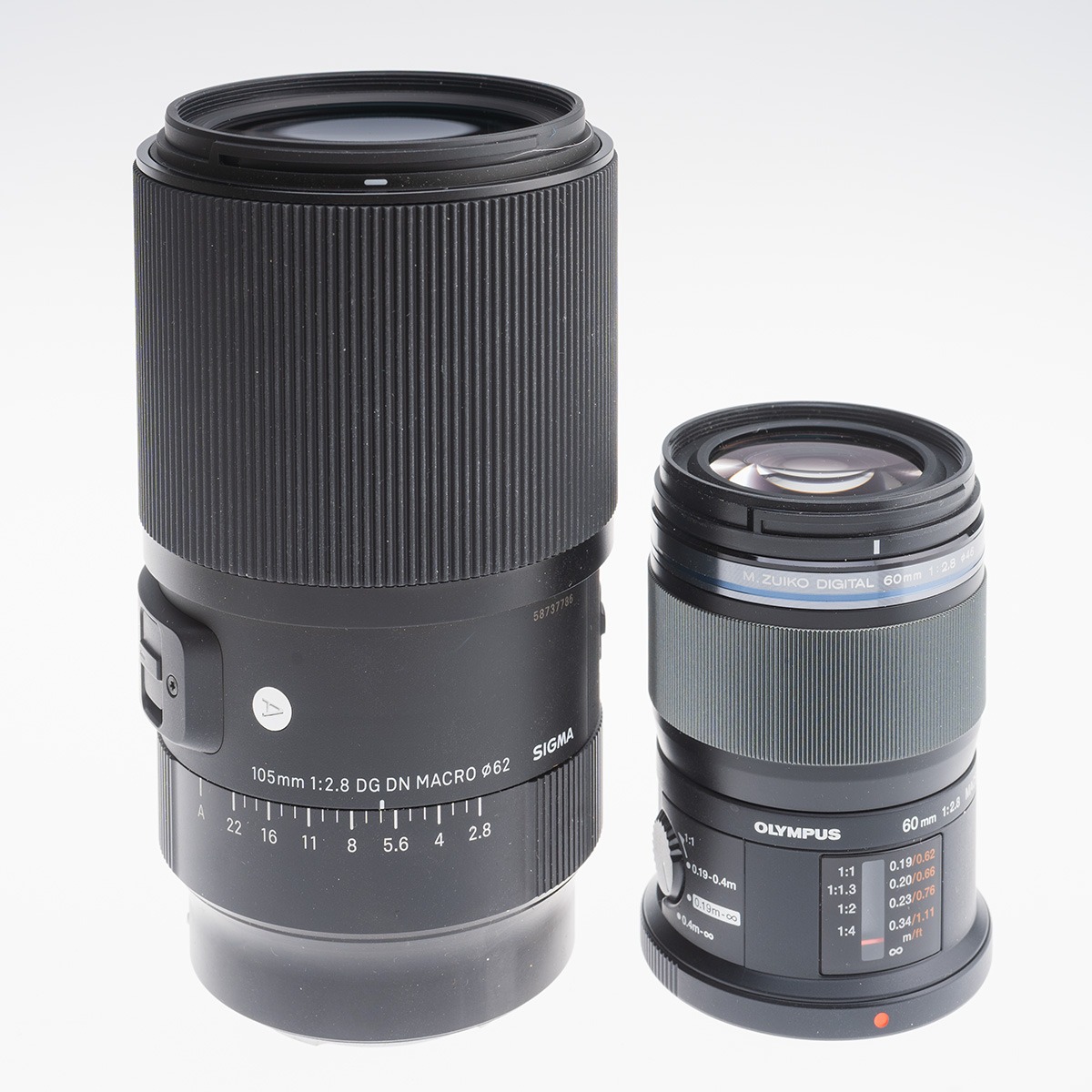
    The OM-Systems 60mm f/2.8 M.Zuiko Macro, right, next to the Sigma 105mm F2.8 macro.for full frame. The Olympus is equivalent to a 120mm F2.8 in full-frame terms, but is significantly smaller and lighter.

    The size avoids touching or disturbing foliage. It’s also easy to hold a camera like the OM-1, currently the largest and heaviest OM-Systems body, one-handed. It’s easy to get low viewpoints using the tilt and twist rear screen when you can not put an eye to the viewfinder.
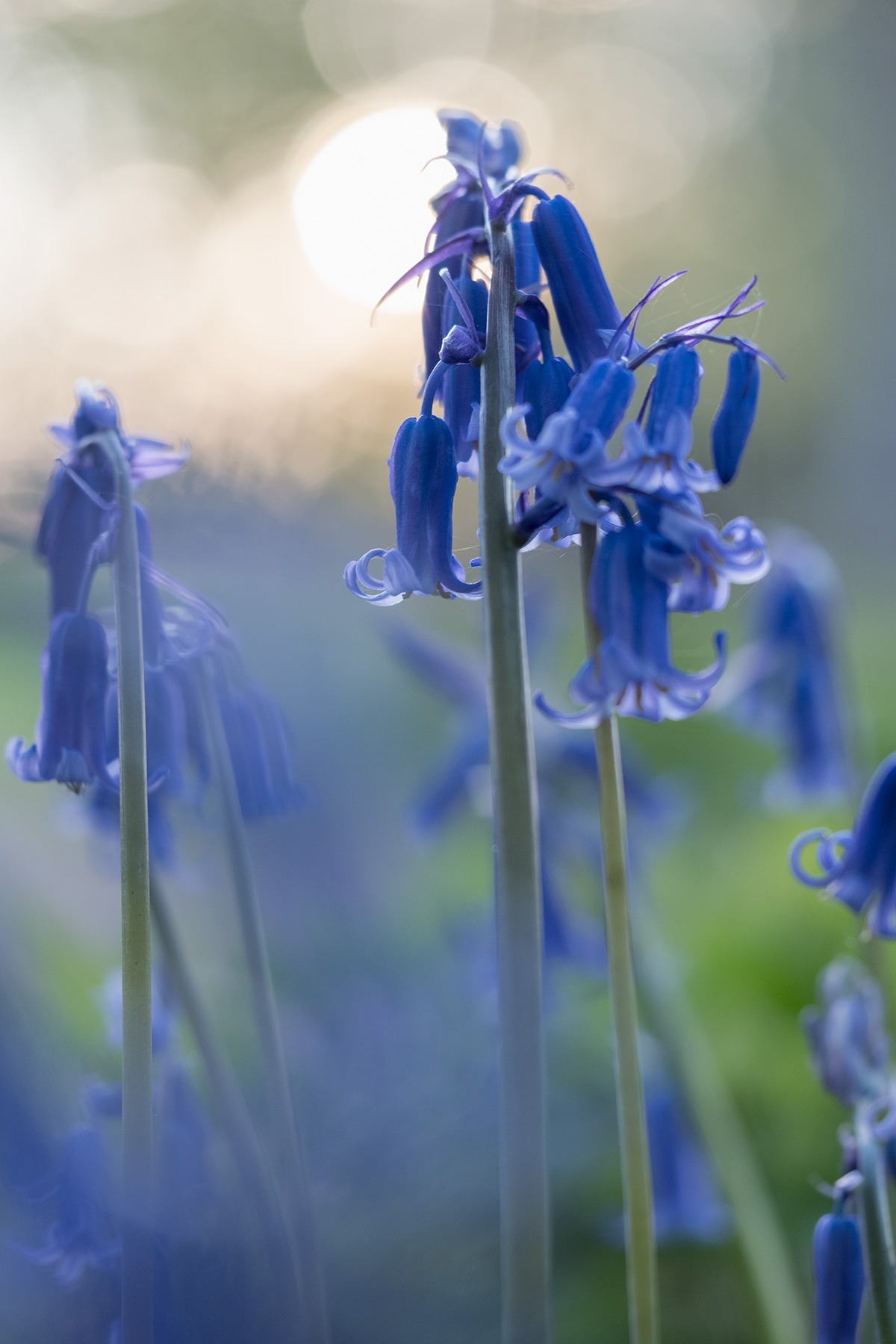
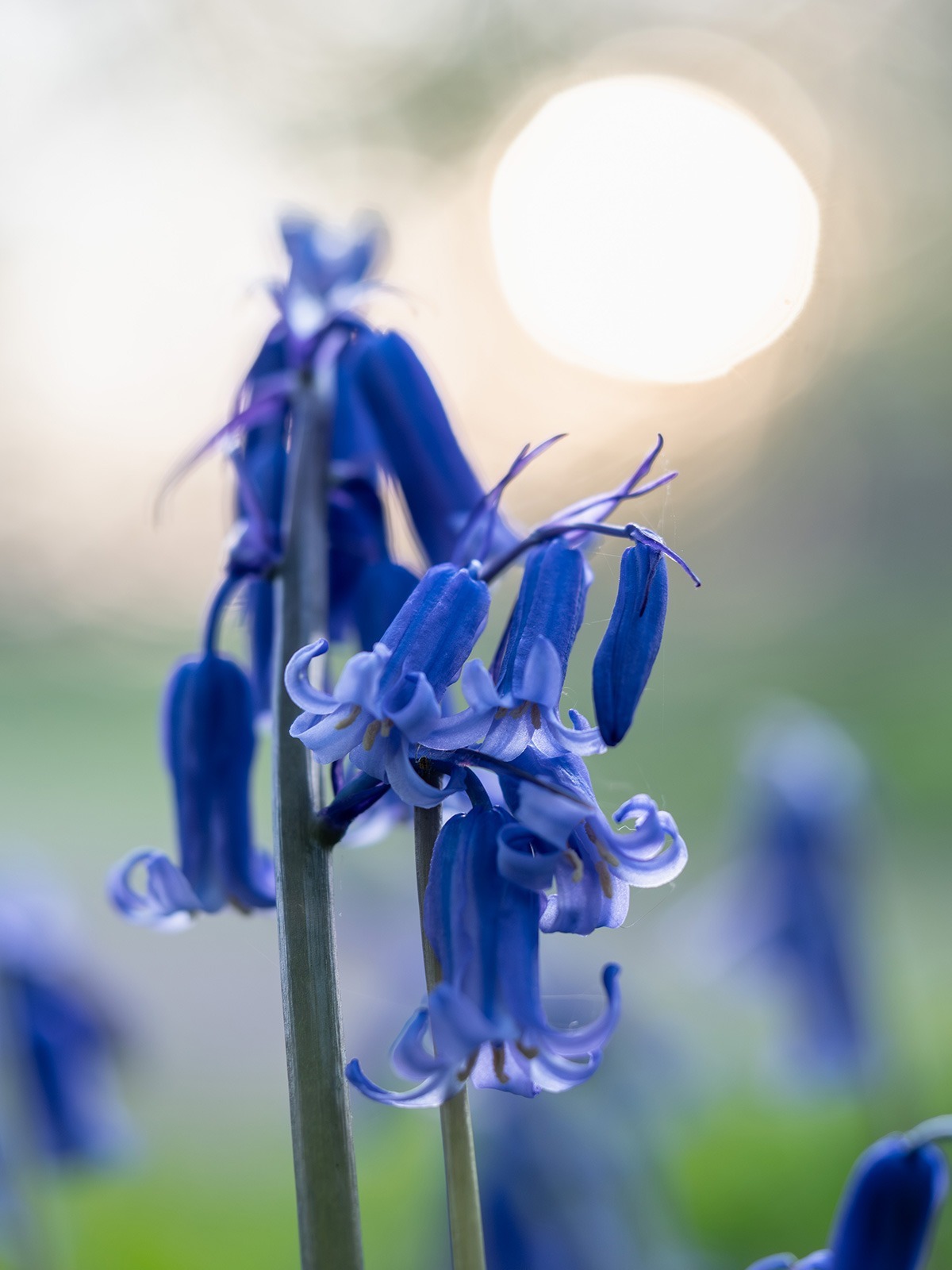
    A picture of bluebells, where the foreground, burred subject imparts an impressionistic glow.

    The f/2.8 aperture means if you do put anything very close to the front element it can dissolve into a blur. Here a bluebell adds an impressionistic glow. Depth of field is tiny wide open. The seven-blade aperture is still present at f/2.8 so the low sun coming through trees creates slightly less than perfect highlight circles. It’s still a lovely effect.

    Shot against the light, the colour of bluebells is realistic. Most digital (and film) shots record too much reflected far red from these flowers making them slightly less pure blue, as the shot below taken at the same time with the light coming from the left hand side. Aperture for this was f/5 to balance keeping most of the main head sharp but still with distinction from the background.

    These are true Scottish bluebells! They are not the Spanish-British hybrids and are a protected species, growing here in woodlands dating from the early 18th century (the big house and estate disappeared long ago). I was very careful not to tread on any. My garden has the invaders, and that’s also what most ‘wild’ ones are. They look very different. See – https://www.wildlifetrusts.org/wildlife/how-identify/spanish-or-native-bluebell
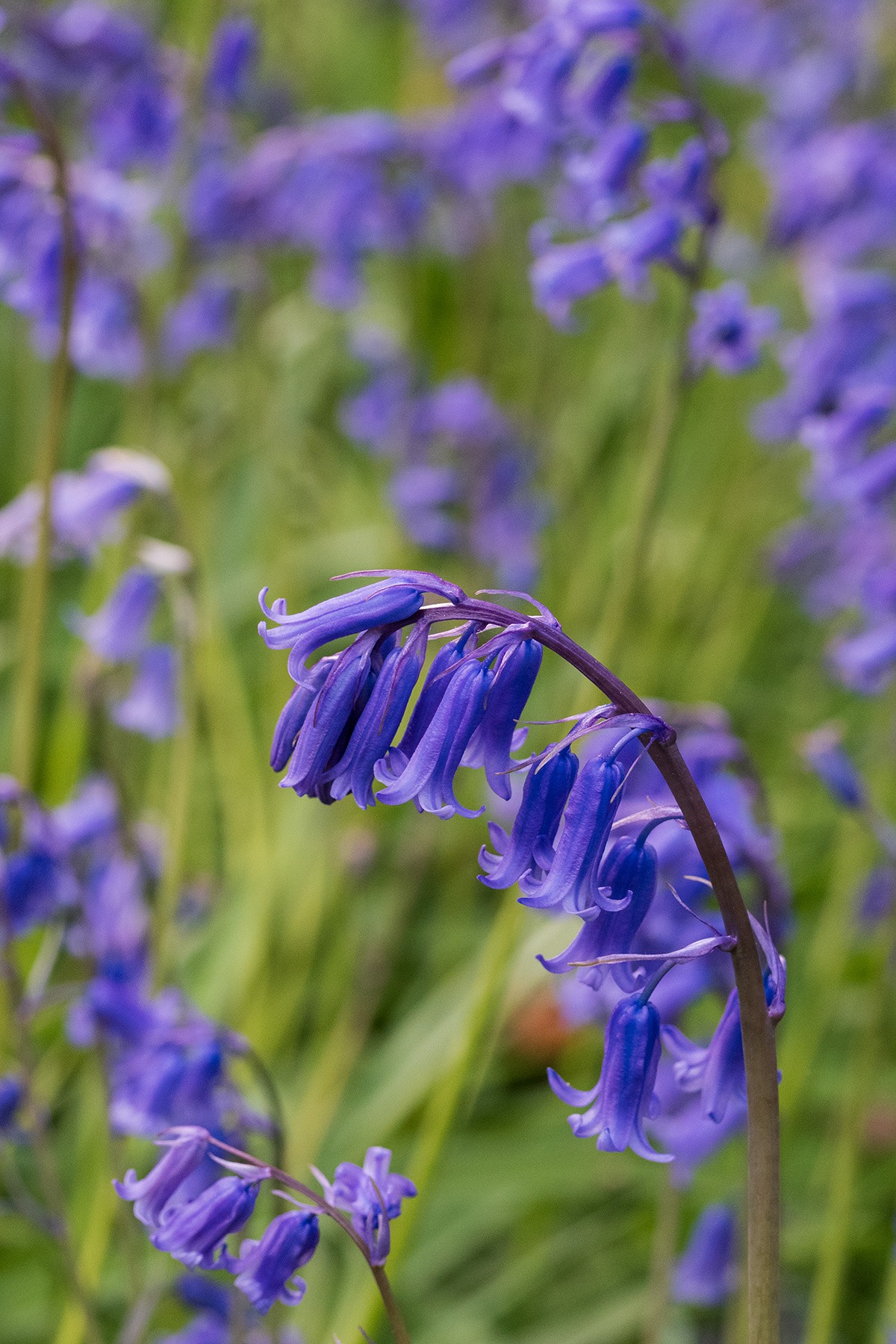
    A crisp frame-filling bluebell shows strong differentiation in plane of focus in the foreground as well as the background, even at f/10.

    I set out with just this lens on the OM-1 walking to a spot where I had seen a large patch of bluebells on the edge of the wood open to the direction of sun, setting behind distant trees. As a subject, bluebells are best shot on a longer lens, which this 120mm-equivalent is. The narrow angle of view compresses them to fill the frame. At f/10, there’s still a distinct plane of focus with softer detail in front and beyond. This lens stops down all the way to f/22 in third-stop steps but using a smaller aperture like f/16 would have lost sharpness slightly where focused – the lens performs best from f/4 to f/5.6 – and even this was at ISO 5000 to keep 1/125s shutter speed. The OM-1 sensor-based stabilisation would allowed 1/30s or even 1/15th without camera shake affecting things, but flowers don’t keep still. At macro distances the vibration from a gentle breeze can blur them.
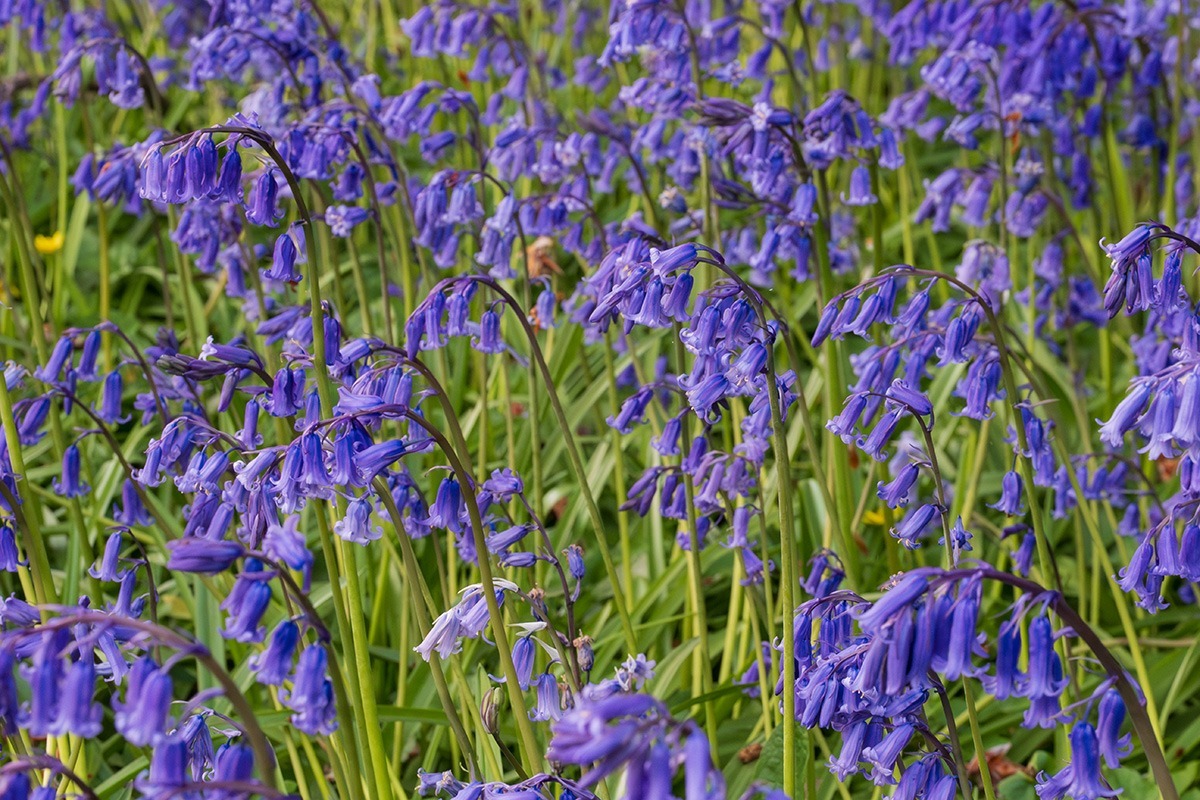
    I also knew where the low sun would be coming from, and it was the backlit effect I was looking for. The side/front lit angle may also have influenced auto white balance, and when this colour is viewed in a mostly green setting, the blue can seem to have more magenta.
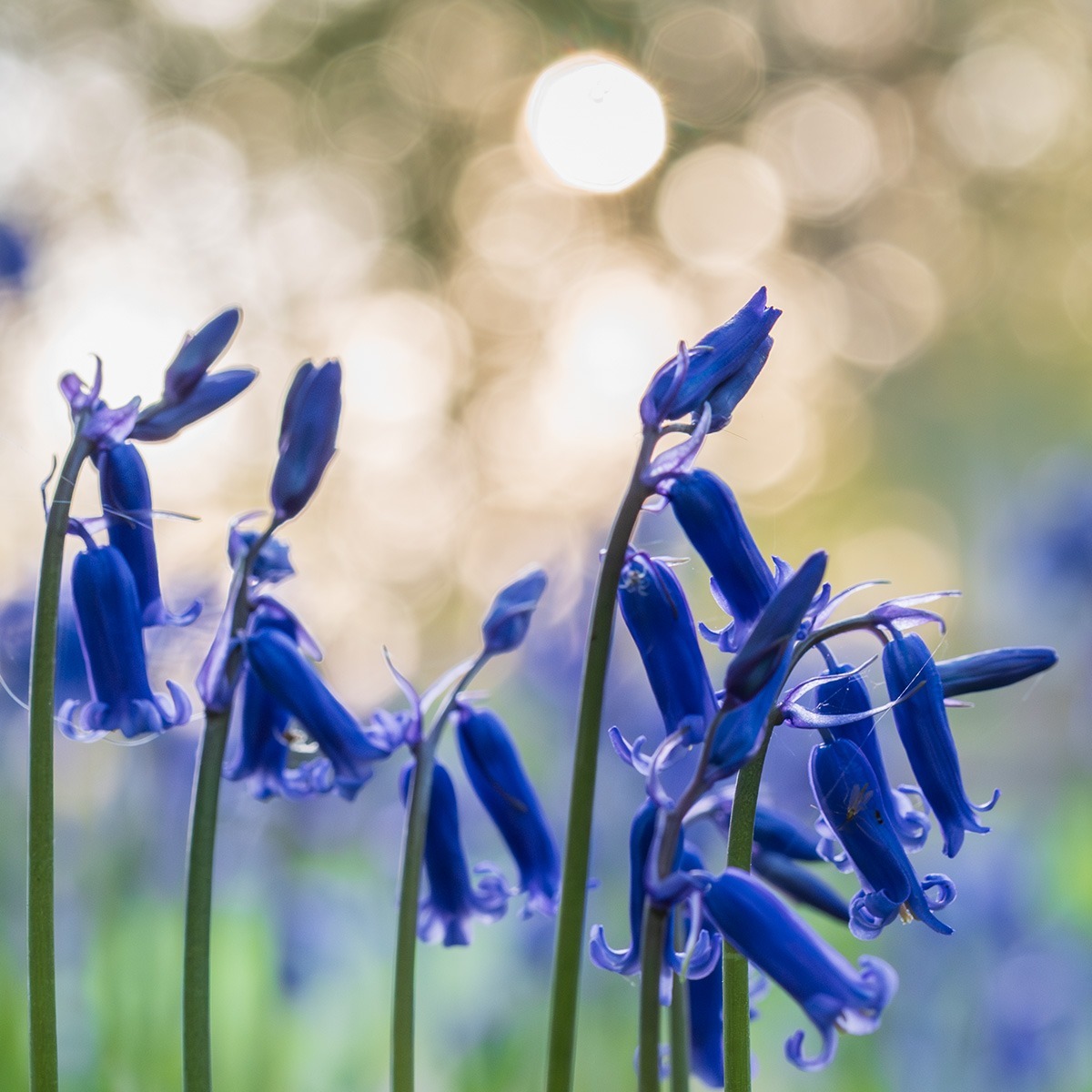
    The multiple overlapping bokeh discs are caused by the distant trees. Here they are made smaller and more distinct by stopping down to f/5.6. Again, this blue is more realistic and very true to nature.
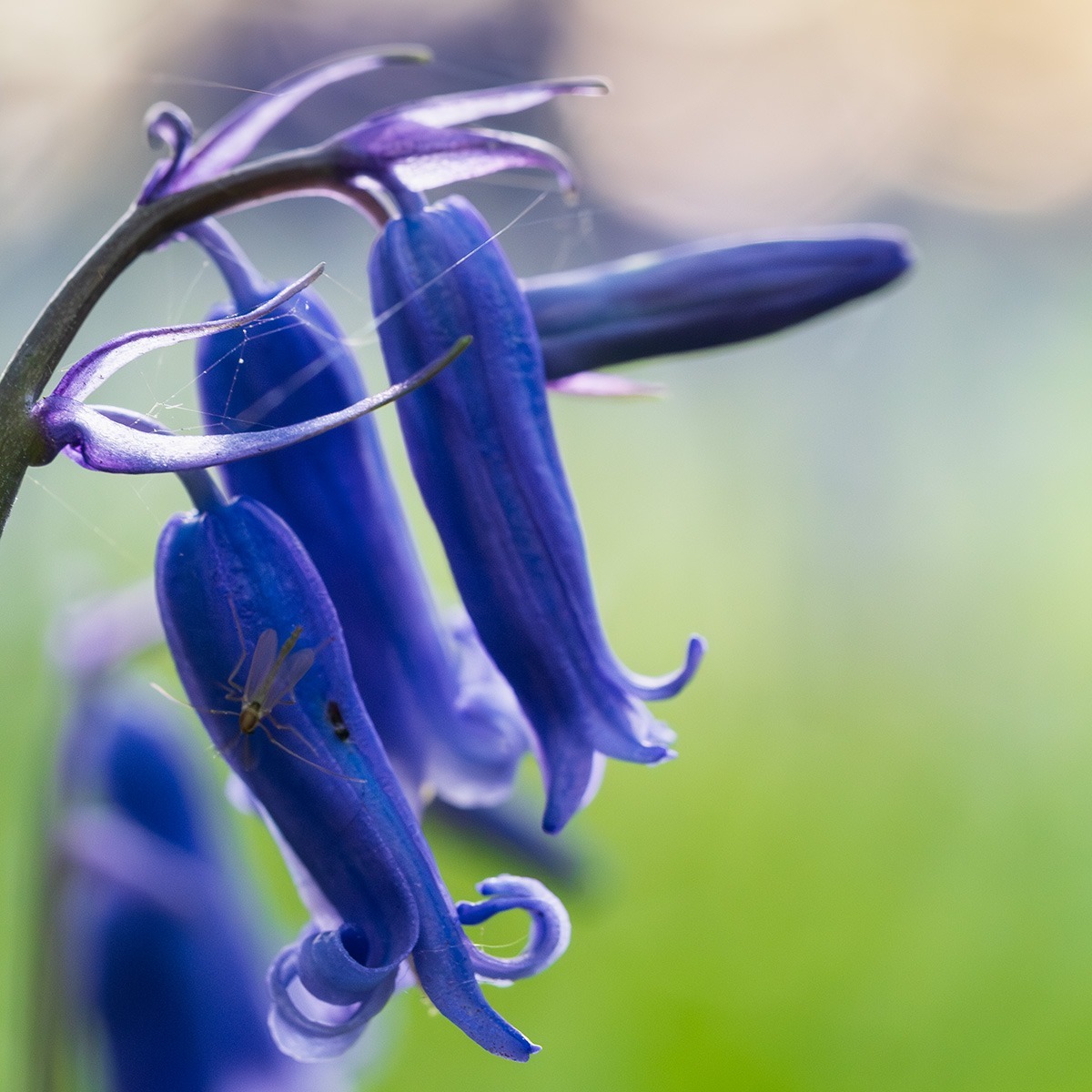
    The 60mm macro enabled very close studies and even at f/2.8. You can see the fly and strands of spider web are well resolved, but the contrast of the fly and flower is low in this lighting.
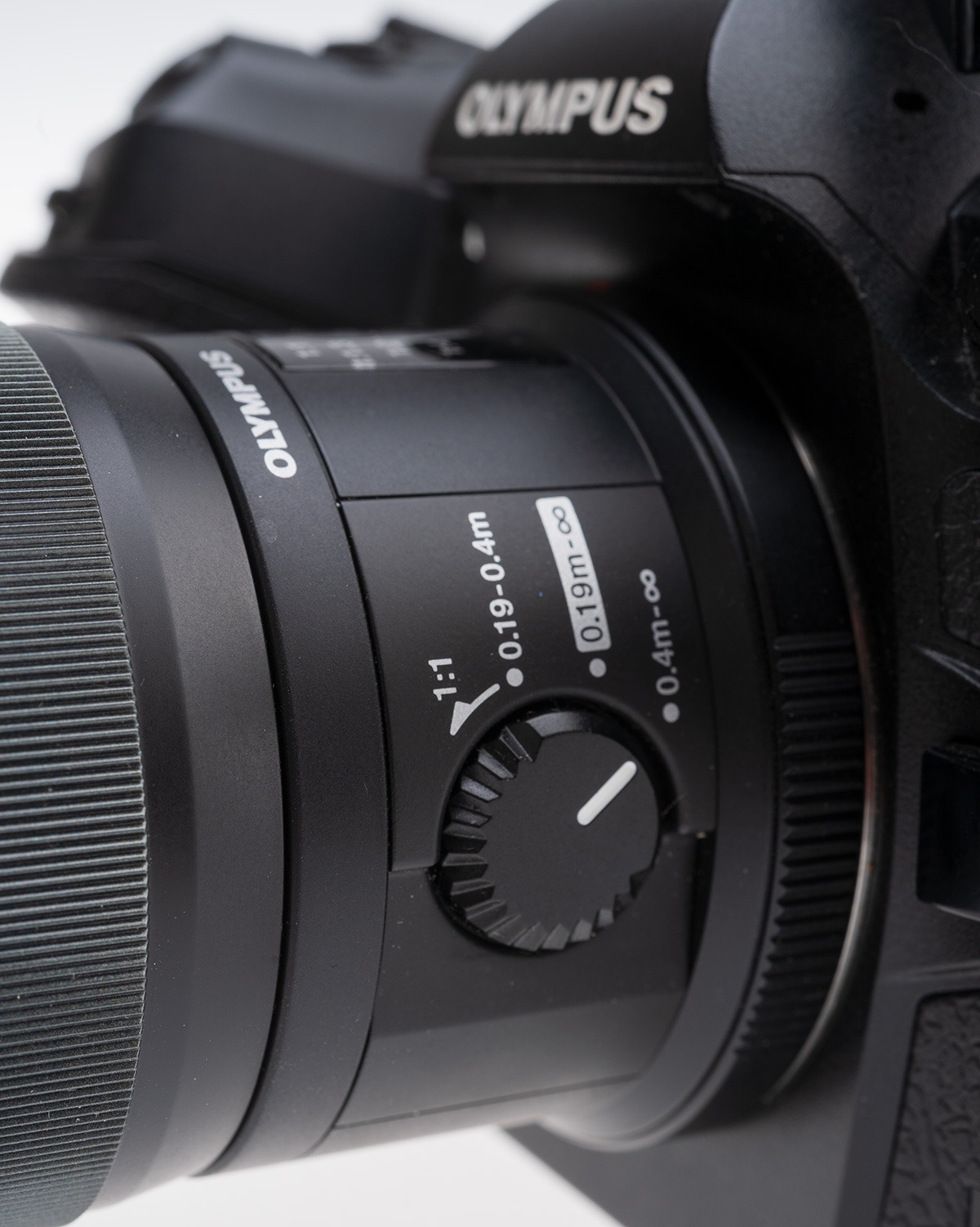
    The focus range limiter switch on the left of the 60mm f/2.8 M.Zuiko Macro lens, showing settings for 0.4-infinity, 0.19-infinity, and 0.19-0.4m and fixed 1:1 magnification (move subject or camera, not focus).

    For more distant shots, the focus range limiter on the lens was set to 40cm to infinity. It focuses very fast and silently but if allowed to range all the way from 1:1 focus may be missed. I had it set to the 19 to 40cm range when two roe deer does walked past just three or four metres away and that was a lost shot!
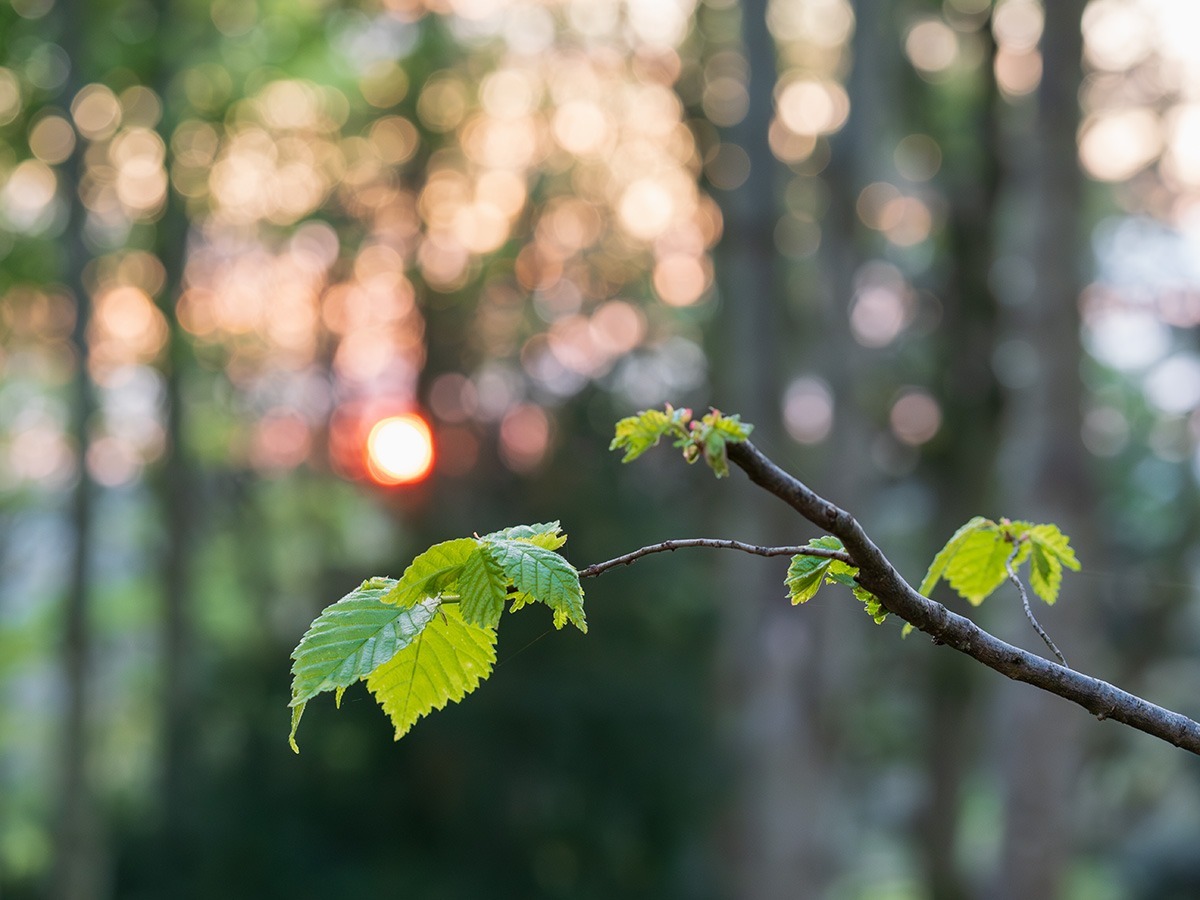
    With this lens, the woodland at sunset continued to provide many opportunities. Young birch leaves here were taken at f/4, and in the rapidly falling light this needed ISO 2500. The small MicroFourThirds sensor – one quarter of the size of a full frame, half the size of APS-C – has reasonable noise levels but without shooting raw as I did for all these, and using Adobe’s Reduce Noise AI-powered conversion, the results would not be as smooth.
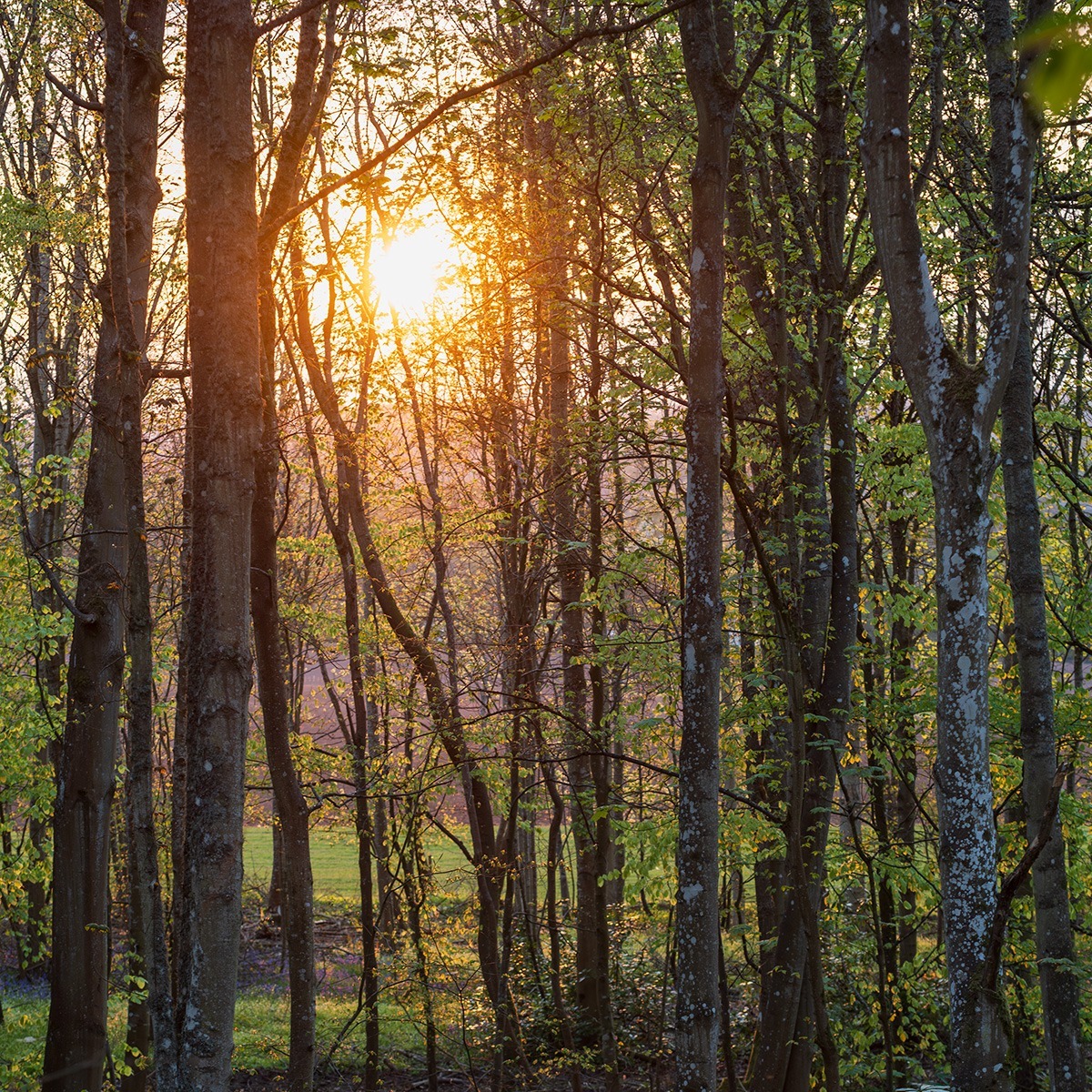
    The 60mm focal length is also great for general landscape views. This is taken 12 minutes earlier and only needed ISO 320 at f/4. That only 1/3rd of a stop faster than the OM-1 base ISO of 200.

    Where and when to find bluebells in the UK?

    In many parts of the UK bluebells are still in bloom and there’s still time to get out into woodlands while the leaf cover on trees is not too far grown to let the light in. In southern Scotland they have just come into their best state and woodlands remain open to light, but that will not last long. Further north it’s a week or so later. May is a good month to catch the new bright green and light environment in woods. By June, most trees are in such full leaf that only a fraction of the light reaches the forest floor and in July the green of leaves begins to darken.

    Get out now, even without a macro lens. Do not just look for subjects. Look for interesting light, which can mean staying out until sunset. Photography is all about light, the subject or scene is not enough on its own!
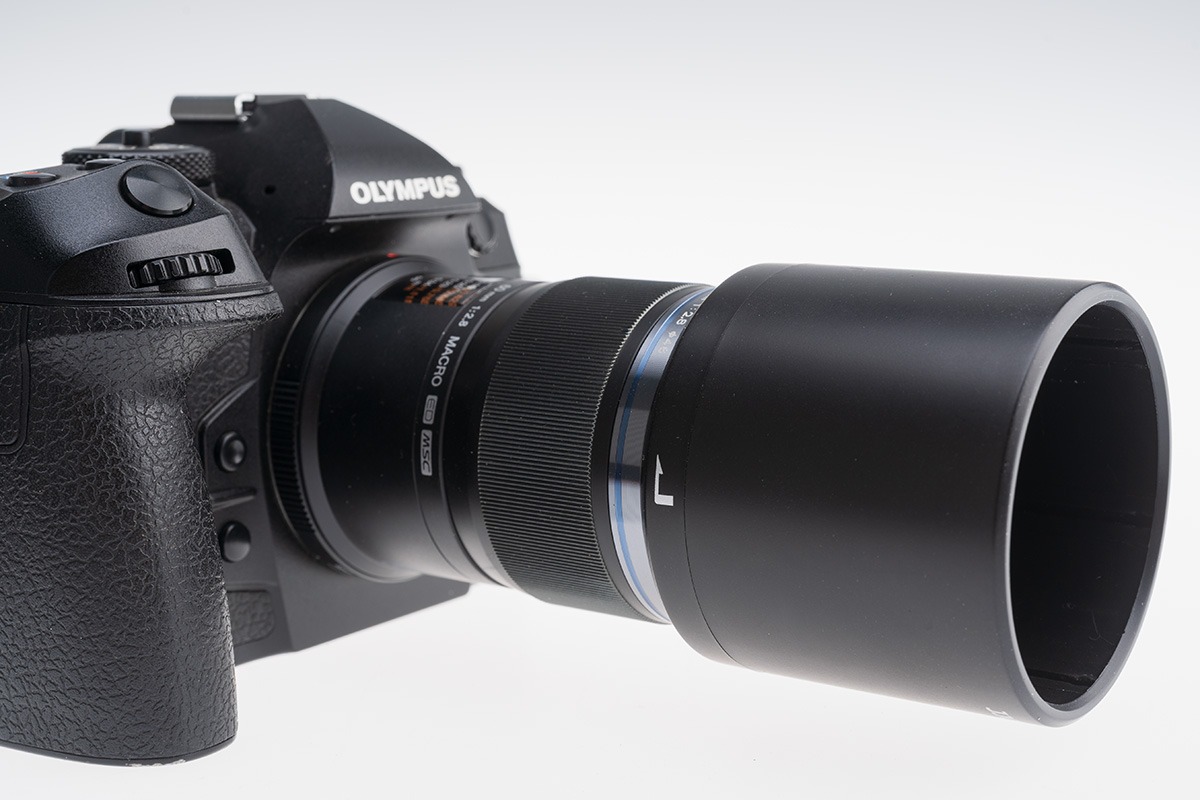
    This lens hood, which retracts with a gentle push to sit back over the lens, is a low cost JJC from Amazon which I rate better than the OM-Systems original. It was used for all the pictures as the working distance of this lens does allow enough space. None of the close shots are anywhere near the lens’s 1:1 which is the same framing as a 2:1, twice life size, view on a full frame camera.

    – David Kilpatrick
  • Three waterfalls

    Three waterfalls

    If it rains, these photo locations just get better…

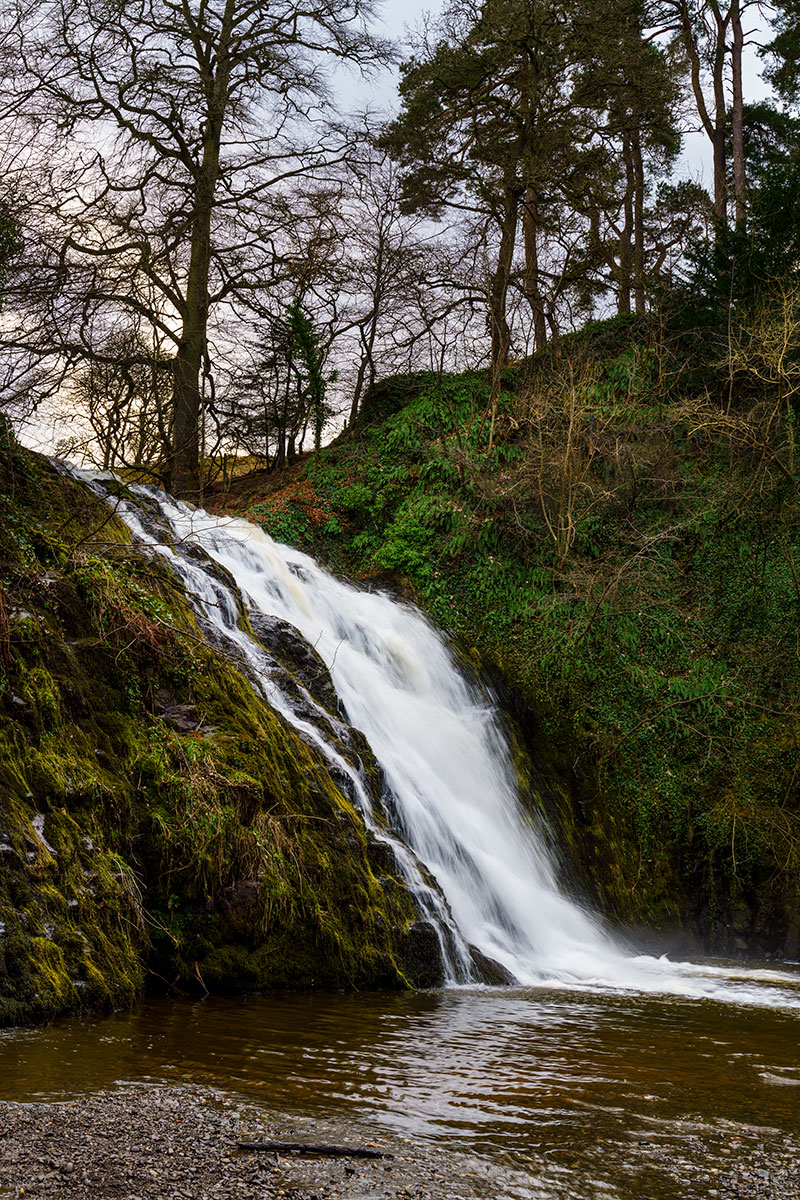
    On our doorstep (writes publisher David Kilpatrick) or just a short drive away there are many rivers and burns coming down from the Cheviots, the Lammermuirs, the Southern Uplands and Tweedsmuir. Some pass through steep small ravines or cleughs (similar to ghylls in north-west England). In both Northumberland and southern Scotland, they are called linns. Some just get called waterfalls, like the Grey Mare’s Tail on the road between Selkirk and Moffat, because they are big enough. Some are very hard to reach or don’t offer potential for photography; some are easy to get to but almost local secrets, without very clear footpaths or signs. If you visit Kelso, Jedburgh or Coldstream here are three which you can easily visit by car with normal walking footwear in the course of a day. The first is just a few minutes from Kelso.

    Stichill Linn is at the site of a former mill and later pioneering hydro-electric on the Eden Water, in the grounds of the Newton Don estate. During the winter of 2020/21 the estate put a big effort into making the riverside, woodlands and the linn accessible after many years of neglect which had made it hard to reach and at time impossible to photograph without obstructions. Though you need to know which minor road (from Ednam) to park on and then where to find the start of the signposted footpaths, once you are on the trail it is an easy walk with occasional boggy spots where small streams cross the path. Wellies are advised, and also help if you plan to cross the river and find positions for a tripod. It is lovely in autumn as the woodlands are mostly deciduous. This usually means the last week in October and first in November. This spot is good for taking your dog as there’s no livestock to encounter and it is very safe to be off the lead.

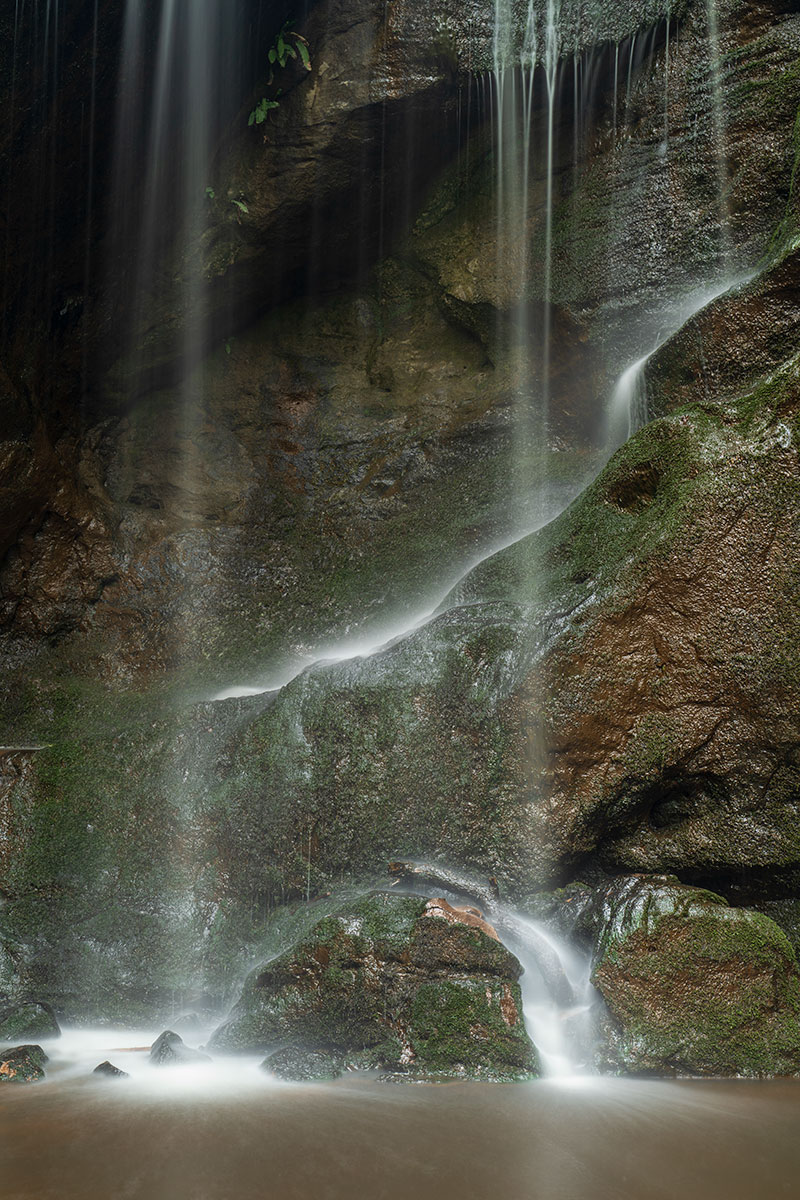
    My next one is Roughting Linn, 20 miles away over the border in England. It can be reached from the village of Ford, or from the A1 side via Lowick. Although the farm estate the woodlands and linn are located on allows access, the paths alongside the stream are not maintained in the same way as Stichill. It’s best to wear shoes or boots suitable for moor or mountain and be prepared to use a stick (or a tripod) to deal with slippery or sloping sections often close to sharp drops into the burn. Wellies are essential to get to the classic position for photography. Sadly some of the moss on the boulders has sheared away and as normal some woodland debris has landed. It’s tempting to go in with help and remove the tree limb which is new feature. The area round the waterfall has some fascinating rock faces, caves, twisted trees and countless interplays of stones, water and light. When I took this in mid-May 2021 the woods were also full of bluebells. There is no phone signal here, there are few visitors and after negotiating a steep scramble back to the path I realise you should really do this in company, not alone. Again, this location does not involve crossing farmland so dogs are OK, but the stream at certain points would not be a welcome invitation!

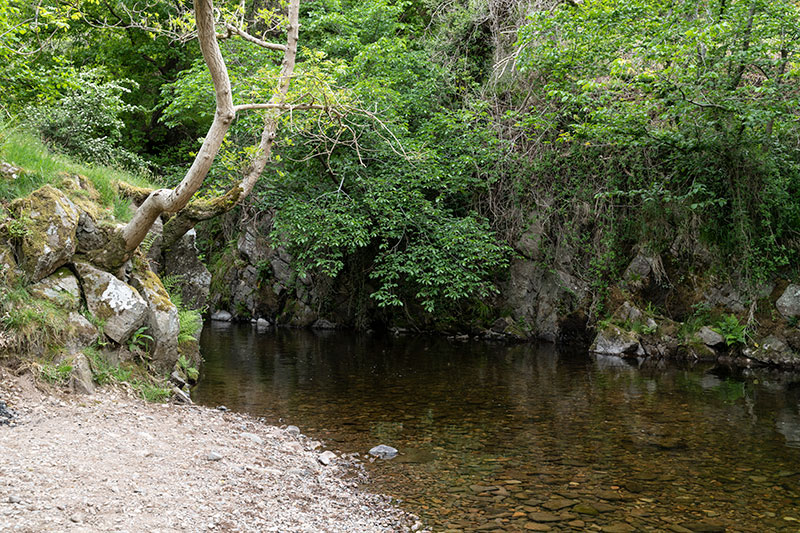
    My final one here is Hethpool Linn, near the farm of Hethpool which is south of the Yetholm to Wooler road, on the College Valley road closed to vehicles except by permit (limited numbers). It’s national park, and also just off St Cuthbert’s Way. There is a car park at the end of the public vehicle access. Beyond it you can walk miles up the College Valley, or turn back a bit and go right down a track leading from the big farm as if following the well-known walking route. Looking at a map you might think the linn could be reached from the east side of the College Burn, but that’s a mistake. Before you reach the crossing, a permissive footpath (without signs to the waterfalls) crosses farm fields, over a stile on the left of the track. This takes you between the farm woodland plantation, and the wooded banks of the river. A couple of stiles or gates later the sound of the water can be heard and small paths through scrub take you to the edge of the ravine. At some points you can climb down and where the path crosses a wooden footbridge the flow is shallow.

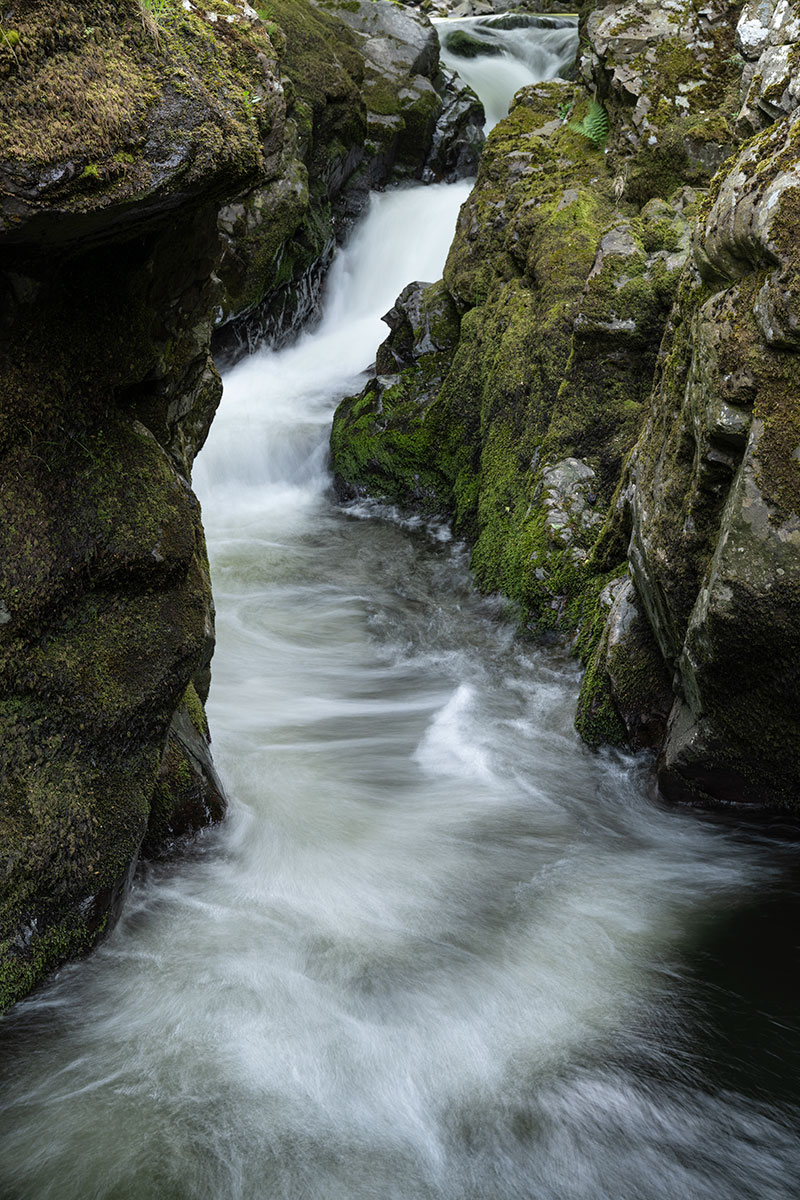
    However, below the bridge the river enters a narrow deep mini-gorge, the linn itself. You take a footpath to the left after crossing the bridge and soon enough encounter the more dramatic stretch. The path then drops down, an easy enough scramble to a calm shallow pool of clear water with a pebble beach. The fast-flowing gorge above is not a tripod time exposure – it’s me clinging on to rocks right over the water, holding camera in contact with contours of the stone able to give it a stable support. Again, there is no phone signal and I realised it wasn’t that clever to be balancing (with £4k of camera and lens!) over a deep fast-flowing turbulent plunge a couple of metres below. I had left my camera bag and tripod (useless on the ledge) near the path high above and lowered myself down the rocks to the viewpoint I wanted. It’s something which people clearly do but safer in company.

    As for the pool just round the bend after the narrow gorge ends, it’s not all that photogenic but you could bring your own naiad along. Maybe with a wetsuit… this water looks inviting and in the heat of summer it would be fine, but it’s a cold mountain stream nevertheless. Hethpool is very definitely farm land and lambs were everywhere on the walk, so taking a dog to enjoy this very dog-friendly pool would require care and control.

    These three linns were photographed on separate sorties, with Stichill Linn in early March a mid-day venture, and both Roughting Linn and Hethpool Linn early evenings in June. Winter can be different but the bare trees let in more light and heavy rainfall transforms any of these.
    – David Kilpatrick

    I now offer an AirBnB in Kelso – the former offices of PHOTOpro, Photon, Freelance Photographer, f2, Master Photography and Cameracraft converted to a flat by my daughter and son-in-law who sailed the Caribbean for a yea, and set it up so it would be suitable for visitors and for their return while buying a home nearby. Everyone loves the town and it’s great to welcome them. I am happy to give pointers to help visiting photographers and the flat has 50+Mbps fibre broadband (from a 900Mpbs service). After returning they converted the opposite wing of the house so in addition to East Wing there’s also West Wing AirBnB – two three-bedroom wings of the house, with their own entrances, licensed to accommodate 10 guests between them or six in any one wing.

  • A7RII shoots in Iceland’s glacier caves

    Sony camera sensor technology enables a closer look at some of Mother Nature’s rarest sights that could not previously have been photographed in this way

     Story: Sony Corporation UK PR release with high resolution images and full metadata – click to view. All images are copyright and may not be copied or reproduced.

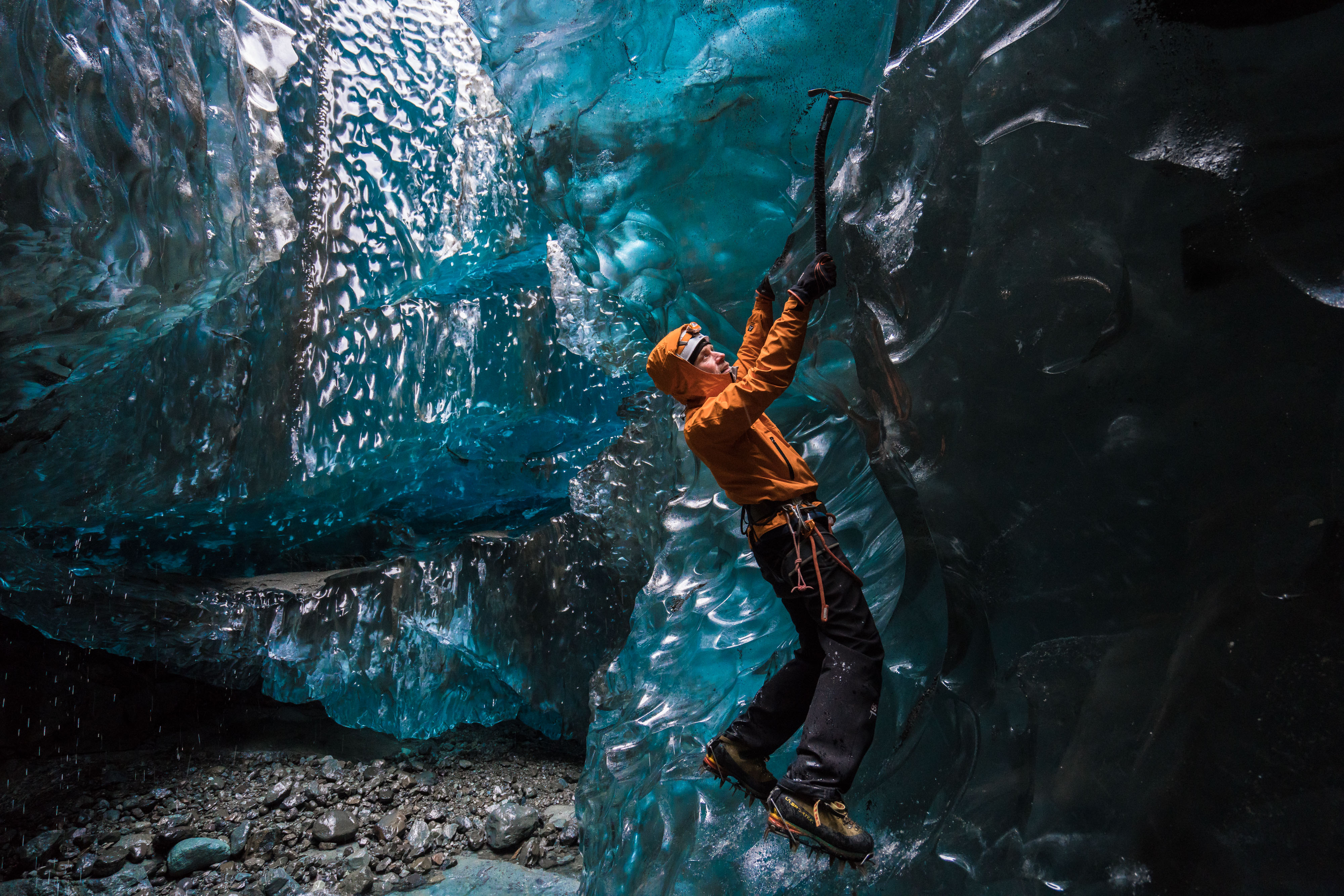
    Wednesday 25th November 2015, Vatnajökull national park, Iceland: Photographer Mikael Buck with assistance from renowned local Icelandic guide Einar Runar Sigurdsson, explored the frozen world of Vatnajökull glacier in Iceland using Sony’s world first back-illuminated full-frame sensor – which features in the ?7R II camera. His images were taken without use of a tripod or any image stitching techniques in photoshop. This was made possible through Sony’s new sensor technology, allowing incredibly detailed low-light hand held photography. Previously images this detailed would have required carrying bulky equipment to the caves, some of which can require hiking and climbing over a glacier for up to two hours to to access. This picture: Inside the 'ABC cave' - which stands for Amazing Blue Cave. Guide Einar Runar Sigurdsson is seen taking a photo at the entrance to the cave PR Handout - editorial usage only. Photographer's details not to be removed from metadata or byline. For further information please contact Rochelle Collison at Hope & Glory PR on 020 7014 5306 or rochelle.collison@hopeandglorypr.com Copyright: © Mikael Buck / Sony 07828 201 042 / mikaelbuck@gmail.com
    Inside the ‘ABC cave’ – which stands for Amazing Blue Cave. Guide Einar Runar Sigurdsson is seen taking a photo at the entrance to the cave. Copyright: © Mikael Buck / Sony

    The enigmatic beauty of the caves of Vatnajokull, one of the largest glaciers in Europe, is revealed in all its frozen, icy splendour through astoundingly sharp and detailed photography.

    The sensor sits at the heart of every camera and defines its capability to capture the amount of light and detail that goes into photographs. Advancements in Sony’s sensor technology are enabling photographers to take pin-sharp photographs in the most challenging low light conditions with the latest cameras from Sony, which formerly would not have been possible.

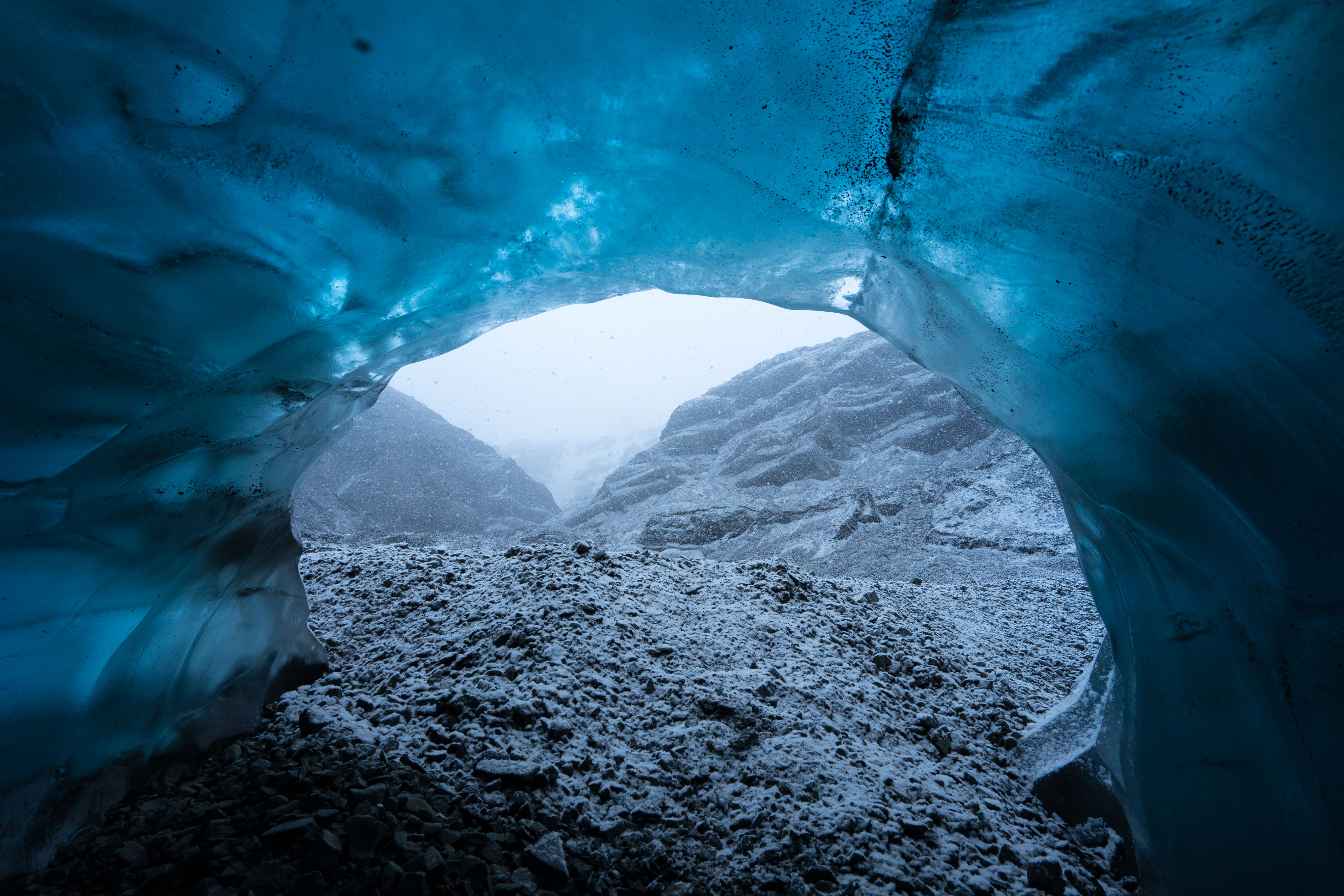
    Wednesday 25th November 2015, Vatnajökull national park, Iceland: Photographer Mikael Buck with assistance from renowned local Icelandic guide Einar Runar Sigurdsson, explored the frozen world of Vatnajökull glacier in Iceland using Sony’s world first back-illuminated full-frame sensor – which features in the ?7R II camera. His images were taken without use of a tripod or any image stitching techniques in photoshop. This was made possible through Sony’s new sensor technology, allowing incredibly detailed low-light hand held photography. Previously images this detailed would have required carrying bulky equipment to the caves, some of which can require hiking and climbing over a glacier for up to two hours to to access. This picture: Inside the 'ABC cave' - which stands for Amazing Blue Cave. This view shows a snow storm outside the entrance to the cave. PR Handout - editorial usage only. Photographer's details not to be removed from metadata or byline. For further information please contact Rochelle Collison at Hope & Glory PR on 020 7014 5306 or rochelle.collison@hopeandglorypr.com Copyright: © Mikael Buck / Sony 07828 201 042 / mikaelbuck@gmail.com
    A snow storm outside the entrance to the cave. Copyright: © Mikael Buck / Sony

    Stunning photo series heroes Iceland’s otherworldly ice caverns, with the cave’s bright blue and bubble-like walls resembling an almost underwater scene. Images also capture flowing waterfalls, and crystal clear crevasses and icy tunnels within the frosty fortress.

    Wednesday 25th November 2015, Vatnajökull national park, Iceland: Photographer Mikael Buck with assistance from renowned local Icelandic guide Einar Runar Sigurdsson, explored the frozen world of Vatnajökull glacier in Iceland using Sony’s world first back-illuminated full-frame sensor – which features in the ?7R II camera. His images were taken without use of a tripod or any image stitching techniques in photoshop. This was made possible through Sony’s new sensor technology, allowing incredibly detailed low-light hand held photography. Previously images this detailed would have required carrying bulky equipment to the caves, some of which can require hiking and climbing over a glacier for up to two hours to to access. This picture: Looking up from inside the 'ABC cave' - which stands for Amazing Blue Cave. Guide Einar Runar Sigurdsson can be seen ice climbing on the glacier outside. PR Handout - editorial usage only. Photographer's details not to be removed from metadata or byline. For further information please contact Rochelle Collison at Hope & Glory PR on 020 7014 5306 or rochelle.collison@hopeandglorypr.com Copyright: © Mikael Buck / Sony 07828 201 042 / mikaelbuck@gmail.com
    Looking up from inside the ‘ABC cave’. Guide Einar Runar Sigurdsson can be seen ice climbing on the glacier outside. Copyright: © Mikael Buck / Sony

    This incredible photo series displays the immense intricacies of never-before-seen ice caverns in Vatnajokull, Iceland – only made possible through Sony’s new sensor technology, allowing incredibly detailed low-light photography.

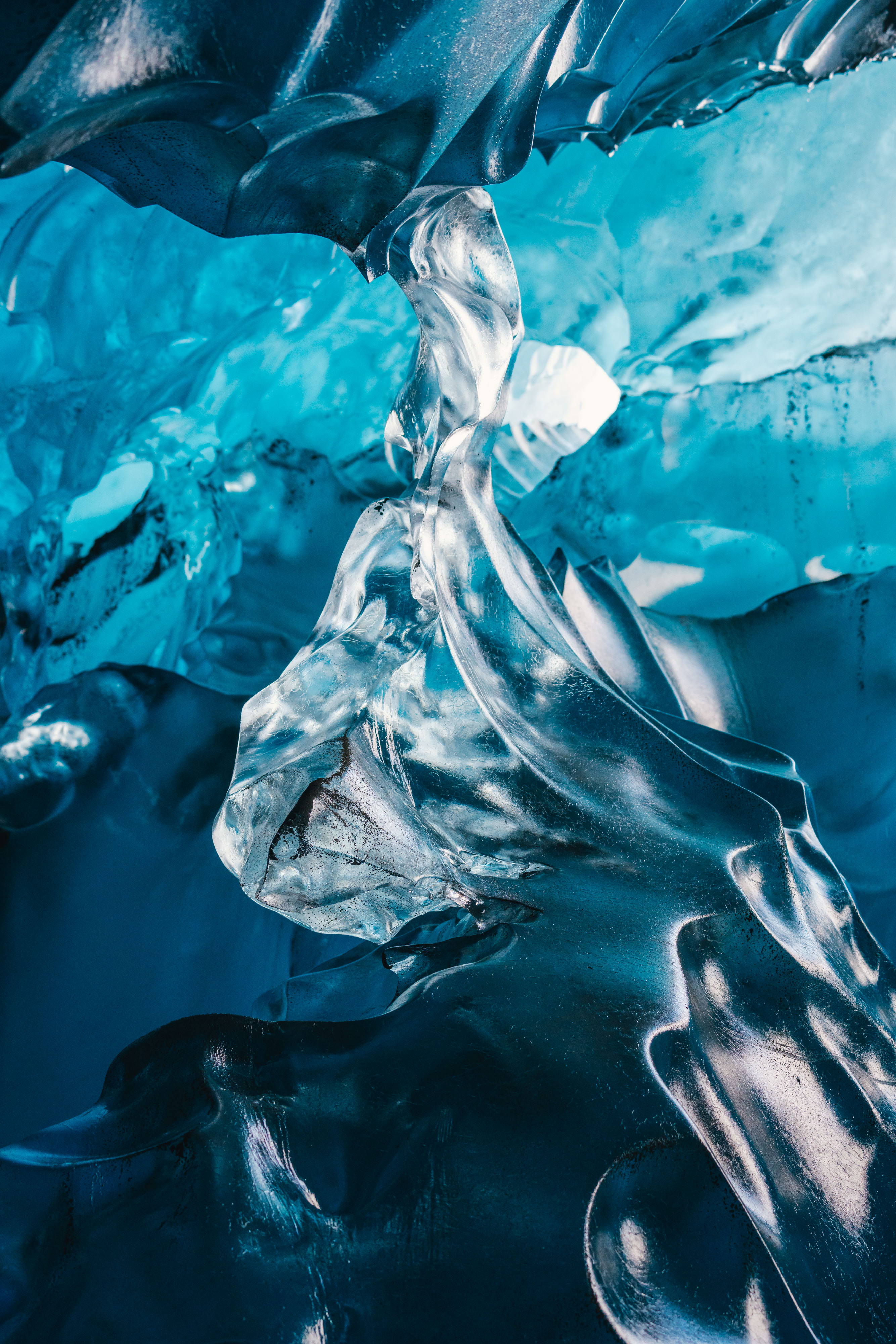
    Wednesday 25th November 2015, Vatnajökull national park, Iceland: Photographer Mikael Buck with assistance from renowned local Icelandic guide Einar Runar Sigurdsson, explored the frozen world of Vatnajökull glacier in Iceland using Sony’s world first back-illuminated full-frame sensor – which features in the ?7R II camera. His images were taken without use of a tripod or any image stitching techniques in photoshop. This was made possible through Sony’s new sensor technology, allowing incredibly detailed low-light hand held photography. Previously images this detailed would have required carrying bulky equipment to the caves, some of which can require hiking and climbing over a glacier for up to two hours to to access. This picture: Inside the 'ABC cave' - which stands for Amazing Blue Cave. PR Handout - editorial usage only. Photographer's details not to be removed from metadata or byline. For further information please contact Rochelle Collison at Hope & Glory PR on 020 7014 5306 or rochelle.collison@hopeandglorypr.com Copyright: © Mikael Buck / Sony 07828 201 042 / mikaelbuck@gmail.com
    Inside the ‘ABC cave’. Copyright: © Mikael Buck / Sony

    Each year, the Vatnajokull glacier shifts and changes, revealing complex cave systems that are there for only a matter of weeks before metamorphosing again.

    Wednesday 25th November 2015, Vatnajökull national park, Iceland: Photographer Mikael Buck with assistance from renowned local Icelandic guide Einar Runar Sigurdsson, explored the frozen world of Vatnajökull glacier in Iceland using Sony’s world first back-illuminated full-frame sensor – which features in the ?7R II camera. His images were taken without use of a tripod or any image stitching techniques in photoshop. This was made possible through Sony’s new sensor technology, allowing incredibly detailed low-light hand held photography. Previously images this detailed would have required carrying bulky equipment to the caves, some of which can require hiking and climbing over a glacier for up to two hours to to access. This picture: Inside the 'ABC cave' - which stands for Amazing Blue Cave PR Handout - editorial usage only. Photographer's details not to be removed from metadata or byline. For further information please contact Rochelle Collison at Hope & Glory PR on 020 7014 5306 or rochelle.collison@hopeandglorypr.com Copyright: © Mikael Buck / Sony 07828 201 042 / mikaelbuck@gmail.com
    Inside the ‘ABC cave’. Copyright: © Mikael Buck / Sony

    Photographer Mikael Buck and renowned local guides Einar Runar Sigurdsson and Helen Maria explored the frozen world using Sony’s latest digital cameras including the α7R II featuring the world first back-illuminated full-frame sensor which brings together ultra-high resolution and ultra-high sensitivity, the  RX10 II and RX100 IV which feature the world’s first 1.0 type stacked Exmor RS CMOS sensor that truly shine in low-light and high contrast conditions. The images were taken without the use of any external sources – just the natural light that filters through the ice caves.

    Wednesday 25th November 2015, Vatnajökull national park, Iceland: Photographer Mikael Buck with assistance from renowned local Icelandic guide Einar Runar Sigurdsson, explored the frozen world of Vatnajökull glacier in Iceland using Sony’s world first back-illuminated full-frame sensor – which features in the ?7R II camera. His images were taken without use of a tripod or any image stitching techniques in photoshop. This was made possible through Sony’s new sensor technology, allowing incredibly detailed low-light hand held photography. Previously images this detailed would have required carrying bulky equipment to the caves, some of which can require hiking and climbing over a glacier for up to two hours to to access. This picture: Guide Einar Runar Sigurdsson is seen ice climbing inside the 'Waterfall Cave' PR Handout - editorial usage only. Photographer's details not to be removed from metadata or byline. For further information please contact Rochelle Collison at Hope & Glory PR on 020 7014 5306 or rochelle.collison@hopeandglorypr.com Copyright: © Mikael Buck / Sony 07828 201 042 / mikaelbuck@gmail.com
    Guide Einar Runar Sigurdsson is seen ice climbing inside the ‘Waterfall Cave’. Copyright: © Mikael Buck / Sony

    Within the photo series, barren caves have been brought to life, making visible the intricate curves of the natural sculptures, the delicate structure of its icicles, and the smooth and the marble-like texture of the cavern walls, which are formed through constant movement. Images capture the misty waterways that flow within the frosty fortress, as well as the ice-cold waterfalls that cascade down and transform the cavern’s bright blue walls. Buck has also captured images of a skilled local climber ascending the icy walls to showcase the scale of the majestic blue cave.

    Wednesday 25th November 2015, Vatnajökull national park, Iceland: Photographer Mikael Buck with assistance from renowned local Icelandic guide Einar Runar Sigurdsson, explored the frozen world of Vatnajökull glacier in Iceland using Sony’s world first back-illuminated full-frame sensor – which features in the ?7R II camera. His images were taken without use of a tripod or any image stitching techniques in photoshop. This was made possible through Sony’s new sensor technology, allowing incredibly detailed low-light hand held photography. Previously images this detailed would have required carrying bulky equipment to the caves, some of which can require hiking and climbing over a glacier for up to two hours to to access. This picture: Guide Einar Runar Sigurdsson is seen ice climbing inside the 'Waterfall Cave' PR Handout - editorial usage only. Photographer's details not to be removed from metadata or byline. For further information please contact Rochelle Collison at Hope & Glory PR on 020 7014 5306 or rochelle.collison@hopeandglorypr.com Copyright: © Mikael Buck / Sony 07828 201 042 / mikaelbuck@gmail.com
    Sigurdsson ice climbing inside the ‘Waterfall Cave’. Copyright: © Mikael Buck / Sony

    Helen Maria of Local Guide – Iceland’s oldest mountain guiding company – comments: “I have been exploring these ice caves for years with Local Guide. Being here in them is a truly wonderful opportunity. Knowing you’re experiencing such a fleeting phenomenon makes it even more special – the opportunity to help capture this nature in all its intricate glory and now in more detail than ever thanks to Sony’s sensor technology is a truly magical experience. This series of photographs has done it justice like never before, and I hope many more people will be spurred on to visit as a result.”

    Wednesday 25th November 2015, Vatnajökull national park, Iceland: Photographer Mikael Buck with assistance from renowned local Icelandic guide Einar Runar Sigurdsson, explored the frozen world of Vatnajökull glacier in Iceland using Sony’s world first back-illuminated full-frame sensor – which features in the ?7R II camera. His images were taken without use of a tripod or any image stitching techniques in photoshop. This was made possible through Sony’s new sensor technology, allowing incredibly detailed low-light hand held photography. Previously images this detailed would have required carrying bulky equipment to the caves, some of which can require hiking and climbing over a glacier for up to two hours to to access. This picture: Guide Helen Maria is pictured inside the waterfall cave PR Handout - editorial usage only. Photographer's details not to be removed from metadata or byline. For further information please contact Rochelle Collison at Hope & Glory PR on 020 7014 5306 or rochelle.collison@hopeandglorypr.com Copyright: © Mikael Buck / Sony 07828 201 042 / mikaelbuck@gmail.com
    Guide Helen Maria is pictured inside the waterfall cave. Copyright: © Mikael Buck / Sony

    Yann Salmon Legagneur, Head of Product Marketing, Digital Imaging for Sony Europe, commented, “These images wouldn’t have been possible a few years ago without having to take bulky kit, lighting and other accessories to the glacier – all of which would have weighed down a photographer. The sensors inside Sony’s α7 and RX cameras ensure that all a photographer needs is a small form factor camera and with its low light photography capabilities and they can then capture incredible images like these.”

    Wednesday 25th November 2015, Vatnajökull national park, Iceland: Photographer Mikael Buck with assistance from renowned local Icelandic guide Einar Runar Sigurdsson, explored the frozen world of Vatnajökull glacier in Iceland using Sony’s world first back-illuminated full-frame sensor – which features in the ?7R II camera. His images were taken without use of a tripod or any image stitching techniques in photoshop. This was made possible through Sony’s new sensor technology, allowing incredibly detailed low-light hand held photography. Previously images this detailed would have required carrying bulky equipment to the caves, some of which can require hiking and climbing over a glacier for up to two hours to to access. This picture: Inside the 'ABC cave' - which stands for Amazing Blue Cave. Guide Einar Runar Sigurdsson is seen taking a photo at the entrance to the cave PR Handout - editorial usage only. Photographer's details not to be removed from metadata or byline. For further information please contact Rochelle Collison at Hope & Glory PR on 020 7014 5306 or rochelle.collison@hopeandglorypr.com Copyright: © Mikael Buck / Sony 07828 201 042 / mikaelbuck@gmail.com
    Sigurdsson is seen taking a photo at the entrance to the ABC cave. Copyright: © Mikael Buck / Sony

    As the global number one in Sensor technology and production with approximately 50% global market share, Sony is proud to continue to push through the perceived boundaries of sensor development and thanks to advancements in this field, images like this are now possible. Sensors are such a vital part of camera performance and being able to release two new advanced sensors this year is enabling Sony to continue its growth in the digital imaging industry.

    Wednesday 25th November 2015, Vatnajökull national park, Iceland: Photographer Mikael Buck with assistance from renowned local Icelandic guide Einar Runar Sigurdsson, explored the frozen world of Vatnajökull glacier in Iceland using Sony’s world first back-illuminated full-frame sensor – which features in the ?7R II camera. His images were taken without use of a tripod or any image stitching techniques in photoshop. This was made possible through Sony’s new sensor technology, allowing incredibly detailed low-light hand held photography. Previously images this detailed would have required carrying bulky equipment to the caves, some of which can require hiking and climbing over a glacier for up to two hours to to access. This picture: The view on top of the Vatnajökull glacier whilst hiking to access the caves PR Handout - editorial usage only. Photographer's details not to be removed from metadata or byline. For further information please contact Rochelle Collison at Hope & Glory PR on 020 7014 5306 or rochelle.collison@hopeandglorypr.com Copyright: © Mikael Buck / Sony 07828 201 042 / mikaelbuck@gmail.com
    The view on top of the Vatnajökull glacier whilst hiking to access the caves. Copyright: © Mikael Buck / Sony

    In addition to being able to capture incredibly detailed low-light photography, sensor technology featured in the RX10 II and RX100 IV cameras also allows photographers, hobbyist and professionals alike, to capture moments not always visible to the human eye, with 40X super slow motion video capture at up to 1000fps.

    Wednesday 25th November 2015, Vatnajökull national park, Iceland: Photographer Mikael Buck with assistance from renowned local Icelandic guide Einar Runar Sigurdsson, explored the frozen world of Vatnajökull glacier in Iceland using Sony’s world first back-illuminated full-frame sensor – which features in the ?7R II camera. His images were taken without use of a tripod or any image stitching techniques in photoshop. This was made possible through Sony’s new sensor technology, allowing incredibly detailed low-light hand held photography. Previously images this detailed would have required carrying bulky equipment to the caves, some of which can require hiking and climbing over a glacier for up to two hours to to access. This picture: On top of the Vatnajökull glacier PR Handout - editorial usage only. Photographer's details not to be removed from metadata or byline. For further information please contact Rochelle Collison at Hope & Glory PR on 020 7014 5306 or rochelle.collison@hopeandglorypr.com Copyright: © Mikael Buck / Sony 07828 201 042 / mikaelbuck@gmail.com
    On top of the Vatnajökull glacier. Copyright: © Mikael Buck / Sony

    Wednesday 25th November 2015, Vatnajökull national park, Iceland: Photographer Mikael Buck with assistance from renowned local Icelandic guide Einar Runar Sigurdsson, explored the frozen world of Vatnajökull glacier in Iceland using Sony’s world first back-illuminated full-frame sensor – which features in the ?7R II camera. His images were taken without use of a tripod or any image stitching techniques in photoshop. This was made possible through Sony’s new sensor technology, allowing incredibly detailed low-light hand held photography. Previously images this detailed would have required carrying bulky equipment to the caves, some of which can require hiking and climbing over a glacier for up to two hours to to access. This picture: Inside the 'ABC cave' - which stands for Amazing Blue Cave. For further information please contact Rochelle Collison at Hope & Glory PR on 020 7014 5306 or rochelle.collison@hopeandglorypr.com Copyright: © Mikael Buck / Sony 07828 201 042 / mikaelbuck@gmail.com
    Amazing Blue Cave. Copyright: © Mikael Buck / Sony
    To enquire about other uses, reproduction rights or prints email [email protected]

  • Frank’s a definite Alpha Male

    We shall be sending Frank Doorhof one of our original and rare Alpha Male T-shirts, in black, though I’m not sure we have anything quite large enough to fit him – which goes for his personality too. He’s a great workshop presenter, overcoming technical problems by just cracking on with whatever will work best. At Edinburgh for The Flash Centre’s full day fashion seminar with Frank on May 24th, the last thing I expected was to be using the same camera as Frank. All workshop leaders use Canon, right?

    Frank now uses Sony Alpha 99, and he had a lot to say about it. Since we already know the benefits of the Alpha system and the current Sony full frame 24MP sensor with its extreme 14-bit dynamic range, most of what he said was not new, but it’s rare to hear a course leader extol the virtues of a system which not one of his delegates (apart from me) was using. He did rather talk down the value of CZ lenses (while using a 24-70mm CZ) and praised the quality of his vintage Minolta 85mm f/1.4 and 35-200mm xi, but I can’t argue with that as I’ve made similar decisions. Indeed, the 35-200mm owes much of its reputation to results we published seven years ago. I was beating him at his own game by using my SAM 28-75mm f/2.8 – cheaper by half than the CZ 24-70mm, and extremely sharp.

    doorhof-church

    We had a rare sunny clear day in a run of mixed weather, though it was cold and windy on the roof terrace of the Glasshouse Hotel in central Edinburgh. The location provided strong backgrounds and details. Simon Burfoot and Chris Whittle from The Flash Centre brought along the Ranger (battery location) and Ranger Quadra (lightweight version) flash systems with Elinchrom Skyport wireless triggers. Of course, in the past if you turned up to a workshop with an Alpha body, you were unable to use the wireless flash connection unless you also remembered to bring a standard hotshoe adaptor. With the A99 (and NEX-6, RX1 and future models) the new Alpha multi function accessory shoe works directly with triggers.

    Frank put everything into using just one light source, and used no reflectors, aiming instead for dramatic lighting by underexposing the main scene but lifting his model subject Nadine by local flash. This was achieved with the 44cm rigid square softbox, newly re-introduced to the Elinchrom system (I have used the original grey one for over 20 years – you only need to buy these expensive accessories once in a lifetime). Fitted with a honeycomb but no diffusing scrim, the single lighting head with this light shaper put a tightly controlled pool of light on to his subject. Though it’s easy to use digital SLRs as a pre-test light metering and flash balancing method, Frank works with a Sekonic flash and ambient light meter able to take incident, reflected and partial spot readings. It is very similar to the discontinued classic Minolta Flashmeter IV/V, with the same 1/10th stop accuracy and display of contrast and memorised values. If I was doing this type of work, I would use my Flashmeter IV, but I would also use its calibration function to match it to specific ISO settings on the A99.

    doorhof-setup2

    Frank’s wife Annewiek used multiple video cameras to film the workshop, as Frank provides his on-line tutorial material through Scott Kelby’s training site. Here you can see one set-up as he explains how he’s seeing the location, addressing the used of the glass window wall, avoiding unwanted reflections, placing Nadine in the shade then adding the flash to match an underexposed daylight scene. To achieve the required settings, he used ISO 100 at apertures around f/16 to f/22, with a 1/160th shutter speed, and mechanical first curtain shutter. I also followed these settings, which are not kind to sensor dust spots. Anyone using a Nikon D600 would have been in serious trouble! Even my ‘clean’ A99 which never needs any spot removal at my regular optimum working apertures between f/8 and f/13 showed a few visible spots at f/18. I would have used ISO 50, which I consider to be an advantage of the A99, and trusted shutter speeds to 1/250th with this camera for flash sync. But Frank was dealing with photographers some of whom had cameras incapable of shooting at less than ISO 200 or synchronising with studio flash at 1/250th without a slight second curtain crop to the frame. It would not have been fair to demonstrate using the advantages of the Alpha 99…

    I did have in my bag, and normally carry, a 4X ND filter. With the Alpha 99, fitting an ND filter has absolutely zero effect on the viewfinder brightness, or the quality of view in sunlight. After all, sunshine with a 4X ND is just like a cloudy day in brightness, and you have no problems on a cloudy day. You can work with an ND just as ‘transparently’ as you can use an UV filter. An alternative would have been to use a polarising filter, which can also enhance the dramatic ‘dark sky – bright subject’ mix. However, Frank wisely kept clear of this. Polarisers have some pretty horrible effects on fabrics, skin and hair. Use them on portrait or fashion shots only with great care. Digital sensors are usually able to do deep blue skies without help.

    doorhof-elinchrom44-web

    Here’s the Elinchrom Ranger head as used. Frank asked delegates to restrict themselves to three shots per situation, a request generally ignored. I took some before the flash had recycled, to show the effect of the scene without flash, and with flash.

    doorhof-set2-shot-web

    This was my ‘take’ on this setup and it’s probably different from most as I used a 12-24mm Sigma HSM lens at 12mm. Now Frank did not explain to the photographers how he was using his electronic viewfinder, and I didn’t ask, but I’m sure he had it set to over-ride manual setting gain, as he was shooting on manual (M) with a degree of underexposure that would have made the finder extremely dark. I didn’t change my setting and though for all the other situations I was able to compose well enough, for this set-up my EVF showed nothing but solid black where the model was. As a result, I did not see what an ungainly shape was made by the extreme angle of the 12mm lens for a couple of poses.

    alpha99-noview

    The left hand side is very much how my finder looked. I don’t like this result, but I could not tell until after it was taken. Nadine was changing poses rapidly. This is one case where the optical viewfinder of my Alpha 900 would have been a better choice.

    If you have a Sony/Minolta wireless flash set-up, you can overcome this whole problem. Your remote flash would perhaps need a softbox, or more realistically a small umbrella to match Frank’s localised soft flash and also receive the control signal from the on-camera flash. You would simply set the remote flash to Manual power not TTL, set the A99 (or other EVF DSLR) to Aperture Priority (A), set f/20, and rely on the flash’s auto communication with the camera body to set 1/160th flash sync and ignore the ambient light. You can also do the same with a slave cell triggered by a small camera top unit converted to invisible IR using a gel filter or old transparency unexposed film-end. You can not do this with the sync cable (PC socket) or flash triggers, as these connections do not tell the camera there is a charged flash fitted, and set the shutter speed.

    Elinchrom! We need, for Sony and other EVF or LCD screen-only cameras, a flash trigger designed to provide a signal to the pin which the camera’s own flash system uses to auto-set flash sync speed when using Aperture priority. When this is live, the viewfinder brightness is set to auto gain regardless of the exposure mode (PASM) used.

    For his first set-up, Frank was actually shooting full lengths from a distance with Nadine making a small element in a large view. I liked the structure she was posing under, and prefer in general to get pictures which are not a copy of the course leader’s work. Although this was also slightly underexposed for the background, I had no problem with the EVF when the subject was in a normally lit area.

    doorhof-set1-shot-web

    You may say, the subject was in sunlight anyway, so why use flash? The dual lighting gives a filmic look, like a movie set lit in Californian sunshine (and Scotland’s legendary blue skies complete the illusion). This essentially sidelight from the sun, with a frontal fill you can see most clearly on the fingers of the left hand glove.

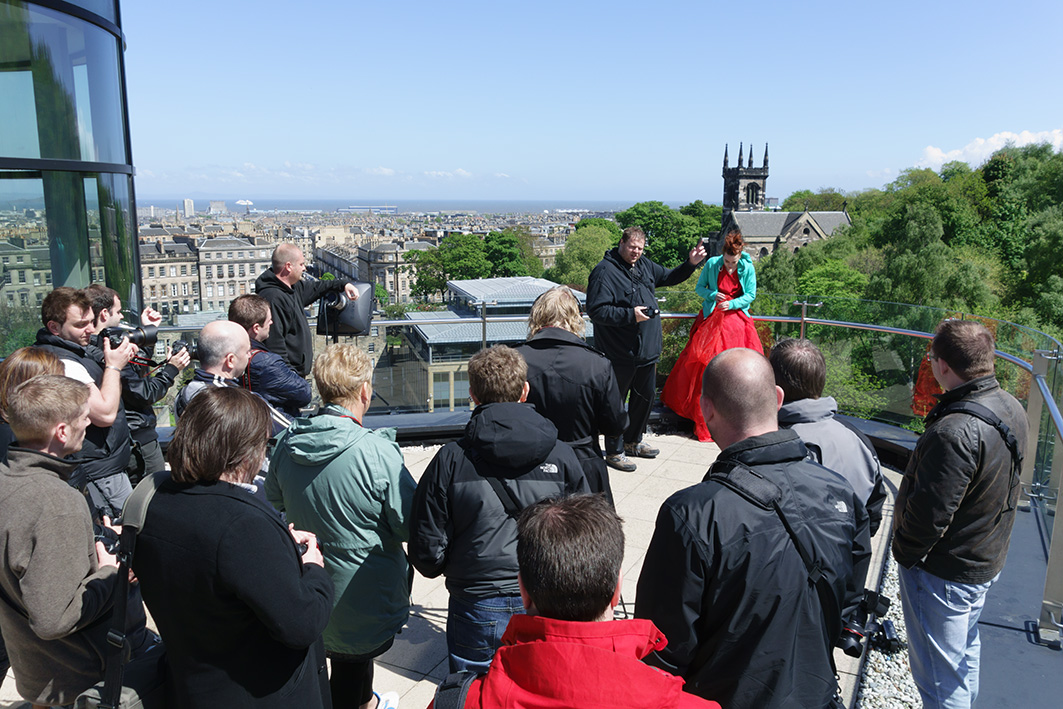
    For a further set-up, Frank moved to the roof terrace view over the north of Edinburgh towards Leith and the Forth (first image on this page). He had demonstrated sets suitable for normal to wide angle lenses, using the 24-70mm, and switched to the 70-200mm f/2.8 Sony SSM G for a different relationship between the model and the background.

    doorhof-churchview-noflash-web

    This was the view without flash – not a bad set-up as it stands. When processing my images, I found that the in-camera standard JPEGs of the A99 handled the red of the dress better than almost any setting or camera profile using Adobe Camera Raw. Colours like this are a good case for trying alternative raw converters, such as DxO Optics Pro or Capture One Pro. Their camera profiles are generally closer to the in-camera conversions than Adobe’s. Frank demonstrated how to use the MacBeth ColorChecker Passport colour patch target and its camera profiling software to create an on-the-spot profile for better ACR/LR conversions.

    doorhof-churchview-flash-web

    This is the shot with flash, again, in-camera JPEG sRGB. AdobeRGB would retain more potential detail in the red, raw conversion to 16-bit using ProPhotoRGB the maximum. But for that you also need something like a Eizo 10-bit monitor with a matching video driver, and no Apple Mac made comes with that. Build yourself a tower system and it’s just about possible to get 10-bit colour… but not using Mac OSX! My monitor is a regular old 27 inch iMac and if it’s 8-bit it’s having a good day. The colour looks lovely, but accurate it certainly is not. I don’t mind as 99% of all the screens any of my images will ever be seen on are no better, and the printed page is far inferior. Putting the above pictures into print would almost guarantee the differences you see here are lost.

    smallscreeneducation

    Because the Glasshouse’s rooftop function suite has a white translucent fabric roof, the overhead projector could not be used. So, Frank sat down with his laptop and the photographers. Later on in the day, the group moved to an inside room, and he demonstrated a series of processing steps in Lightroom with special attention to the use of plugins producing Clarity, pseudo-HDR and ‘image look’ and to fashion and beauty retouching.

    To read more about Frank’s work, visit his own website www.frankdoorhof.com or follow him via Kelby Training. He regularly does workshop tours. I’ll be reporting on some of his views and hints for professional photographers, specifically, in the June 2013 edition of Master Photography magazine (you can subscribe here for this 10X a year magazine which we also produce).

    For more information on the Elinchrom flash system, Skyport wireless triggering and battery powered Ranger/Ranger Quadra location flash, see The Flash Centre website.

    – David Kilpatrick