Category: NEX System

  • Go wider than wide with Photomerge

    In the latest incarnation of Photoshop, CS6, the Photomerge function is faster than ever before and leverages all the context-aware, pixel matching math of the previous versions enhanced to a degree you’ll find hard to believe.

    Sony NEX and Alpha cameras have the same technology built-in for their sweep panorama mode, but anyone who’s used this frequently will know that failures happen, like stepped sea horizons and double imaged or squished-flat people.

    Photoshop has the menu item Photomerge under ‘Automate’ in the File Menu. It is a panoramic stitching function, but it does not need you to shoot with a tripod or even shoot with care. You can stick a wide angle lens on your camera, take two pictures with radically different vanishing points, and still end up with a neatly stitched perspective.

    What you need to know is how to NAME your images or what order to shoot them in. Contrary to what you might expect, Photomerge inherits its geometry from the LAST image in your sequence. So, if you have these three images:

    This is the order you need to name them. I shot these with the bottom one first, of course – my level horizon straight-on shot. Then I aimed up, and then up again, overlapping three shots. If I then select these for Photomerge, Photoshop will correctly realise I want a vertical panorama stitch but it will not use the straight-on shot to set the image angle and geometry. It always picks the LAST shot, so I must rename my JPEG conversions 1, 2 and 3 as they appear above.

    If your open tabs, or the stacked order of open windows, does not place the target perspective LAST you’ll get the wrong result. Here is what happens if the first shot (the bottom one above) is placed as the first tab in a multi-tab PS window, or the top window in a stack of separate windows, before adding OPEN FILES to the Photomerge window:

    I used the NEX-7 with the 16mm f/2.8 SEL wide angle for these three shots. The composite, before cropping, measures a substantial 130MB. This technique enables you to use almost any wide-angle lens to create impossible wide views.

    Here is the result when you stack the shots in the right order, so the program takes its perspective cues from the vertically-correct frame (the last one shown at the top):

    You have no manual control over the perspective rendering. It’s all down to feeding Photomerge the right images, in the right order. Here is the fine tuned and cropped result:

    This is an unretouched merge of the three frames. I’ve been trying this on various subjects, some rather silly, and Photoshop CS6 simply nails the merging even with focus, exposure or tilted camera errors. There are much lower cost programs which stitch images and do it well, but this takes a matter of a few seconds to create a final image equal to 40 or more megapixels. Not bad for a tiny 16mm lens!

    Tip: instead of adding Open Images, browse and add one at a time, making sure the perspective-key shot is the last one added.

    If you shoot architectural or landscape images, this function’s enhanced performance allows you to leave behind your 8mm. Except, of course, you don’t have one. If you do have an 8mm, welcome to the world of 5mm…

    Added example – the next day…

    I returned to the building (the other end of it) the day after posting this article because I wanted to add something far more complex, still shot by hand, using the NEX-7 and 16mm, showing just how amazing Photomerge has become. I wanted foreground and background elements, complex geometry and a matrix of shots not just a row of them.

    Here is my matrix of shots – every one of these is an 85° diagonal view, 16mm on APS-C:

    Here is the result of the Photomerge window before final adjustment and cropping:

    This is a 400MB+ Photoshop document and over 200MB in flattened data size. Below is the final crop, with a small rotation and correction of vertical perspective:

    This is a 119MB JPEG 6919 x 6013 pixels in size, no retouching has been used and the raw conversions are default with the 16mm E lens profile. Some fringes remain visible, the image could be downsized and corrected further. Remember.. this is the often-criticised 16mm which I find to be an excellent little lens. You can download the full size sRGB JPEG saved to Level 10 quality (14MB file) from the link below if you are Photoclubalpha subscriber. It will not appear if you are not a subscriber.

    [private]

    Subscriber Link

    [/private]

    – David Kilpatrick
  • David and Goliath? Nikon D4 dwarfs NEX-7!

    Side by side on my light table (which collapses with a ‘pop’ when sixteen tons of Nikon is placed on it), and the NEX-7 is given the foreground role to avoid any accusations of using perspective to make it look tiddly.

    I’m writing some reviews of the Nikon and other new professional DSLRs for the British Journal, so I won’t say anything about the Nikon’s rather wonderful 16 megapixel full frame sensor or its stunning low light performance. I hope when Nikon read my reports they’ll decide to send me to photograph in the Arctic Circle in December – there would be plenty of light for this beast.

    This picture won’t be going to the BJP. I like it because these are equivalents. The Nikon’s 28-300mm VR is admittedly f/5.6 at the long end (and a vast amount better than any Sigma or Tamron 28-300mm or 18-200mm yet made). But otherwise, these are zooms with the same range of angle, both stabilised, both very quiet in both focusing and IS action, both very well-made.

    And the cameras are both a real pleasure to use and produce 100% professional results. The difference is that if I stick the NEX-7 combo under my coat, I do not look like a shoplifter or terrorist with a concealed weapon of mass-perturbation.

    Watch out for our NEX-7 review soon. I’m not hurrying and it may be a month or more.

    – David Kilpatrick
  • The EVF future

    At photokina 2010, Paul Genge from Sony pretty much told me that Sony’s future lay in the EVF (translucent mirror or otherwise, Electronic View Finder) models. He was not able to say anything firm. Since then, I’ve spoken to him on several occasions and he has repeated that Sony left all options open but the EVF design was likely to be the way ahead. What he has not said directly to me is that conventional SLR design – Optical View Finder – was off the roadmap.

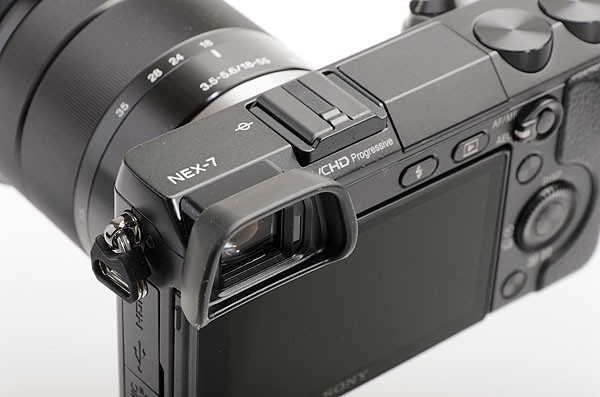
    EVF does away with the need for the finder to be positioned anywhere near the optical axis. Noses can safely hit thin air not a rear screen. Unless you are left eyed. NEX-7 with ocular surround fitted.

    Although Sony did not attend Focus on Imaging 2012, the UK website TechRadar secured an interview statement during Focus week, in which Paul appears to have confirmed without ambiguity that the future was EVF-only, and that the forthcoming full frame successor to the Alpha 900 would be an SLT-EVF design. At the same time, we learn that the 70-200mm SSM G and 70–400mm SSM G lens are to be revised for 2013.

    We know, from several sources, that Sony is not currently making all its lenses – even the high end ones – in one facility, or in its own workshops. I believe the 70-400mm SSM G is a contracted-out design and that the 70-300mm SSM G has always been made by a third party lensmaker. This is nothing new; the Minolta 100-400mm APO was patented by Tokina and sold to Minolta as an exclusive (no-one else got the lens) and the same company made some if not all the 100-300mm APO lenses. Using different sources means that various types of coating are appearing; traditional Minolta style – the multi achromatic coating, Carl Zeiss T*, Tamron’s BBAR-derived coatings, some Sony multicoatings of unknown pedigree on Chinese SAM lenses, and a new water and oil resistant coating due to be used for the revised 70-200mm and 70-400mm.

    This coating is nearly always combined with weather or splash proof design, and companies which have the ability to apply it include Hoya (Tokina, Kenko, Marumi, Pentax), Olympus, Canon, Nikon, and Sigma. Sigma is very significant as they have installed new coating lines recently and they are going through a bit of a subcontracting boom. Their facilities are all in Japan, they are on high ground and were slightly affected by the earthquake but not by the tsunami. They have a long history of building lenses and cameras for Leica, Carl Zeiss, Panasonic, Olympus, Canon/Kodak and interchangeable lenses for nearly all the major names.

    If the high end tele zooms are to be revised, weatherproofing and the new coating will certainly arrive along with a synchronisation of lens appearance and finish. But I’m willing to bet something else is involved. The SSM focus system is only partially suitable for contrast-detect operation. It works, on static subjects, but unless some major advance is made in CD-AF it’s lacking the refinement and speed of the AF found in SEL (native Sony NEX) lenses. I’ve tested the 70-400mm on the LA-EA1 with NEX-7, I can work with the lens comfortably on most subjects and the camera is very good at refusing to take the shot until focus is 100% locked.

    All that just to get 2X the magnification – NEX-7 with LA-EA1 and 70-400mm SSM G (an operational kit, if not fast) compared to Tamron 18-200mm NEX lens with the correct type of contrast-detection friendly focus motor and protocols.

    What Sony must surely want to do is dispose of the SLT (‘translucent’) pellicle mirror and the Phase Detection AF module. It makes most sense to focus, meter, view and expose from one single sensor. In order to do so, lens focus motors need a slightly different control protocol. SSM lenses are already CD-AF compatible, as are SAM onboard focus motor lenses, but they don’t match the NEX system SEL lenses. Sigma HSM and Tamron USD Alpha mount lenses are not CD-AF compatible and do not work correctly on the LA-EA1 adaptor. Upgrading matters most with tele lenses, and they are also most likely to be used in adverse weather for wildlife, news or sports. So my guess is that the upgrade to these lenses will be comprehensive and that it will look forward to possible Sony Alpha bodies with either no SLT mirror, or a movable SLT mirror and choice between PD-AF and CD-AF.

    As for the EVF itself, it’s one stage away from being better than a very good optical finder on balance of qualities. Unlike optical finders, the EVF is not susceptible to user eyesight error (incorrect dioptre correction, combined with eye focusing accommodation) and presents the user with a low resolution but otherwise very accurate view of the image focused on the sensor. It can do this at light levels where optical finders become difficult to use, while also presenting a review of the captured image if desired – ‘shot success’ confirmation.

    Differences between the ‘identical’ EVF of the NEX-5n accessory finder FDA-EV1S and the NEX-7 fixed built-in version are mostly down to the difference between the 16 megapixel generation 2 sensor, and the 24 megapixel. Response speed, low light noise, quality of colour and contrast are all influenced more by the two very different sensors. User observations that one is better or worse than the other will nearly always be down to this, and variations in settings between the two cameras compared.

    There are things you can do on an EVF, such as magnifying a focus point well away from the centre, which simply can’t be done at all with an optical finder and may not always be convenient to do on a rear screen. The fact that EVFs permit eye-level video shooting, and that video is now a permanent feature of the Alpha class of camera from entry to semiprofessional, makes the EVF design change more inevitable.

    Paul Genge had a short exchange of information with me when I was considering selling my Alpha 900 and all my frame Alpha lenses (after starting to use the A77). He said I’d regret selling my good full frame lenses when I replaced my Alpha 900 with a full frame model I would just not believe. His message was ‘you wait – you’ll not regret it’. So, I sold my old Minolta-era full frame lenses and bought myself a brand new 28-75mm f/2.8 SAM, Sony 50mm f/1.4 (replacing Minolta vintage), a 24mm f/2 Carl Zeiss SSM, and a 70-400mm SSM G. I kept the Alpha 900  and a few lenses I like which are unique in their function, such as the Samyang 85mm f/1.4 manual, the Sigma 70mm f/2.8 Macro, the Sigma 12-24mm and an old 16mm f/2.8 full frame fisheye. Instead of getting out of full frame, I re-invested in it.

    I’m expecting the Alpha 900 replacement to be either an SLT design like a scaled-up A77 with 36 megapixels, or a second generation hybrid SLT design with a mirror you can raise to use CD-AF or manual live focusing. I’m hoping that it will appear with a new 28-75mm, 24-70mm or better midrange f/2.8 with improved SSM, weatherproofing and new coatings like the 16-50mm f/2.8 DT.

    – David Kilpatrick

  • Tamron 18-200mm VC for NEX

    Tamron’s has announced a high-power zoom for Sony’s NEX-series – the 18-200mm F/3.5-6.3 Di III VC (Model B011).

    The image-stabilised lens has exactly the same nominal specifications as Sony’s own zoom. The angle of view is 27-300mm when converted to 35mm format.

    It weighs 460g, uses 62mm filters, and has VC (Vibration Compensation). The metallic lens barrel exterior is available in two colors: black and silver. A newly constructed stepping motor allows contrast-detection AF during video shooting. Direct Manual Focus (DMF) allows the user to make fine manual adjustments in the AF focus.

    Di III (Digitally integrated design): A new designation Tamron gives to lenses engineered specifically for mirrorless interchangeable-lens cameras with no internal mirror box or pentaprism, adopting an optical design that matches the characteristics of the digital camera.

    The result of this development is a lens that is compact and lightweight, featuring a 62mm filter diameter and weighing only 460g. The lens is available in silver and in black.

    Tamron’s VC mechanism employs a three-coil system, electromagnetically moving the VC group via three steel balls. The VC lens elements are held in place only by contact with the steel balls, achieving smooth movement with little friction. This provides a stable viewfinder image with excellent tracking performance that eliminates the blur from handheld shots for cleaner, crisper shots.

    Tamron’s earlier VC unit has a moving magnet system with heavy magnets in the vibration-compensating lens. However, the new VC mechanism adopts a lightweight moving coil system that reduces the load on the drive system. This allows the drive to be operated with smaller coils and magnets, reducing the weight and size for the entire VC unit. In addition, improvements to software and other elements of the VC mechanism used in the 18-200mm Di III VC have made the mechanism even quieter.

    Specifications 18-200mm F/3.5-6.3 Di lll VC (Model B011)

    • Focal length: 18-200mm
    • Maximum aperture: F/3.5-6.3
    • Angle of view3: (diagonal) 76˚ 10´-8˚ 03´
    • (Horizontal) 66˚ 16´-6˚ 43´
    • (Vertical) 46˚ 51´-4˚ 27´
    • Lens construction: 17 elements in 13 groups
    • Minimum focus distance: 0.5m (throughout zoom range)
    • Maximum magnification ratio: 1:3.7 (at f=200mm: MFD 0.5m)
    • Filter size: φ62mm
    • Length4: 96.7mm
    • Entire Length5: 102.0mm
    • Diameter: φ68mm
    • Weight: 460 g
    • No. of diaphragm blades: 7
    • Minimum aperture: F/22 – 40
    • Standard accessories: Flower-shaped lens hood (included)
    • Compatible mounts: Sony E-mount

    The angle of view of the lens when used for video on the Sony digital HD video camera recorder NEX-VG10 is 32.4 – 360mm when converted to the 35mm format.

    Due to an inherent characteristic of this TAMRON lens, the resulting image in the LCD monitor may be displayed in a “pumping” manner in the continuous operation of the focus search function when using the Sports Action mode on Scene Selection. The actual images captured will NOT be affected by this circumstance. In other Shoot Modes (P, A, S, M), when the focus mode is set to Continuous AF (AF-C), the same condition may also arise. The actual images captured will also NOT be affected by this circumstance.

    As an alternative to the above settings, you can change the focus mode to Single-shot AF (AF-S) or Direct Manual Focus (DMF).

    This lens was developed, manufactured and will be sold based on the specifications for the E-mount that was disclosed by Sony Corporation under Tamron’s license agreement with Sony Corporation

    Price: The suggested retail price is yet to be announced. Availability: Early 2012. Exact date to be announced.

  • Sony launches new range Alpha, NEX

    All the predicted new models from Sony were unveiled today – the Alpha 77, Alpha 65, NEX-7, NEX-5n and NEX-VG20.

    Full details are up on Sony’s websites. The A77/65 cameras will be on sale from October 2011 onwards. View Sony press information online.

    Those who grab the cameras will find the virtual 1.09X 100% field of view given by the OLED finders looks to be visually 10% bigger than the largest APS-C viewfinders made, an experience close to using a full frame DSLR with an optical prism (1.09X at 23mm eyepoint).

    The Alpha 77 is launched with the new 16-50mm f/2.8 SSM (not SAM as rumoured!) lens, and the Alpha 65 shares the same new 2.3 megapixel OLED viewfinder technology. The burst speed of the 77 is revealed to be 12 frames per second (predictions have ranged from 10 to 15) with the A65 achieving 10. The new 19-point, 11-cross point AF module is fitted to the A77 only, the A65 has a simpler 15-point, 3-cross module.

    Both have the 24.3 megapixel CMOS sensor also found in the new NEX-7 model, but only the A77 allows ISO 50 capture (all allow 16,000). The A77 has a fully articulated 3-way swivelling rear screen and the A65 a simpler 2-directional hinge. HD video is upgraded to full 50/60 frames 1080 progressive (no longer 25/30p or 1080i) with full manual control.

    The A77 has a semipro spec 1/8,000th shutter speeded to 1/250th for X sync, and rated for 150,000 cycles (tests will probably showe it uses a hybrid electronic/mechanical timing method to reduce shutter wear, but you’ll have to look elsewhere to confirm that, as we are not at the launch event). It has the expected GPS onboard.

    The A65 is regular plastic-skin construction (see strap lugs, above) but the A77 is moisture/dust sealed and so, according to the information, are ther 16-50mm and the new HVL-F43AM flash and VG-C77AM vertical grip. The 77 uses full size NP-FM500H batteries.

    Paul Genge, Technical Field Sales Manager for Sony UK, will be online for a one-hour live video Q&A session on the company’s Facebook page from 7.30pm GMT – visit www.facebook.com/SonyUK to partticipate.

    Key points: auto ISO remains 100-1600 not expanded in range on the A65, but can be user set for 100-12,800 on the A77, which also has separately set 50 and 16,000 options plus a multishot 25,600 (the A65 also has this high speed mode). The A77 offers JPEG Extra Fine, the A65 does not.

    The viewfinder magnification (eyepiece/screen combination) is not stated but is superior to the A55 with a half-inch OLED.

    On the A77 only, exposure bracketing has been expanded to 3 frames at 2EV and 3EV intervals, in addition to 3 or 5 frames at 1/3, 1/2, or 2/3 EV; the A65 offers only 1/3 or 2/3 for 3 frames. Peculiarly, neither offers 1 EV bracketing.

    The A77 or A65 normal motordrive with full AF/AE is 8fps (slow speed 3fps), the higher speeds are obtained with Continuous Advance Priority (fixed settings during burst). Both can achieve 13 raws, 17 fine JPEGs before slowing.

    It doesn’t look as if either accepts the HVL-F58AM as a wireless controller, but both have built-in wireless. The rumour of CF card compatibility in the A77 was false, the cameras have dual MemoryStick PRO Duo/SD drives.

    The NEX-7

    The professional NEX has the 24.3 megapixel sensor, ultra-fast response with startup and focus time improvements, the same OLED viewfinder as the A77/65 built in to the body, the same full HD 1080/50/25p movie (Europe, 60/30 US) and the same sensitivity range as the A77. Manual refocusing is possible during video, 10fps bursts can be shot, and a leather case turns the camera into a Leica-like for eye level use.

    The NEX-7 has the slower 1/4,000th with 1/160th sync shutter found in the A65 so it’s not all professionally-biased. And it’s got a small buffer, allowing a mere 6 raw frames or 4 raw+JPEG in a burst, 10 JPEGs at Fine res (no Extra Fine option is offered).

    All the pre-existing bells and whistles remain included, such as Sweep Pan, 3D Pan, etc.

    Please note: the OLED viewfinder on all these cameras is a power hog. With the NEX, for example, the rated battery life is 350 images using the finder, 430 images using the rear screen. The bigger battery of the A77 can still only power 470 shots (because of GPS?) where the A65 manages a respectable 510. Switching to the rear screen for composition increases these figures to 530 and 560.

    There is NO new updated standard lens for the NEX and the existing 18-55mm will fight it out with the increased 24 megapixels!

    No GPS. No info on potential GPS attachment.

    View press info online.

    The NEX-5n

    The 16.1 megapixel sensor, also found in the new video VG20 model, gets into the updated NEX-5 which has the same improvements in response time and focusing as the 7 (claimed doubling of readout speed from the CD-AF system).

    Its USP appears to be the ability to simulate a preview of adjustments on the screen and adjust them using touch control. It has 10fps burst.

    There is a new EVF attachment. View press release online.

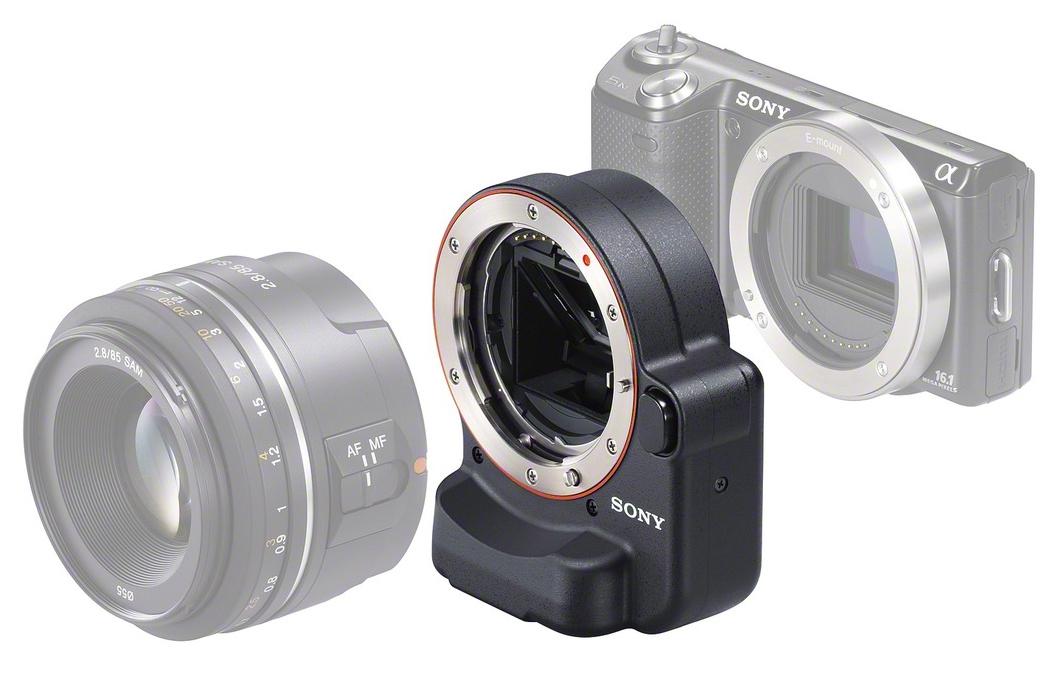
    A new battery powered LE-EA2 adaptor which allows autofocus with ALL Alpha lenses including Minolta body-drive types back to 1985 is also to be available, above. It includes a downward-facing SLT pellicle mirror (don’t know why they did not use this design in regular cameras) and a Phase Detect AF module so the NEX can behave exactly like an Alpha 55. Note the screw drive focus coupling.

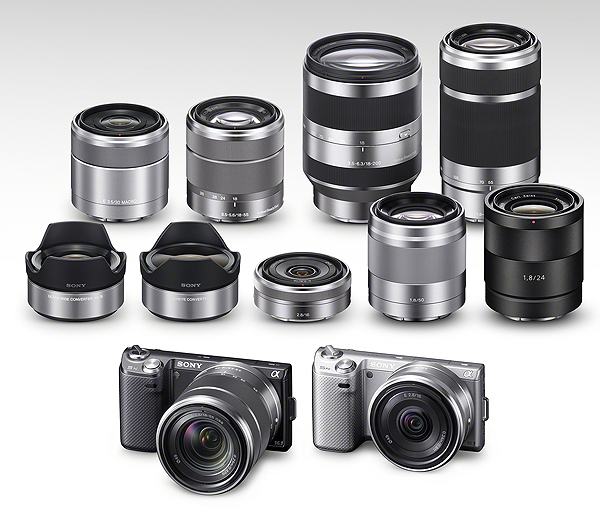
    Looks like a decent lens-line-up, but me, I prefer more pancakes for my breakfast, not just a stack on one…

    Along with the two new NEX models, the Carl Zeiss Sonnar T* E 24mm f/1.8, the Sony E 50mm f/1.8 OSS and the telephoto zoom E 55-210mm f/4.5-6.3 OSS are to be launched. Availability of the new NEX gear should be quick – from September for the 5n, November for the 7.

    The NEX-VG20

    Aye well, it’s 16 megapixel video formfactor model as per VG10. See the info online. It claims the best ever video from such a camera – but they say the same about the ‘still’ models and they are probably right.

    Sorry about a few of Sony’s uncropped image files with loads of white round them, they always do this and we will crop them later. But I’m due 100 miles away for a major Associateship and Fellowship annual judging to see some good photography and I have already made myself late with this! The article will be revised tonight. – David


  • Pentax Q up to battle it out with NEX and Ricoh

    Although it’s not Alpha, this product announcement – embargoed until 5am UK time, 23rd June, though no doubt by adhering to the embargo we will be a day later than hundreds of websites breaking it – speaks volumes for the impact of Sony’s Alpha system, its interformat lens compatibility, and the future of non-SLR systems.

    Kenko, a Hoya group company like Pentax, showed a C-mount digital camera body in February, as a prototype planned for release this summer. Nothing more has been heard of this project. It looked rather like the Pentax in a way.

    But Pentax Q is not a NEX competitor as it uses a tiny lens mount and a tiny sensor. It’s more like today’s equivalent of the Pentax 110 SLR system. Only Ricoh currently uses such small sensors in a nominally ‘interchangeable lens’ (not really) camera format. And our own testing of the Fujifilm F550 EXR, with a similar back-illuminated CMOS sensor, indicated that the gap between such microformats and the APS-C subformat is massive.

    Just as your first dust spot will be… the anti-dust system is going to have to be 100% efficient, as a single dust bunny landing on a 1/2.3″ sensor will be disaster.

    The lens throat is approximately 38mm diameter, very slightly smaller than Leica screw. The back focus is around 9mm, or half the thickness of the NEX body from sensor surface to flange. This will present the anti-shake, anti-dust vibration mounted sensor (on a magnetic carriage) in a fairly exposed ‘well’. The high speed limitation of 1/2,000th is unexpected, but the camera does not use a focal plane or electronic gating; instead it uses leaf-shutter lenses, which due to the small aperture size, can achieve this fast speed. But they can still only manage 1/250th flash sync, when it would be expected that a leaf shutter on this scale could achieve 1/1,000th.

    Here is the Pentax Q system, due to go on sale in the Autumn (press release with comments).

  • Wait for the NEX SLT, folks…

    That is, the next slot in Sony’s programme of new product releases. Almost exactly five years after the Alpha 100 was launched to the world (also a Wednesday in the second week of June, back in 2006) Sony selected an auspicious date to announce the NEX-C3 and the Alpha A35. But these cameras, rather like the Alpha 100 in its day, are not what we are waiting for.

    So – what’s new? 16.2 megapixels, 5.5fps native size, 7fps using a 1.4X crop (about 8 megapixels), no articulated rear screen, some candy functions in the menus for technophobes, and that accessible D-Range button can be made into a rapid custom control.

    Everyone has suggested that a NEX-7 will be what they want. I rather think they will be get a NEX-C5, applying the same transforms to the 5 as the C3 (Compact 3) applies to the 3. That means it will have proper HD video, which the C3 lacks being restricted to MPEG4 HD720. Already, the rustle in the undergrowth is that the diminutive C3 misses the mark for this one single reason only. Sure, a 16.2 megapixel sensor (supposedly a new version, not just borrowed from the A55/580) is a welcome upgrade but NEX is a multipurpose system, and HD720 is back in 2006 not in 2011.

    Nice mic slots, nice big CZ 16-80mm shown on the adaptor – but this, dear Sony, misses the point. We actually want the CZ 16-80mm to be updated to an SSM design so that it will focus on the NEX, and be better on the Alpha bodies, and so that its slightly manky mechanical design can be turned into something so smooth existing 16-80mm owners queue up to buy the replacement.

    Good points – the shift in position of the stereo microphones to the front of the camera, the change to using a separate cover for the memory card instead of having to open the battery compartment. There’s a claim that along with a 20% better battery life, greater heat efficiency means the new cameras won’t cut out before 29 minutes is up when filming HD, even if you use SSS on the A35. Of course the NEX has no SSS but still managed to overheat, at least in the NEX-5, unless you were savvy enough to shift the rear screen away from contact with the camera back – in which case it generally keeps filming OK.

    The operating times, startup, focusing speed are all reported to be much improved – by a factor of two or better. Only the image review time is worse due to the larger file size. Sony’s information makes it clear that very strong noise reduction is applied and this may affect raw files as well as JPEGs.

    The new 30mm f/3.5 Macro SEL is theoretically interesting, but not so much for me personally as we have already got the 30mm f/2.8 SAM and the NEX adaptor. Eventually, you come to terms with the simple fact that a 2.5cm working distance for 1:1 shots prevents you shooting half the 1:1 shots which present themselves. You disturb the butterfly, hit bits of the plant, or cast the lens’s own shadow across the picture.

    The firmware update (see end of story) to provide a ‘focus confirm’ overlay for manual focusing is actually of far more interest to the macro photographer – along with almost any other specification of macro lens except 30mm f/3.5. These lenses are fun, I love the SAM 30mm, but it’s not the answer.

    The new HVL-F20S flashgun (based on the HVL-F20AM only in the design of its rotating reflector/diffuser) has changed a load since it was previewed with a mockup based on the Alpha model. Sony has decided to power it from the NEX battery, much as Minolta did with flashguns like the 316i in the early 1990s. That’s almost certainly because the NEX Smart Connector is simply not capable of holding the gun with a couple of AA cells in it, the weight would be too much.

    In an ideal world, this new flashgun would do for the NEX system what its orginator does for the Alpha 900 and 850 – act as a remote wireless flash commander. But it does not, leaving NEX outside the main Alpha system still. If you want remote flash (or even just a more powerful flash mounted on a bracket beside your camera) the Nissin Di 866 MkII remains your best bet, programmable to fire correctly in synch with the NEX and to use its own auto-exposure cell for metering.

    Alpha 35 – one step forward, two steps back

    The Alpha 35 is similarly not earth-shattering news, especially if you own an Alpha 55 with GPS function and rather better overall performance in all respects except (perhaps) ultimate high ISO. The firmware updates for both NEX and SLT models, to be available from June 20th, add most of the benefits of the new models along with some of the child-friendly hipsta stuff. Again, wait until the next round. A higher end SLT camera is firmly promised, it’s been prototyped and mocked up and preproduced and somewhere as I write someone is actually using it.

    Losing the articulated rear LCD (see above), not even replacing it with a tilting one, is a big sacrifice. The 7fps 1.4X digital tele conversion mode – with continuous AF tracking – is interesting and reminiscent of the sensor crop mode of Nikon’s first CMOS, the D2X, which was itself developed from a Sony sensor (the Cybershot DSC R-1). It shows that there are genetic traits in the Sony line that won’t be forgotten.

    But is there really much point to this camera? Not much. Unlike the NEX-C3 which sees a significant body size reduction and style change, the A35 contrives to be a poor relation of either the A33 or the A55 because it lacks that excellent, reversible, twist and swivel rear screen.

    Photoclubalpha has been a photographer’s thing not just a camera owner’s thing – a small difference, these days, but important. For photographers any reason to prefer the new models to what you’ve got may depend on small hidden differences which come to light as people use them. Certainly the provision of functions with changed names because no-one can be expected to understand what an aperture is, what a shutter speed is (and so on) is no reason to want the new models. Probably the reverse!

    Video enthusiasts may like to note that the firmware update for the A55/33 allows all the overlaid text to be removed from the live view, which can be output from the HDMI port to surprisingly high quality. Recording devices to accept HDMI signals like this are just starting to appear at affordable prices. There’s some potential to experiment with the image provided for LV (Focus Check Live View more so than Quick AF LV) once fed into other systems free from overlays.

    Version 04 firmware update for NEX-5, NEX-3
    Available from June 20th, a firmware upgrade for existing NEX-5 and NEX-3 cameras adds the new ‘Picture Effect’ function as introduced on the new NEX‑C3. It also adds a Peaking function to assist with more precise manual focusing. Available free to registered users, latest Version 04 firmware update for NEX-5/NEX-3 can be downloaded from:
    NEX-3
    Windows:
    http://support.sonyeurope.com/dime/downloads/downloads.aspx?f=FW_NEX3_V04_WIN&site=odw_en_GB
    MAC OS:
    http://support.sonyeurope.com/dime/downloads/downloads.aspx?f=FW_NEX3_V04_MAC&site=odw_en_GB
    NEX-5
    Windows:
    http://support.sonyeurope.com/dime/downloads/downloads.aspx?f=FW_NEX5_V04_WIN&site=odw_en_GB
    MAC OS:
    http://support.sonyeurope.com/dime/downloads/downloads.aspx?f=FW_NEX5_V04_MAC&site=odw_en_GB

    Editor’s note June 9th: please note that these URLs will not work – they are incorrectly transcribed by Sony. The URLs should be similar to those for the A33, A55 with a hyphen between sony-europe. Unfortunately, Sony has issued press releases and web pages with the incorrect URLs. We have changed the link so that it will work when the time comes.

    Version 2.00 firmware update for α33, α55
    Available from June 20th, a firmware upgrade for existing α33 and α55 cameras by Sony adds several creative and operational enhancements. Support for the ‘Picture Effect’ function featured on the new α35 is now offered. High-Speed Synch is supported during wireless operation with a compatible external flash (only α55). Ergonomics are further improved with revised menus and a new mode that lets users switch off shooting parameters overlaid on screen for clear, uncluttered composition. The camera’s Digital Level Gauge can also be displayed when shooting via the optional CLM-V55 external LCD monitor. Frequently used features can now be custom-assigned to the D-RANGE button for rapid, menu-free access.

    Available free to registered users, from the 20th of June the latest GB English Version 2.00 firmware update for α33 and α55 can be downloaded from:
    A33
    Windows:
    http://support.sony-europe.com/dime/downloads/downloads.aspx?f=FW_A33_V2_WIN&site=odw_en_GB
    MAC OS:
    http://support.sony-europe.com/dime/downloads/downloads.aspx?f=FW_A33_V2_MAC&site=odw_en_GB
    A55
    Windows:
    http://support.sony-europe.com/dime/downloads/downloads.aspx?f=FW_A55_V2_WIN&site=odw_en_GB
    MAC OS:
    http://support.sony-europe.com/dime/downloads/downloads.aspx?f=FW_A55_V2_MAC&site=odw_en_GB

  • NEX shoots the ‘Flight of the Angel’ – HD1080 YouTube

    The shape of the NEX-5 and the availability of 180° (fisheye) and 99° (ultrawide) converters for the 16mm pancake lens persuaded us that with a suitable harness or secure housing, we would get permission to make a unique high definition film on the famous Volo dell’Angelo, one of the most dramatic zipwire experiences in Europe.


    (more…)

  • Replacing Sony LCD screen cover glass

    The Sony NEX-5 and NEX-3 both use the same plastic-framed, metal stamping mounted rear 3 inch 16:9 LCD display for composition, menus and image review. The original LCD has a multilayer structure claimed by Sony to reduce reflections, increase contrast and resist scratches. But in use, these rear screens have shown a tendency for the surface layer to delaminate, creating very ugly and distracting patchy reflections. It is easy to replace this surface film completely, with a new toughened glass surface. (more…)

  • Pro underwater housing for NEX-5

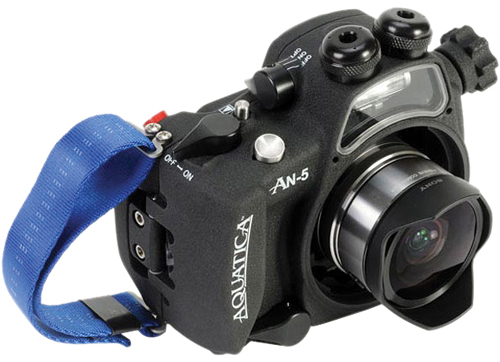
    Most underwater housings for compact cameras are basic items intended for use down to 10m or so. The NEX-5, with its magnesium alloy body and exceptional 16mm f/2.8 optic with fisheye and wide conversion options, is worth far more than that. It can be turned into the modern-day equivalent of the Nikonos rather than a modern day equivalent of that peculiarly unreliable subaqua Vectis which Minolta bowed out with…

    Here’s something which we found in an email for B&H Photo Video. It is not exactly cheap – you are looking at a near-$2000 investment to take your NEX and lenses below the waves – but it’s got a specification to make serious subaqua shooters rush for that low-cost NEX-5 outfit to complete the kit. Especially as anything similar for DSLR cameras may cost 50%, 100%, even more than this.

    There is a waiting list now – the Montreal manufacturer (reports Photoclubalpha forum member Javelin) is 4-6 weeks from delivery after a big rush following the product announcement. So if you want one of these for summer, get your order in right now, do not delay as all production is likely to be pre-ordered this year.

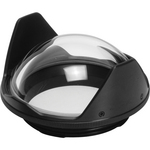
    To complete this you need an extension and dome port front, of course

    The Aquatica AN-5 Underwater Housing for Sony NEX 5 Camera is a compact (5.5 x 3.25 x 6″/14.2 x 8 x 15.4 cm) housing machined from a solid block of aluminum designed for the Sony NEX 5 camera. This lightweight (2.2 lbs/1 kg) housing has a baked-on powder coating and is fully anodized against the corrosive effects of sea water. It has replaceable sacrificial anodes, plus pad printed function labels that won’t peel off or fade. It has built-in dual optical connectors, and all controls are easily accessed, with the LCD screen at a more-comfortable 15° viewing angle. A variety of ports are available for the AN-5 housing.

    Note: Requires Lens port
    Also Note: Most zoom lenses require a close-up diopter filter to correct focus distance.

    • Accurately balanced ergonomic design – all controls are within easy reach.
    • Depth rating: 300′ (90 m).
    • Excellent balance underwater.
    • Replaceable sacrificial anodes protect the housing from electrolysis.
    • Precision machined from a single aluminum block
    • Lightweight and compact housing is fully anodized
    • Covered with baked-on powder coating to protect against the corrosive effects of sea water
    • All function labels are pad printed so they will not peel off or fade.

    Pre-order from B&H

    This is a new product, and B&H show it as available for pre-order, along with the accessory ports (to fit either the 18-55mm zoom, the 16mm f/2.8 alone or the 16mm fitted with the VCL-ECF1 fisheye converter) and accessory L-type hand grip. See comments above about production and orders. This is a hot product and likely to be hard to get.

    The housing is compatible with the Sea & Sea Y110a slave-strobe underwater flash. This will set you back the better part of $1000 more, but it’s been tested synched with the NEX mini flash and apparently all works well. Flash is essential for good colour at depth, even down 5m or so and you’ll require it in many water conditions. The premium option is the twin Y110a dual unit (the housing has two optical connectors for the strobe’s fibre optic triggering cables).

    If you are put off by the cost, maybe you can’t afford that two week trip to the Maldives to photograph manta ray convocations – the basic housing is $1399, a typical dome port as shown is $499 (for the 16mm lens alone, only $159 and the cheapest option), the L-grip is $59, there’s also an optional zoom control. But 90m diving with an APS-C live view autofocus camera with f/2.8 lens focusing down to a few inches, usable ISO to 1600 and then more, has to make this worth the cost. And if you want to match the combo, you can easily spend $10,000 on a DSLR with housing which will not get into the same space or handle anything like as well.

    – DK