
PENTAX UK is pleased to announce the launch of the PENTAX K-7 lens-interchangeable digital SLR camera. The K-7 combines a variety of advanced functions and user-friendly features to ensure outstanding reliability and capability within a compact, lightweight body (says the press release from Pentax in the UK).
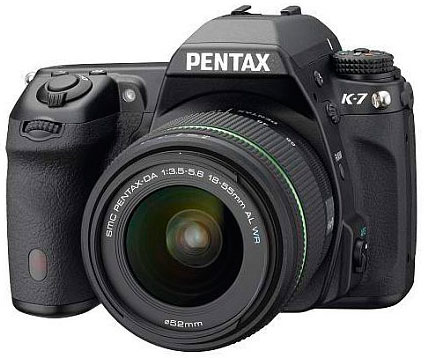
The K-7 joins the current PENTAX K digital SLR camera series as a high-end model in the range. True to its series concept, it has been designed to deliver outstanding image quality combined with ease of use, to benefit photo enthusiasts of all levels, including advanced amateurs. The K-7 also includes revised and upgraded features including viewfinder, shutter unit, continuous-shooting capacity, and exposure and autofocus systems.
Protected by a durable, high-quality metallic body, the K-7 is extremely compact and functional — as with all other K-series models — delivering enhanced portability and manoeuverability. The model includes several new user-friendly features, including video recording, high dynamic range (HDR), and automatic horizon correction. All of these features serve to deliver a highly effective photographic tool, perfect for all discerning digital SLR photographers.
(more…)
Category: Cameras (Digital)
-
Pentax K-7 -720p video, serious competition
-
New skins versus old wine – A350 or A380?
As the generation of Alpha 200, 300 and 350 reaches early retirement age it may be the time to grab bargains. The new Alpha 230, 330 and 380 have plenty of bonus points to win over new users despite the critical lack of video capture. But the older generation has some very tangible benefits.
The most obvious changes in the ‘Plus-30’ range are the use of a new smaller battery (NP-F50AM) shared with Cyber Shot consumer models, a dual MS ProHG Duo and SD card interface, substantial reduction in weight and size, improved rear LCD screen with auto brightness adjustment (only on the A330 and A380), and a radical overhaul of the graphical user interface to include sample picture tips (pioneered by Nikon).
(more…) -
Sony Alpha 230, 330 and 380 update

The new Alpha 230, 330 and 380 models are radical ergonomic redesigns of the existing 200, 300 and 350 series. There is a 15% reduction in size (volumetric) and weight, an update to the styling, and a completely revised user interface with graphic representation of setting adjustments – with a built-in ‘handbook’ to accompany the modes and options. They also have mini-HDMI image output, compatible with Bravia TVs and with interactive software inside the camera to allow the Bravia’s own remote control to change, orient and zoom into images (Bravia Sync). Twin card storage is MS ProHG Duo/SD and only one card is usable at a time, with a hardware switch to change slots. A smaller battery type (shared with the HX1 Cyber Shot) is used. A new self-timer drive mode grabs a quick burst of 3 or 5 frames, cutting the chances of spoiled portraits and groups shots when someone blinks at the wrong moment.
The new flashgun HVL-F20AM operates as a wireless flash controller for the full-frame α900. “While Sony’s flagship DSLR does not have its own integrated flash, the HVL-F20AM can be used as an inexpensive trigger for wireless remote flash heads” according to Sony UK.
(more…) -
Nikon D5000 first day – quick HD vid
True to promise, the Nikon D5000 did become available on May 1st in the UK, and my review camera turned up mid-day in time to be photographed and have its battery charged. Taking it out on my walk to the post (regrettably, to send in large sums of VAT and tax…) the sun came out though it was a very cold and windy day. With the sun, the breeze dropped to a reasonable level and on the way back I was struck by the motion of the trees, leaves and flowers.
(more…) -
Canon EOS 500D video HD example
My first tests with the Canon EOS 500D were posted on cameracraft.online, but given the number of search engines now flagging up this site for Canon 500D searches, I’m putting this post here as well.
This is an edited selection, shot in a mixture of 1080 and 720 modes, assembled using iMovie and written as a 720p final project for YouTube. Please feel free to link directly to the YouTube vid or to this page.
(more…) -
Sony and Zeiss renew co-operation agreement
OBERKOCHEN/Germany, 15.04.2009.
Carl Zeiss today announced that its Camera Lens Division will extend their successful collaboration with Sony Corporation for a further 5 years. Taking full advantages of their competence both companies agreed to cooperate even closer in developing and commercializing new imaging devices in the future.
(more…) -
Nikon D5000 – HDvid, articulated screen
Nikon has announced a May 1st launch for a competitor to the Canon EOS 500D, in their D5000. This camera has the first articulated screen (only 230,000 pixels) to be designed by Nikon. See:
http://www.cameracraft.online/2009/04/14/nikon-d5000-live-view-hdv-articulated-screen/
(more…) -
Canon EOS 500D – video plus 15.1 megapixels
Canon has announced a consumer level EOS 500D camera, with 1080p resolution video limited to 20 frames per second, and 15.1 megapixels but a maximum shooting rate of 3.4 frames per second:
http://www.cameracraft.online/2009/03/25/canon-eos-500d-151-mp-plus-hd-video/
This continues the trend for all new DSLRs to have HD movie shooting in addition to live view modes, something which Sony to date shows no sign of catching up on. However, the obvious compromises present in the 500D would be criticised harshly if they were to have appeared first in a Sony model, so this is good news. Canon has made it acceptable for others to follow with 20fps instead of the required 24fps, and still claim true 1080p video.
– DK
-
Tamron's new 60mm f/2 1:1 macro
Tamron Co., Ltd (Mr. Morio Ono, President), a comprehensive manufacturer of optical products with its head office in Saitama City, has announced the development of the SP AF60mm F/2.0 Di II LD (IF) MACRO 1:1 (Model G005), a life-size macro lens designed exclusively for digital SLR cameras with APS-C size image sensors* that offers a fast maximum aperture of F/2.0. (Text here is directly from their press announcement).
(more…) -
Sony CMOS sensor background revealed
There is a white paper by Sony Semiconductor on the imaging processing which I think is in the HX1, http://www.sony.net/Products/SC-HP/cx_news/vol55/pdf/featuring55.pdf. I assume it is the IMX-032 CMOS sensor (http://www.sony.net/Products/SC-HP/cx_news/vol55/np_imx032cqr.html) mated to a CXD4109AGG image processing chip. There seem to be some interesting techniques employed, multi-plane synthesis to combine several frames for low light and HDR capture.
With the IMX-032, it is interesting to note that the on-board programmable gain amplifier has a gain value of up to 18dB or a factor of 8, so if base ISO is 80, then maximum “analogue” ISO is 640. If we compare the IMX-032 versus Sony’s first column ADC CMOS chip (IMX-017), the IMX-32 has an 11.8% better photo-electron efficiency per unit area (2300e per 1.75 micron square pixel compared to 4500e per 2.5 micron square pixel). Might be a sign that Sony is improving the process and design used to make their CMOS chips.
The backside illuminated chip is called the IMX-061, http://www.chipworks.com/uploadedFiles/Aliased_Pages/CMOS_ImageSensors_Spotlight/Chipworks%20-%20Sony%20IMX061%20EXR-0902-813.pdf
6MP and 1.75 micron pixels in ClearVID (45 degree) layout with a 1:6:1 RGB Bayer filter array, sacrificing colour resolution for spatial resolution.
The Nikon D90 chip is called the IMX-038 (not the IMX-021 as for the A700), so this suggests it has significant revisions compared to the IMX-021 (possibly linked to LiveView and HD Video?).
– Dr Daniel K. L. Oi