Category: Lenses – Alpha Mount

  • Minolta 70-210mm f4 versus Canon 70-200mm f4 L IS

    The Canon 5D MkIII arrived, but I will not be reporting on that here – it is with me for a British Journal review, and that will take a little time and will also be exclusive to the BJP in print and on iPad App. So no sneak preview anywhere else!

    However, with the camera came a 70-200mm f4 Canon L IS lens. This month I picked up a very cheap 70-210mm f4 Minolta AF – the ‘beercan’ original from 1985 which has a broken lens hood, the wrong lens cap (why the hood got broken) and a slightly rough focusing travel that tends to get locked into a near or far range without having a limiter.

    So, since the loaner 70-200mm from Canon was in an equally well-used state, and the question keeps being asked whether the old Minolta is a match for it, I thought I would A-B the two lenses with the Canon on the new 5D MkIII and the beercan on the Alpha 900.

    I call this comparison ‘can o’beer versus a yard of L’ for reasons the product size comparison should make clear:

    Of course a lot of this is the Canon lens hood (anyone with a flair for geometry will spot that the narrower, shorter Minolta hood is nearly as effective, just draw a diagonal from front left to rear right of the hood to see why). And the Canon has IS built in, as well as a focus range limiter. During operation the Canon was rather noisy, making a constant whispering sound from the IS even though the USM focusing was silent. The Minolta of course zips and clunks into focus, but is otherwise silent, and the A900 in-body stabilisation did not make anything like the same level of operating noise as the in-lens IS.

    Although there is no doubt the Minolta lens is less sensitive to AF commands (if that’s the best way to put it) actual targeting a new focus point and locking on seems every bit as fast. It’s nowhere near as good as the Canon at continuous AF subject tracking, but the Canon was nowhere near as good as the Minolta/Alpha combo at user-targeted aim and focus operations. The Canon spent a lot of time being out of focus and then rapidly refocusing, with my moving targets (backyard hens, if you have them you’ll know what perfect focus test subjects they provide). The Minolta spent time staying focused and not responding much.

    Reviewing the results, I can only say the Alpha/beercan combo had a better success rate. Nearly all the shots were critically sharp where a good few Canon shots either didn’t get enough IS to combat shake, or maybe the IS was actually taking the edge off sharpness. This applied particularly at closer distances, where the Minolta (210mm, front group focus  and 1.1m focus distance) seemed much better than the Canon (200mm, internal focus and 1.2m minimum).

    For this article, I have made 2000 pixel wide reductions from my test images. These are within the 2MB limit at high quality for images within the site. Subscribers to photoclubalpha can also access hi-res full sized images (over 70MB in total, so beware) through an additional page link provided at the end of this report.

    The tree and twigs test

    Our big old holly tree provides a suitably evil subject for any lens with chromatic fringe or purple fringe issues. I shot everything raw; no lens profiles were used, the conversion was done using Adobe Camera Raw 6.7Beta. Like Lightroom 4, this offers automatic analysis of CA even without requiring lens profiles. In fact, adjustable CA is entirely disabled – gone. I can tell you it works amazingly well. Lenses which have been very difficult to clean up are fixed. It isn’t even one-click – just set ‘Remove CA’ as a default, and that is it, for all lenses, for ever.

    I used the tree for hand-held (with stabilisation) ISO 100 tests at f/4, f/5.6 and f/8.

    I thought the beercan would be bad for fringes and CA. On the Alpha 900, it simply wasn’t. The full aperture image was surprisingly clean. The Canon lens on the MkIII actually showed more colour fringing. Both cleaned up in ACR 6.7b. As for sharpness, it seemed to me to be a draw. I picked a 3D target to avoid slight front of back focus differences influencing the result.

    Above – Canon at 70mm and f/4 – click image to open 2000 pixel wide version

    Above – Minolta at 70mm and f/4 (same applies, to all these example)

    Above – Canon at f/5.6

    Above – Minolta at f/5.6

    Above – Canon at f/8 (for the f/8 images, the ACR conversion was cut by -0.30 EV exposure, as I felt both cameras had predictably overexposed a little, but the wider apertures were left this way as it emphasises any CA – since f/8 is an optimum aperture with cameras of this resolution, I aimed for the best straight conversions)
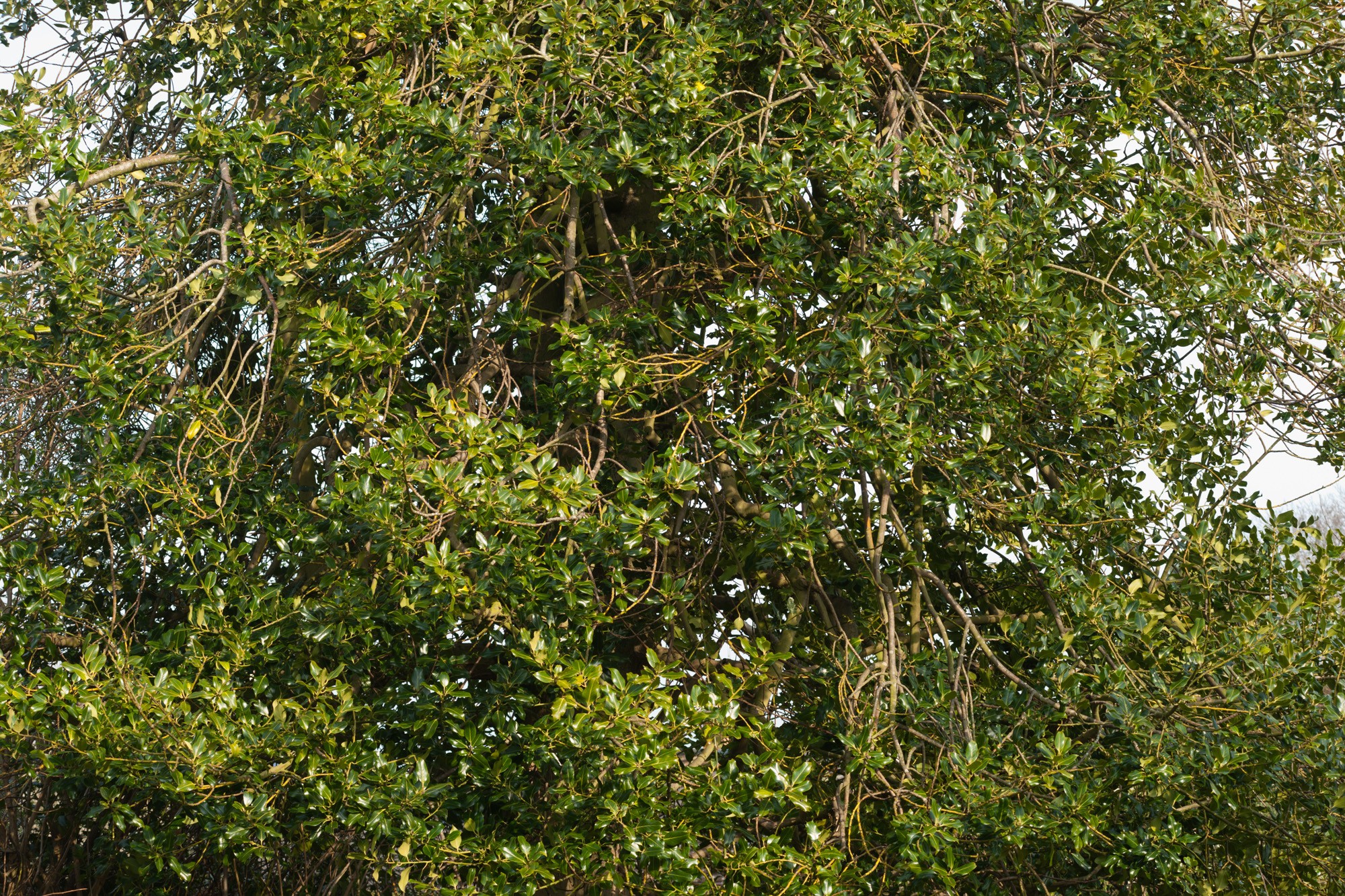
    Above – Minolta at f/8.

    Long end tests, moving and static, medium to close

    A range of different subjects ended up being shot on both cameras in the garden. I was, at the same time, shooting various tests on Fuji X10 and Pentax Optio WG-2. If that Pentax could shoot raw files it would be a real winner because the lens is lovely! When you start poking small cameras one or two cm away from small flowers, you realise how limiting the larger format and longer lenses can be.

    But the small cameras could not catch a single decent snap of hens scratching around as I worked. They move too fast and just the focus lag along, let alone the shutter lag, stops even the best compact or pocket digitals from being useful.

    Here’s a Canon shot. I took half a dozen similar shots with both cameras, slightly varying in distance and with two different hens, at f/5.6 and also some at f/8, all at maximum focal length. It would be hard to say the Canon was better as the success rate was lower. It seemed to focus faster but not as accurately, with both cameras set just to use the centre sensor (as the overall frame compositions tell you).

    This is 50% of original pixel scale. Click the image for a 1200 pixel square, 100% clip view.
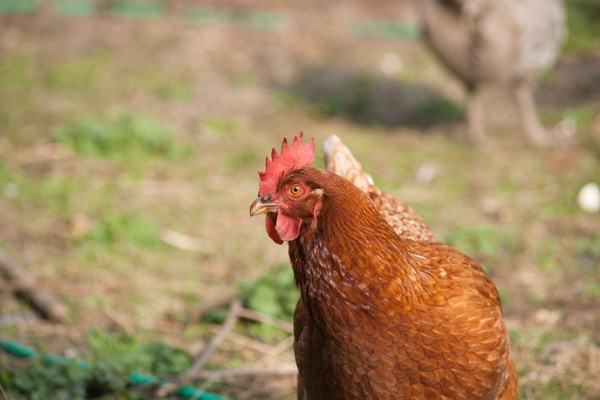
    Here’s an Alpha 900 shot with the  Minolta at the same settings, ISO 320 RAW, exactly the same ACR 6.7b parameters used (25, 0.5, 25, 0 Sharpening; 20, 25, 0, 25, 50 L and C NR; strong contrast curve; black point 0; Adobe Standard colour calibration; CA Correction enabled with Defringe Highlights but no Lens Profile; both with exposure dropped by -0.3EV, no other change to defaults).

    Again, if you click this 50% view you get a 1200 pixel square clip. Remember, no web or print sharpening is applied. The red hen is a little lower in contrast but so is the Minolta lens, I think, and so is the Alpha 900 default rendering – the 5D MkIII either has less dynamic range, or processes with a steeper curve to the raw. Or Adobe simply applies more contrast to the Canon raw ‘under the hood’.

    These pictures are at 1/320th for the Canon, 1/200th for the Alpha – anything less than 1/200th and hens move their heads so fast you don’t stand a chance of a sharp image. Aperture priority auto.

    Close-up ability

    I find the small difference between 1.1m and 210mm, and 1.2m and 200mm, significant. This is a recurring theme for me. Around 1m, differences of 10 or 20cm either way in minimum focus distance are critical. They can make the difference between working at arm’s length, within reach, or out of reach. My perfect close-up situation allows me to reach a hand out and adjust a subject, so I really like lenses which focus down to 60cm or so. I also like to be able to place my lens against glass, or right up to wires, to get shots through windows and barriers. A classic example would be a small animal in a wire zoo cage. If your lens won’t focus closer than say 1.5m, often you can’t place it up to the wire and therefore you can’t get the shot and blur the wire out. But if the lens focuses down to say 0.9m you can. So for me, any gain at all in minimum focus distance is good. I’m not keen on the way Sony’s SAM versions of once-screw-drive lenses generally lose a bit of close focus range.

    Here are the results of the Canon and the Minolta at their closest focus-confirmed setting. I used ISO 320, and f/11, hand-held with stabilisation.

    Again, if you click this image you will get a 2000 pixels high version. The Canon colour – or maybe the Auto White Balance – is better than the Alpha shot which follows. It may be down to lens colour transmission, as the 1985 Minolta glass is yellower than the Canon. I measured the transmission using a Kenko Color Meter (the new version of the classic Minolta Colormeter IIIF). The Minolta is roughly 5Y+5G and would need a 5B+5M filter pack to match the Canon lens transmission.

    Here’s the Minolta lens shot, closer because of the 1.1m focus and 210mm focal length:

    Again, clicking on the image will get you to a 2000 pixel high size.

    These close-ups had me really thinking. I had to go back and check the settings. I can assure you the pix really are from a distance of 10cm apart – I did not move, I just squatted back a bit with the Canon; the lenses were at 200mm and 210mm; the apertures were both f/11, both cameras were at ISO 320, both gave the same 1/160th exposure. Yet just study the bokeh (differential focus) of the Minolta images. Look at the thickness of the blurred dry plant stem crossing upper right in the background. Look at the green leaf behind the hyacinth. Study the larger version for the focus point in each case (it’s comparable). The beercan just seems so much better able to separate out the subject from the background, without losing depth of field within the flower. Yet if you look through the two lenses from the back element end, wide open, the Canon appears to have a huge aperture by comparison – a really wide exit pupil.

    Does it all prove anything?

    So, what do I conclude? Well, I know from many years of using the 70-210mm that it can benefit from an even deeper hood, maybe on the scale of the Canon. It’s not a contrasty lens, and it can get some serious internal reflection – big flare patches, even veiling the entire frame. And on some earlier cameras even APS-C size, my earlier examples of this lens had been prone to very strong purple fringes. But I have never had an unsharp example and some of our best, sharpest digital shots have come from the classic 70-210mm beercan.

    I’ve already been finding just what a transformation Adobe’s Camera Raw 6.7 beta (release candidate) makes with its auto analysis of the image to apply CA removal. Distortion and vignetting just aren’t significant issues with tele zooms of this type, so full lens profiles are hardly needed (and they are very difficult to make, you need a working distance most studios or homes do not contain).

    Using this rather beaten-up example makes me think that it would be good, again, to find a mint condition little used one. It is a lens with interesting properties; it is a true zoom, and a constant aperture, which means that if you lock the focus down and shoot video you can zoom without losing sharpness (many modern ‘zooms’ are varifocal not parfocal, and shift focus as you zoom) and without any aperture jumps (only constant aperture lenses offer you this).

    Most of all, comparing this lens with the relatively expensive and much larger Canon it’s clear that the performance is either equal, or better. Take into account advances in coatings, and the effects of age on any lens, and I would have to think a new version of exactly this same Minolta lens would be stunningly sharp and ideal within the Alpha system. It would be a perfect companion for the 16-50mm, or 24-70mm, on APS-C or full frame.

    Full size images for subscribers only

    If you are a registered subscriber to photoclubalpha, you can go to our download page for this article, and get the full size (JPEG quality 10, sRGB) images for all the shots here except the chicken pix which are already available clipped as 100% views. It is very interesting to study the twigs at the extremes of the 70mm shots from both lenses, look at the level of colour-fringe induced tinting to out of focus details, and affirm that the legendary status of the ‘beercan’ may indeed be deserved.

    And, as a final point, though I am sure the Canon will win me over in low light situations and many other ways, these tests certainly proved that the Alpha 900 has not been made obsolete by almost four years of progress.

    – David Kilpatrick


  • Sony DT 16-50mm f/2.8 SSM

    I’m about to offend myself. I own this lens, and I know how upset owners of brand new lenses get when someone says it’s not perfect. Well, the 16-50mm SSM is far from perfect and if you know how to check out lenses, you’ll agree should you be lucky enough to own one. It’s a compromise. But I love it.

    Here’s the problem; this lens has such soft corners and complex distortion at 16mm and f/2.8 that it makes the NEX’s legendarily reviled* 16mm pancake look like a Super Angulon in disguise. It’s got a curved field at 50mm and stopping down does not always bring distant scenes into perfect focus across the frame. It suffers from rampant chromatic aberration which just becomes a dead-sharp fringe on stopping down. *Not by me!

    This shot was taken on a preproduction A77 and 16-50mm. I was not supposed ever to show it. But I know there is no fault with the shot, the pre-release gear was just fine. And I really like the minimum focus, at 50mm, at f/2.8!

    Yet it also has exceptionally high central sharpness, great colour and contrast, and a lovely quality to its differential focus. That’s the old traditional English-language term for the context in which people over-use the term ‘bokeh’, and deserves to be revived. With f/2.8 to play with across the entire zoom range, you can use differential focus creatively. At medium settings, 24-35mm, the distortion disappears and the sharpness extends corner to corner wide open. You have to set it to 50mm to lose the edge.

    More than this, the 16-50mm SSM is a video-tuned lens. Its natural host camera, the Alpha 77, crops the frame considerably when shooting HD video. The soft corners and even most of the distortion don’t get a look in, they are outside the video area. The standard and 3D pan modes of the A77 also crop out the problems. The focus action and silent supersonic motor of the 16-50mm are ideal for A77 video shooting with active AF (if you want it) during takes. The f/2.8 aperture allows the lens to be stopped down to the optimum f/3.5 used for movies and also for high speed (12fps) mode, and have no issues with aperture shifts if the focal length is changed.

    The Carl Zeiss 16-80mm, left, is smaller than the Sony 16-50mm SSM.

    After testing the lens, I decided to keep my 16-80mm CZ which is now five years old. It’s not just the different quality of image produced by the CZ coatings and design, or the very slighter better close-up ability (you can’t get quite as close but at 80mm the subject scale is a touch bigger on the CZ – the 16-50mm wins at 16mm, where getting two and half inches closer to the subject makes a real difference). The CZ is lighter, takes 62mm filters rather than 72mm, and is considerably smaller with lens hood size adding to the difference. Working in the field, it is a lens which can easily be held in the hand with fingers free to operate the lens-mount release button, hold a rear cap, or even another lens – the usual juggling of two lenses which photographers get used to.

    With lens hoods fitted, the overall relative sizes become more obvious. The SSM lens has an attractive metal front ring, a new trademark of higher-end Sony lenses, shared with the 70-400mm G.

    The 16-50mm is at the limit of diameter, shape, balance and weight to be safely gripped with another lens in the same hand, even briefly during the process of swapping over. That’s not to say it is cumbersome, just that the 16-80mm is faster and more secure to work with because it’s that little bit smaller and lighter.

    Once on the camera, I have to say I like the overall balance created by the 16-50mm. It tends to help the A77 hang lens-down, a position I prefer with the camera under my left arm and the strap over my shoulder. The zoom action is super-smooth and well damped, and also has a lock which operates at 16mm to prevent gravity-fed creep, and keep the action firm in future.

    No creepy zooming – thanks to Royal Mail, and their neat Sony-coloured rubber bands which are a perfect fit to go on the CZ 16-80 and make the zoom action super-smooth and stay put!

    My CZ is now well used and over-free in action. A rubber band to go over the front end of the zoom ring is the cure! You can get proper broad Alpha-ish orange silicone rubber ones from Lens Band as well as the free orangey-red ones used in the UK to hold our postal deliveries together. My way of using a rubber band is not quite the same as Lens Band’s method, it goes over the flush seam between zoom ring and lens barrel on the 16-80mm and it doesn’t just hold the zoom, it smooths the zoom action.

    The zoom lock on the 16-50mm was missed from the 16-80mm… missed by all owners, that is. The 16-50mm has a type of raised  moulded marking. Durable? Maybe not. The similar raised ‘P’ on my A77 mode dial is now a ‘D’ having lost its stalk.

    The best shots I’ve got from the 16-50mm are as good as the best from the 16-80mm, but I can trust the CZ more in the 35-80mm range. From 35-50mm the SSM becomes increasingly soft and sharpness towards the edges of the frame can be poor. At first I thought this was only at full aperture, but shots at apertures like f/5 and f/7.1 were affected. I compared my own lens with two pre-production Sony samples I had used months earlier; we were told not to release images taken with these. The degree and type of sharpness loss was identical, enough for me to conclude this is a characteristic of the lens and not a coincidental case of rogue lenses.

    Major plus points for the 16-50mm include focus accuracy, which is much better than the 16-80mm on most Alpha bodies. The f/2.8 aperture activates higher accuracy sensors, such as the Alpha 700’s central point and the extended range of the 11 cross sensors of the Alpha 77. When used on the Alpha 580 for live view pre-shot AF, or on the NEX models with the original LA-EA1 contrast-detect AF adaptor, both focus speed and accuracy are optimum.

    The SSM lens has an AF/MF switch but no on-lens button control. Direct Manual Focus is supported and unlike SAM (conventional in-lens motor) lenses, the supersonic drive is not damaged by moving the focus ring without engaging MF.

    Despite the large area of glass, the 16-50mm is no more prone to flare than the 16-80mm. The new Sony coatings used for this lens (water and oil/dirt resistant, very hard, similar to Nikon’s NanoCrystal) do a great job. And, of course, they are part of the final reason I am keeping this objective. It’s weatherproofed to some degree, as is the Alpha 77 body. Reports vary between dowsing with a bucket of water without harm, to reluctant use in slight drizzle. I think I’ll get myself a Sigma EX DG filter for my lens, as these have the same coating now and they are about the best slim-mount UV filters made for optical quality without paying Hoya Pro1 Digital prices.

    Also, with the 72mm filter thread, there seems to be less need for a super-slim filter. The CZ lens suffers from very strong mechanical vignetting at both ends of the scale, producing dark corners at 16mm or 80mm alike. At 16mm, depending on the position of the SSS/AS sensor-based stabilisation, a dark corner can be well enough defined to need cloning out or the image cropping. The 16-50mm SSM has no such issues. Not only is optical vignetting well-controlled, the mount does not create any dark corners.

    These dark corners are created by adding vignetting and grads in raw processing. The 16-50mm, at 24mm, turns in great shadow to highlight detail without a hint of flare; 1/50th at f/9, ISO 100, hand-held with SSS – mid-January in the Scottish Borders. When I pulled up to shoot this, a car with two camouflage-kitted big Nikon and Canon multi lens ‘serious enthusiast’ shooters pulled in alongside. They were still struggling with tripods, a kissing-gate, a stone wall, lenses and car by the time I’d got the sunray shot (which disappeared in seconds) and left. I just carry my Alpha 77 – but then, I’m not a ‘serious enthusiast’ and my ideal camera would be invisible and with me all the time. I’m a panda – sees shoots and leaves.

    Though Sony owners may be reluctant to admit it, the SSS mechanism can decentre the sensor and if the lens coverage is so tight it barely covers the corners of the frame (16-80mm and 16-105mm both guilty) you can get the occasional asymmetric dark corner. I’ve never seen this yet from the 16-50mm. But when I check the 16-80mm against the 16-50mm using the Alpha 900 full frame finder to examine the image circles, if anything the 16-80mm has more apparent clearance round the extremes of APS-C, with a softer gradation. The 16-50mm has a tight exact circle.

    I have also checked the way the 16-80mm and 16-50mm focus as you zoom. Though the CZ is not perfectly parfocal. That term describes a zoom which retains exactly the same focus point, as you zoom. Video and TV camera lenses are parfocal, otherwise, the focus might ‘go off’ during a zoom. The CZ is nearly parfocal, just a touch varifocal. That’s the opposite term, and means a zoom which changes the focus as you change focal length. At one time, varifocal lenses were not actually called zooms; they date back to the 1920s, and J H Dallmeyer’s adjustable telephoto lenses. Konica made a famous 35-100mm f/2.8 Varifocal in the 1970s.

    Silent focus, silent A77 camera (almost), 16mm and ISO 800 at f/3.2 – with ACR profile correction. Café society, Hawick.

    The 16-50mm is either a perfect parfocal zoom, or so close you will never know. It is possible to focus at 16mm, and zoom in to the subject. This can only happen with very accurate focus, and a parfocal zoom. Try it with the 16-80mm CZ and you will see the image go out of focus, not to mention clicks and jumps in brightness changing as the aperture adjusts (that’s because the CZ is a variable maximum aperture lens, f/3.5-4.5). The 16-50mm can zoom during video, in or out, without losing the original focus point and without any brightness change or aperture adjustment.

    Now you may understand why I want to keep this lens even though – unlike some enthusiastic new owners – I find that its sharpness across the field is not actually as consistent as the CZ. It is a far better overall match to the Alpha 77 especially for video work. But in January, I chose the CZ in preference for a week abroad, and I would most likely do so again.

    The Alpha 77 (and 65) include built-in correction profiles for this lens. They are so effective that when I first saw JPEGs from it, I thought the geometry was perfect. If you intend to use the lens for JPEG and movie shooting, any criticisms can be moderated. The correction profile can not improve sharpness, and it does change the effective focal length slightly so than you don’t get a true 16mm.

    This is a straight-on shot of the Adobe chart used (not this way, shot nine times per full frame) for profile creation and it shows how very bendy the 16mm f/2.8 setting is at this range, the target is A2 size. Click image to see full size.

    This is the same, but JPEG with the in-camera correction enabled.

    This is the same, with the Adobe Lens Profile I have created and sent to Adobe, applied in raw conversion of the first example. Please note that the Adobe profile applies to shots taken at three times this distance or more – these profiles, like the in-camera profile, are never much good at rigorous correction of geometric targets shot a couple of feet from the lens.

    For Adobe Camera Raw, I have made a profile for the lens which covers three apertures (f/2.8, f/5.6, f/11) and three focal length settings (16mm, 24mm, 50mm) between all of which ACR will interpolate correction values. Because the extreme corners of the image go so much out of focus when shooting the target (refocusing ruins the profiling process) I don’t think this profile handles chromatic aberration as well as it could. The profiling program needs a sharp image of the RGB colour channels to work out their relative scale, which is how CA is corrected. Applying 150% CA correction, instead of the default 100%, seems to improve the conversion.

    Here is an uncorrected real-life shot on the 16-50 and 16mm, 1/125th at f/9, ISO 200 (click image for full size 24 megapixel view, and note the chromatic aberration at the left end of the shot especially).

    This is the same raw file processed using the Adobe Lens Profile I have produced for the lens.

    You can dowload from here the 16-50mmA77rawAdobeLensProfile, hopefully it will also become available from Adobe’s user-created download area. Unzip the file to extract the .lcp file, and place this in your Application Support/Adobe/CameraRaw/LensProfiles/1.0/Sony directory. You require Photoshop CS5 to use the profile.

    So what is my conclusion? I do not agree with some of the over-the-top reviews including one to be found on the Sony store USA site claiming it’s the best zoom of this range and aperture for any system. It is not, you get more than you pay for (much less than a lens of this specification might cost from others) but not an optical miracle. You get a very well designed optical compromise housed in a particularly good mechanical design. I would compare it favourably with Olympus’s waterproof ‘Top Pro’ range fast lenses for 4/3rds. I think it can claim to match Canon’s 17-55mm f/2.8 and Nikon’s similar lens, I’ve used both and the Sony is rather neater. It’s probably a little better than the Pentax/Tokina 16-50mm f/2.8, which it most resembles but definitely is not related to.

    It’s different from the CZ 16-80mm, not better or worse; it has a different mix of good qualities and failings. The obvious competitors are Sigma’s 17-50mm f/2.8 OS and the Tamron 17-50mm f/2.8. The Sigma offers Optical Stabilisation. The Tamron is now an older design, replaced by a new VC stabilised version for other mounts, but still issued without stabilisation at about 60% of the price of their VC versions, for Alpha. It is the lowest-cost option in this range.

    The Sony Alpha SSM 16-50mm f/2.8 DT lens is supplied with rear cap, 72mm lens cap, and bayonet petal hood. It does not come with a case or pouch. My lens was purchased ‘white boxed’ – that is, split off from an Alpha 77+16-50mm kit by a dealer and priced accordingly. The lens is only available with the A77, or as a separate item; it is not currently offered as a kit option with the Alpha 65 or other models.

    – David Kilpatrick
    Check the current price from B&H Photo Video – remember, B&H ship worldwide and for the UK buyers, offer a UK service.

    Technical Data (Sony information) amended to remove nonsense

    • Lens Type : Standard Zoom
    • Focal Length 16-50mm (35mm equivalent 24-75mm)
    • Lens Mount Type : Sony A-mount, SSM in-lens supersonic motor focusing, electronic coupling
    • Aperture (Max.) : f/2.8
    • Aperture (Min.) : f/22
    • Filter Diameter : 72mm
    • Lens Groups-Elements : 13 groups, 16 elements
    • Minimum Focus Distance : 12″ (30cm)
    • Distance Encoder : Yes
    • Distance Scale: Yes
    • Angle of View: 83°-32°
    • Non-rotating Filter Thread : Yes
    • Aperture : 7 blades (Circular aperture)
    • Lens Weight : 20.4 oz (577g)
    • Maximum Magnification : 0.2x
    • Dimensions (Approx.) : 3-1/4 x 3-1/2” (81 x 88mm)

    Compare the 16-80mm Carl Zeiss technical data:

    • Lens Type : Standard Zoom
    • Focal Length 16-80mm (35mm equivalent 24 – 120mm)
    • Lens Mount Type: Sony A-mount, in-body motor focusing via mechanical drive coupling
    • Aperture (Max.) : f/3.5 – 4.5
    • Aperture (Min.) : f/22 – 29
    • Filter Diameter : 62mm
    • Lens Groups-Elements : 10 groups, 14 elements
    • Minimum Focus Distance : 14.4” (36cm)
    • Aspheric Elements : 2 aspheric
    • Distance Encoder : Yes
    • Distance Scale : Yes
    • Angle of View: 83°-20°
    • Non-rotating Filter Thread : Yes
    • Aperture : 7 blades (Circular aperture)
    • Lens Weight : 15.7 oz (445g)
    • Magnification : x 0.24
    • Dimensions (Approx.) : 2 7/8 x 3 3/8” (72 x 83mm)
  • Sony ‘HowTo’ videos – a different level

    Paul Genge of Sony UK noted my criticism of the Sony corporate videos. Well, what Sony were not publicizing so well was that Paul has been making some rather homespun but far more valuable and interesting videos – in fact, going beyond the usual remit of Sony staff to do stuff almost off the cuff.

    I remember Paul telling me a few years ago that Sony was most cautious about any publicity material, especially its wording. Even short press releases had to be approved by a management meeting and looked over by the lawyers. That is not unusual with large corporations.

    It’s also, back in the 1970s to 90s, what made Dick Bryant’s job with Minolta so remarkable – he had a roving brief and an expense account and he could travel pretty much anywhere in the world and publish any set of images he wanted (such as his exceptional treatment of Eugene Smith’s Minimata essay). He may have reported back to Osaka but he certainly had a degree of freedom, creative and fiscal, which very few representatives of corporations seem to have today.

    Could Paul convince Sony that uncontrived, honest, genuine enthusiastic reporting and involvement with photographers merited a similar job today? Doing a Dick Bryant?

    Here’s one example, Paul with our friend Gustav Kiburg on Inner Farne in July.

    What you need to do, though, is visit Paul’s complete SonyHowTo YouTube collection (as I write this I think there are 27 short vids up, varying from wobbly and unpolished to pretty good – all well edited, with excellent use of inset illustrations and still photo examples).

    Here’s the link:

    http://www.youtube.com/user/SonyHowTo

    So far Paul’s channel only has 44 subscribers (Sept 1st, I’ll bet that changes) and if you subscribe you can also ask to be notified by email of new vids. Also, you can chat with Paul on the comments sections, and you can probably request subjects to be covered. I think we should ask for – using the Alpha 99 and 500mm G lens…

    – DK

  • Sony launches new range Alpha, NEX

    All the predicted new models from Sony were unveiled today – the Alpha 77, Alpha 65, NEX-7, NEX-5n and NEX-VG20.

    Full details are up on Sony’s websites. The A77/65 cameras will be on sale from October 2011 onwards. View Sony press information online.

    Those who grab the cameras will find the virtual 1.09X 100% field of view given by the OLED finders looks to be visually 10% bigger than the largest APS-C viewfinders made, an experience close to using a full frame DSLR with an optical prism (1.09X at 23mm eyepoint).

    The Alpha 77 is launched with the new 16-50mm f/2.8 SSM (not SAM as rumoured!) lens, and the Alpha 65 shares the same new 2.3 megapixel OLED viewfinder technology. The burst speed of the 77 is revealed to be 12 frames per second (predictions have ranged from 10 to 15) with the A65 achieving 10. The new 19-point, 11-cross point AF module is fitted to the A77 only, the A65 has a simpler 15-point, 3-cross module.

    Both have the 24.3 megapixel CMOS sensor also found in the new NEX-7 model, but only the A77 allows ISO 50 capture (all allow 16,000). The A77 has a fully articulated 3-way swivelling rear screen and the A65 a simpler 2-directional hinge. HD video is upgraded to full 50/60 frames 1080 progressive (no longer 25/30p or 1080i) with full manual control.

    The A77 has a semipro spec 1/8,000th shutter speeded to 1/250th for X sync, and rated for 150,000 cycles (tests will probably showe it uses a hybrid electronic/mechanical timing method to reduce shutter wear, but you’ll have to look elsewhere to confirm that, as we are not at the launch event). It has the expected GPS onboard.

    The A65 is regular plastic-skin construction (see strap lugs, above) but the A77 is moisture/dust sealed and so, according to the information, are ther 16-50mm and the new HVL-F43AM flash and VG-C77AM vertical grip. The 77 uses full size NP-FM500H batteries.

    Paul Genge, Technical Field Sales Manager for Sony UK, will be online for a one-hour live video Q&A session on the company’s Facebook page from 7.30pm GMT – visit www.facebook.com/SonyUK to partticipate.

    Key points: auto ISO remains 100-1600 not expanded in range on the A65, but can be user set for 100-12,800 on the A77, which also has separately set 50 and 16,000 options plus a multishot 25,600 (the A65 also has this high speed mode). The A77 offers JPEG Extra Fine, the A65 does not.

    The viewfinder magnification (eyepiece/screen combination) is not stated but is superior to the A55 with a half-inch OLED.

    On the A77 only, exposure bracketing has been expanded to 3 frames at 2EV and 3EV intervals, in addition to 3 or 5 frames at 1/3, 1/2, or 2/3 EV; the A65 offers only 1/3 or 2/3 for 3 frames. Peculiarly, neither offers 1 EV bracketing.

    The A77 or A65 normal motordrive with full AF/AE is 8fps (slow speed 3fps), the higher speeds are obtained with Continuous Advance Priority (fixed settings during burst). Both can achieve 13 raws, 17 fine JPEGs before slowing.

    It doesn’t look as if either accepts the HVL-F58AM as a wireless controller, but both have built-in wireless. The rumour of CF card compatibility in the A77 was false, the cameras have dual MemoryStick PRO Duo/SD drives.

    The NEX-7

    The professional NEX has the 24.3 megapixel sensor, ultra-fast response with startup and focus time improvements, the same OLED viewfinder as the A77/65 built in to the body, the same full HD 1080/50/25p movie (Europe, 60/30 US) and the same sensitivity range as the A77. Manual refocusing is possible during video, 10fps bursts can be shot, and a leather case turns the camera into a Leica-like for eye level use.

    The NEX-7 has the slower 1/4,000th with 1/160th sync shutter found in the A65 so it’s not all professionally-biased. And it’s got a small buffer, allowing a mere 6 raw frames or 4 raw+JPEG in a burst, 10 JPEGs at Fine res (no Extra Fine option is offered).

    All the pre-existing bells and whistles remain included, such as Sweep Pan, 3D Pan, etc.

    Please note: the OLED viewfinder on all these cameras is a power hog. With the NEX, for example, the rated battery life is 350 images using the finder, 430 images using the rear screen. The bigger battery of the A77 can still only power 470 shots (because of GPS?) where the A65 manages a respectable 510. Switching to the rear screen for composition increases these figures to 530 and 560.

    There is NO new updated standard lens for the NEX and the existing 18-55mm will fight it out with the increased 24 megapixels!

    No GPS. No info on potential GPS attachment.

    View press info online.

    The NEX-5n

    The 16.1 megapixel sensor, also found in the new video VG20 model, gets into the updated NEX-5 which has the same improvements in response time and focusing as the 7 (claimed doubling of readout speed from the CD-AF system).

    Its USP appears to be the ability to simulate a preview of adjustments on the screen and adjust them using touch control. It has 10fps burst.

    There is a new EVF attachment. View press release online.

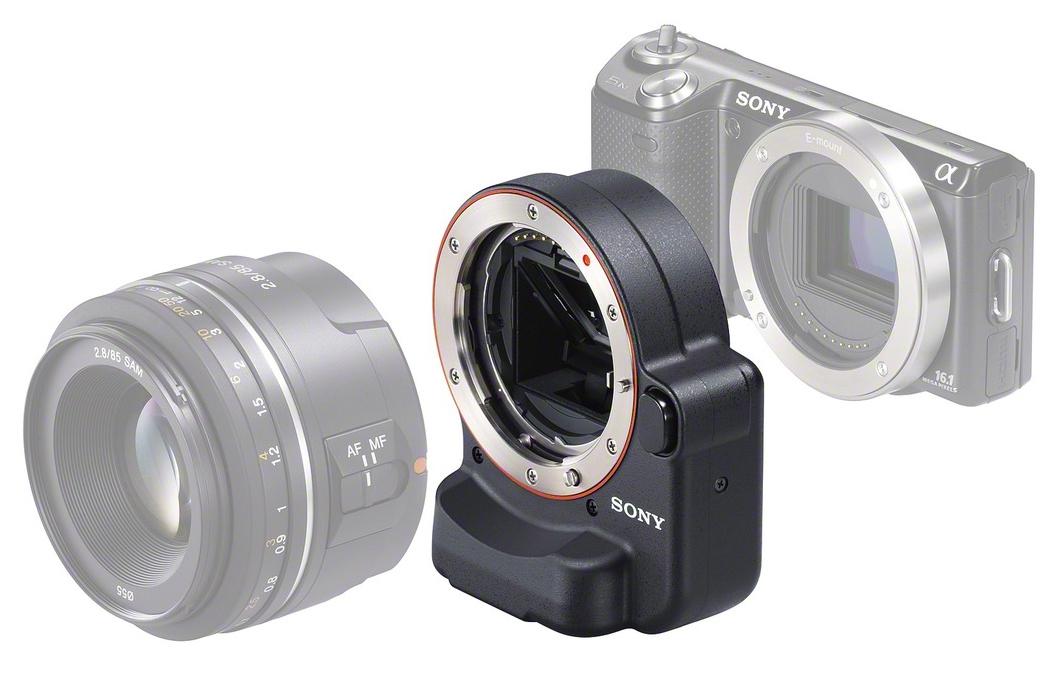
    A new battery powered LE-EA2 adaptor which allows autofocus with ALL Alpha lenses including Minolta body-drive types back to 1985 is also to be available, above. It includes a downward-facing SLT pellicle mirror (don’t know why they did not use this design in regular cameras) and a Phase Detect AF module so the NEX can behave exactly like an Alpha 55. Note the screw drive focus coupling.

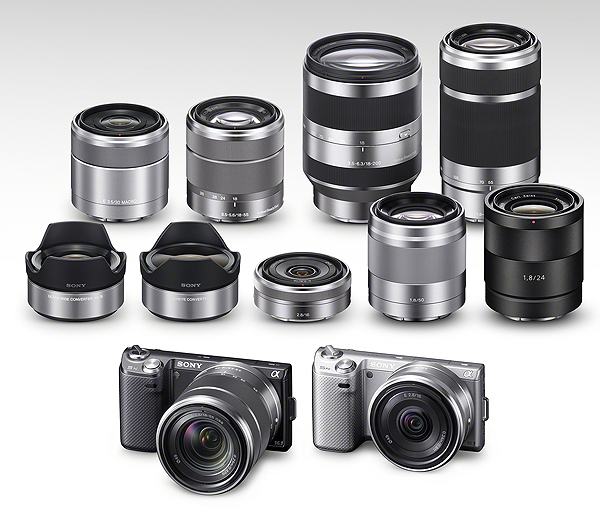
    Looks like a decent lens-line-up, but me, I prefer more pancakes for my breakfast, not just a stack on one…

    Along with the two new NEX models, the Carl Zeiss Sonnar T* E 24mm f/1.8, the Sony E 50mm f/1.8 OSS and the telephoto zoom E 55-210mm f/4.5-6.3 OSS are to be launched. Availability of the new NEX gear should be quick – from September for the 5n, November for the 7.

    The NEX-VG20

    Aye well, it’s 16 megapixel video formfactor model as per VG10. See the info online. It claims the best ever video from such a camera – but they say the same about the ‘still’ models and they are probably right.

    Sorry about a few of Sony’s uncropped image files with loads of white round them, they always do this and we will crop them later. But I’m due 100 miles away for a major Associateship and Fellowship annual judging to see some good photography and I have already made myself late with this! The article will be revised tonight. – David


  • Supermoon on A55

    One-minute sequence of the Moon and clouds at its closest point and largest size, shot using the A55 with 500mm Minolta AF reflex lens and 2X Teleplus converter.

  • Alpha 55 1080p HD video – snow in Scotland

    This video was made on December 23rd using the Alpha 55 (AVCHD recording) hand held, with SS enabled, and the Carl Zeiss 16-80mm zoom. This video has been uploaded in full 1080p HD and can be viewed at high resolution if you have a fast enough connection. The soundtrack is a classical guitar piece I wrote ten years ago, on the last day of the year 2000, when snow was falling by moonlight which I guess the music represents a bit better than mid-day.
    Some camera-mic sound has been left in place for two of the takes, and the shot of the stone wall uses active phase detection AF during video. This was not possible for most takes, as the snowflakes falling made the focus constantly change as they passed the focus zones!

    Hope you enjoy it! The camera got very wet with snow – you can see where flakes landed on the lens filter – and ended up being wiped down many times. Eventually, after going into a shop for a few minutes, everything steamed up. But it seems fine after letting it dry out and warm up. It was not very cold, around 1°C for snow to be falling like this.
    – David

  • The Alpha 580 – a three-way view

    Once I had a quarterplate hand-and-stand camera, vintage 1920s. Attached to the front standard was a small reflex viewfinder, giving a miniature composition you could use at waist or chest level. On the same standard was a folding wire frame, with a companion eye-sighting window flipping up from the side of the body. This gave a direct view from eye level. But for the most accurate framing and focusing, a groundglass screen at back could be used with the shutter open and a viewing hood folded out.

    Those three ways of viewing have never been available in a modern SLR. Until now! The Alpha 580 (for which you can also read 560 throughout this review, give or take the sensor) is the first modern SLR to offer three entirely different viewfinder systems, all with their own unique focus and exposure methods. There have been cameras made by Alpa and Praktina which had optical finders tucked in alongside their pentaprism, and Rollei invented a finder which could switch from eye-level to waist level at the flick of a lever. But the Alpha 580 offers three through-the-lens systems and it’s unlikely any DSLR will do so again.
    This is a 10-page article – please use the navigation bar at the bottom to move on to the next page, or click the ‘Continue Reading’ link to view as a single long article (this function is not very reliable though and may produce an ‘undefined’ error)

    (more…)

  • HD videocast – NEX adaptors and odd lenses

    I’ve finally got round to trying a ‘proper’ videocast – perhaps the first of regular short demonstrations – with the Alpha 55 offering me HD filming while demonstrating the NEX-5. And I can use the NEX-5 to film stuff about the Alpha 55. A Canon 60D helped, though its inability to refocus during filming (which the NEX-5 and Alpha 55 can do) proved a small problem. The sound from the Canon was used, mainly because it had been set with a manual level, while the Sony was using an external condensor mic that pickup up some serious interference from the lights.
    The lighting is nothing more than one 30W daylight colour energy saver and one 20W – using an angle desk lamp from IKEA and a spare table lamp. The background is a Calumet (Lastolite in disguise) canvas. To do the filming, I ran a 7 inch Lilliput monitor from the HDMI output of the Alpha 55, and mounted it facing me on a bar right next to the camera. The Canon was set up as a second camera and left running from that position. Editing, including cutting and pasting the soundtrack and parts of the Canon video, was in iMovie 11.

    This is a full 1080p HD YouTube film – if you can view it (bandwidth is an issue) try the higher resolutions. The Alpha 55 consistently overheated at around 7 minutes, showing me a temperature warning then shutting off. The room was not warm and the camera screen was both not active, and moved away from the camera back. My first attempt at this film was spoiled by the overheating issue, perhaps because SSS was left on in error. However, on a tripod SSS is not active to any extent when shooting video (it does not have the same problems of creating blur, which happen with still images due to the way mirror or shutter vibration are reflected by the tripod). Previous time limited movies I’ve made have been hand held and of course SSS is both used and expected to be very active.
    – David Kilpatrick
  • Sigma lens incompatibility with A33 and A55

    Edited from Sigma Japan’s announcement:
    Sigma’s lenses for Sony mount may have a potential aperture operation problem when used with the Sony α33 and α55 Interchangeable Lens digital cameras.
    To overcome this issue, we will be offering, free of charge, a modification service to our customers who have purchased a Sony α33 and α55 and own Sigma lenses for Sony mount. This phenomenon will only occur with Sony α33 and α55 cameras. Future production of Sigma lenses will be fully compatible with these cameras.
    We deeply apologize for any inconvenience caused to our customers.
    Phenomenon
    When shooting with a Sony α33 and α55 cameras, the aperture may not work properly and a “camera error” message will be displayed on the camera.
    Lenses requiring the modification
    All current Sigma’s lenses for Sony mount.
    For lenses discontinued several years ago, a modification may not be available. For further details, please contact your nearest authorized Sigma Service Station.
    Support for this issue
    We will be offering a modification service for our current range of lenses free of charge. Please contact your nearest authorized Sigma Service Station.
    World Network
    Mark for compatible lenses
    alpha33_alpha55
    Future production of Sigma lenses will be compatible with these cameras. The above sticker will be put on the product box of compatible lenses.
    For further information, please contact your nearest authorized Sigma Service Station.
    Editor's comment: Depending on whether the aperture problem is entirely mechanical (the coupling) or also involves electronics, it would be fair to assume that problems with the A33/A55 may not be restricted to Sigma independent lenses, but may also apply to other makes, especially older lenses. Brands made by Sigma such as Quantaray are almost certain to be affected. We await Sony's statement on compatibility with older lenses, including Minolta. Please note that the Alpha adaptor for the NEX E-mount provides normal aperture operation with Sigma lenses; how the A33/A55 mount differs we have yet to see.

  • Fitting a Vectis 80-240mm to the NEX

    OVER the past few days I’ve been looking at the NEX-5 and a range of lenses and optical systems. I’ve got adaptors for C-mount (16mm/TV/CCTV) lenses, Leica 39mm screw, Minolta MD and the LA-EA1 for Alpha A-mount. The NEX-5 has proved able to provide a surprisingly bright focusing image through a classic German microscope:

    It also proved very competent with the Sigma 70-300mm f/4-5.6 OS lens, the adaptor providing power for the OS which is fully functional, and also for auto exposure, leaving only manual magnified focusing to tackle. (more…)