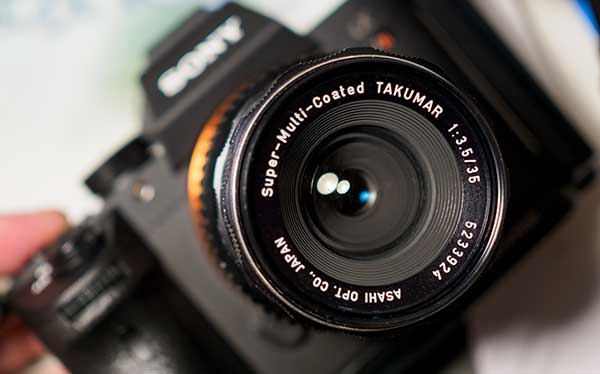
We’ve got one from the first Sony ILCE-A7R3 delivery in the UK, and with a first review of two pages appearing in Cameracraft January/February 2018 from tests in early December, I will be following up with a fuller printed review and more on-line articles here as the camera’s potential unfolds.
There’s a lot of noise about the Nikon D850 right now but few direct comparisons. One problem I have with some early reports is that new D850 owners are most likely to be existing D810 or perhaps D750 or D5 owners. Any comparisons are therefore being made with earlier Nikon sensors.
Recently a Nikon ambassador whom I respect greatly placed some .NEF raw files into a Dropbox for fellow professionals to examine. Since this article effectively criticises Nikon, I will not reproduce anything recognisable. I naturally grabbed the files and processed them with my usual care in Adobe Camera Raw. This includes making adjustments to the Sharpness and Noise Reduction settings depending on the ISO used. My standard with Sony, Nikon and most other files is to reduce the radius for sharpening to the minimum (0.5) leaving the basic settings of 25 for sharpness and 25 for detail untouched, with no masking. I also don’t touch the Colour Noise controls at all, and usually only adjust the first Luminance control leaving Luminance Contrast and Luminance Detail at default. This first Luminance control tends to set to zero for ISO 100 (or the minimum for a given camera), 10 to 15 around 400 to 800, 25 at 1000 to 2000, 30 to 35 at 2500 to 4000, 50 at 6400 and never above this level.
In practice these settings make raw files from the Sony A7RII (and presumably A99II, which I do not own) fully useful to ISO 3200 regardless of conditions and intent. Blue skies do not have grain, shadows are smooth and clean, detail is fine, skin tones are not marred by noise. ISO 6400 is slightly grainy but only to the degree we used to expect from ISO 800 in cameras of the first CMOS period (2007-2008, the A700 and A900).
So, given the glowing reports on the new Nikon sensor, I was expecting to see something at least matching the A7RII. There’s not a huge difference between 45 megapixels (Nikon) and the earlier 42 megapixel Sony BSI CMOS. I have already seen that the Canon 51 megapixel sensor in the 5DS/R offers no benefit at all, just a steep fall-off in shadow detail and loss of dynamic range combined with more noise.
Here, then, is a 100% section from a raw .NEF at ISO 1000 on the D850, with the Adobe Camera Raw settings I would expect to turn in a clean result. It has been saved at JPEG 12 but WordPress’s image engine causes some quality loss:
The NR was set as described above, to Luminance 25.
Then I looked back through my files to locate some ISO 1000 raws from the A7RII and try to find something with broadly comparable tone (surprisingly difficult!). Here is the result, with exactly the same process and settings:
You will note that the grainy noise is much finer. Both are taken from regions away from the image centre where the camera’s firmware will be adding some gain to combat sensor-created vignetting. On-axis areas are slightly less noisy in both cameras. This may also depend on the lens. You probably think this looks noisy for the A7RII, and this light colour and exposure level does indeed tend to increase noise.
Here is another A7RII ISO 1000 clip in better light, brighter subject matter, closer to the frame centre – this is more typical of the noise level you should see (or not see) in Sony 42 megapixel images:
I’ver chosen blurred neutral areas beyond the point of critical focus because these emphasise noise. If the same settings are used with sharply focused detail, with strong colours or contrast and textures, you simply won’t see noise at all at ISO 1000 and NR 25.
I will also say that while the Nikon community seemed impressed by the sharpness of sample images, I was not. I have to reconsider my critical opinions of Sony’s lenses. I have been judging zooms against Carl Zeiss and Voigtländer primes, and used to seeing a level of detail in images at 100% which I guess regular DSLR users simply don’t expect. Part of this is down to the quality of the A7RII sensor, part down to the lenses, and a whole lot is down to the zero-error focusing of the mirrorless system. I am part of another community, where most photographers use Canon or Nikon and prefer to have fast zooms and primes (the usual 16-35mm f/2.8 or 14-24mm f/2.8, 24-70mm f/2.8, 70-200mm f/2.8, 35mm f/1.4, 50mm f/1.4 and 85mm f/1.4 kit). In this group, many are having their cameras and lenses custom matched and reporting improvements in sharpness which transform their autofocus work.
Those who use Sony, Fujifilm, Olympus or Panasonic mirrorless systems don’t tend to make any comment as they have been getting critically sharp focus ever since they made the switch from DSLRs.
Conclusion? My A7RII is now two years old. It’s a 2015 model which is certainly not surpassed by 2017 rivals at least in the ‘core competence’ of its sensor. Other Sony models may offer different levels of special features, like the blistering shooting speed and focus tracking of the A9, but the A7RII continues to do its job as a great all-rounder and this quick comparison shows why.
To support Photoclubalpha, buy through our Affiliate links… or subscribe to David’s premium-quality photographic bi-monthly Cameracraft which includes regular Sony-related editorial, with system expert Gary Friedman as Associate Editor – see www.iconpublications.com
At a workshop given by John Denton for The Flash Centre, with Elinchrom lighting and Pentax 645Z demonstration. model Laura posed for a comparison pair of shots using the Pentax with 90mm macro lens and the A7RII equipped I regret to say with a much inferior lens, the basic 28-70mm.
To compare the quality bear in mind that the Pentax was ISO 200 at f/5.6 and the Sony was ISO 400 at f/8 as I felt it necessary to stop down – I should not have, as I had forgotten than the 28-70mm is sharper at f/5.6 than f/8, which introduces local unsharpness to the left hand end of the image (landscape) and did with all three samples I have used. This means the model’s face is smeared on the Sony shot, because this lens can’t produce a sharp image under these conditions in that part of the frame. Yes, I’ve had some OK results, but this was the first time I used the 28-70mm on the A7RII. It is OK on the A7II and A7S, as the blur is not so visible at those magnifications. It’s really not good on the A7R or A7RII.
So, please examine everything except the face…
This is the Pentax shot. Despite the matched for theoretical exposure, it is much darker and the ISO 200 is only equal to ISO 100 in Sony terms. Daylight balance set for the flash, Adobe Camera Standard profile since no other is available.
Here is the full resolution link to 146MB (if opened or downloaded) original:
This is the Sony shot. The Camera Portrait profile in ACR gave much improved skin tones, so I’ve used this. The pBase link appears to have scaled the images proprotionally, so the 42Mp image is correctly smaller than the 50Mp.
Enjoy – John teaches retouching and has set up deliberately harsh lighting to create over-sharp skin and too much detail, which he then expertly ‘fixes’. My shots are un-fixed. His workshops are worth every penny as he delivers an entire set of notes and his Photoshop actions to all delegates.
Sony has now released full details of the Alpha 58. Although I don’t think the camera is a game-changer or a vital upgrade for owners of Alpha 55 and 57 (the 55 will leave me only when it expires, with its useful GPS, 6fps/10fps and fully articulated reversible rear screen) there are hidden bonuses for anyone investing in the 58.
Firstly, the new OLED finder – probably a step better visually – is a league better in power consumption. The penalty for using the EVF instead of the rear LCD on the Alpha 77 and is siblings has been a sharp reduction in the battery stamina for shots, 470 versus 530 official figures for the 77 as an example. The new finder on the 58 gives a reduction for 700 to 690 – not just an overall improvement, but a minimal difference you can ignore. The smaller, non-reversile tilting rear 2.7″ LCD screen may also be less power-hungry than 3″ types.
Secondly, the camera supports an extended TriLuminos colour gamut. The colour gamut of existing Sony DSLRs and SLTs (and NEX) equipped with HDMI output does not need to exceed AdobeRGB (52.1% of the recognised visual gamut for a ‘Standard Observer’, CIE 1931 vintage). That’s because regular HDTV throws away a stack of this colour, showing only 35.9% of the gamut. That’s why it looks so colourful and bright. The less gamut you show, the brighter and more saturated colours look, for the capabilities of any given display. That may sound the reverse of what you would believe to be the case, until you apply a bit of thought to it.
TriLuminos gamut is the larger triangle, regular HDTV is the smaller (similar to sRGB) while AdobeRGB falls between the two. One colour space you can use when processing raw files – ProPhotoRGB – is so large is exceeds part of the CIE 1931 colour space.
The TriLuminos gamut is massive. Unlike HDTV, it’s bigger than AdobeRGB and much bigger than regular sRGB (what most computer screens can show). It is 75.8% of the CIE 1931 colour space. That, by the way, is simply a standard based on what a bunch of test subjects could perceive back in 1931 and it’s been criticised for failing to include a wide enough range of genetic backgrounds and learned visual abilities. We all see colour differently (men notably with far less accuracy and discrimination than women, young better than old). If you’re a teenage girl you’ll love the TriLuminos displays. If you’re an old bloke you may not notice…
Sony claims that the A58 can output colours to the TriLuminos TV sets which show “a dramatically expanded palette of vivid, ultra-realistic colours when videos and still images (are played back)”. In theory since AdobeRGB (offered by all Sony models to date) would already show an expanded palette, this might not mean any big change in the sensor. But TriLuminos uses a colour space which requires 12-bit depth and it can’t be used effectively unless the sensor itself is going beyond the range of AdobeRGB. You can’t get out what you do not put in. Then again, if you’re using a normal printer or computer, you can’t get it out anyway. The camera captures colours you can’t see on its own rear screen, in its viewfinder, on your computer screen or in a print.
We can therefore deduce that the Bayer filter colours on the new 20 megapixel sensor may be changed, along with the BIONZ processing and the JPEG colour management and compression (after all, the JPEGs will still be 8-bit and going beyond AdobeRGB risks significant banding in smooth graded colours such as skyn blues). Sony say this is the first ever A-mount camera to offer this colour ability. Will DxO Mark have to change their colour measurements to cope with it?
It is possible the sensor has no colour gamut benefits and that all Sony is doing is expanding AdobeRGB (or the native gamut, which is close enough to AdobeRGB) to fill the wider space of the TriLuminos TV screens, making certain colours appear dramatic in the process, but not realistic. Obviously what we should all hope for is that this improvement starts with the sensor itself.
Since the NEX-3n (possibly not the camera rumoured by Nippon Camera as NEX-F3R) also offers TriLuminos extended gamut but has a regular 16 megapixel sensor, I’m going to have to wait to see what the real colour science experts at DxO, and our various friends in Russia with special knowledge of this field, find. We do have a resident colour scientist but sadly none of the gear needed to analyse this properly.
Whatever the case, we appear to be getting a camera whose new 20 megapixel sensor will have significantly better power consumption which almost certainly also means lower heat generation, in turn meaning lower noise and longer ‘safe’ durations for video. Sony is gearing up for the next phase of HDTV – 4K – and the UHDTV beyond this going to 8K. They will eventually need to produce 39 megapixel sensors for uninterpolated 8K, and this will be the target for both APS-C/Super35 and full-frame between now and 2015 when the industry expects to see the first 8K UHDTV retail sales (those in the UK, don’t hold your breath, we’re likely only to get 4K and may not see that become the standard until 2020).
Nikon has stolen an interesting march by enabling a 1.3X, 15 megapixel crop for 7fps shooting in the new 24 megapixel D7100 – a very useful size almost equal to a 2X crop from full frame. Sony has an unspecified ‘tele-zoom’ feature in the A58 to achieve 8fps. But no-one has so far been able to reveal what the tele-zoom crop is; Sony’s ‘technical specifications’ so far released for the A58 are minimal.
If the same 24.1 megapixel, AA-filter-less sensor is used in an A78 (as some rumour sites think likely) then perhaps sub-frame readout aka tele-zoom will be implemented on that too.
The A58 has a new 18-55mm SAM lens with improved build quality and a redesign to the rear element configuration. Sony says this is to avoid ghosting. We’d be surprised if it was not also to change the exit pupil geometry slightly, in order to work better with current and future phase-detection on sensor models.
Samsung has a patent and a plan for using two lenses with triangulation (image offset) depth detection between two images in what is roughly a stereo pair. Here’s a link:
Pentax also have a system on the new Q range which takes more than one exposure, changes the focus point between them, and uses this to evaluate the focus map and create bokeh-like effects. Or so the pre-launch claims for this system indicate, though the process is not described. It’s almost certain to be a rapid multishot method, and it could equally well involve blending a sharp image with a defocused one.
In theory, the sweep panorama function of Sony and some other cameras can be used to do exactly the same thing – instead of creating a 3D 16:9 shot it could create a depth mapped focus effect in a single shot. 3D is possible with sweep pans by simply taking two frames from the multi-shot pan separated by a certain amount, so the lens positions for the frames are separated enough to be stereographic. 3D ‘moving’ pans (scrolling on the TV screen) can be compared to delaying the playback of the left eye view and shifting the position of subject detail to match the right. But like 16:9 pans, they are just two JPEGs.
All these methods including the Samsung concept can do something else which is not yet common – they can alter any other parameter, not just focus blur. They could for example change the colour balance or saturation so that the focused subject stands out against a monochrome scene, or so the background to a shot is made darker or lighter than the focused plane, or warmer in tone or cooler – etc. Blur is just a filter, in digital image terms. Think of all the filters available from watercolour or scraperboard effects to noise reduction, sharpening, blurring, tone mapping, masking – digital camera makers have already shown that the processors in their tiny cameras can handle such things pretty well.
Once a depth map exists there’s almost no limit to the manipulation possible. Samsung only scratches the surface by proposing this is used for the esoteric and popular bokeh enhancement (a peculiarly Japanese obsession which ended up going viral and infecting the entire world of images). I can easily image a distance-mapped filter turning your background scene into a Monet or a van Gogh, while applying a portrait skin smoothing process to your subjects.
Any camera with two lenses in stereo configuration should also, in theory, be able to focus using a completely different method to existing off-sensor AF – using the two lenses exactly like a rangefinder with two windows. So far this has not been implemented.
Way back – 40 years ago – I devised a rangefinder optical design under which you can see nothing at all at the focus point unless the lens was correctly focused. It works well enough for a single spot, the image detail being the usual double coincident effect when widely out of focus, but blacking out when nearly in focus and suddenly becoming visible only when focus is perfect. I had the idea of making a chequerboard pattern covering an entire image, so that the viewfinder would reveal the focused subject and blank out the rest of the scene, but a little work with a pencil and paper quickly shows why it wouldn’t work like that. The subject plane would have integrity, other planes would not all black out, they’d create an interestingly chaotic mess with phase-related black holes.
Samsung’s concept, in contrast, could isolate the subject entirely – almost as effectively as green screen techniques. It would be able to map the outline of a foreground subject like a newsreader by distance, instead of relying on the colour matte effect of green or blue screen technology. This would free film makers and TV studios from the restraints of chroma-keyed matting (not that you really want the newsreader wearing a green tie).
The sensitivity of the masking could be controlled by detecting the degree of matched image detail offset and its direction (the basic principle of stereographic 3D) – or perhaps more easily by detecting exactly coincident detail, in the focused plane. Photoshop’s snap-to for layers works by detecting a match and so do the stitching functions used for sweep and multi shot in-camera panorama assembly. Snap-to alignment of image data is a very mature function.
Just when you think digital photography has rung all the bells and blown all the whistles, the tones of an approaching caliope can be heard rolling down the river…