Sony has announced two new lenses for E-mount mirrorless cameras.
The FE 100mm F2.8[i] STF GM OSS is the first Smooth Transition Focus prime since the acclaimed A-mount 135mm and is designed for the best possible bokeh without any trace of aperture-related artefacts. The compact, lightweight FE 85mm F1.8 portrait prime lens may put an end to sales of Canon 85mm f/1.8 USM lenses mounted on FE adaptors… but at £550 and not stabilised it’s just over the typical cost of that combo, which also enables the use of other Canon lenses and of course the use of the Canon glass on native bodies.
It’s a slightly disappointing lens as the 80cm close focus is no improvement over the 85mm G-Master f/1.4, and much less useful than the 85mm A-mount SAM f/2.8 which focuses to 60cm. With the 85mm such a popular choice for portraits, food photography and creative close-ups (short of the macro range) this is a missed opportunity even it is also very much an industry standard. In contrast to this the 100mm STF has an excellent close focus of 57cm and the same close-up ability as zooms like the classic ‘Beercan’ 70-210mm f/4 by Minolta, the magic ‘quarter life size’ which covers the area of a 6 x 4″ postcard print when used on full frame.

Sony also introduced a new flash HVL-F45RM with radio-controlled wireless communication ideal for off-camera multi flash TTL work with Sony’s line-up of α7 full-frame cameras. This flashgun uses the Sony Quick-Navi visual system for its rear panel – so they did learn something from the success of this in the old A700!
TO SUBSCRIBE TO OUR OWN TOP QUALITY PHOTOGRAPHIC PUBLICATION CAMERACRAFT, SIX TIMES A YEAR, VISIT ICON PUBLICATIONS LTD WEB PAGE
(Sony information follows)

FE 100mm f/2.8i STF GM OSS Telephoto Prime Lens
A specially designed mid-telephoto, full-frame prime lens, the new 100mm STF is built to produce truly unique, magnificent and beautiful bokeh while maintaining the exceptional standard of resolution that is showcased throughout Sony’s entire line-up of flagship G Master series lenses, making it a powerful photographic tool for any portrait, fashion, nature or wedding photographer.
These impressive defocus capabilities are made possible by the lens’ advanced optical structure, as it features a newly designed 11-bladed aperture and a unique optical apodization lens element. Similar to a neutral density filter that increases in density towards the edges, the apodization element creates beautiful transitions of in-focus to out-of-focus areas within an image, making for exceptionally soft, smooth bokeh that adds depth and dimensionality. This allows the subjects to stand out against beautifully defocused elements in both the foreground and background, producing an image that is naturally pleasing to the eye. The design of the lens also ensures that vignetting is kept to an absolute minimum, ensuring optimum image quality.
David Kilpatrick writes: The STF function is available from full aperture (an effective T=5.6 despite the f/2.8 physical aperture) over a one-stop adjustment range to T=8. This is less than the f/4.5 to f/8 (T) range of the original STF design and indicates that a more powerful apodisation element (radial/circular graded element created by using neutral density in a double concave glass) or apodisation filter (a cheaper method using a conventional radial graduated ND filter inside the lens near the aperture position). This should actually mean that f/5.6 looks smoother than f/4.5 could have. Confusing, but true. You can the depth of field of a more-or-less f/8 lens with the bokeh of an f/4.
Additionally, the new 100mm lens supports both contrast AF and focal-plane phase detection AF[ii], and has a high-precision, quiet direct drive SSM (Super Sonic Motor) system that ensures exceptionally fast and accurate AF performance. The SEL100F28GM also offers up to 0.25x close-up capabilities with a built-in macro switching ring, built-in Optical SteadyShot™ image stabilisation, a customisable focus hold button, AF/MF switch, aperture ring and is also dust and moisture resistant.[iii]
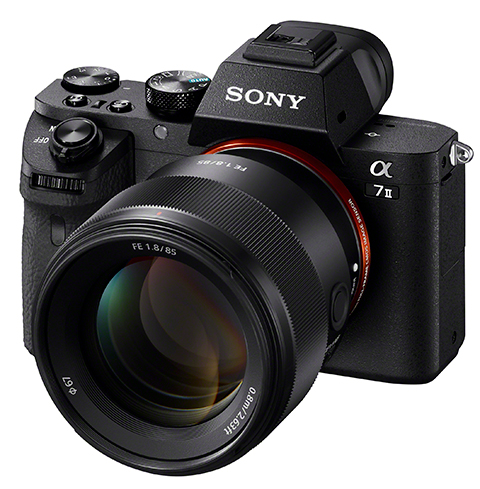
FE 85mm f/1.8 Telephoto Prime Lens
The new SEL85F18 mid-telephoto prime lens offers an extremely versatile, lightweight and compact telephoto prime lens solution for a variety of Sony camera owners ranging from working professionals to emerging enthusiasts that have stepped up to an APS-C or full-frame camera for the first time. With its wide f/1.8 aperture, it can produce impressive, exceptionally sharp portraits with soft background defocus that take advantage of its 85mm focal length and wide f/1.8 maximum aperture.
The new prime lens features a 9-bladed circular aperture mechanism that ensures smooth, natural looking bokeh, and a double linear motor system to allow for fast, precise and quiet focusing. It also has a focus hold button that can be customised and assigned together with functions in the camera body like the popular Eye-AF feature. There is a smooth, responsive focus ring and AF/MF switch and the lens is also dust and moisture resistant.iii
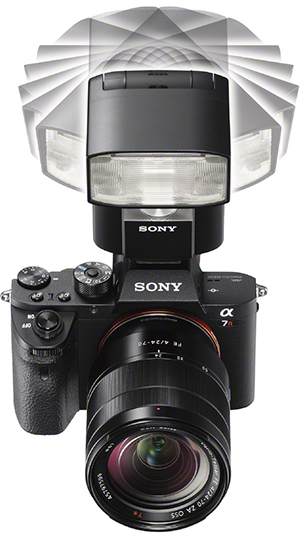
New Compact Radio-controlled Flash
Sony’s new HVL-F45RM flash enhances the radio-controlled lighting system capabilities of their growing system, offering a compact professional shooting solution when combined with the currently available wireless remote controller FA-WRC1M and receiver FA-WRR1.
The new flash, which is designed to complement the compact bodies of Sony’s E-mount camera line-up including full-frame α7 models, produces a maximum lighting output as expansive as GN45[iv]. This ensures sufficient illumination even when shooting with bounce lighting or high-speed-sync (HSS) flash. The radio capabilities of the HVL-F45RM allow it to be used as a transmitter or a receiver at up to 30m (approx. 98 feet[v]), making it an ideal fit for creative lighting with multiple flashes. Additionally, unlike optical flash systems, radio-control flashes do not require a direct line-of-sight between components to function properly, while also minimising any impact that bright sunlight has on signal transmission and control.
The HVL-F45RM flash has an impressive battery life of up to 210 bursts, and can tilt up to 150o vertically, a complete 360o horizontally and up to 8o downward to maximise versatility. Usability has been maximised with a new large, bright and highly visible LCD display, an LED light, dust and moisture resistant design3 and a revamped menu system that mimics those of Sony’s newest camera systems.
Pricing and Availability
The new lenses and flash will start shipping in March 2017. The SEL100F28GM will be priced at approximately £1700, the SEL85F18 will be priced at approximately £550 and the HVL-F45RM will be priced at approximately £420. Further information can be found on the Sony Camera Channel: www.youtube.com/c/ImagingbySony/ and the Sony Photo Gallery: www.sony.net/Product/di_photo_gallery/
[i]T-number (T) =5.6
[ii]With compatible α camera bodies. Please visit Sony support webpages for details.
[iii]Not guaranteed to be 100% dust and moisture proof.
[iv]Guide Number (GN) 45 (105mm, in meters at ISO 100)
[v]Sony internal measurement