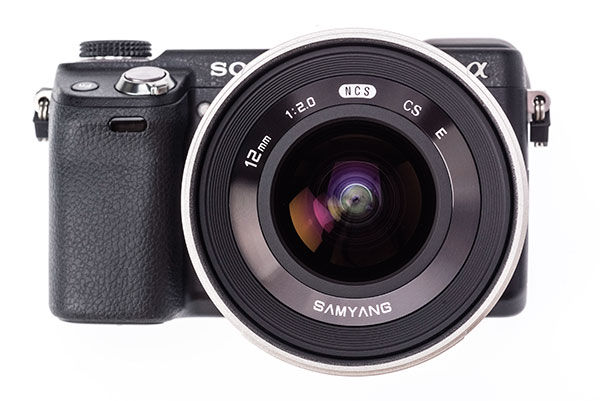
Sometimes you find a chunk of glass which just works. One of the problems with lenses is that you can never have too many. They overlap, they duplicate each other, and yet they can be so different that you need every single one. The new Samyang 12mm f/2 for mirrorless APS-C systems is one of these. It’s the budget alternative the Carl Zeiss Touit Distagon 12mm f/2.8 T*, and so far everyone I’ve found who has used both lenses – including me – rates it as better optically. This isn’t what you expect from a lens with twice the maximum aperture at half the price.
I have good reasons for not owning a Touit 12mm. I already have a Sony 10-18mm f/4 OSS E, and rather like the Fujinon XR OIS 10-24mm f/4 this lens offers nearly perfect performance as a working ultra-wide zoom and adds the benefit of stabilisation for video or tripod-free interior shots.
The Sony appears to have very fine detail sharpness wide open, little sign of fall off in illumination or sharpness, and good geometry.
Click this image for a full size, f/2 available light shot taken in a covered archaelogical dig
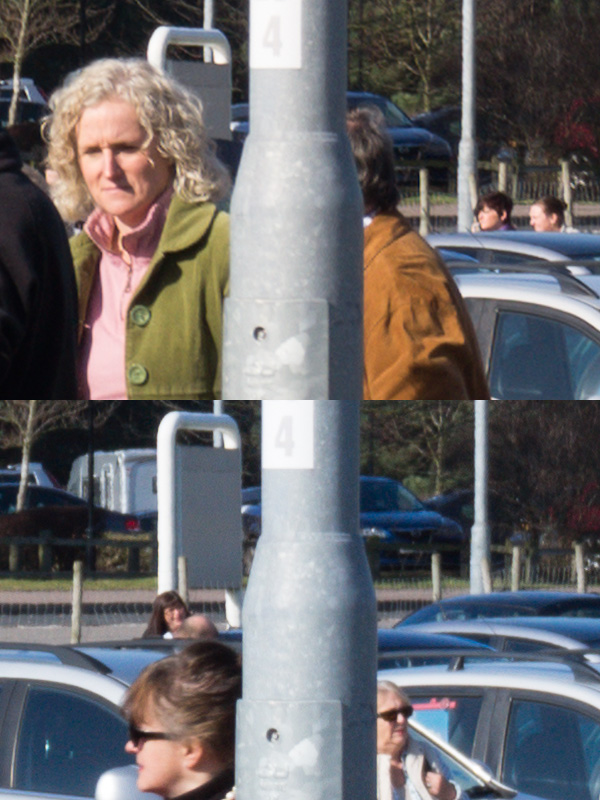
However, the Samyang when used on the same Sony NEX-6 16 megapixel camera forced a reappraisal. It offers sharpness on a different level and manages to do so even at f/2, with corners far more detailed and clean than any lens with a 99° angle of view should manage.
It is equivalent to an 18mm on full frame, and this is around my favourite angle for an architectural, street and general lens. Where the 24mm angle is a common feature of consumer zooms and easy enough to use, lenses in the 17-21mm equivalent range produce a distinctive result but need careful composition and an understanding of perspective and lens geometric projection. Lenses like this separate the experienced user from the unskilled masses.
Stopping down to f/16 secures great depth of field (the Canarian cacti are not huge, bush sized and very close not tree size!) with just a hint of sharpness loss. Click image for a full 16 megapixel file
Weighing only 245g, it’s not a big lens though it has a generous 67mm filter thread round a much smaller front element which does not protrude. The bayonet lens hood is removable and reversible for storage, with a soft pouch supplied to hold everything. You can use circular filters without cut-off provided they are reasonably slim-line, and filter systems from 75mm rectangular upwards. Our sample was in a matt silver finish, with conventional black as an alternative. The focusing down to 20cm is very smooth, with a travel of 135°, and the aperture is click stopped gently but positively in half steps all the way to f/22. The mount is metal, as is the barrel skin, though plastic components are used internally. It is an advanced design with 14 elements in 10 groups using both low dispersion and compound aspheric glass, nano-coated with Samyang’s water and dirt resistant hard NCS multiple layers.
Above: Auto White Balance and auto exposure with the Sony 10-18mm at 12mm, on NEX-6
Above: AWB and AE with the Samyang 12mm set to f/11 like the Sony (darker, and much colder colour)
Above: Samyang raw shot after colour correction to taste
Though this lens had to be manually focused and lacks any electronic connections, it rapidly proved to be a reliable companion. Auto exposure tended to be slightly under, and auto white balance was nearly always too cold. On the NEX-6 manual exposure and a fixed daylight or custom set white balance proved better than relying on auto setting.
The results are the reward. For its aperture and angle, it defies the laws of trade-off. The geometry, even without creating a profile or applying the slight barrel correction sometimes needed, is so good that uncorrected raw conversions worked perfectly. The example above is a full frame, with no correction at all (you can click the image to open the full size file, though remember it has strong compression for storage and display here).
Here is the same view taken with the Sony 10-18mm, at 12mm, and at f/11, exactly the same compression
For some subjects, a two-pixel blue chromatic aberration correction removed a barely visible tendency to purple fringes, more likely to affect high contrast patterns than high contrast edges. The lens has such high resolution that moiré patterns appear from many subjects.
Compared to the Sony 16mm f/2.8 fitted with a 12mm ultra-wide converter – the original Sony solution from 2010 – it’s like moving from small to medium format.
Here’s an example which shows the geometry of the lens pretty well (click for full size)
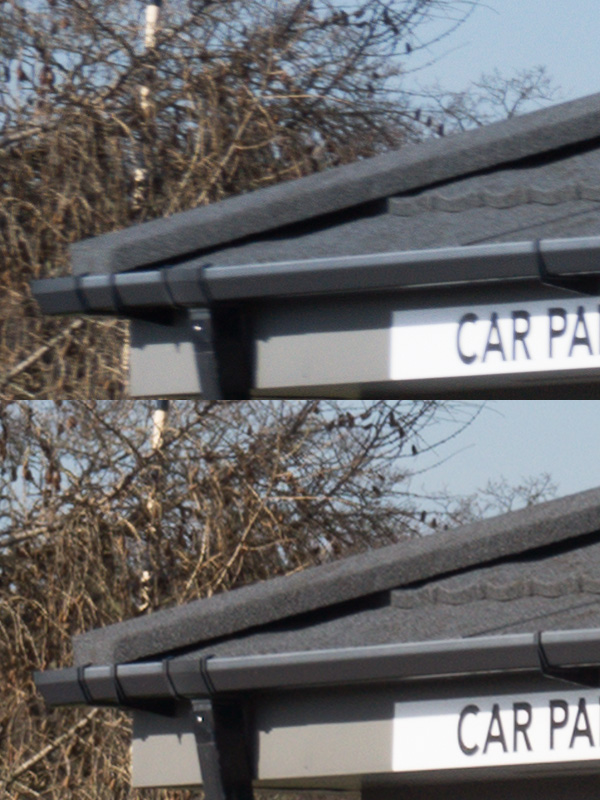
And here’s the same historic suspensioon bridge, again at f/11 to get the necessary depth of field. But the sharpness is not destroyed and a 100% clip shows the spiders have been busy (compression almost loses the strands of the webs which are easily seen in the original file):
It does not have enough circle of coverage in reserve to make it valuable on full frame, but a near-24mm square can be cropped on the A7 series.
This lens would be a dream to use if it incorporated a chip to convey EXIF data including the aperture. AF really doesn’t matter, after a few days I learned to preset the focus manually and only check the most critical wide-open subjects using magnified manual focus view. At under £300, it’s so tempting just to have it for the sheer sharpness right into the extreme corners and the straight-line rendering. Much though I like my £700 10-18mm it has had less use since the Samyang arrived – and that says it all. My main reason for sticking with the 10-18mm is its ability to work well on the A7R for 15mm shots, and its full recording of EXIF data along with full control from the body. Much though I like my boxful of manual lenses, after a year and more using them, I am missing the vital data – as going back a year to look at original files shows. Unless I made a special note at the time, I often have no idea what lens was used let alone what aperture. For these shots, of course, I noted the details.
This article original appeared in a slightly shorter form in f2 Freelance Photographer, our six times a year super-quality professional and enthusiast magazine, Nov/Dec 2014 issue published in early October 2014. In 2017, f2 was merged with Cameracraft and we now use the Cameracraft name. You can subscribe to this magazine, which supports my work here, at www.iconpublications.com
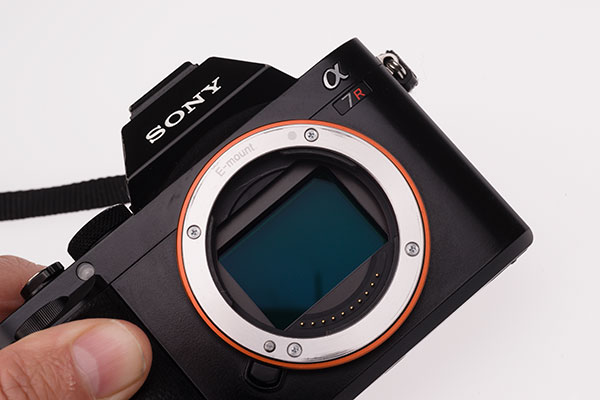
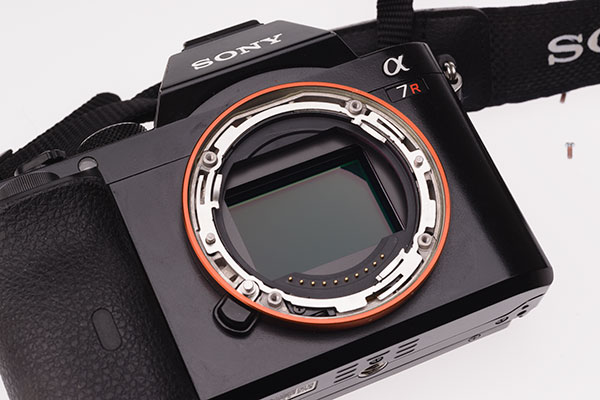
Machined from brass and chrome-plated, in the tradition of lens mounts from 50 years ago and not necessarily the best solution for precision or lifetime wear, Fotodiox’s TOUGH E-mount is a replacement body mount bayonet which you can fit to your existing A7R, A7, NEX-7, A6000 or any other metal-mount E-mount body in a few minutes. You need a clean well lit work table, a small engineer’s or large jeweller’s crosshead screwdriver, and a similar flathead screwdriver or old credit card.
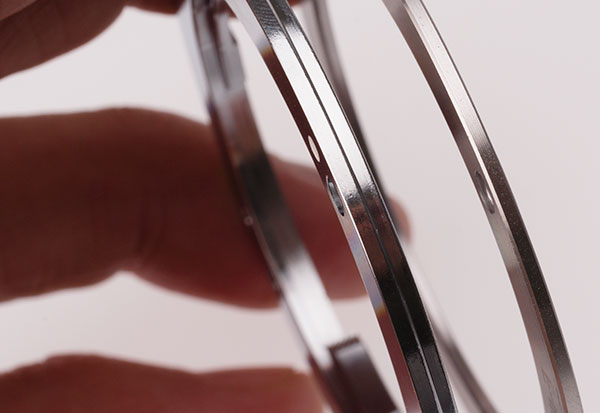
The NEX/A bodies are fitted with a three-part lens mount. Here’s what a bonded, single piece, original Alpha lens mount looks like when removed from an old Minolta 7000 –
This mount is stainless steel, which would be prohibitively expensive for a small shop engineering replacement on the E-mount. It’s in two parts, a front surface and the inside with a bonded bayonet spring pressure action, a thin shim with bent ‘arms’ forming three pressure points to hold the lens tight to the mount.
From Fotodiox comes this neat box taking 10 days to the UK from USA –
Since I also ordered a focusing Leica M to E adaptor, my overall value was marked as $80 and I had an £8 admin charge and a little over £7 in VAT to pay.
Inside, the TOUGH E-Mount is boxed and bagged without instructions. For these, you visit the Fotodiox site and watch a video:
Here’s the rear face of the Fotodiox mount, which does not have any second layer of spring metal to grip the lens:
However, as we will see, this component (fixed to the mount for the A-mount design) is a separate loose item which sits in the camera body mount recess on the E-mount, and performs exactly the same function. You could probably remove it and bond it to the new mount.
So, why replace the E-mount on a £1200+ camera body like the A7R, which has a magnesium body casting into which the lens mount is anchored by four screws? The reason given by Fotodiox is that an intermediate plastic moulding is used behind a simple unprofiled mount face, so two parts make up the overall thickness. The tensioning ring sits behind the plastic ring, forming a three-part sandwich to make up the mount. The front mount is a relatively soft, crudely CNC lathed alloy.
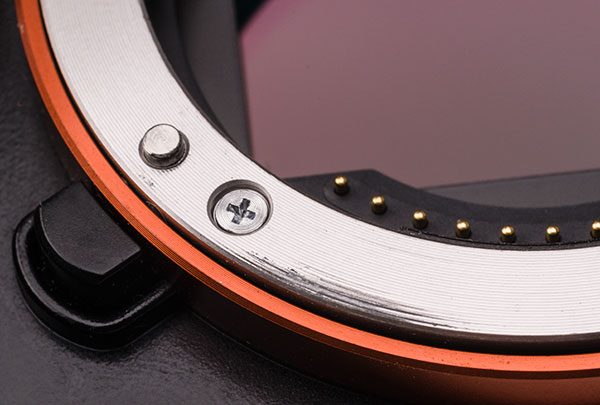
Here’s my camera after 10 months of use. This camera has shown signs of light leaks, and has not been sent back for a fix. The mount flange is a completely flat item, relatively thin, and the leaks may be partly down to slight distortion of the front plane face, as shown by uneven wear from lens mounting.
Here’s a detail. You can see the lathe circles on the mount face, and you can see where the metal has abraded and either collected plastic from a plastic lens mount (most likely my MEIKE extension tubes) or paint from a cheap adaptor (my Novoflex and Fotodiox adaptors don’t use paint, they are anodised).
The mount is very simple indeed. It can be removed from all the cameras without disturbing the electronic contacts or the lens release mechanism.
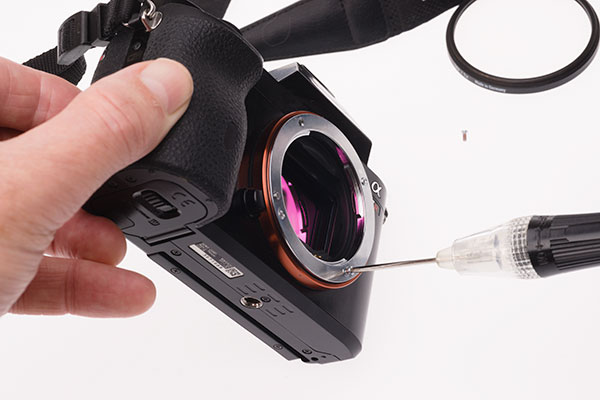
Fotodiox video shows the camera on its back and warns about dropped screws etc. I just prefer to unscrew each screw in turn with the camera held vertically on my table, so that if the screw drops it won’t go inside the camera. Care is taken not to allow the spring loaded lens changing pin to disassemble itself, but that’s really very easy.
One removed, you can compare the Sony ‘washer’ (which is really more or less is!) with the Fotodiox mount – a much thicker unit, stepped to fit the recess on the camera body. A point worth noting is that the original mount has no recesses at all to fit over the four threaded posts on the camera body. Its position is maintained by two pins (at 9 and 3 o’clock) which engage in two holes on the otherwise plain flat rear face of the mount. The Fotodiox mount not only engages with these pins, as it replaces the plastic secondary mount shown below, but also has holes into which the threaded posts fit. It is better proofed against rotation.
You now see the plastic middle part of the sandwich. This is secured by a very thin double-sided tape in places. A flat blade screwdriver or a suitable cut piece of old credit card (or indeed a guitar pick!) pushed gently under the plastic at various point all round will free it. It lifts out easily. Unless you are amazingly clumsy you are not going to go anywhere near the sensor but if you have a clean 40.5mm filter or lens cap around, you can pop it in to cover the sensor safely. I used a 62mm filter to place over the whole mount when checking instructions and looking at the parts, as I don’t want to risk hairs and dust covering the upturned unit.
Underneath the plastic component you’ll find the third part of the mount, the thin flexible stainless steel tensioning ring which acts to pull the lens tight against the front face of the mount. You may note that if your lenses ever begin to seem slack, it would be easy to re-tension this ring by a gentle bend to the three arms. The four screw holes are in metal posts mounted directly into the magnesium body. The plastic ring can be argued to have no effect on precision, as the original mount rests on these posts, leaving the plastic and the stainless tension ring more as a ‘lubricated’ assembly with a little ‘give’, affecting only the tightness of the lens to the body. The plastic has no sacrificial role, as it does in many lenses (Sigma, Tamron, Nikon, and Canon all use plastic to create weak points where the lens will break on hard impact rather than having it shear the body mount off the camera – not sure about Sony).
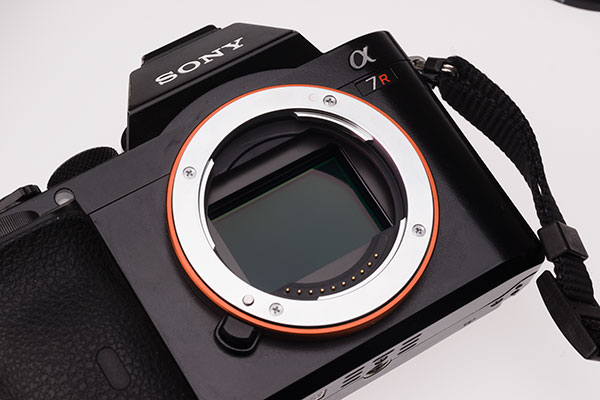
The final step is to place the new mount, aligned with its white dot and cut-outs and screw holes, in the only position it will fit. Please note that the TOUGH wording goes inside and is not shown on the camera front! Again, I don’t place the camera on its back, and prefer the control given by holding both the camera and the screwdriver (which if properly chosen will support the screw). No pressure is needed to locate the screws for a few turns. I rotated the camera so that the screw hole being worked on was always below the sensor. Finally, when tightening up each screw in turn to a firm fit, the camera was laid on its back and my 62mm filter was placed to cover the mount opening, held firmly. You can also just place a finger against the screwdriver on the ‘inside’ while tightening up, so that if for any reason it slips, you block it from entering camera.
Once fitted, there’s little more to say. It looks a touch classier than the cheaply machined soft metal Sony original, it is a snug and perfect fit, and lens mounting has a slightly more solid feel without resistance or any scraping sensation. Fotodiox may be taking the mickey by suggeting you give the old mount to the cat to play with, of course you should keep it carefully. While doing this I discovered that the original old Minolta SR bayonet shares the screwhole locations and almost perfectly matches the overall size of the E-mount. I could actually take a Minolta SR bayonet off the front of some old extension tubes and fit an E-mount in place. This would serve no purpose but it’s a fascinating hint at the pedigree of the new system – it has a three-flange bayonet so similar to the SR mount, introduced 52 years after Minolta’s SLR debut!
Everything worked perfectly as expected once fitted (see notes below). Cost – $39.95 plus shipping. I consider it a good upgrade.
Notes on infinity focus, fit, and light leak issues
While Sony native E mount lenses seem fine, some of my third party adaptors are not fitting well, and very short focal length lenses show that the infinity focus may be affected. If you use lenses 12mm to 20mm on adaptors, proceed with caution. I am not able to get the Kipon tilt shift adaptor to mount without a forceful twist, though a similar age Kipon shift-only adaptor is happy enough (just no longer able to hit infinity with my chosen 20mm lens).
Infinity collimation after tests and measurements – I’ve now checked infinity focus using stars. I’m just OK on all but one lens and adaptor combination, and all Sony E or FE lenses are fine, as they have loads of spare adjustment (no hard infinity stop – they will all focus way beyond infinity and can handle big differences in camera assembly accuracy). Same with LA-EA3 and LA-EA4 adaptors and Min/Sony A lenses, the worst case lenses hit infinity at exactly infinity, most focus just past.
Kipon Nikon Tilt-Shift – extremely tight fit, so tight it has to pulled off the camera physically. Here I’m thinking that some very gently polishing or ultra fine emery (the sort I use for polishing guitar frets) might ease the adaptor.
Novoflex Leica M adaptor – will not bayonet-lock with the new mount, can’t work out if the flanges are obstructing the full turn or the locking pin hole is slightly off position. Fotodiox helical M adaptor locks perfectly. All other adaptors fit and lock comfortably.
Checked my Kipon shift adaptor for Canon and it’s 21.34mm from rear to front flange, and the lens won’t focus on infinity. My plain cheap Canon FD adaptor is 21.16mm and the lens will hit infinity perfectly. On the original mount, the shift adaptor was just OK to infinity – not for stars, but for landscape. So maybe 0.1mm actual difference in front face register to sensor on the Fotodiox Tough mount, compared to the Sony original.
Light leak issue – a day later I had bright full sunshine and was able to position the camera with the mount getting direct sun, and give exposures of 30 seconds to 1 minute with the lens completely stopped down and blocked off, and the ISO set to 1600. The results proved that it’s not the camera mount assembly which has most effect –
The pure black exposure above is from the 28-70mm kit zoom set to 40mm, at f/25, with the lens cap on.
This result is from a Voigtlander 40mm f/1.4 mounted using a Novoflex Leica M adaptor, at f/22, with the lens cap on. Simply swapping the Voigtlander adaptor for a Fotodiox helical focusing Leica M adaptor, which has a far wider flange and double the ‘bearing surface’ on the mount and it also a much firmer overall fit, produced the same solid black as the 28-70mm. The 10-18mm also produced a solid black though it was clear that the lens cap lets in a bit of light at the spring clip positions.
To double check, I fitted a disc of Rosco Black Cinéfoil (totally lightproof heavy metal foil you can cut with scissors) into another mount so it sat behind the back of a 50mm lens. This was a Ukrainian shift mount and Zenitar lens. This mount also has a large, black anodised rear surface. No light was admitted. I found that most of my third party adaptors let in light, usually the small angled line/crescent top right, and so did the Sony LA-EA3 and 4. The Novoflex has me surprised and baffled as it let light in over a wider pattern, and it seems to be the best engineered adaptor I have, but the well for the bayonet locking pin is shallow and perhaps too precise as the pin does now not engage (you can feel it just begin to hit the lock position).
(don’t read beyond this point if you don’t like seeing measurements…)
This adaptor works perfectly on other NEX/E bodies and worked perfectly before changing the mount. Relaxing and re-tightening the mount fitting screws, to be doubly sure of correct seating, did not solve the problem. The pin recess in the Novoflex adaptor is 2.30mm wide, and in all the other adaptors measured and also on Sony lenses, from 2.36mm to 2.5mm. The slight wiggle present on Sony lenses when fitted seems to be down to approx 0.07mm tolerance allowed for the locking pin to engage, as this is the part of the mount which limits or fixed the position of the mounted lens. Lenses and adaptors tested, when mounted with the locking pin depressed, can move around 0.5 to 1mm beyond the optimal mounting position.
It looks as if the locking pin mechanism is one area identified as a source of light leaks, and that if the pin is not allowed to engage fully (recess too shallow or not accepting the pin) more light will be admitted. All my manual adaptors varied in the depth and exact design of the locking pin well – 1.1mm deep on Kipon, 0.69mm deep on Fotodiox, 1.23mm on Novoflex, 1.1mm on Sony G 10-18mm, 1.18mm on Sony 16-50mm PZ. The 28-70mm which had perfect light sealing also has an unusual locking pin hole, almost perfectly circular not an elongated oval like all the other lenses. This was 1.2mm deep and with a 2.5mm radius. It is obviously perfectly placed and very precise despite this being a non-G, non-CZ, cheap Sony kit lens.
Anyway, 10 seconds with a Dremel and the Novoflex adaptor is now a perfect locking fit ready for another test if the sun comes out again this year.
Sony did say, back in 2010, they would make the E-mount specifications public for all to use. If anyone has information on what tolerances were specified, please let us know!
Update 30/10/14: using a high intensity single LED torch, the Novoflex adaptor problem was eventually narrowed down to light leaking through the mount between high-grade Leica mounts (Cosina Voigtlander, and Carl Zeiss) and the adaptor. Tightening the flange pressure did not cure the fault. No leak is present when using a low-cost Chinese M adaptor on a screw thread lens, which is a firmer fit. The Nokton and Tele-Tessar lenses also show no leak with the Fotodiox adaptor. It’s just an issue with these mounts – probably from the same source, as Cosina assembles CZ Leica mount lenses – and the Novoflex.
Absolutely no light leak can be identified on the A7R body with the new mount fitted. All leaks turn out to have been down to third party adaptors. The LA-EA3 and LA-EA4 give no light leaks, same for all E/FE mount Sony lenses. The Kipon Tilt-Shift (Nikon, $200+) has so many light leaks I can’t map them – every stage of the unit from the lens mount to the body mount, and all the moving parts, admit light; unit dangerously tight on Tought-E mount. Kipon Shift adaptor (Canon FD) admits light freely, especially when shifted. Canon FD plain adaptor, low cost – leaks at body mount. Cheap Minolta MD adaptor – no leaks. Cheap Nikon adaptor – OK at the body mount, lens release catch admits light freely (repaired using black putty compound but ineffective, still leaks light). Cheap tilt MD to Nex adaptor – one strong light leak in mount between some lenses (chrome flanges) and the adaptor, but otherwise light-tight to the body and in its tilt mechanism. Low-cost L39 to NEX adaptor – no problems at all. Ukraine/Kiev/Zenitar 50mm tilt combo – perfect, no leaks in any position. Samyang 12mm f/2 – small local leak at mount (top right crescent issue). 28-70mm FE – absolutely light-tight, no issues. 10-18mm Sony G – ditto, no light leak at all. 16-50mm Sony PZ – no light leak. Tamron 18-200mm – top right crescent issue. Fotodiox Leica M helical, with any lens, no problems. Focus brand Canon EF to FE mount AF adaptor – no leaks. Original 1st gen Kipon 42mm tilt device – no leaks at all.
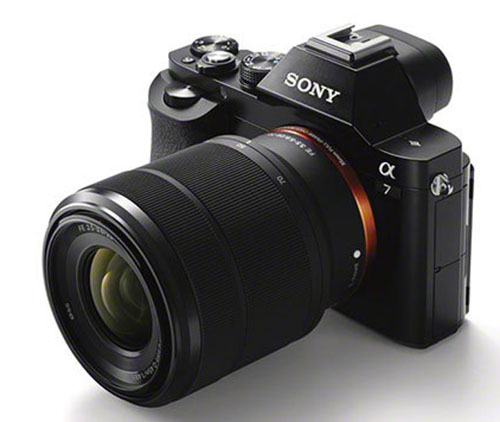
Although some of my information back in September was off-mark (writes David Kilpatrick), the post which I put up here was definitely right about the new A7 or rumoured ‘full frame NEX’ being based on the RX body design. I gather it was not the Alpha division, or the NEX division, which handed the prototype cameras to photojournalists from Magnum and Panos agencies. It was either Sony management at an even higher level, or the Cyber-shot division. The photographers involved had previously been using the RX1. They were given the pre-production A7 as a development of the RX1. It may even have been produced because Sony got the feedback that an RX with interchangeable lenses would be great.
Richard Kilpatrick attended the London launch event on Wednesday 16th October and has a small gallery of JPEG shots taken with prototype or pre-production bodies and lenses:
Richard also relays these comments (now finalised and properly written, evening of a busy day):
Both cameras are deceptive; you simply don’t expect this image quality out of something that light. It’s not like carrying a Leica, where you’re wielding something that might double as a weapon – the magnesium body and full-frame sensor feel solid yet after carrying my regular full-frame SLR, it’s a genuine shock.
The Zeiss lens on the Alpha 7R I used, the 55mm F1.8, looks to be exceptional. When first looking over the JPEGs, I went straight to the corners – the clarity, the even illumination, just instantly impressive. The kit lens I didn’t spend as much time with, and I tried it on the 24Mp Alpha 7 mostly investigating the AF, but I would be opting for primes anyway on this body. I’m curious to see how it handles Leica M-targeted lenses – there will undoubtedly be a 15mm or similar, but one of my favourite inexpensive lenses on the M9 was the Voigtländer Super Heliar II, which showed dramatic falloff and magenta tinges in one corner on that full-frame CCD. It was possible to correct, it seems Sony’s work on short registration full frame may be extremely successful, or their lenses are very well matched. Either way, it works.
I’m not very familiar with Sony’s user interface, and I found some controls slightly unintuitive – on this pre-production model, I couldn’t change the ISO whilst the file was being written. That’s the sort of thing which if I’ve left it set to Auto, or simply hadn’t been paying attention between uses, I might want to do – noticing an incorrect exposure and wanting to rapidly correct my error and reshoot.
Other areas of the UI impressed. The animations for aperture and so forth as you adjust the wheels are quick, clear and unobtrusive, whilst still providing the feedback that would allow less experienced users to see which direction they’re heading and what options are available.
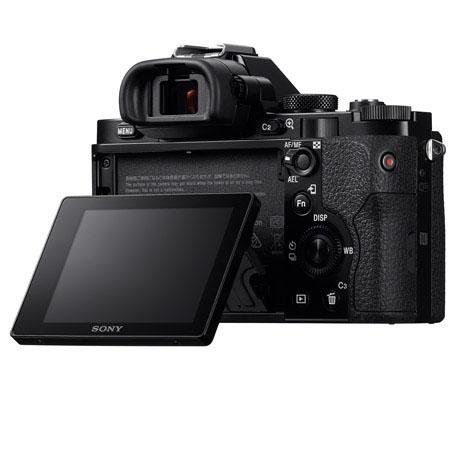
The main screen is very nice. Sharp, and I’m a big fan of articulated screens that allow the use of a camera in a “waist level finder” format. Felt solid, robust enough to cope with professional abuse.
Card door and battery compartment aren’t combined, which is a bonus on a compact body. It also has a well sculpted grip. Perhaps it’s unfair to make direct comparisons, but let’s say I prefer this sort of body design to the flatter, more ‘retro’ inspired mirrorless options on the market.
Can not mention this enough, it’s tiny. It’s properly tiny. Not tiny like “well, it’s as big as a classic SLR from X manufacturer, but it’s packing a tiny sensor in there” – it’s “35mm film era compact body” tiny. With a proper, serious sensor in it, the design compromises to achieve a digital, high-tech UI in a small form factor feel like a much better trade than if you’re working with small controls and sacrificing sensor area.
Port covers are hard plastic, hinged, a bit annoying (rubber ones will at least bend if you catch them by accident). Again, lack of familiarity with Sony catches me out here, as the accessories I’d often expect to hook into the ports use the hotshoe accessory port. An adaptor for the earlier hotshoe is available and about £25 apparently, I was more concerned that I wouldn’t be able to use a regular wireless trigger and thus finding a conventional – albeit very sophisticated – hotshoe was reassuring. I wonder how many regular professionals share that perception – that there will be a non-standard interface on the Sony body.
Shutter sound is very solid, mechanical. A really nice sound. There is not a fully electronic shutter mode available, so no silent shooting, but it’s discrete enough.
Ergonomics are really good. The wheels are logical, I found my way around it very quickly on the whole, though without the experience David has of Sony’s software I didn’t know where to find specific features right away. It was logical enough for the main features, such as setting file size and type. There’s an optional battery grip, though it’s really not vital for changing orientation – the camera is so light, one handed shooting and quick rotation is easy.
I am not a fan of EVFs, though I’m happy to work with them if that’s what I’ve got, an optical viewfinder will always be my preferred route. That said, the EVF really did impress. It’s very sharp, has an impressive refresh rate and of course, somewhere there’s a lot of data being shifted to generate that 2.4Mp image. Cannot deny the technical accomplishment! The overlaid virtual horizon was useful and unobtrusive, though I wasn’t clear on what focus point I was using due to my lack of familiarity with the interface.
Sensor exposed when lens detached. This is common on mirrorless bodies, but I’d really like the option for the shutter to close when detaching a lens. Pros do not treat their kit the way an enthusiast or amateur will cherish the substantial investment – the job, be it on sandy beaches, muddy fields or pouring with rain at a wedding, must take priority and the cameras and lenses get subjected to abuse.
I want one, in an abstract way. it’s really very nice. To expand on that – I’ve a feeling when I see what the finished firmware and raw files offer, and have had more experience with the Zeiss lenses in particular, the shift to an EVF is a change I’d willingly accept for the size and quality advantages, but it’s also just a lovely bit of design. Really appealing.
Sony want to move to pro market. Sony have pretty much always had good glass and bodies, but this offers something really unique that should appeal to many professionals – not least because of that 36Mp sensor.
NEX brand is no more. All models will be united under the Alpha brand, with A, E and FE mounts (Alpha, E and Fullframe E) – Richard Kilpatrick
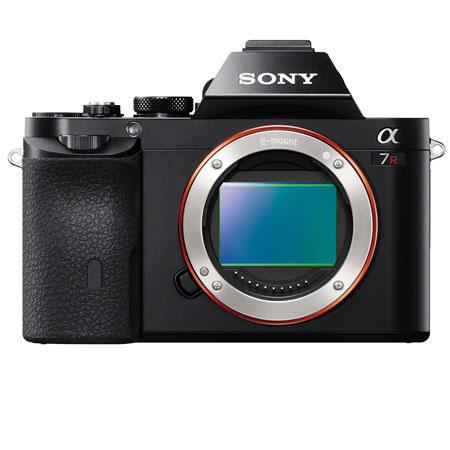
That it should use the NEX E-mount (already used for full frame on the VG-900) was never in any real doubt, though other prototypes may have existed using a different approach. Today, worldwide, the A7 (24 megapixels full frame with Phase Detect focusing pixels on the sensor) and the A7r (36 megapixels without PDAF, but with AA filter) were officially announced.
Compare the body here with the RX1 below – and make a special point of looking at the film plane index mark on the left-hand top plate end. You’ll see that the sensor is positioned much further forward in the A7 body, as the FE mount has the same 18mm register as the original E-mount (including the RX-style decorative orange lens throat bezel) and the RX body is thicker than a NEX even before this is added. This enables a flush-mounted double hinged rear LCD screen, but it’s not a fully articulated or reversible screen, which is a pity.
You will also see that the entire body has been extended in length, despite the RX being full frame.
This is necessary to accommodate the mechanical drive for the focal plane shutter, which sits more or less between the lens and chunky right hand grip (the RX has no FP shutter as it uses an interlens design). All other principal aspects of the A7 stem from the RX design but the construction is not the same, with multiple magnesium body components sealed together and a different set of interface covers.
The cameras include WiFi and NFC (NearField) communication to enable cable free transfer of images. It does not have built-in GPS but a GPS module is expected for the Multi Function Accessory shoe. The cameras have 2.3K dot 0.71X 0.5 inch OLED EVFs, essentially the same as the A99 with a similar generous eyepiece size and auto switching.
There also appears to be some extra depth to the body. You could dream that the extra body depth, length and height conceal the required mechanism for in-body stabilisation… but it’s just what is needed for the focal plane shutter.
We had hoped that the 35mm f/2 lens would be replicated, but this was not to be despite some information that the 35mm being used on prototypes was ‘the same’ as the RX1. Instead, there’s a 35mm f/2.8 Zeiss. I will admit to being underwhelmed by that, as it puts the A7/A7r into a category which almost every camera ever made matches (very few cameras can’t achieve a 60° view angle at f/2.8 – it’s what the cheapest compact 35mms used to start with). It is not stabilised.
One zoom lens also announced – a lower cost stabilised(?) Sony G 28-70mm f/3.5-5.6 – also fails to set the heart racing (or the hands racing for the wallet) when you consider its modest aperture and fairly substantial size. Unlike the 35mm, it has a rear ring which is marked for aperture adjustment like the RX1 (silent or clicked at choice). The FE mount, while compatible with existing E-mount lenses and accessories and has the same ten-pin contact array, may have additional protocols to handle the on-lens aperture setting.
The 28-70mm zoom is not a true parfocal, it’s similar to lenses such as Canon’s 18-135mm sold with their EOS 70D which almost negates the value of on-sensor PDAF by having massive focus shift when zoomed.
If you want contrast detect focus to work, you need parfocal zooms. You need to keep the subject as close to being sharply focus when you zoom as you possibly can. This zoom does not have a constant aperture though setting it to f/5.6 or smaller may have that effect, and it has a large varifocal range (closest focus at 28mm is 0.30m, at 70mm, it’s 0.45m).
Looking at this, I feel that the 24-105mm Sony f/3.5-4.5 D I’m using on my A99 has real appeal.
This shot shows a Carl Zeiss 24-70mm f/4 OSS lens, not a kit lens, but an option at a high price. This is a more realistic range. My guess is that this lens will not only be a constant aperture (regardless of setting) but also parfocal so zooming during video will not force a refocusing process.
The A7 models have audio manual level control during video and a conventional 3.5mm jack for mic input, clean HDMI output for professional external recorders, and for stills only (not video which remains 1080 50/60 or 25/24p – there is no 30p option) the camera will play back at 4K resolution for the new Triluminos gamut Sony 4K televisions.
The final lens of those released with the camera is a 55mm f/1.8 – again, a slightly odd choice for an expensive standard angle lens of reasonable speed without being special. Bear in mind all these lenses are weathersealed and built for professional use, with the kind of smooth focusing and aperture control required for video as well as stills. A 70-200mm f/4 is also released, putting a total of five lenses in the showcase for launch despite the absence of a true super-wide.
A brand new LA-EA4 Alpha mount lens adaptor provides phase detection AF via an SLT mirror, and has sufficient clearance internally to prevent image cut off (the LA-EA2 casts a shadow on the sensor as it has a smaller throat). A new 70-200mm SSM G II A-mount lens has been launched today as well as is picked out by Sony as compatible with this adaptor.
For most potential buyers, the preview of many other lens adaptors – for Leica and for Canon, as examples – will not just be an added attraction, it will be a essential function. It would be interesting if the FE-mount allows adaptors with their own aperture ring controlling lenes such as Nikon G, and reporting EXIF correctly to the A7’s CPU. That kind of detail we’ll have to wait to learn about; most early reviewers will have other concerns. Adaptors are vital because this camera is launched in sharp contrast to the original NEX-5 and 3 models, with at the best a semi-wide prime lens and a basic wide angle on its zoom.
The NEX system set off with a 24mm lens equivalent, an 84° angle of view considered to be the most desirable all-purpose wide angle, in the box. The NEX SEL 16mm f/2.8 may have had its critics and its QC problems, but it’s become a much-loved lens and got hundreds of thousands of NEX owners off to a great start needing no other wide angle lens. It also had the 12mm wide and 10.5mm fisheye adaptor options at modest cost, meaning that those who wanted true wide views had no reservations buying into the system.
The A7/r is in sharp contrast to this, without no prime in the launch range shorter than 35mm. Professionals would definitely want to have a fast 24mm (and a faster 35mm!) and a geometrically good 20 or 21mm. The Leica 21mm Super Angulon was almost the standard lens for photojournalists from as long ago as 50 years, reaching a peak of popularity in the 1970s, still considered vital when you’re in a tight situation with crowds. The A7 is an incomplete professional tool until it has a moderate sized, f/3.5 or f/2.8 20-21mm. Vignetting is acceptable as long it’s not accompanied by a colour shift. Vignetting actually helps with the look of the images!
The AA filter
The A7r with its D800 level resolution (but a sensor not related to the D800) has the AA filter removed, as in the RX1r. I have tested the RX1r against the RX1 for the British Journal of Photography and I’ll write here about the whole issue of AA filters and moiré only after the BJP has published my report. I will say that the moiré is not a minor issue, the RX1 standard version is already capable of throwing up moiré as it has a very weak AA filter, and the RX1r is bitingly sharp.
So why does Sony do this? It’s hostile to video though the scaling down from the 6000 pixel sensor to a 1920 pixel HD frame is accompanied by moiré removal. The answer lies in conventional contrast detection autofocus. AA filters reduce fine detail contrast and tend to smooth the luminance peaks and troughs used by contrast detect focusing to decide when the image is most sharp. Removing the AA filter has a small but significant effect on the speed and accuracy of contrast detection focusing, along with an improvement in many irregular textures like distant woodlands, lawn grass and human skin. So if you incorporate image processing able to remove some of the resulting moiré, it makes sense. This is the route being taken by most other makers now to get the best possible live view auto follow-focusing.
The A7r sensor has a sensitivity of 100-25,600 expandable to 50, and to 51,200 with multi-frame noise reduction.
The battery
The RX1, like the RX100, charges via micro USB and uses a very small battery., NP-BX1. This is fine for running a camera without a focal plane shutter, though pushing it for capacity when running the larger RX1 with EVF (you need spares). The A7 models have a large finger grip partly to accommodate a more substantial battery. The tiny NP-BX1 is really a consumer compact camera cell. The NP-FW50 used by the A7 models is the same cell used by NEX and Alpha 55 (etc).
A battery grip VG-C1EM accepts two of these cells for extended shooting. Charging remains in-camera despite the battery size, as with the Alpha 3000, the first camera to charge this battery type via USB. However, there is an external battery charger available.
As this image, released in the early hours of the morning, shows it’s a bridge camera with an 8.8-73.3mm f/2.8 lens which is equal to 24-200mm on a 1″ sensor (2.7X factor, 2:3 format shape). This is the spiritual heir to two cameras – the Konica Minolta A200 and the Sony Cyber-shot DSC-R1 – rolled into one. The A2/A200 was described as having a 28-200mm lens, but because it had a 4:3 format shape, the lens was actually equal to a 24mm if you wanted an 8 x 6″ print shape (the 28mm equivalent assumed you cropped the frame down to 2:3… not many people know that…). And that camera had a 7.2-56mm lens, which tells you that the 2/3 inch sensor is for some reason more like a 3/4 inch sensor relative to the 1″ standard.
The RX10 has a mechanical zoom just like the earlier Minolta/KM and Sony models. As long as the lens lives up to expectations, it’s going to be a great general purpose camera, with its 1/3rd click stopped aperture ring round the lens and its Alpha style mechanical AF mode switch. Why would you really want anything more than this for 90% of your out-and-about photography? It has Nearfield (NFC) connectivity but does not have WiFi, or GPS built-in. It does have the Multi Function Accessory shoe which can add many accessory functions in future.
One surprise is that this camera has a mini XLR balanced powered adaptor kit for microphones – this is the small XLR you may have seen on wireless mic sets, locking and more secure than the minijack which is built-in for regular use. This also has audio level metering and manual gain control (thus beating the Alpha 77, which remains hampered by forced auto gain for audio).
Local noise reduction
All the new Sony models have improved sensors and processors. The A7r has the microlenses moulded directly to the sensor, rather than added in an overlay layer as it normal, and they are gapless. The RX10 has a back-illuminated sensor. All have ‘local noise reduction’ which sets alarm bells ringing. If it’s a function that only affects JPEGs, all very well; if we have adaptive local NR affecting raw files, it will only be acceptable if it can be turned off (at least, to some users).
HD video at 60FPS, used prices around £100 to £175 (18-55 kit)
The Sony A3000 is an E-mount camera which looks like an SLR but takes all your E-mount lenses and has a pretty good 20 megapixel sensor. It even has a metal lens mount. In 2018 five-year old Sony A3000 bodies sold for as little as £100 – and 2026 suggests that they really couldn’t be any cheaper, with most resellers such as CeX asking £150-175 for 18-55mm kits.
So what has been cut back to let Sony sell this pioneering mirrorless system for less than £299 new in 2013? The saving is mainly in the expensive EVF innards – it uses a tiny 0.2″ display and a high power eyepiece, more like a consumer compact with a token EVF.
There’s not much really, in a difference of just three tenths of an inch. There’s even less when the inch isn’t a proper inch, but the sort of inch used to express the size of sensors or display chips. Except, that is, when the difference is between 0.5 inch and 0.2 inch and you’re comparing the electronic viewfinder of cameras like the A6000, NEX-6 or Alpha 77 with the EVF found in the entry-level Alpha 3000 (above and below, from both sides).
Here’s our 2013 review:
I’ve had the Alpha 3000 (ILCE-3000, Sony model reference number) now for a few weeks (writing in 2013), and used it as much as my eyesight and patience would permit, given a wide choice of other cameras to use instead during the same period. I can now say without fear of being shot down in flames that it has the most inadequate electronic viewfinder I can remember using, including finders on various bridge cameras of the distant past.
The viewfinder of the vintage Konica Minolta Dimage A2 used a 0.44 inch 922,000 pixel display chip with a generous eyepiece size and accommodation latitude. That is, anyone able to focus their eyes comfortably between 1m and 3m, with or without specs, would rarely need to touch the dioptre control.
The Alpha 55 used an 0.46 inch and the Alpha 77 (and accessory EVFs) 0.5 inch.
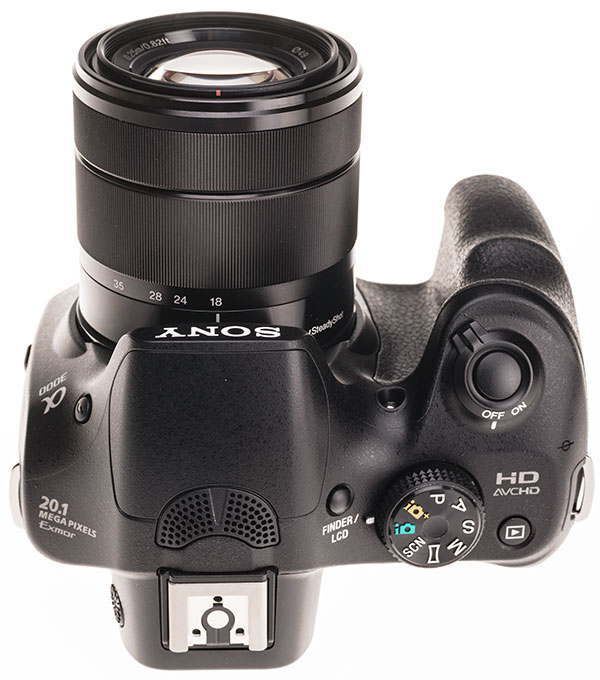
The A3000 eyepiece has a hard plastic surround and small, only slightly recessed ocular. The accessory shoe is over the eyepiece unit not over the camera body, and the eyepiece assembly sticks out well clear of the screen.
The Sony A3000’s EVF has 201,600 pixels, not even equal to one-quarter of the 2004 Dimage A2 bridge camera’s display. Because it is such a small chip – a mere 2.88 x 2.15mm which compares to a match-head or a grain of rice – the viewfinder eyepiece has to be a low powered microscope. Like any cheap microscope, it only looks sharp if your eye is precisely centered and the slightest nudge to the focus (dioptre) blurs the image. I found that the click-stops of the dioptre control on the A3000 were so crude it was possible to have a sharp image between them, yet uncomfortably unsharp when set to the clicked position either side. I can’t put a graphic of the actual size of the display chip here, because different screen resolutions would change its size.
To make it worse, the quality of the ocular lens is very poor, with distortion and smeary blurring together with considerable flare from the brightly illuminated display chip; it does not have the level of multicoating or internal light baffles to present a crisp clear view.
Since the main selling point of the A3000 over any comparable camera is that it has a built-in EVF, the extremely ‘stretched’ design parameters of this EVF will cost it sales in actual stores where it can be tried out.
The A3000 kit box. This unit is made for more than one country’s market.Inside there’s no software CD, and that super fat looking manual is actually a minimal introduction to the camera printed in 12 languages. It is the Rosetta Stone for a future alien civilisation discovering the remains of Earth!The bonus for buying a multi-zone package is that you get stubby cable UK and European mains leads. There is no battery charger, instead you get a 5v USB transformer (as with the RX100 and RX1 models) and a USB cable to charge the battery in-camera. The neckstrap is Sony’s standard chafing and scratching type.
Children, young women and most people under 40 in bright weather will find they can accommodate just enough to use the finder comfortably, though the vague smudge which represents the scene is only to be considered as a composition guide.
If you are male, over 40, have typical Western rather than Japanese eyesight age-related changes and try the camera out in a dimly-lit environment you’ll hand it back to the salesman and buy something which is easy to view through and shows a clear sharp image.
That said, the entire camera and its 18-55mm SEL black metal skinned E-mount lens costs a bit less than the accessory EVF for the RX1/100II. And you read that right, this is an Alpha (so are all NEX cameras, as anyone able to see the Greek letter on them will realise) but it’s not an Alpha A-mount. And though it looks like a DSLR or a DSLT, it is neither.
Sony A3000: great sensor, thick-skinned
The A3000 is nothing more than a rather appealing sensor upgrade to the NEX range, accidentally fitted into a NEX-3 body, dressed in a hollow plastic sumo suit. In Spain you can see parades with impressive giants, twice life size, concealing a very strong young man who can make them dance.
That’s rather what the A3000 is like.
On an iMac 27″ screen you will see the NEX-5n and A3000 precisely life size. The front face of the mounts has been aligned.
My photograph doesn’t just show the relative sizes of the 5-series NEX body and the A3000 together. I have positioned the front face of the lens mounts to coincide. This enables you to see how much space is wasted BEHIND the sensor in the A3000. There should be no cooling problems for extended video shooting with so much air circulation!
The A3000 has a focal plane index mark to show where the sensor actually sits inside the body (hard to see – right hand end above the strap fitting) but it’s ahead of the middle of the 38mm thick body, as the mount to sensor distance is 18mm leaving 20mm behind it.
The A3000 focal plane index mark is hard to see – it’s embossed rather than painted on the right hand grip, with the entire strap fitting comfortably in the space behind it.
The whole body, though it can claim to be small by SLR standards and therefore get a ‘smallest lightest’ accolade, is just a big plastic skin inside which the intestines of a much smaller NEX have been concealed. You get the same 3-inch rear screen, though without any kind of articulation or touch function and only 230,000 pixels like much earlier generation cameras.
You get a genuine metal lens bayonet mount not a cheap plastic version like the A-mount Alpha 58, presumably because the entire NEX system has always been of much higher overall precision than the A-mount range (just as the 1990s Vectis APS cameras were built to finer tolerances).
You also get a metal tripod bush, though this is in an odd position for panorama fans, located close to the focal plane but well centered on the lens axis; a really well-shaped right hand grip taking advantage of the larger body size.
It uses NEX-3 style controls lacking any front or rear wheels and just using the back mounted dial-rocker and unmarked soft-function buttons.
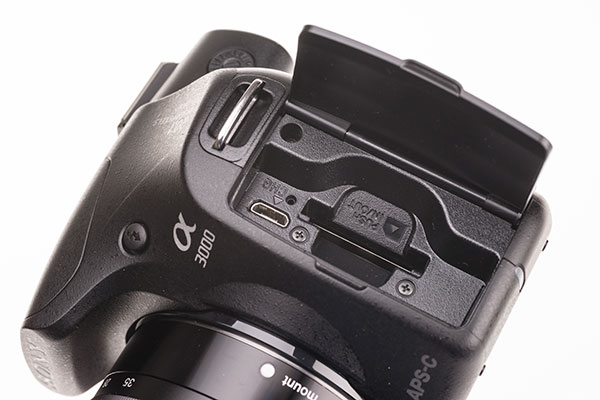
There is a super-simple interface on the left end of the camera with a single SD/MSPro card slot and a versatile USB connector which is remote release compatible.
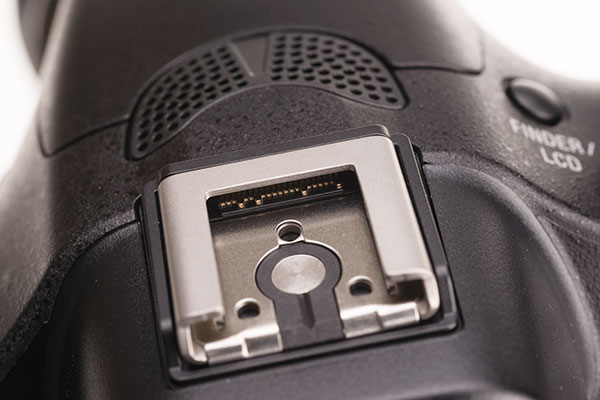
The big bonus is on the camera’s fake prism top (which does have a GN4 flash, unable to control wireless flash, but giving excellent exposure and coverage with the 18-55mm). Here you find the Sony Multi Function Accessory Shoe, reassuringly metal and hiding an array of contacts under its forward edge.
The A3000 has no HDMI port, no microphone input despite pretty good built-in stereo mics, no remote release socket, no wifi, no GPS, no wireless flash, no studio flash sync socket. It can or will have all of these through the Multi Function shoe.
I have not been able to check whether it can also support one of the superior EVFs which would fit (I do know that the Alpha 99, for example, does not support an RX1 EVF mounted in its similar shoe). Perhaps Sony’s expectation is to sell barrowloads of these extremely cheap (£299/$399) entry level interchangeable lens cameras and see the new owners buy two or three lenses, flash, microphones and more.
It’s about time they actually launched the GPS module which this shoe is contact-pinned to accept.
Sony A3000 20.1MP sensor performance
Against all the minimal feature set and basic menu-driven user interface must be set one of the best sensors around, the 20 megapixel APS-C seen earlier in the Alpha 58. It is not a stunning sensor, in that some noise can be seen even at minimum ISO, but that may be because it’s got a very weak AA filter (helps with contrast detect focusing) and decent colour discrimination.
With 2012 processing tools, applying just a little raw conversion NR keeps the images clean up to 1600 and allows usable (professional, on-line library etc) ISO 3200. It can go beyond this right up to 16,000 but if you need this sensitivity, you’ll find the EVF so noisy and dark it’s hard to see anything at all.
In 2026, updated camera profiles and powerful post-processing algorithms can get even better results from the A3000.
At ISO 800 (click these sample images for the full size file) you can see the general focus accuracy and sharpness of the 18-55mm used wide open, f/5.6 at 55mm, and also the quality of the flash for shots like this.This is an ISO 12,800 in-camera JPEG at default settings.This is the same shot carefully processed using Adobe Camera Raw Photoshop CC.Here’s a shot at f/8 and 18mm, at ISO 100 (minimum) processed without any NR or sharpening from raw. The sky blue does show some noise even at this low setting. The sharpness of the focused zone (to the left side) is excellent.Inside the Castle Restaurant, Edinburgh, the light is natural window-light, looking good but fairly low. This is 1/30th at f/9 with ISO 3200, processed from raw with some sharpening and some NR. I’d say nice colour and tones, a little soft because of limited depth of field, but sharp where it can be expected to be.This one is also ISO 3200, but it’s been put through Photoshop CC Noise Reduction filter (NIK Dfine 2.0 looked superficially better but created artificial looking tone breaks) and then downsized to 3600 x 2400 pixels.
There is no phase detect focus on this sensor, and the only focus method is contrast detection, as on earlier NEX models. It carries this out quickly and extremely accurately. Anyone used to the vague calibration of traditional DSLRs will be amazed by the lens quality the A3000 can reveal just through its pinpoint focus ability. No doubt this is helped by the rigid mounting of the sensor, which has no SteadyShot stabilisation and no vibration to clean off dust. The only self-cleaning is an anti static cover glass. A rigidly mounted sensor requires none of the complex carriage supports and adjustments found in Alpha DSLRs and DSLTs right from the Konica Minolta Dynax 7D onwards. It is probably more accurately parallel to the lens mount than an Alpha 900 or 99, let alone any of the lesser models.
Since the camera has an electronic first curtain focal plane shutter speeded 30 seconds to 1/4,000th and full PASM controls (with a little difficulty) with fully auto mode, scene modes and respectable plus-minus override and bracketing/HDR functions there is nothing an Alpha 99 or 77, NEX-7 or any other high end model can do to exceed its abilities except in some cases achieve a 1/8,000th top speed and shoot burst sequences faster and longer.
Contrast and dynamic range from raw as exposed without any adjustment in raw processing.With adjustments for black, highlights, shadows, exposure the sensor shows that it has recorded plenty of detail in all zones.
Used for single exposures, it’s just as much a professional tool as a Nikon D4 even though it might not last a week in the hands of a pressman.
For £299 perhaps that pressman might consider buying a couple of these just to get into the next urban war zone street demonstration, or to cover a Spanish tomato fight. The pictures will probably be just as good and if the camera gets kicked into touch, the light plastic half empty body skin could well survive better than a crackable alloy jam-packed top model NEX.
Without accurate focusing and exposure, the 20 megapixel sensor would be of little value. Since both focus and exposure are read directly from the sensor, they are about as accurate as you can get. The raw files also show a very good dynamic range and as expected it’s just a little better in ISO performance and DR than the Alpha 58, because there is no SLT mirror in the way.
Sony A3000 advanced custom functions
Again, despite being an entry-level camera probably designed for a huge Chinese and Indian potential market but sold worldwide to ensure it’s taken seriously, the A3000 has vital functions which Sony could have omitted in a purely consumer model.
It has a setting for shutter release without lens, which makes it suitable for use with the vast range adaptors and third party lenses for the E-mount (almost every lens ever made for any format larger than half-frame, whether rangefinder or SLR).
Will A3000 buyers want to spend as much again on Novoflex, Kipon or Metabones adaptors and legacy lenses? Maybe not, but they can, and they will work well on this body.
It has a ‘Setting Effect Off’ option – that is for the LCD screen and the EVF, disabling the accurate simulation of exposure/contrast/colour, and permitting use with modelling lights and studio flash. It’s got AF Calibration, usable with the LA-EA2 phase detect Alpha lens adaptor, and the contrast-detect AF is compatible with many SSM and SAM focus motor lenses used on the LA-EA1.
It has focus peaking for manual focus, with magnification, but the low resolution of both the EVF and the rear screen render this less functional than it is in some other models.
A criticism has been made of a very faint click generated, apparently through the audio speaker, when the shutter is pressed. I thought this was a mechanical or electrical relay click connected to the operation of the E-mount aperture, but someone has determined that if the circuit to the speaker is cut (beep off does not work) the click disappears.
Actually, the click indicates the moment of capture for brief exposures and the start of exposure for longer ones (like 1/15th). The first shutter curtain on this camera makes no noise, so you would press the shutter and hear nothing at all. Even ‘silent’ cameras like the RX1 and RX100 do make some noise from leaf shutters. This click is similar in volume or less.
To me this indicates proper concern for the user in a camera where there may be no image displayed on the rear screen and the eye may be away from the viewfinder. You can tell when the exposure is made because the finder blacks out, but if you are not studying the finder, you would have no idea. The shutter button does not have a very obvious point of resistance after first pressure for focusing and you do not have to jab it down. Very gentle pressure will take the shot.
Electronic first curtain shutters are slightly confusing because all the mechanical shutter sound you hear happens AFTER the shot is taken. It is valuable to have this tiny audible clue, which no subject is likely to hear, that you have timed the shot as intended.
Using the Sony A3000
The practical side of the A3000 includes a weight so minimal (281g body only) you can take it on a Thomson package deal flight and still carry your wallet and toothbrush as well. The bulk means you are unlikely to mistake it for your iPhone, and the shape means that some people will take your seriously as a photographer while others who would have ignored a NEX will shy away or physically assault you. However, if you hold it out and use the rear screen to compose, no-one will do either as they will assume you are a beginner and ignore you.
To do this, you must press a button on the top. The camera has no eye sensors (it does not even have a rubber eyepiece surround and its 21mm eyepoint just helps to avoid the regularly clattering on spectacle lenses against hard plastic). This means that you can lift the camera to do a rear screen frame-up and the screen is, of course, dead. You get used to it.
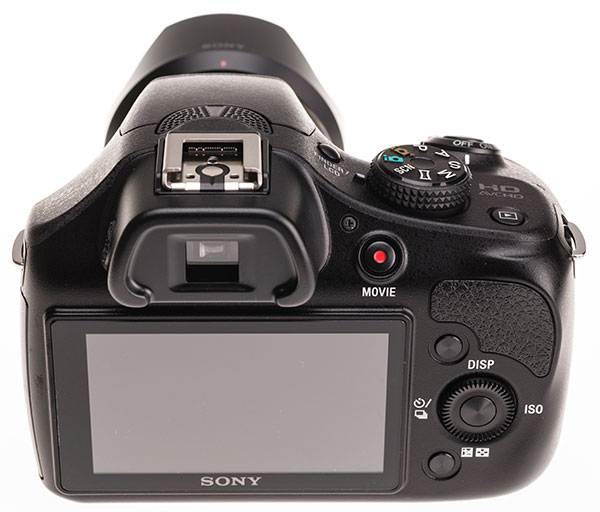
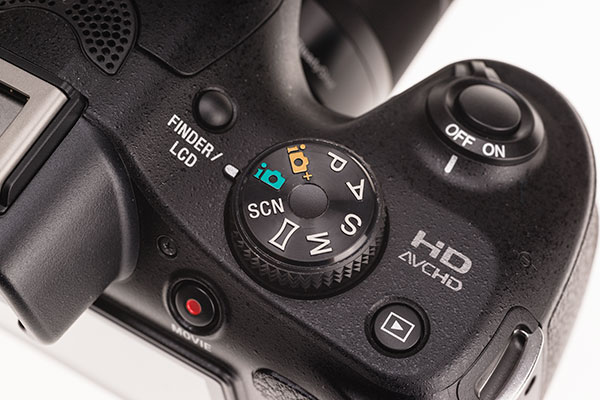
The mode dial appears to be metallic and has raised markings. Note the Finder/LCD manual switching button and the safe position of the Movie button away from accidental pressure (it can also be disabled completely).
The camera lacks any kind of finger or thumb wheel so the adjustments are all made after the fashion of the most basic NEX (3 or 5 series models). This is only a bit of a nuisance when setting shutter speed and aperture manually. It does have a lockout for the movie button, a lesson learned from the notoriously free triggering of video shooting by the badly placed red button on countless previous Sony models. The button is actually placed where you wouldn’t hit it by mistake anyway – belt and braces.
The 3 inch rear screen seems to have a very good quality finish – a better acrylic, or might it even be glass? Mine seems to be remaining unscratched to the same degree as Gorilla Glass protectors do.
The EVF is only just acceptable in bright sunshine, when it is also most useful as the rear screen may become unusable. It does not really show the tones of the scene (take a shot and play it back and the difference is obvious) and it shows very little detail. You can make out all the larger shapes in a composition. In some ways it probably encourages good composition. You can’t really tell if the focus is sharp but green confirmation rectangles or a wide zone will activate, with beep if requested, and the shutter release won’t operate until focus is OK. It has optional grid line display and 25 focus points so the little display can get pretty busy.
I have no interest in medium rate burst sequences personally as there’s hardly any action or subject where I do not prefer to time individual shots. A modest 2.5fps is no different to 3.5fps or even 5fps or 1.5fps for me. Really fast stuff like 8 or 10fps or Nikon’s incredible 60fps on the 1 V2 and AW1 has some appeal as this does give you a chance of optimum timing for sports and general action. The A3000 doesn’t. OK, photograph your toddler stumbling towards the camera, just don’t try to advertise the kid on Facebook. Try eBay instead, it’s a far surer way to get rid of them before they become too much trouble.
The worst experience I’ve had with the A3000 has been EVF use in extremely dim indoor conditions, with or without flash, regardless of ISO set and lens used. The rear screen performs much better so it is not just a matter of the sensor’s live view feed. However, in typical well-lit interiors its only failing is that Auto White Balance doesn’t seem to work even if Setting Effect is enabled – it will look brighter than an optical finder, and reasonably clean and clear, but often show a strong colour cast which is not present in the final shot.
I’ve shot a few video clips with acoustic performers and found the sound to be good but very prone to auto gain ducking and boosting. To make decent videos with sound, you have to buy the shoe fitting accessory microphone or audio preamp unit. This is no great surprise as to date only the Alpha 99 has the right functions to control levels and use a conventional plug-in condensor mic directly.
And back to those small differences
I started out by observing the miniscule size of the EVF display chip. I’m going to end with something unexpected. Snapsort.com’s camera comparer states that the A3000 has a larger than normal APS-C sensor, 25.1 x 16.7mm instead of the normal 23.5 x 15.6mm. If this was the case, the camera would gain a huge bonus point, as 1.6mm in 23.5mm would ‘turn’ your Sigma 8-16mm zoom into 7.5mm-15mm.
But the handbook clearly states the A3000 actually has a smaller than normal sensor, 23.2 x 15.4mm. The Sony website says that it has a 23.5 x 15.6mm sensor. Amazon incorrectly lists the size of the original APS-C film format.
The handbook also claims that the EVF is 0.7X when Snapsort comparison specifications gives 0.49X – without knowing where this figure comes from, I can only confirm that the EVF is visually a fraction smaller than a typical 0.72X APS-C like the Alpha 580 (this is easily established by holding two cameras, one to the left and one to the right eye, and seeing how the finder windows compare). So don’t believe everything you read about the A3000. The 0.70X is true. The specs also show an extreme dioptre range (-4.0 to +3.5) for the eyepiece, which is necessary given the critical viewing conditions produced by such a high powered ocular and small display chip.
Actually the Snapsort comparator is very badly written, as it also claims a normal Sony Alpha body is 3.5 inches deep (it’s actually 2.55, 65mm mount to back, compared to the A3000’s 38mm) and that the A3000 is 4.7X smaller than an Alpha 57. This is based on measuring the A57 including prism and grip, and the A3000 on mount to back body thickness only. The A3000 is volumetrically 1.35X smaller including all external air space – the ‘box’ it can fit in – and in linear terms it’s only about 4mm less tall and 102mm long as opposed to 132mm. It’s small but there is a fair amount of bad measurement and worse measurement floating around the net.
Don’t tell me stabilisation would not be a bonus even for the 16mm. If not, why did they make the 10-18m an OSS lens?The 16mm chrome lens looks rather odd on this body.
Snapsort also lists the lack of in-body stabilisation as an advantage compared to the Alpha 57 because apparently in-lens stabilisation gives ‘less risk of blur’. In my experience the two methods are equally effective and our many Alpha bodies offer the choice between using IBIS and lens IS. The A3000 with IBIS (SS) would have been a great companion for the 16mm, new 20mm f/2.8, Zeiss 24mm f/1.8, SEL 30mm Macro, SEL 35mm f/1.8 and the Zeiss TOUIT 12mm f/2.8 and 32mm f/1.8 – not to mention the Sigma 19mm f/2.8, 30mm f/2.8 and 60mm f/2.8. All these excellent lenses currently must survive with no stabilisation other than pixel-shift electronic processing for video work on some cameras.
The A3000 is very small, but the saving is mostly on width left to right, and on the thickness of the body disregarding the ‘prism’ overhang and the right hand grip. The grip extends nearly as far as any other Alpha, meaning that you actually get a much deeper inside surface so your fingers wrap right round.
It gives the A3000 the most secure right hand grip of any E-mount camera I know, almost 30mm of sculptured rubber-skinned moulding. Like the rear of the body, this appears to be completely empty. It’s just a moulded grip with a few connections in the top for the shutter button and on-off switch. It does not even house the battery (NEX type) which sits well behind it.
Sony A3000 kit lens – 18-55mm F3.5-5.6 SEL OSS
The cheapest kit for the camera includes a black 18-55mm f/3.5-5.6 SEL OSS. Well, I might as well admit I sold the black 18-55mm which came with my original NEX-7 for £200. Previous 18-55mms were chrome, I bought a Tamron VC DiIII 18-200mm, and the black lenses were in high demand. Now, I get one again, but in with an A300 body and the brand new price was only £349 – one month later, cut to £299. So does that mean I really only paid £99 for this body?
I was not over-impressed by the performance of the 18-55mm on NEX-7. Now I find this latest 18-55mm seems much better. It is made in Thailand, not Japan or China, just like the camera body. Sony must have opened a new plant or recovered the factory which was swamped by two metres of floodwater a couple of years ago. Whatever the case, the Thai contractors (whose story started with the Nikon Pronea APS SLR) have a highly skilled workforce now with almost two decades of experience.
The A3000 looks great with the 18-200mm, whether Sony or Tamron branded.
This lens is so good it compares with the Fujinon 16-50mm I was using recently, and Fuji’s lenses are generally a level above Sony in quality as well as cost. I have found the A3000 body to be a great companion for my 18-200mm as well. It just looks much better on this body, handles better with the right-hand grip, and focuses better than on my NEX-5n. The EVF with the VC stabilisation is better to use than any rear LCD screen when a lens can be extended to 200mm on this format.
The final dilemma
As you will gather, I have big problems with the very poor EVF of this camera. I don’t really have any issue with the relatively low resolution rear LCD. The only other thing which causes me any problems is that I’ve been using Olympus OM-D E-M5 for a while alongside my Sony kit, and I have come to value its in-body stabilisation. I felt able to buy a Sigma 60mm f/2.8 for the Olympus – this is a truly wonderful lens, equivalent to a 120mm on the MicroFourThirds format. I don’t feel able to buy one for the NEX as I know the combination of a 90mm equivalent lens and no stabilisation at all will result in poor sharpness from a super-sharp optic, in many of the conditions I like to use such a lens.
Had Sony decided to put SteadyShot into this body, I think it would have made a great difference. The NEX mount market is just waiting for a stabilised-sensor body able to guarantee the best results from the hundreds of adapted lenses around (Olympus, of course, has a menu to let you enter the focal length of any adapted lens and thus ensure correct IS). But the price point would then have been missed and the precision of the assembly might have been compromised without even greater expense in manufacturing.
I have been using the OM-D more often; its 12-50mm standard zoom is a very good lens, I have a 45mm f/1.8 portrait lens and now the Sigma 60mm which is semi-macro with a great working distance for flowers and fungi. The 5-axis stabilisation works well. I have a drawer full of legacy lenses, adaptors and accessories for NEX but all of them are let down by the lack in sensor stabilisation. The only thing stopping me from ditching NEX and shifting to MicroFourThirds is the lack of a decent wide-angle within that system. I have access to 12mm (16mm+ converter) or 8mm (Sigma zoom with LA-EA1) but for the Olympus I really would need a 6mm lens and no such thing is made.
So, do I sell the A3000? I like to buy rather than beg and borrow cameras for test purposes. Borrowed cameras are OK when it’s not possible – there’s a Canon EOS 70D kit about to land for a couple of weeks – but bought cameras don’t half focus the keyboard fingers. It is easy to be too kind to a camera lent to you for a couple of weeks. It is not so easy to be kind to one you have paid for, unless you are dishonest and think that writing it up favourably will make a camera you don’t like easier to sell on!
Take the Nikon D600. We couldn’t lie about the showers of stuff deposited on the sensor by the shutter. We had bought a full kit. My reviews didn’t hestitate to mention the shutter issue. Nikon replaced the shutter in the camera under warranty and we immediately sold it, the buyer getting a considerable bargain (effectively, a 28-300mm Nikon lens, a GPS unit and a Sigma 17-35mm of proven performance thrown in free with a body that included a transferrable warranty). The buyer also knew who was selling it and could read the reviews.
Soon after, the Nikon D610 launched with an entirely new shutter mechanism, though Nikon has never once admitted the problem with the original D600. Reviewers and critics and technicians, 1, Nikon 0. Reviewer’s bank balance, -1.
My inclination is to keep this camera despite no GPS and a poor EVF. It’s so cheap that it is really only a swap for the NEX-3 kit I sold this year. I’ve written one paid review which writes off part of the cost of the camera (we make nothing from this website now unless visitors decide to subscribe to Cameracraft magazine which is not all that directly related).
I can use it alongside my NEX-5n which is so much better with the 16mm f/2.8 – that lens just looks silly on the A3000. I can maybe even fit my optical finder to the 5n for the 16mm now. I have recently bought some extension tubes.
The A3000 has all the contacts – but are they all wired?
If only the A3000 had a tilting rear screen…or the NEX-6 had the 20 megapixel sensor… or the NEX-7 had the new hot shoe… if any one of the them had on-board GPS like my A55, A77 and A99… if the GPS module for the new hot shoe existed…
What a mess! Sony does not offer choice. It offers buyers’ dilemmas and buyers’ remorse, as in ‘did I buy the right model?’ or ‘did I pick the wrong system?’. Sony is doing just the same with the Alpha A-mount system. You have to pick a sensor you trust over a viewfinder which is great or a format and lens kit change or controllable audio input or having GPS or missing your built-in flash. No way can you have it all in one body.
(below – my conclusion written in October 2013 – we now know of course what was launched, and also that there will be an A5000)
Sony must surely follow this up with an A5000, or whatever, adding a few missing refinements to the camera and making it a £499 kit. That is what I would really like. But for the moment, the results from this cheap entry-level ILC are so good I have not touched the NEX-5n or the Alpha 77 since it arrived. And that is maybe the last word.
Except for the full-frame NEX or the interchangeable lens RX1 or the NEX fitted with Olympus-derived 5-axis IBIS – or whatever mid-October brings.
(added below – a comment at the end of 2013)
The A3000 is now sold for as little as £220 including in the UK (£185 before tax) and for $300 US. It is also sold with incentive deals for the 55-210mm E OSS lens, an excellent telephoto option, in addition to the 18-55mm. Am I upset that my camera’s value has been reduced? Well, I often sell cameras I buy to review, eventually.
This one I decided to keep. It’s got the best imaging quality of ALL my APS-C cameras and so far, the 20 megapixel sensor responsible for this has not appeared in anything else except the plastic-bayonet A58. It’s a remarkable bargain now and it’s almost being given away.
(added below – a comment in September 2018)
I’m struck by how Canon’s way of making the new EOS R full frame mirrorless system look rather DSLR-like resembles what Sony did in the A3000!
The long-rumoured Alpha 3000 was announced earlier in August but placed under a n embargo until August 27th. At the same time, the Press was given an insight into new smartphone related products (also widely rumoured) but again, not allowed to print anything officially.
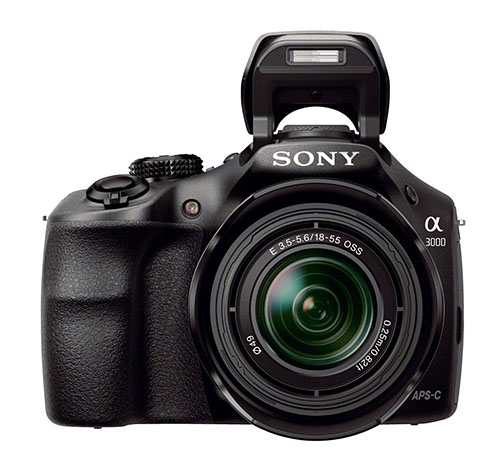
The A3000 is a DSLR-like body with an electronic 1.44MP viewfinder in a prism-style top bulge, but the body is much slimmer at the lens mount and built to the smallest Alpha form factor as the 3 series indicates (smaller than the A57). Indeed, it’s not so different from the relationship of the very first Alpha 3000 series cameras back at the end of the 1980s. The mount is a regular NEX E-mount and the camera lacks any form of Phase Detection AF, depending on Contrast Detection matched to both existing (18-55mm SEL, etc) and new E-mount lenses. The rear screen is a 230KP fixed type.
Along with this first Alpha E-mount body, Sony announced three new E-mount lenses – a 50mm f/1.8 E OSS (£249) in black, CZ Vario-Tessar T* SEL 16-70mm f/4 ZA OSS (£800) and a Sony SEL Power Zoom 18-105mm f/4 G OSS (£500, and also destined to be matched to the next generation of NEX camcorders, with its friendly left hand operated PZ switch and quiet, controllable action). There may also be another power zoom, probably 16-50mm f/2.8 or a similar short wide aperture range, maybe even the 10-18mm in a power zoom housing. The reason these new lenses are made with constant apertures has nothing to do with the ‘Canon f/4 L’ obsession; it’s entirely to do with video work, to enable zooming without brightness change. The power zoom function is also there for video.
Caveat: the 18-105mm has a close focus of 45cm at 18mm, 95cm at 105mm. This indicates that the lens is not a true zoom but a varifocal. Varifocals are not of much use for zooming during a take in video, which goes against the constant aperture and power zoom features. So either the lens has an automatic compensation system which can refocus intelligently during power zoom, or a physical limiter on focus travel (unlikely – what would happen if you focused on 45cm at 18mm, then zoomed to 105mm?). The 16-70mm focuses to 35cm over its zoom range, and is actually capable of close-ups with better than double the image scale (less than a quarter of the frame enlarged) relative to the best the 18-105mm can offer, at 0.23X.
The relatively high level specification of the 16-70mm ZA does not necessarily indicate that there is a higher level of Alpha E-mount body on the way quite yet; at 20.1 megapixels (the same size sensor as the Alpha 58, with some improvements) the performance in terms of imaging may be optimal for a while. photokina 2014 should be when any professional body appears. But this is no way professional – it’s a mere £370 kit with 18-55mm f/3.5-5.6 E OSS, ISO range 100-16000, full HD video, A58-like viewfinder and general performance. You’ll see it in the shops before the end of September.
Sony’s agenda
Much has been made of Sony’s relationship with Olympus and the possible inclusion of OM-style 5-axis sensor stabilisation in E-mount bodies. Though the A3000 seems to have SteadyShot Inside (not confirmed by our man at the press conference, and not one of the features shown on the swingtags of the first cameras photographed by others) Carl Zeiss, traditionally wary of stabilised lens design, would not be issuing the 16-70mm with OSS unless fixed sensors were going to around in NEX and Alpha E-mount bodies for some time.
Whatever type of in-body stabilisation it has, the A3000 with SS looks like a good companion for existing un-stabilised lenses such as the Sigma 60mm, 30mm and 19mm f/2.8 designs or specialities like the Voigtlander Nokton 42.5mm f/0.95. However, I’m writing this prior to the big release of information this morning. Despite many statements that the camera does have IBIS, I see no rock-solid evidence that it does and I’m very aware that Sony staff if asked whether it has stabilisation could well say ‘yes’ on the basis of the OSS present in the kit 18-55mm lens. So, I treat this information with caution. It would not be the first time an expected feature has not materialised. Check the Sony site if you are reading soon after 5am GMT, I’ll amend this article later in the day.
In the meantime, we know that Sony has been increasingly close to Sigma (a company which also works with Zeiss) and that some ideas may be shared between the two companies. One of the most important ideas promises to end the way your camera system choice locks you in to one company’s products. Sigma has taken the first visible step with its mount switching service. Future Sigma DSLR lenses can be returned to the workshop and their entire rear mount changed, at a cost, to another mount. So you will be able to own your 300-800mm (2014 version…) and if you switch from Canon to Nikon, the lens can switch with you. Now that many regular lenses cost £1000 or more and Sigma’s quality is so highly regarded (35mm f/1.4, MFT and E-mount lenses, DP series) it will make sense to keep the glass for longer. The new USB-interfaced lens calibration kit will also enable such lenses to be user tuned to work with their new host bodies.
The second idea is the switch to E-mount for more products by Sony. There is already a full frame E-mount Sony, the NEX VG-900E, and it’s actually a 24 megapixel still camera shooting raw, as well as a high-end full frame camcorder. It just gets very little attention because it does not look like an SLR or a NEX. This camera has adaptors for other systems of full-frame DSLR lens, as well as a specialised full-frame version of the Alpha mount plain adaptor (LA-EA3 without APS-C internal baffles found in the LA-EA1). However, third party makers have not yet gone the distance. Prime lenses from Samyang and Carl Zeiss are the main E-mount full frame offerings, made for video.
With the Alpha 3000 we see the introduction of an idea I sketched out for film cameras in the 1970s based on discovering the Contarex with its interchangeable 35mm backs. My concept was a camera body with a shutter unit, and a mechanical linkage for slot-in modules including a rangefinder mount, an SLR mirror-box with prism, and a pro mirror-box with interchangeable finders, plus several further front components to switch between Pentax, Minolta, Nikon, Canon and other lenses. Alpa came close to managing this with their very slim bodies and mount adaptors, plus a combination of optical direct finder and prism.
Sony’s future, like Sigma’s, lies in crossing all boundaries. The eventual full-frame, E-mount DSLR-style camera may well have the rumoured 36-50 megapixel sensor, 4K electronic viewfinder, and five-axis sensor stabilisation. It will also have an Alpha lens adaptor and firmware lens recognition good enough to let SSM and SAM in-lens focus motor lenses function adequately with on-sensor focusing. But what it will also have, for certain, is a range of adaptors for other mounts including Canon EF and Nikon G with translated control of AF and aperture (exactly what Sigma has now built in to the front ends of its ‘switchable mount’ new lens series). These will likely be third party products, but Sony has already shown (in 2010, at photokina and other shows) that it has no difficulty welcoming makers such as Metabones and Novoflex on board as co-operative vendors.
What’s more, in theory there will room to build a phase-detect mirror system (SLT) into some adaptors and even to add a focus drive motor. With the right chipset to translate the protocols from body to lenses, or to mechanical functions in the adaptor, almost any lens ever made for any SLR or rangefinder from the last century of miniature camera development will find a home on Alpha E-mount bodies.
Then you will have the ‘DSLR-CSC’ hybrid to end all – the body which can be sold with a Nikon mount, or a Canon mount, or an A-mount – or use its highly optimised future full-frame E-mount optics. To some degree the NEX has already done this but the real impact of the 18mm thick body, compatible with full frame lenses, has yet to be seen.
Caveat – if a full frame model does use sensor stabilisation, mechanical obstructions could mean that a crop factor of somewhere around 1.2X was needed. Sony already has pixel-shifting electronic stabilisation for video, not stills, and this also needs a crop factor to work. It would be easy to imagine the full-frame NEX accepting this limitation, and providing electronic stabilisation on-sensor only, removing moving parts and improving precision/calibration.
The NEX-5T
The NEX-5T has the same forward flippable rear screen mechanism as the 5R, one of the advanced over the earlier 5 and 5N designs.
The NEX-5T is the successor to the NEX-5R (5n, 5 etc), available as a black or white body. The 16.1 MP APS-C CMOS sensor NEX-5T will sell for around £600 and adds Near Field Connectivity technology to WiFi. Fifteen of Sony’s PlayMemories ‘apps’ are now available. Features include Hybrid AF (CD-PD on sensor), 180° tilting LCD, and maximum sensitivity of ISO 25600.
It’s not the fast f/2 design everyone was hoping for, but maybe the quality will be right – Sony has announced a new 20mm f/2.8 pancake lens for NEX. At the same time, the power zoom first seen at photokina, aimed at video NEX models, is available separately.
Here is the release:
Photographers and video makers are spoilt for choice with two additions to the range of E-mount interchangeable lenses for SonyαE-mount cameras and semi-professional camcorders.
E 20mm F2.8 ‘pancake’ wide-angle lens
Measuring approximately 20mm from front to back, this short focal length ‘pancake’ lens makes an ultra-slim yet tough ‘walkaround’ partner for your α E-mount camera.
With the 35mm equivalent of its 30mm wide-angle view and bright F2.8 aperture, it’s perfect for a broad range of everyday shooting opportunities, from interiors to landscapes, street scenes and casual snaps. Excellent contrast and resolution are also augmented by enhanced clarity in corner areas to satisfy the most discerning photographer.
E PZ18-200mm F3.5-6.3 OSS powered telephoto zoom lens
Offering a generous 11x magnification range, this high-quality telephoto zoom makes an ideal partner for shooting video with the E-mount interchangeable lens Full HD camcorders. The NEX-VG30EH is already supplied as a kit with the E PZ 18-200mm F3.5-6.3 OSS power zoom lens.
A comfortably positioned zoom lever is partnered with a switch on the lens barrel, allowing zoom speed to be selected in six steps, from slow, beautiful shifts in perspective to dramatic crash-zoom effects. Thanks to a newly developed internal linear motor, power zoom is complemented by exceptionally smooth focusing and aperture operation. Zoom can also be controlled directly from NEX-VG900, NEX-VG30 and NEX-FS700*.
*Firmware update is required for NEX-FS700.
Built-in Optical SteadyShot cuts the effects of camera shake, allowing handheld use of slower shutter speeds without image blur. Active Mode further enhances stabilisation at the wide end of the 11x zoom range – even when you’re walking along – making the lens a compelling choice for capturing smooth, stable video footage.
While optimised for video, it’s also a flexible choice for shooting stills with Sony’sαE-mount interchangeable lens,, from expansive landscapes to high impact close-ups of wildlife and athletes
E-mount lens family keeps growing
There’s now a family of thirteen E-mount lenses plus two converters, covering virtually any shooting situation with your Sony α E-mount camera or camcorder. Spanning ultra-wide angle,powerful telezoom, macro and fast, bright primes, the range includes premium optics by Sony and Carl Zeiss. Beautifully styled to complement yourαE-mount camera, every E-mount lens offers refined performance and easy handling.
The new Sony E 20mm F2.8 interchangeable lens will be available from March 2013,and the E PZ18-200mm F3.5-6.3 OSS lens from February 2013.
Perhaps the strangest news from photokina, which I have not rushed to post here because I reckon every single website in the world will have treated it as urgent breaking unparalleled wonder – is that Sony and Hasselblad have signed a deal under which Hasselblad will make an APS-C (or perhaps full-frame NEX mount) mirrorless camera in Sweden.
Without any images other than a Hasselblad H logo to accompany the revelation, the world is left wondering what exactly Fujifilm has done wrong. A drawing of what might be an A-mount mopdel was shown at photokina but looks as if it could have been done by a teenager on the back of a school jotter; a prototype or mock-up NEX revision called the Lunar was little better. Clearly, Sony already announced its intention to allow approved partners to use the E-mount, and we can assume that the Hasselnex will come thus equipped. Carl Zeiss has announced a roadmap for E-mount lenses, and of course that would fit Hasselblad down to the ground. No need for a new lens range, their bodies (NEX-7/6 type?) would be sold with blueprinted Zeiss glass. Surely? Not just with relabelled Sony zooms?
And the bodies would be made in Sweden. That means less than you might assume, since all the internal component parts would presumably be sourced from Sony as a CKD kit. CKD is motor industry speak for ‘Completely Knocked Down’ – a car shipped as parts to a factory, to be assembled there. Hasselblad Sweden used once to be very good at assembling cameras, they recently moved all Danish production back to Gothenburg and re-established Swedish manufacture.
The BJP has been told the body would be aluminium. The NEX-7 is magnesium alloy. And the 7/6 body already looks really classy. The Lunar simply does not.
From the BJP report on this €5-6,000 version of the NEX-7 – click image to see their interview.
So, what of the H-series blads – made in Japan by Fuji, Hasselblad’s long-term partner in the H-range project?
And, when Hasselblad was quite willing to work with Rittreck/Norita/Fuji on rangefinder type cameras (the XPan was not their idea, it was a Rittreck/Norita concept) what has changed?
After all, Fuji’s XPro-1 and XF are staggeringly good cameras with a ridiculously ambitious and excellent range of lenses, not just superfast primes abut extending into popular zooms. They are built and styled to fit Hasselblad ambitions. Fuji optics have proved good enough for Hasselblad H.
Something has shifted. Maybe Hasselblad is no longer tied to Fujifilm and the announcement of manufacture returning to Gothenburg, made earlier this year, relates to a shift not from Denmark only but also from Japan. Perhaps Sony has demonstrated that superior medium-format size CMOS can be fabbed, saving costs for future generations of yet unimagined H-series bodies/backs where six 24 megapixel APS-C sensors will be stitched to create a 144 megapixel sensor measuring 47mm square!
Or perhaps Hasselblad realises that mirrorless need not mean hand-waved. They used to build waist-level cameras. How about a mirrorless waist-level, styled like a mini ‘blad and with the screen on top with a flip-up hood and magnifier?
Too much kölsch and imagination, I fear. But this certainly is strange news. A scoop for Sony – but exactly what for Hasselblad remains to be seen.
Sonyalpharumours has posted a firm rumour that there will be a full-frame NEX. Anyone who understands the design of camera bodies, and the geometry of optical projection, has known from the start that this was possible given the design of the E-mount.
Those who have made uninformed comments (all over web forums!) to the effect that the rear register is ‘too short’ or would cause problems simply don’t have their brains switched on. There is no such thing as a camera body which is too thin or a mount to focal plane register which is too short.
Sony already designs lenses for NEX APS-C which incorporate what amounts to an extension tube to push the rear nodal point and exit pupil positions as far forward as needed for optimum illumination and matching of off-axis ray bundles to the sensor’s microlenses, filter array and cover glasses. That’s why the 30mm Macro is not so very different in size from putting a 30mm f/2.8 Alpha SAM macro on an adaptor (and that’s why we do exactly that here!).
What matters for full frame is a correlation between the clear lens throat diameter (the bayonet mount inside width), the sensor size, and the register.
The NEX system uses an 18mm register. That is the term of the distance between the front surface of the bayonet mount on the body (or rear surface of the mount on the lens) to the sensel layer surface of the sensor. There is a very small adjustment made in all digital cameras for the four physical layers which usually go between the sensor and the lens: the RGB filter layer (so thin it has no effect), the microlens layer (again, no effect), the low-pass or anti-aliasing filter and the infra-red cut and protective self-cleaning outermost glass. These filters may be combined into a single glass but in NEX they remain separate.
The sensor requires an image circle of just under 30mm allowing for assembly tolerances of 0.5mm overall in positioning and conformance of the lens axis. If in-body stabilisation is used, this diameter must be increased to 35mm at least; some Konica Minolta documentation suggests that a clear diameter closer to 40mm was needed for the original AS/SSS.
For full-frame, the required image circle is 44mm and the maximum diameter for in-body stabilisation could be between 49mm and 54mm depending on how Sony’s statements about sensor travel are understood (“5mm in any direction” could mean the total scope is 5mm, or that 5mm travel from axis might be possible). A good idea of the actual travel of an APS-C sensor with IBIS is given by the Pentax K-5, which has a manual sensor shift function allowing the user to move the sensor off-axis for a slight rising or cross front effect – but only by 1.5mm. This sounds more realistic though it would, of course, be a great feature if you could shift a sensor 2.5mm or an extreme 5mm – every lens with enough coverage would become a PC lens!
Now let’s compare these image circles with the lens throat diameter and its distance from the focal plane.
The Alpha system has a register of 44.5mm and a clear lens throat internal diameter around 42mm. Allowing for the orientation of the film plane and the position of control connections and the electronic contact array, the Alpha mount ends up providing an almost exact fit for the optical projection path if a 45mm diameter image circle is needed. Even if a 2000mm non-telephoto lens was attached, its image would cover the sensor without physical shadow vignetting caused by the mount.
It is important to remember that a 44.5mm register allows space for the reflex mirror, but also allows the image forming light to spread out from a rear element positioned over a wide range of possible distances, from just inside the camera body (by about 5mm before the mirror would hit it) to a good three or four centimetres in front of the mount. This allows a larger overall image circle and indeed most SLR lenses produce one greater than 50mm diameter. That’s how the Alpha 900/850 is able to offer in-body SSS, and also why certain lenses show vignetted corners occasionally when SSS is active because their image circle is only just sufficient to cover the sensor in its central, parked position.
This is a very accurate representation of 24 x 36mm sensor areas excluding any of the surrounding assembly, showing that the internals of the E-mount could be modified to fit FF. The white line shows the 24 x 36mm in the sensor plane, relative to the APS-C sensor. The red line shows the 24 x 36mm sensor as it relates to the mount, in the flange plane. The two rectangles are needed to show the size accounting for the perspective of the macro lens used to take this shot.
The NEX E-mount appears to have not much smaller a diameter, but this is deceptive. You need to look INSIDE the mount and study the position of the electronic contact pins. Once these are considered, the actual clear diameter is not 46mm at 18mm from the sensor (apparently bigger than the A-mount) it is 39mm at 12mm from the sensor. The contacts are located 5mm into the camera body and occupy a clear 3mm zone. The outermost contacts in the array are positioned sufficiently far from the extreme corner of a theoretical 24 x 36mm sensor to allow a full frame design, assuming most of the other detail of the darkchamber design is changed to ensure the widest possible clear area.
Ideas about putting SSS and full frame into such a NEX are wishful thinking, unless the camera was to be huge and the possibility of the lens mount innards shadowing part of the image was accepted. There’s just enough room to fit a full frame sensor, and no more.
It is more likely that Sony would introduce a range of new full-frame lenses with OSS, or non-stabilised adaptors for Alpha lenses designed to allow an unrestricted light path. It is also possible that a stabilising optical adaptor could be made, but we’d put that as the least likely option and one which would probably cost over $1000. Sony would more likely to put an electronic pixel-shift IS into a full frame NEX, though at present this only works with video and imposes a slight crop (1.87X) on what would be the maximum 16:9 frame area.
As for suggestions that existing NEX lenses might cover full frame, that is also uninformed speculation. They won’t and don’t. The same applies to the LA-EA1 and LA-EA2 adpators – neither of these would allow Alpha lenses to be used on the NEX and cover full frame, though there are a few wide angle lenses which might just squeeze their image through the small internal baffles. A few of the third party adaptors for lenses such as Leica M might allow coverage, some would not, depending on exactly how the light baffles and inner mount components have been designed. For APS-C NEX, it pays to add baffles which prevent stray light and flare; for FF NEX, the same baffles might vignette the image.
The question of sensor design is another matter, but it can be assumed many owners would use a full frame NEX to host legacy full frame lenses from a wide range of systems. Most of these have a degree of telecentricity which removes corner colour shifts. New full frame NEX lenses would be designed to match the new sensor, so that would not be an issue. Old rangefinder lenses would have no more problems on full frame NEX than they do on, say, a Leica M9. Sure, there would be issues, and weak combinations alongside strong ones.
These would not over-ride the value of a full frame NEX body. Good photographers can use any format well. They do not demand ‘the full frame look’ or believe that any one format is going to change their work in some way to make it superior to others. There’s a place for every format and choice is a good thing. End of story.
– David Kilpatrick
If you like the analytical and practical approach taken to this subject you may enjoy our new international quarterly magazine, Cameracraft, which publishes its first issue in September, replacing the old Photoworld with a bigger, better publication covering all systems and approaches to image-making from film to the future. See our subscription page and sign up to receive it from the very first edition!
Much of my NEX-7 critique was written while also using a NEX-5n outfit. I was lucky enough to find an opened NEX-5n 18-55mm kit missing its mini flash at a very low price, as new. By the time I had finished completing my NEX-5n system with bells and whistles, the total would almost have paid for a NEX-7.
The final kit consisted of the 5n, the FDA-EV1S electronic OLED viewfinder, the ECM-SST1 stereo microphone, and the HVL-F20S flash. The microphone was inherited from my NEX-5 so maybe doesn’t count. In the NEX-7 review, I start by suggesting that the 7 is really more part of the Alpha A-mount system and not the NEX system. The 7 either doesn’t need, or doesn’t accept, any of the accessories shown.
The NEX-7 finally became available after the 5n kit, and for a while both were used together. Just as the 5n can not use a plug-in stereo microphone or an Alpha system flash, the 7 can not use the NEX microphone or the HVL-F20S flash. Although I had one ‘NEX system’ with two bodies, the NEX-7 needed my HVL-F20AM flash originally bought for the Alpha 900 or one of the larger guns, and my Rode Video Pro mic, bought for the Alpha 77.
That’s why I count the NEX-7 as a hybrid, partly ‘big Alpha’ in heritage. It does not integrate with other NEX accessories, and vice-versa. Sony shows no sign of dropping the NEX Smart Accessory Terminal from 3 and 5 series bodies so this parallel range situation continues. If you’ve bought a mic or a GN 20 flash for your 5, it will not be usable with the 7 you plan to buy tomorrow.
The OLED Tru-Finder
Harking back to the wonderful Minolta Dimage 7i and later the Konica Minolta Dimage A2, the FDA-EV1S slightly resembles the fragile hinged EVF of those cameras. Like them, it can be flipped into a 90° upright position or used at angles between, so the eye looks down rather like using a waist-level finder with magnifier, or a Hasselblad 45° prism.
The finder is supposedly identical to the Alpha 77 or NEX-7. It has a different dioptre adjustment, a small slider which has a huge effect for very little travel. It’s not easy to adjust but stays put when set. If you wear and remove spectacles at random, and use the camera with both the naked eye and glasses, it’s one of the least ergonomic adjustments. The eyepiece surround is a semi-hard plastic and not as comfortable or efficient as a larger soft eyecup (which Sony does not make, but would be so easy to add to the system).
The add-on finder appeared to be slightly less clear and smaller to the eye than the A77. The same goes for the NEX-7 finder. The difference seems to be in the optical train, how the lenses are arranged in the ocular itself. It may even be nothing more than an eye-surround and eyepoint issue. The OLED screen is identical but I do not seem to get precisely the same viewing experience. Maybe it’s also a little dimmer by default to conserve battery power.
In use, the way the finder sticks out behind the NEX-5n rear screen is a bonus. I’d love to get an Alpha 580, my wife Shirley uses one and she is blessed with a small nose. I’m not! The 580 eyepiece is set forward of the screen surface by a good distance. It makes a very uncomfortable viewing position for me, and add-on magnifier eyepieces don’t help all that much. The FDA-EV1S in contrast is almost perfect. The NEX-7 is better because my nose can end up beside the camera not touching it.
In practice, I ended up hardly ever using the vertical viewing position. The finder sits forward when flipped this way, and somehow my hand position wasn’t all that comfortable holding the camera and looking down at a normal scene. Instead, I found the flipped-out rear screen and a waist-level camera position more useful. Then, of course, the EVF gets in the way. The sticking out eyepiece which is so comfortably in use can obscure your view of the screen slightly.
Finally, I ended up removing the finder most of the time. It seemed a bit vulnerable, it reduced battery life greatly, it prevented pocketability with my favourite 16mm lens (or at least, felt even more vulnerable in a pocket) and much of the time I realised I was composing on the rear screen anyway. As a result the buyer of my kit got a very little-used EVF.
It is the best EVF made, or at least on a level with the best other EVFs using new technology. I can work with an EVF. Some just can’t and almost need an optical finder. But I’m not sure I would ever fork out well over £200 (or around $300 before tax in the USA) on this accessory again. I’m looking at getting a 5n back into the fold, especially after going back to my raw files. I don’t think this small accessory should cost more than a lens, and the 16mm optical finder is equally overpriced. Sony’s accessory prices generally are a negative customer experience and do not create evangelists for the system.
The vertically-angled finder was tried, but not used, for this shot with the camera near ground level. It was far more comfortable just to use the rear screen.
Enhanced vision
Somewhere out in webland, it’s been pointed out I’m old and that my opinions on EVFs (etc) may be irrelevant. That’s a bit of an own goal, as EVFs have maximum appeal to those with ageing bad eyesight. Old eyes tend to be longsighted, and can’t accommodate to close focusing, needing reading glasses as well as distance glasses in many cases. Older people find composing pictures on rear LCD screens difficult, they may have to hold the camera right at arm’s length (you see it all the time!) and even then, they may not be reading the screen menus clearly or seeing the picture at pixel-sharp quality.
It’s young eyes which work best with phones and compact cameras lacking a viewfinder. They can focus on a screen held inches away from the eye. So can older eyes with serious short sight – just remove your specs, and you are away!
The EVF, especially in the NEX-7 and as an add-on to the 5n, is a boon to these with presbyopia. Suddenly, menus can be seen sharply and pictures composed and reviewed in better detail. The dioptre slider allows correction for the most common range of near and far sight, though it can’t correct for other conditions like astigmatism. For those who must always wear specs, just removing the eyepiece ‘cup’ can help.
As with the NEX-7, one key step is to disable image review when using the finder. It is disconcerting to have the image you have just shot block your view for even 2 seconds, especially when it prevents photography. The effect is different to having the same happen on the rear screen, because while the camera is to your eye, it becomes your window on the world.
Straphanging
Here’s something not often mentioned, and once again, I end up knocking the NEX-7. The NEX-5n and previous models have simple slot-type strap connectors mounted so that the camera always hangs with the lens down, LCD screen up. Even with a 16mm only, this lens-to-the-ground position protects your lens. You can even walk around in light rain and be confident it won’t get on the glass.
The NEX-7 with its magnesium body shell uses the higher end traditional post and triangular D-ring found on the Alpha 77, Dynax 7D, Alpha 700 and 900. And it does not hang lens down like the 3 and 5 models. The strap also gets twisted more easily. No need to say which I prefer. The cheap connector may be cheap, but it has a better function.
The rear screen mounting
The mechanism of the screen on the NEX-5n is slightly better than the earlier 3 and 5, perhaps because the EVF demands it must be able to move outwards in a slightly different way to be seen clearly for waist-level shots. It is my own view that Sony missed a trick, as the EVF on this camera would certainly have allowed a reversible, fully articulated Alpha 55 type screen and its extra thickness, without impeding EVF use.
Because the rear screens of all the NEX models do not twist to allow vertical composition combined with waist or overhead viewing, it makes less difference to me whether they are hinged at all. This probably reflects the emphasis on video shooting, where vertical composition is not needed. For the still photographer, cameras with articulated screens that can orient for verticals and also aim forwards for composing self-timer groups are most desirable. The screen is there. It’s already detached from the body. All that’s lacking is the correct mechanism, even when Sony has shown they have the necessary rights or patents, and can make them.
Refinements
The NEX-5n in addition to a 16 megapixel sensor offers lens corrections (for JPEG), AF correction for Alpha lenses attached via the LA-EA2, automatic sensing of DMF (manual focus taking over from confirmed AF) with magnification and focus peaking, electronic front curtain shutter, true 50/60p HD1080 video, extended sensitivity from ISO 100 (instead of 200 minimum) to 3200 (instead of 1600 maximum), and high-speed 10fps sequence shooting (this not really matched by the focusing abilities of the camera, any more than the 1/50th second shutter lag is).
To the earlier 3 and 5 models, firmware updates have retrofitted focus peaking with or without magnification, and AF correction for lenses with the adaptor. They can’t add lens corrections, DMF, new video modes, better low light and HDR multishot modes, or change the louder double-action shutter with its 1/20th second delay.
The NEX-5n also has a touch screen. I disabled this function from the start, along with smile shutter. Face detection I leave on as this does help with focus and exposure for many shots. Since I’d parted company with my NEX-5n before using the touch screen, I can’t comment on its value. It’s just something I don’t like using.
The only advance I would argue against is the extension of Auto ISO to 3200 with no ability to control the range. Though 3200 on the NEX-5n is not unlike 1600 on the NEX-7, both these settings are too high to allow a perfectly clean image from raw after the best processing. In-camera JPEGs confirm that. I found the NEX-5n working at 3200 in many conditions where I would have been confident of a good image at 800 or even 400. This obliged me to use manually set ISO, or put up with the 3200 quality.
NEX-5n, 16mm, 1/30th at f/11, closest focus, ISO 3200, ACR conversion from raw
100% clip showing how the presence of sharp detail (wallpaper) reduces the appearance of grain compared to defocused tones (right hand side).
How good is that quality? Compared to the 24 megapixel sensor, I’d still say it’s better than a one stop advantage. One of my magazine reviews (f2 Freelance Photographer) was accompanied by a near double page spread from the NEX-5n shot above taken at ISO 3200. It’s certainly good enough for that. However, ISO 1600 is much better. ISO 1600 is so good that in decent light, you could easily be using ISO 200 off a camera of the Nikon D200 or Sony Alpha 100 era, even at 100% pixel comparison. 3200 is amazing, as you can see. But it’s definitely a grainy look where 1600 can almost be noiseless.
If a firmware update could ever achieve it, I’d like to see Sony put a maximum and minimum auto ISO selection into the NEX models, as they have done in the Alpha 77. Failing that just a maximum limit would be useful.
There is no doubt that the 16 megapixel Sony CMOS is one of the best sensors yet made, and a great balance between pixel count and image quality. See below…
16 versus 24 with ACR
Adobe Camera Raw has the ability to open files with a set of fixed size interpolations from the raw data. In this respect, it is better than Lightroom, which can export files to different sizes on demand but shows (at least from my observation) a slightly lower quality. ACR’s image sizes are slightly arbitrary and clearly are not related to the pixel dimensions of the raw image. You can open a 17.5 megapixel or 25 megapixel image from a 12, 14, 16, 18 or 21 megapixel raw.
When you select an enlarged or reduced conversion, the large image preview and editing window reflects this. Your 100% view changes to be a 100% view of the size you are producing. In the case of the NEX-7, the 24 megapixel image size is the largest option on the list. You can not open to 25 megapixels as you can with the NEX-5n. You can reduce to 17.5, 11.2, 6.3, 2.8 or 1.6 megapixels.
The largest size is always 6144 pixels wide (longest dimension), or the native size of the raw file. So a Nikon D800 image which is 7360 pixels wide also shows up with only smaller options, and rather oddly skips the 6144 24 megapixel choice. With ACR, you can not open or preview a D800 raw at 24 megapixels, only at full size, 17.5 megapixels and the smaller choice.
If the raw file has unusual dimensions – 4:3 or square for example – you may get interesting options. The 21.3 megapixel Dalsa medium format backs show a 6144-wide 28 megapixel maximum size output option. The 16 megapixel Kodak MF backs allow 5120 square or 6144 square output, the largest size being 37.7 megapixels. As these backs have no AA filter and are teamed up with unrivalled lenses, a 16 megapixel Hasselblad 80mm Planar shot scaled up to 28 megapixels is hard to tell from a native Nikon D800+zoom lens image. D800E with top grade prime beats either.
Using the NEX-5n (or the earlier 14 megapixel 3 and 5 models) ACR offers 17.5 and 25 megapixel conversion, viewing and export or opening as well as the native size and the smaller ones mentioned above. It is largely my experience using the resizing functions along with NR and sharpening that makes me prefer the 16 megapixel sensor to the 24.
This view was taken with the NEX-5n and 18-55mm at 55mm, ISO 100, happen to end at f/11 though is was intended to be at f/10 (the non-lockable controls of the NEX-5n did this to me far too often).
This view was taken a few seconds later using the NEX-7 with a different (black) 18-55mm at f/10, all other parameters being similar, and both as raw files.
Here are 100% clip sections of both images. The 5n is top, the 7 is bottom. Both files are 6000 x 4000, the 5n image was exported by Adobe Camera Raw to 6144 pixels wide. Both images use Sharpen 25, Radius 0.5, Detail 50 and zero for both luminance and colour NR. In the very subtle low contrast texture of the lamp-post and the definition of the hex nut, the 7 clearly wins but it’s a surprisingly fine margin.
Yes, the difference is obvious. The 7 wins. Think again – for this clip, I’ve put the NEX-7 native size image TOP and the NEX-5n interpolated 24 megapixel output BOTTOM. What is the conclusion? That the lens you use – even the individual sample of the lens used as no two 18-55mms will perform identically – has far more effect on usable image detail than 24 megapixels versus 16.
Scaling images down in size
When I have been editing NEX-7 images at their native 24 megapixels the NEX-5n upscaled image has sometimes looked better overall, and the native size NEX-5n image nearly always wins. The NEX-7 image misses the mark for me maybe 30% of the time. For all ISO settings above 400, I tend to set the ACR output to 11.2 megapixels. Setting it to 17.5 doesn’t lose the granular feel. ACR’s 2012 process (CS6) has noise reduction and sharpening controls which work faster and better than any of the plugins or other raw conversion programs I’ve used.
Checking as I write: for 66 images just processed from the NEX-7, Alpha 77 and Alpha 580 (16 megapixels) I counted that 33 of the 24 megapixel images had been downsized to 3600 x 2400 pixels or thereabouts to resolve issues with noise or sharpness. Not one of the Alpha 580 images had needed downsizing. The 6000 x 4000 shots could, perhaps, have been downsized to the 4912 x 3264 of the 16 megapixel sensor or the 4076 x 2731 offered by ACR; the 3600 x 2400 size is the minimum for image library Alamy. If you send them anything except the sharpest and most noise-free images, you risk having all your work rejected, your submissions placed in a slow queue, or your entire account deleted for repeatedly less than perfect technical standards.
For stock library use, this image was reduced from 24 megapixels to a slightly cropped version just over 9 megapixels. The 18-200mm Tamron lens at 66mm, with the NEX-7, was used at f/8 and the focus was on the gold pan. A 24 megapixels, the degree of softening on the young girl’s face is beyond the acceptable limit; scaled down, it looks natural when viewed at 100%. Shooting with 16 megapixels instead of 24 will give an impression of greater sharpness, or greater depth of field, when checked at 100% though this is an illusion and two prints made at the same size will show no difference.
Working with the 16 megapixel sensor, across the usual range of conditions from daylight to night scenes, hardly any images need reducing in size to hit Alamy’s QC mark. Working with the 24 megapixel sensor, every image has to go through ‘is this really OK at full size?’.
While I definitely want my 24 megapixel Alphas for studio, tripod, architectural, landscape, artwork copying and similar tasks, having sold both the NEX-5n outfit and the NEX-7 if I was to purchase again it would be a NEX-5n with reservations.
Reservations
After using the NEX-7 interface, especially with the settings lock function, it is very difficult to go back to using the 5n or earlier interface. On all NEX cameras the menus are very easy to navigate, consistent, and reasonably fast. But on all NEX cameras except the 7, the rear controller is much too prone to accidental operation. The vertical straphanging reduces this a bit, as it avoids the control touching your clothing. The action is so light that just brushing against a coat or the fabric inside a camera pouch can be enough to change the aperture in A-Mode, the shutter in S-Mode, or the EV exposure correction (requires a light pressure to the bottom of the control followed by rotation).
It would be good if Sony could make a firmware modification which locked the primary function of rear controller rotation – something like a two-second press on a specified button – while leaving the compass-point click/rotate functions (located North, East, South, West or 12, 3, 6 and 9 o-clock on the controller) available.
The final reservation is where I started, about the Smart Accessory Terminal and how it differentiates the 3 and 5 models from the 7. The 7 fits well into any existing Alpha setup, the lesser models are only a partial match. The terminal has appeal. It’s long been thought that Sony could use it to add other functions, such as a GPS module or a wireless flash commander. No such accessories have appeared yet. Does that mean it’s a dead end, to be replaced by 7-style interfacing – or is the 7 a level on its own?
Sony has provided some kind of road map for lenses and would perhaps be giving too much away if they issued a roadmap for NEX development. It would make planning today’s purchases less of a gamble for existing system owners and new adopters if they could.
– David Kilpatrick
To see NEX-5n specs and prices at B&H follow this link. Clicking on our Amazon or B&H search boxes can benefit this site (many thanks to the person who keeps ordering dozens of academic books from Amazon!).
Tamron’s has announced a high-power zoom for Sony’s NEX-series – the 18-200mm F/3.5-6.3 Di III VC (Model B011).
The image-stabilised lens has exactly the same nominal specifications as Sony’s own zoom. The angle of view is 27-300mm when converted to 35mm format.
It weighs 460g, uses 62mm filters, and has VC (Vibration Compensation). The metallic lens barrel exterior is available in two colors: black and silver. A newly constructed stepping motor allows contrast-detection AF during video shooting. Direct Manual Focus (DMF) allows the user to make fine manual adjustments in the AF focus.
Di III (Digitally integrated design): A new designation Tamron gives to lenses engineered specifically for mirrorless interchangeable-lens cameras with no internal mirror box or pentaprism, adopting an optical design that matches the characteristics of the digital camera.
The result of this development is a lens that is compact and lightweight, featuring a 62mm filter diameter and weighing only 460g. The lens is available in silver and in black.
Tamron’s VC mechanism employs a three-coil system, electromagnetically moving the VC group via three steel balls. The VC lens elements are held in place only by contact with the steel balls, achieving smooth movement with little friction. This provides a stable viewfinder image with excellent tracking performance that eliminates the blur from handheld shots for cleaner, crisper shots.
Tamron’s earlier VC unit has a moving magnet system with heavy magnets in the vibration-compensating lens. However, the new VC mechanism adopts a lightweight moving coil system that reduces the load on the drive system. This allows the drive to be operated with smaller coils and magnets, reducing the weight and size for the entire VC unit. In addition, improvements to software and other elements of the VC mechanism used in the 18-200mm Di III VC have made the mechanism even quieter.
Specifications 18-200mm F/3.5-6.3 Di lll VC (Model B011)
Maximum magnification ratio: 1:3.7 (at f=200mm: MFD 0.5m)
Filter size: φ62mm
Length4: 96.7mm
Entire Length5: 102.0mm
Diameter: φ68mm
Weight: 460 g
No. of diaphragm blades: 7
Minimum aperture: F/22 – 40
Standard accessories: Flower-shaped lens hood (included)
Compatible mounts: Sony E-mount
The angle of view of the lens when used for video on the Sony digital HD video camera recorder NEX-VG10 is 32.4 – 360mm when converted to the 35mm format.
Due to an inherent characteristic of this TAMRON lens, the resulting image in the LCD monitor may be displayed in a “pumping” manner in the continuous operation of the focus search function when using the Sports Action mode on Scene Selection. The actual images captured will NOT be affected by this circumstance. In other Shoot Modes (P, A, S, M), when the focus mode is set to Continuous AF (AF-C), the same condition may also arise. The actual images captured will also NOT be affected by this circumstance.
As an alternative to the above settings, you can change the focus mode to Single-shot AF (AF-S) or Direct Manual Focus (DMF).
This lens was developed, manufactured and will be sold based on the specifications for the E-mount that was disclosed by Sony Corporation under Tamron’s license agreement with Sony Corporation
Price: The suggested retail price is yet to be announced. Availability: Early 2012. Exact date to be announced.