Tag: bokeh

  • Bluebells, bokeh and OM-1 macro

    Bluebells, bokeh and OM-1 macro

    • Classic 2012-on OM-system M4:3 60mm F2.8 Macro on OM-1, £449 street price
    • Less than 200g, 8cm 1:1 reproduction (from lens front)
    • Make the most of the micro four-thirds system’s size advantage

    Can a smaller sensor deliver the artistic and creative potential for narrow depth of field and use of bokeh? Absolutely. The Olympus family of mirrorless cameras has evolved into the OM system – we look at the 2012 60mm f/2.8 M.Zuiko Macro for creative close-up photography and explore the opportunities made available by cutting the size of your system.
    What is the 60mm f/2.8 M.Zuiko Macro lens?

    The OM-Systems 60mm f/2.8 M.Zuiko Macro is one the best lenses for close-up nature photography. Introduced in 2012, after 14 years it’s still an essential in any Olympus OM kit. True 1:1 focus at 8cm from the lens front is thanks to an internal focus system with no change in the barrel length. It weighs just 186g, takes 46mm filters and is only 82mm long. This makes it ideal as a field companion.

    Although it was introduced 14 years ago at the time of writing, it has remained part of the OM-System lineup and is available new for £449 from Clifton Cameras (this link supports Cameracraft), from Amazon UK, or used from around £250 from reputable secondhand dealers such as London Camera Exchange or CeX.

    Here’s a shot of with it next to the full frame Sigma 105mm f/2.8 macro – the 60mm is equivalent to a 120mm – which says it all.
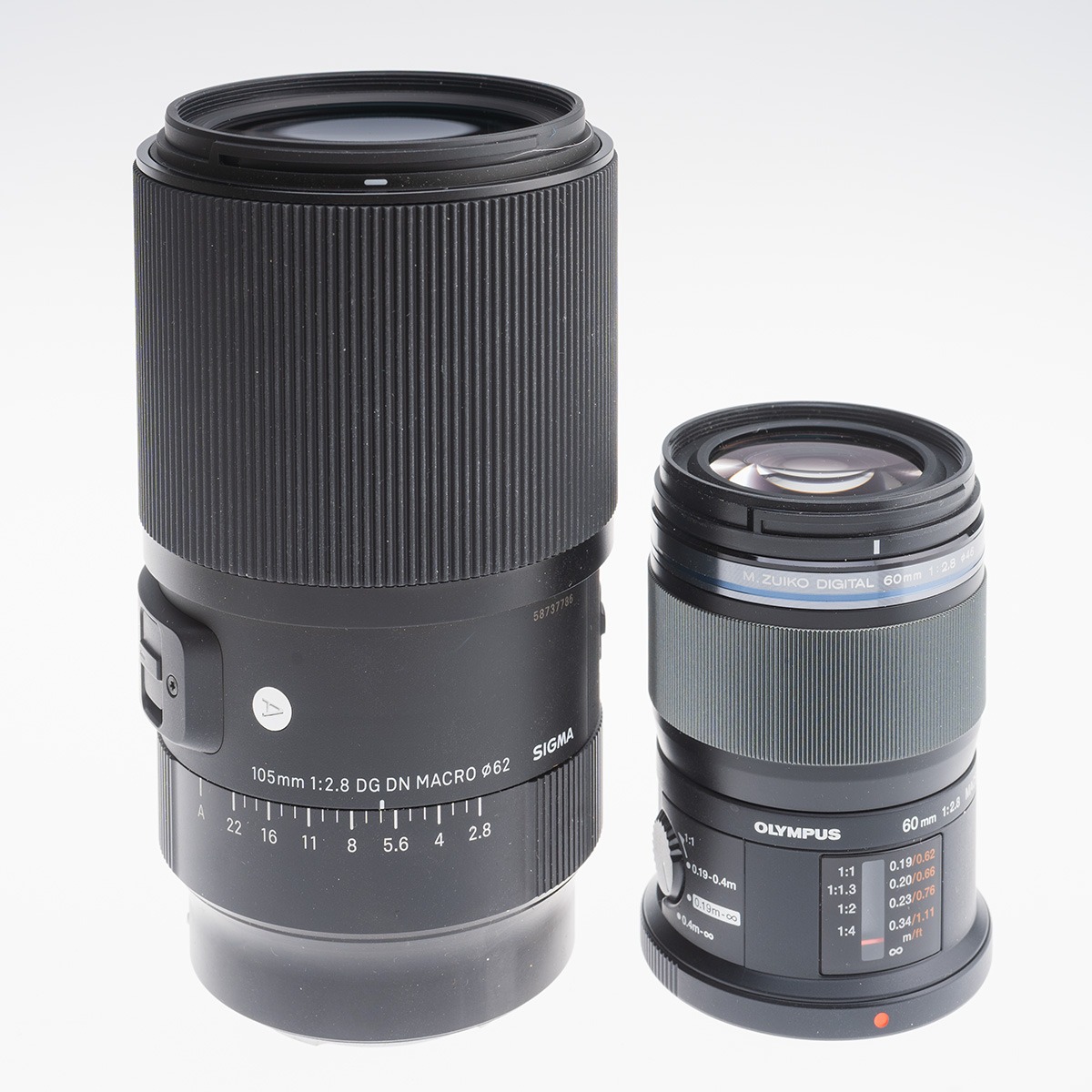
    The OM-Systems 60mm f/2.8 M.Zuiko Macro, right, next to the Sigma 105mm F2.8 macro.for full frame. The Olympus is equivalent to a 120mm F2.8 in full-frame terms, but is significantly smaller and lighter.

    The size avoids touching or disturbing foliage. It’s also easy to hold a camera like the OM-1, currently the largest and heaviest OM-Systems body, one-handed. It’s easy to get low viewpoints using the tilt and twist rear screen when you can not put an eye to the viewfinder.
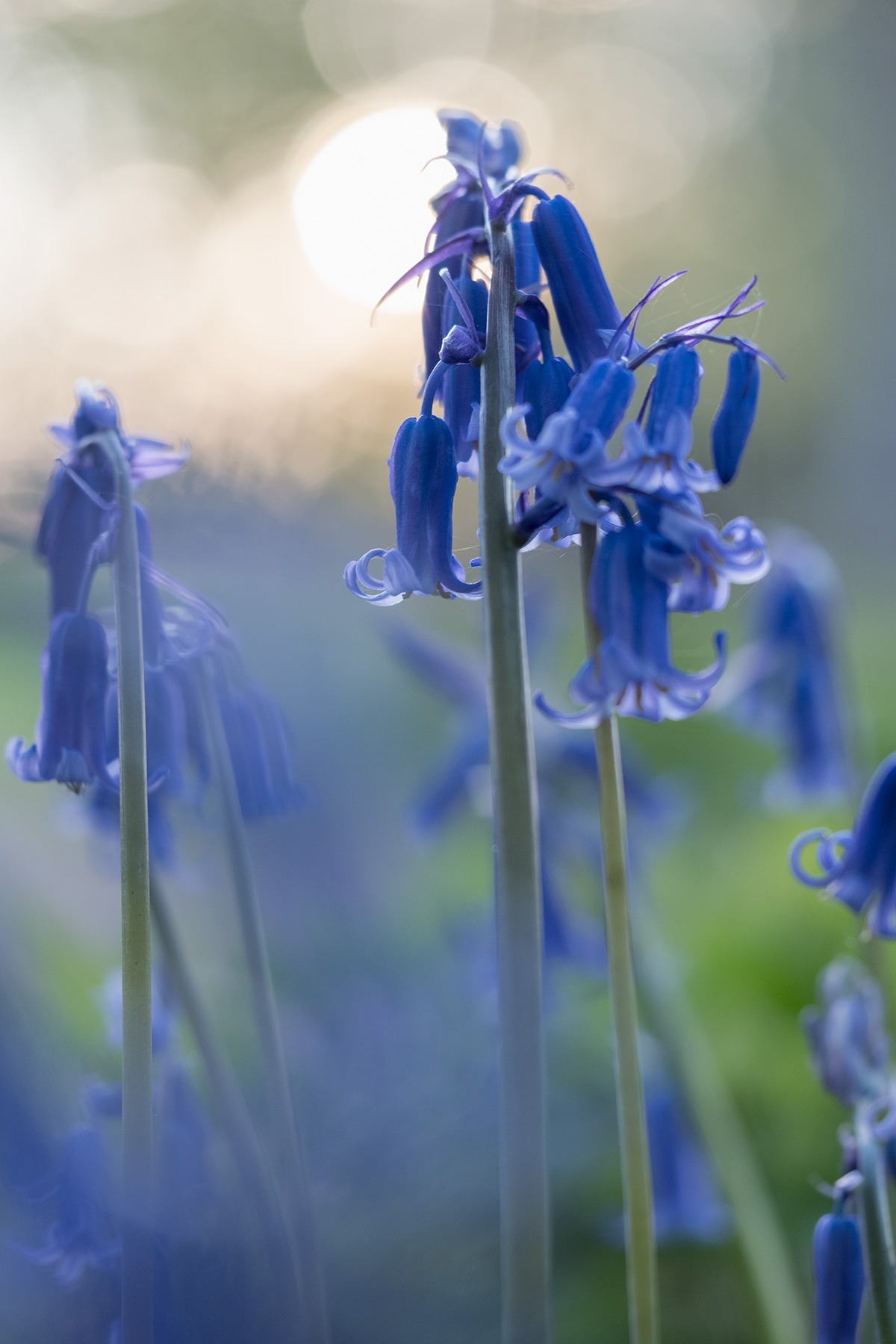
    A picture of bluebells, where the foreground, burred subject imparts an impressionistic glow.

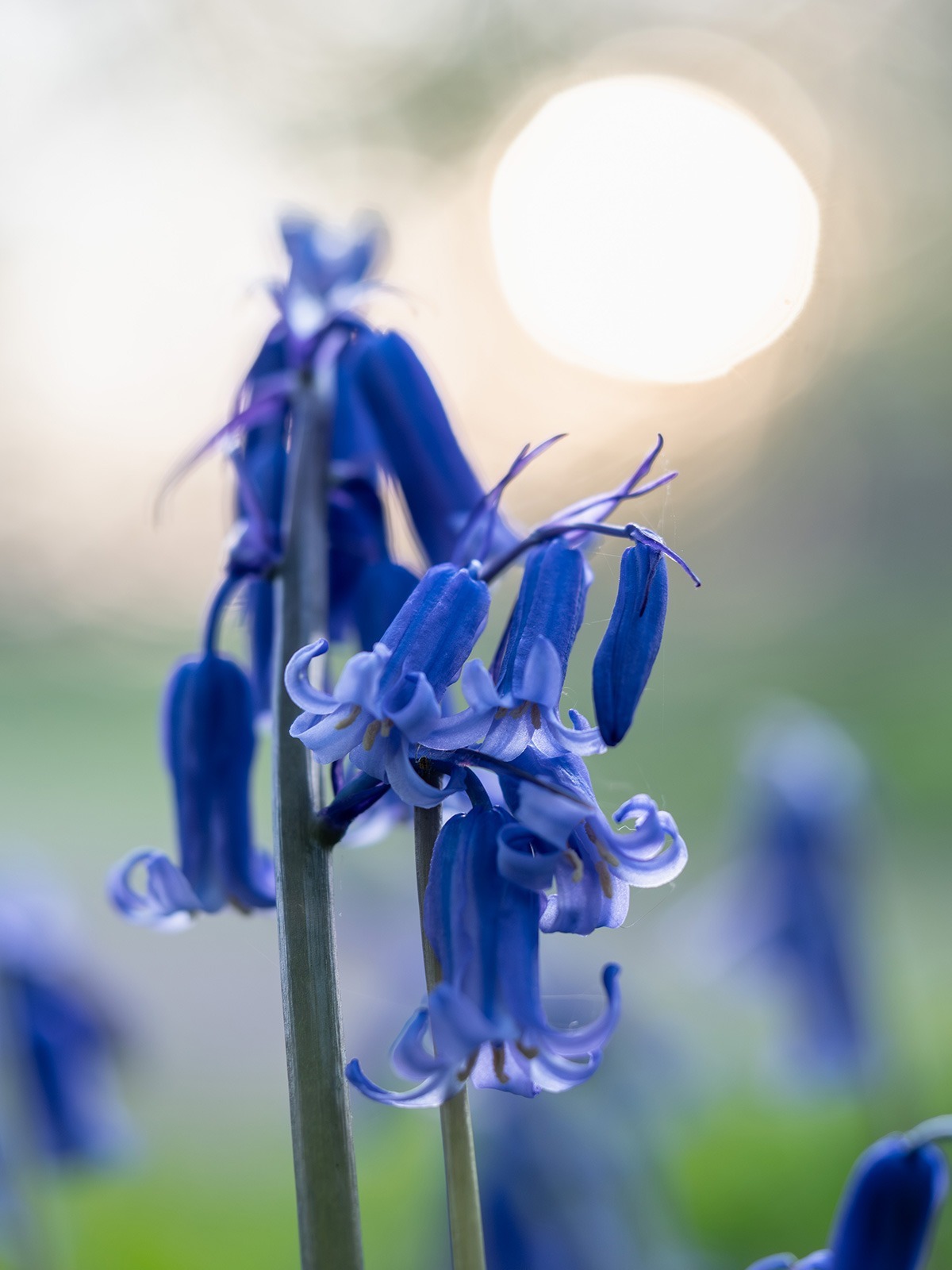
    The f/2.8 aperture means if you do put anything very close to the front element it can dissolve into a blur. Here a bluebell adds an impressionistic glow. Depth of field is tiny wide open. The seven-blade aperture is still present at f/2.8 so the low sun coming through trees creates slightly less than perfect highlight circles. It’s still a lovely effect.

    Shot against the light, the colour of bluebells is realistic. Most digital (and film) shots record too much reflected far red from these flowers making them slightly less pure blue, as the shot below taken at the same time with the light coming from the left hand side. Aperture for this was f/5 to balance keeping most of the main head sharp but still with distinction from the background.

    These are true Scottish bluebells! They are not the Spanish-British hybrids and are a protected species, growing here in woodlands dating from the early 18th century (the big house and estate disappeared long ago). I was very careful not to tread on any. My garden has the invaders, and that’s also what most ‘wild’ ones are. They look very different. See – https://www.wildlifetrusts.org/wildlife/how-identify/spanish-or-native-bluebell
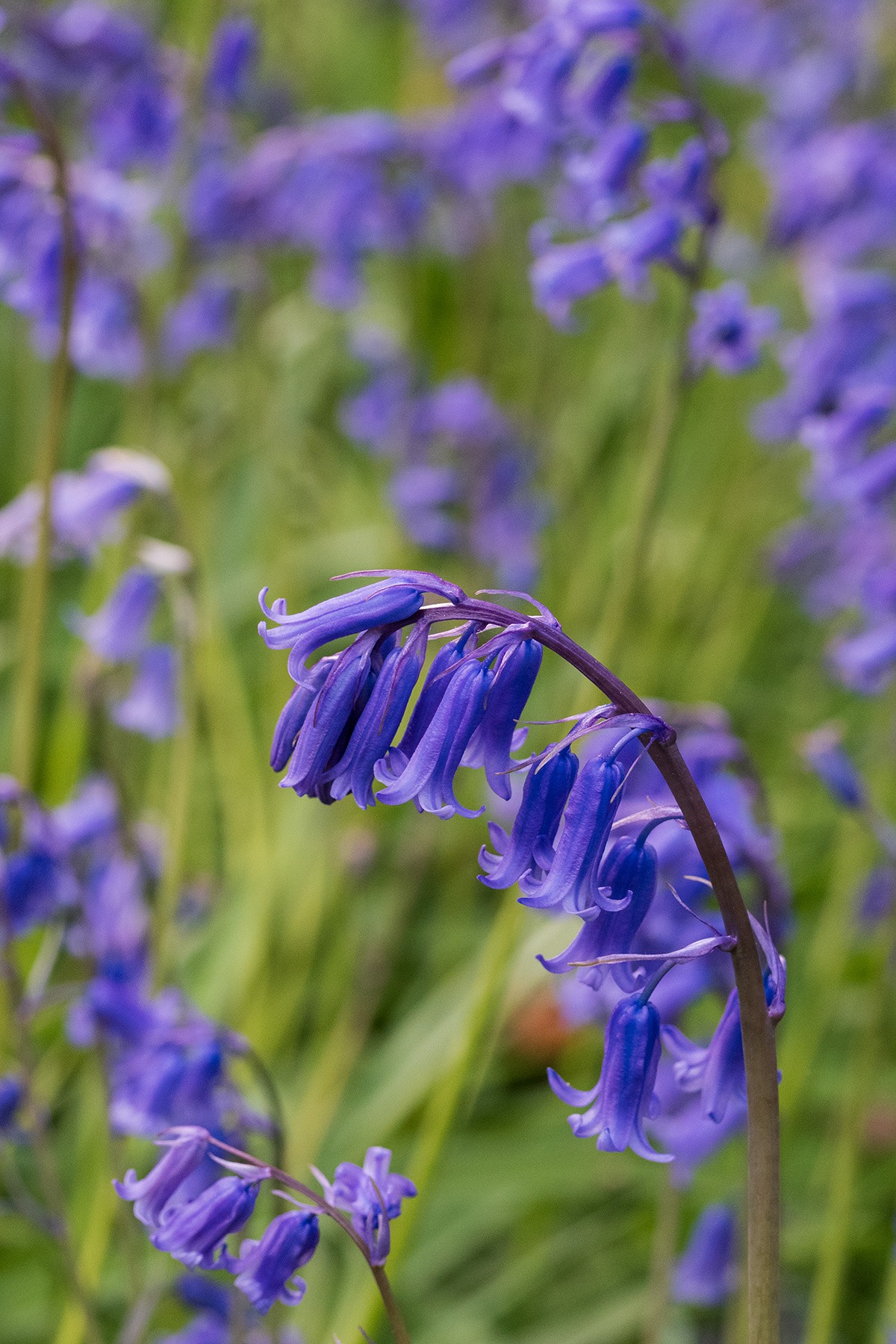
    A crisp frame-filling bluebell shows strong differentiation in plane of focus in the foreground as well as the background, even at f/10.

    I set out with just this lens on the OM-1 walking to a spot where I had seen a large patch of bluebells on the edge of the wood open to the direction of sun, setting behind distant trees. As a subject, bluebells are best shot on a longer lens, which this 120mm-equivalent is. The narrow angle of view compresses them to fill the frame. At f/10, there’s still a distinct plane of focus with softer detail in front and beyond. This lens stops down all the way to f/22 in third-stop steps but using a smaller aperture like f/16 would have lost sharpness slightly where focused – the lens performs best from f/4 to f/5.6 – and even this was at ISO 5000 to keep 1/125s shutter speed. The OM-1 sensor-based stabilisation would allowed 1/30s or even 1/15th without camera shake affecting things, but flowers don’t keep still. At macro distances the vibration from a gentle breeze can blur them.
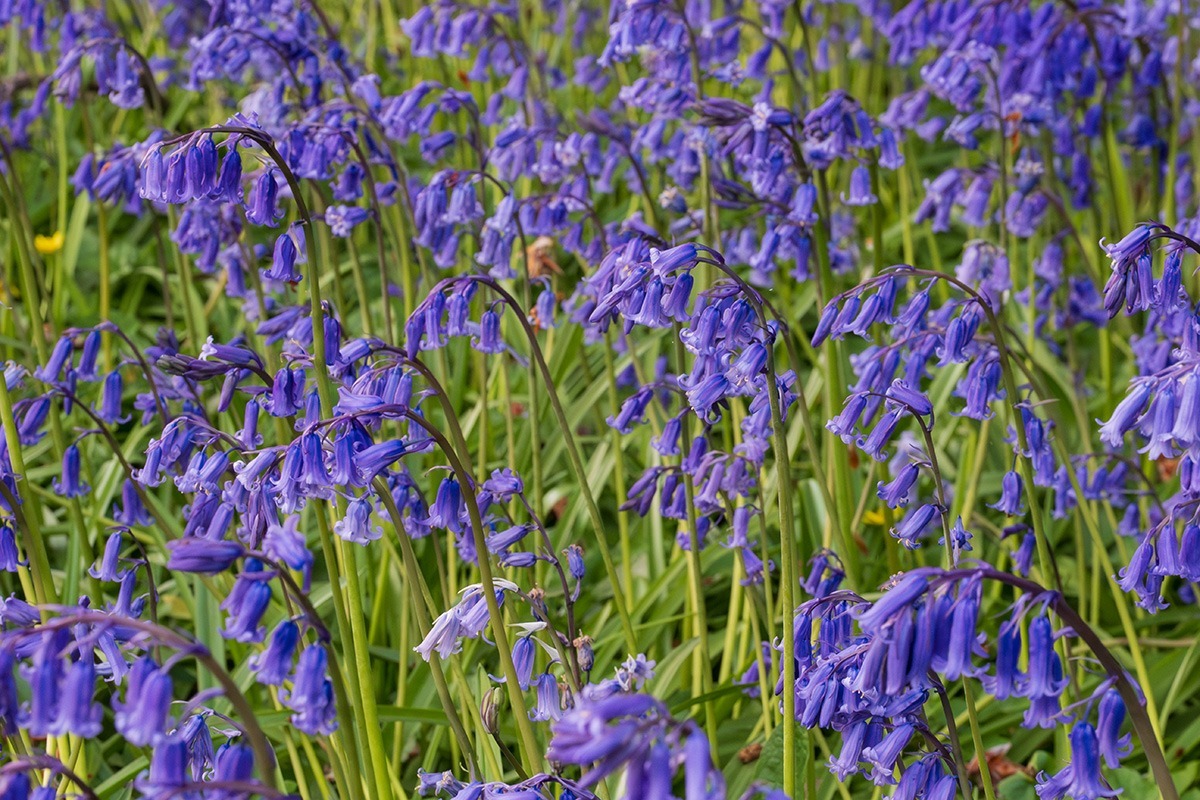
    I also knew where the low sun would be coming from, and it was the backlit effect I was looking for. The side/front lit angle may also have influenced auto white balance, and when this colour is viewed in a mostly green setting, the blue can seem to have more magenta.
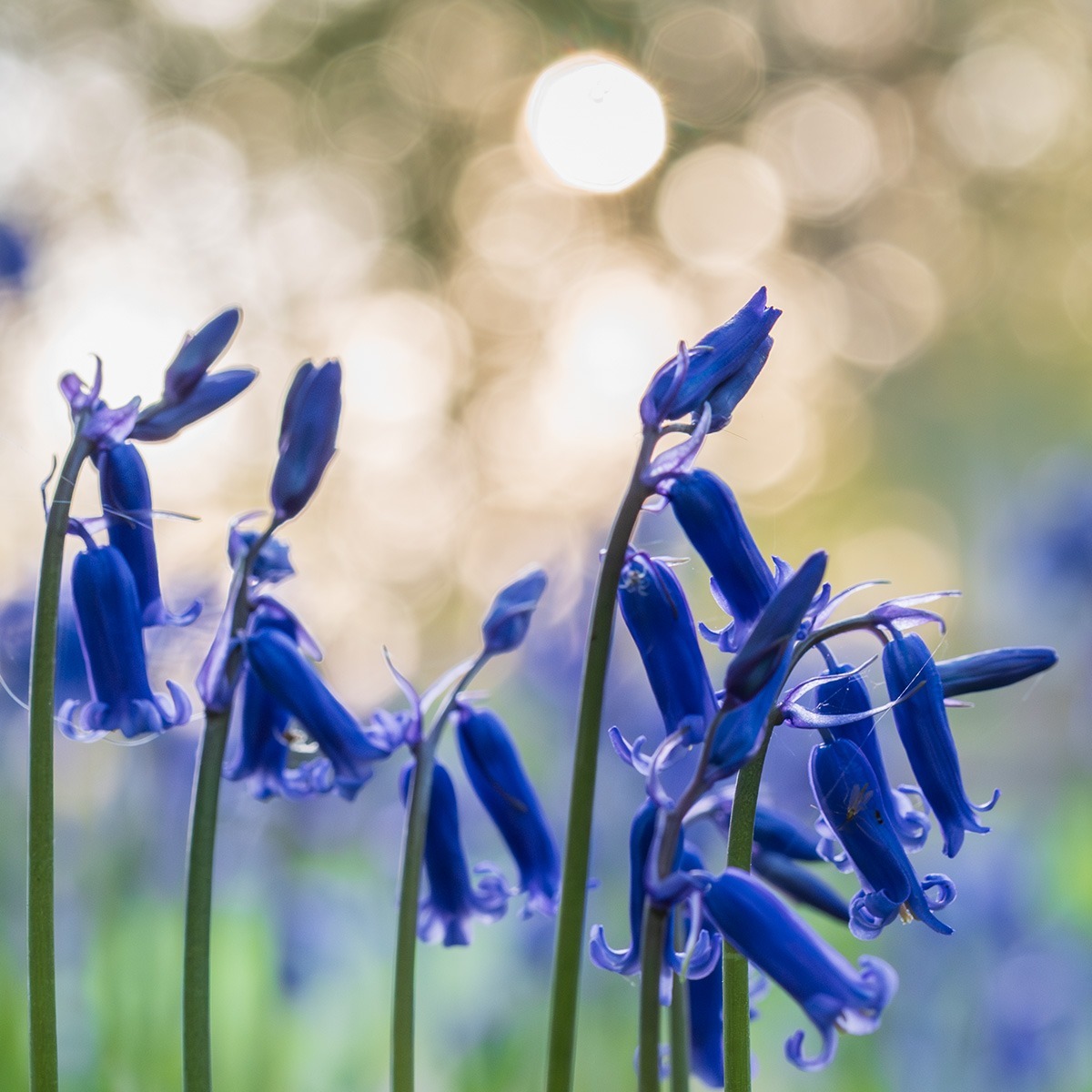
    The multiple overlapping bokeh discs are caused by the distant trees. Here they are made smaller and more distinct by stopping down to f/5.6. Again, this blue is more realistic and very true to nature.
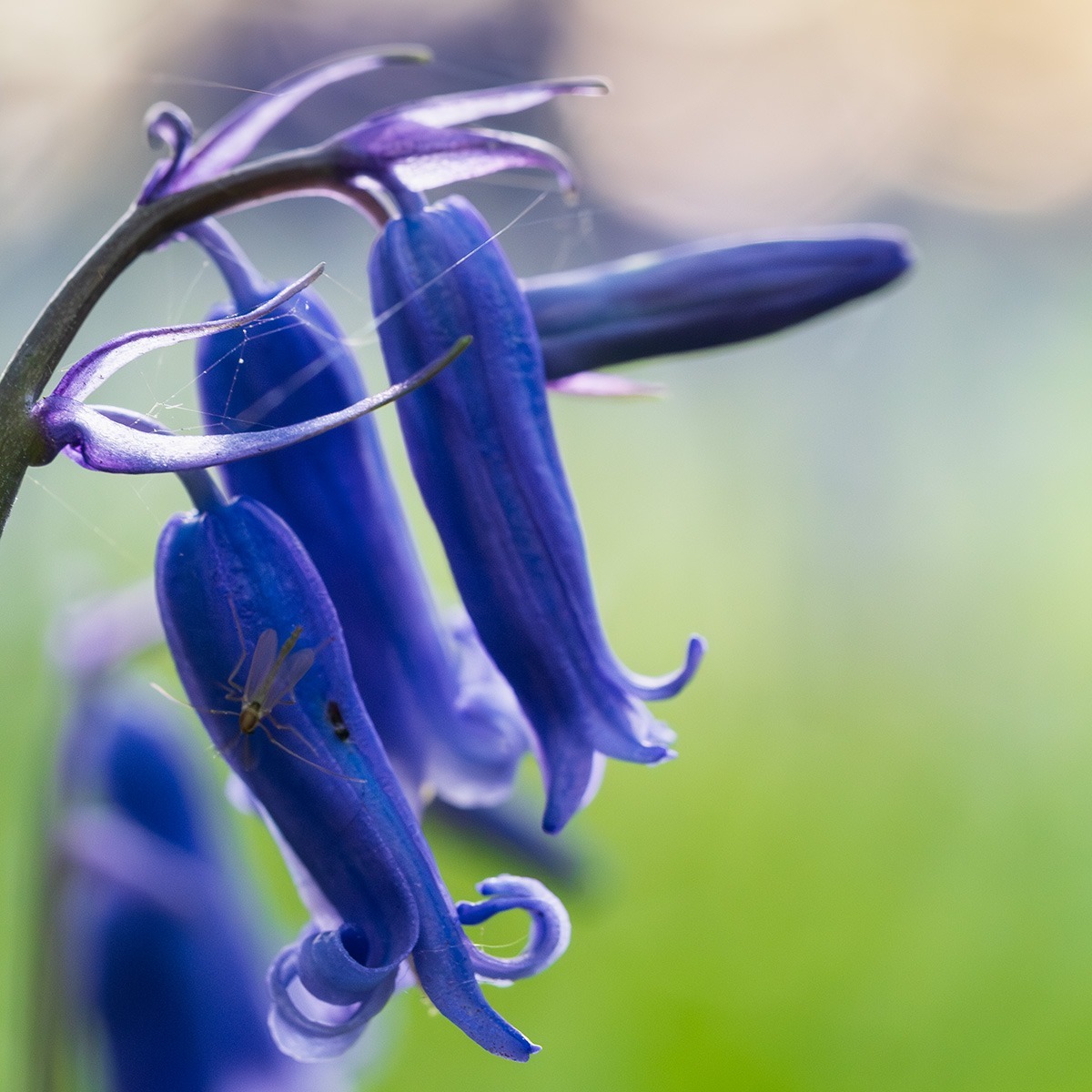
    The 60mm macro enabled very close studies and even at f/2.8. You can see the fly and strands of spider web are well resolved, but the contrast of the fly and flower is low in this lighting.
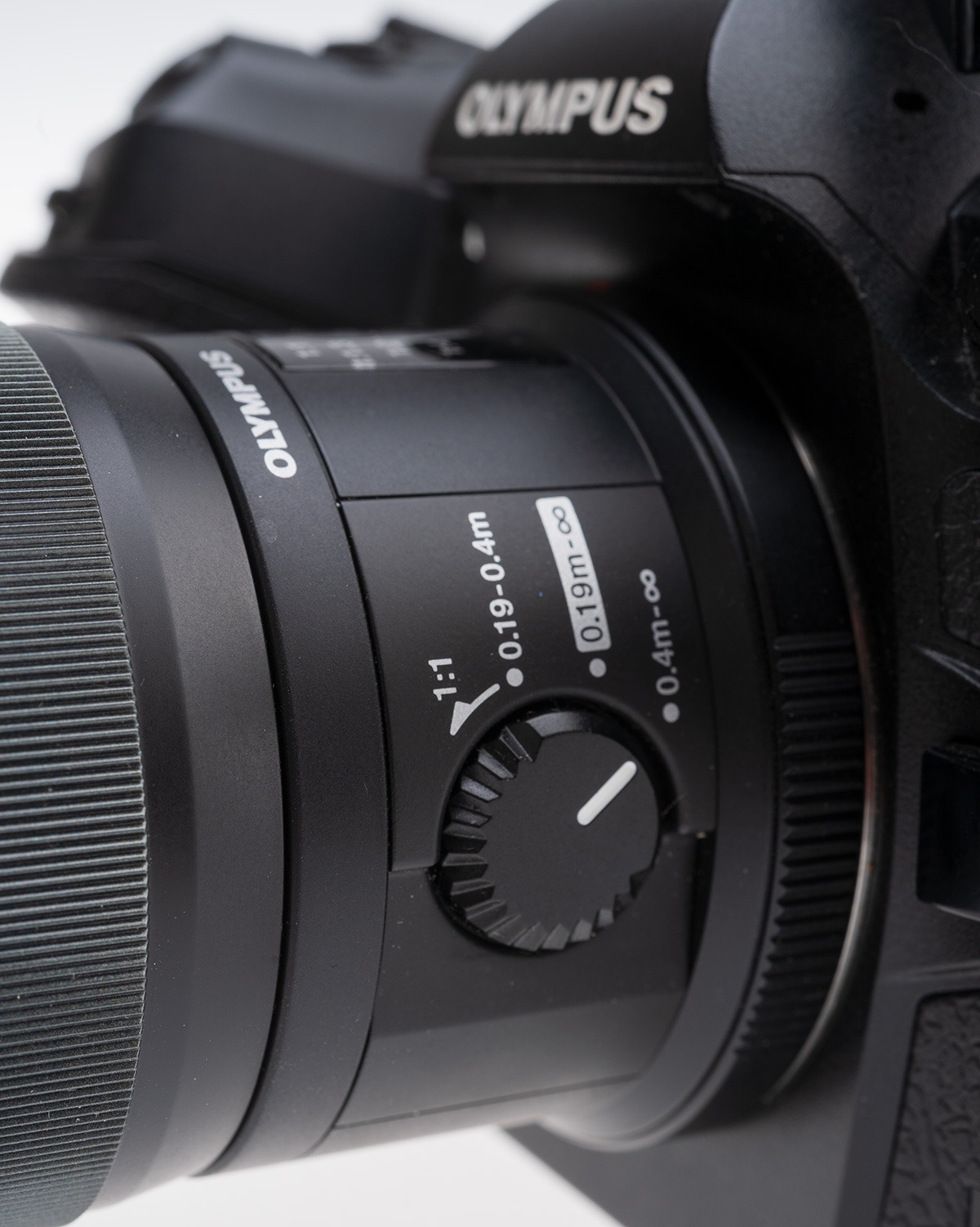
    The focus range limiter switch on the left of the 60mm f/2.8 M.Zuiko Macro lens, showing settings for 0.4-infinity, 0.19-infinity, and 0.19-0.4m and fixed 1:1 magnification (move subject or camera, not focus).

    For more distant shots, the focus range limiter on the lens was set to 40cm to infinity. It focuses very fast and silently but if allowed to range all the way from 1:1 focus may be missed. I had it set to the 19 to 40cm range when two roe deer does walked past just three or four metres away and that was a lost shot!
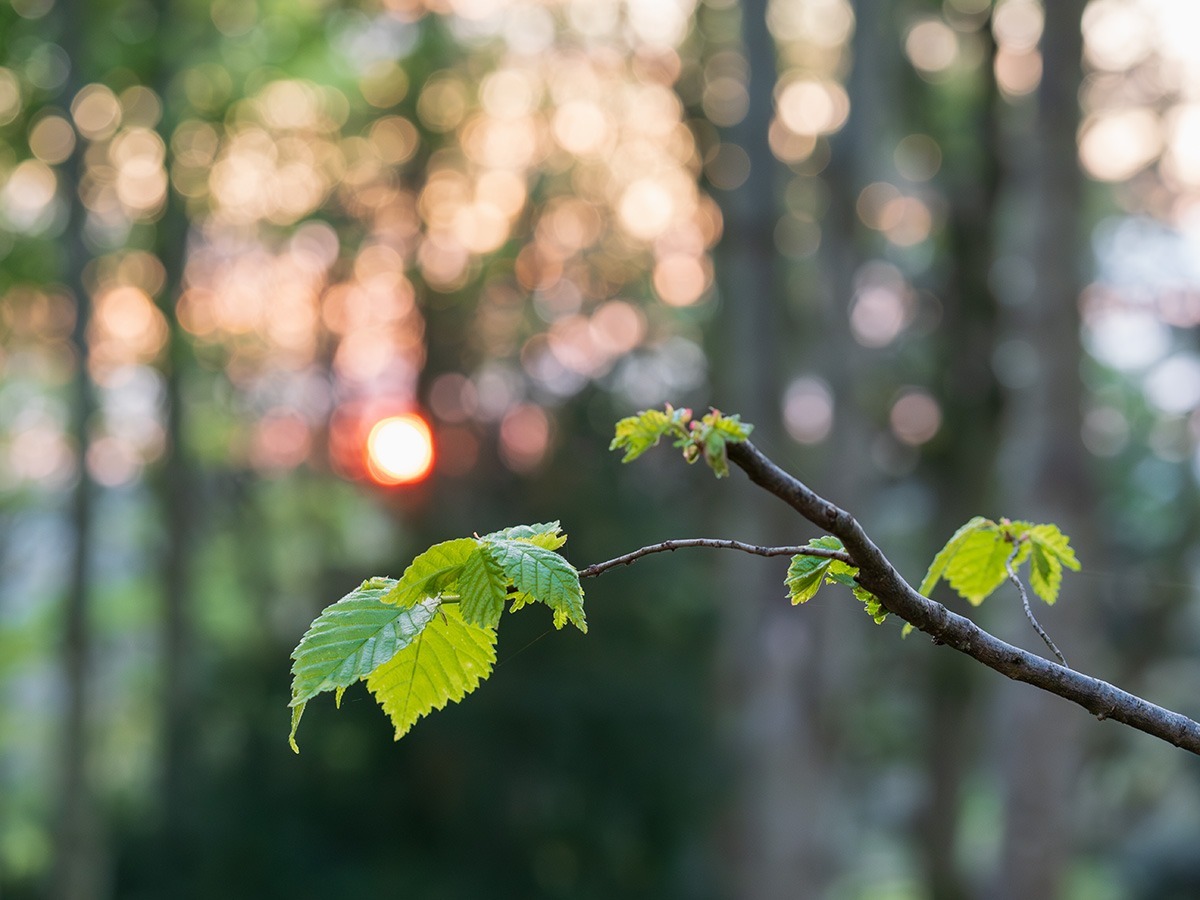
    With this lens, the woodland at sunset continued to provide many opportunities. Young birch leaves here were taken at f/4, and in the rapidly falling light this needed ISO 2500. The small MicroFourThirds sensor – one quarter of the size of a full frame, half the size of APS-C – has reasonable noise levels but without shooting raw as I did for all these, and using Adobe’s Reduce Noise AI-powered conversion, the results would not be as smooth.
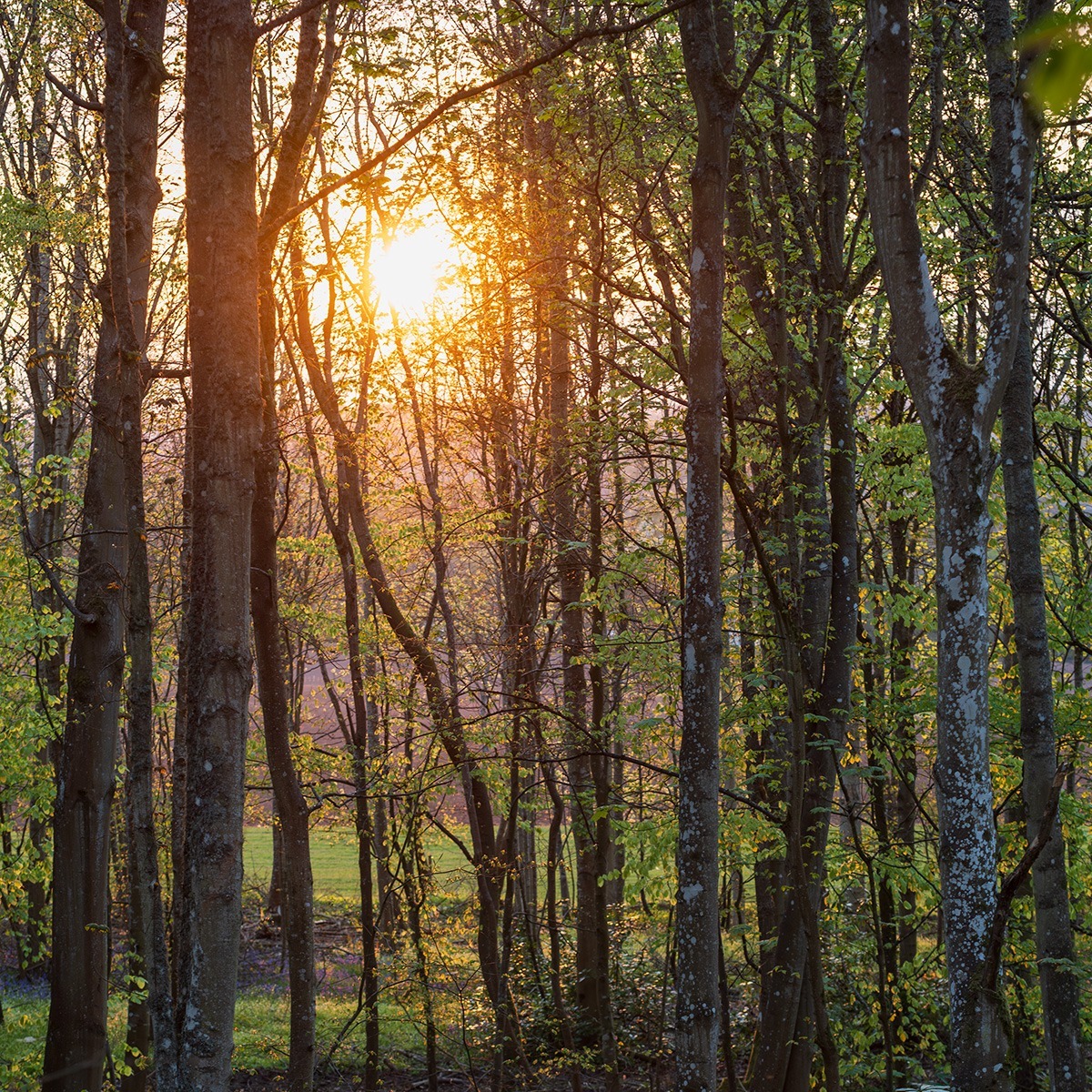
    The 60mm focal length is also great for general landscape views. This is taken 12 minutes earlier and only needed ISO 320 at f/4. That only 1/3rd of a stop faster than the OM-1 base ISO of 200.

    Where and when to find bluebells in the UK?

    In many parts of the UK bluebells are still in bloom and there’s still time to get out into woodlands while the leaf cover on trees is not too far grown to let the light in. In southern Scotland they have just come into their best state and woodlands remain open to light, but that will not last long. Further north it’s a week or so later. May is a good month to catch the new bright green and light environment in woods. By June, most trees are in such full leaf that only a fraction of the light reaches the forest floor and in July the green of leaves begins to darken.

    Get out now, even without a macro lens. Do not just look for subjects. Look for interesting light, which can mean staying out until sunset. Photography is all about light, the subject or scene is not enough on its own!
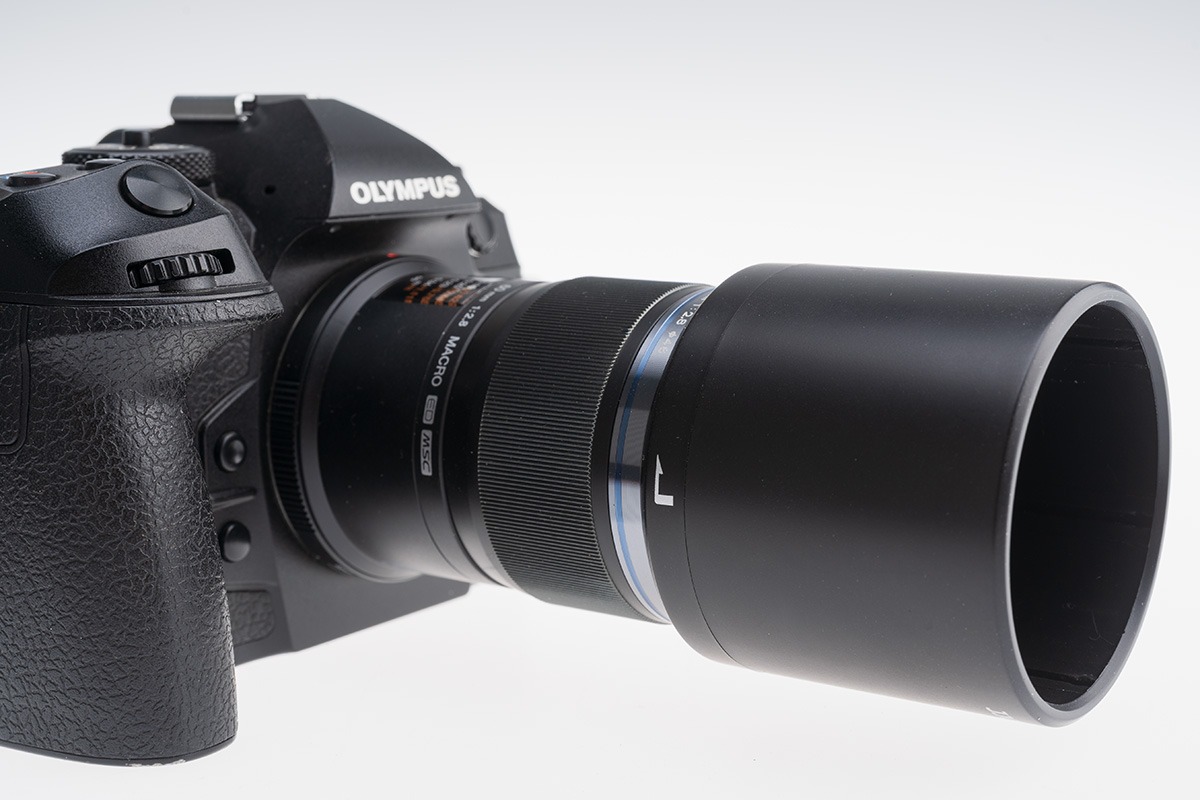
    This lens hood, which retracts with a gentle push to sit back over the lens, is a low cost JJC from Amazon which I rate better than the OM-Systems original. It was used for all the pictures as the working distance of this lens does allow enough space. None of the close shots are anywhere near the lens’s 1:1 which is the same framing as a 2:1, twice life size, view on a full frame camera.

    – David Kilpatrick
  • The best 50mm for A7RII

    After testing the Sony Carl Zeiss 55mm f/1.8 FE in 2014, I was less than impressed. I may have had a decentred example (it happened to dPreview and at least one photographer I trust to know his lens performance expectations). It was, certainly, pin-sharp on a test chart or a brick wall but the moment three-dimensional subjects were involved at wide aperture the defocused detail could be very untidy. The clip below from trees behind a building which was sharply focused is at f/1.8 and 1/2500th (a suggestion that it could be caused by camera shake is easily ruled out). See my additional notes at the end!

    cz55mm1p8distance

    It’s worth saying that when I had this lens I made some tests of the bokeh using very strong defocus which looked good. Many examples I’ve seen, which true believers put forward, show a figure (from full length to portrait) centre of a horizontal frame at f/1.8 with a pleasant enough looking distant background. My gripe has been with what happens when your subject is further away, or the background is not all very distant. This is an expensive lens but it seems to me to have fussy bokeh with too much CA fringe and also more focus-related colour shift than desirable.

    Here is a full size example with EXIF. Honestly, the best standard lens around? //www.pbase.com/davidkilpatrick/image/162847304

    Now I’ve got a fair collection of 50, 55 and 58mm lenses and also the little Canon 40mm f/2.8 STM which is my alternative to having a 35mm and a 55mm. No matter what the lens – Pentax, Minolta, Sony 50mm f/1.4, Helios, Zenitar, Nikon, CZ Jena – the full aperture between f/2 and f/1.4 always proves to be a touch soft. They all have residual aberrations that the CZ 55mm f/1.8 design has eliminated. While they can have a smoother bokeh, they also have marked colour shifts and uncorrected CA. Generally, they also all perform extremely well once stopped down to f/8 and most designs are great by f/4.

    Despite the advantage of full AF functions, the CZ 55mm does not have a particularly good close focus or maximum image scale. In use I often found myself framing up closer than 50cm. That’s half a metre – it’s even further than the old 55 and 58mm lenses of the 1960s, which generally manage 45cm. I find this limitation hard to understand. 50 years ago CZ Jena started to put helicoids on their standard 50mm lenses which enabled focus down to 35cm. We have gone backwards since then.

    And then I realised I’ve already got a lens which is free from all vices, gives me AF and manual focus options using adaptors I already own, which cost me about a third of the price of a CZ 55mm – and I was not being used on my A7RII. We bought a good used example of the Sony SAL 50mm f/2.8 Macro to use with our Alpha DSLR.

    First of all, I compared this with the idea of buying a Zeiss Loxia 50mm f/2, by fitting it to the LA-EA3. Although the focusing ring does not communicate to the camera to invoke magnified manual focus, the lens has a Focus Hold button which can be set to this. The focusing throw is steep but in practice very accurate focus is easily set. At f/2.8, the lens is already perfectly sharp with some contrast improvement at f/4. The lack of vignetting and distortion, the flatness of field and generally very attractive smooth defocusing without CA issues make the lens better than typical fast standard designs.

    On the LA-EA4 with autofocus, a limited set of AF functions ends up activated and there’s always the issue of the slight delay and sound caused by mechanical aperture operation. AF-C is of limited use, along with this video functions. However, I don’t generally use this type of lens for action or for video.

    I made plenty of non-image tests by defocusing bright edges, both ways, and could find no hint of colour problems. I then set up a small food shot using the close focus – exactly the reason I find a lack of close focus restricting – and made tests at f/2.8, f/5.6, f/11 and f/22 to look at the bokeh. My conclusion is that I will be hard pressed to find anything technically better, or with a more pleasant character to the background defocus, in the c.50mm focal length. The series covers all four apertures.

    I am aware that one comment will be that f/2.8 simply isn’t wide enough. There’s no significant differential focus and you’d need 50mm f/1.0 to get what many photographers want. However, this is all to do with viewing size. We all tend to see pictures on smartphone screens, on Facebook, or even on our own camera three-inch screens. In fact, at f/2.8 there isn’t enough depth of field for a typical real-world use of a full page reproduction and f/5.6 is just about right. For a poster, f/11 would be good. At f/22 the whole image is slightly softened as expected and it’s just there to complete the set.

    For the moment – at least until a Batis version of the 50mm f/2 Makro Planar appears and answers all my demands perfectly – I think this Minolta-derived 50mm macro will do fine as my ‘standard’ lens.

    David Kilpatrick, aka ‘some random blogger’ (©SAR comments March 2016)

    Added August 30th 2016: Sony has announced an E-mount 50mm f/2.8 Macro focusing to 1:1 with a stated RRP of $500 – really, they must have read this article in March. In the meantime, during the Brexit fiasco I caved in and bought a 55mm f/1.8 CZ, suspecting the price would be 20% higher soon enough (and sure, it was). My new example is no better than those I originally tested but it has its uses and in a flat plane – no defocused image to screw the results up with an ugly mess – it’s the sharpest 50-55mm I have used. I’m still using the 50mm macro and recently spend a month using the Samyang 50mm f/1.4, which is not as sharp as the CZ but handles blur and bokeh more elegantly. Both lenses don’t really excel at suppressing Longitudinal CA, one of the strengths of the A-mount macro. Hopefully the new SEL FE 50mm macro will also give clean, colour-shift free foreground and background bokeh.

    Added July 29th 2017: I have now bought the 50mm f/2.8 Sony FE Macro, and put my A-mount macro lenses up for sale. The E-mount focuses to 1:1 rather closer than I would like, at 16cm which indicates its internal focusing changes the focal length to something more like 37mm to 1:1 (16cm is a pure 40mm at 1:1 assuming no optical thickness to the lens). It’s an extremely sharp lens with bokeh as good as the A-mount 50mm and no trace of CA.

  • Mapping the planes

    Samsung has a patent and a plan for using two lenses with triangulation (image offset) depth detection between two images in what is roughly a stereo pair. Here’s a link:

    http://www.photographybay.com/2011/07/19/samsung-working-on-dslr-like-bokeh-for-compact-cameras/

    Pentax also have a system on the new Q range which takes more than one exposure, changes the focus point between them, and uses this to evaluate the focus map and create bokeh-like effects. Or so the pre-launch claims for this system indicate, though the process is not described. It’s almost certain to be a rapid multishot method, and it could equally well involve blending a sharp image with a defocused one.

    In theory, the sweep panorama function of Sony and some other cameras can be used to do exactly the same thing – instead of creating a 3D 16:9 shot it could create a depth mapped focus effect in a single shot. 3D is possible with sweep pans by simply taking two frames from the multi-shot pan separated by a certain amount, so the lens positions for the frames are separated enough to be stereographic. 3D ‘moving’ pans (scrolling on the TV screen) can be compared to delaying the playback of the left eye view and shifting the position of subject detail to match the right. But like 16:9 pans, they are just two JPEGs.

    All these methods including the Samsung concept can do something else which is not yet common – they can alter any other parameter, not just focus blur. They could for example change the colour balance or saturation so that the focused subject stands out against a monochrome scene, or so the background to a shot is made darker or lighter than the focused plane, or warmer in tone or cooler – etc. Blur is just a filter, in digital image terms. Think of all the filters available from watercolour or scraperboard effects to noise reduction, sharpening, blurring, tone mapping, masking – digital camera makers have already shown that the processors in their tiny cameras can handle such things pretty well.

    Once a depth map exists there’s almost no limit to the manipulation possible. Samsung only scratches the surface by proposing this is used for the esoteric and popular bokeh enhancement (a peculiarly Japanese obsession which ended up going viral and infecting the entire world of images). I can easily image a distance-mapped filter turning your background scene into a Monet or a van Gogh, while applying a portrait skin smoothing process to your subjects.

    Any camera with two lenses in stereo configuration should also, in theory, be able to focus using a completely different method to existing off-sensor AF – using the two lenses exactly like a rangefinder with two windows. So far this has not been implemented.

    Way back – 40 years ago – I devised a rangefinder optical design under which you can see nothing at all at the focus point unless the lens was correctly focused. It works well enough for a single spot, the image detail being the usual double coincident effect when widely out of focus, but blacking out when nearly in focus and suddenly becoming visible only when focus is perfect. I had the idea of making a chequerboard pattern covering an entire image, so that the viewfinder would reveal the focused subject and blank out the rest of the scene, but a little work with a pencil and paper quickly shows why it wouldn’t work like that. The subject plane would have integrity, other planes would not all black out, they’d create an interestingly chaotic mess with phase-related black holes.

    Samsung’s concept, in contrast, could isolate the subject entirely – almost as effectively as green screen techniques. It would be able to map the outline of a foreground subject like a newsreader by distance, instead of relying on the colour matte effect of green or blue screen technology. This would free film makers and TV studios from the restraints of chroma-keyed matting (not that you really want the newsreader wearing a green tie).

    The sensitivity of the masking could be controlled by detecting the degree of matched image detail offset and its direction (the basic principle of stereographic 3D) – or perhaps more easily by detecting exactly coincident detail, in the focused plane. Photoshop’s snap-to for layers works by detecting a match and so do the stitching functions used for sweep and multi shot in-camera panorama assembly. Snap-to alignment of image data is a very mature function.

    Just when you think digital photography has rung all the bells and blown all the whistles, the tones of an approaching caliope can be heard rolling down the river…

    – David Kilpatrick