Wait for the NEX SLT, folks…

That is, the next slot in Sony’s programme of new product releases. Almost exactly five years after the Alpha 100 was launched to the world (also a Wednesday in the second week of June, back in 2006) Sony selected an auspicious date to announce the NEX-C3 and the Alpha A35. But these cameras, rather like the Alpha 100 in its day, are not what we are waiting for.

So – what’s new? 16.2 megapixels, 5.5fps native size, 7fps using a 1.4X crop (about 8 megapixels), no articulated rear screen, some candy functions in the menus for technophobes, and that accessible D-Range button can be made into a rapid custom control.

Everyone has suggested that a NEX-7 will be what they want. I rather think they will be get a NEX-C5, applying the same transforms to the 5 as the C3 (Compact 3) applies to the 3. That means it will have proper HD video, which the C3 lacks being restricted to MPEG4 HD720. Already, the rustle in the undergrowth is that the diminutive C3 misses the mark for this one single reason only. Sure, a 16.2 megapixel sensor (supposedly a new version, not just borrowed from the A55/580) is a welcome upgrade but NEX is a multipurpose system, and HD720 is back in 2006 not in 2011.

Nice mic slots, nice big CZ 16-80mm shown on the adaptor – but this, dear Sony, misses the point. We actually want the CZ 16-80mm to be updated to an SSM design so that it will focus on the NEX, and be better on the Alpha bodies, and so that its slightly manky mechanical design can be turned into something so smooth existing 16-80mm owners queue up to buy the replacement.

Good points – the shift in position of the stereo microphones to the front of the camera, the change to using a separate cover for the memory card instead of having to open the battery compartment. There’s a claim that along with a 20% better battery life, greater heat efficiency means the new cameras won’t cut out before 29 minutes is up when filming HD, even if you use SSS on the A35. Of course the NEX has no SSS but still managed to overheat, at least in the NEX-5, unless you were savvy enough to shift the rear screen away from contact with the camera back – in which case it generally keeps filming OK.

The operating times, startup, focusing speed are all reported to be much improved – by a factor of two or better. Only the image review time is worse due to the larger file size. Sony’s information makes it clear that very strong noise reduction is applied and this may affect raw files as well as JPEGs.

The new 30mm f/3.5 Macro SEL is theoretically interesting, but not so much for me personally as we have already got the 30mm f/2.8 SAM and the NEX adaptor. Eventually, you come to terms with the simple fact that a 2.5cm working distance for 1:1 shots prevents you shooting half the 1:1 shots which present themselves. You disturb the butterfly, hit bits of the plant, or cast the lens’s own shadow across the picture.

The firmware update (see end of story) to provide a ‘focus confirm’ overlay for manual focusing is actually of far more interest to the macro photographer – along with almost any other specification of macro lens except 30mm f/3.5. These lenses are fun, I love the SAM 30mm, but it’s not the answer.

The new HVL-F20S flashgun (based on the HVL-F20AM only in the design of its rotating reflector/diffuser) has changed a load since it was previewed with a mockup based on the Alpha model. Sony has decided to power it from the NEX battery, much as Minolta did with flashguns like the 316i in the early 1990s. That’s almost certainly because the NEX Smart Connector is simply not capable of holding the gun with a couple of AA cells in it, the weight would be too much.

In an ideal world, this new flashgun would do for the NEX system what its orginator does for the Alpha 900 and 850 – act as a remote wireless flash commander. But it does not, leaving NEX outside the main Alpha system still. If you want remote flash (or even just a more powerful flash mounted on a bracket beside your camera) the Nissin Di 866 MkII remains your best bet, programmable to fire correctly in synch with the NEX and to use its own auto-exposure cell for metering.

Alpha 35 – one step forward, two steps back

The Alpha 35 is similarly not earth-shattering news, especially if you own an Alpha 55 with GPS function and rather better overall performance in all respects except (perhaps) ultimate high ISO. The firmware updates for both NEX and SLT models, to be available from June 20th, add most of the benefits of the new models along with some of the child-friendly hipsta stuff. Again, wait until the next round. A higher end SLT camera is firmly promised, it’s been prototyped and mocked up and preproduced and somewhere as I write someone is actually using it.

Losing the articulated rear LCD (see above), not even replacing it with a tilting one, is a big sacrifice. The 7fps 1.4X digital tele conversion mode – with continuous AF tracking – is interesting and reminiscent of the sensor crop mode of Nikon’s first CMOS, the D2X, which was itself developed from a Sony sensor (the Cybershot DSC R-1). It shows that there are genetic traits in the Sony line that won’t be forgotten.

But is there really much point to this camera? Not much. Unlike the NEX-C3 which sees a significant body size reduction and style change, the A35 contrives to be a poor relation of either the A33 or the A55 because it lacks that excellent, reversible, twist and swivel rear screen.

Photoclubalpha has been a photographer’s thing not just a camera owner’s thing – a small difference, these days, but important. For photographers any reason to prefer the new models to what you’ve got may depend on small hidden differences which come to light as people use them. Certainly the provision of functions with changed names because no-one can be expected to understand what an aperture is, what a shutter speed is (and so on) is no reason to want the new models. Probably the reverse!

Video enthusiasts may like to note that the firmware update for the A55/33 allows all the overlaid text to be removed from the live view, which can be output from the HDMI port to surprisingly high quality. Recording devices to accept HDMI signals like this are just starting to appear at affordable prices. There’s some potential to experiment with the image provided for LV (Focus Check Live View more so than Quick AF LV) once fed into other systems free from overlays.

Version 04 firmware update for NEX-5, NEX-3
Available from June 20th, a firmware upgrade for existing NEX-5 and NEX-3 cameras adds the new ‘Picture Effect’ function as introduced on the new NEX‑C3. It also adds a Peaking function to assist with more precise manual focusing. Available free to registered users, latest Version 04 firmware update for NEX-5/NEX-3 can be downloaded from:
NEX-3
Windows:
http://support.sonyeurope.com/dime/downloads/downloads.aspx?f=FW_NEX3_V04_WIN&site=odw_en_GB
MAC OS:
http://support.sonyeurope.com/dime/downloads/downloads.aspx?f=FW_NEX3_V04_MAC&site=odw_en_GB
NEX-5
Windows:
http://support.sonyeurope.com/dime/downloads/downloads.aspx?f=FW_NEX5_V04_WIN&site=odw_en_GB
MAC OS:
http://support.sonyeurope.com/dime/downloads/downloads.aspx?f=FW_NEX5_V04_MAC&site=odw_en_GB

Editor’s note June 9th: please note that these URLs will not work – they are incorrectly transcribed by Sony. The URLs should be similar to those for the A33, A55 with a hyphen between sony-europe. Unfortunately, Sony has issued press releases and web pages with the incorrect URLs. We have changed the link so that it will work when the time comes.

Version 2.00 firmware update for α33, α55
Available from June 20th, a firmware upgrade for existing α33 and α55 cameras by Sony adds several creative and operational enhancements. Support for the ‘Picture Effect’ function featured on the new α35 is now offered. High-Speed Synch is supported during wireless operation with a compatible external flash (only α55). Ergonomics are further improved with revised menus and a new mode that lets users switch off shooting parameters overlaid on screen for clear, uncluttered composition. The camera’s Digital Level Gauge can also be displayed when shooting via the optional CLM-V55 external LCD monitor. Frequently used features can now be custom-assigned to the D-RANGE button for rapid, menu-free access.

Available free to registered users, from the 20th of June the latest GB English Version 2.00 firmware update for α33 and α55 can be downloaded from:
A33
Windows:
http://support.sony-europe.com/dime/downloads/downloads.aspx?f=FW_A33_V2_WIN&site=odw_en_GB
MAC OS:
http://support.sony-europe.com/dime/downloads/downloads.aspx?f=FW_A33_V2_MAC&site=odw_en_GB
A55
Windows:
http://support.sony-europe.com/dime/downloads/downloads.aspx?f=FW_A55_V2_WIN&site=odw_en_GB
MAC OS:
http://support.sony-europe.com/dime/downloads/downloads.aspx?f=FW_A55_V2_MAC&site=odw_en_GB

Capture One 6.2 – A55/33, NEX-5/3

The new Capture One 6.2 release includes raw conversion for the Sony Alpha 55, Alpha 33, NEX-5 and NEX-3. It offers enhanced options for local adjustments, additional camera controls for Canon and Nikon and improved XMP metadata functionality.

The release also adds camera support for the latest Samsung, Fuji, Ricoh, Panasonic, Canon, and Nikon camera models as well as camera support for Phase One IQ180, IQ160, and IQ140 including tethered support.

Capture One 6.2 includes the following new features and enhancements:
– Local adjustment of saturation and clarity
– Invert local adjustments mask
– Copy local adjustments mask from other layer
– Auto sync of XMP metadata (sidecars only)
– Additional camera controls for Canon and Nikon
– Improved OpenCL and 64 bit performance

Capture One 6.2 offer support for the following new cameras and ! hardware:
– Phase One IQ180, IQ160 and IQ140 including tethered support
– Canon 600D/Rebel T3i and 1100D/Rebel T3 including tethered support
– Fuji X100
– Nikon D5100* and tethered support for Nikon D-7000 (*preliminary)
– Panasonic DMC-GH2 and DMC-GF2
– Ricoh GR DIGITAL, GR DIGITAL II, GR DIGITAL III, GX100, GX200, GRX S10, GXR P10, GXR A12
– Samsung NX5, NX10, NX11 and NX100
– Sony SLT-A55, SLT-A33, NEX-3 and NEX-5

Learn more about Capture One 6.2 here

Download Capture One 6.2 here

New HVL-F43AM Alpha flash with rotating design

Sony has announced a new HVL-F43AM flashgun using the same type of rotating body design found in the top of the line HVL-F58AM, to replace the existing HVL-F42AM with its traditional bounce design. At the same time, some more Alpha system accessories have been rolled out.

HVL-F43AM ‘rotator’ flash

With a powerful output of GN43 (105mm ISO100 m), the compact yet versatile HVL-F43AM flash from Sony is optimised for superb results with all A-mount cameras.

As featured on the HVL-F58AM, the innovative Quick Shift Bounce system allows flash head position to be adjusted instantly when switching between horizontal and vertical compositions. This maintains consistent shadow positions regardless of camera orientation, allowing easy creation of natural-looking ‘bounce’ effects.

Smart flash functions open up even broader creative lightning possibilities. Wireless Ratio Control makes it easy to select light emission ratios for up to three separate flash units*. This allows quick creation of sophisticated multi-point lighting effects without the need for complex professional equipment.

Ideal for everyday shooting and more serious applications, its dust- and moisture-resistant design makes the HVL-F43AM ideal for demanding assignments, indoors or outside.

Flash power levels are switchable in 22 increments, from 1/1 through to 1/128 level in 1/3 steps. High output power is complemented by a quick 2.9 second (approx.) recycling time. Despite the flash’s extensive functions, operation is refreshingly clear and simple via the high-quality LCD screen and direction buttons.

Main specification for external flash HVL-F43AM
Guide Number – 43 (105mm, ISO100・m)
Flash Coverage – 24-105mm (15mm focal length covered with built-in wide panel)
Flash Control – Pre-flash control, manual flash control selectable, direct through-the-lens (TTL) flash metering
Bounce Flash – Click positions: up (30°/45°/60°/75°/90°/120°/150°); down (8°); right (30°/45°/60°/90°); left (30°/45°/60°/90°)
Recycling time (based on Sony measurement) – Approx. 2.9 seconds (with alkaline battery)
Battery performance (based on Sony measurement) – Approx. more than 200 flash cycles (with alkaline battery)
Power level switching – 22 levels: (1/1, 1/2, 1/4, 1/8, 1/16, 1/32, 1/64, 1/128), 1/3 steps
Wireless Ratio Control – Available to control by 3 groups when used with DSLR-A900/A850/A700
Other features
Auto WB Adjustment with Colour Temperature Info; Auto zoom control optimised for image sensor size; High-Speed Synchro; Modelling Lighting; Test Lighting; Multi Lighting. Supports camera’s Red-eye reduction feature. Built-in wide panel and bounce sheet. High quality LCD screen.
Compatible Shoe – Auto-lock Accessory Shoe
Included items – Mini-stand, Case
Dimensions (WxHxD) – Approx. 75 x 129 x 87 mm
Weight – Approx. 340g (without batteries)
Power source – Four AA-size cells of the same type, either alkaline or Ni-MH

VCT-55LH bracket
The VCT-55LH is a versatile mounting bracket that offers space for mounting additional ISO cold shoe accessories. A useful add-on for all A-mount cameras by Sony, the bracket can also be used with E-mount cameras such as the NEX-5, NEX-3 and the Handycam® NEX-VG10E HD camcorder.

Other accessories – like a shotgun microphone – can be securely mounted while the camera’s main shoe is occupied. The VCT-55LH is ideal for use with the CLM-V55 clip-on LCD monitor that offers a clear, high-resolution view of images during video and still shooting.

Soft Carrying Case LCS-AMB
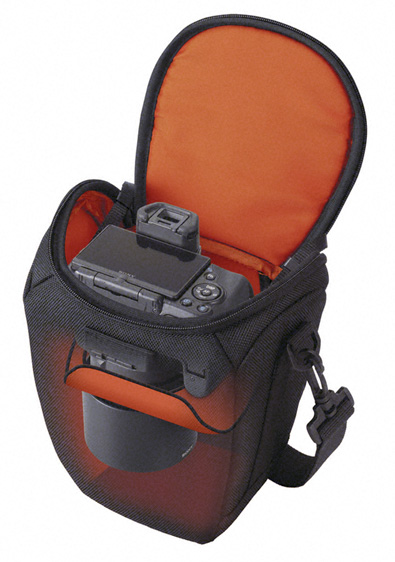
The LCS-AMB carry case protects your A-mount camera and attached standard zoom lens while you’re travelling. A special suspended partition cradles the camera securely while allowing quick access. Finished in durable black polyester material, the case can be slung over a shoulder using the supplied strap, carried by the grab handle or attached to a belt. It also features handy pockets with space for up to two extra batteries, spare memory card and lens cap. (NB: Not compatible with DSLR-A900/A850).

Lens Hood ALC-SH111
Compatible with DT 35mm F1.8 SAM and 85mm F2.8 SAM lenses, this round-profile hood shades from direct sunlight to prevent glare and lens flare.

See all accessories by Sony for the α camera system here: www.sony.co.uk/hub/dslr/accessories

The new HVL-F43AM external flash, VCT-55LH bracket, LCS-AMB soft carrying case and ALC-SH111 lens hood for α cameras by Sony are available from Spring 2011.

Alpha and NEX overtake Nikon UK DSLR sales

Chris Cheeseman writes in Amateur Photographer, reporting on figures released by photo industry analysts GfK, that Sony interchangeable lens camera sales in the UK have overtaken Nikon, moving the company into second position behind Canon.

http://www.amateurphotographer.co.uk/news/canon_and_nikon_lose_ground_as_camera_wars_hot_up_news_305118.html

In the Japanese home market, Canon remains top, Nikon second and Sony is third with over 15% of the market share. No attempt is made by AP to analyse the importance of Sony having a market share which is roughly half that of Nikon and Cano respectively, in that market.

The figures relate to the year 2010 – a calendar year – and it needs to be considered that Sony’s NEX system effectively went on sale slightly before midway during that term, and the SLT system one quarter later. Some Sony models were only introduced after photokina, in the final three months of the year.

In fact, it’s almost impossible to judge Sony’s impact when 2010 is viewed as a year rather than in terms of monthly or quarterly figures. If a graph was to be drawn with four lines on it – Nikon, Canon, Sony and ‘everything else’ – it looks as if the 11% overall decline in Nikon and Canon would contrast with a steep late year climb from Sony.


New Photoworld edition available

The latest Photoworld edition, No 1 2011, is now available to electronic edition subscribers (Normal or Premium) and is being printed to mail out before the end of January to all print edition subscribers.

The cover shot is by Shirley Kilpatrick, and is an uncropped capture very rapidly taken using the Alpha 550 with Sigma 18-250mm OS zoom at 250mm, a single frame as the hoopoe changed position and flew off immediately. With no time to make adjustments and the camera set to ISO 200 and aperture priority at f/8, the metering produced the dark result which would be expected from this situation and a shutter speed of 1/500th:

The Alpha 550 14 megapixel file is extremely low noise, so adjusting the image using Adobe Camera Raw produced hardly any loss of quality – including lens corrections for the Sigma automatically loaded, as all Sigma lenses are now included in Adobe’s database. For a rapid grabbed shot, the focus is spot-on and the Sigma lens at full focal length and only 2/3rds of a stop down from full aperture has performed extremely well. Shirley was testing the Alpha 550 for a week in November, after two years of using the Alpha 700. She found the smaller viewfinder acceptable and the general success rate and image quality to be an improvement; she has now traded the Alpha 550 up for the 580 which is even better.

Subscribers can download the full size 14 megapixel ACR converted file from our Extra Content area.

Alpha in the cathouse….

It was a photo-call too good to be missed. Shirley Kilpatrick reported for duty at Europe’s biggest brothel where fashion photographer Steve Thornton was staging a publicity stunt for California Sunbounce. Welcome to the House of the Rising Sunbounce, also known as Pascha.

The first person we saw in the empty corridors of the photokina 2010 halls, the day before the show opened, was Steve Thornton. You can’t really miss a six-foot-something figure with an extra six inches of hat, cowboy boots and everything except the spurs and chaps, even from behind.

“That’s Steve Thornton”, said David. “He’s the guy you are going to the brothel with on Thursday…”

Cologne has always been known for its robust seamy side. When David went to one of his first photokinas with John Battison and David Shaw from Japanese Cameras Ltd – importers of Minolta in the 1970s – he was courteously treated. “After you”, said Messrs Shaw and Battison as they hit yet another hostelry. Gay bars were not common in Britain in 1976, and it was a minute before he realised they had stayed outside the revolving door…

But this location, Pascha, had to be seen. It is Europe’s largest legal brothel, a multi-storey block just outside the inner city limits of Cologne (it would be illegal within them). It is claimed to have 120 working girls, and one thousand customers a day. Thursday mornings must be quiet, as they seemed able to close down the main cabaret and lapdancing bar to allow German lighting and accessory makers California Sunbounce to stage their model shoot with invited press and TV crews.

Because of its location, Pascha was a taxi fare away – half the taxis in Cologne seem to carry advertising for it, and unless a visitor already knew the true identity of the business you’d assume it was a nightclub. Indeed, it does stage music gigs and many will visit it just for the floorshow.

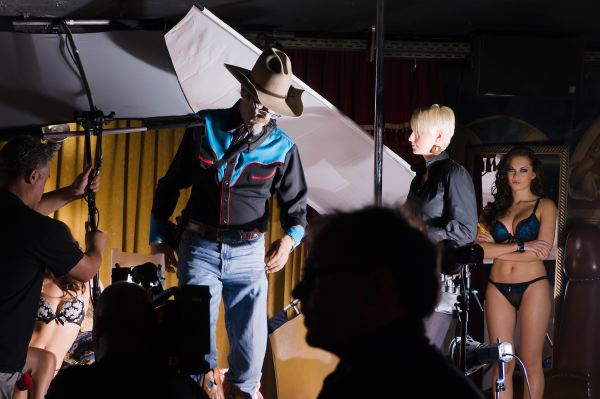
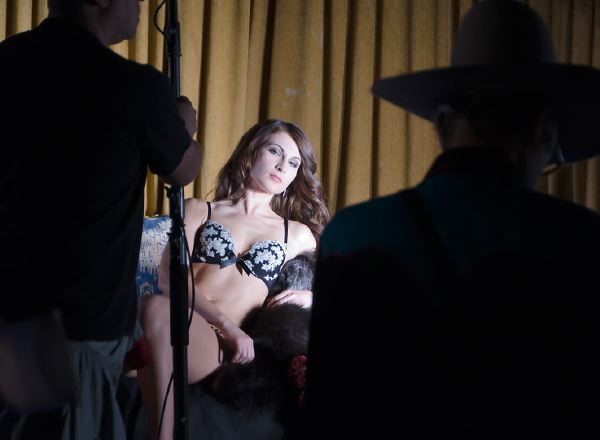
In the cocktail-cabaret bar, with Thornton’s halogen video lights positioned on stands or waved on poles by assistants, the grubby state of the decor was only too clear. The floor carpet stuck to my sandals and the beige curtain behind the first model to ‘take the stage’ had threadbare patches. The furnishings felt as if you really wouldn’t want to touch them without rubber gloves on, let alone lounge around posing in undies. Pascha may be the biggest cathouse in the west, but it didn’t smell wonderful and looked about as tired and well-used as its statistics suggest. Our models, of course, were unconnected with the venue and along with make-up and stylist Davina took the occasional wry look at their location.

As for Steve Thornton, we had stopped by one stand during photokina where he was holding forth with a lecture. He was animated, gesturing, extrovert and kept his audience attentive.

At Pascha, he did less to explain what he was doing with the lighting, or how he was using the large California Sunbounce reflector panels  which were the key to controlling such small, hard light sources. His instructions to his crew were not aimed at the posse of journalists and press photographers assembled to witness the event. I had thought he would be conducting the shoot more as a masterclass or demonstration, but it was very much a working session with one exception, permission for the invited media to take their own pictures and publish them as we are doing here.

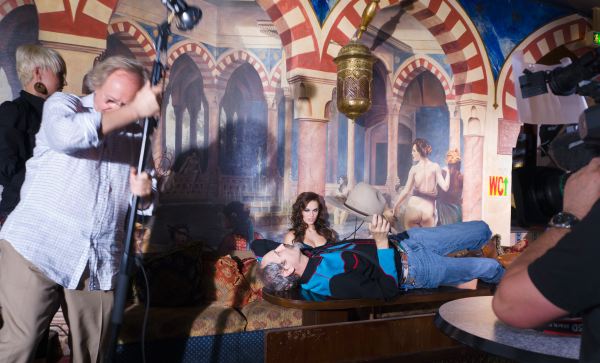
This is unusual, but our models knew the score and posed for all of the press gang in turn. The second girl, working in front of a not-quite-good-enough Turkish bath wall painting, had more direct communication but from my angle the lighting cast a strong face profile shadow. When this worked with a flattering face silhouette and visible shadows from her eyelashes, it was good; when it cast the wrong shaped shadow from her profile, much less so.

Thornton worked hard and his crew moved the halogen lights and Sunbounce panels round while dodging both the still cameras and the video crew. I was shooting with my Sigma 18-250mm ƒ3.5-6.3 OS stabilised zoom, which proved more than useful  at the long end. Originally, I planned to use just a 28mm ƒ/2 Minolta RS on my Alpha 700, but this would not have got me either the overall scenes or the close-up final shots.

The A700 was set to use auto ISO all the way to 1600, as we have found that Adobe Camera Raw 6.2 (or Lightroom 3.2) makes such excellent noise-free conversions it is safe to use even 1600 for model shots. At this setting, typical exposures were around 1/80th wide open at ƒ6.3. The slight hint of softness in lens at full apertures was flattering; a few shots stopped down in stronger direct light were cruel to skin, to say the least.

Well, it may be the first and last time I will be able to claim I went to work in a brothel. German social morals accept this place in a way which I think real Californians might not. The brand name makes you think it’s an American product, but California Sunbounce was developed in Germany and all their early publicity shots were taken on the sunny shores of the Baltic!

They also make the SunSniper camera sling (used by Thornton) and they are imported to the UK by The Flash Centre.

– Shirley Kilpatrick

All photographs are © Shirley Kilpatrick and use is reserved in connection with media coverage of this event. You can view and download full size (as cropped for repro) images from the full set of shots as a 13MB zip file from our Subscriber Pages.

Sony 5″ video monitor for DSLRs

For some time, I have been using a 7″ Lilliput external monitor for my Alpha and other HDMI output cameras. This is fairly bulky, with its external battery pack, and is mounted on a flash bracket holding it to the side of the camera. The main use of the monitor is for interview-style filming with it facing the subject (self filming) but it also has uses making location shooting simpler. Such monitors are usually mounted within video rigs, off camera, often at waist or chest level even when the camera is held above and forward of them.

The cost of the Lilliput is around £150-£200 depending on supplier and battery/mains power choices. Similar monitors from Marshall and other makers typically cost two to three times this, because they are sold for the photo market – the Lilliput is sold to the in-car entertainment sector, and therefore is not marked up by 300% to allow for the deep pockets of camera owners relative to car owners.

Sony’s new 5″ monitor is much lighter, and comes with mounts for hot shoe and Alpha shoe, and a neat lightweight HDMI-miniHDMI cable (oddly enough, that’s about the hardest thing to find – a short, skinny cable). It costs $395, but for that you do get a folding hood which is neat. They have many photos of it and not one shows it facing forwards, but the use is mentioned in the publicity.

It does not draw power from the HDMI, but requires either a mains adaptor or a battery pack, which is not shown in any of the photos. Sony have done the same as LED-video-light makers – provided a bay for fitting the regular Alpha camera battery as a power source. The press release implies that the battery pack is a separate item (‘optional’) instead of making the point that you use any large Alpha battery (including old ones left over from the A100). I find it very convenient that my video light accepts the same batteries as my camera system, and not very convenient to have a bulky rechargeable pack for my 7″ monitor. (NB: all that white space is part of Sony’s image we have linked to – nothing like wasting a bit of bandwidth by not cropping pix, is there?).

Here’s the press release:

—————————————————-

A new clip-on LCD monitor from Sony gives DSLR camera owners a bigger, better view of their footage while shooting HD video.

The CLM-V55 is a portable video monitor featuring a high-resolution WVGA (800 x 480) (5”) LCD panel. Attaching easily to most Interchangeable Lens Digital cameras and compatible HD camcorders via the supplied adaptor, it displays video footage during shooting/playback with excellent clarity and a wide viewing angle.

The clip-on screen tilts and swivels to any angle for comfortable framing in any position – even self-shooting when you’re in the picture.

The CLM-V55 is loaded with pro-style features to help photo enthusiasts and videographers shoot high-quality HD video footage with their Interchangeable Lens Digital camera.

Pixel magnification mode assists with accurate focus confirmation, giving an enlarged pixel-perfect view of a selected portion of the Full HD image. It’s complemented by a colour peaking function that highlights the edges of accurately-focused areas of the video image.

An intuitive control wheel allows quick, positive adjustment of a wide range of monitor settings without interrupting shooting. Adjustable parameters include aspect ratio (16:9/4:3), volume, brightness, contrast, colour tone (phase), colour temp and auto dimmer. On-screen markers aid precise framing by giving precise indication of a TV’s 16:9 or 4:3 actual display area. The LCD monitor’s on-board mono speaker is complemented by a headphone jack for accurate audio monitoring during shooting.

The CLM-V55 attaches easily to a wide range of Interchangeable Lens Digital cameras from Sony and other manufacturers that support HD video shooting. The supplied adaptor simplifies mounting on any camera or HD camcorder that features an auto-lock accessory shoe or ISO shoe. Signal connection from camera to monitor is via the supplied HDMI cable, while power can be supplied using a battery pack or AC adaptor (both optional). The CLM-V55 comes with a detachable LCD hood for more comfortable viewing when shooting outdoors in bright sunlight.

The CLM-V55 LCD video monitor by Sony is available from March 2011.

Alpha 55 1080p HD video – snow in Scotland

This video was made on December 23rd using the Alpha 55 (AVCHD recording) hand held, with SS enabled, and the Carl Zeiss 16-80mm zoom. This video has been uploaded in full 1080p HD and can be viewed at high resolution if you have a fast enough connection. The soundtrack is a classical guitar piece I wrote ten years ago, on the last day of the year 2000, when snow was falling by moonlight which I guess the music represents a bit better than mid-day.
Some camera-mic sound has been left in place for two of the takes, and the shot of the stone wall uses active phase detection AF during video. This was not possible for most takes, as the snowflakes falling made the focus constantly change as they passed the focus zones!

Hope you enjoy it! The camera got very wet with snow – you can see where flakes landed on the lens filter – and ended up being wiped down many times. Eventually, after going into a shop for a few minutes, everything steamed up. But it seems fine after letting it dry out and warm up. It was not very cold, around 1°C for snow to be falling like this.
– David

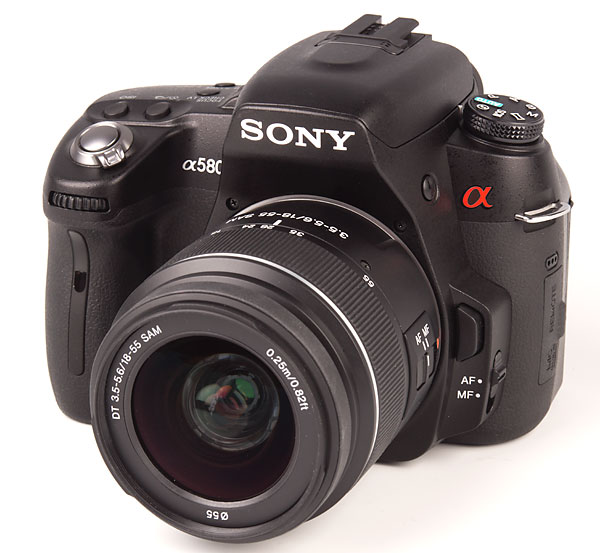
The Alpha 580 – a three-way view

Once I had a quarterplate hand-and-stand camera, vintage 1920s. Attached to the front standard was a small reflex viewfinder, giving a miniature composition you could use at waist or chest level. On the same standard was a folding wire frame, with a companion eye-sighting window flipping up from the side of the body. This gave a direct view from eye level. But for the most accurate framing and focusing, a groundglass screen at back could be used with the shutter open and a viewing hood folded out.

Those three ways of viewing have never been available in a modern SLR. Until now! The Alpha 580 (for which you can also read 560 throughout this review, give or take the sensor) is the first modern SLR to offer three entirely different viewfinder systems, all with their own unique focus and exposure methods. There have been cameras made by Alpa and Praktina which had optical finders tucked in alongside their pentaprism, and Rollei invented a finder which could switch from eye-level to waist level at the flick of a lever. But the Alpha 580 offers three through-the-lens systems and it’s unlikely any DSLR will do so again.
This is a 10-page article – please use the navigation bar at the bottom to move on to the next page, or click the ‘Continue Reading’ link to view as a single long article (this function is not very reliable though and may produce an ‘undefined’ error)

Continue reading »

1 4 5 6 7 8 22