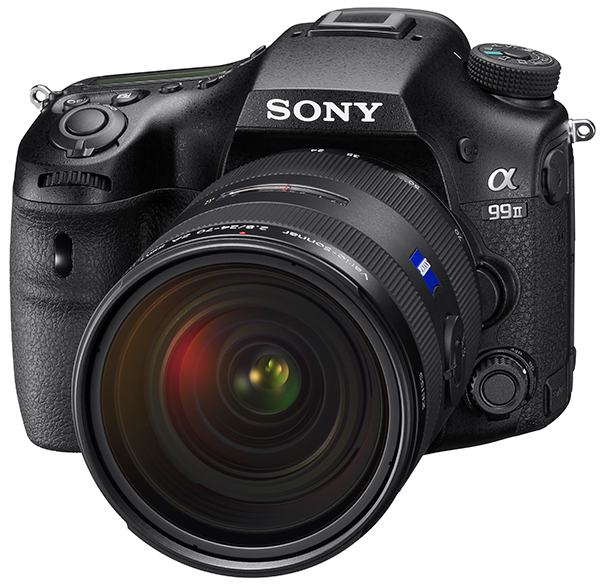
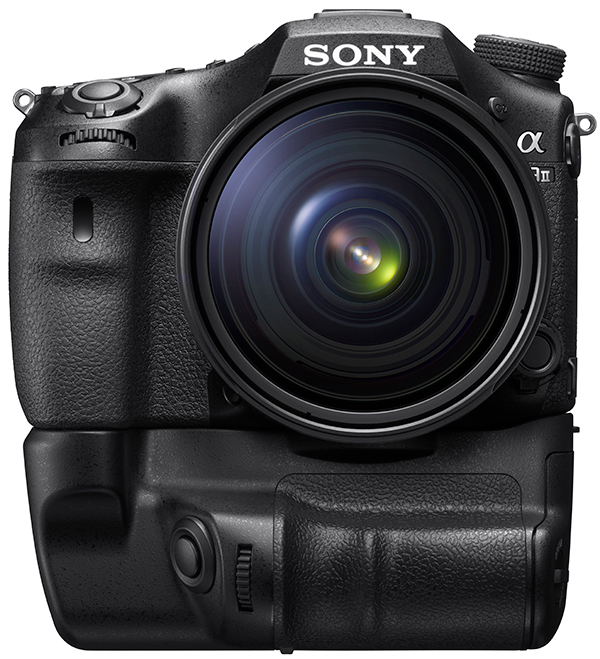
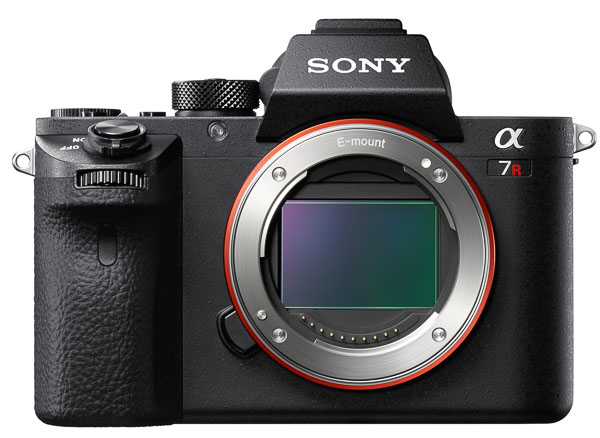
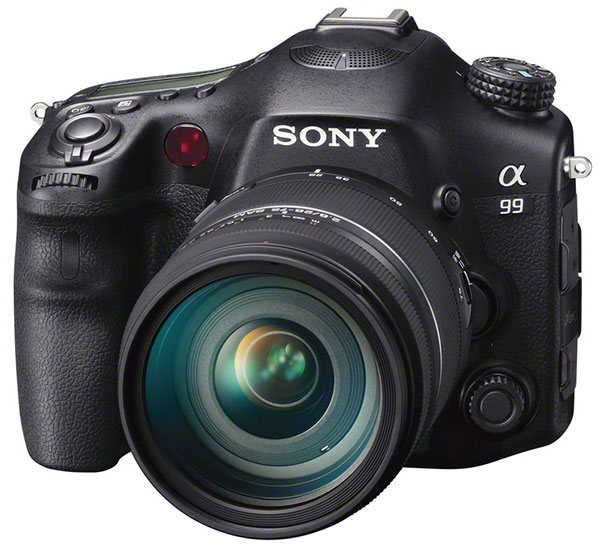
Sony has today released the details of the updated A99II, using a 42MP sensor and 5-axis stabilisation to match the A7RII. It does not appear to have retained GPS and the paragraph highlighted in red later on indicates a weasel-worded possible get out for this – it may not embed GPS in the image files, but instead store a mobile phone location data track on the camera’s memory card. We may guess that this choice could be partly down to cutting out fees payable to incorporate a GPS module. Not the same, guys, not the same:
From Sony’s site, the ambiguous word is highlighted here:
Use Location Information Link to make the most of your camera anywhere you go together. After the camera has been paired to the PlayMemories Mobile app installed on a compatible mobile phone or tablet device, it can acquire location data from the mobile device and record that data with still images. The acquired location data can also be used to correct the camera’s date/time and location settings. The PlayMemories Home application can then be utilised on a personal computer to organise still images imported into the computer on a map.
Edit: note that Sony’s later announcement for A6500 uses specific wording which says that its GPS Blueooth app embeds location data in the images as they are shot. This wording has not been used for A99II. We have not, though the A9II has now been released and bought by some users, been able to confirm how it works yet.
In the Sony release (used almost complete, slightly edited, to form this post) they appear to imply that dual SD card slots are new, which of course they are not, the original A99 has this already. No UHS-II, no USB 3 Not only that, the dual slots are apparently exactly the same spec as the original unless someone at Sony Towers has forgotten to edit their website:
Some of the hidden, clever features of the A99 remain like the buttons which are coded to touch with concave or convex tops or a small raised dot, making it easy once you have learned their feel to find them by fingertip. In fact the entire interface remains constant (in the way that Canon did throughout the EOS 1D series) meaning you can pick this up and shoot immediately, coming fom the A99. Only the Silent Controller is significantly improved, and the badly placed Movie button remains exactly where it was.
Full-frame 4D Focus: Innovative Hybrid Phase Detection AF system with accurate 79 hybrid cross AF points[i] enabled by 79-point dedicated and 399-point focal-plane AF sensors and continuous shooting at up to 12fps[ii] There is no AF Illuminator, but please note that -4 EV is quoted with an f/2.8 lens at ISO 100. In the past, AF low limits were always quoted with an f/1.4 lens (although the sensor only works at f/2.8). This is very good.
42.4 effective MP 35mm Full-frame Exmor R™ CMOS sensor so it’s essentially an A7RII
Newly developed optical 5-axis in-body image stabilisation system
Outstanding operability and reliability in newly designed downsized body
Internal 4K movie recording in XAVC-S format[iii] with host of pro-orientated movie features IMPORTANT: this appears to be a Super-35 4K mode if you want no pixel binning and the highest overall quality but near-full-frame is offered with the usual partial readout.We would add a few extras – this camera has the much-needed (almost essential) Copyright Info function, minimum shutter speed when using Auto ISO, 10/5/2 sec self-timer, Hi+ in addition to Hi, Med and Lo motordrive shooting (not just shifting three settings over a faster range but giving 12, 8, 6 or 4 fps); built-in WiFi wireless including WiFi remote control and NFC (but not, apparently, apps); there are new Highlight and Average metering modes, and for each metering mode, you can calibrate the standard exposure if you prefer your shots slightly lighter or darker than the camera’s default.The A99II can capture 54 uncompressed RAW+JPEG images at 12fps (Hi+) before the buffer is full. There’s no great advantage in capturing RAW only, or JPEG only, and even with Fine JPEG at Hi speed (8fps) the limit is still 71, not ‘until card full’.
Omissions include no Multi Shot Noise reduction, no GPS, and the external DC power supply is no longer via a dedicated socket, instead it uses the dummy battery approach. The camera is still not officially recommended for use in temperatures below freezing or over 40°C/104°F, both of which can easily be achieved in Scotland in a single sunny winter day (even without the benefit of your car parcel shelf oven).
The upgraded autofocus
The newly developed Phase Detection AF System is capable of ‘full-time AF’ and is the first implementation of 4D FOCUS in the full-frame ɑ series, bringing a supreme new level of AF performance to ɑ99 II users. The Hybrid Phase Detection AF System is enabled by combining a precision 79-point[iv] dedicated phase detection AF sensor with 399 focal plane phase detection AF points to produce a 79 hybrid cross AF point[v] array. These cross points deliver incredibly precise autofocus performance and advanced subject tracking of any moving objects right across the image, at high speed. In addition, as there is no moving mirror, TMT enables continuous AF operation and the finder image remains unaffected during any type of shooting, including live view and movie recording.
Low light conditions present no problem to the ɑ99 II. The precision AF system will function properly down to EV-4[vi] brightness levels where most other cameras struggle. Editor’s note: the A99 is poor in this respect and often can’t focus modest aperture lenses at all in low light.
Data flow through the ɑ99 II has been redesigned to allow for high resolution and continuous shooting at high frame rates. A new front-end LSI works with the image sensor and BIONZ X image processing engine, as well as a newly designed shutter unit, to enable continuous shooting at up to 12fps with AF/AE tracking[vii], all whilst harnessing the sensor’s 42.4MP capabilities. The result is an ultra-fast camera that will deliver incredibly detailed shots, even with fast moving objects in challenging light conditions. Thanks to a large buffer and sophisticated data processing, these shots can be viewed immediately after shooting even when in high speed continuous shooting mode and if shots are being taken indoors under artificial lighting, flicker is automatically detected and the shutter is timed to minimise its effect on the end image[viii].
Improvements to the EVF display algorithm now deliver continuous live-view shooting at up to 8 fps[ix] with AF/AE tracking with minimal display lag so that the viewing experience is essentially no different from that of an optical viewfinder. Exposure, white balance and other camera settings are displayed in real time in the viewfinder and continuous live view shooting can be set in 3 stages to match a variety of subjects: 8 fps, 6 fps and 4 fps.
Pixel Power
The back-illuminated full-frame 42.4MP[x] Exmor R CMOS sensor benefits from a gapless-on-chip design and allows for fast readout of large volumes of data as well as being extremely efficient in its light gathering ability. The net result is very high sensitivity with low noise, wide dynamic range and 42.4MP resolution across an ISO range of 100-25600, expandable to ISO 50 – 102,400[xi]. The ɑ99 II has been designed without an optical low-pass filter to allow the finest natural details and textures to be captured with unprecedented depth and realism and the photographer can select compressed or uncompressed RAW files, as required.
5-axis SteadyShot™ INSIDE Image Stabilisation
Having proved to be incredibly popular in the ɑ7 II series of cameras, Sony has designed a new in-body 5 axis image stabilisation system for A-mount cameras which debuts for the first time in the ɑ99 II. In addition to movement in the pitch and yaw axes that tend to occur at longer focal lengths, this system effectively detects and compensates for shift blur that can occur on the X and Y axes when shooting close-up, and roll blur that is often apparent in still images and movies that are shot at night. Newly implemented precision gyro sensors are capable of precisely detecting even tiny camera movements that can cause blurring, providing a 4.5 step[xii] shutter speed advantage that can help realise the full potential of the 42.4MP sensor, in both stills and movies. The effect of image stabilisation can be monitored in the viewfinder or on the LCD screen during live view when the shutter button is half pressed or the Focus Magnifier functions are used. This allows framing and focus to be accurately checked via live view when shooting at telephoto focal lengths or macro distances.
Improved design and operability
The design of the new ɑ99 II has noticeably evolved compared to its predecessor, based upon feedback from professional users. The new model is 8% smaller than the original ɑ99 and has a newly designed grip, magnesium alloy body, dual SD[xiii] card slot and other upgrades that improve both hold and operation. All major buttons and dials are provided with seals and the media jack cover and enclosure edges feature tongue and groove – the result is a body that is both dust and moisture resistant[xiv] and can be used in the toughest and most challenging shooting conditions.
In addition to being designed for faster response, the new shutter unit is also more durable and has passed endurance tests in excess of 300,000 shutter operations[xv].
The XGA OLED Tru-finder has a ZEISS® T* Coating and has a 4 element lens group that includes a double sided aspherical element whilst offering a powerful 0.78x magnification, delivering outstanding clarity from corner to corner. It also has a fluorine coating on the outer lens to prevent fingerprints, dust, water, oil and dirt from sticking, thus ensuring a clear view. Editor’s note: the ocular of the original A99 is a weak point, and in the A7RII Sony finally produced a really good non-squiffy eyepiece optical train which shows a clear view with some leeway to move your eye. So this is a major upgrade as much of the experience of using the SLT models comes down to finder quality.
The silent Multi Controller introduced in the original ɑ99 has been improved so that in addition to allowing control of aperture, shutter speed, ISO, exposure compensation, AF area, AF mode and other settings, it now features a click-stop ON/OFF switch. When ON, the preferred setting for still image shooting, the control clicks, providing a tactile indication of the length of rotation. When OFF, the control turns smoothly and quietly, ideal for movie shooting. Location data acquisition has also been made possible via Bluetooth[xvi] connection to a compatible mobile device and it is now possible to select whether the storage location should just be on a tethered computer or also on camera for easy review without leaving the shooting position. Based upon feedback from a number of ɑ users, the menu structure of the ɑ99 II has also been updated to deliver a smoother navigational experience.
Internal 4K movie at 100 Mpbs
The ɑ99 II enables internal 4K movie recording[xvii] featuring full pixel readout, without pixel binning[xviii], for ultimate high resolution video in the pro friendly XAVC S format. It is capable of recording high quality footage at 100Mbps for 4K recording. A new ‘Slow and Quick’ mode[xix] (S&Q) supports both slow motion and quick motion. Frame rates from 1 fps to 120 fps (100 fps) can be selected in 8 steps for up to 60x (50x) quick motion and 5x (4x) slow motion recording.[xx] A number of features designed for a professional movie production workflow are included such as picture profiles, time code and HDMI clear output and the new ɑ99 II now also offers gamma assist for real time S-Log monitoring and a zebra mode for easier exposure adjustment. S-Log3 and S-Log2 gamma are now included, making wide dynamic range shooting possible with(out) – our edit, the press release says with! blown highlights or blocked shadows making the ɑ99 II easily integratable into a fully professional movie production workflow.
Editor’s note: there’s a problem with the A99II for movies, which also applies to the LA-EA4 and SSM/SAM or other A-mount lenses on the E-mount bodies – the lenses really don’t work well at all. Sony had pictures of this camera with the 24mm f/2 SSM, still a current lens. I sold mine because it could not handle the same AF and exposure control functions as the 25mm f/2 Batis or the 28mm f/2 Sony (which I use) during video shooting. The A-mount was never built for movies, the E-mount has been from the start. However, both are fine using purely manual focus, manual aperture ciné lenses which many professionals prefer.
The new ɑ99 II will start shipping in November, priced at approximately €3600 and full technical details can be seen here.
[i]The number of usable AF points may depend on the lens and shooting mode. Up to 323 focus points are selectable. Not available for movie recording
[ii]Continuous shooting mode set to ‘Hi+’
[iii] Class 10 or higher SDHC/SDXC memory card required for XAVC S format movie recording. UHS-I (U3) SDHC/SDXC card required for 100Mbps recording
[iv]The number of usable AF points may depend on the lens and shooting mode
[v]Hybrid Phase Detection AF active. The dedicated phase detection AF sensor or focal-plane phase detection AF sensor may be used independently in certain photographic situations.
[vi]Central focus point
[vii]The supported focus area will depend on the shooting mode and lens used. Furthermore, when“Continuous Shooting: Hi+” is selected, focus will be fixed at the first frame shot when Hybrid Phase Detection AF is active at aperture settings of F9 or higher, or when Hybrid Phase Detection AF is not active at aperture settings of F4 or higher
[viii]When Anti-flicker Shoot. is ON. Flicker detection at 100 Hz or 120 Hz only. Continuous shooting speed may decrease. Does not function during bulb exposure or movie recording
[ix]Continuous shooting mode set to ‘Hi’
[x] Approximate effective megapixels
[xi]Still images only
[xii]CIPA standards. Pitch/yaw shake only. SAL135F18Z lens. Long exposure NR off.
[xiii]One slot can hold an SD card or a Memory Stick.
[xiv]Not guaranteed to be 100% dust and moisture proof
[xv]Electronic front curtain shutter activated
[xvi]Requires pairing with compatible mobile devices running the PlayMemories Mobile app. Supported devices are Android smartphones running Android 5.0 or later and compatible with Bluetooth 4.0 or later. iPhone/iPad: iPhone 4S or later/iPad 3rd generation or later
[xvii]SDHC/SDXC memory card of Class 10 or higher is required for movie recording in XAVC S format. UHS-I (U3) SDHC/SDXC card is required for 100Mbps recording
[xviii] In Super 35mm recording mode
[xix]Sound cannot be recorded. SDHC/SDXC memory card of Class 10 or higher is required
No doubt everyone’s seen the article on Petapixel which can best be described as successful clickbait – by Sator, essentially claiming that the whole idea of mirrorless full frame is flawed. Well, the good news is that this article is more flawed than the flaws it’s claiming to point out.
First of, let’s simply dismiss the groundless myth that a shorter mount to focal plane register (body thickness) cause any problems with lens design. It simply doesn’t. Nor does an empty space without any body at all. The only aspect of register which can ever cause problems is additional body thickness, as found on single-lens reflex (SLR and DSLR) designs. In the early days of SLRs, it caused so much trouble for the design of very wide-angle lenses that SLR mirrors had to be locked ‘up’ and a lens fitted with a rear assembly almost touching the shutter, sticking right back into the darkchamber.
The quote from Zeiss in the article about the ‘short flange distance’ being an engineering challenge for wide-angle lenses may well be a result of mistranslation as it’s hard to imagine any Zeiss engineer actually saying that and meaning it. This is the company which effectively built the Hasselblad SWC, not to mention the aerial and stereoscopic models based on the 38mm f/4.5 Biogon. And they made the Hologon camera. Flange distance? What flange distance?
Take a look at the optical design of one of the best Zeiss/Sony collaborations, the RX1 series with its 35mm fixed f/2 lens, and you’ll see that Tatsuo Kureishi, Sony product planner, was probably right to say this: “We eventually realised that only a camera with a non-interchangeable lens could significantly increase image quality, since it would allow us to optimise performance between the lens and image sensor.” And what did he mean? That by not even having a focal plane shutter, by having an even slimmer body than the E-mount, a lens which almost touched the sensor, they could engineer something better. And they could align it to perfection. The ghosted product view below says it all. As far as I have been able to work out, the actual body register of the RX1 would be around 12mm, or like the FE mount’s 18mm but with the lens sticking into the body even more than the 5mm depth of the E-mount bayonet.
Now if there’s any reason the A7 series can’t have the same 35mm f/2 as the RX1, it’s down to the shutter assembly and the filter/coverglass pack of the sensors used in A7 bodies. But it’s not to do with the mount, and as this lens proves perfectly, claims that you ‘can not get lens performance without size and weight’ are also made on a weak foundation.
Now the throat diameter can indeed cause problems. Sator quotes a set of throat diameters:
However, all these are meaningless without reference to the register. Back on 2012, in Issue No 1 of Cameracraft (the quarterly I produced with the co-editing help of Gary Friedman for three years) I printed the register distances then applicable to a range of new and legacy systems:
A 46.1mm throat placed 18mm from a 43mm diagonal image sensor clearly isn’t ideal, but it’s for ever better than Fuji’s 44mm throat at the same 18mm. Or is it? Measure the actual mount, and the 46.1mm turns out to be a generous figure including the bayonet recesses. The real circular size is only 43mm and the internal diameter once any mount is fitted is only 42mm. The electronic contact array removes a further 4mm but fortunately not in a bad place. On the Fuji X mount, the contacts are placed to prevent any real chance of a full frame body (the same applies to Canon’s EF-M mount).
Sony got in by the skin of their teeth, and it is this mount diameter which actually starts to impose design contraints on lenses and makes some of them larger. A good example is the 85mm f/1.4 GM. That, in its purest form, would be a lens normally positioned >85mm from the sensor with an aperture diameter 0f 60mm. However, many of image-forming rays from this would be obstructed by the E-mount. A complex telephoto construction is therefore needed which reduces the virtual size of the lens aperture as seen from the focal plane and simultaneously moves its apparent location closer (placing the rear nodal point of the lens somewhere between 18mm and 85mm). Most lenses longer and/or faster than 50mm f/1.2 will need some increased complexity of design to condense the exit pupil.
Telecentric design
But against this, there’s a fortuitous benefit. Digital sensors, with their optically active filter/low-cut/IR glass packs, don’t respond well to very oblique angles of ray incidence. If you can make a telecentric lens – one which produces an almost parallel bundle of image-forming rays from a greater register distance – you’ve overcome this issue. That is what Olympus did with the original FourThirds format, which if scaled up to full frame size would have had a 77mm register – and they made their lenses telecentric, which means they produce a relatively parallel ray bundle, with a long back focus. Although FourThirds is now almost obsolete, it did have this odd advantage (also a real challenge which Olympus overcame in the creation of a fully retrofocus 7-14mm zoom with a 38mm register).
The point I’m making is that large size, complexity and weight are not as so many state ‘laws of physics’ relating to making good lenses. They may simply be the most expedient solution. Remove all constraints – as Sony did with the RX1, Minolta did with the TC-1, and Ricoh did with the original film GR – and exceptional lenses can be made to be very compact, almost as compact as the theoretical physics will allow. Indeed it surprised many users to find large glass elements almost touching the film plane in some cameras.
Sorry to be so wordy but it needs explaining. Does it matter? Yes, if you still believe in a Sony A7/FE system which can be as compact as a Leica kit used to be. In fact the E-mount makes it possible to design slightly smaller medium to long zooms and very much smaller wide-angles, and normal sized standard lenses. To adjust your perception, it’s important to take Sator’s camera size comparison images and align the focal plane index marks, not the front or back of the camera body. It’s surprising how much of an A7RII is behind the sensor plane.
The screen grab above is from Sator’s article. It purports to compare two 85mms. There’s just one small problem – it doesn’t. The lens shown fitted to the A99 on the right is the 24mm f/2 CZ SSM A-mount, not the 85mm CZ. The 85mm is 1mm shorter but 3mm fatter with a generally chunkier look, and if you align the focal plane index marks, its front would come almost exactly level with the GM lens. It’s still smaller than the GM but if comparisons are to be made this way, they really should be correct, not wrong.
Why other big lenses?
Blame Canon and Nikon. Both have had SLR mirror paths which are very generous, and there are some lenses you can adapt to Canon which will give you a damaged mirror and lens in return (those lenses can’t be adapted to Nikon at all). Makers like Sigma and Tamron have to design all their lenses to clear the Canon full-frame (EF) mirror swing, and if that means adding 5mm to the back focus and then adding even more in glass to the overall assembly to make this work, so be it.
Therefore, when a nice fast 20mm f/1.4 Sigma appears designed for a retrofocus with a 42mm physical clearance, it’s going to be the same size when remounted (if they ever do) for a skinny 18mm register. Actually, the same size plus 24mm of deadspace extension.
If you think that a fast superwide is bound to be huge, try a Voigtlander 21mm f/1.8 Ultron in Leica M fit. It’s not f/1.4, but it’s also the size of your palm not your forearm – and no doubt an autofocus lens could be made much the same. In fact you can buy an E-mount to Leica M autofocus adaptor and turn it into one. My point is that where Sony’s own lenses may sometimes be fairly large in order to deliver the best results from the existing sensors and the mount constraints, DSLR system lenses can be even larger. Where there is potential for Sony native lenses to be small, there’s very limited potential for this with DSLRs. I use a couple of rare examples, the 20mm f/3.5 Voigtlander Nikon fit wide and the Canon 40mm f/2.8 STM pancake. They are exceptions. Within the range from 28mm to 90mm, there have always been excellent and fairly compact lenses for all types of system – Contax G, Canon, Nikon, Pentax, Leica, Minolta CLE. Sony should look to these for inspiration for a core set of lenses, and seem to have done so with the 28mm, 35mm, 50mm, and 55mm. A neat 85mm f/2.8 next in line then?
Adaptors and focus calibration
The general comment that adaptors introduce error is very true, but Sator doesn’t explain why the E-mount is so prone to such errors. Let me do so. It was designed, from the ground up, to be self calibrating and not to require much precision. When the original 16mm f/2.8 pancake was launched with the NEX-3 and NEX-5, that lens had so much focus travel it could go well beyond infinity. Just 0.1mm makes a huge difference with a 16mm lens at f/2.8 – and the actual flange to sensor register of those first bodies was not even accurate to 0.1mm. Sony just made the lenses able to cover the manufacturing tolerance, because the on-sensor contrast detect focusing always got it right. You would never know if a body had 0.1mm or 0.2mm variation from spec, as the lens had more than this leeway.
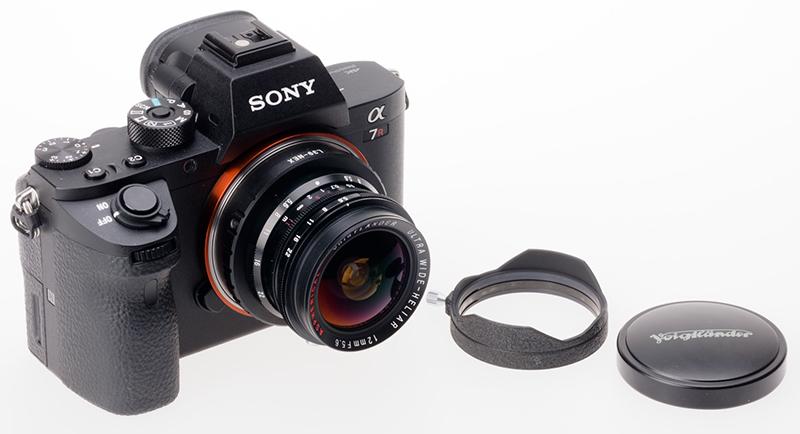
Why the A7 system still wins – though now old, a Voigtlander Leica screw original 12mm f/5.6 ultrawide works well using a $10 simple adaptor. A very much more expensive adaptor – $300 – turned out to have incorrect infinity focus.
Then along came awkward early buyers of adaptors and lenses like the Voigtlander 12mm, or for example the 40mm f/1.4 which was the lens that really alerted me to the problem. These lenses are calibrated to Leica focus register with the aim of a hard infinity stop. They are supposed to hit infinity just as the stars in your night sky snap into perfect focus. We found that whether this happened depended on the individual Sony body and also on any adaptors. Manual focus lenses were not self-calibrating! That’s why the Fotodiox Tough-E mount arrived, why Sony tightened up generally on tolerances after the A7 and A7R, and also why makers like Samyang wisely allow a generous over-run past infinity for manual focus lenses (their 12mm f/2 for E-mount is an example, with plenty of tolerance to handle different bodies).
Now all of Sony’s E and FE mount autofocus lenses have continued to be self-calibrating. They do not have hard infinity stops and many don’t form an image properly at all unless powered up (the power moves groups and elements into position, centres any stabilisation group, and finally performs AF). The start-up routines can also involve opening the lens aperture and closing it, often every time the shutter release is touched for first pressure. This is why expert users often prefer to AF using an assigned custom button, not the shutter release. It can save a wasted quarter-second and greatly speed your response time for action and grab shots. It’s also why manual lenses are popular, as these always shave the response time of the camera body down to an absolute minimum.
The mistake some make is to assume the Sony E-mount needs to be as precise and accurate as a 35mm SLR or DSLR. It does not. It may feel like a precision instrument but in fact it’s not. Where an SLR design requires micron precision in alignment of the lens mount and the focus plane, the principal mirror and the secondary AF mirror, the AF module, and the focusing screen – all at once – the E-mount mirrorless requires only two conditions to be met. The axis of the lens should be centred on the sensor, and should be perpendicular to the sensor (and any focus mechanism used should retain this). If this is achieved, all other degrees of precision can be covered by tolerance. Obviously the IBIS, 5-axis moving sensor, does require considerable engineering excellence to do what it does and keep everything right. But unlike the old DSLRs, it will never need you to adjust hidden screws just to get the focus working properly.
The IBIS question
Sator suggests that with such a small throat aperture, the 24 x 36mm stabilised sensor really can’t do its job. We all saw the first demonstrations of AS, or SSS, or SSI or whatever we call it – the sensor apparently gyrating over many millimetres. Those who bought the original Sony A100 and 16-80mm CZ lens also found that sometimes the sensor would be a little more off-centre for the shot and one corner would be sharply vignetted. Well, you might expect that from the A7RII with certain lenses but in fact I’ve never observed it.
The IBIS never allows the sensor to sit off-axis. It will constantly correct for your wavering hold, but always return to a centred position. It’s not trying to dive 5mm past the shadow of the lens throat or outside your lens image circle, even if it can do so in theory. The real stabilisation corrections made are within a millimetre or two, and even that is a considerable blur when there are over 200 pixels in one millimetre of travel! Consider what a 200 to 400 pixel blur looks like. What IBIS is doing often corrects shake producing blur in the region of 2 to 20 pixels.
So, the reply to the apparently valid point that the whole sensor size, stabilisation movement, lens throat size, and lens image circle combine to make Steady Shot Inside a guaranteed failure can only be this: it works. It’s like a bicycle – look at it, think about it, and it’s not promising… but in practice it works very well. It also works, however its firmware interfaces with lenses, to use OSS optically stabilised Sony lenses very successfully.
Conclusion
The Leica screw system was probably designed with its 39mm lens thread much smaller than the diagonal of the film gate because it was originally made for an 18 x 24mm ‘single frame’ (later called half-frame) format. When a fixed lens was replaced with the screw mount, the inherent problem of having this smaller than the film diagonal was missed. That gave later generations the vignetting Leica Visoflex and the limited range and performance of all lenses over 135mm focal length!
To some extent Sony has done the same thing and simple large aperture long lenses might in theory vignette. In practice they don’t. The limitations are nothing like the Leica or Contax rangefinder mounts were in the past. The argument against full frame mirrorless, or the specific design of the Sony FE/A7 series, ignores many things including simple points like volumetric heft (looks very different from overhead views of the camera footprint) and multi-body kits. I use A7RII, A7 and A6000 and all three bodies together barely take up the baggage space of a single pro DSLR.
So, just relax. The Petapixel article was not a very carefully constructed one or a balanced argument. You’re going to find many different form factors of digital camera in future. The Sony full frame mirrorless system is just one. Because Fujifilm, Olympus, Panasonic, Nikon, Pentax, Samsung and Canon have all made design decisions for their mirrorless offerings which rule out full frame it’s not going to have ‘competition’ right now, and all users of other systems will find reasons why it doesn’t work for them – or take the plunge.
We’ve had news of the new Sigma Art HSM high speed wide angle full frame zoom – 24-35mm f/2.
It will be available in Nikon, Canon and Sigma mounts only (release date not yet confirmed) according to Sigma in the UK.
Note that this will be a bit of monster with its 82mm filter thread, 117mm long barrel and substantial petal lens hood.
Sigma does not make a full frame DSLR. Sony is now a major market for high end full frame lenses. What’s going on here? We’ll just have to wait and see. Maybe Sigma just reckon every FF Sony mirrorless owner will have a Canon AF adaptor and maybe their HSM – which works pretty well on the A7II – will even allow fast AF on the new A7R II.
SIGMA is going to start a new “Mount Conversion Service” which will enable Sigma to convert the mount of customers’ Sigma Art, Sports and Contemporary lenses from one camera fitting to another.
The ranges convertible include the new Sports models such as the 120-300mm f/2.8
“We believe that a lens is not only such a key device for photographic expression, but also an important resource for photographers”, they say. “It has been our hope to develop the lens system that is genuinely photographer-centered, and you can enjoy it for a longer period of time. As an experienced lens manufacturer that has been creating a diverse range of interchangeable lenses, our desire and know-how is crystalized in this unique service. With this service, the mount of your SIGMA lenses can be converted to another mount system, depending on the specification of camera bodies. This service will be available from September, 2013.”
Editor’s comment – this feature of the new Sigma lens designs was not even mentioned at photokina 2012. They have kept something under wraps which must have been planned from a very early date. The main lens unit of all Sigmas in these series has to be effectively independent of the mount, with electronic protocol conversion chips to handle aperture and focus operation while different rear assemblies change the bayonet.
“Interchangeable lens camera systems appear to be superior in offering photographers more options, allowing them to change lenses freely and have more flexible photographic expression”, states the Sigma release. “Nevertheless, each interchangeable lens is limited with the specification of different camera systems. In other words, you can’t use those lenses if you change it from one type to another. Although lenses are the key devices to create photographic expression, it is a shame that there is no system that purely sets the standard based on the functions and individual qualities of interchangeable lenses.
“In this circumstance, SIGMA is going to start the “Mount Conversion Service” from 2nd September 2013. Our goal is to provide more freedom for photographers so that they can select new camera bodies without worrying about the conventional limitation around the mount system of cameras, and keep on using their current lenses by adjusting them to fit with a new mechanism.”
For the details, please check the Sigma website http://www.sigma-global.com/en/lenses/cas/service/mcs/index.html * This “Mount Conversion Service” is different from a normal repair. In order to apply for the service, please contact your nearest authorized subsidiary / distributor of SIGMA.
In the last year two cameras have been through my hands and impressed more than any others with the quality of their sensors. Those cameras were as different as they could be – the full frame Canon EOS 6D, and the pocketable Sony Cyber-shot DSC RX100. They have one thing in common, 20 megapixel sensors.
Of course there is no connection; a 24 x 36mm Canon sensor and a 8.8 x 13mm Sony sensor are very different. But if you shoot at ISO 125 on both cameras, and process from raw with a normally exposed scene, you will be hard pressed to tell the results apart.
So, when Sony – proving a giant-killer with the 1.0” format RX100 sensor – creates a budget DSLT model with an APS-C 20 megapixel sensor it would be reasonable to expect that this would outperform the RX100 and in the process prove superior to the 24 megapixel Alpha 77, 65 and NEX-7. It might even match the Alpha 99.
The Alpha 58 was announced at the end of February 2013, and some major websites had still not reviewed it by June. This is the first new Sony APS-C silicon for two years. It’s not found in any other body. Why the lack of urgent interest?
Perhaps, like me, the entry-level grade of the A58 has been responsible. It’s by far the worst Alpha body ever manufactured, and the first to have a plastic lens mount where machined metal is normally used. The whole physical feel of this Thai-made camera is inferior; it even has a slightly rough external texture which picks up handling marks the moment a store customer (or cynical on-line orderer intending to try, but return for a refund) so much as touches it.
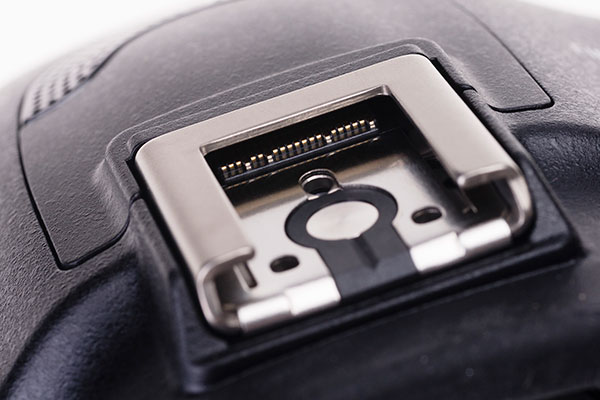
It has a relatively low-resolution, small rear screen (2.7 inches and 460,800 pixels) which is in the simplest and most restricted kind of up/down angle hinged mount. Against this economy, though, you need to balance a better OLED electronic viewfinder based on a one-inch 1,440,000 pixel display and a change to the new Sony Multi Function Accessory Shoe (without a protective cap, and without the adaptor for the Minolta/Sony Auto Lock shoe). It also uses the larger FM-500H battery common to all other current Alpha models, not the smaller FM-50H used by the NEX and also by some previous Alphas like the A55.
What is really new about the A58 is the price. I was not interested in the camera, though curious about the new sensor, because it was $600 US or £499 UK with the most basic lens , a new 18-5mm f/3.5-5.6 SAM II with quieter and improved internal focus motor (delivered, like Canon kit 18-55mms, without a lens hood). Then while helping a professional friend decide how to replace an A350 used for some unique underwater photography where the Quick Live View AF function has no equivalent in other makes, I looked into the A58.
It was on sale, in Britain, including VAT and properly sourced from Sony, for under £350. The actual price of the kit was only £291 before added VAT sales tax. This was £100 cheaper than the lowest price of the RX100, less than any other DSLR on the market with anything like the same specification. Bear in mind what a replacement Sony battery costs (around £50) and what an 18-55mm fetches (officially more, but in practice around £100 new) and this body was coming in at about £150. That’s a point and shoot compact price.
So I bought one.
First impressions
The packaging for the A58 cuts down on many things – recent Alphas have been festooned with stickers, this one has a single swingtag and a sticker on the rear LCD promoting connection to Sony’s webserver to obtain PlayMemories Home, the kiddy-friendly name for what is probably quite functional software, if you happen to use a Windows PC.
When you have charged the battery and loaded it, the first time you turn on a similar message fills the rear screen. Everything works as you expect from an Alpha, though some mysterious glitch stepped the entered date back by two days. You can only set to complete minutes, not seconds. Some defaults are set to ‘on’ including Smile Shutter and Auto Object Framing, and for my use these were disabled and the recording mode set to shoot RAW+JPEG, sRGB.
The supplied lens is a cheap product glitzed up by the addition of a metal microskin on the front bezel, behind the rotating rubber rimmed zoom and focus tube, 55mm filter thread. The SAM focus is quieter than the original version. The plastic-on-plastic mounting action is smooth enough, but when changing between the 30mm SAM macro (very noisy and jerky motor in comparison) engagement of the contact array was not always positive and the lens had to be twisted back and forth once with the lock pressed to enable AF.
The A58 is set to use electronic first curtain and SteadyShot Inside sensor-based stabilisation, both switched via the main menus. The Function button, which can access most regularly used settings does not reach these directly (a second menu screen is involved, very easy to use). There are also direct access button-positions round the rear controller for the important Drive, Picture Effect and White Balance settings, and a dedicated ISO button close to the shutter release. These can be customised to a degree, like the stop-down/intelligent preview button on the camera front which can be changed to work as a focus magnifier.
What’s initially surprising is that the shutter sound is noisier than many cameras with flipping mirrors. It’s not a pleasant sound either, mechanical in a clockwork-motor way. It all happens after the shot has been captured, as you can tell if you make a long exposure. Maybe the lightweight mostly plastic construction of the body, with its minimal metal skeleton, fails to damp the sound.
The viewfinder has the same contrast and dark detail failings as the A77, and in some ways the old A55 finder provides a more useful view. The rear screen is not very bright, and there is no auto brightness setting, just a 5-step manual control. In return, whether you use the LCD or the EVF makes on a tiny 10 shot difference to the 700 frames expected from one battery using the former. This stamina is double that of an EVF camera using the smaller battery type and restores a more than acceptable battery life per charge to Sony’s consumer entry level.
What is excellent about the finder is the ocular. It has been designed to give extreme eye relief – 26.5mm from the eyepiece glass, 23mm from the rubber frame surround. This compares to 19mm/18mm for the same data on the A55 (eyepiece glass not well protected from dust and light ingress, but eye needs to be close) and 27mm/22mm for the A77 (very deeply recessed and shaded ocular, reasonable eye distance). Part of this is down to display module sizes: 1.0 inch for the A58, 1.2 inch for the A55, 1.3 inch for the A77. Matters are further confused by the A55 failing to use all its EVF for the image, so the eye also sees a large near-black surround except when using menus which then expand to fill it.
Overall, the EVF looks like a view which is A55 size but A77 quality, like using a cropped section of the A77/99 2.4 megapixel EVF module. Sony has made this much easier to use with spectacles, or with the camera held an inch away from your eye. So although it’s not the best finder ever, it may be one of the best choices for anyone who has trouble with eyepoint. I found the EVF very blue at its neutral point, and set two notches of warming up to match the eye’s view.
The controls are no different from any other Alpha, they don’t feel rough or weak, and every button push got a response as expected.
The cover for the single dual purpose SD/MSDuoPro card slot is not a tight seal, and does not need firm action to open. The synthetic rubber single seal door over the microphone jack (no manual level control), Micro USB matching the RX100, and Micro HDMI ports is a good flush fit. There is also a Minolta/Sony unique DC in socket with similar cover.
What’s missing is the old Minolta and later on Sony remote control socket. Instead there’s a pretty clunky wired remote which works via the micro USB port. It looks like a version of a Chinese generic. This connection offers the only way to get wireless remote control, with a suitable device, as the camera lacks the IR receiver and has no Drive Mode for it.
The body shape in the hand is just a little more cramped than the A55, far more so than the A580, both cameras we have and both ‘replaced’ in the Alpha line up by this one model. I’d say it was less of a good fit to my hand than the classic Minolta Dimage series bridge cameras, or the Nikon 1 V2. Both of these were around to compare directly.
The critical bit
Then after getting acquainted with the camera, comes the question of the sensor performance. Here, the viewfinder gave the first clue that unlike the ‘sweet sixteen’ CMOS this 20MP newcomer was not going to move any goalposts. In domestic lighting, the level of noise in the EVF is higher than the old A55 and comparable to the A77.
However, I chose to compare the A58 with the RX100, because of the great advances made in the RX100’s very small 2.7X sensor. The results show an interesting divergence from minimum (100 for A58, 125 native for RX100) ISO to maximum. There is almost no advantage to the A58 up to ISO 400. Both cameras, with similarly adjusted raw conversion, yield clean images and it’s not even easy to tell ISO 400 from 200 or 100. If you click the images below, you’ll access a full size original conversion from raw (ACR).
A58, ISO 100, full sun, shadow to highlight from rawRX, ISO 100, deep shadow to full sun on white, from rawA58, ISO 400, full sun on wide tone range, from rawRX100, ISO 400, wide tone range in full sun, from raw
As you increase the speed, the 58 rapidly shows its advantage and by ISO 1600 has both a structure which looks finer in terms of granularity, and with far less chroma noise. Where a carefully processed ISO 800 from the RX100 might match a carelessly handled 800 from the Alpha, at 1600 it’s very difficult indeed to close the gap. By 6400 the RX100 is not really useful but the 58 can still deliver a fairly normal looking shot – it does begin to look like a desperate measure. Then you have 12,800 and the absolutely pointless 160,000 top setting which seems to be there for advertising purposes.
Taking into account differences in colour rendering, the advantage of the larger sensor is levelled if the RX100 file is reduced to 4500 x 3000 pixels and moderate chroma noise reduction applied. In relative terms, the small sensor is better, because it’s actually only a little over one quarter of the size of APS-C.
Compared to the 16 megapixel Sony sensor (NEX-5n, A55 and many later models as well as Pentax and Nikon variants) the 20 also fares pretty well. It has higher levels of luminance noise but minimal chroma noise. It’s not easy to reduce the luminance NR without softening detail, when using Adobe Camera Raw or Lightroom. It does not harm sharp detail much if left alone; if this sensor actually has an AA filter, it’s very weak.
This a MacBeth ColorChecker rendered using the official sRGB values.
This is an ISO 200 shot on the A58 with the greyscale white balanced to match the above, Iridient Raw Developer conversion using Iridient’s A58 profile. See later comments on colour and reds.
As for dynamic range, it falls off as the ISO in increased. At ISO 100 or 400 a typical high contrast sunlit scene is perfectly recorded, with only bright specular highlights clipping to 255-255-255. It can handle everything from shadows on dark areas to direct light on white. A few practical comparison shots show that the RX100 can do exactly the same things – indeed, precisely the same areas clip at the highlight end.
This simply indicates to me that Sony has matched the processes used in the two cameras against a common exposure and contrast standard. I’d have the rate the JPEG engine of the RX100 a little better than the Alpha, and images seem to need less work. Against the Alpha 99, the 58 gains some significant processing speed in raw converters as it’s producing 20 megapixel 12-bit files compared to 24 megapixel 14-bit.
Click this for the full size to see detail.Compare this RX100 shot. It’s interesting.
A hidden benefit of the 20 megapixel sensor is that if you use Adobe Camera Raw, this program offers a range of preset optimised output sizes converted directly from raw, which can be previewed at 100% of their actual pixel size before conversion. All 24 megapixel cameras have this as their largest output size, all you can do is downsample. 20 megapixel cameras offer a 25 megapixel output option, as do 16 or 18 megapixel models. The RX100 has already proved to me that it can make a 25 megapixel image that’s hard to tell from a native A77/99 image. The same goes for the Alpha 58. It can be set to export to this larger size, and if you use a top grade lens and low ISO, the result will be better than a native 24 megapixel at higher ISOs with a medium-quality lens.
Overall, I find it hard to rate the new 20 megapixel sensor as better than either the classic 16 megapixel ‘sweet spot’ sensor or the maximum 24 megapixel APS-C, but it is as competent as either of these in its own right. I guess the truth is that at all these resolutions, superb image quality is possible.
Other aspects of performance
Since the A58 uses the 15-point, 3-cross AF sensor which has been proven ever since it first appeared in the A580 and A55 it has identical performance; fast, very accurate AF down to EV -1 (50mm f/1.4). The exposure metering is, again, the familiar 1200-zone Sony system and works down to -2EV.
The actual focusing mechanism works no better with SAM or SSM lenses than with screw drive. It’s not the best ‘old’ mechanism in there and it lacks fast/slow AF setting, but it’s fast for certain. In low light although AF will lock, it needs a good target. Throughout my use of the camera I found the focus the least accurate and consistent of any Alpha body I’ve used, leading me to question whether I had accidentally set the lens to MF, so many pictures were clearly focused on some other plane than the subject, nearly always a definite back focus. The AF module is officially the same as the A55, A580 and so on. I can’t help thinking it is the same design but perhaps, like the rest of the camera, built to a budget.
The A58 couldn’t really back focus this shot at f/8 but it took three shots to get one sharp.Click the RX100 (f/5.6) example too, to see the real difference.
Switching between rear screen and EVF using the eye sensors, or if you have the rear screen off just turning on the EVF, is good on this camera. Its balance tends to prevent the eyepiece sitting against your chest, and thus avoids accidental activation, but it’s always brought the EVF into action by the time your eye is close enough to use the finder.
Regrettably the EVF and rear screen both lack the instantly visible high resolution needed to know whether your image is pin-sharp. Even the far superior finders and screens of the A77 and A99 do not give you the same awareness of this as an optical finder. The good news is that Focus Peaking can be turned on. This really isn’t sensitive or accurate enough unless you magnify the image, and much of the time, you simply don’t have time to do this.
So, the A58 is capable of pin-sharp images and you can be sure under the right conditions with the right technique that you won’t be short changed out the 20 megapixels you expected. But a lot of the time for everyday shooting it’s not very good at getting AF pin-sharp, and those same 20 megapixels do their best to show any error clearly.
In practical situations, ISO 400 is as noise-free as ISO 100 and gives you the chance to use a smaller aperture for more depth of field. The 18-55mm SAM II lens is not very sharp at 55mm wide open, and it proved optimistic to expect f/6.3 or f/7.2 to be much better. The old ‘one stop down for zooms’ rule works well enough. The 20 megapixel sensor shows signs of slightly softening at f/11 so the sweet spot for me has to be around f/9 or f/10.
The A58 has slightly warm tones overall and pinkish flesh colourThe RX100 on the same scene is more neutral or cool
You can click the images above for full size versions (same applies to all those shown in link frames like this).
As for colour, you’ll be happy if you have always like Canon DSLRs. not so happy if you were either a Sony (sunny!) or Minolta (full spectrum) sensor colour fan. This sensor shows every sign of having relatively weak RGB colour filters and a non-linear response, with underexposed shadows on higher ISOs in daylight tending towards magenta. It’s rather too easy to get putty-pink skin tones and a certain lack of subtelty in sky gradations, though blues and greens are not bad. Subjects like red flowers test the colour discrimination of the sensor to the limit.
It’s truly intense – but is it realistic? Camera profiles for raw conversion may tame this.
Let’s just say that every other current Sony Alpha model, and many past ones, will yield more visible difference between close hues. This is what you might expect from the more densely populated 20 megapixel sensor but, as ever, I’m left wondering why the little RX100 seems able to yield better colour (whatever DxOMark.com may say – but they also put the low light ability of the RX100 way below its actual performance).
At present there are no camera profiles available when converting files using Adobe Camera Raw, and the Adobe Standard colour seems to handle reds from the A58 badly (this is why I refer to Canon – the reds look much the same as problem Canon reds of the past). I don’t believe that red paint, red clothes, red street signs and red flowers are all are one type of red and when clipping warning is turned on, almost all the reds clip.
Shutter and flash
The shutter of the A58 is able to synchronise short-duration fast triggered flash, such as a thyristor camera top gun, up to 1/250th on manual without any shutter curtain clipping; at 1/320th, a shadow intrudes slightly on the frame. This is a better performance than indicated in the specifications, but for studio flash (mains powered) I would recommend working at 1/125th and for Sony/Minolta dedicated flash at 1/160th.
The shutter itself does not operate or make any noise whatsoever until AFTER the picture is captured when you use ‘Electronic First Curtain ON’ setting. The capping shutter blind has a cycle (close and return) of approximately 230ms overall in single frame mode resetting the camera ready for the next shot, or 115ms for continuous shooting which fits in with 8 frames a second fastest (cropped) frame rate. If you use the mechanical first shutter curtain, this adds exactly 50ms or 1/20th of a second to your release lag, which is not as easy to measure but seems to be in the order of only 20ms (1/50th).
Overall, this makes the A58 one of the most hair-trigger responsive cameras you can possibly own for capturing action – or would if the AF were faster and more reliable. Pre-set focus, use manual exposure, and you can trigger exposures with this camera as fast as you can think – just like the A99.
With its built-in flash or dedicated Sony flash, there’s the usual small delay caused by preflash. You may think the shot is being delayed more, because the shutter operates after the exposure, and then as the finder returns to life you get about 1/30th of a second of ‘review’ of the shot taken even with the 2s or 5s (etc) image review disabled. This happens all the time with the camera, the first frame or two of the finder refresh is a fleeting glimpse of your captured shot, and it’s useful. With flash you may be viewing a dark scene, the finder itself is blacked out when your flash fires, but this sudden bright image looks almost like a delayed flash through the eyepiece. Of course it is not, this is just an impression.
The built-in pop up flash becomes a rather aggressive AF illuminator when flash is active and the camera has trouble finding enough light for an AF lock. You certainly do see the effect of this through the finder, a surprisingly long and bright burst of light. It must drain the battery fast.
Flash exposure, long a problem with Alphas, seems predictable. A pile of black camera bags produces a full exposure (histogram hitting the buffers at the right hand end) while a white paper document in the middle of the frame results in one stop under. No doubt users will find specific flashguns or situations which produce wildcard exposure. That’s why you should always enable DRO+ Automatic or something like level 3 when shooting with flash. This dynamic range contrast optimisation process can produce great flash pictures out of the camera but remember it only works well at lower ISO settings, do not go over 800 and expect DRO+ to keep you smooth noise-free image.
The A58 appears to allow DRO to be used at higher ISOs, which earlier cameras often lock out because of its effect on shadow noise. However, both the printed manual and the downloadable handbook contain many inaccuracies and ambiguities; even Sony’s specification for the camera on-line has problems, listing standard and magnified views in the finder instead of eyepiece glass and surround against the two eye-point figures.
Wireless flash operates in the usual way, with the pop-up flash acting as a commander once paired by first fitting the remote flash, turning on, selecting WL Flash mode, and removing the remote. This is now a 20-year old Minolta technology updated – something which took Canon fifteen years to catch up with, after which they progressed further. The Alpha wireless flash works but it’s frozen in time. At least, with the optional adaptor, you can use earlier Minolta and Sony flashguns of the HS(D) generation and later.
HS is the high speed burst mode (long duration resembling continuous light) and the A58 can use HS flash at all shutter speeds up to 1/4,000th. The A58 has a useful Slow Sync function which delivers and automatic dragged shutter setting according to the available light, and a Rear Curtain sync as well. The camera may, with the built-in flash, switch to a slow longer recycling time even if you load a fresh battery when shooting flash intensively. This is to prevent the camera (not the flash) from overheating.
Studio compatibility
One reason I obtained an A58 to look at was because Ian Cartwright, a friend of mine who shoots models and babies underwater, had obtained an Alpha 580 on my advice to replace an A350 only to find that this camera forces a strange blackout delay of almost half a second when using any dedicated flash. The A350’s otherwise similar Quick Live View does not have this peculiar firmware fault. I can confirm that the A58 fires in real time, and unlike either of the other two models, can be used with PocketWizard or an infrared trigger. That’s because the finder view can be switched to ‘Setting Effect OFF’ which defeats exposure simulation and gives you a bright view even in manual with setting like 1/125 and f/11 under dim modelling or ambient light. The A58 can be used in the studio as easily as the A99, because of its ISO hot shot compatibility and this feature.
For this studio shot I chose not to use flash, it was lit by my Interfit 3200 tungsten outfit (great for video) instead. The colour rendering matters little because the image is adjusted in processing to give this look.
As to whether you would ever want to use an EVF camera for studio work, that’s another matter. I have bought a replacement Alpha 900 after three months trying to use EVF for studio set-ups and temporarily reverting to my A700. It’s not just the quality of what you see when composing and adjusting your studio shot (stray hairs over a face or a clothing fibre landing on your still life are just not visible with EVF) it’s the need to have power saving permanently turned off to keep the screen or finder awake as you do all the lighting and reflectors, background and subject adjustments. Nothing is more annoying than having to half-press the shutter to wake up your camera every time you go back to check – and with the A58, the shutter release is so light it’s easy to take a shot instead of waking the finder view.
The A99 can be used tethered and plugged in to AC, with a USB cable to a remote capture Mac or PC, and a live feed to an HDTV monitor. Do that and the business of setting up and adjusting a studio shoot becomes far easier with live view. I just don’t do enough work of any kind to justify that, it’s quicker to keep using the old familiar glass prism. It looks as if the A58 can be used the same way, joining the A77 and A99 by having PC Remote capability and HDMI previewing, while the A900/850/700 are the only other choices in Alpha history able to use PC Remote.
This does open the door to using a netbook, for example, as an intervalometer timer or remote release. There is no App for iOS or Android but the PC Remote control panel is well designed to fit a smartphone. There is no Wifi in the camera (it has good compatibility with EyeFi cards, invoking special display icons).
Video
Due to the softness and lack of AF sensitivity of the 18-55mm SAM II lens, my couple of quick test videos in real situations were not stunning but also not too bad. The sound quality is reasonable without plugging in my Rode Video Mic, stabilisation of video is very good indeed, and by using the dedicated video setting I was able to set my own shutter and aperture. You can also lock out the movie button except when the mode dial is set to video, preventing accidental video clips.
If you want the camera for video, either the 18-135mm SAM lens or even better the 16-50mm f/2.8 SSM (quiet fast focus) will do much better than the 18-55mm. The A58 lacks the highest quality video encoding of the A77 and A99, but you can get the vital requirement of 25/30fps at 1080p, the second highest level found on other Alphas. The clip above is at best quality with the 18-55mm; it took some fairly extreme action (the car driving right towards the lens) to persuade the AF to bother to try to track, most of the time it was telling me, hey, that’s good enough, no need to refocus… or even focus to start with.
Special functions
Although the A58 has been trimmed down in some ways, other aspects have been improved, compared to past entry-level cameras. There is no wireless remote drive mode, and no 2sec self-timer, so unless you buy the unusual Micro USB wired release you have to use a 10sec timer for shake-free tripod work.
Bracketing is only three frames, but the range is now large – 0.3EV, 0.7EV, 1EV, 2EV or 3EV steps. HDR Auto can also use a 6EV span (±3EV). You can not control the auto ISO range, but it’s a reasonable 100-3200. If you shoot JPEG and choose multishot noise reduction, an auto 6400 may be selected, and some of the Scene modes may also enter this range. But if you shoot raw, you have to select ISOs from 4000 to 160,000 manually which makes them harder to get by mistake.
There are many picture effects, both single and multi-shot, in the A58. One of the more interesting is Rich Tone Black and White, which uses three shots to build a gradation resembling a traditional darkroom print.
The sensor does not appear to support sub-frames, or cropped raw files, in the same way the A99 or Nikon D600 can do. The maximum frame rate for continuous shooting is 5fps for full size raws, but the buffer is minimal and the best I could get was four frames in a burst before a major pause and intermittent resumption, never at 5fps. On raw you get click-click-click, off to make coffee, click, take a walk round the block, click, remember to turn the lights off before going to bed. It’s that bad. JPEG Fine, which delivers 4 frames at 5fps, then becomes intermittent and variable in capture speed but a little faster than raw.
To get anything better, you must convert the camera into a 5 megapixel 3X factor (2X crop of the 1.5X sensor) by setting it to T8 (Tele 8fps) continuous mode on the main control dial. This delivers about 8.1fps for 24 frames on a 95MB/s SanDisk card, then slows to capture around 5-6fps in a regular pattern of two frames at 8fps, hesitation, two more and so on. On a slower card, Transcend SDHC, I got 12 frames continuous and a slower more regular tail. Memory card speed is clearly critical for getting the best from the A58.
Since you can’t get a 5MB cropped raw, exactly how this mode functions is a bit of a mystery as JPEG images are produced via an intermediate raw file – that’s how things work. So inside the camera, 24 frames can be processed and cropped in 2 seconds – but it can’t even manage one second of unprocessed raws at 5fps. This indicates the processor is fast and the input buffer big enough, it’s the output buffer and card interface which causes the bottleneck. Card interfaces and drive assemblies are third party products normally bought in by the camera maker, while the main processor is their own (or a dedicated design based on a Fujitsu module or other OEM).
This camera is extremely low cost and I think this is simply one area where cost savings ended up reducing what could have been a great specifiction and performance.
Digital and Clear Image Zoom
The A58 has a Zoom button, like a Cyber-shot DSC RX100’s zoom control that goes beyond the mechanical range of the zoom. Since you can’t go beyond the zoom on the lens itself, you go to the tele extreme, press the zoom button and a bar appears on the displays. Up to 1.4X magnification, you get a cropped shot (JPEG only) but this crop fills the EVF/screen and is enlarged by interpolation to 20MP. Up to 2X, you get Clear Image Zoom which is profiled or custom interpolation, similar to software packages which can enlarge JPEGs better if they have a profile for the camera used. Up to 4X, the rest is ordinary Digital Zoom which means the resulting 20MP image has really been created from a 1.25MP area of the sensor, and it shows.
Fine JPEG, normal shotInterpolated Zoom 1.4X. 18-55mm at 55mm.Clear Image at 1.9X (all at f/8)Digital zoom to 4X.
I made some tests with the 18-55mm and its vague focusing and overall modest quality lowered the bar for the digitally zoomed range. Then I tried with my extremely sharp Sigma 70mm macro. I think the 1.4X range is acceptable for all normal uses, the 2X range is almost acceptable, beyond this the softness overpowers any possible reason to want a 20MP output file. There is a mark on the zoom bar showing the change from resized and Clear Image (1.0-2X) to Digital Zoom (2.0-4.0X) but I was unable to get the zoom to fix on 2.0X, instead it insisted on using 1.9X or 2.1X but placed the 2.1X on the ‘safe’ side of the mark.
70mm macro, raw shot at f/10Fine JPEG of same ISO 200 shot.1.4X interpolated zoom.2X Clear Image zoom4X Digital Zoom. Still 20MP…
As expected, the A58 has Sony’s excellent sweep panorama mode, and just about every other Sony original technology around from face recognition and smile shutter through to auto framing (an intelligent crop which keeps a copy of your uncropped JPEG too) and AF object tracking. Its Intelligent Auto and Super Auto modes will serve the beginner and general family photographer well.
The A58 has sensor cleaning and does vibrate the sensor on shutdown, not on switch on; this is not listed in the specification, which just mentions the anti-static coating. Manual cleaning is possible and Sony make two notes of interest – they advise blower cleaning the back of the mirror before lowering it (so clean both this and the sensor in one step) and they say that you can not shoot with the mirror raised. My camera had no sensor spots on delivery.
Future expansion
The A58 shares with the NEX-6 and Cyber-shot DSC RX1 the new Multi Function Shoe, and some of the accessories for this shoe are futureware. All these cameras lack the GPS found in the A99. The Multi Function Shoe’s interface includes pins to connect a GPS device and record location data as you shoot.
Despite my affection for the robust qualities of the little Alpha 55, the Alpha 58 does more and when armed with my 16-80mm CZ lens makes a good travel camera. For that, I want to have GPS. So of all the possible future accessories for the shoe, this is the one I hope Sony will produce soon. Other possible accessories are a Wifi remote shooting module (the interface could allow image preview remotely) and a PocketWizard or similar wireless flash trigger. The shoe interface might even enable uncompressed video streaming to external recording devices, or back up between the camera and an external SD card or USB stick. It can also feed an external larger video monitor or a mic/headphone module which might have auto gain over-ride for sound recording – or perhaps these functions may be combined one day in a video/audio adaptor.
These are the prospects which this one change in the Alpha system brings, yet there is no sign that Sony is rolling out MFAS accessories. It’s also true that each camera’s own MFAS may have missing pins, or differently assigned pins (that would be seriously bad planning). You can not, for example, use the EVF of the RX1 on the A99 shoe, though both cameras have 24 megapixel sensors and the same EVF display resolution. The camera does not recognise it.
Made in Thailand – not a bad thing, and Thailand has a big camera industry with Nikon, Sony and others. But this does feel like the lowest cost, most pared-down offering ever in the Sony DSLR/SLT lineage.
Changing the market
It is a pity that a camera with a brand new sensor and many advanced features and functions should ever have been designed down to the lowest price-level by reducing the specification of far too many components, from the lens mount and body itself to the displays and the buffer and card interface.
Sony’s manual and general approach to the camera menus and built-in help indicate that it’s targeted at what Americans would call a ‘soccer mom’ market. Well, your own kids are always beautiful even if the rest of the internet community groans inwardly every time another snapshot of infant overfeeding is posted to support how wonderful dad’s new camera is. They are always polite and agree.
Same goes for this camera – for those who acquire it as a new addition to the family, it will be the best thing ever made. And in some ways they will be right, nothing else comes close for the money. Unlike the sprogs, the Alpha 58 has inherited many desirable genes but suffered from malnutrition during its gestation. It could have been a robust, capable semi-pro camera in the tradition of the A580, the last Sony Alpha to have an optical finder.
Perhaps the 20 megapixel sensor will appear in a higher level body. How about an A68? For me that would be close to home (look it up on a UK road map!).
Sigma Imaging, already one of our favourite lens makers, has announced upgrades and new functions for their entire system which will transform the way it works with all the major camera systems.
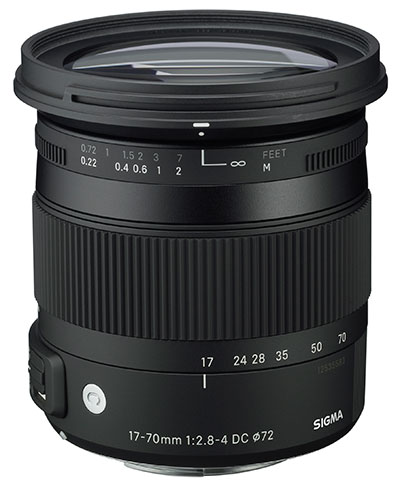
The new DC 17-70mm f/2.8-4 – DC (APS-C format) lenses have never been given the EX designation, even when they clearly matched the EX specifications. Now the EX name and its exterior finish are both going, replaced by one standard for all formats, and one finish.
The entire Sigma range is being restyled, with a new finish, and the old distinctions between EX DG and other lens ‘grades’ are disappearing. “All our lenses have become what we once called EX”, said Graham Armitage of Sigma UK, at photokina. “The demands made by digital systems with higher resolutions mean we have to produce perfect lenses for all the formats from MicroFourThirds to APS-C and full frame.
“Our greatest breakthrough is in MTF testing. We have designed new MTF equipment, which will be used on the production of new lenses from now on. The MTF testing system we use for development is too slow to be used in production, and we have had our own Bayer sensor based system for this purpose. But it was not proving high enough resolution for new camera sensors like the D800.
“Now we have built our own MTF testing system, based on the 46 megapixel Foveon Merrill sensor used in the latest cameras. This allows a much better MTF tests. It will be used to test the sharpness of every new lens that Sigma manufacturers.”
We asked Graham if this would only apply to expensive professional teles, zooms and specialist lenses. “No, it will apply to all lens types”, he said. “We have been able to use the data from the Foveon sensor based tests to improve the performance of all our lenses.” Because the sensor is true RGB not Bayer much better information about chromatic aberration has been gathered and Sigma is feeding this back into the design and manufacture process.
The new lenses have a robust feel, with machined metal barrel and mount components (a current trend for many lens makers) and a slightly soft-looking matt or silk finish. All Sigma lenses are assembled by hand, in Japan, using traditional construction methods.
But the most exceptional advance has been made inside the new lenses – sadly, it can’t be retro fitted to older ones.
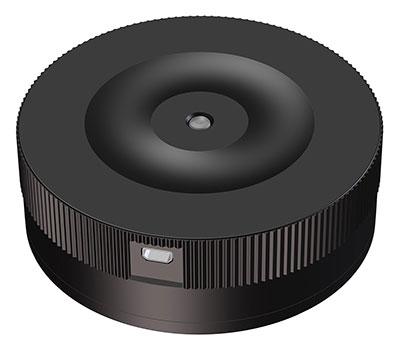
The USB ‘dock in a cap’ has an LED activity indicator and we handled the real thing. This photo looks a bit over-retouched.
All new Sigma lenses will be compatible with a USB-connected dock allowing firmware updates to be made by the user. Sigma has honoured its relationship with users for decades by upgrading the chips inside lenses free of charge whenever the protocols used by camera makers created an incompatibility. Now they have developed a way in which users can do this themselves without the lens having to be returned or ‘operated on’ in a workshop.
“The USB dock will cost about the same as a filter”, Graham told us. I suggested this could mean £50. He indicated I was on the high side. This dock device, which resembles a thick rear lens cap, might be £30 or so.
“It does more than just upgrade the chip”, he continued. “With a PC program, you will be able to change the focusing speed of the lens. All AF systems are a compromise, a balance between speed and accuracy. You will be able to set the lens to suit your working style, increasing the focus speed if you shoot action or improving accuracy if you take subjects like landscapes and portraits.
“All DSLRs have problems with front and back focus. Some cameras offer AF calibration, but not all allow you to have different corrections for each focal length of the zoom lens and for different focusing distances. Using our program, you will be able to calibrate new Sigma lenses for the full range of settings so you don’t get front or back focus at any distance or focal length.
“Not only that, with new telephoto and macro lenses you will also be able to change the distance ranges used by focus limiter switches.”
The new-style 120-300mm f/2.8 – one of the first lenses compatible with the USB programming system, allowing perfect tuning of front and back focus corrections across the zoom and focus distance range.
This function sounds familiar, indeed it’s almost what the new Sony Alpha 99 offers with a restricted range of Sony lenses – on-camera setting of focus range limits. The difference with the Sigma option is that future lenses with a range setting switch can each have their individual far, middle and near limits set and there will be no need to go into camera menus to change the setting when shooting.
Along with Sigma’s recently introduction of nano-type hard coatings which resist water and dirt, their improvements in environmental and dust sealing of lenses, we look forward to testing Sigma products in future and finding them close to the blueprint for the optical design. These innovations draw a line between existing generations of Sigma lenses and the future, as they can’t be fitted to older models. They also take Sigma yet one more step ahead of the camera makers’ own aspirations.
Sigma has always shown the industry what can be done in terms of advanced optical design – often unmatched for many years, with such specifications as the 8-16mm and 12-24mm zooms, the 300mm-800mm and many others remaining unchallenged even by Nikon and Canon. Now they have set out to show what can be done by harnessing a simple standard interface and allowing communication to the lens IC through the contact-pin array.
Finally, Graham showed us the new 35mm f/1.4. “Nikon has done really well with their 35mm f/1.4”, he said. “We thought we would try to beat them with this one. We are hoping it turns out to be the best 35m f/1.4 on the market”. The new MTF testing may yet be proved! I mentioned that Samyang had also done pretty well with a 35mm f/1.4. To that there was no comment…
And then there’s the obligatory picture from any trade show – the man who can’t resist trying to find out what the butler saw, courtesy of the Sigmonster!
– David Kilpatrick
This post has been edited with Sigma’s help on October 3rd. The original reference to Zeiss MTF equipment was incorrect; this is used in design and prototype development, and will continue to be used. Sigma’s own production-line testing system is what’s been updated with new high speed Foveon-based MTF bench.
Most Japanese camera companies have divisions, groups, and teams right down to the very last individual product. Even a single lens design may have its own small team, from R&D and design down to final assembly. What we are seeing happen in Sony right now is the result of complex competition and collaboration between several teams.
Take, for example, the new Sony 300mm f/2.8 G SSM II. You might assume this lens was mainly an Alpha division product from the former Minolta heritage, but in fact it’s been redesigned to work better with NEX and also with both consumer and professional HD video cameras from APS-C through Super-35 to full frame 35mm.
SLT/SLR system users gain with improvements like Nano AR coating (similar to new coatings introduced by Sigma, Nikon, Pentax and Canon), better MF control, and a better degree of weathersealing. It’s the complete update of the SSM motor (is it SSM II, or entire lens version II?) which provides compatibility with on-sensor PDAF and enhances CDAF, to offer the prospect of object-tracking AF during video. At £6,700 UK it needs to show major benefits to compete in the still field, but may have a market all to itself when fitted to the new NEX-VG900E full frame video camera.
It’s easy to think – ‘the first ever full frame video cam!’ but that is not the case. The Canon 5D MkII established the DSLR form as an acceptable professional video camera, and in the last three years a vast industry of shooting rigs, grips, follow focus devices, monitor screens and accessories has grown up all based on turning this video-unfriendly camera into something movie and TV crews are comfortable with.
Sony has implemented the sought-after 24 frames per second rate in all the new models just announced, not going for the European excuse of 25fps being close enough. This is to allow a so-called cinematic look, despite the fact that the movie industry has been trying to get away from 24fps just the same way as it threw off the shackles of 16 or 18fps many years before. Users want it, so they have at last provided it.
From the very start of reviewing HD capable cameras, we have emphasised the issues with audio – the *absolute* not optional need for audio fixed or adjustable manual gain control. I’ve done this for years in printed magazines. So has any other writer who ever had to use a camera with auto gain and nothing else. First Nikon (basic) then Canon (full control) and now Sony show they listened, if slowly and relunctantly, to something their own audio engineers would have told them was vital not a luxury.
End result – Sony enters the mainstream for HD video shooting with the Alpha and NEX systems.
The same technologies, in terms of sensor use and implementation of optical advances linked to Phase-Detection On Sensor (which I’ll call PDOS), now apply across the entire range of Sony digital imaging products from Handycam, through Cyber-Shot, through NEX, to Alpha. The Cyber-shot range is only missing an APS-C model.
What is particularly interesting is that this divided path is a parallel path now and not a divergent one. There’s no question of one straight and narrow path leading to heaven, one broad and easy road to hell, and winding ferny way to faery. Instead we get a four-lane highway joining Sony present to Sony future, with every option to change lane if you want to overtake.
Legacy and inheritance planning
Sony acquired a lot of old Minolta tech as a dowry in the 206 marriage to the Alpha system. Now having invested that legacy they have to make sure it still has value for future generations.
And example of what this really means can be found in the PDOS restrictions of the A99. The AF-D mode won’t work with some lenses, yet. For example – the 16mm f/2.8 fisheye, the 20mm f/2.8, the 16-35mm CZ f/2.8 zoom, any Konica Minolta zoom, any old Minolta AF system lens, the 35mm f/1.4, the 85mm f/1.4 CZ and G, the 135mm f/1.8 CZ and f/2.8 STF, the 200mm f/4 Apo G Macro, the 24-105mm D, any macro lens, the 400mm f/4.5, 600mm f/4, 200mm f/2.8 or the 300mm f/2.8 G SSM (pre-II). It is not even flagged as working with the 30mm f/2.8 SAM macro, 35mm f/1.8, 50mm f/1.8, 85mm f/1.8 or the 24mm f/2 Carl Zeiss SSM ZA. Or the 70-300mm G SSM, let alone the basic 75-300mm SAL.
It will only work with the 24-70mm f/2.8 CZ, the 28-75mm f/2.8 SAM, the 50mm f/1.4 current design, the 70-200mm f/2.8 SSM, the new 300mm f/2.8 G SSM II, 70-400mm f/4-5.6 G SSM and the new 500mm f/4 G SSM. Sony’s firmware requires that the user enter the focusing range involved. This is put forward as an advantage – making the system less likely to focus on a fence instead of the view through it – but in fact it’s an integral part of PDOS. Each of the 102 focus points spread across the sensor* is not a single pixel-pair, it’s a cluster of several pixel pairs tightly grouped. There may be the minimum of three differently pitched PDOS points per location, or perhaps more, to cope with the wide range of exit pupil conditions encountered when using Alpha-mount lenes.
For any one lens, the camera will need to know the broad focus range involved (hopefully the main PDAF array will normally provide this), the aperture at which focusing is taking place, and some further information about how the zoom or lens design influences the exit ray cone. From this, it will select the correct PDOS configuration and I think that for some lenses only a central zone will be active.
Sony states that firmware updates will add further lenses, but this technology only requires some relatively simple information based on the optical design. If they could have added more lenses from the start, they would have. Watch this space, because it may remain more of an empty space than you hope for.
* Sony imply that the PDOS area is large – actually it’s about 13mm square, within the APS-C zone, and does not extend towards the ends of the full frame much further than the cluster of regular PDAF points. These seem to be the same module as the A77, giving the A99 an AF ‘zone’ much smaller relative to its frame.
Zones and maps
The Alpha 99 also introduces something which almost has to happen if any of the above is going to work at all. Anti-aliasing filters do not have an even effect on sensors, especially full frame with wider angle lenses where the rear nodal point of the lens is relatively close. Geometry means that light passes through them at more of an angle towards the edges and corners, and there is therefore more distance between AA filter and sensor surface. With an AA filter having a single value diffraction-created diffusion of the image-forming light (aka blurring), the effect gets stronger as you move away from the centre (axis).
Since most lenses are also sharper in the centre and typical sensor microlenses are not ‘tuned’ from centre to edge, the overall result is to emphasise fall-off from centre to edge. Secondary results include a dramatic tendency for bright sources imaged in the extreme corners to have a strong, directional, surrounding glare. This is boosted by internal multiple reflection between the sensor surface and the inner face of the AA filter, especially if the incident rays are at 40° or less to the focal plane (where on-axis rays are described as being at 90°).
The best solution to this is the classic one – what Olympus called telecentric lens design, where you do your best to project the image on to the sensor from a relatively distant position keeping all rays, centre to edge, as close to 90° as possible. But that calls for new lens designs and also restricts the optical formulae, tending to produce much larger heavier lenses. It’s very practical on one-inch or smaller sensors, OK on MicroFourThirds, feasible for NEX but not much an option for a full-frame coverage.
So, Sony has introduced an AA filter which they describe as ‘multi-segment lo-pass’. It’s not one strength across the entire frame, but divided or graded to optimise performance towards the corners. At the same time, they have introduced a similar zoning to noise reduction, which we assume to mean the NR applies to the raw output before a raw file is saved. Combined with the usual sensor mapping, and lens profile based vignetting compensation, the overall effect of these refinements should be to:
Even out the apparent resolution and image acutance across the frame
Reduce the mapped peripheral gain effect, under which images appear to be noisier at the edges unless natural vignetting is allowed to be present
Remove artefacts such as corner streaking or softening, and fringes or flare from light sources towards the extremes
No doubt this is also combined with the detailed ‘repair’ function used to deal with PDOS. More on this later, as there’s an implication that the PDOS on the A99 is not the same as that on the NEX-5R or NEX-6, and may use a second layer of pixels leaving all 24.3 megapixels of the imaging layer untouched.
The area-specific NR is probably essential to achieve the high ISO range at 14-bit conversion, though it’s not unusual for cameras at this level which claim 14-bit conversion to have a variable true bit depth depending on ISO, image style and exposure conditions. We can assume that 14-bit will only be fully utilised under ideal conditions at ISO 100.
Exactly how Sony has managed to adjust AA values in ‘segments’ without visible transitions, we’ll have to find out. The same goes for NR.
The missing NEX-9
There is one camera absent from the September 12th launch – the 24 megapixel full frame NEX-9. The appearance of the HD video Handycam, NEX-VG900E, indicates that the model name for the full frame 24 megapixel NEX will be NEX-9. Images of the VG900 show it using an Alpha via the standard LA-EA2 adaptor, and we can be sure that this and not a special range of E-mount full frame lenses (almost pointless) will be how the NEX-9 takes A-mount glass.
In the meantime, the NEX-6 appears to be perfectly pitched in price, but see my comment below about GPS.
The missing GPS
While the A99 has GPS, we’re still left with no NEX model yet featuring GPS despite these being the ideal travel and walking companion. Nor is there a current SLT model with 16 megapixels and GPS, as the Alpha 55 replacement doesn’t have it and the ‘baby’ A77, the A65, is a 24 megapixel again. The Cyber-shot RX100 and RX1 models also don’t have GPS. Whether or not the new hot shoe will allow an add-on GPS remains to be seen.
The new 50mm f/1.4 SSM Carl Zeiss T* Planar
Whatever you think of Minolta glass, or new Sony glass, the Carl Zeiss name on a lens is a huge draw. Reactions to the otherwise rather pedestrian DSC-RX1 prove this. People will put up with being back in 1972 – the era of cameras like the Minolta Hi-Matics with fixed 40mm f/1.7 and similar Gauss design lenses of very high quality – if only it means getting rid of poor quality digital images. There was a time when you couldn’t sell a 50mm standard lens with a camera, and there was a time before that when every system was judged initially on the quality of its 50mm choices. We may be returning to that way of thinking.
Edit – at the 2006 launch of the Alpha 100, a 50mm f/1.4 CZ was briefly shown in Paul Genge’s presentation to UK/English language journalists. I did not report on this as none of the literature confirmed what we saw on the Powerpoint screen. I believe this lens has been planned for six years.
Flash
The new HVL-F60AM flash with rather weak video light and new hot shoe might seem an annoying departure, but remember, the A99 has no built-in flash and thus can not control wireless remotes without a commander. No HVL-F20AM style mini flash has been previewed, so the F60AM is the only commander. But your old flash will work fine off-camera controlled by your new one.
Parked on the hard shoulder
So, having looked at the four way road map for Sony, I must confess that I’m pulling into a rest area for a while. I did not sell my Alpha 900 or Alpha 77, and I’m glad I didn’t. Nor did I sell my 24mm f/2 even though it has been little used for a few months. It has been waiting for a 36 megapixel full-framer, which makes a 24mm a much better all-round lens because of the croppable image size.
I’m not one of those photographers obsessed by bokeh or the need to throw parts of my picture into extreme defocus. At 24 megapixels, APS-C is already seriously short of depth of field even at optimum apertures like f/9. I’m more likely to spend my money on a Samyang 24mm f/3.5 full frame tilt-shift lens to use with both the A900 and A77 than to invest in an A99. I have no use for a revised 300mm f/2.8, especially on full frame where it seems to me now to be a very conservative focal length, and though I’m sure a 50mm CZ will be wonderful I have no complaints about my Minolta-design Sony 50mm f/1.4. I do shoot video, but rarely in conditions which demand that I use full frame, and if Sony don’t put manual audio control into older models via a firmware fix, I’ll just buy a Canon 600D.
The price of the Alpha 99 is not as bad as people suggest, with UK stories launching it at £2082+VAT, or $3200. But I’ve got a very good quality pure still camera in the Alpha 900, with effectively noise-free imaging from ISO 100 to 320, excellent battery life and exactly the same maximum image size offered by the 99.
I think I’m in the market for the NEX-6 body but I do not care in the slightest about the WiFi aspect, or the downloadable apps. If the new remote control can actually trigger and end video shooting with the A77, NEX-5n (etc) I’ll definitely buy one. The RX1 is not for me either – had it been fitted with a 17mm, 20mm or even a conservative 24mm then it would have followed in the footsteps of the great wide-angle cameras I have worked with over the years from the Brooks Veriwide through the Plaubel 55W to Hasselblad SWC and Fujfilm G645SW. I would not even mind a separate optical finder for that, much; I was used to it!
Things we forget
The industry has put a huge effort into autofocus solutions ideal for interchangeable lenses and zooms, and apparently set aside the idea of external AF modules for good. With a fixed lens like the RX1, an AF module not working through the camera lens itself is a practical idea and could be far faster. We have also forgotten about those twin-lens compacts, with a switch to go from 35mm to 65mm (or whatever). Small sensor sizes, new lens design and ideas could make that concept work again.
The story of development for all types of camera is not over as there are old ideas to be revisited, and new ideas yet to come.
A-mount flagship 35mm full-frame camera debuts Dual AF System and pro-style video features
Flagship camera with Translucent Mirror Technology and newly developed 24.3 effective megapixel full-frame Exmor CMOS sensor
World’s first full-frame camera1 with Dual AF System with 19 sensors (including 11 cross sensors) + 102 AF point system (focal plane) and a new AF range control function to set the distance range recognised by the AF system
Very wide sensitivity range ISO 50-25600 (at expanded sensitivity setting) with extremely low noise
Advanced Full HD 50p progressive movie shooting with non-stop Continuous AF and pro-style audio features
XGA OLED Tru-Finder with 100% frame coverage
Enthusiast-class handling with tough, light magnesium alloy body, weather seals and revised Quick Navi Pro interface
Ruggedly built to cope effortlessly with tough assignments, the α99 sets new standards of imaging performance, creative options, user-focused ergonomics and reliability to satisfy demanding enthusiasts.
Unsurpassed imaging performance and responses
Unique to the α99, a newly developed full-frame Exmor CMOS sensor with 24.3 effective megapixels is teamed with a highly advanced BIONZ image processing engine. This powerful sensor/processor combination guarantees unprecedented levels of imaging performance with still and video shooting.
Now advanced photographers can explore the creative possibilities of full-frame imaging plus the responsiveness of Translucent Mirror Technology.
The eagerly awaited successor to the flagship α900 DSLR, the new α99 is the first Translucent Mirror camera from Sony to feature a full-frame 35mm image sensor.
The full-frame sensor’s resolving power is enhanced by a newly developed separate multi-segment optical low-pass filter. Assisted by an all-new front-end LSI, the BIONZ engine processes massive amounts of image signal data from the Exmor CMOS Sensor at very high speeds. Together with a powerful new area-specific noise reduction (NR) algorithm, this achieves a 14-bit RAW output, rich gradation and low noise.
The evolved BIONZ processor boosts maximum sensitivity range (in expanded sensitivity mode) as wide as ISO 50-25600 – a range of 9 stops. Its unprecedented processing power also enables the α99 to shoot a burst of full-resolution images at up to 6 frames per second or 10 fps in Tele-zoom high speed shooting mode.
For the first time ever, the 19-point AF system with 11 cross sensors is complemented by a multi-point focal plane phase-detection AF sensor. With no less than 102 AF points, this additional AF sensor overlays the main image sensor. Harnessing the power of Translucent Mirror Technology, this unique Dual AF System permits ultra-fast, accurate autofocusing that maintains tracking focus even if the subject leaves the 19-point AF frame.
The α99 also debuts an advanced new AF-D continuous autofocus mode that’s supremely effective with moving subjects. The 19-point AF system provides reliable depth focusing information. It’s complemented by the 102-point multi-point focal plane phase-detection AF sensor that copes effortlessly with subjects traversing the focal plane.
From launch, new AF-D mode is supported by the SAL2470Z, SAL2875, SAL50F14, SAL300F28G2, SAL70400G and SAL500F4G lenses. More lenses will be supported via future firmware updates.
As a further focusing refinement, a new AF range control function allows users to set the distance range recognised by the AF system. This smart feature significantly aids operability if you’re focusing on distant sports action through a nearby wire mesh fence.
Crafted for videographers and movie-makers
The α99 inherits the world-leading ‘cinematic DNA’ from professional movie cameras and high-end camcorders by Sony. The unmatched resolving power and sensitivity of the full-frame sensor is complemented by advanced features optimised for professional video production.
The α99 supports the needs of professional movie-makers, offering full-frame Full HD 50p/25p (switchable to 60p/24p) progressive video recording to meet AVCHD Version 2.0 specifications. As introduced on the α77, Full-time Continuous AF Movie allows smooth, non-stop tracking of moving subjects. Other movie-oriented enhancements include real-time Full HD video output via HDMI, and uninterrupted ‘dual-card’ recording using both of the camera’s media slots.
For extra convenience during movie shooting, a silent new multi-controller is easily accessible via a dial on the front of the camera body. This allows smooth, silent adjustment of exposure compensation, ISO sensitivity and metering method, shutter speed, aperture and audio record levels during Full HD video capture. Shooting stamina is tripled by partnering the camera with the new VG-C99AM Vertical Grip that houses up to three batteries in total (see below). It’s even possible to exchange batteries ‘on the fly’ without interrupting movie recording.
Audio features have also been significantly enhanced to meet the exacting needs of serious videographers. An audio level display and adjustable audio record levels are joined by a headphone jack for accurate in-the-field monitoring. The optional XLR-K1M adaptor kit adds a high-quality mono shotgun mic and pro-standard XLR connections for dependable audio acquisition.
Uncompromised handing for serious photographers
The XGA OLED Tru-Finder gives a detail-packed view of your subject, offering 100% frame coverage with exceptional brightness, contrast, clarity and resolution.
You’ll enjoy a full 100% view on the Tru-Finder screen, even if you’re shooting with a DT lens that’s optimised for cameras with an APS-C sensor. Angle of view is converted automatically for image recording and display. This viewfinder is completely compatible with the APS-C format and displays scenes using the entire finder screen.
Complementing the Tru-Finder, there’s also a three-way tiltable 1229k-dot (VGA equivalent) XtraFine LCD with WhiteMagic™ technology to boost screen brightness in outdoor conditions.
Despite its uncompromising pro-class credentials, the α99 is the world’s lightest1 35mm full-frame interchangeable-lens digital camera. A weight of just 733g (without lens and battery) is made possible by Translucent Mirror Technology, while high-rigidity magnesium alloy panels contribute to an extremely tough yet light design.
Weather-resistant seals protect against dust and moisture, while controls and buttons are ruggedized for years of unflinching operation on virtually any assignment. The camera’s stamina and reliability is underlined by a redesigned shutter block that’s tested to approximately 200,000 release cycles.
Ergonomics have been refined for a smooth, seamless workflow that doesn’t interrupt your creative focus. Enhancements include a re-designed grip, while switches and button shapes are differentiated for intuitive fingertip operation without taking an eye off your composition. There’s also a new exposure mode dial lock that prevents accidental rotation.
Further evolved from the acclaimed α700 and α900, the newly-developed Quick Navi Pro interface gives quick, intuitive one-handed access to shooting parameters.
The camera can also be operated via remote PC connection. Supported functions include switching between still/movie shooting, plus automatic transfer of still images from camera to PC for enhanced studio workflow. *Editor’s note: betcha there’s no Mac app given Sony’s historic attitude to Apple!
Designed for professionals: new lens and accessories
The full-frame imaging capabilities of the α99 make an ideal complement for the new 300mm F2.8 G SSM II (SAL300F28G2) lens. Designed for demanding sports and wildlife applications, this bright super-telephoto offers a significantly uprated optical design and improved handling compared with its predecessor. The Sony-developed Nano AR Coating on optical surfaces assures flawless still images and HD video with reduced flare and ghosting, offering enhanced contrast with crisp black, while a new LSI drive circuit offers faster, more accurate autofocus with enhanced tracking AF. The dust- and moisture-resistant design makes the lens ideal for the toughest outdoor shooting assignments.
In addition, a new wide-aperture Carl Zeiss A-mount prime lens is now under development. Optimised for superb results with the camera’s 35mm full frame image sensor, the Planar T* 50mm F1.4 ZA SSM will be available in Spring 2013.
Offered exclusively as an option for the α99, the brand-new VG-C99AM vertical grip can house and manage three batteries in total (including the camera’s own on-board battery). Resistant to dust and moisture, the grip is ideal for lengthy shooting sessions in the studio or outdoors.
The range-leading HVL-F60M is a powerful flash (GN60, in metres at ISO 100) with built-in LED light that’s ideal for creative applications with stills or movie shooting. Smart functions include wireless multi-flash ratio control and Sony’s unique Quick Shift Bounce adjustment, while operation can be controlled quickly via the flash’s intuitive Quick Navi system. Resistant to dust and moisture, the HVL-F60M comes supplied with a bounce adaptor for flash, and a colour conversion filter for use with LED lighting. Ideal for the α99 and other cameras featuring the new Multi Interface Shoe, the HVL-F60M can also be used with Auto-lock Accessory Shoe cameras via the supplied ADP-AMA Shoe Adaptor.
Compatible with 49mm and 55mm diameter lenses, the HVL-RL1 Ring Light offers highly effective LED illumination of small subjects that’s ideal for macro shooting. Its high output level (approx. 700 lx/0.3m) is approximately four times brighter than the previous model. Brightness can be adjusted steplessly for precise control of creative lighting effects. Operation can also be switched between full-ring illumination for shadowless lighting and half-ring illumination to create shadow effects. The optional FA-MA1AM Macro Light Adaptor is required when using the Ring Light with SAL30M28 or SAL50F18 lenses. Compatible with the Multi Interface Shoe of the α99, the HVL-RL1 can also be used with cameras that have an Auto-lock Accessory Shoe via the supplied ADP-AMA Shoe Adaptor.
The new XLR-K1M XLR Adaptor Kit meets the demanding audio needs of professional movie production. It provides two pro-standard XLR terminals for connecting the α99 with professional microphones and mixing consoles. Operating flexibility is maximised by MIC/LINE input selection and separate adjustment of two channel levels. The adaptor kit comes supplied with the ECM-XM1 monaural shotgun microphone, but may also be used with a wide range of professional microphones. An optional bracket is required when using the XLR-K1M with the α99.
The RMT-DSLR2 Remote Commander allows wireless shutter release for still images and start/stop control of video shooting. As well as the α99, it’s also compatible with other α A-mount and E-mount cameras that include a remote control receiver. (Our highlighting in red – this may NOT mean that it can operate video on other cameras, just that it will operate their existing remote functions – dependent perhaps on firmware updates)
Styled to reduce carrying fatigue, the LCS-BP3 Backpack is designed to meet the stringent demands of professional photographers. Its generous capacity can hold the α99 camera body plus Vertical Grip and attached telephoto zoom lens, together with 3-4 spare lenses, accessories and a 15.5” laptop.
The ADP-MAA is a new shoe adaptor that allows Multi Interface Shoe2 cameras to be used with Auto-lock Accessory Shoe accessories. Conversely, the ADP-AMA she adaptor allows Auto-lock Accessory Shoe cameras to be used with Multi Interface Shoe accessories.
The PCK-LM14 Screen Protector Semi Hard Sheet safeguards the camera’s LCD screen against dust, scratches. It’s supplied with a separate protector sheet for the top display panel.
Sony’s new SDXC UHS-I memory card, SF-64UX(64GB) with ultra-high speed interface (UHS-I) compatibility, offers significantly higher transfer speeds up to 94MB/s (read) and 43MB/s (write). The SF-64UX is ideal for burst shooting with the α99, without missing the moment. It also enables rapid data rates when transferring content including large RAW images or video files to your PC.
The new cards have been subjected to rigorous Sony testing, in order to achieve high levels of reliability and data integrity. Additionally, the new cards are water-resistant, and are designed to perform under a wide range of operating temperatures. Users can also shoot with ease knowing their photos and videos are protected thanks to Sony’s File Rescue Software* which can help recover photos and videos that may have been accidentally deleted.
(*This software is available for Sony memory media products customers through free download at www.sony.net/memorycard)
The new α99 full-frame Translucent Mirror camera from Sony is available in the UK from early November 2012.
1 Among interchangeable-lens digital cameras with a full-frame image sensor (as of 12th September 2012). According to Sony internal survey.
2 The α99 is equipped with Sony’s newly-developed Multi Interface Shoe. This is capable of accommodating various accessories for photo and movie shooting such as flash and microphones, while drawing power from the camera. It’s also compatible with Sony accessories that use the standard ISO 518 accessory shoe. The Multi Interface Shoe was developed as a common shoe for imaging products by Sony – such as digital still cameras, digital video cameras and interchangeable lens cameras – promoting compatibility among accessories and offering an enhanced shooting experience for users.
Compatible with full-frame A-mount lenses via supplied adaptor (also compatible with growing range of E-mount lenses)
Full HD 50p/25p/24p progressive movie recording
Extensive manual controls and ‘seesaw’ zoom lever
Quad Capsule Spatial Array Microphone for high-quality stereo and 5.1ch sound
High contrast XGA OLED Tru-Finder
7.5 cm (3.0”) XtraFine touch panel LCD
Video makers can embrace the limitless expressive power of full-frame imaging with the new Handycam® NEX-VG900E E-mount interchangeable lens Full HD camcorder from Sony.
It’s joined by the Handycam® NEX-VG30E that builds on the success of the NEX-VG20E, sharing the same APS-C image sensor as its predecessor while adding several enhancements.
Handycam® NEX-VG900E
Offering supreme imaging quality and generous creative options, it’s the first Handycam® with a 35mm sensor to fully exploit the artistic potential of interchangeable lenses by Sony and Carl Zeiss.
With a resolution of 24.3 effective megapixels, the Sony-developed Exmor CMOS sensor inside the NEX-VG900E is around 40 times larger than the equivalent in ordinary consumer camcorders. It’s also more than twice the size of the APS-C sized sensor found in other interchangeable lens Handycam® models.
As well as permitting beautiful ‘bokeh’ (defocus) effects with the growing range of α lenses, its high sensitivity assures extremely clear, low-noise images. The large sensor size assures effortless reproduction of the finest tonal gradations, helping the most demanding cinematographer fully realise their creative vision.
The sensor also allows the NEX-VG900E to shoot full-frame 24.0 effective megapixel still photos, with all the quality you’d expect from a pro-class DSLR camera. Still images can be shot in RAW format for total post-processing freedom.
Beautiful, film-like results can be achieved by shooting video in 25p/24p progressive mode, with Cinema Tone Gamma™ and Cinema Tone Colour™ offering precise control over cinematic colour grading effects. AVCHD version 2.0 standard 50p recording is additionally supported, maximising the range of creative options for movie-makers to explore. Even greater flexibility is provided by a choice of new Picture Effect modes, enabling easy creation of artistic ‘in-camera’ treatments whether you’re shooting HD video or stills.
Video shooting is further enhanced by a ‘seesaw’ lever that allows smooth, polished electronic zoom control. The lever adjusts optical zoom when using compatible E-mount lenses that feature built-in zoom drive. The lever controls electronic zoom when using the camcorder with fixed focal lenses for impressive creative results.
As an extra refinement, the NEX-VG900E switches automatically from full-frame operation to APS-C mode when an E-mount or A-mount DT lens is attached. This allows users to get the most out of their collection of DT lenses that are optimised for cameras with a smaller APS-C image sensor.
The camcorder also comes supplied with the LA-EA3 adaptor that lets photographers use full-frame A-mount DSLR lenses at their designated focal length.
There’s a generous palette of control options and manual settings to satisfy the demanding video enthusiast. Aperture priority, shutter speed priority or manual exposure, are all selectable and white balance can be adjusted manually to suit the demands of any scene. Iris, shutter speed, and gain adjustments can be easily made via logically-positioned direct access keys. Accurate manual focusing is assisted by the camcorder’s pro-style display peaking function, complemented by a one-touch focus magnification button on the top of the grip.
Serious videographers will welcome the detail-packed XGA OLED Tru-Finder that offers high-contrast image monitoring with superbly natural colour rendition. Complementing the Tru-Finder, there’s an adjustable XtraFine touch-panel LCD monitor, with Sony’s unique technology for high contrast images with rich, deep blacks.
High-quality audio is a crucial part of the HD video experience with the NEX-VG900E. A unique Quad Capsule Spatial Array Microphone features four omnidirectional capsules that can be switched for stereo or 5.1ch surround recording. Recording levels are adjustable, with accurate visual confirmation provided by an audio level meter on the LCD display. There’s also a headphone jack for direct monitoring of sounds being recorded.
The new Multi Interface Shoe provides compatibility with accessories including the optional XLR-K1M adaptor kit that adds a high-quality mono shotgun mic and pro-standard XLR connections.
Handycam® NEX-VG30EH/VG30E
Sharing many of the pro-oriented enhancements of the NEX-VG900E, the Handycam® NEX-VG30E succeeds the acclaimed NEX-VG20E. With a resolution of 16.1 effective megapixels, the new camcorder’s Exmor™ APS HD CMOS sensor assures outstanding image quality with the range of interchangeable E-mount lenses.
Like the NEX-VG900E, it’s possible to shoot smooth, cinematic Full HD video footage at either 50p, 25p or 24p (progressive) frame rates, supported by a palette of artistic Picture Effect modes.
The NEX-VG30E also features the same XGA OLED Tru-Finder, comprehensive manual controls and ‘seesaw’ style zoom lever as the NEX-VG900E.
The NEX-VG30EH comes supplied as a kit with the new E PZ (Power Zoom) 18-200mm F3.5-6.3 OSS (Optical SteadyShot) lens that provides a versatile range from wide angle to telephoto. Offering smooth, quiet AF operation and Optical SteadyShot image stabilisation, the lens also features an additional ‘seesaw’ lever on the barrel for smooth, professional-style zoom control with adjustable speeds.
The Handycam® NEX-VG900E and NEX-VG30E camcorders from Sony are available in the UK from November and December respectively.
For almost a decade the Sigma 12-24mm full frame ultra wide angle zoom has been unrivalled by any other makers – not Nikon, not Canon, not Tamron, not Tokina, not Sony. No maker has ventured where Sigma went, to the extremes of over 120° coverage combined with well corrected straight line geometry.
Today, the original 12-24mm is in its fourth incarnation, having progressed through EX to EX DG (digital) and then with added HSM hypersonic motor focusing, which never arrived for Alpha mount in the original design. The fourth version is an entirely new design, and does have HSM for Alpha. It is very similar to the new 8-16mm design, introduced three years ago for APS-C cameras, which also offers HSM focusing in Alpha mount.
Update five years later, 2017: there is now a constant aperture 12-24mm f/4 ART lens. This is a completely new design and has an almost-perfect performance, especially in terms of corner detail wide open. I’ve tested it in Cameracraft magzine. However, I did not have the various older models to make direct comparisons. The MkII remains available as the current non-ART, lower priced Sigma option.
Here you can see, from left to right, the EX DG 12-24mm f/4.5-56, the DC 8-16mm f/4.5-5.6, and the DG HSM II 12-24mm f/4.5-5.6. Don’t be fooled into thinking the original is wider in diameter, it actually shares exactly the same lens cap module as the new design; it’s smaller and around 100 grams lighter. Both the 8-16mm and new 12-24mm are surprisingly solid items.
First, we’ll look at the difference between old and new 12-24mms. I have used the old one in several versions on several different camera makes. and I’ve never had one which was truly sharp at all point across the frame wide open. The field is not perfectly flat, and autofocus modules are very bad at getting an exact focus at 12mm. Combined with lens mount tolerances, sensor flatness problems (mostly in Canon full-frame, which historically have not had very ‘plane’ sensors), sensor parallelism problems (all makes, Sony not excepted)… it was always a good idea to stop this lens down to f/11.
How bad is that? Perfectly normal for any lens covering over 85°. Even the best large format lenses, single focal lengths like Super Angulons, have always been used in the awareness that full aperture is for focusing and you stop down to between f/11 and f/32 for the actual shot. On 35mm format digital, using anything much below f/16 is counter productive for sharpness and my normal choices on the Alpha 900 have been f/10, f/11, or f/13.
The good news is that the latest version has a different kind of field flatness. The old one tended to have a zone, like a doughnut, of closer effective focus surrounding a sharp middle. At 24mm, where this older lens performed at its worst, this zone was pushed out to the far edges and could result in the corners looking softer than they do at 12mm. The new one has a simple barrel distortion in place of a wave-form distortion, and along with this goes a simple curvature of field.
The bad news is that the overall level of distortion is much higher than the old design. At 12mm, it’s close to needing the fingers of two hands. Adobe Camera Raw had a correction profile for this lens from Sigma almost the day it became available. That profile fixed the distortion perfectly but leaves you slightly less of a 12mm than you’ve paid for, because it reduces the angle of view.
Here are some comparative views. First of all, I’ve used only 10 megapixels of the Alpha 900 frame, cropping from the top of a vertical shot, to get this architecturally correct view. This is like using the 12-24mm as an extreme 12mm shift lens on an APS-C camera. As and when we get a 36 megapixel Alpha full framer, the crop to do so will be more like 16 megapixels. This is the full frame:
Below you can see the crop used to 10 megapixels, and by rolling your cursor over the image, the change between a profiled conversion and a raw conversion with no lens corrections. On this crop it does not look extreme.
But this is a relatively kind way to use the new lens. Here is an example pushing straight lines into places where extreme wide angles don’t like ’em:
This is an uncorrected 12-24mm DG II HSM shot out of the Alpha 900 at 12mm. It’s not exactly what you want, and in fact, it’s not as ‘good’ as the old design despite being sharper. Hovering your cursor over the image shows the same raw file with the Adobe Camera Raw Sigma-generated Lens Profile (also works in Lightroom) applied. As you will see, straight lines have been restored along with even illumination. But – how much of that 12mm, 122° angle has been lost? Is it now really only a 12.5mm?
In practice, the new 12-24mm gives you a great range of creative choices when confronted with a building. Here is a revisit to the first subject, taken at different focal lengths, getting closer to the building with each shot:
24mm
20mm
17mm
15mm
12mm
When it comes to comparisons with the older design, the new one is much sharper at the edges. It does not need stopping down to f/16 to pull in the worst aberrations, though it does still display some around f/8 to f/11. Here’s an original 12-24mm EX DG design shot (12mm, f/9, vignetting corrected but distortion not corrected):
And here’s the new 12-24mm under the same conditions (small exposure difference due to changing light) processed similarly, without any geometric corrections:
On this shot, the corrugated barn sides have clean ribbing to the extreme ends, with some softening; on the old design, they begin to look a bit of a mess in the outer quarter of the frame.
Trying the 8-16mm extreme
But when doing these tests, I decided to throw a novelty into the mix. What if I put my 8-16m APS-C format Sigma DC HSM zoom on to the Alpha 900? Because it is not an Alpha lens, the 900 does not automatically crop the full frame. This is what I actually got with the lens set to 8mm:
And in Adobe Camera Raw, I just dialled up the Scale in Lens Correction to 146%, which blew up the central 12 or so megapixels of the frame to become a full 24 megapixel image:
And here, for comparison, is what the 12-24mm set to 12mm could produce:
This is a little tighter than the 8mm using the maximum I could get (including some extra image height), so the 8-16mm used this way can produce something closer to an 11.5mm full frame lens. However, I have not yet done the obvious – to get an engineer to remove the petal lens shade from the 8-16mm (it appears to be part of the front element assembly). This would enable even more angle without shading, and the possibility of square or 10 x 8 shape format crops.
What was particularly interesting about this experiment was the quality of the 24 megapixel file extracted from a smaller section of the Alpha 900 sensor by Adobe Camera Raw upscaling. Full size files are available to download for subscribers to Photoclubalpha – it’s well worth the $10 for a full year of access to any of the extras we provide. See the download links at the end of the article, which will become visible if you are a registered subscriber to the site.
The 8-16mm also achieves full frame coverage on the Alpha 900 when set to 16mm, though with fairly marked vignetting:
Here are some more samples from the 12-24mm DG II HSM: first, 17mm at f/8 – no geometry correction:
Next, at 12mm at f/13 which on the A900 seems to be the limit for good detail sharpness without extra effort in processing:
And 17mm at f/22 – beyond the diffraction limit, but processed carefully for detail:
And 12mm at f/9, an optimum setting for detail with plenty of depth of field for this subject:
So, what was my own decision? I own the 8-16mm and an Alpha 77. That’s what I use for travel and general work. I own an original EX DG 12-24mm. I decided not to buy the new 12-24mm because I concluded that the 8-16mm used on APS-C was effectively as good. The angle is not quite a match for the 12-24mm on full frame, as APS-C is not a true 16 x 24mm. For those occasions where a 12-24mm on full frame is needed, I’m nearly always able to work on a tripod at f/13 and focus manually (which overcomes most of the issues with the earlier lens). Since it needs less drastic geometric correction, it offers a very small angle of view advantage over the new lens in return for the risk of poor sharpness if not used well stopped down. I have no doubt the new lens is better, but it’s not £400 better which is what the ‘trade-up’ would cost – and the old lens is lighter and smaller, which I appreciate.
The test made me even happier with the 8-16mm, especially with the thought that some modification could make it a unique lens to use on the Alpha 900 or a future full frame EVF model (A99). After doing these tests, I decided it was not necessary to take the Alpha 900 and a 12-24mm despite the investment in two weeks’ shooting in the Sierras and Pacific Coast of California – the A77 and 8-16mm would do everything I needed.
But for those buying a 12-24mm, for full frame on any system, the new Sigma represents even better performance than the 8-16mm (better edge and corner sharpness at one stop down from wide open) and has none of the failings of the older lens even if it does need more post-process geometry correction.
Download full size images [private] 24 megapixels 12-24mm EX DG at 12mm f/9 Download Link
Download full size image 24 megapixels 12-24mm DGII HSM same as above Download Link
Download full size image 24 megapixels 8-16mm lens scaled to 24 megapixels from A900 ‘crop’ Download Link
Download full size image 24 megapixels 12-24mm DGII at 12mm compared to 8-16mm at 8mm cropped Download Link
Download full size image 24 megapixels 8-16mm at 16mm filling full A900 sensor Download Link
Download full size image 24 megapixels 17mm f/8 fence example shot boat Download Link
Download full size image 24 megapixels 12mm f/13 sequoia tree example shot Download Link
Download full size image24 megapixels 17mm f/22 boat Download Link
Download full size image24 megapixels 12mm f/9 riverside tree Download Link [/private]