Lightest in class for fast, full-frame 85mm AF lenses
Available for E-Mount and L-mount systems
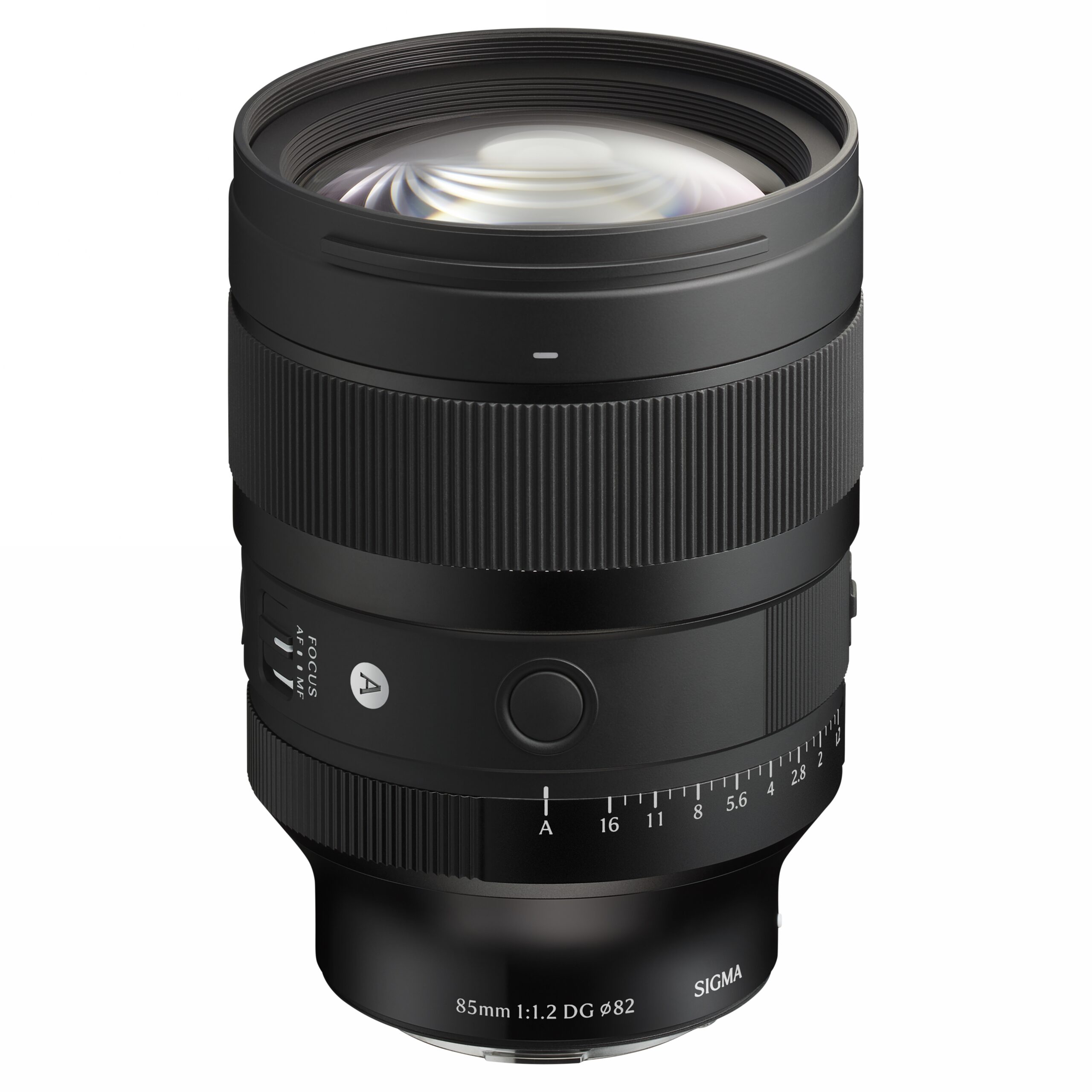
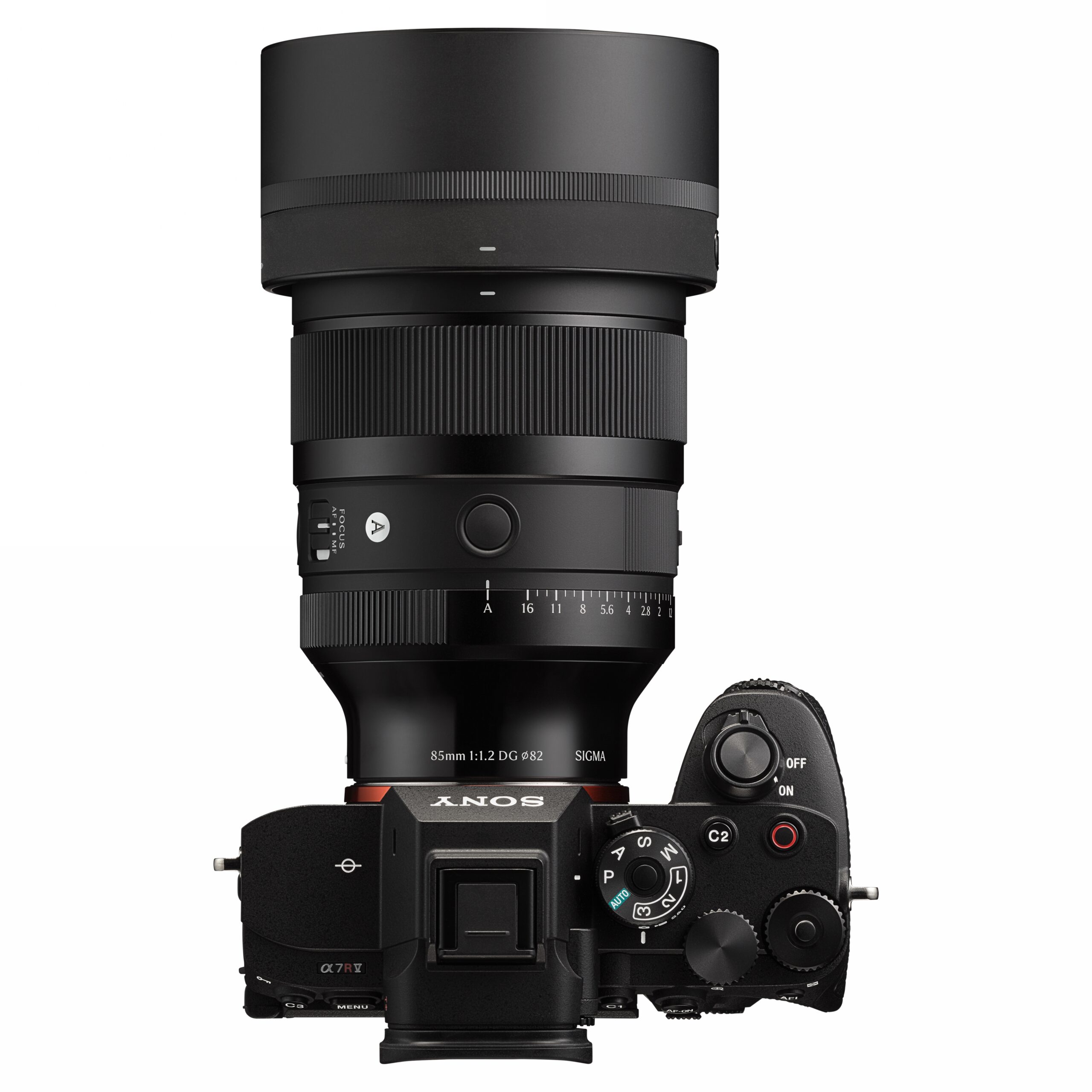
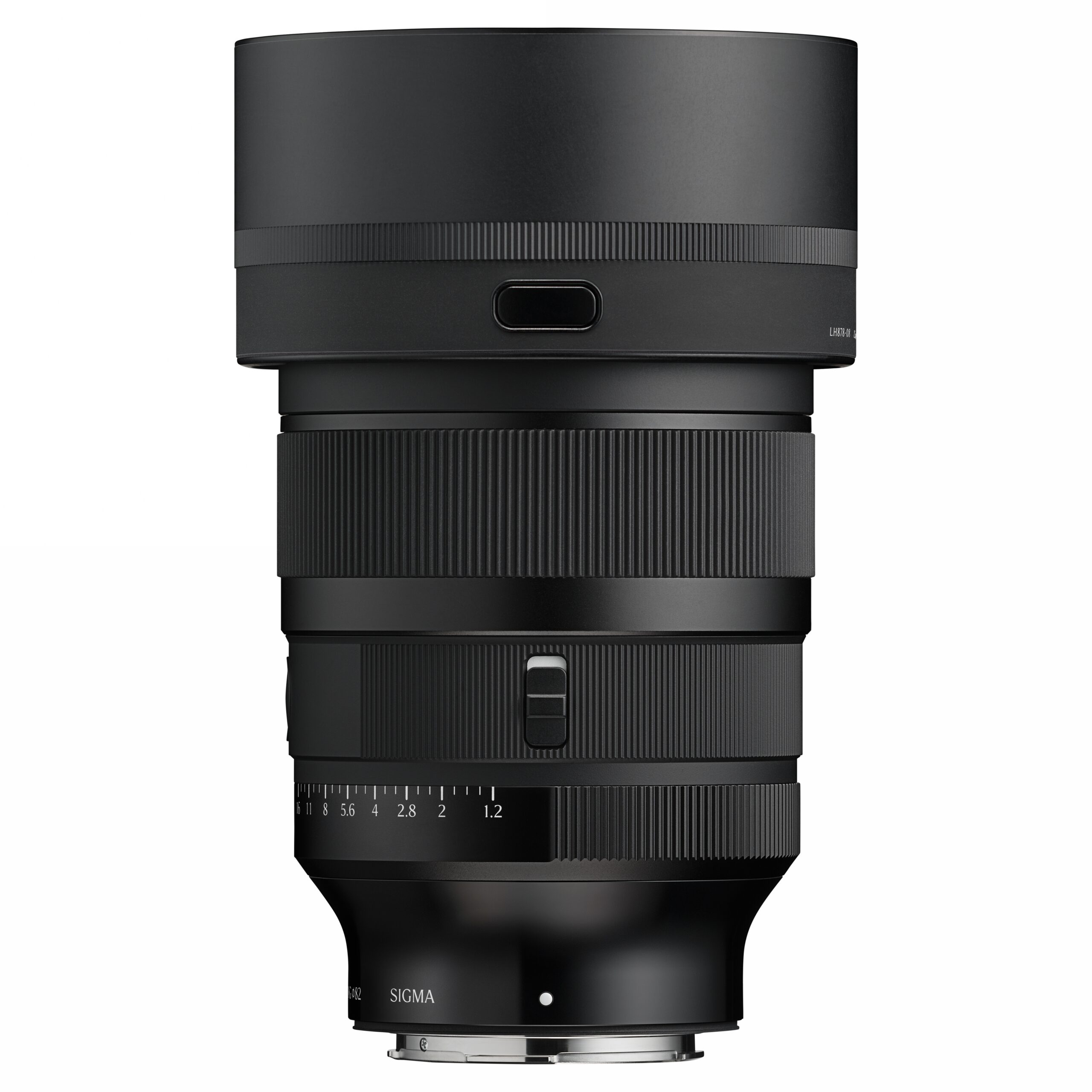
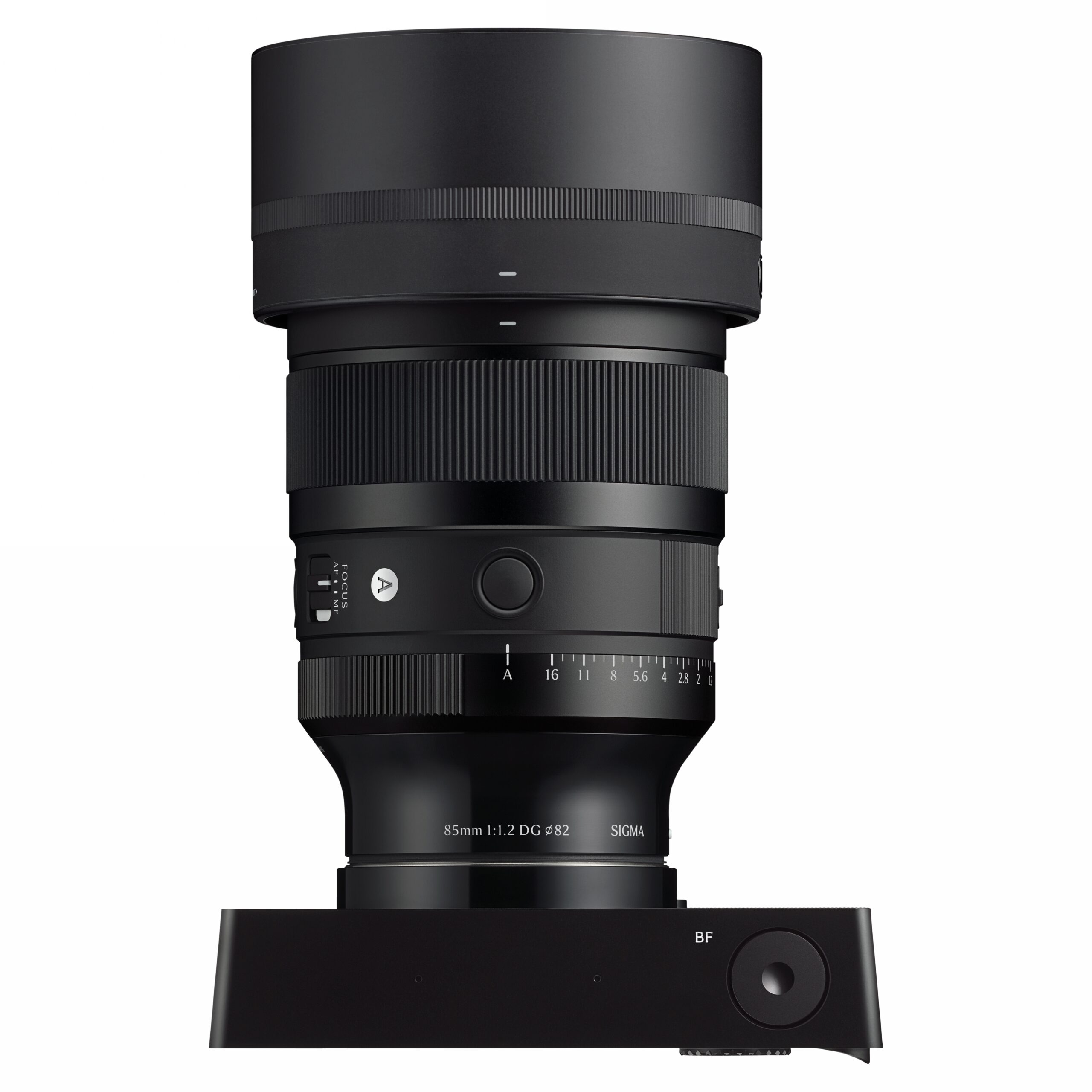
Completing a trio of F1.2 full-frame prime lenses, the Sigma 85mm F1.2 Art offers the control and clarity of the best large-aperture 85mm lenses, but with less bulk thanks to pioneering industrial design and materials. The new lens complements the existing 50mm F1.2 DG Art and 35mm F1.2 DG Art.
Sigma’s use of composites and engineering plastics has evolved since the first ‘Global Vision’ lenses were announced in 2012, and in the latest Art series this makes it possible for a 17-element, 13 group 85mm f/1.2 lens to weigh 905g.
A dual-mode locking aperture ring (auto mode, or range mode, is locked at power up based on selection) plus two AF-L buttons which can be reassigned, and the abilty to turn off aperture click stops.
Taking advantage of the F1.2 shallow depth of field is a 13-blade rounded diaphragm, and an optical formula including two SLD elements also uses high anomalous dispersion glass to suppress axial chromatic aberration.
The Sigma 85mm F1.2 Art costs £1299, and is available in E-Mount for Sony, and L-mount for Sigma, Leica and Panasonic mirrorless camera systems. Pre orders open 8 September 2026 with stock expected from 30 September 2026.
Compact wide-standard zoom for E-Mount and L-Mount
Full-frame 3x zoom at a size and weight close to APS-C options
On sale from 30th September, RRP £749
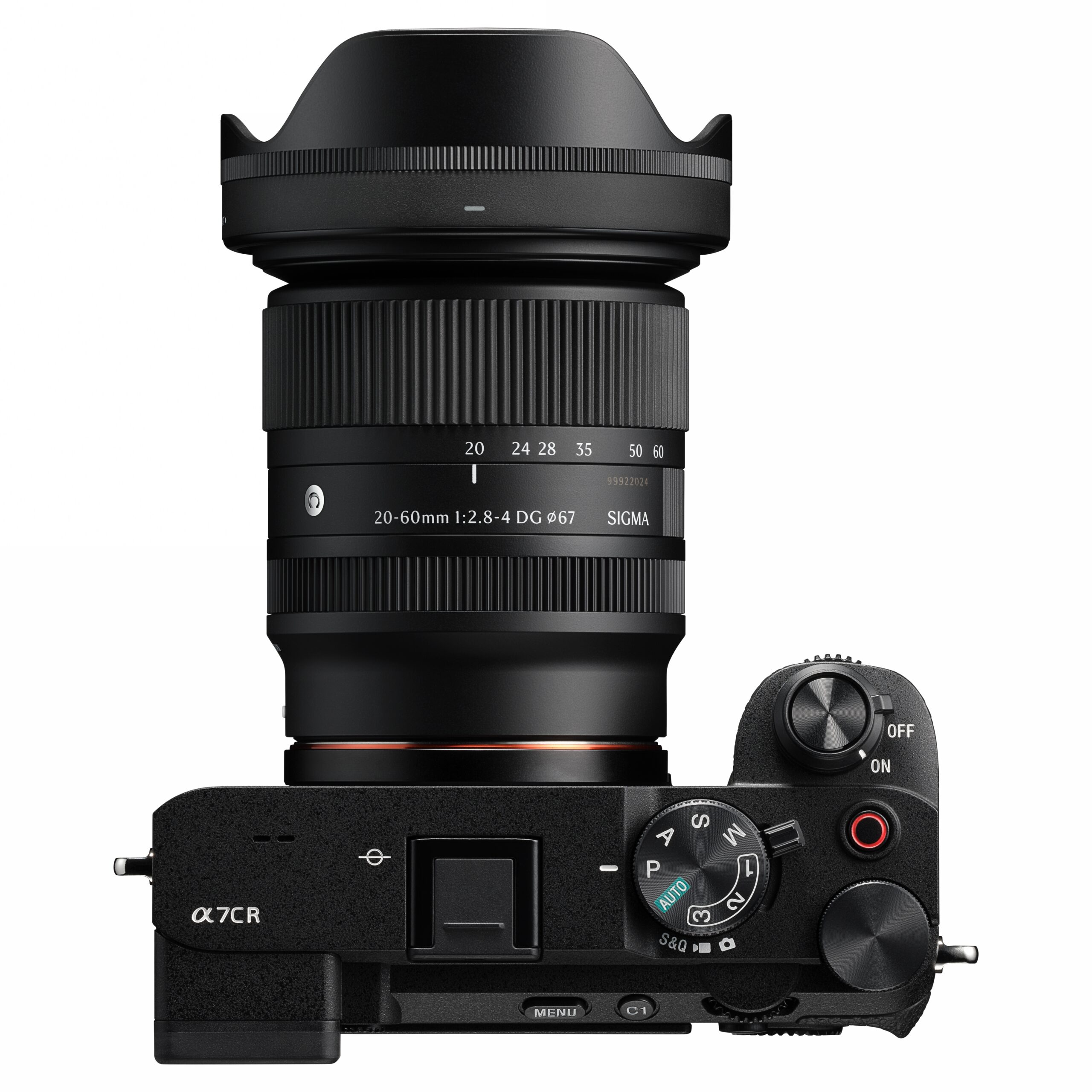
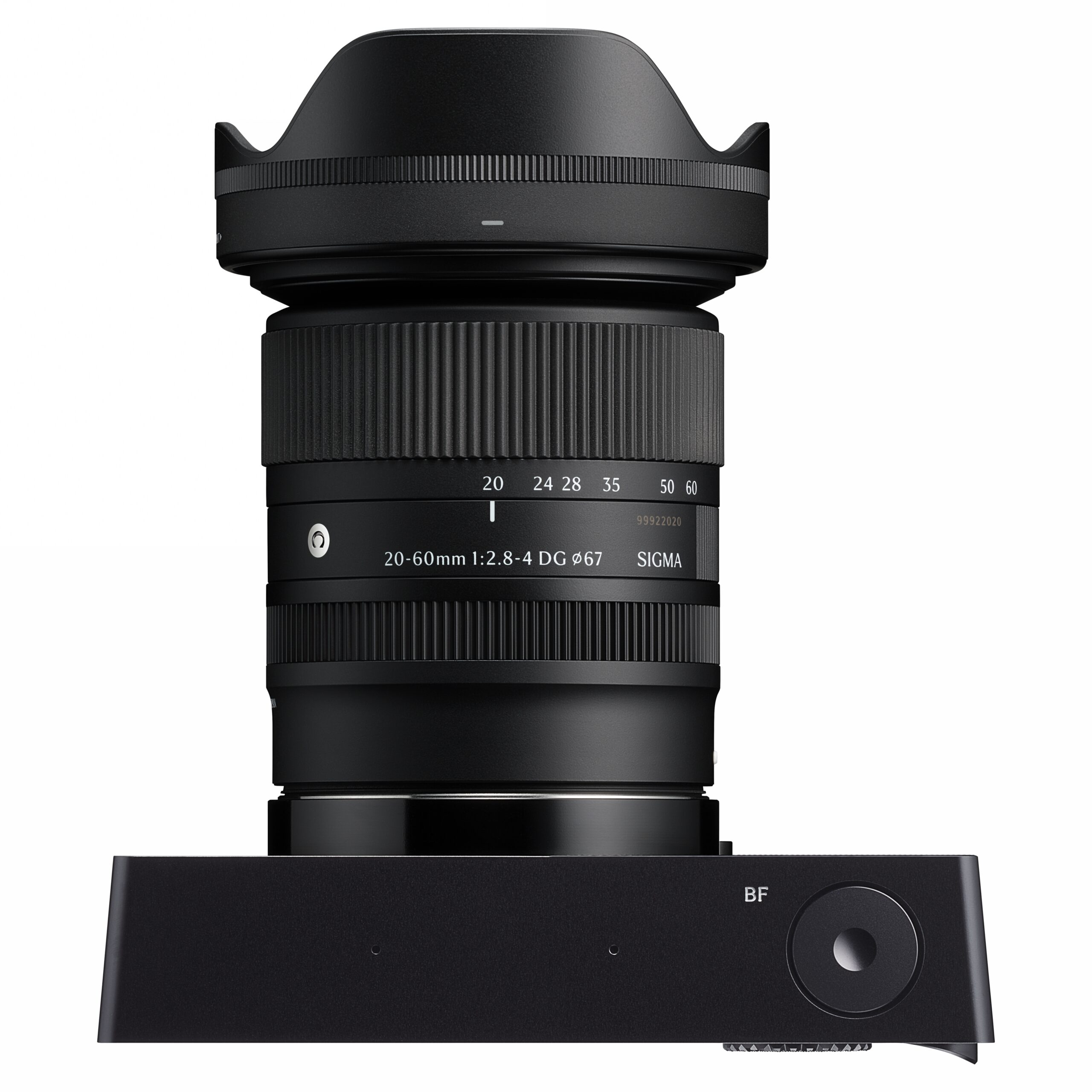
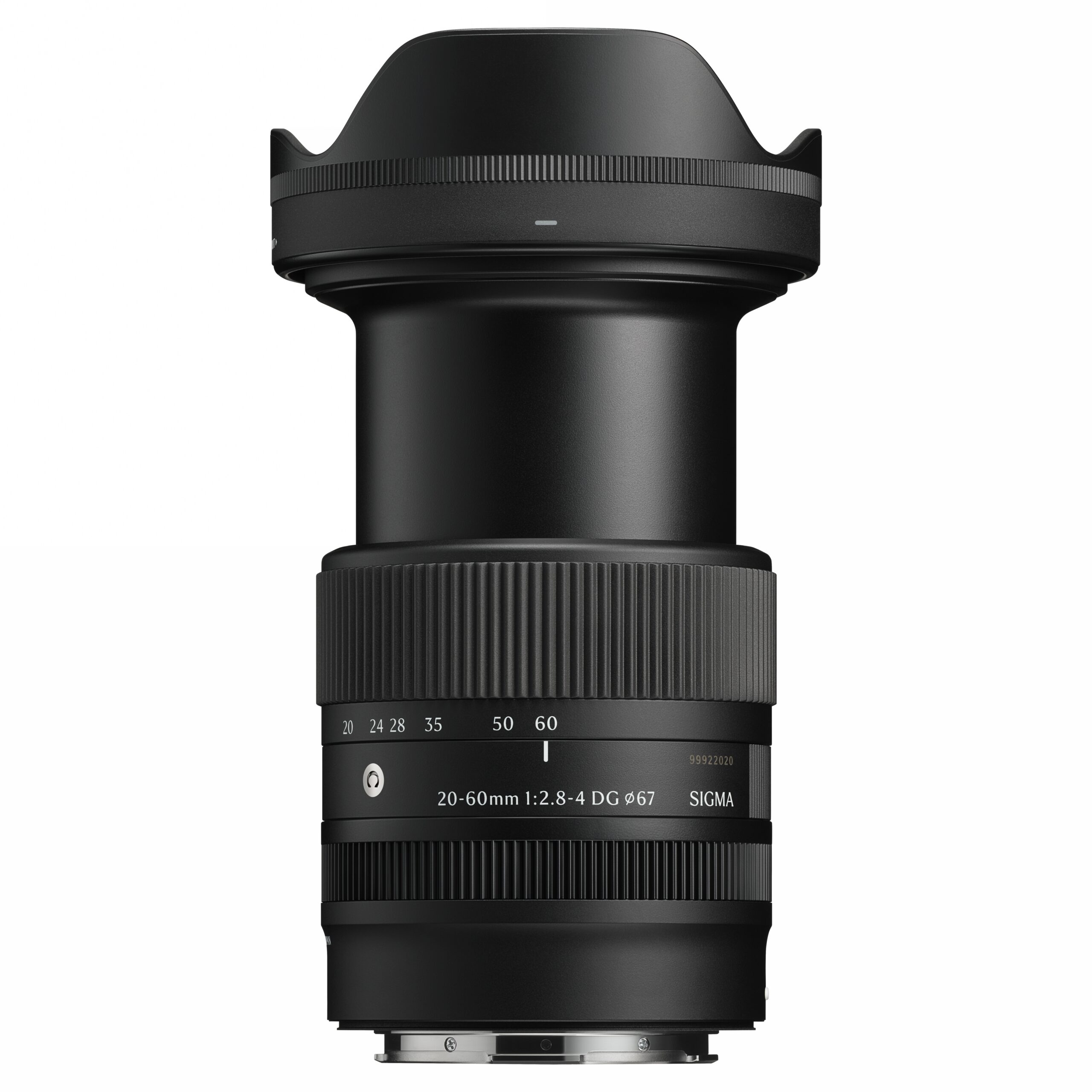
Sigma expands the full-frame Contemporary lens range with a wide-standard zoom for L-Mount and Sony E-Mount systems, offering light weight and a versatile close-up capability for a competitive price. The 20-60mm F2.8-4 DG I Contemporary lens weighs less than 400g and features weather resistant coating and seals, a 67mm filter thread, and compact 86-88mm minimum depth.
Designed to offer optical performance better than typical kit lenses, the 15 element, 13 group construction includes three aspherical, three SLD elements. A nine-blade rounded diaphragm contributes to a modern, clean bokeh and the lens has been engineered to minimise focus breathing.
As a versatile and compact 3x zoom covering ultra-wide to standard focal lengths, the 20-60mm F2.8-4’s flexibility extends to a minimum focus distance of 15.8cm at 28mm and a 1:2.3 magnification ratio at 35mm. At 60mm the minimum focus is 25cm with 1:2.9 magnification. The 67mm filter thread means affordable accessories, and the lens comes with a petal bayonet hood, rear and front caps, and a carrying pouch as standard.
The Sigma 20-60mm F2.8-4 DG I Contemporary lens for Sony E-Mount and Sigma/Panasonic/Leica L-Mount systems is available to pre-order at around £749 from 8 September 2026, with stock expected from 30 September 2026.
Sigma is also offering an additional £50 trade-in bonus on pre-orders (above the agreed trade-in value) until 30 September 2026.
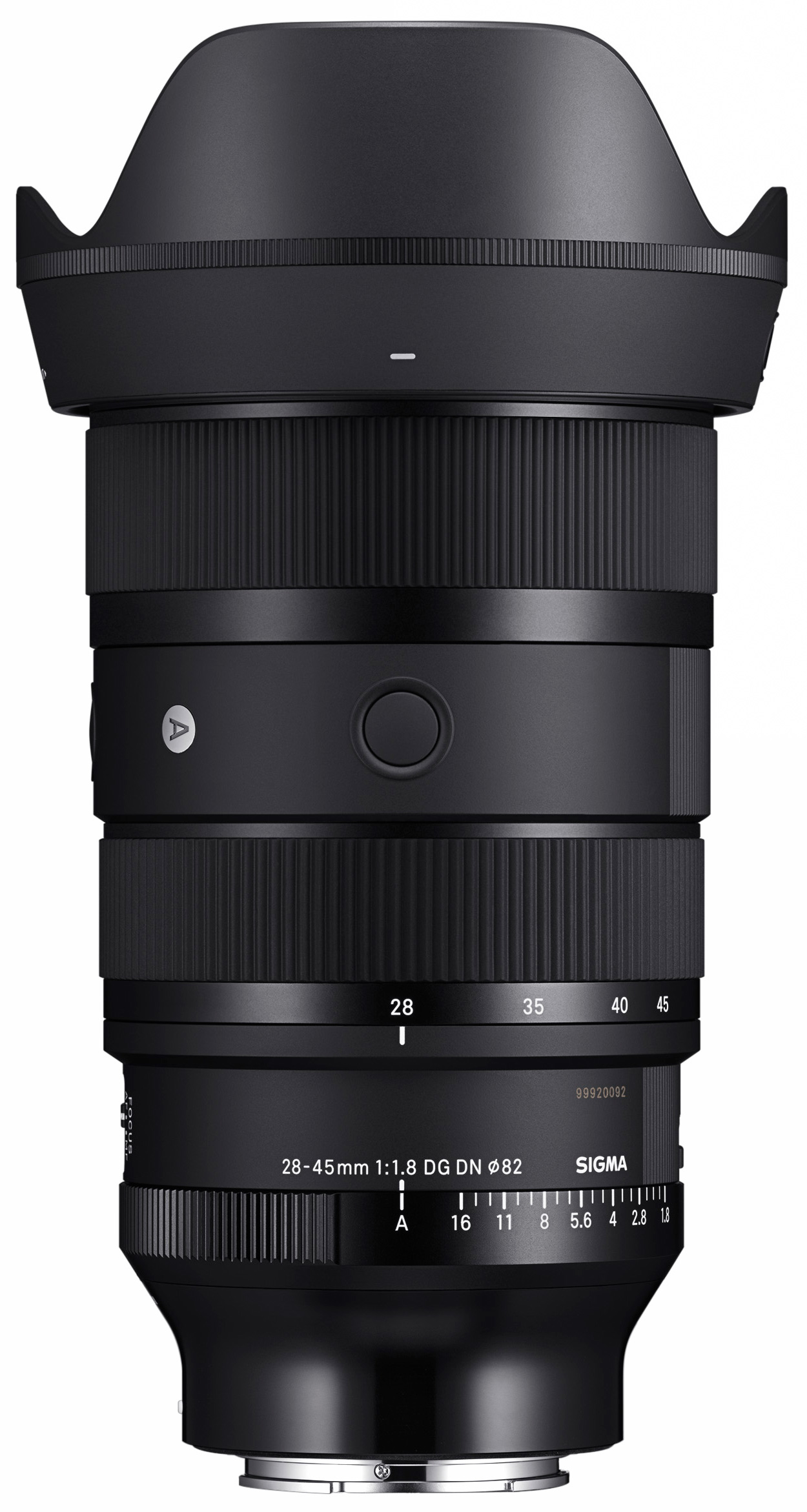
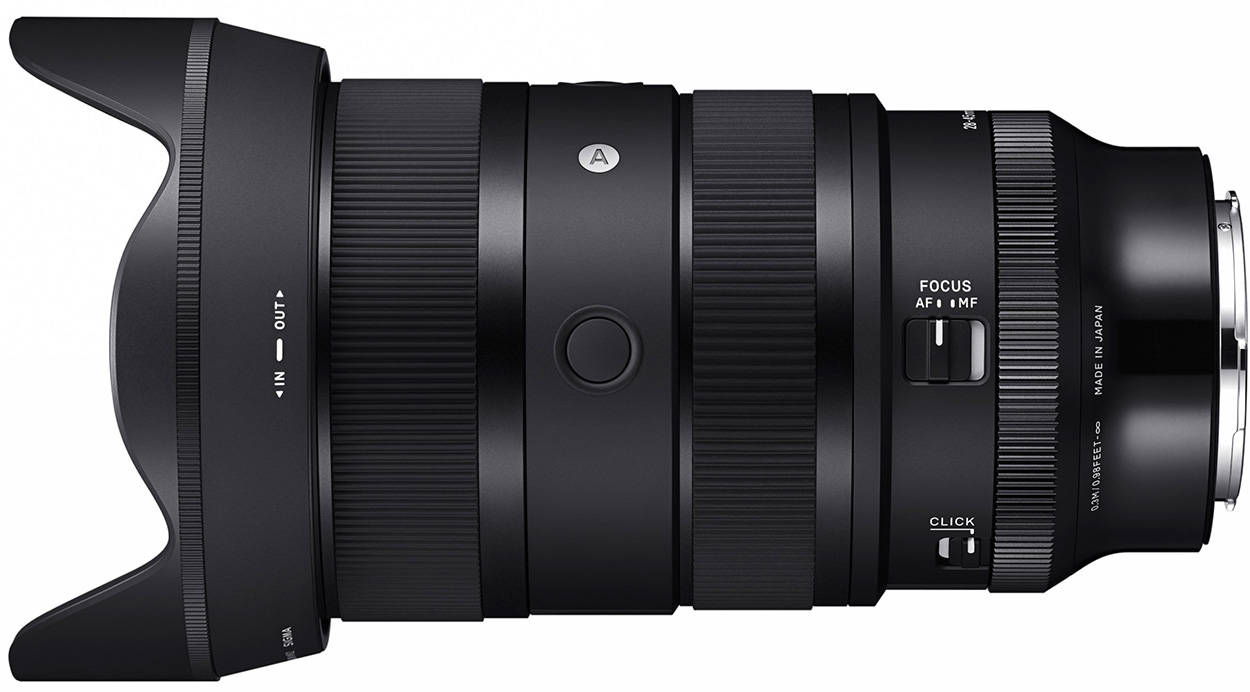
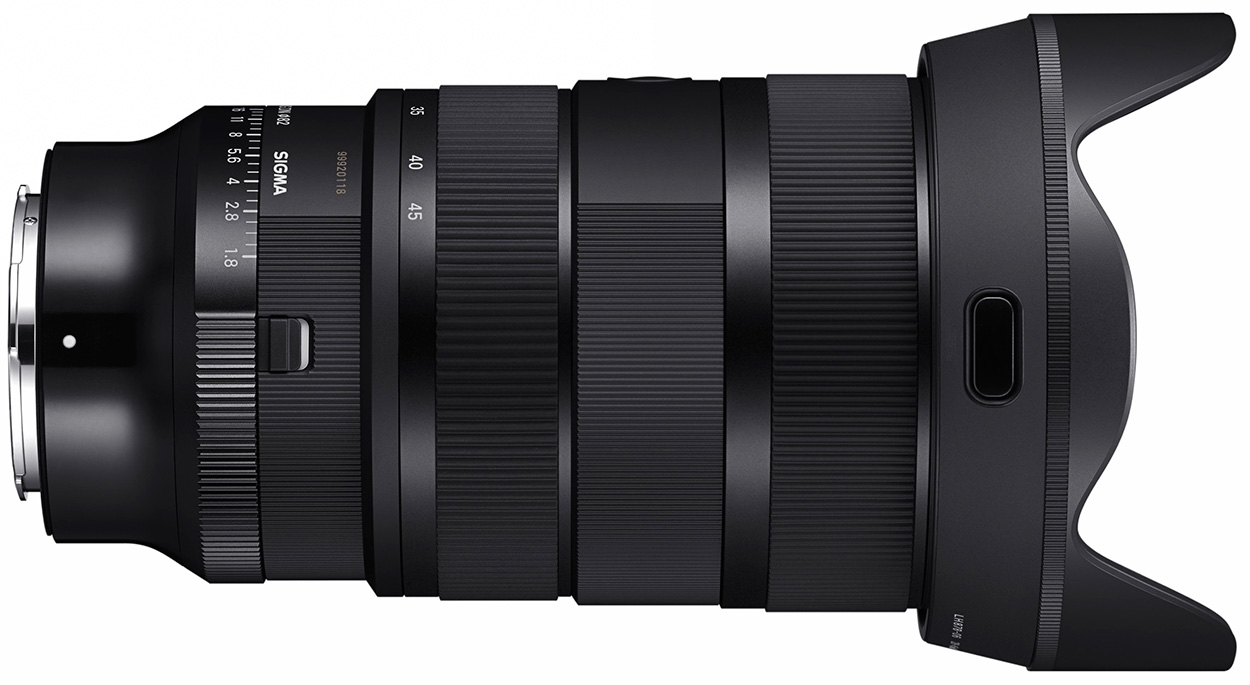
Today Sigma announced their latest E and L mount DG DN Art series wide to standard zoom with a constant maximum aperture of f/1.8. The focal length range from 28 to 45mm on 24 x 36mm full frame covers 75° to 51°.
It’s a large lens taking 82mm filters as does the new 24-70mm f/2.8. It is six inches/151mm long and and does not extend during zooming. It weighs 950g (E-mount) and focuses down to 30cm for quarter life size 1:4 close-ups at 45mm. It has 18 elements in 15 groups, with three aspherical and five super-low dispersion.
No previous mirrorless lens from Sigma has been similar but two have a good reputation in DSLR fit, from 2015. The 24-35mm ƒ2 DG HSM Art weighs only 20g less, takes the same filter size and is smaller by the difference between mirrorless and DSLR body depth. The 18-35mm ƒ1.8 DC HSM Art is for crop format (1.5-1.6X) not full frame.
The 28-45mm comes with a new type lens hood, front and rear caps and a padded zip case. It goes on sale on June 20th for £1299 inc. VAT, UK retail. Sigma claim ‘sharpness and clarity comparable to that of a prime lens throughout its entire zoom range’. A de-clickable physical aperture ring stops the 11-blade rounded diaphragm down to f/16. A function button, AF-MF switch and zoom lock complete the controls.
Our review of the 24-70mm f/2.8 DG DN Art will appear in the July/August edition of Cameracraft, it’s being tested right now. First impressions: crystal clear images, good handling for a large zoom, usual top-grade Sigma case/strap/new-type hood and excellent value. We expect the 28-45mm to appear in a later issue.
In the last few weeks I’ve found myself replying to Facebook Sony user group posts where new owners building their systems have asked about the Sony 90mm f/2.8 G OSS Macro FE lens. Over the months before this, I’d seen so many comments saying this was the best ever Sony and perhaps the second best lens ever.
Cameracraft January/February started the A7RIII test report, and March/April 2018 continued it. Both are free to read here. In the second issue you’ll also find the review of the 24-105mm f/4 FE G OSS lens. In the first issue, Gary Friedman looks at the RX10 series and one-inch sensor quality as well – and David tests the Voigtländer Nokton 40mm f/1.2 Aspherical FE manual focus lens, Sigma 16mm f/1.4 DN DC, and Samyang 35mm f/2.8 AF FE.
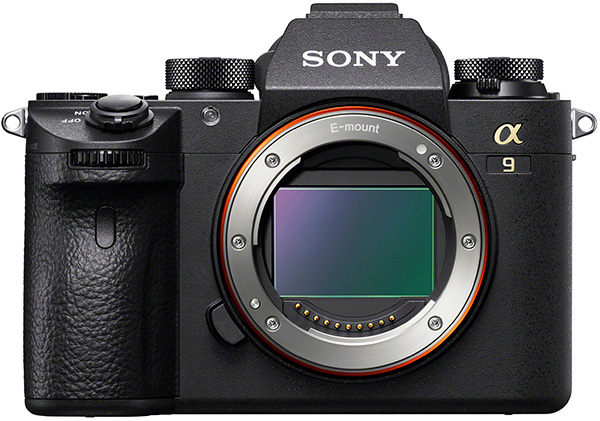
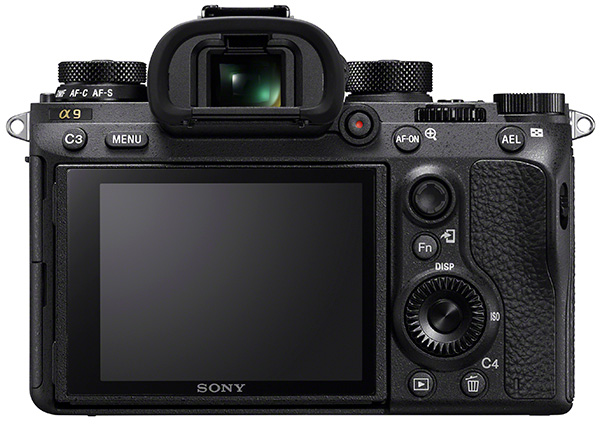
The front view below of the Sony Alpha A9 body, introduced today, gives a subtle clue about changes under the hood. For some time we’ve been nagging Sony about the weak, potentially tilting, 4-screw mount on the mirrorless bodies. Now they have at least added two more screws, to match Fujifilm X or the A-mount, even if the distribution is a bit odd with all the extra strength concentrated at the sides not the top and bottom where heavy lenses normally cause most stress.
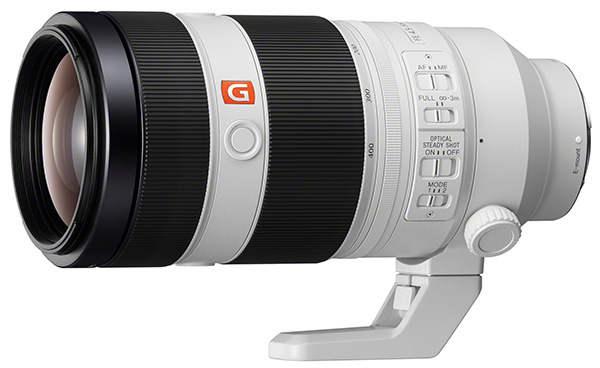
It’s a clue to a different internal construction, probably stronger all round, to make it possible to support the new 100-400mm G Master lens, a native E-mount new design which should come as a relief to those struggling with the A-mount 70-400mm varieties on adaptors:
But the lenses still have four-screw mount fitting (as do most A-mount lenses), and fairly weak sacrificial assemblies to prevent damage to the camera if knocked. See this video (it’s a bit long but makes a point): //www.youtube.com/watch?v=qGvlX9BtiTQ
The EVF of the A9 is around twice as bright as the A7RII and also runs at twice the refresh rate, while offering 50% more pixels. Part of this is down to the new stacked-CMOS 24.2 megapixel full frame sensor, which has a readout some twenty times faster than the A7II and previous generation 24 megapixel models. That, of course, is linked to the 6K native live feed from the full frame (used to create very high quality 4K video as well as an excellent live view) which in turn enables a distortion-free purely electronic silent shutter running to 1/32,000s plus 20 frames per second sequence shooting.
AF is claimed to be 25% faster than the A7RII and when the shutter speed is faster than 1/125s there is no visible blackout in the finder when shooting. Personally, a single frame (1/120s or 1/60s) blip would never be unwelcome as it helps tell you when you’ve shot. As for the low-light capability, not too much is being said; it’s in the usual up to 56,200 range with extension of two more stops. (Edit: April 20, we have noticed that at least one ‘reviewer’ – Sony Artisan paid to promote – completely wrongly claims 2,048,000 ISO not the actual 204,800, when comparing the A9 with the Nikon D5’s listed 3,276,800). The high speed sequences, movie frame rate and EVF refresh all tend to limit ultimate low-light clean imaging and we would guess that the A7SII and A7RII will not be made redundant.
That can not be said for the old weeny weedy weaky batteries of the E-mount range. The stripling NP-FW50 used in all the NEX to A7 series models gets kicked aside by a slightly larger variant with 2.2X the capacity. Frankly, it’s overdue but it creates a split system. I’m happy to travel with my A6000, RX10, and A7RII all sharing a pool of batteries even if those do run down alarmingly fast.
If it means carrying a new dual charger too, to get the necessary 2.5 hour recharge time instead of a leisurely overnight in-camera top up, I can only hope the charger (cum mains adaptor with clumsy dummy battery connection) also accepts the older batteries. It’s carrying multiple chargers that increases my travel bag weight not carrying extra batteries.
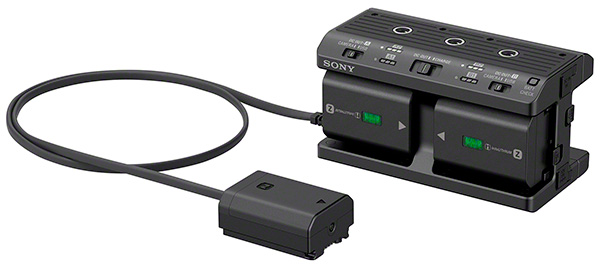
But… I see that the charger ‘cradle’ can mount four of the new cells, and charge the lot in 480 minutes. This cradle has a dummy battery on a lead, and 1/4″ tripod thread mounting points to add it to a video rig (which this camera is not specially made for, indicating an A9S is on the way with S-Log and direct 4K top quality encoding). The dummy battery then powers the camera for roughly 10X the life of the current A7 series batteries. So what if you have an A7 model? Easy – the outer shell of the battery simply slides off, revealing a SMALLER dummy inside, which fits the entire NEX/A7 mirrorless range or indeed the RX10 series. So your existing Sony mirrorless kit can be powered using this ‘battery bank’.
The top plate reveals that some input has been listen to. As a regular M1-M2-M3 user on my A99, the drop to only two memory registers on the A7RII is unwelcome but survivable. A return to three, plus a a custom button memory recall function, will make the a9 better. Having the drive modes on a physical control is good too. But I’ll leave any verdict on all this until the actual operation is better known – whether, for example, the memory registers now cover more than just the primary camera settings and thus enable one-step tripod setup.
I’ll have to say that after using the Olympus OM-D E-M1 MkII, which offers many of the advantages being claimed by the A9 as major selling points, the non-reversible simple tilt rear screen remains a negative compared to a fully articulated reversible screen. Sony does now offer a real glass protector, but I like the A55 to A99 style screen which can be turned to face the wall permanently if you want (and has never arrived on the E-mount models).
The new joystick controller takes something from the A99/II controls and adds it to the wheel of the A7 series, while the upper thumb button becomes a native back-button AF. In addition to being able to move the focus points faster (it’s a pain with the A7RII design) there is a memory for AF point selection and a horizontal-vertical switch function. Combined with a larger number of AF points covering 93% of the sensor, the action/sports performance of the A9 should be a long way ahead of any earlier mirrorless (though the A6500 is pretty good).
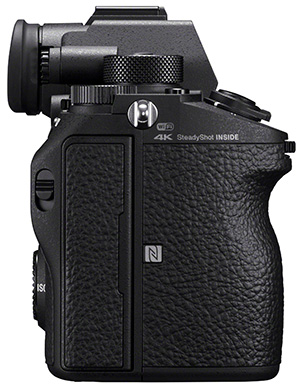
Though not visible here, there are two SDXC (one UHS-II) card slots with the usual recording options similar to the A99/II, and also an Ethernet port which is almost a requirement for some major sports events. You will notice that the Drive control has a Focus control below it, giving direct access to the kind of AF/MF/DMF choices found on the dedicated controller of A-mount bodies – no more need for menu or Function/Custom button operations.
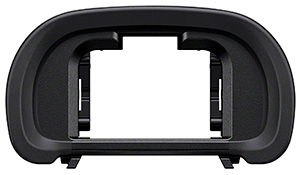
The eyepiece, shown here, may perhaps be a little less prone to detachment and we are promised the least squiffy finder view with new optics.
There is one minor fly in the ointment, a price-tag of £4,500 (UK) body only; the 100-400mm will be £2,500. While the team of assembled ambassadors made much of praising the silent shutter mode and small size of the camera at Sony’s vidcast press conference, none of this is new and pretty much anything the A9 can do is also within the reach of the A7RII and A7SII even if it does it faster and perhaps better. There was some praise for the durability of the system – what? I don’t know about others, but I find the Sony/Zeiss lenses are the worst I’ve ever owned for showing almost immediate signs of wear from the lightest contact with clothing and bags. Silver appears through the molecule-thin black coating instantly and neither the regular lenses nor the bodies have ever struck me as being suitable to knock around in a busy press kit or travel bag. Where old Leicas survived years of abuse elegantly, gradually brassing at the edges, my Sony kit generally just looks a bit scruffy and used despite minimal handling. The A9 looks about the same in this respect as the mark II lesser models.
Full official press information and specifications can be seen here:
Sony has announced two new lenses for E-mount mirrorless cameras.
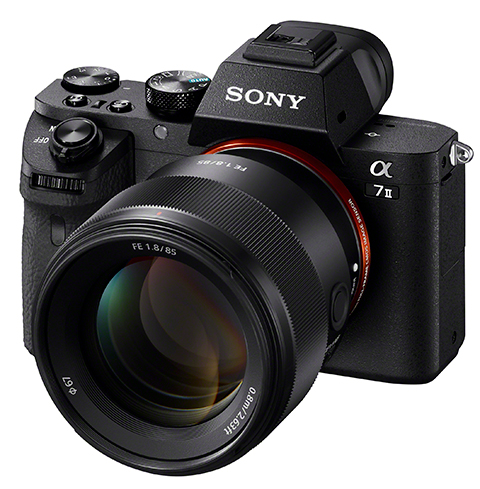
The FE 100mm F2.8[i] STF GM OSS is the first Smooth Transition Focus prime since the acclaimed A-mount 135mm and is designed for the best possible bokeh without any trace of aperture-related artefacts. The compact, lightweight FE 85mm F1.8 portrait prime lens may put an end to sales of Canon 85mm f/1.8 USM lenses mounted on FE adaptors… but at £550 and not stabilised it’s just over the typical cost of that combo, which also enables the use of other Canon lenses and of course the use of the Canon glass on native bodies.
It’s a slightly disappointing lens as the 80cm close focus is no improvement over the 85mm G-Master f/1.4, and much less useful than the 85mm A-mount SAM f/2.8 which focuses to 60cm. With the 85mm such a popular choice for portraits, food photography and creative close-ups (short of the macro range) this is a missed opportunity even it is also very much an industry standard. In contrast to this the 100mm STF has an excellent close focus of 57cm and the same close-up ability as zooms like the classic ‘Beercan’ 70-210mm f/4 by Minolta, the magic ‘quarter life size’ which covers the area of a 6 x 4″ postcard print when used on full frame.
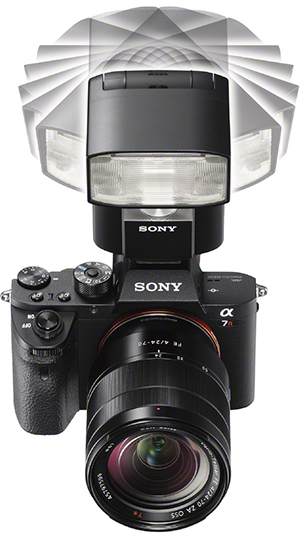
Sony also introduced a new flash HVL-F45RM with radio-controlled wireless communication ideal for off-camera multi flash TTL work with Sony’s line-up of α7 full-frame cameras. This flashgun uses the Sony Quick-Navi visual system for its rear panel – so they did learn something from the success of this in the old A700!
A specially designed mid-telephoto, full-frame prime lens, the new 100mm STF is built to produce truly unique, magnificent and beautiful bokeh while maintaining the exceptional standard of resolution that is showcased throughout Sony’s entire line-up of flagship G Master series lenses, making it a powerful photographic tool for any portrait, fashion, nature or wedding photographer.
These impressive defocus capabilities are made possible by the lens’ advanced optical structure, as it features a newly designed 11-bladed aperture and a unique optical apodization lens element. Similar to a neutral density filter that increases in density towards the edges, the apodization element creates beautiful transitions of in-focus to out-of-focus areas within an image, making for exceptionally soft, smooth bokeh that adds depth and dimensionality. This allows the subjects to stand out against beautifully defocused elements in both the foreground and background, producing an image that is naturally pleasing to the eye. The design of the lens also ensures that vignetting is kept to an absolute minimum, ensuring optimum image quality.
David Kilpatrick writes: The STF function is available from full aperture (an effective T=5.6 despite the f/2.8 physical aperture) over a one-stop adjustment range to T=8. This is less than the f/4.5 to f/8 (T) range of the original STF design and indicates that a more powerful apodisation element (radial/circular graded element created by using neutral density in a double concave glass) or apodisation filter (a cheaper method using a conventional radial graduated ND filter inside the lens near the aperture position). This should actually mean that f/5.6 looks smoother than f/4.5 could have. Confusing, but true. You can the depth of field of a more-or-less f/8 lens with the bokeh of an f/4.
Additionally, the new 100mm lens supports both contrast AF and focal-plane phase detection AF[ii], and has a high-precision, quiet direct drive SSM (Super Sonic Motor) system that ensures exceptionally fast and accurate AF performance. The SEL100F28GM also offers up to 0.25x close-up capabilities with a built-in macro switching ring, built-in Optical SteadyShot™ image stabilisation, a customisable focus hold button, AF/MF switch, aperture ring and is also dust and moisture resistant.[iii]
The new SEL85F18mid-telephoto prime lens offers an extremely versatile, lightweight and compact telephoto prime lens solution for a variety of Sony camera owners ranging from working professionals to emerging enthusiasts that have stepped up to an APS-C or full-frame camera for the first time. With its wide f/1.8 aperture, it can produce impressive, exceptionally sharp portraits with soft background defocus that take advantage of its 85mm focal length and wide f/1.8 maximum aperture.
The new prime lens features a 9-bladed circular aperture mechanism that ensures smooth, natural looking bokeh, and a double linear motor system to allow for fast, precise and quiet focusing. It also has a focus hold button that can be customised and assigned together with functions in the camera body like the popular Eye-AF feature. There is a smooth, responsive focus ring and AF/MF switch and the lens is also dust and moisture resistant.iii
Sony’s new HVL-F45RM flash enhances the radio-controlled lighting system capabilities of their growing system, offering a compact professional shooting solution when combined with the currently available wireless remote controller FA-WRC1M and receiver FA-WRR1.
The new flash, which is designed to complement the compact bodies of Sony’s E-mount camera line-up including full-frame α7 models, produces a maximum lighting output as expansive as GN45[iv]. This ensures sufficient illumination even when shooting with bounce lighting or high-speed-sync (HSS) flash. The radio capabilities of the HVL-F45RM allow it to be used as a transmitter or a receiver at up to 30m (approx. 98 feet[v]), making it an ideal fit for creative lighting with multiple flashes. Additionally, unlike optical flash systems, radio-control flashes do not require a direct line-of-sight between components to function properly, while also minimising any impact that bright sunlight has on signal transmission and control.
The HVL-F45RM flash has an impressive battery life of up to 210 bursts, and can tilt up to 150o vertically, a complete 360o horizontally and up to 8o downward to maximise versatility. Usability has been maximised with a new large, bright and highly visible LCD display, an LED light, dust and moisture resistant design3 and a revamped menu system that mimics those of Sony’s newest camera systems.
Sony’s official press release – we’re working here on magazines with deadlines tonight so this is unedited hot news. Enjoy!
Sony today introduced its new flagship APS-C sensor camera, the α6500 (model ILCE-6500). As the latest addition to Sony’s line-up of award winning mirrorless cameras, the new α6500 shares the same unrivaled 4D FOCUS™ system as the α6300 camera, which can lock focus on a subject in as little as 0.05 seconds, the world’s fastesti AF acquisition time. Also shared with the α6300, the new α6500features 425 phase detection AF points that are densely positioned over nearly the entire image area – the world’s highestii number of AF points on any interchangeable lens camera. The new model can shoot images at up to 11 frames per second with continuous autofocus and exposure tracking and up to 8 frames per second in a live-view shooting mode that makes it easy to track fast moving subjects, as it combines all of the benefits of an electronic viewfinder with the immediacy of an optical viewfinder.
The camera can shoot at these high speeds for up to 307 frames[iii] thanks to its expanded buffer, which, along with the fast response speeds described above, are all achieved with the support of a new front-end LSI chip that has been added to the camera. This new front-end LSI also serves to enhance both still and video image quality.
Additionally, the new α6500 features Sony’s acclaimed in-camera 5-axis optical image stabilisation, making it the first Sony APS-C sensor camera to offer all of the benefits of advanced in-body stabilisation, which include a shutter speed advantage of approximately 5 steps[iv]. It also offers touchscreen AF capabilities for focus point selection and adjustment.
Unmatched AF Capability
Sony’s new α6500 camera utilises the same 4D FOCUS system as the α6300 – a Fast Hybrid AF system that combines high-speed phase detection AF with extremely accurate contrast AF and allows it to capture and lock on to moving subjects in as little as 0.05 secondsi. It also features 425 phase detection AF points and High-density Tracking AF Technology, which significantly improves subject detection and tracking performance.
New for the α6500, thanks to faster internal processing capabilities enabled by the front-end LSI, the maximum buffer for high-speed continuous shooting is an impressive 307 framesiii, greatly increasing the chances to catch that decisive moment.
The camera’s 425 phase detection AF points, focusing tracking and accuracy are also available when using non-native A-mount lenses[v] with Sony’s LA-EA3 mount adaptor. Additionally, it includes silent shooting, Eye AF in AF-C mode, AF in focus magnifier modes, Expand Flexible Spot AF and more.
One of the most exciting developments in the new α6500 is the implementation of 5-axis image stabilisation for the first time in a Sony APS-C sensor camera. Additionally, through a total revision of the internal design of the camera, this newly developed stabilisation system fits entirely within a body that is nearly the same size as the α6300 model.[vi] This innovative 5- axis system provides a shutter speed advantage of 5 steps,iv ensuring the full resolving power of the sensor can be realised, even in challenging lighting.
The shake compensation provided by the system works with a variety of lenses, including E-mount lenses without OSS (Optical SteadyShot) stabilisation and A-mount lenses[vii] when used with a compatible mount adapter. When an E-mount lens with OSS is mounted, pitch and yaw are compensated in the lens and horizontal, vertical and roll axes are compensated in the camera body, resulting in optimal 5-axis stabilisation.vii
Also, with a simple half press of the shutter button, the effect of the image stabilisation can be monitored in the viewfinder or on the LCD screen, allowing framing and focus to be accurately checked and continually monitored. This is available even when a lens is attached that does not have built-in shake compensation.
New Touch Screen Focusing
The new α6500 comes equipped with touch screen functionality, allowing users to lock focus on a subject simply by touching it on the screen. This is a powerful compliment to its advanced AF system and video shooting capabilities.
Additionally, in a first for Sony cameras, the α6500 features touchpad functionality. When utilising the viewfinder for framing and shooting, the LCD screen can be used as a touch pad. Simply drag a finger across the screen to shift the focus point from one area to another.
Powerful 24.2 MPviii Exmor CMOS Sensor, BIONZ X® Processor and New Front-End LSI
The new α6500 features an APS-C sized 24.2 MP[viii] Exmor CMOS sensor that works together with a BIONZ X image processor and the newly developed front-end LSI to maximise processing power and achieve an impressive sensitivity range of ISO 100-51200.[ix]
The image sensor employs a thin wiring layer and large photodiode substrate that maximises light collection efficiency, plus copper wiring in its structure for outstanding read-out speed. The BIONZ X image processor and newly developed front-end LSI ensure superior image and video quality with low noise even when using higher ISO settings, in particular those at high sensitivity values where other cameras typically struggle. The LSI is also responsible for the expanded buffer depth for continuous shooting.
Professional Video Capabilities
The new α6500 becomes the latest Sony interchangeable lens camera to offer internal 4K movie recording, as it can shoot 4K (3840x2160p) video in the popular Super 35mm format on the full width of the image sensor. When shooting in this format, the camera uses full pixel readout without pixel binning to collect 6K of information – approximately 2.4x[x] (20 MP equivalent) as many pixels as 4K UHD and then oversamples the information to produce high quality 4K footage with exceptional detail and depth.
Additionally, the α6500 will focus exceptionally fast during movie shooting thanks to its Fast Hybrid AF system, offers touch focusing for professionally smooth focus shifts, whilst also offering adjustable AF transition speed and AF tracking sensitivity. The camera supports the XAVC S codec[xi] during video shooting, which records at a high bit rate of up to 100 Mbps during 4K recording and 50 Mbps during Full HD shooting, ensuring maximum detail and clarity in both video formats.
Other professional calibre video features include the ability to record Full HD at 100fps at up to 100 Mbps, which allows footage to be reviewed and eventually edited into 4x slow motion video files in Full HD (25p) resolution with AF tracking.
New on the α6500 is the incorporation of a ‘Slow and Quick’ (S&Q) mode that supports both slow motion and quick motion. In this mode, frame rates from 1 fps to 100fps can be selected in 8 steps for up to 50x quick motion and 4x slow motion recording[xii]. Footage shot in this mode can be previewed after shooting without the need for PC-based post processing.
The camera also offers S-Log gamma recording[xiii] for wide dynamic range shooting – approximately 14-stop latitude in S-Log3 gamma setting – and supports S-Gamut for a wider colour space. Both options allow for greater creativity for processing video post-production.
Shooters also now have the ability to select, extract and save still images from movie footage directly on the camera. Approximately 8 MP images and 2 MP images can be pulled from 4K modes and Full HD modes, respectively.
Enhanced Operability and Reliability
The new α6500 has a refined design, maintaining the mobility of the α6000 series while adapting much of the usability of Sony’s acclaimed α7 II series. The new model features the same high contrast, high-resolution 2.4 million dot XGA OLED Tru-Finder as the α6300 that offers exceptional corner-to-corner visibility.
New hardware features on the α6500 include a magnesium alloy body and a high-durability shutter with a tested life span of approximately 200,000 release cycles.[xiv] It also has several design features that are borrowed from the α7 II series of full-frame cameras, which include a robust lens mount, a recessed grip to improve handling, a larger release button and ten total custom buttons including ‘C1’, ‘C2’ and ‘C3’. It also has an improved operation feel for its mode and control dials and rear face buttons, as well as a softer eyepiece cup for more comfortable usage.
On the software front, there is a new overall user interface, which allows for a much smoother process for searching and adjusting menu settings, as well two new metering modes – Highlight, where exposure metering is focused on the brightest area of the frame, and Entire Screen Avg, which maintains an average metering for the entire image.
The camera is Wi-Fi®, QR and NFC compatible and fully compatible with Sony’s PlayMemories Mobile™ applications[xv] available for Android™ and iOS platforms, as well as Sony’s growing range of PlayMemories Camera Apps™. The α6500 also offers location data acquisition via a Bluetooth[xvi]connection to a compatible mobile device and an updated menu structure to deliver a smoother navigational experience.
Pricing and Availability
The new Sony α6500 interchangeable lens camera will be available in Europe in December priced at approximately €1,700 body only or €2,800 with SEL1670Z lens. Full product details can be seen here. The current α6000 will also see a new colour introduction in Europe in December with the model also available in Graphite Grey.
[i]Among interchangeable-lens digital cameras equipped with an APS-C image sensor as of October 2016, based on Sony research, measured using CIPA-compliant guidelines, and internal measurement method with an E PZ 16-50mm F3.5-5.6 OSS lens mounted, Pre-AF off and viewfinder in use.
[ii]Among digital cameras as of October 2016, based on Sony research.
[iii]With “Hi” continuous shooting mode and “Fine” image quality.
[iv]Based on CIPA standard. Pitch/yaw shake only. With Sonnar T* FE 55mm F1.8 ZA lens mounted. Long exposure NR off.
[v]A-mount lenses with SSM or SAM only. Users can choose phase-detection AF or contrast-detection AF in AF System menu. “Phase-detection AF” is not available during movie shooting. AF-C in AF System menu is available only with “Contrast-detection AF” selected, but no motion tracking is performed during continuous shooting (Hi+, Hi, Mid).
[vi]Excluding grip, frontal-view size and main body thickness are the same as for the α6300
[vii]All 5-axis stabilisation is performed in-camera when SEL90M28G is mounted
[xi]SDHC/SDXC memory card of Class 10 or higher is required for movie recording in XAVC S format. UHS-I (U3) SDHC/SDXC card is required for 100Mbps recording.
[xii]Sound cannot be recorded. SDHC/SDXC memory card of Class 10 or higher is required.
[xiii]S-Log2 and S-Log3 are premised on processing pictures
[xiv]With the electronic front curtain shutter, under internal test conditions of Sony.
A quintessential wide-aperture 50mm “normal” lens, the new ZEISS® Planar F1.4 offers high resolution, high-contrast and overall exceptional performance
Sony today introduced a new full-frame lens for their E-mount camera system, the Planar T* FE 50mm F1.4 ZA (model SEL50F14Z). (Press release 2pm UK time)
“This 50mm prime lens features a large F1.4 maximum aperture that offers impressive contrast and outstanding resolution that are hallmarks of the ZEISS® brand. It produces these consistently strong qualities throughout the entirety of the frame – from centre to corner – and at all aperture settings, even while shooting wide open at F1.4. The cutting edge optical structure includes high-precision AA (Advanced Aspherical) and ED (Extra-low Dispersion) glass elements that reduce spherical and chromatic aberration, as well as a ZEISS® T* Coating that minimises flare and ghosting, creating the classic ZEISS® clarity. Additionally, its Planar design ensures minimal distortion.
The large f/1.4 maximum aperture of the FE 50mm F1.4ZA lens provides a level of brightness and speed that are advantageous for dimly lit indoor shots, night scenes, and portraits, while its 11-blade circular aperture allows for stunning ‘bokeh’, or background defocus, in images. The lens also features an aperture ring with de-click option, an AF/MF switch, and a dust and moisture resistant design[i], further increasing its functionality.”
(PR blurb slightly edited but leaving in all the garbage, Registered Trade Mark symbols and stuff including the gratuitous capitalisation of Zeiss)
Editor’s comments: AA elements have no orange-peel microstructure, and thus reduce the granular appearance of bokeh circles created by point sources out of focus – they resemble traditionally ground and polished elements, even though they are moulded aspherical. Those who say ‘I love this lens in the A-mount version’ or Canon or Nikon or Contax are misguided, as although this is a Planar, it’s not the same 50mm f/1.4 Planar in any way as a traditional design.
The new lens is also equipped with a ring drive SSM (Super Sonic wave Motor) system, which allows it to efficiently lock focus with speed, precision and in near silence, making it particularly useful for shooting movies.
Pricing and Availability
The new FE 50mm F1.4 ZA lens will ship this July and will be available across Europe for approximately €1,800 (this price given by Sony). US price from B&H for pre-order is $1498 which is considerably less, possibly because Europe has VAT tax generally between 20% and 25%.
Although the design is dust and moisture resistant, absolute protection from dust and moisture is not guaranteed.
With the 24-70mm f/2.8 new Sony GM FE lens selling for £1799 (UK) and the A-mount version two 24-70mm f/2.8 for a full £100 more, the cost of a basic mid-range zoom to use with a camera like the A7RII remains very high. There are good arguments to be happy with the 24-70mm f/4 FE zoom, or even the 28-70mm f/3.5-5.6 though that is best limited to use on the A7 (24 megapixel) and A7S (12 megapixel) bodies rather than the A7R (36 megapixel) or A7RII (42 megapixel).
Of course there are good lens adaptors out there and 24-70mm f/2.8 lenses from Canon, Tamron or Sigma with ultrasonic focus drive in Canon EF mount offer one solution. The original 24-70mm f/2.8 for A-mount with its SSM motor of this type can also be found for a fair price. But there’s one lens which I sold after my A7R arrived, mostly because I was parting company with my full-frame A-mount body survivors. It’s the Tamron-based but Sony revised SAL 28-75mm f/2.8 SAM.
Although I did have an LA-EA3 adaptor to use SSM and SAM drive A-mount lenses on the E-mount bodies, the 28-75mm didn’t really work very well on the A7R so it remained on my A99 or A900. I made a few tests and saw that it was certainly OK on 36 megapixels, though even on the 24 megapixel A99 where it played nicely with the AF system it had slightly soft corners when used wide open. They were not any softer than the 24-70mm f/2.8 Carl Zeiss of that time and in some ways the lens was better behaved.
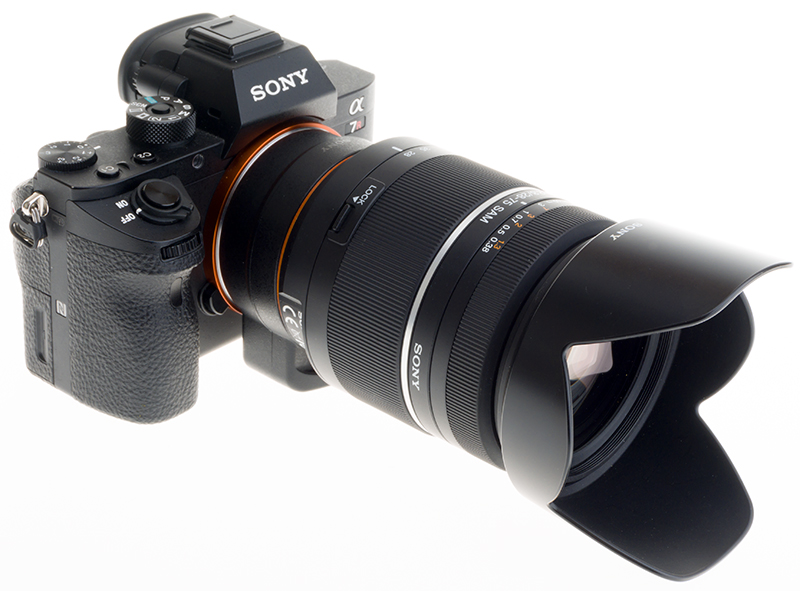
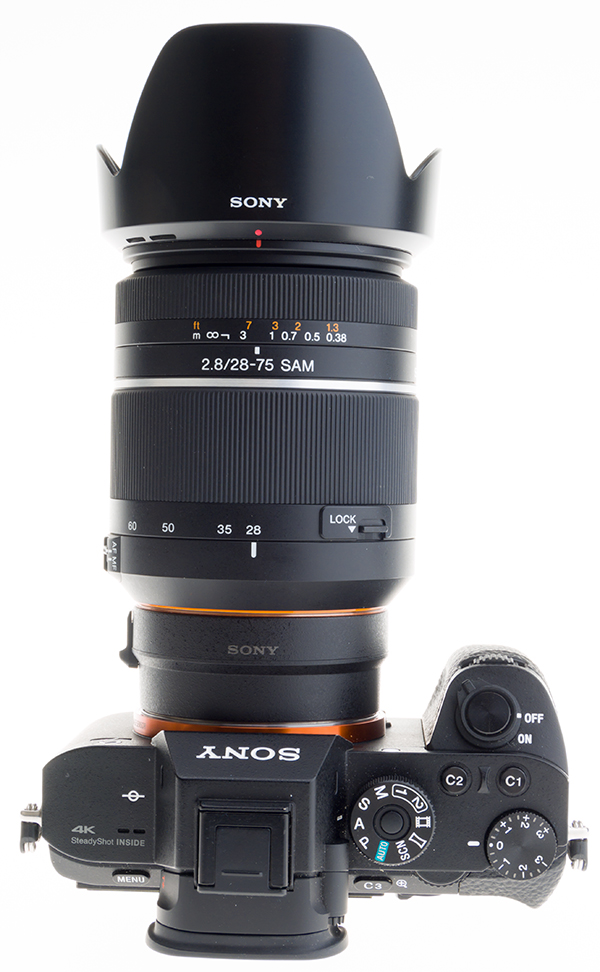
The first thing to do was to fix this lens to the LA-EA3 creating an FE lens unit. Imagine the adaptor is just part of the lens (that’s pretty much how Sony makes many lenses for E-mount anyway). The total unit measures up at 115mm long including the adaptor, and 75mm diameter taking 67mm filters. The lens itself weighs only 565g, the combo weighs 683g with adaptor and lens hood. That compares with the new GM lens at 136mm long and 88mm diameter using 82mm filters and weighing 886g. As I already have a 16-35mm f/4 CZ which covers the 24mm requirement well, the 28-75mm range is just as useful to me as 24-70mm.
While the 28-75mm SAM activates PDAF and multiple AF points, it’s not the full works with tracking and Eye-AF. But it’s also not as noisy as some reviews imply. It’s much quieter than the 85mm f/2.8 SAM, and silent compared to the grinding focus of the 30mm DT SAM macro. Startup is fast, with the lens initialising quicker than FE mount stabilised zooms. The aperture actuation is slicker than with body-drive SAL lenses on the LA-EA4, and quieter. Focus is fast and the only downside is the rotating focus ring which does not support DMF or over-ride on the fly, or auto manual focus magnification. Manual focus requires you to set it on the lens and the body, and whatever you are doing, you need to avoid either turning the focus ring when there is any resistance, or blocking it from turning during AF. It’s a bit vulnerable and the direction of focus is the opposite to normal Sony/Minolta design. The zoom ring which locks at 28mm only operates in the normal direction.
So, what you get with the LA-EA3+28-75mm SAM is basic but fully controlled and communicating, EXIF accurate with profile correctly invoked. It will track with continuous focus and during movies, though slightly noisy for in-camera sound recording; it seems to do so when some SSM lenses, like the 24mm f/2 CZ, don’t play.
As for optical quality, it’s still a 14-year-old Tamron in disguise, but it can match up to 42 megapixels centrally across its full range. The performance over the APS-C image area is superb, even wide open at all focal lengths, with just a hint of misty aberrations slightly masking a super-sharp result on axis. On full frame, a marked ‘cap shape’ deviation from flat field towards the extremes causes strong softening on flat subjects and landscapes at 28mm and is not entirely removed at longer lengths. You would not want to use this at 50mm and f/2.8 if you had a faster 50mm you could fit and stop down to f/2.8. On real three-dimensional subjects at typical working apertures between f/4 and f/11 it can be extremely sharp. The respectable 38cm close focus and 0.22X subject scale (not as good as the new Sony GM 24-70mm) reveal microscopic detail on the A7RII at f/5.6. The shot below is at the closest AF on the large water drop in the centre, at 75mm and f/5.6 – you can see the bokeh is very acceptable, not complex or ‘nervous’ which it tends to be when used wide open for more distant subjects with a slightly defocused background.
A 100% crop from th A7RII file (converted from raw ISO 500 14-bit, without any sharpening for web and with minimal NR) gives an idea how good this lens is and also just how little depth of field you’re ever going to see from a 42 megapixel full frame image used this way!
It would hardly be worth buying an LA-EA3 and a new 28-75mm just to save about £1000 over the GM 24-70mm. If you already own an LA-EA3 and you can find a cut price or good used 28-75mm go for it. The way its aperture works means you’ll get very fast low light focus and minimal shutter lag (but you do need a mark II A7 series body to get the best functioning).
The zoom action is a real pleasure to use, very light but positive, and the overall build and feel of the lens will not disappoint. It also seems to get just the right response from the in-body stabilisation of the A7RII. Sure, 67mm filters may be smaller than many midrange zooms require, but I will either have to use a stepping ring or get a couple of new filters – not cheap, for the quality needed to maintain the lens performance. Also, it’s not weatherproofed.
Here’s a quick set of three hand held (with SSI) comparisons at 28mm – f/2.8, f/5.6 and f/9. I’ve loaded these up at full size so they should open the original Level 10 sRGB JPEG when clicked. The focus in on the foreground railing spike and the fine spider web gives the best idea of how the resolution and contrast of the lens improve from wide open. It’s clearly resolved at f/2.8 but with a gentle ‘glow’ at pixel level. First image – f/2.8.
Second image – f/5.6. If you download all three images and load them into Photoshop, it’s interesting to switch between tabs and see the depth of field change.
The third image is at f/9 and here the ISO is high at 2000. The A7RII can produce great results up to 3200 but I might not choose to have this at 2000. Even so, the sharpness can be judged without problems as the noise doesn’t have much effect on fine detail with current Sony sensors and processing. It always shows more in defocused, smooth areas.
Because I use other lenses – such as the 24-105mm f/3.5-4.5 Sony and 50mm f/2.8 Macro Sony on LA-EA4, 40mm f/2.8 Canon STM, Sony FE 28mm f/2, 16-35mm CZ f/4 and also the unrivalled 24-240mm FE zoom I have many choices overlapping the range of this lens. I remember that for landscape work on the A900 it was hard to beat. Here’s one of my images from that combination, using a 6 second exposure at 40mm focal length, f/8 and ISO 100 with a variable ND filter. With the restrictions on tripod position given by the location, the zoom range of 28-75mm proved just right for a range of studies.
With this lens arriving during a period (for my corner of the UK) of sustained white skies and drizzling rain, it’s not been out and about much. One thing it has done is to focus very well in dim room lighting on my sofa companions –
And, for those who don’t think f/4 is wide enough and desperately want 55mm f/1.8 or f/0.95 lenses, this is at 55mm f/2.8 and of course when the iris of the eye is sharp the fur around it is not and Willow’s nose is blurred. Once again, despite correction for tungsten light at the extreme limit of Adobe Camera Raw, and using ISO 3200, it’s pretty amazing what the A7RII can do seen at 100% (below).
But this super-shallow depth of field is what happens at 42 megapixels. Depth of field used to be worked out based on a 10 x 8″ print held in your hand, not a 6 x 4ft image viewed through the ‘window’ of a screen. Of course for social media you do indeed need very wide apertures because when your pictures are mostly viewed on smartphones, it’s like looking at a contact print from a Vest Pocket Kodak…
To support Photoclubalpha, subscribe to f2 Cameracraft (it’s probably the only photo mag edited by two long-standing Sony system users, myself and Gary Friedman).