Luminar Neo has gained a new tool – Portrait Background Removal, enabling the background behind a subject to be made transparent in one click. Careful hair-by-hair selections are done by trained neural networks.
Portrait Background Removal tool can be found in the Luminar Neo Layer masking options.
It offfers:
Remove Background without Layering. Just open Luminar Neo, load an image, and select Portrait Background Removal.
Get clean assets for composing. Any portrait you edit can be exported as a PNG with a transparent background, a great base for seamless photo composing.
Create realistic portraits with AI that’s precisely trained on people. AI scans the image to find and select human figures as accurately as possible. Luminar Neo has an option to edit several images in a click with custom saved Presets, so editing event portraits becomes faster.
Achieve precise selections without extreme effort. The portrait and the background are highlighted in different colours. A Transition Brush refines the edges by removing unnecessary elements where the portrait and background touch. The Object Brush revives portrait details that may have been eliminated by the neural network, while the Background Brush helps to additionally remove parts that aren’t detected by the AI.
Luminar Neo is available as a one-time purchase or as a subscription. The new architecture is flexible, so it can be easily updated in the future. Luminar Neo is available in both the Microsoft Store and the macOS App Store. Luminar Neo works as a plugin, so you can keep your images in your preferred photo editor while still benefiting from its powerful AI tools.
Additionally, the brand-new Luminar Share mobile app allows you to quickly and seamlessly transfer images from your phone to your computer. Take a photo, edit it, and post it to social media without third-party programs that reduce quality. Luminar Share is available on the Google Play Store and the macOS App Store.
ExpoImaging, Inc., creators of the Rogue FlashBender speedlight modifiers, today announced new Rogue Round Flash Magnetic Modifiers for popular round flashes and rectangular speedlight flashes including Godox V1, Godox R100, Godox HR200 head for AD200, Geekoto GT 250, Geekoto GTR, and Westcott FJ80. Compatibility with Profoto A1, Profoto A1x, and Profoto A10 flashes requires the Rogue PF Adapter. Photographers want their speedlight modifiers to be easy-to-use, lightweight, and durable, and the new Rogue Round Flash Modifiers are all those things. Each modifier component is made from impact-resistant materials to withstand drops and conveniently stack together, whilst the white silicone dome collapses to save space in your gear bag. Rogue Round Flash Modifiers stay put because each magnetic component incorporates six custom-designed neodymium magnets, which provide a strong attachment force to the flash. The custom design safely and securely keeps the magnets within the modifier ring.
Rogue Flash Adapter has a stretchy silicone mount that enables a quick attachment to speedlight flashes using a metal ring mount to attach other magnetic modifier components. Small adapter is compatible with Godox TT350, Canon 430, Nikon (SB600, SB800), Nissin (i40, i60A), Sony F32, and other similar sizes. The larger standard adapter is compatible with Canon 580, Godox 685, Nikon SB900, Nissin Di700A, Sony F60, and other similar sizes
Rogue Flash Gel Lens Enables users to attach colour gels to circular flashguns by placing gels between the magnetic Gel Lens. Unlike other magnetic modifiers, the unique design safely captures the neodymium magnets and keeps them in place. Compatible with Godox (V1, R100, and HR200 head for AD200), Geekoto (GT 250, GTR) and Westcott FJ80Requires the Rogue PF Adapter (sold separately) to be compatible with Profoto flashes (A1, A1x, and A10)Can be used with rectangular speedlight flashes when combined with the Rogue Flash Adapter (Standard or Small)
Rogue Flash Grid 45 The Rogue Flash Grid 45 provides a popular grid angle for spotlighting control when shooting classic portrait or commercial product photography. Use alone to create a circle of light with a 45-degree spread or stack together to create smaller light circles. Compatible with Godox (V1, R100, and HR200 head for AD200), Geekoto (GT 250, GTR) and Westcott FJ80Requires the Rogue PF Adapter (sold separately) to be compatible with Profoto flashes (A1, A1x, and A10)Use with rectangular speedlight flashes when combined with the Rogue Flash Adapter
Rogue Flash Diffuser Dome Great for wedding, event, and portrait photography, the Rogue Flash Diffuser Dome snaps securely to the flash and softly diffuses the light from shoe mount flashes. Attaches directly to the flash with the Rogue Flash Gel Lens included in its baseCompatible with Godox (V1, R100, and HR200 head for AD200), (GT 250, GTR) and Westcott FJ80Requires the Rogue PF Adapter to be compatible with Profoto flashes (A1, A1x, and A10)
Rogue Round Flash Gels Place Rogue Round Flash gels between any two magnetic modifier components to add a colour correction or vibrant colours for your portrait photography. Available in two sets including the Ultimate Portrait Collection and the Colour Correction Collection. Enhance your portrait photography with multiple shades of flash gelsGel diameter of 71.5mm fits other round flash modifier systemsCompatible with Godox (V1, R100, and HR200 head for AD200), Geekoto (GT 250, GTR) and Westcott FJ80
Bundle Kits for Round Flashes and Rectangular Speedlight Flashes The new Rogue Round Flash Modifiers are also available in kits with the most popular modifiers bundled for round flashes or rectangular speedlight flashes. For photographers exclusively using round flashes, the Rogue Round Flash Kit comprises the essential light modifiers, including the Rogue Flash Grid 45, Rogue Flash Gel Lens, Rogue Flash Diffuser Dome, 3-Gel Sample Set, and a storage pouch. This kit allows for the modification of two round flashes simultaneously using the grid or diffuser dome with the included sample gels. For photographers using round flashes and rectangular speedlight flashes, the Rogue Round Flash Kit + Rogue Flash Adapter bundle includes the Rogue Flash Grid 45, Rogue Flash Gel Lens, Rogue Flash Diffuser Dome, 3-Gel Sample Set, storage pouch, and a Rogue Flash Adapter (standard or small). This bundle allows for the modification of 2 flashes simultaneously (round flash or rectangular speedlight flash) using the grid or diffuser dome with the included sample gels.
Rogue Round Flash Magnetic Modifiers Compatible with Rogue FlashBenders v3 The Rogue FlashBenders v3 design is compatible with the new Rogue Flash Magnetic Modifiers. Previous versions of the Rogue FlashBenders are not compatible with the new magnetic modifiers.
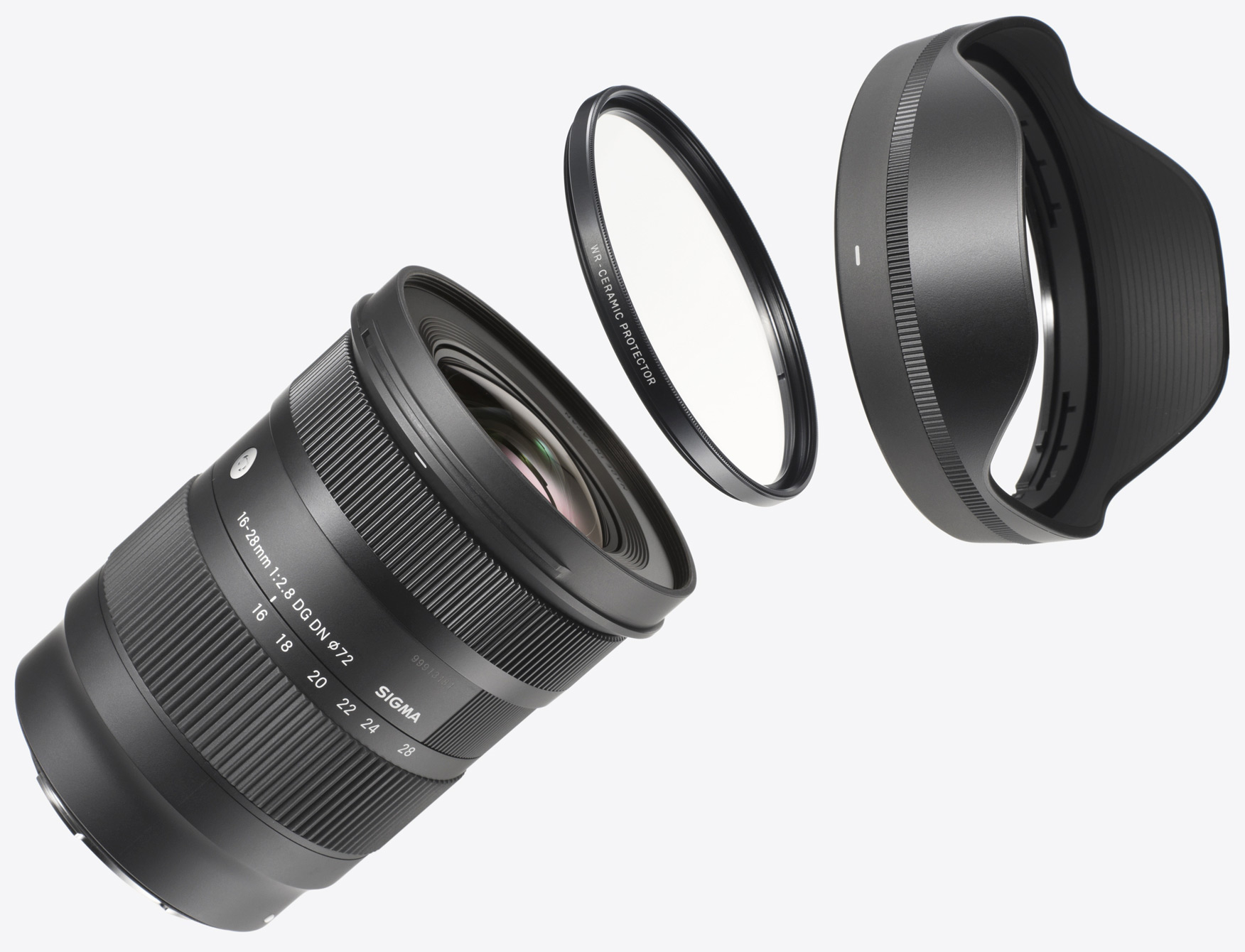
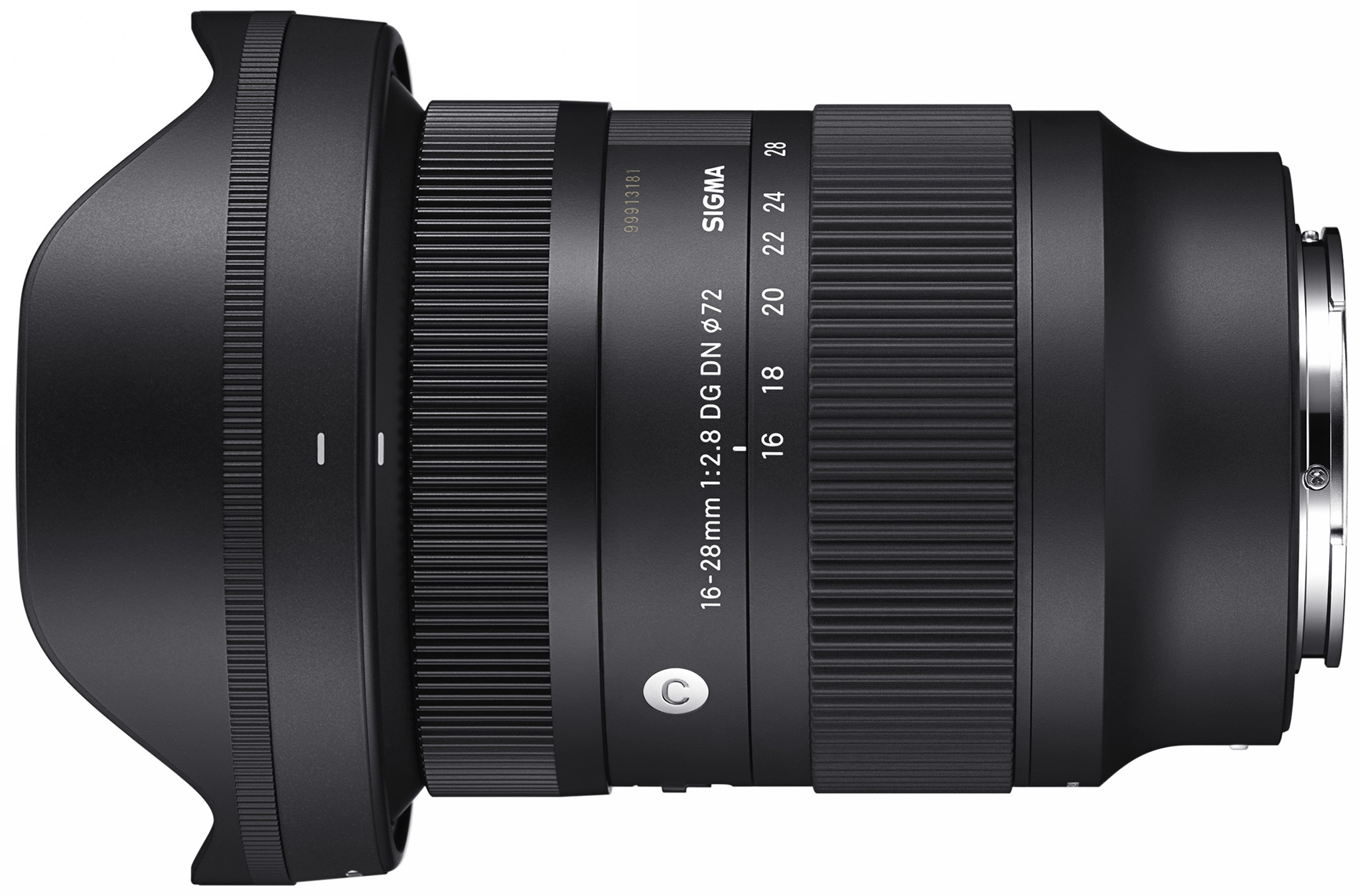
The companion for Sigma’s highly regarded 28-70mm f/2.8 compact zoom adds an unbroken range down to 16mm while retaining a small c. 77x100mm size, 72mm filter fit, and 450g weight. It is announced today and will be available to buy from June 17th for £749.99 (UK SRP) or $899 (US retail before tax).
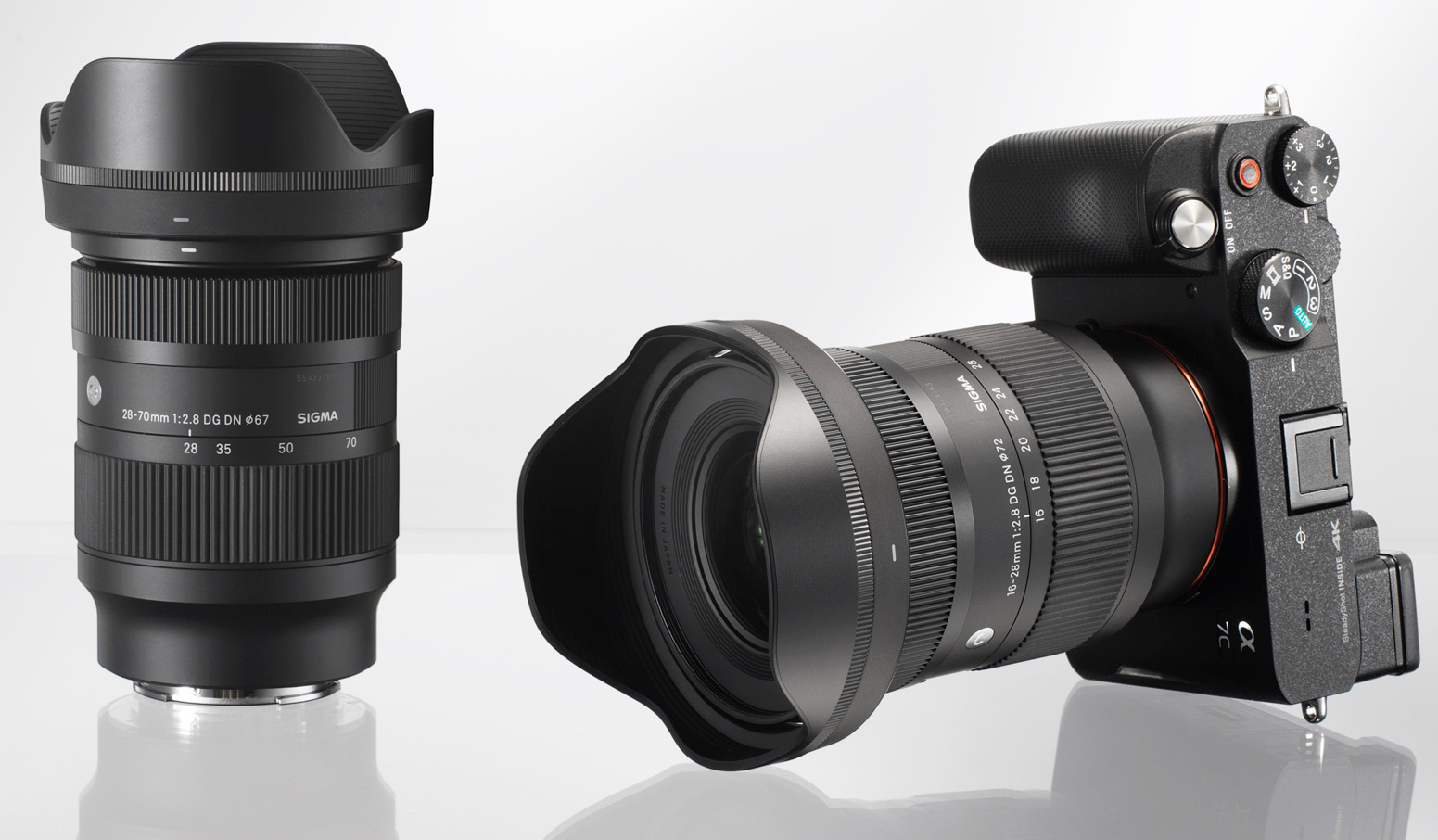
The new 16-28mm seen fitted to Sony’s compact A7C, with the companion 28-70mm left. The two lenses together weigh only 920g.
The full-frame Sigma 16-28mm f/2.8 DG DN Contemporary offers a promise of exceptional optical quality with a faster constant maximum aperture in barrel size similar to existing f/4 16-35mm designs. Special attention has been given to field curvature correction for edge-to-edge sharpness, important in wide-angle views – this is enabled through the use of a built-in lens profile, correcting distortion and vignetting in-camera or during raw image processing.
It uses five FLD (fluorite-like glass) elements and four aspherics to minimise chromatic and off-axis aberrations. The lens has an inner zoom mechanism that keeps overall length and the centre of balance constant, improving performance when zooming during a gimbal take. The 72mm filter thread is larger than the 67mm of the similarly light and small 28-70mm f/2.8 DG DN Contemporary.. At just 100.6mm long (L-mount version) and 450g it’s appealing for outdoor, social, street and travel photographers who want a lightweight outfit for day-long use.
The lens is constructed using aluminium and thermally stable polycarbonate, performing well in temperatures from the arctic to the equator, and has a dust and splash resistant mount. AF uses a proven stepper motor compatible with high-speed AF, DMF and AF or MF modes with an MF switch on the side. It focuses down to 25cm with a maximum image scale of 1:5.6, 0.17X and has a nine-blade rounded aperture. On the L-mount version only, linear and non-linear focus ring behaviour can be set using the USB Dock UD-11.
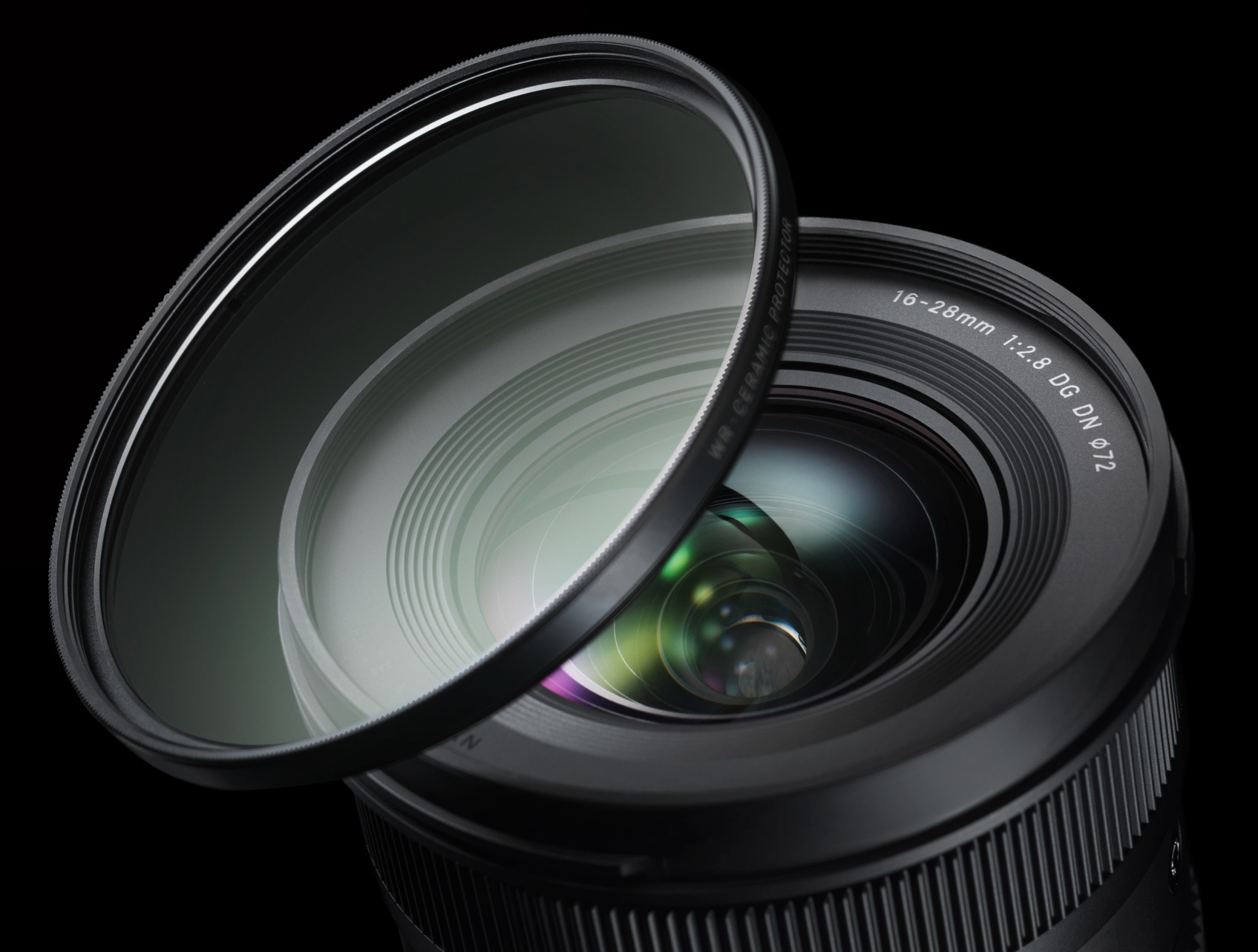
The lens is supplied with front and rear caps and a bayonet mounted petal lens hood. Sigma WR or WR Ceramic,WR UV and WR Circular Polarising 72mm filters are optional extras.
The first magazine test of the new Tamron reached Cameracraft readers in our March/April 2022 edition. Now that other magazines have reviewed the lens, it’s time to read David Kilpatrick’s practical user report on-line.
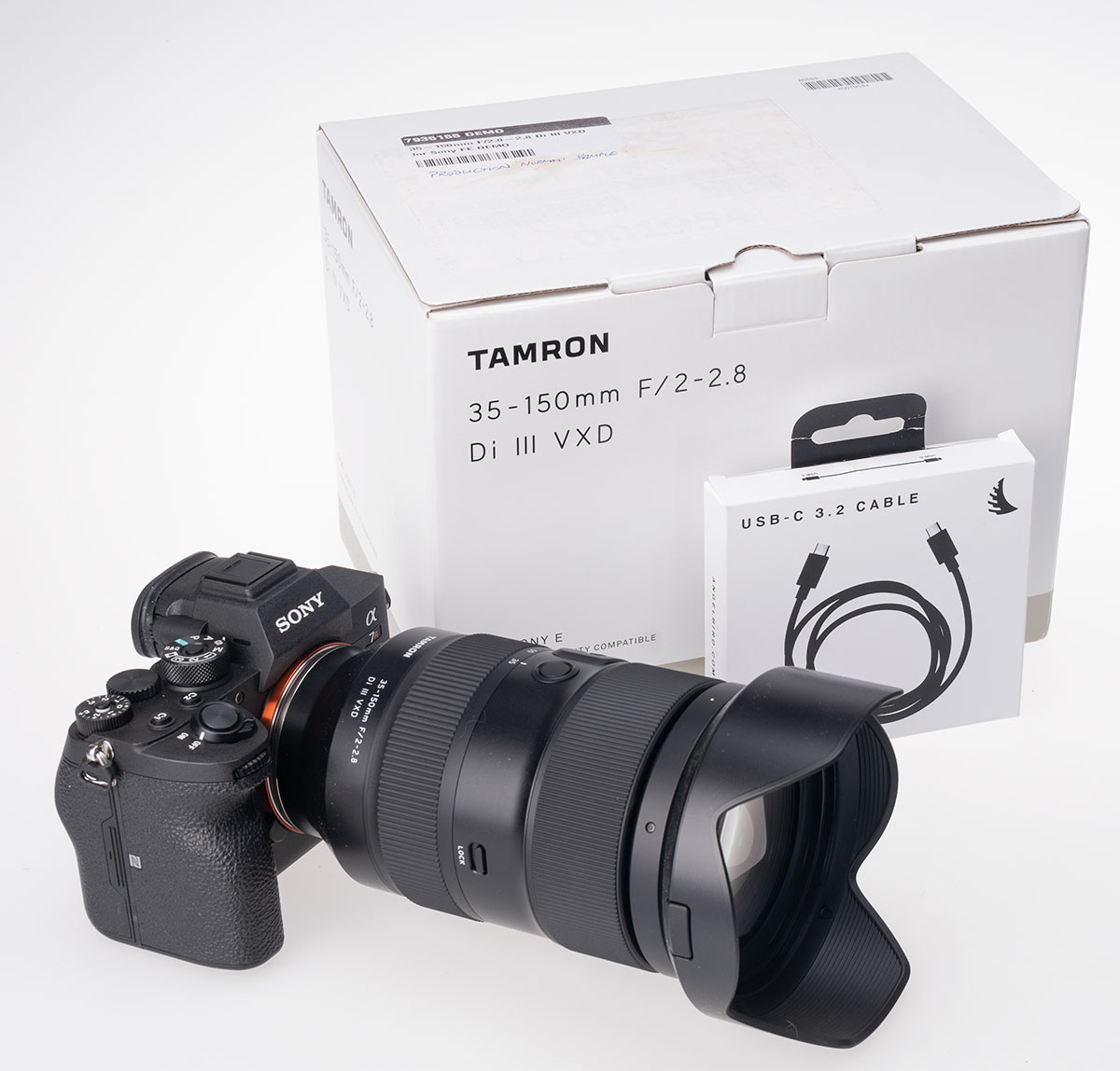
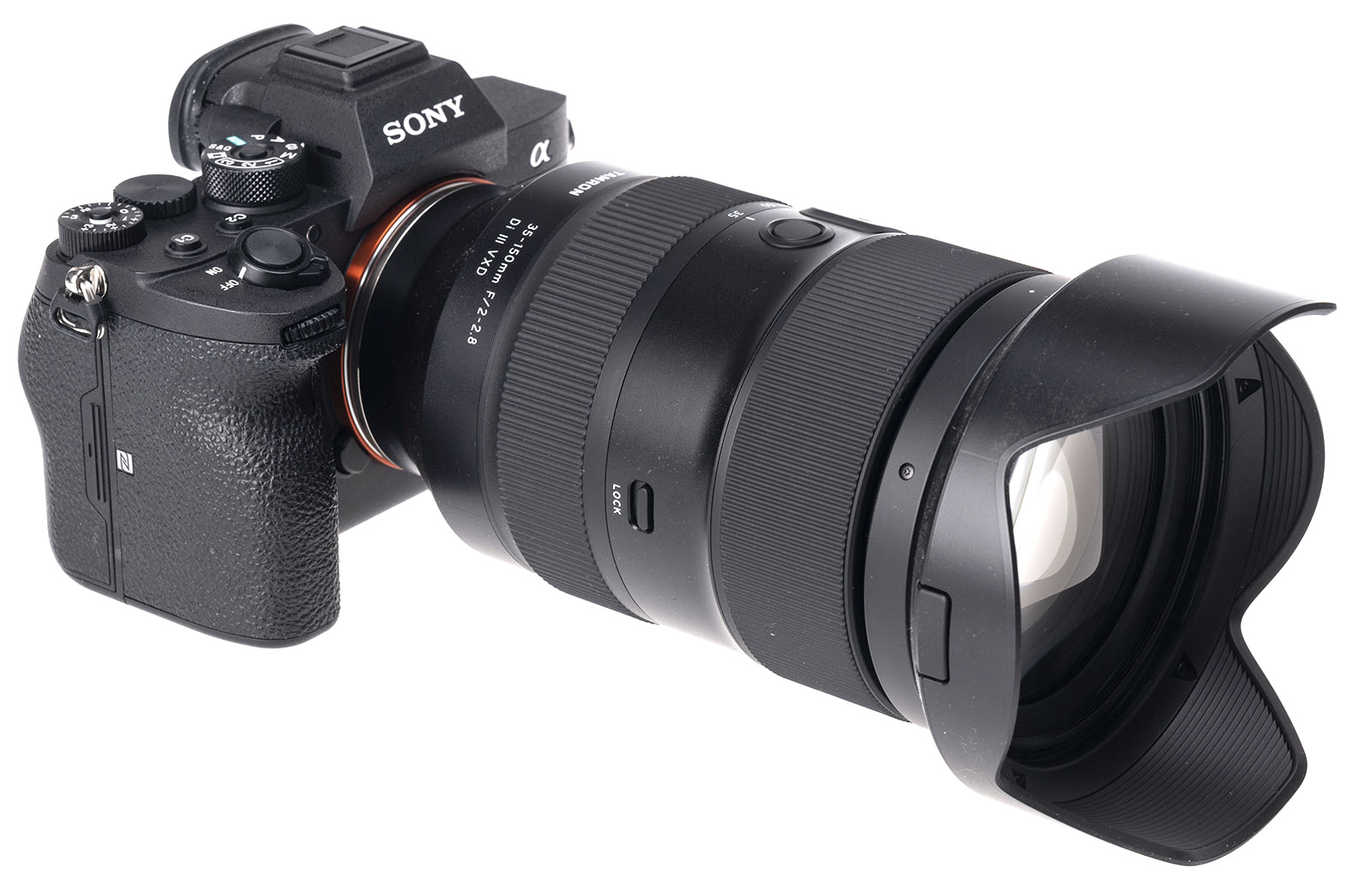
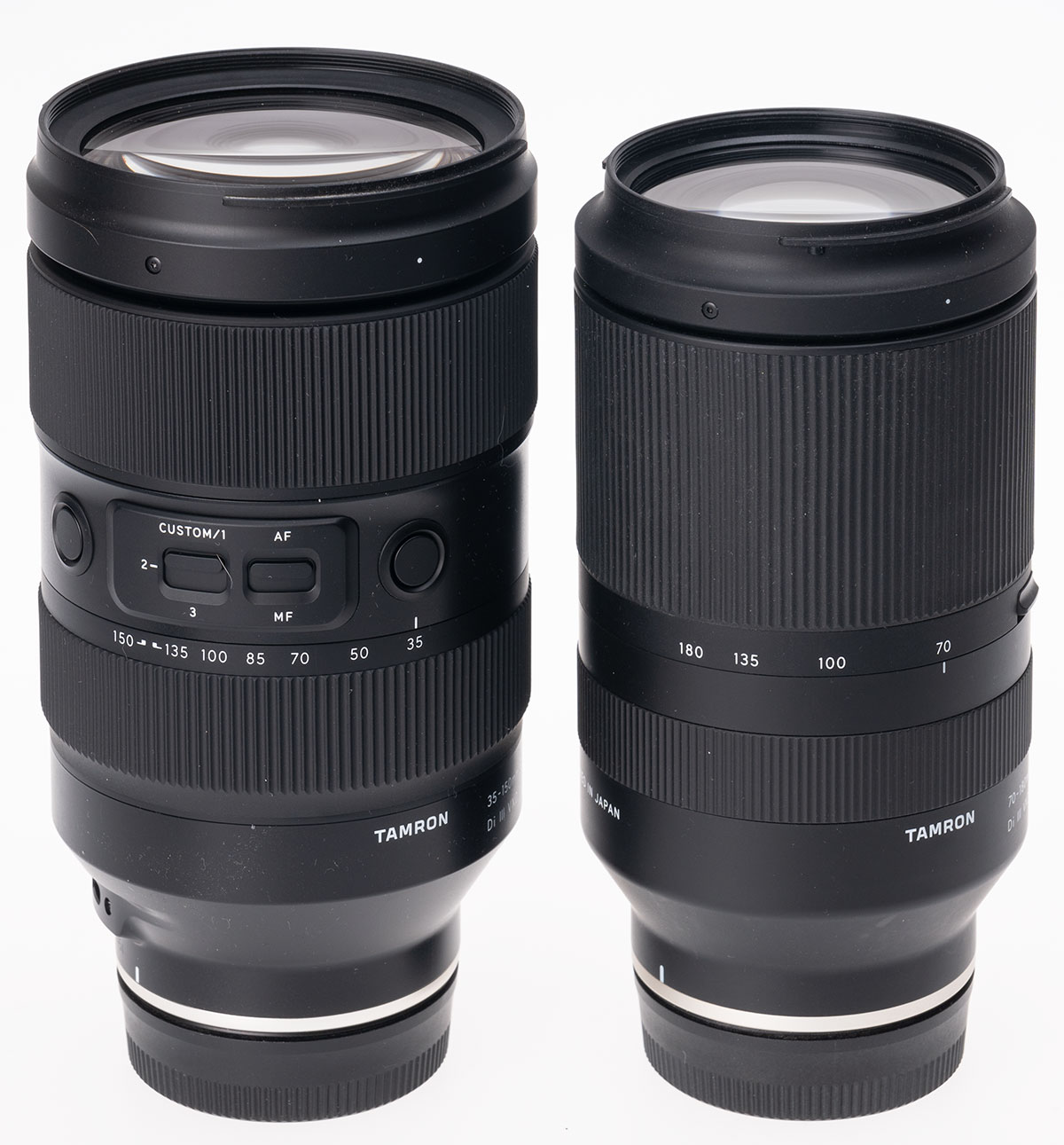
Tamron 35-150mm on Sony A7RIV body
IT’S THE MIDDLE of a dark winter and the new Tamron super-fast ‘group to portrait’ zoom has been doing the rounds of dealers, and we get the chance to use the lens for a good test period starting in January just as the days are getting longer. It’s 3pm and it looks like 4pm with heavy cloud. A quick exposure check says why this lens will be a priority purchase, in a hurry, for wedding photographers. Fortunately the days get brighter and longer during the time trying out this versatile lens.
So many weddings have been postponed due to earlier Covid venue restrictions. To get 1/125s shutter speed, which is very much needed to ensure expressions and fairly small movements are not motion-blurred, it was ISO 2500 at f/2.8 on the day the lens arrived. Between this and the end of useful daylight that changes rapidly to ISO 6400 and beyond, and eventually to 1/30s. Any sensible wedding photographer would now be digging out the f/1.4 lenses, firing up the battery flash kit and hoping the indoor setting works well.
However, there’s a zoom now for Sony full frame users which can cover most weddings or outdoor portrait sessions on its own, replacing a fast 35mm and 50mm and most of the range of a 70-200mm f/2.8.
The Tamron is 155mm long and 90mm in diameter
The new Tamron 35-150mm manages to hold its widest aperture of f/2 from 35mm to just short of 40mm, and doesn’t drop to f/2.8 until 80mm.
f/2 35 to 39mm
f/2.2 40 to 59mm
f/2.5 60 to 79mm
f/2.8 80 to 150mm
This is good, as so many zooms with a fast minimum focal length lose a third or half a stop with a mere nudge of the ring – those 17-35mm f/2.8-4 lenses made for SLRs were often f/3.2 at 18mm! With studio flash you might set f/2 and start work at the short end of the zoom, but with so many systems studio or location now being TTL and high-speed sync of one kind of another this probably doesn’t matter. Set the lens to f/2.8 or any smaller aperture, and it acts as a constant aperture zoom
How about the chosen focal length range? I’d argue that 28-135mm, with similar aperture benefits, is more useful because there’s a chance of never needing to change lenses. There’s a quick way to check what matches 35mm for groups, using just the long side of a landscape frame. It’s almost the same as the 36mm dimension of the sensor, with an angle of 55° covered horizontally. If you’ve got an APS-C sensor it matches 23mm, on MFT 17mm, on Fujifilm GF and other popular 50MP medium format models it’s 44mm, on the biggest like Hasselblad HD6-100C it’s 53mm.
35mm is not a bad wide end for practical reasons
This angle of view works well because many rooms have Golden Ratio dimensions, not unlike an A4 page. Stand near one end of a 5 x 7m room, put a group at a comfortable distance away from the opposite wall, and you’ll cover it well with some of the side walls visible. In a square room, you can just take in the opposite wall with no sides visible. The working distance gives scope for bounced flash, there’s no distortion of body or face width towards the ends of a group even if it’s tightly composed.
In fact having the wide-angle end limited to 35mm may improve your group photography and weddings in particular by making you keep that little bit of extra distance.
However, the real world sometimes throws difficult spaces and camera distances at you. This new Tamron is not an all-in-one outfit. It’s almost essential to have a 24mm, or a zoom such as Tamron’s 17-28mm or Sony’s 16-35mm.
The range
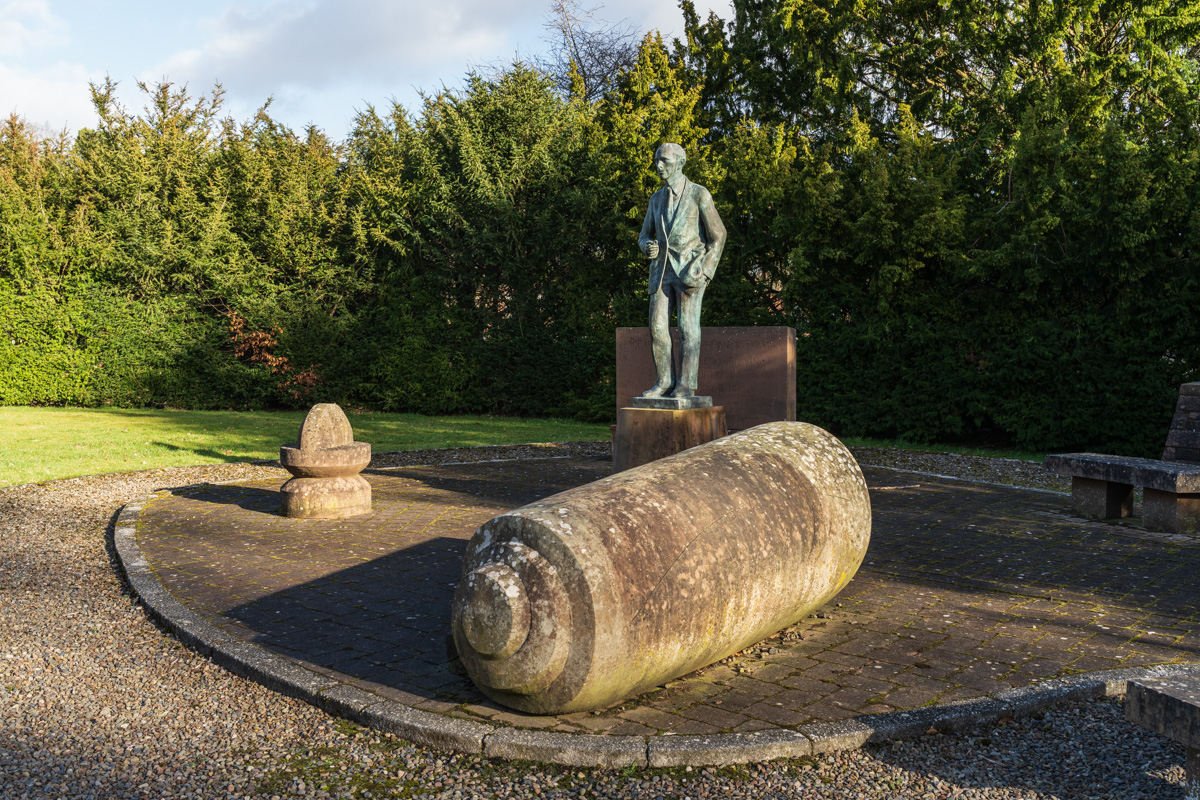
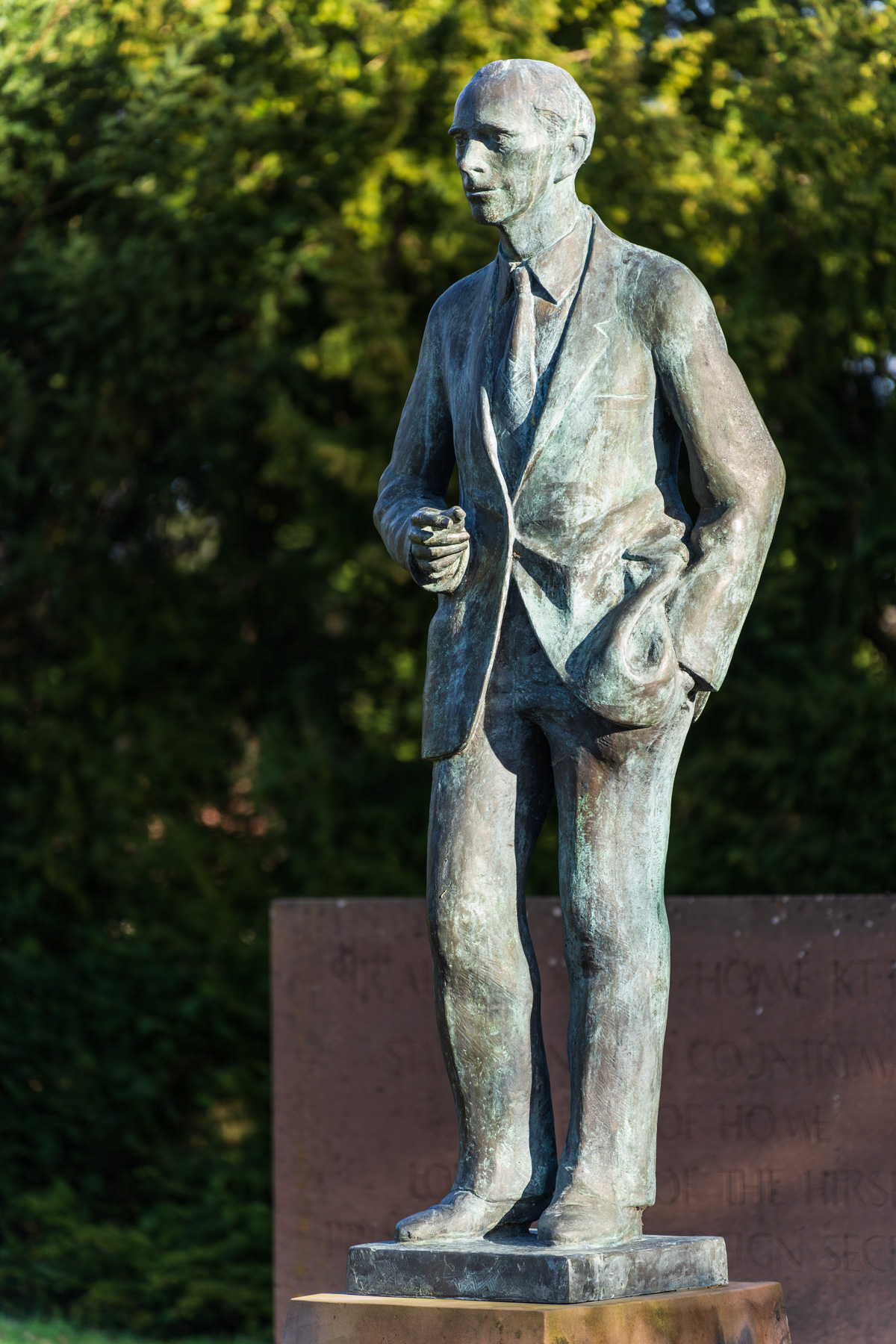
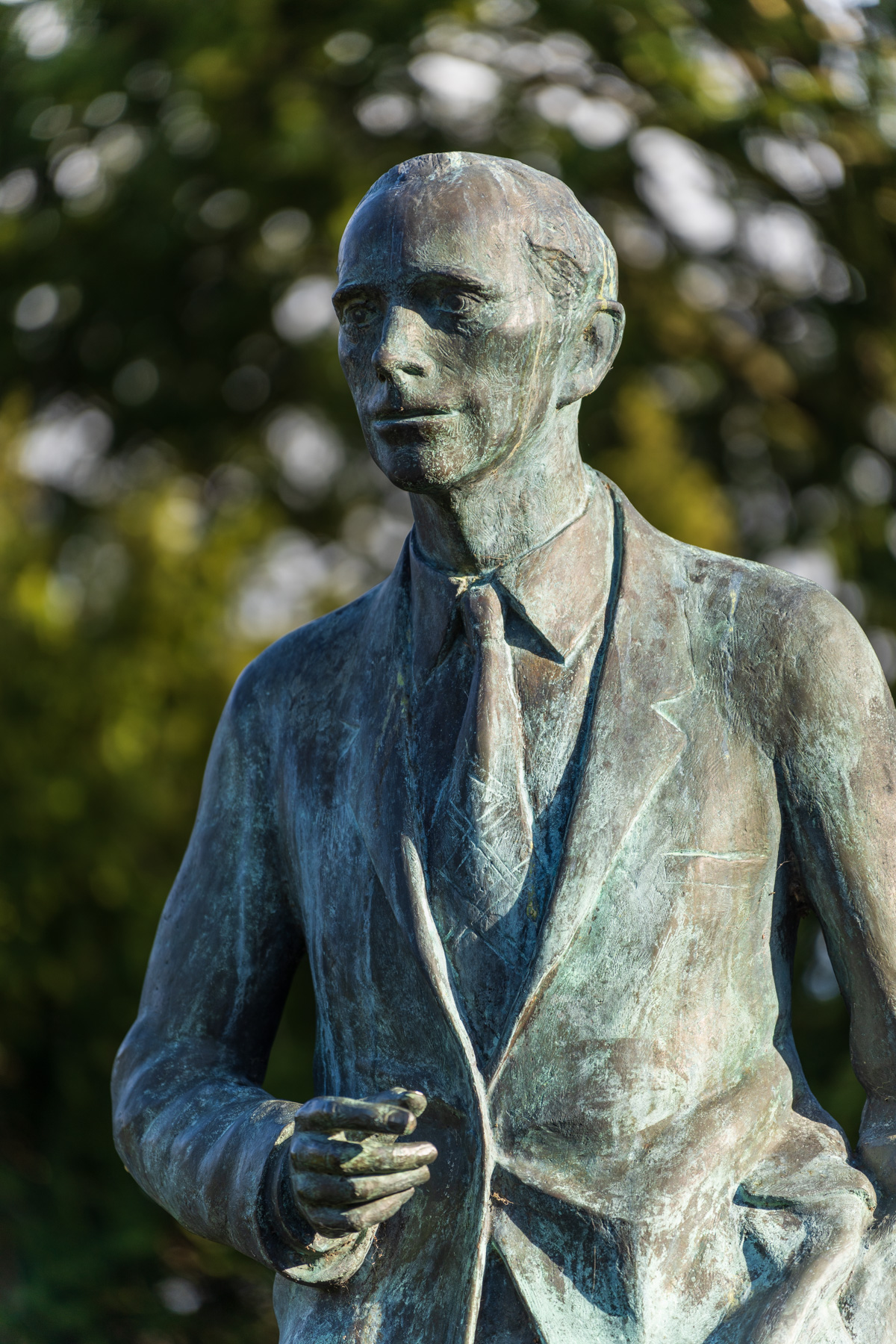
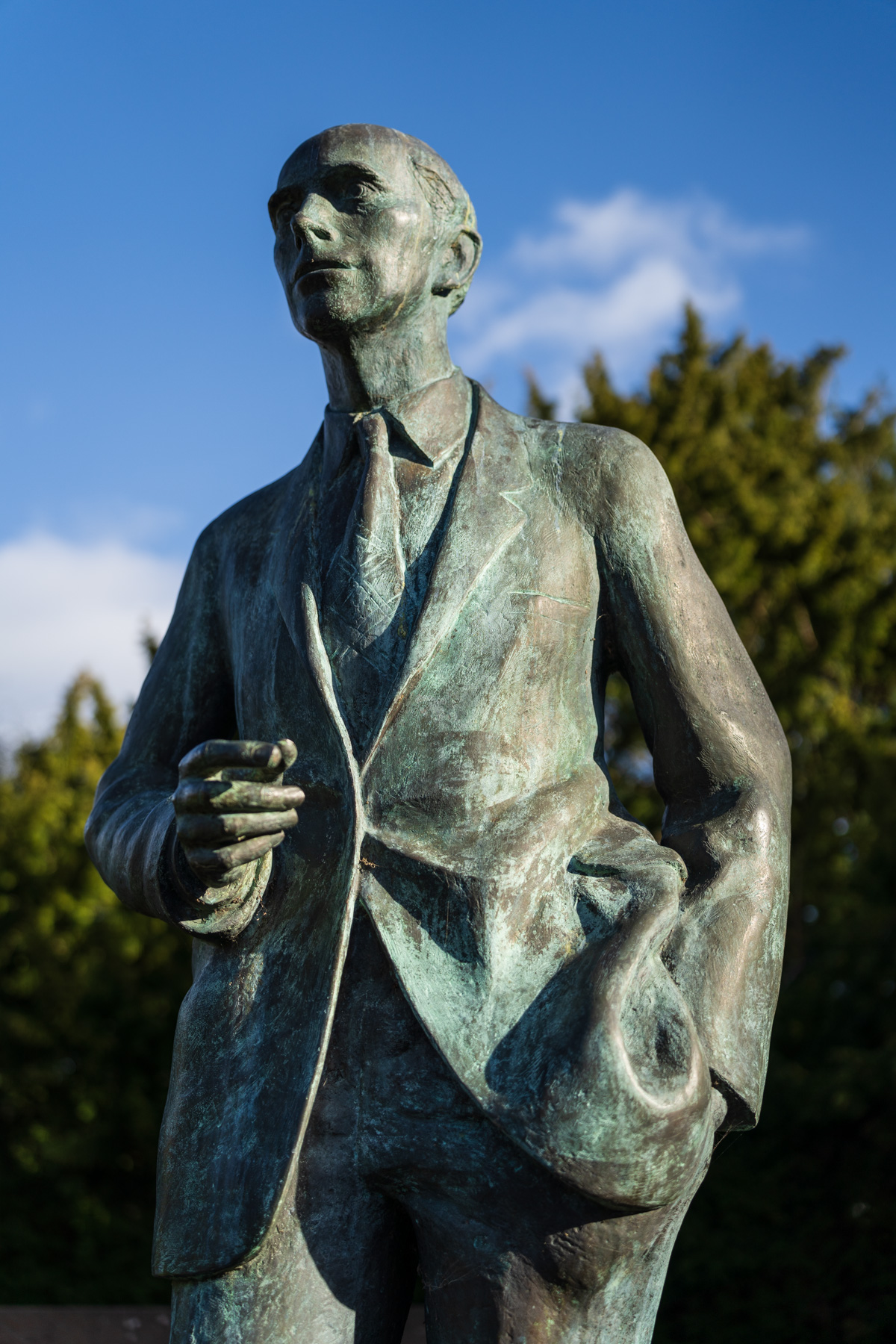
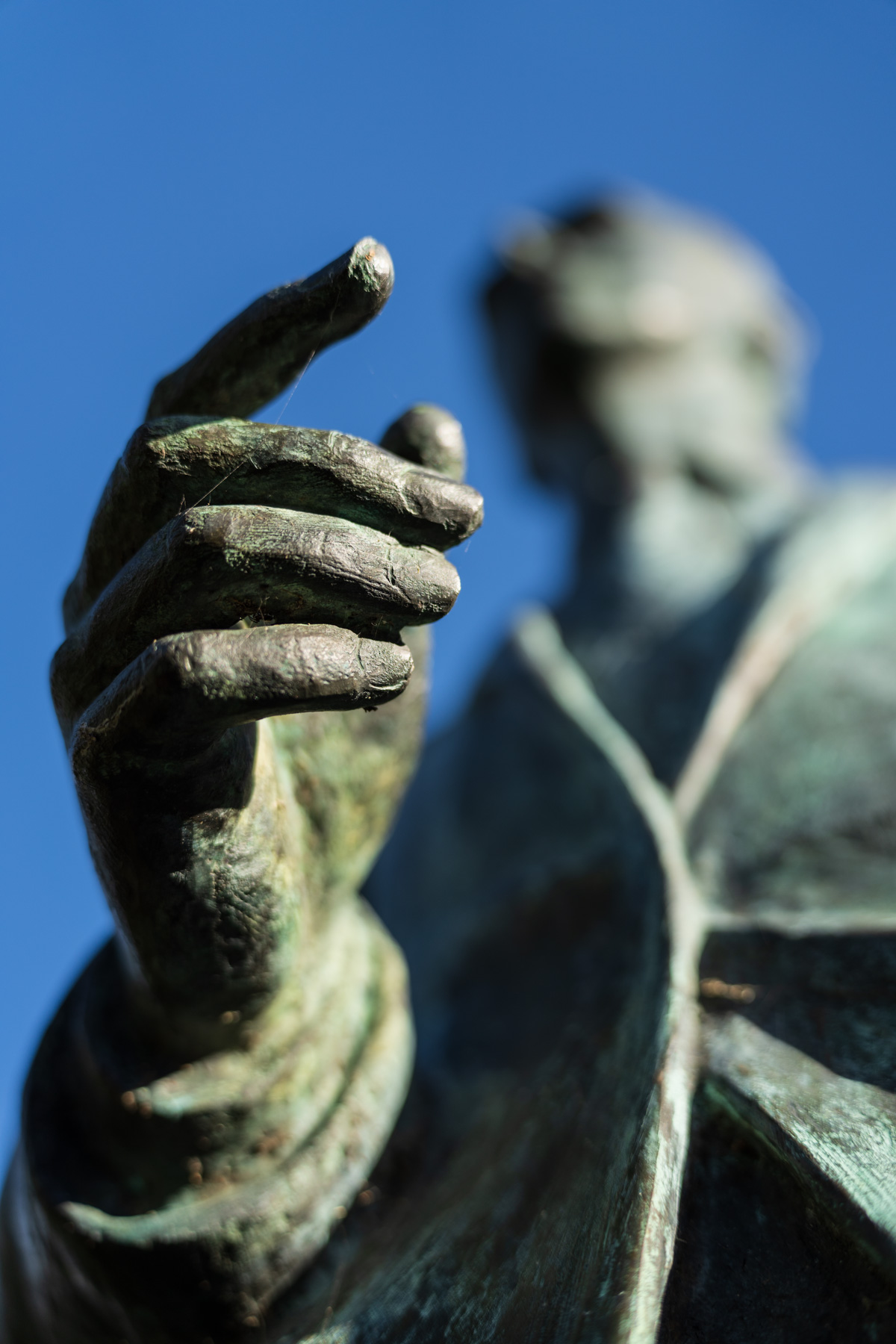
The statue of Sir Alec Douglas Home at The Hirsel estate, Coldstream, is a rare example of a life-size bronze standing on a soap box height plinth. The versatility of the 35-150mm range and the fast aperture is demonstrated here – above, 35mm and f/9 for the depth of field; below, both at 150mm and f/2.8 from different distances, showing the bokeh pattern.At 150mm, from a distance…At 150mm again, from closer in. Both at f/2.8.Zooming out to 35mm and closing in a bit shows how different a perspective on a figure can be achieved. For test, taken at f/2 full aperture.Still at 35mm, moving in close and keeping the aperture wide open at f/2. This can be a versatile lens.
Tamron 35-150mm performance
The optical performance of the 35-150mm is well above expectations for an f/2-2.8 design. It’s better than any past attempt at ƒ2.8 on a similar range, and this is down to mirrorless versus SLR body thickness. You can use it wide open at any focal length and be sure of sharpness in the plane of focus, and that is pretty flat corner to corner despite considerable pincushion distortion growing from 50mm to 150mm. The built-in and Adobe lens profiles are essential but not identical – while in-camera JPEGs are very well balanced across the frame, the default Adobe vignetting correction is much too strong.
Without correction this lens loses between one and two stops of light in the outer field when used wide open, with a central zone of around 20mm diameter representing the nominal aperture. The lens profiles boost the gain to compensate and if you set the Sony A7RIV to its ISO invariant optimum of 400, faces at the extreme ends of a group may be recorded as if ISO 1600 was used. For the best results, shoot raw and don’t underexpose (no need to follow the expose to the right mythology though). If you use the Adobe Lens Profile, adjust the vignetting to minus 60 for full aperture shots if you want to remove the effect. If you stop down to ƒ5.6 it’s pretty much gone anyway.
At 150mm with no Adobe lens profile correction, showing vignetting and pincushion distortion at ƒ2.8.The same raw file with Adobe Camera Raw profile corrections applied. In-camera JPEG corrections do much the same.Here we have 35mm and f/2 uncorrected.This is the same raw f/2 file with profile correction applied.
There’s a strong case for just letting the wide aperture vignetting be – don’t correct it at all. Many pictures will look better, including landscapes, portraits and most street shots. The distortion correction, on the other hand, is worth leaving turned on. Because the lens has pincushion rather than barrel distortion over most of its range, the corners don’t get stretched, it’s the centre of the image which is expanded slightly. As this is the sharpest area the correction tends, if anything, to even out the finest detail rendering over the frame unlike barrel distortion correction which degrades the corners visibly in many cases.
When Sony’s 90mm G macro was constantly being called the best lens ever, I tried three examples and all fell short of the standard expected. Just for interest I set the Tamron 35-150mm to 90mm (actually reported 91…) and shot a series from wide open to smaller apertures, on the same architectural distance subject I’d used for the Sony. Despite being on 60MP not 42MP the Tamron zoom was clearly much sharper across the frame than the Sony.
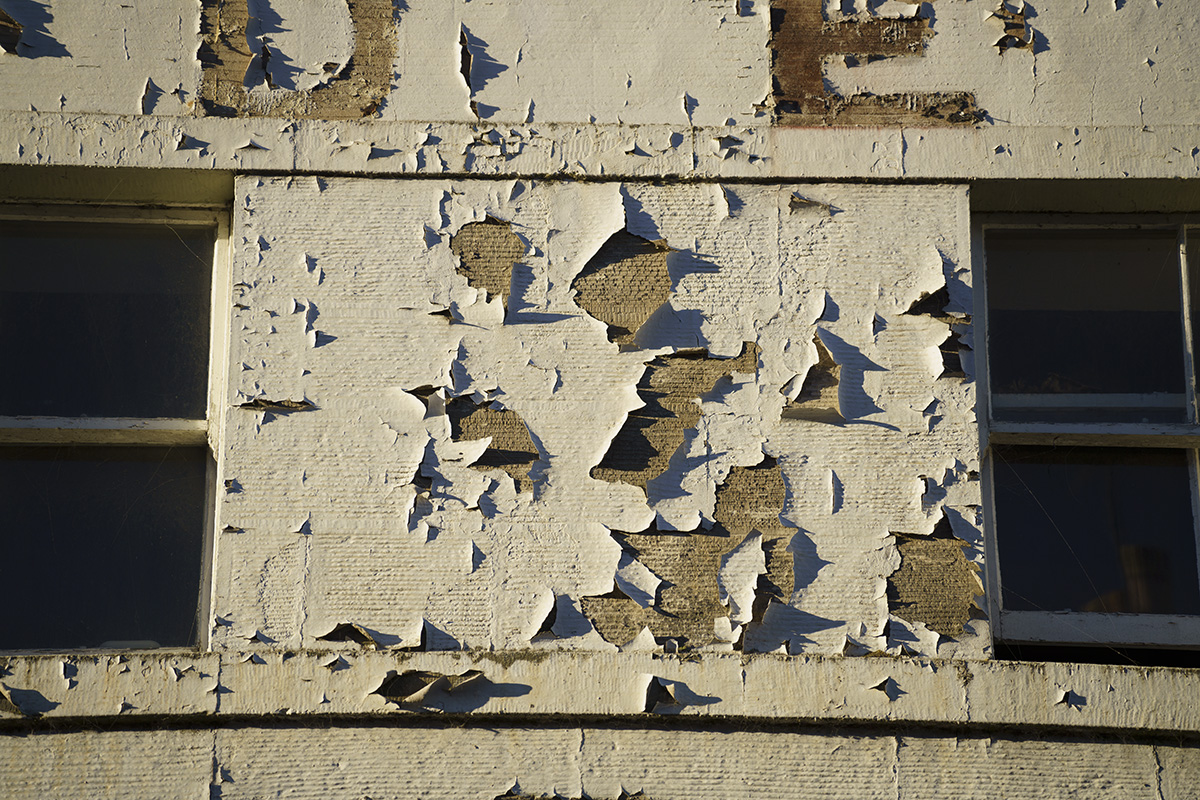
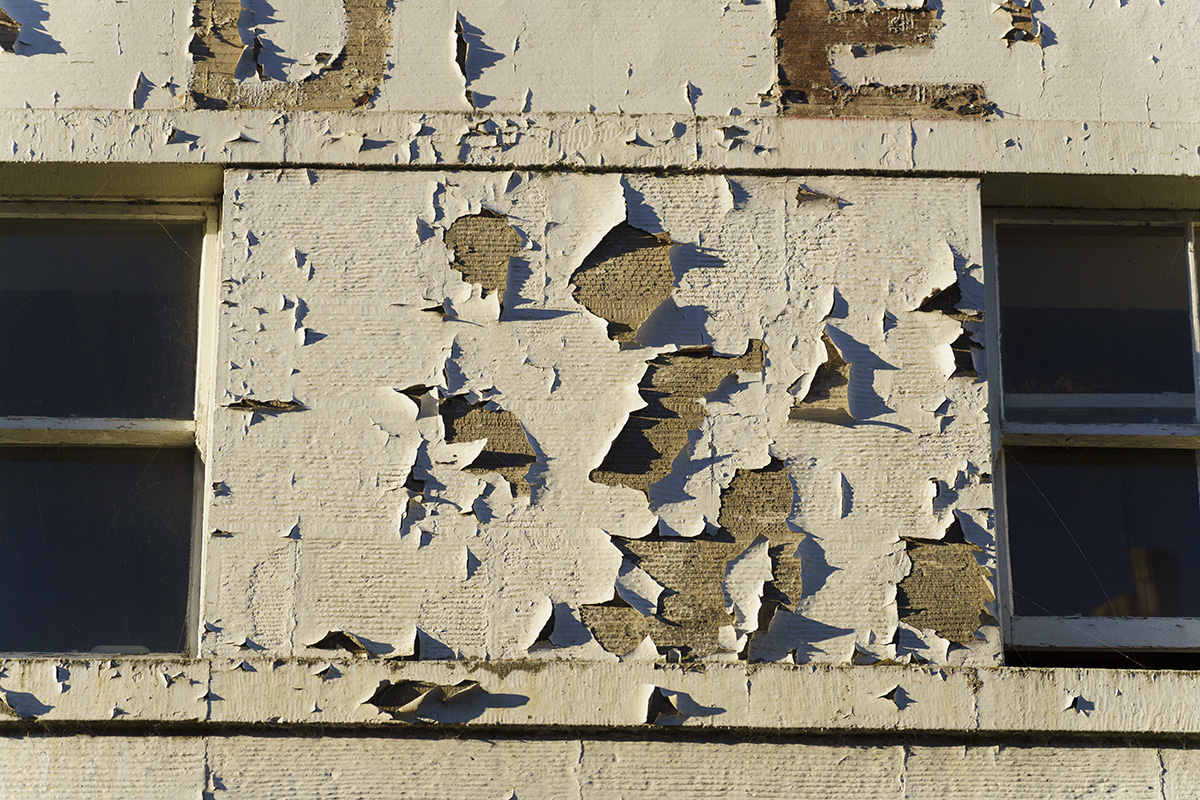
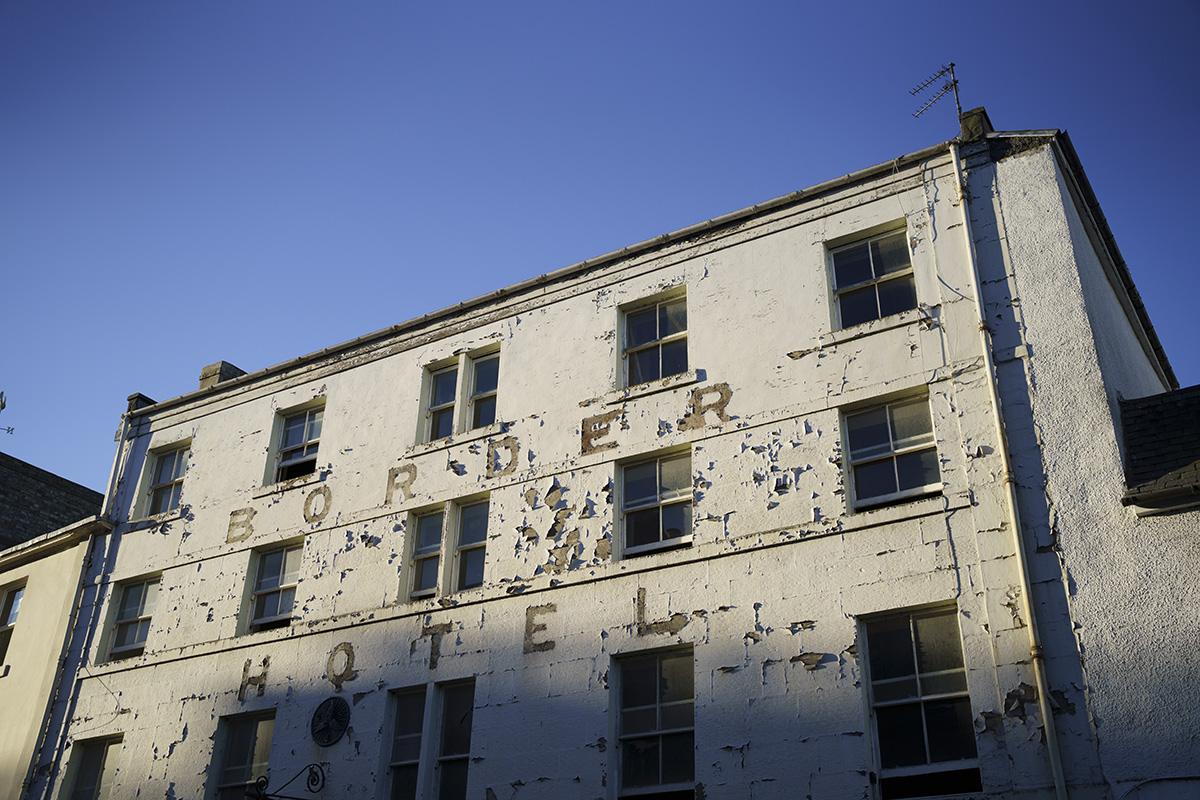
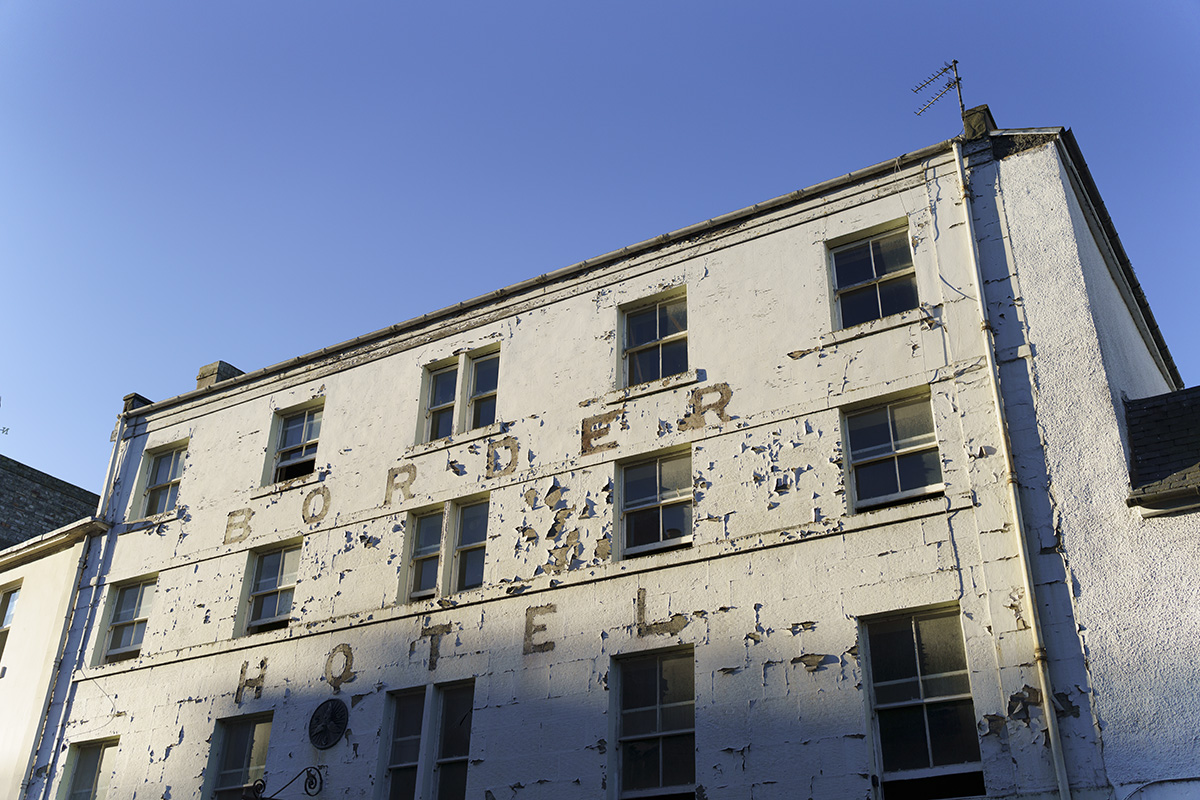
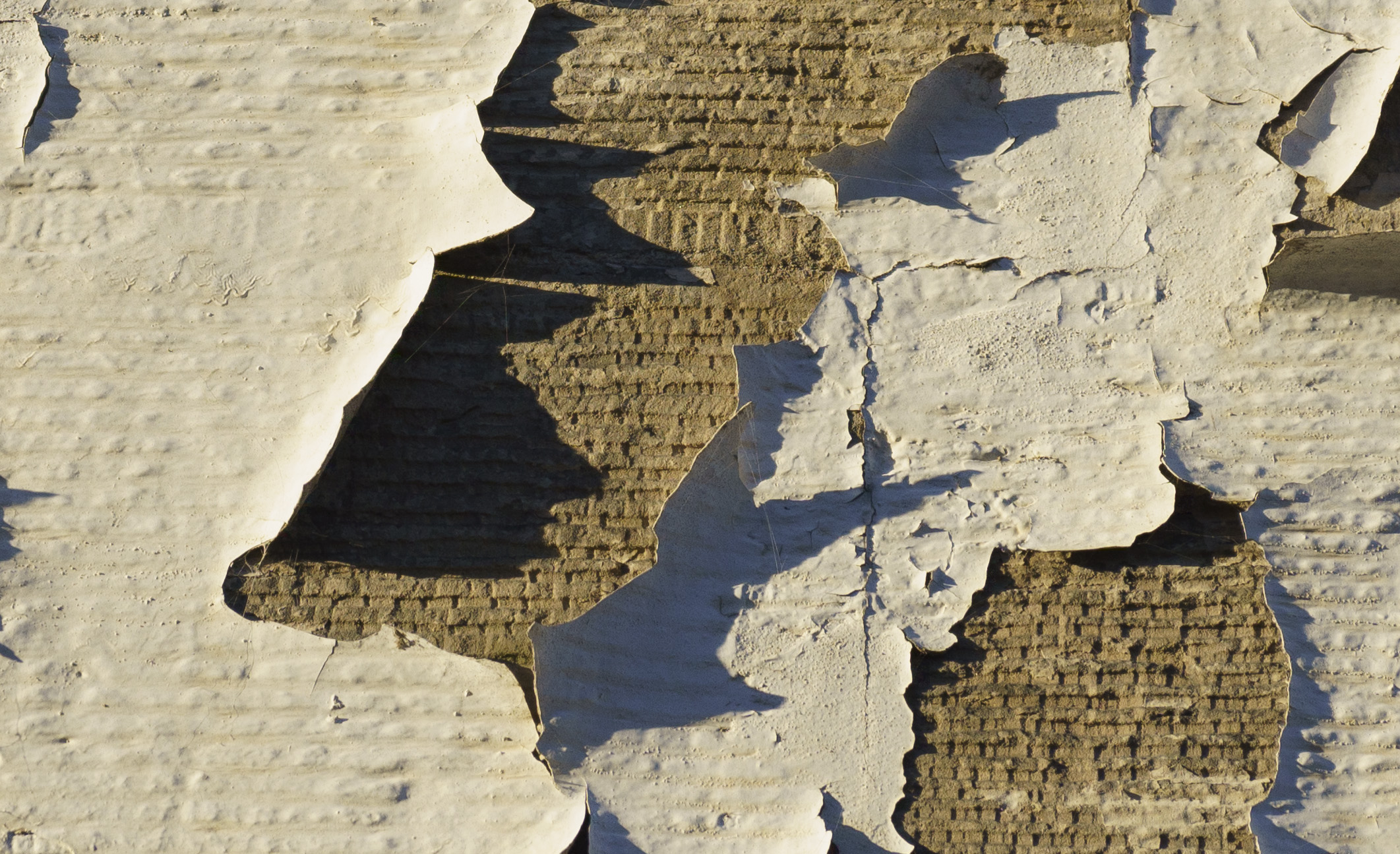
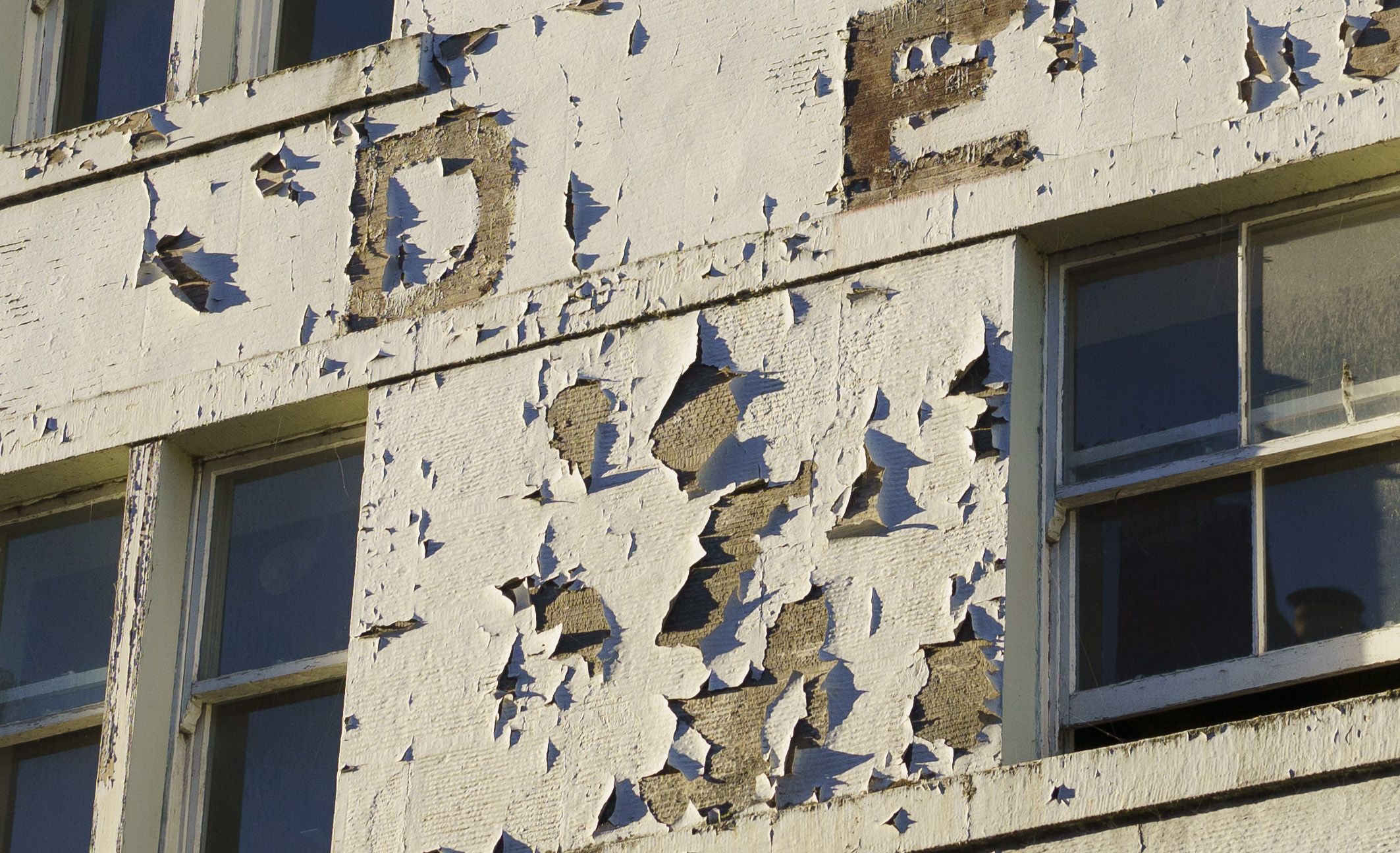
Here’s what detail enlarged from the 150mm f/2.8 shot looks like.Here’s 35mm f/2 detail. Sadly The Border Hotel’s delapidated facade will soon be a thing of the past, as it’s been a great test target for several years. The letters of the name fell off one by one but no-one was killed…
But – it’s a fast superzoom. Plenty of expert voices on Facebook will assure you it can not possibly be as good as a modest range zoom or an acclaimed macro prime. Don’t take their word for it, try the lens. And now we need to look at the downside of such an ambitious superzoom – it’s a large and heavy lens, it uses an unusual internal and extending hybrid zoom design, and it doesn’t focus into the semi-macro range like most other Tamron and competing lenses now do.
I regularly walk round with the 70-180mm Tamron f/2.8 on the camera and the 17-28mm and 28-75mm in a small shoulder pouch. All three of those go into the little Vanguard Sydney II 22 bag with the A7RIV. But just the body and this one 35-150mm lens could fit.
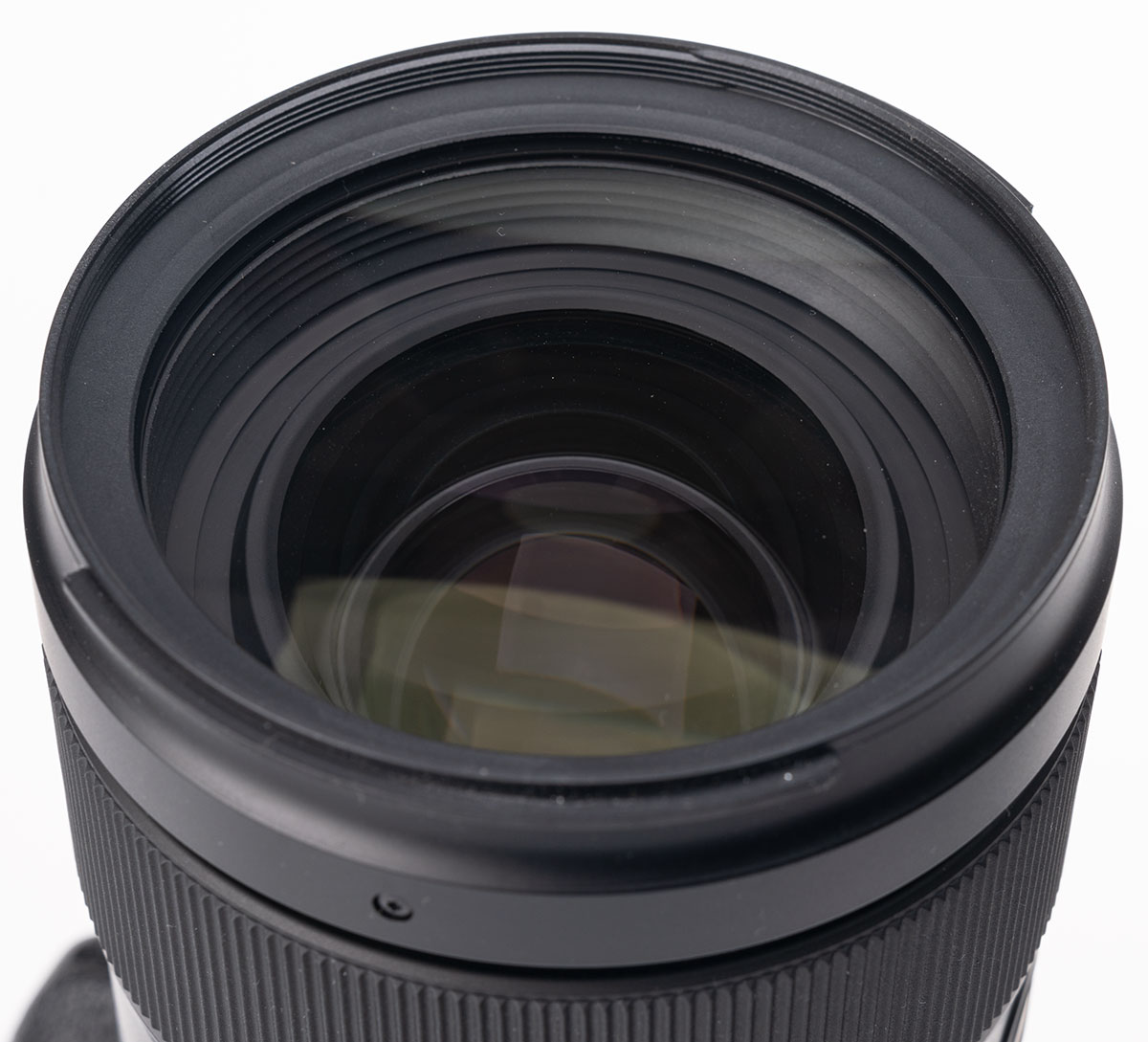
My first step was to replace my slim camera strap with an extra wide heavy duty neoprene Optek – the springy shock-damping handled almost 1.9kg of combined camera and lens round my neck well enough. Often I hold my camera in my right hand ready to lift to the eye and shoot, and don’t let the weight hang on a strap. It was like having a 70-200mm f/2.8 to handle and many users are happy with that all day. I’m not that keen on the 82mm filter thread, but that’s what it has to be.
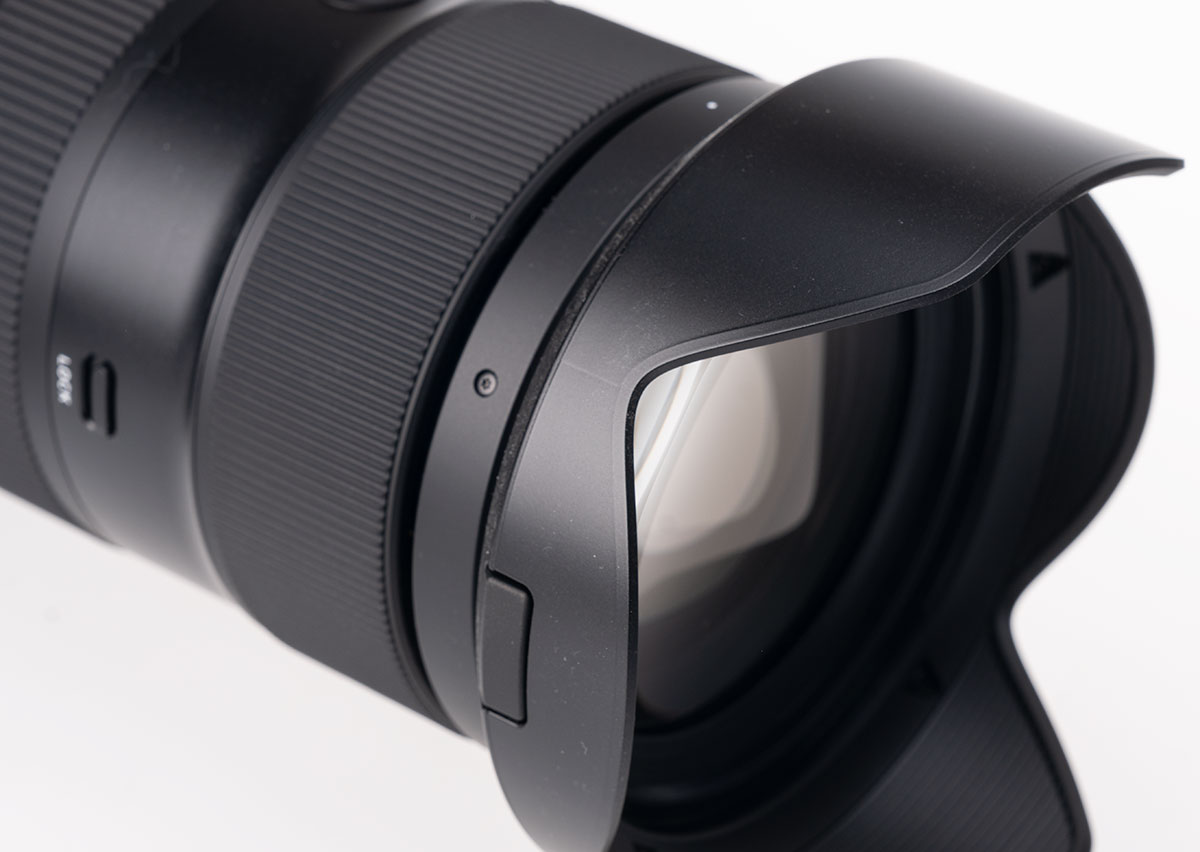
The lens hood has a single bayonet release button set in its rim, and you need to get it the right way up to fit. It’s very secure once on.
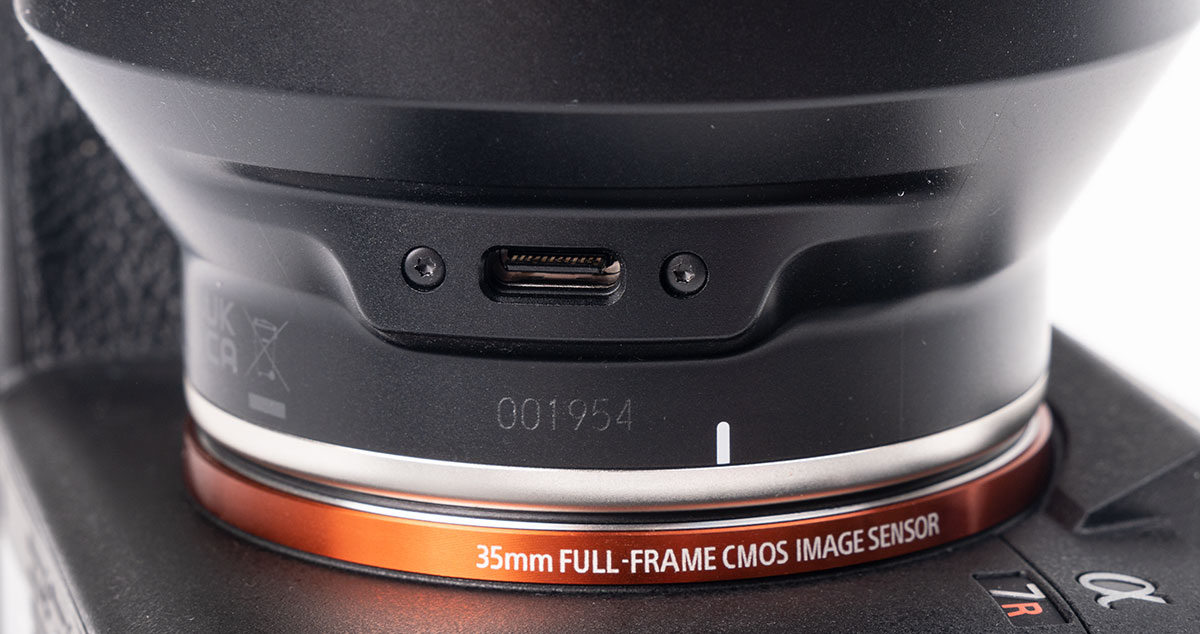
The USB socket
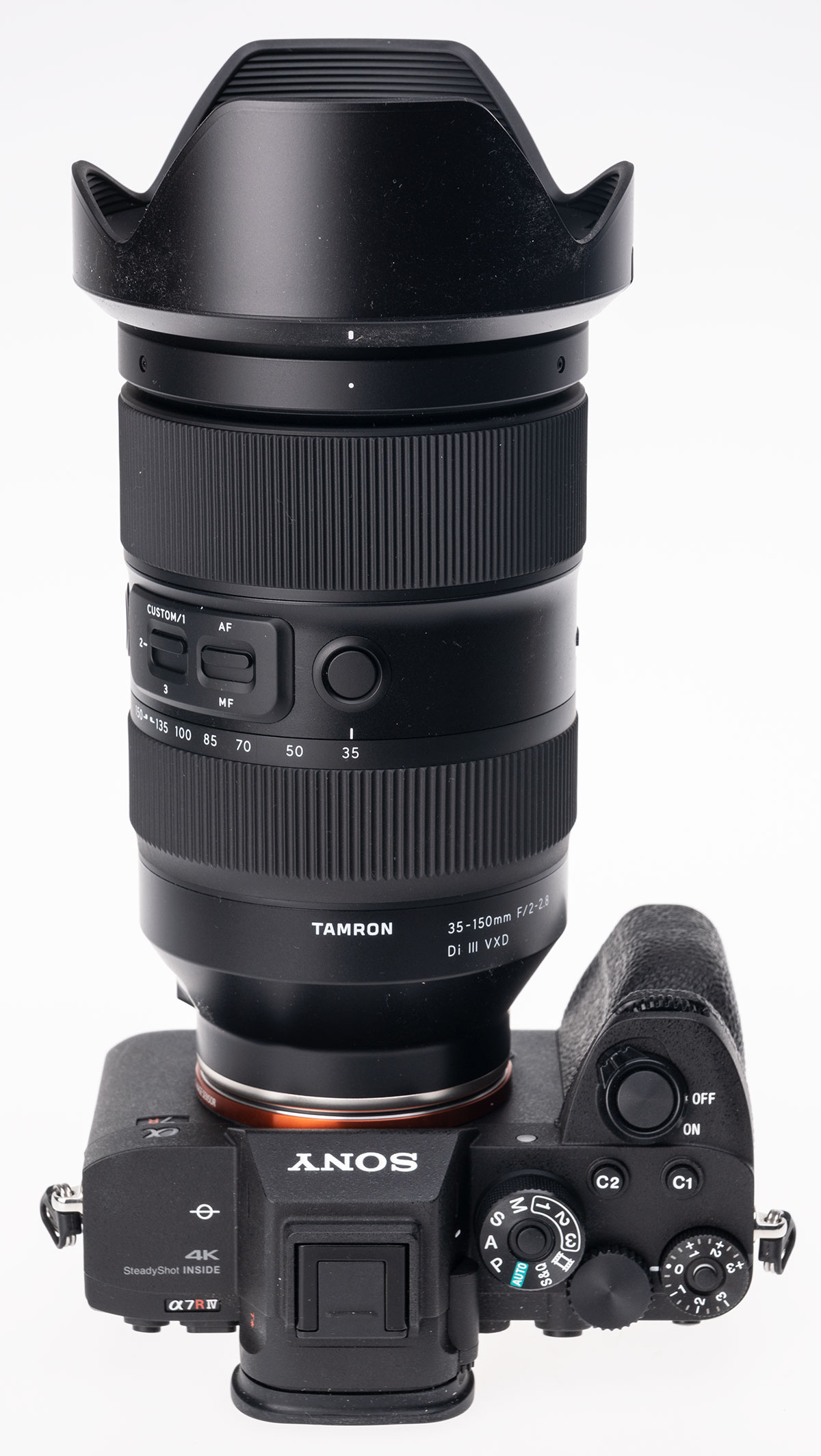
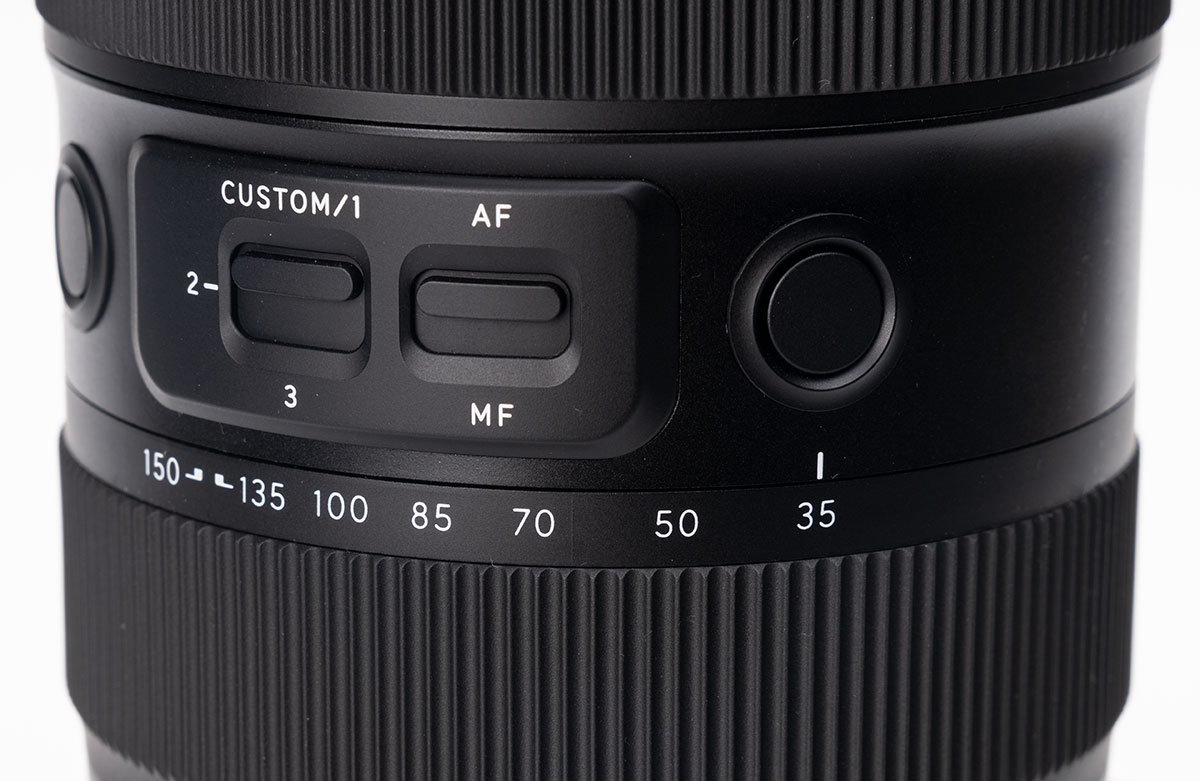
Then you come to the advanced aspects – this is a very fast focusing near-silent voice coil drive (VXD) design, and has three control buttons plus zoom lock, AF/MF and a three-position Custom function switch. With the aid of USB connected software (no dock needed) the lens can be customised for aspects like focus barrel direction/speed and even function (change to control ƒ-stop), and two preset focus points via the buttons.
The zoom ring is placed near the body with the focus ring being the main much deeper front barrel. This is the opposite to existing Tamron zooms and takes some getting used to, but it’s practical with the size and weight of the lens.
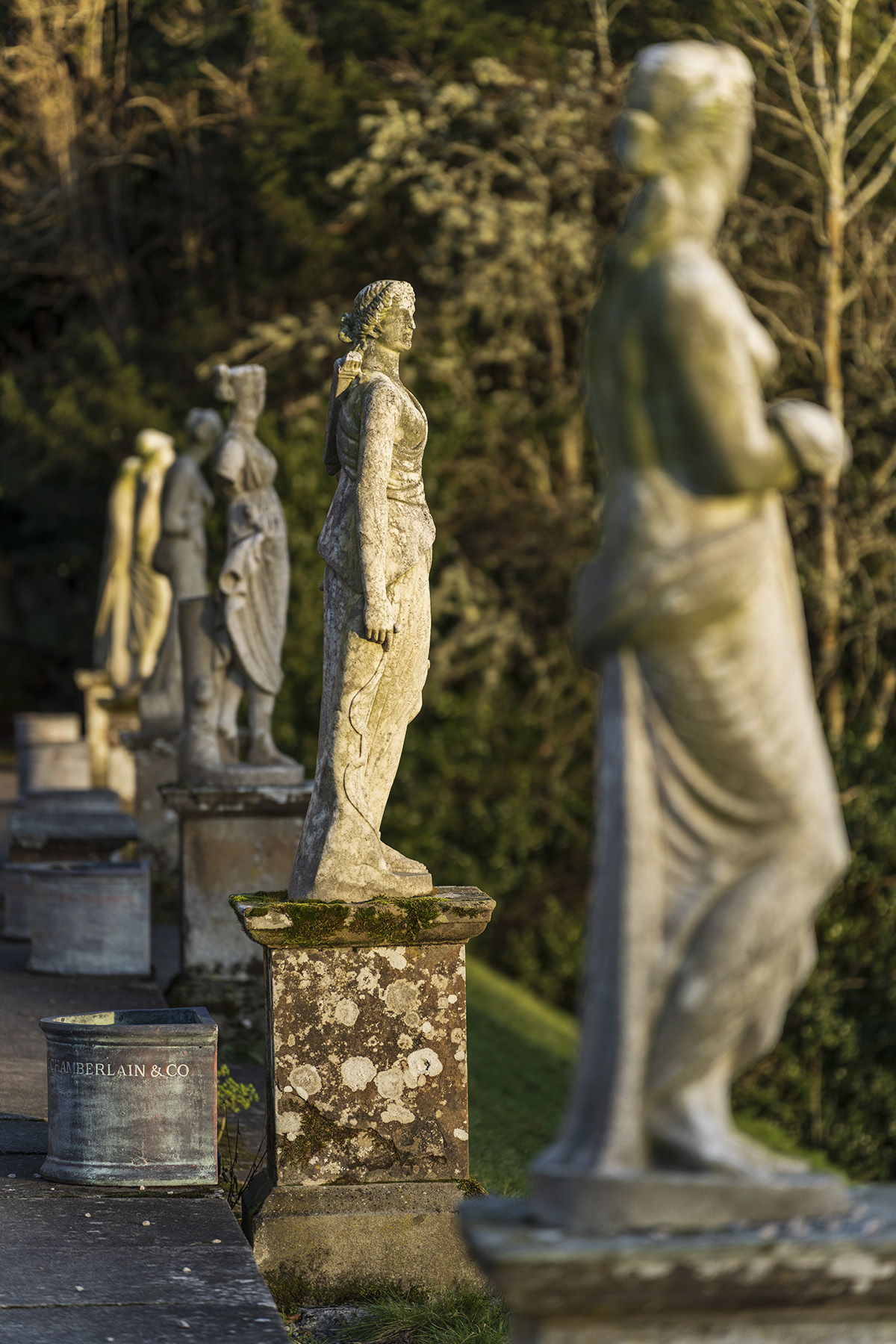
More statuary, this time at The Haining, a publicly owned mansion with a loch and grounds entirely free to walk round – not even a parking charge – in Selkirk, Scottish Border. This one is at 150mm and f/2.8.Here’s a more likely aperture to use if you had real people in a random group – f/11. But note how obtrusive the background has become.
With minimum focusing of 85cm at 150mm to 33cm at 35mm, the subject scale is 1:5.9 and 1:5.7 respectively – that’s a field around 9.5 x 14cm, so not in the wedding ring shot class but fine for flowers, hands and many other close-ups. The 9-blade aperture creates a very attractive smooth defocus and if there are lights or candles in the background this lens gives full aperture bokeh discs, not clipped ellipses, at focal lengths from 35 (f/2) to 60mm (f/2.5) and with only a hint of cat’s eye shape at the extremes of the shot at 80mm (ƒ2.8). Longer than this and you’ll see some degree of this effect though using an APS-C or smaller crop cuts out the more visibly ellipsoid highlight bubbles. Depending on the light source you’ll see some ‘orange peel’ texture which is typical of zooms using moulded aspherical elements – there are many ways to remove this from finished edits. There are no ‘onion ring’ effects which are much harder to remove and occur with lenses using older aspherical moulding methods.
Bokeh Airey discs, f/2.8 and 150mm.Zooming back to 107mm still at f/2.8.82mm and f/2.8 – a 10 x 8 shape crop from something like a party or wedding shot with lights would lose the cat’s eye shapes at the ends of the frame.At 60mm and f/2.5 the chatoyance only affects the extreme corners. Sure, I write elliptically. What less would you expect?
As for real cat’s eyes, the lens behaves perfectly with Sony’s animal and human face detection and eye AF and even managed to keep up with the most impossible close range movement of chickens – fine for eye sharp focus if not for the shutter speed.
Sony Animal Eye-AF at 150mm and f/2.8. It’s got that bit more depth of field than a 200mm f/2 or something extreme. However, it’s hardly unique to this lens. Every 70-200mm f/2.8 pot-boiler zoom ever made for an SLR or DSLR or mirrorless can do 150mm f/2.8 much the same. They just can’t do 35mm f/2.
This lens has a USB-C connection (no cover, it’s a waterproof port) and the Tamron Lens Utility, on 64-bit PC or Mac, can customise functions. After thinking the utility was not working (on three different systems) because it said Lens Not Connected when it was, I found you ignore this and click on the Start button for the functions you want to modify – like changing the 1, 2 and 3 positions of the Custom switch to alter the behaviour of the focus ring (direction, linearity, use as aperture ring) or lens buttons (AF/MF, A-B Focus, Preset Focus, Assign Function from Camera, or Clear Settings).
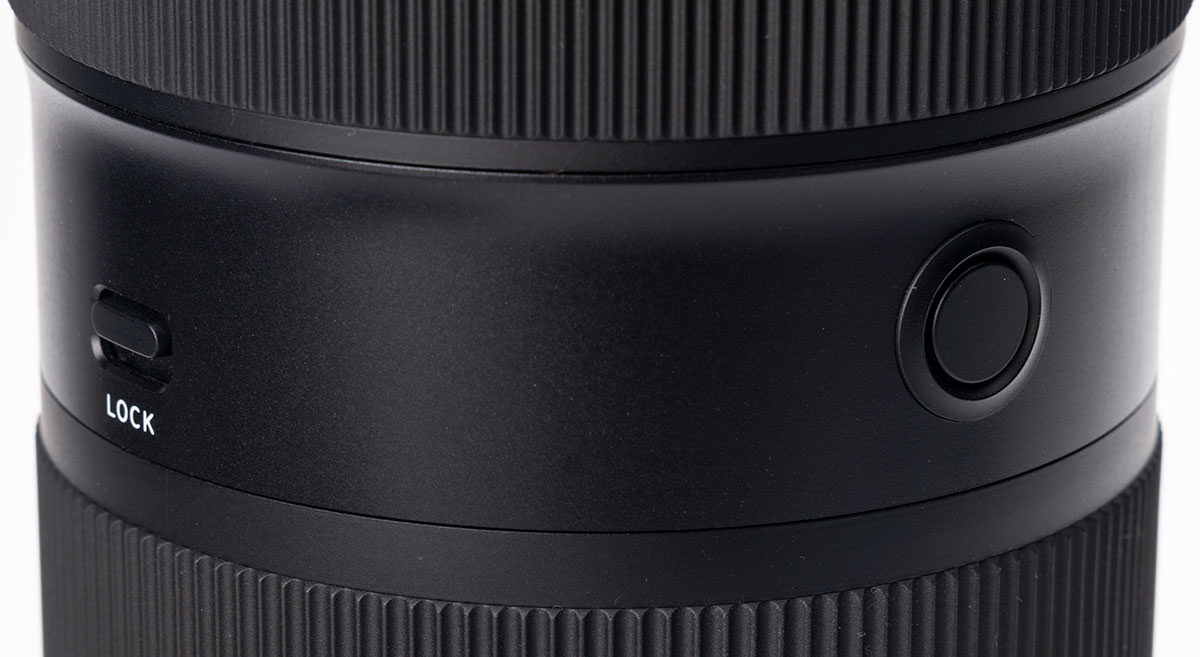
Lock for zoom (not really much needed) and one of the three lens function buttons which occupy the remaining cardinal points.
All three lens buttons do the same, which might be missing some useful tricks such as two focus points assigned to different buttons. A-B focus and Preset distance have selectable focus speeds, and are strictly Movie functions (you have to press the Record button in Movie mode to program the distances, then use the lens buttons to activate the focus change during filming). The lens is fairly silent in focusing but an external microphone is desirable. It has almost no focus breathing regardless of the focal length set, though use at full aperture will produce some shifts as the bokeh expands and contracts – the real angle of view remains very constant from close-up to infinity.
You are advised to get a good USB-C cable to make use of the software to program the lens’s functions (mostly of interest to movie makers who can set the buttons to initiate point-to-point focus transitions).
This lens costs £1,599 (editor’s note: 2022 price at time of writing) so you need to know you need it to invest. It hardly came off the camera in six weeks partly because of the convenience of not having to change lenses, and just carrying the camera and this one lens.
The lens now sells for around £1800 new (link to Sony version at WEX) and £1300 used.
It is also now available (update) for Nikon Z link here to WEX – bundles with bodies are also offered.
My comment: we have assumed for years that it’s best to wait a year after launch before buying as prices fall rapidly. This is no longer the case as inflation and issues with worldwide shipping costs mean prices are rising and set to rise further. Don’t assume that you can save by delaying, but saving by sensible used market buying is still practical.
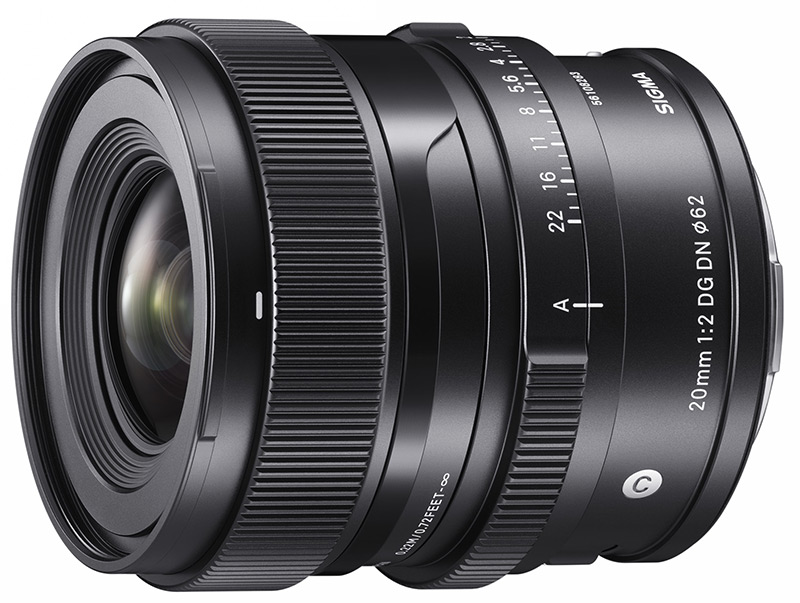
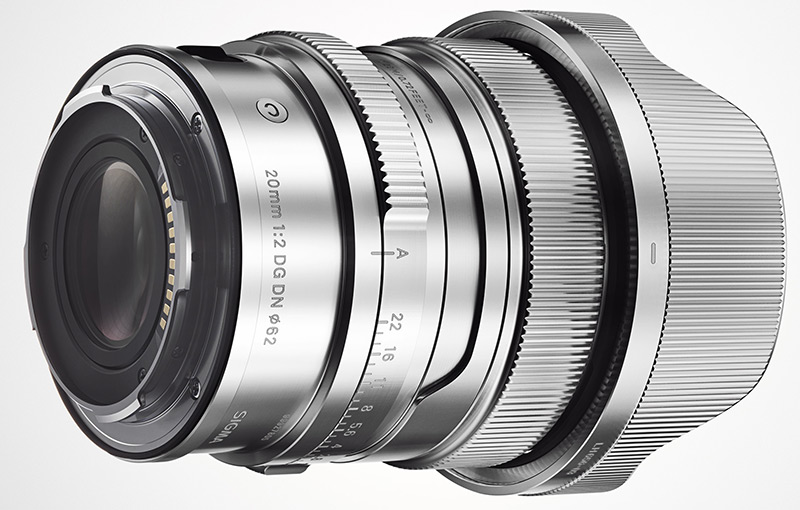
The new 20mm f/2 DG DN Contemporary lens for full frame E and L mounts from Sigma will sell for under £650 in the UK from February 25th. It extends their compact, metal barrel prime ‘I’ series range which includes f/2 models in 24mm, 35mm and 65mm focal lengths.
Sigma I-series 20mm f/2 DG DN Contemporary
It also offers a filter-friendly alternative to the very large and heavy 20mm f/1.4 Art lens. It uses 62mm filters, weighs 370g and is just 72.4mm long (much the same as the 24mm f/2). It has a magnetic lens cap and all metal construction, including the bayonet lens hood. A second plastic clip-in lens cap is also supplied. The design with a physical aperture ring is similar to Sigma’s high-end ciné lenses.
The lens with its hood, seen here in ‘bare metal’ before the black coating is applied to the components.
It uses three high-precision glass-molded aspherical lens elements, one SLD element, and one FLD element. Suppression of sagittal coma flare makes the 20mm f/2 ideal for night sky with stars near the extreme corners of the field.
Other specifications include:
Lens construction: 11 groups, 13 elements
Angle of view: 94.5
9 rounded diaphragm blades
Minimum aperture: f/22
Minimum focusing distance: 22cm
Maximum magnification ratio: 1:6.7
Inner focus system
Compatible with high-speed autofocus
Stepping Motor
Compatible with Lens Aberration Correction
Support DMF and AF+MF
Nano Porous Coating
Super Multi-Layer Coating
Aperture ring
Focus Mode Switch
Petal-type lens hood (LH656-03)
Magnetic metal lens cap (LCF62-01M)
Mount with dust and splash resistant structure
Support for switching between linear and non-linear focus ring settings (for L-Mount only)
Compatible with SIGMA USB DOCK UD-11 (sold separately / for L-Mount only)
Designed to minimise flare and ghosting
Every lens checked using proprietary MTF measuring system
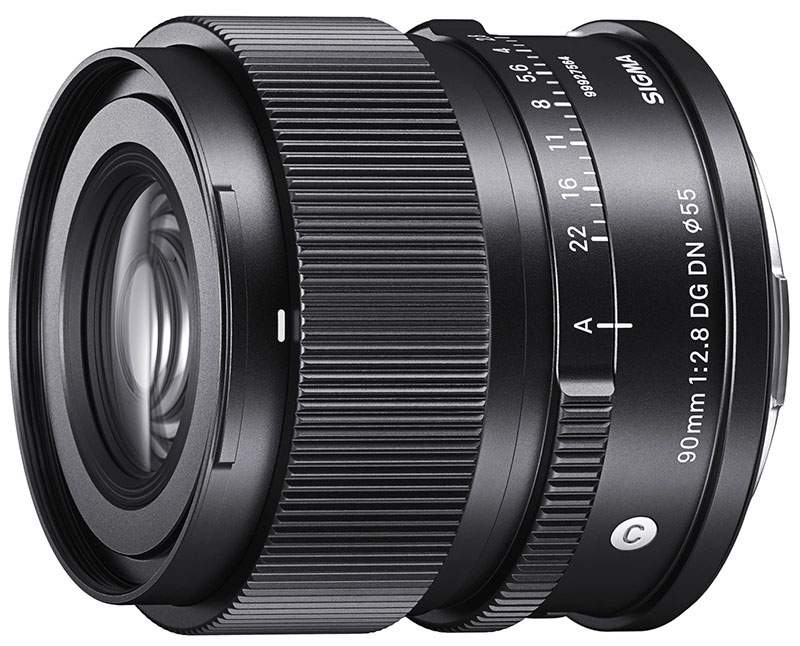
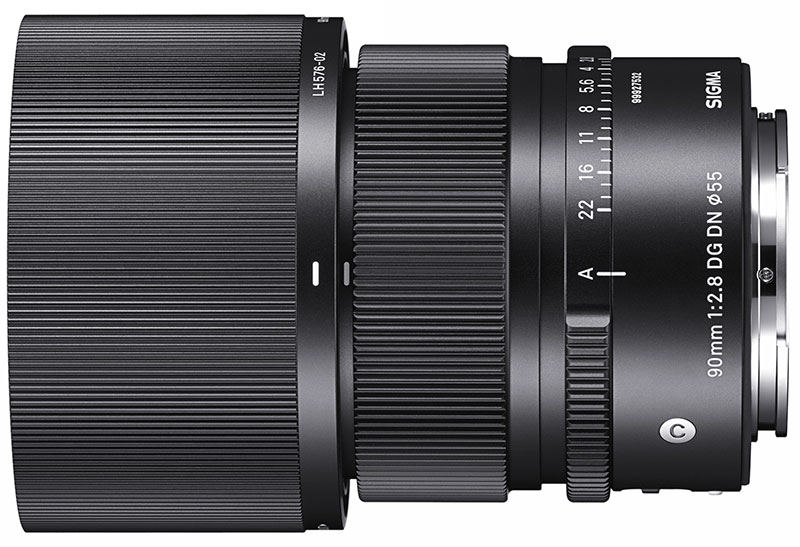
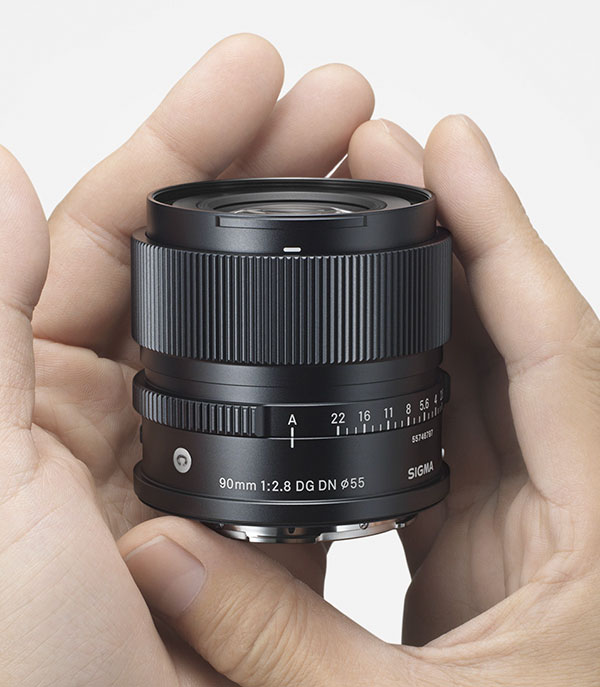
With the introduction of a super-compact 90mm f/2.8, Sigma has made the I-series of high performance full frame mirrorless system lenses match the very best classic kits of the rangefinder era.
The I-series lenses are all fixed focal length (primes) and feature aperture control rings as well as fast autofocus with MF/DMF via the lens focusing barrel. The construction is solid metal, not a thin skin of metal over plastics as found in some earlier primes from makers like Zeiss, Samyang, Tamron and the Sony and Panasonic camera brands themselves. Every component in the lens is metal down to the stepper motor focusing carriage and the mounting of the glass elements.
It’s a return to the standard of Leica rangefinder – or Contax G autofocus – lenses updated for users of the Sony E (FE) and Sigma, Leica and Panasonic L mounts.
We’ve only tried the 60mm f/2 in this series so far, but the performance supported the company’s claim to be delivering very high resolution suitable for 60 megapixel or higher sensors. The 90mm f/2.8 has special attention to chromatic aberration in its design which uses no fewer than five SLD (super low dispersion) elements. We expect to see foreground and background blur unaffected by colour-bokeh shifts, made very smooth by a nine-bladed aperture and aided by third-stop f-stop setting on the lens or via the camera. The closest focus of 50cm compares with a typical figure around 85cm for most 90mm lenses, and yields a 0.2X (1:5) close-up.
This lens accepts 55mm filters and weighs only 295g – you can see the size ‘in hand’. It can be teamed up with the 24mm f/3.5 and 45mm f/2.8 in the same range weighing in at less than 750g overall. Combined with a lightweight smaller body like the Sony A7C it’s the closest a digital shooter can get to have a Leica with autofocus.
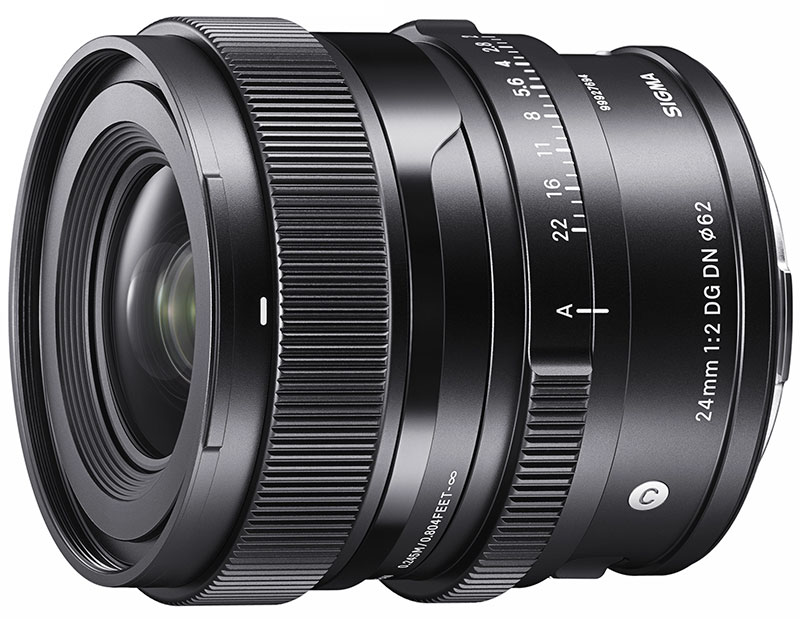
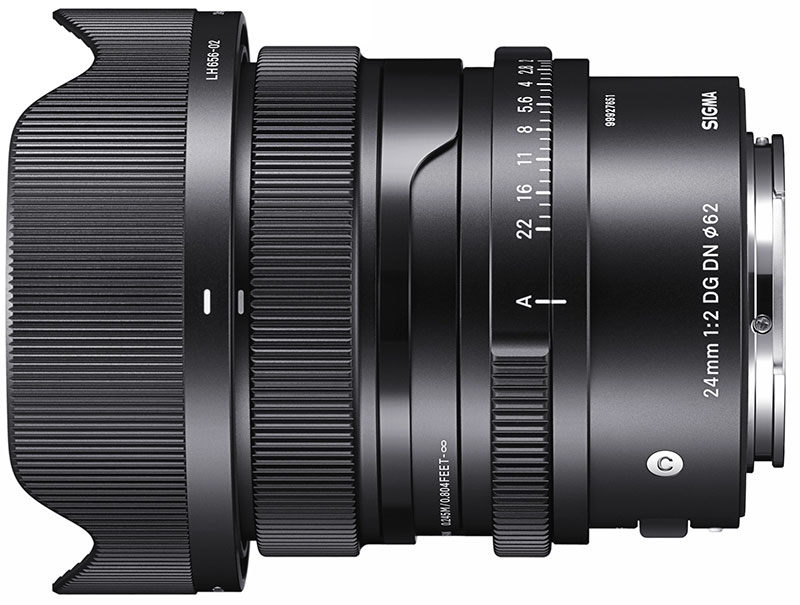
Alongside the 90mm, also available from September 24th will be a faster version of the 24mm at f/2. It’s sure to attract buyers at the same £549.99 RRP UK ($669 USA) as the 90mm and although it takes 62mm filters and is a little bigger, weighing in at 365g, but it’s really part of the f/2 I-series which now includes the 35mm and 65mm so well matched there. Focus is down to 24.5cm, 1:6.7 scale, which is not exceptional when some 24mms achieve 1:2 but entirely practical.
As for cost, it’s less than Sony’s 24mm f/2.8 G as well as a stop faster and much less than the Zeiss Batis 25mm f/2 or the APS-C only Sony Zeiss 24mm f/1.8.
Both these lenses, and the whole I-series, are compatible with Sony’s high-speed autofocus and they’re all made in Japan. The standard now set by Sigma are well-known and they seem to be the only maker left producing new lenses with dust and splash resistant all-metal barrel and mechanical design, brass mounts, and resolution to match the most demanding sensors.
If it rains, these photo locations just get better…
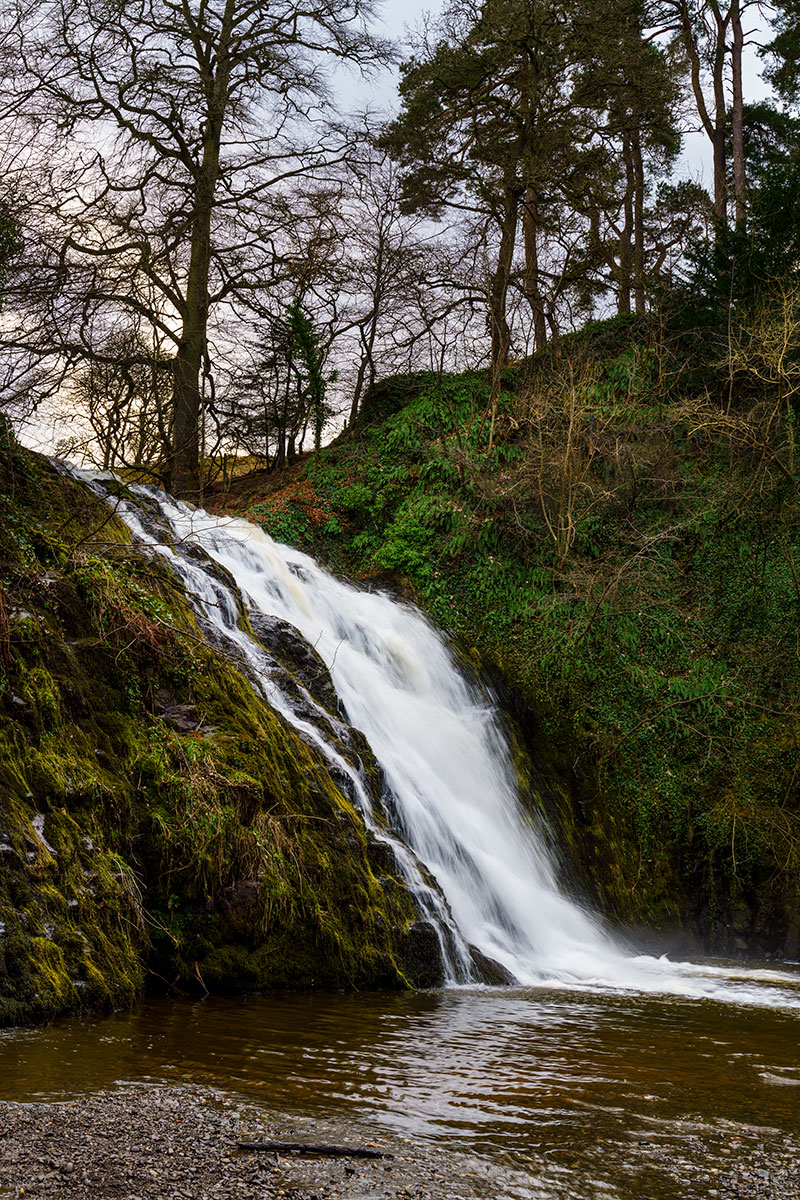
On our doorstep (writes publisher David Kilpatrick) or just a short drive away there are many rivers and burns coming down from the Cheviots, the Lammermuirs, the Southern Uplands and Tweedsmuir. Some pass through steep small ravines or cleughs (similar to ghylls in north-west England). In both Northumberland and southern Scotland, they are called linns. Some just get called waterfalls, like the Grey Mare’s Tail on the road between Selkirk and Moffat, because they are big enough. Some are very hard to reach or don’t offer potential for photography; some are easy to get to but almost local secrets, without very clear footpaths or signs. If you visit Kelso, Jedburgh or Coldstream here are three which you can easily visit by car with normal walking footwear in the course of a day. The first is just a few minutes from Kelso.
Stichill Linn is at the site of a former mill and later pioneering hydro-electric on the Eden Water, in the grounds of the Newton Don estate. During the winter of 2020/21 the estate put a big effort into making the riverside, woodlands and the linn accessible after many years of neglect which had made it hard to reach and at time impossible to photograph without obstructions. Though you need to know which minor road (from Ednam) to park on and then where to find the start of the signposted footpaths, once you are on the trail it is an easy walk with occasional boggy spots where small streams cross the path. Wellies are advised, and also help if you plan to cross the river and find positions for a tripod. It is lovely in autumn as the woodlands are mostly deciduous. This usually means the last week in October and first in November. This spot is good for taking your dog as there’s no livestock to encounter and it is very safe to be off the lead.
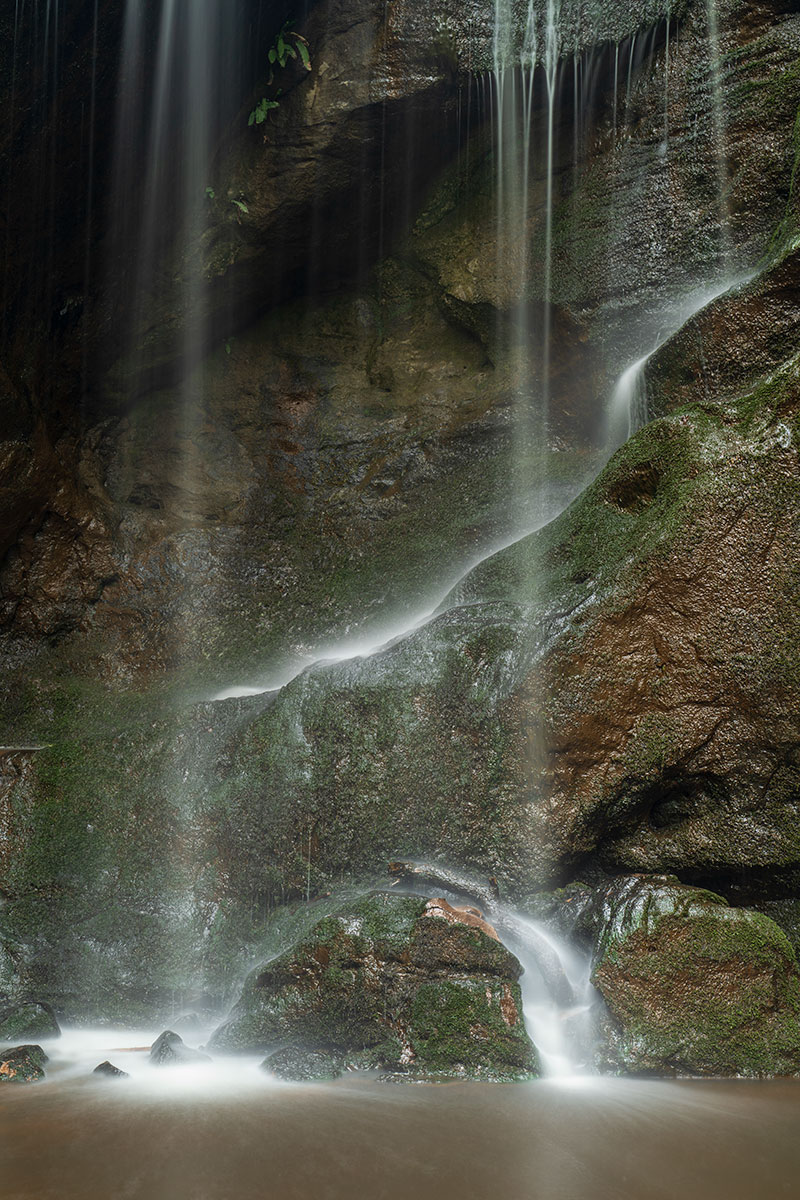
My next one is Roughting Linn, 20 miles away over the border in England. It can be reached from the village of Ford, or from the A1 side via Lowick. Although the farm estate the woodlands and linn are located on allows access, the paths alongside the stream are not maintained in the same way as Stichill. It’s best to wear shoes or boots suitable for moor or mountain and be prepared to use a stick (or a tripod) to deal with slippery or sloping sections often close to sharp drops into the burn. Wellies are essential to get to the classic position for photography. Sadly some of the moss on the boulders has sheared away and as normal some woodland debris has landed. It’s tempting to go in with help and remove the tree limb which is new feature. The area round the waterfall has some fascinating rock faces, caves, twisted trees and countless interplays of stones, water and light. When I took this in mid-May 2021 the woods were also full of bluebells. There is no phone signal here, there are few visitors and after negotiating a steep scramble back to the path I realise you should really do this in company, not alone. Again, this location does not involve crossing farmland so dogs are OK, but the stream at certain points would not be a welcome invitation!
My final one here is Hethpool Linn, near the farm of Hethpool which is south of the Yetholm to Wooler road, on the College Valley road closed to vehicles except by permit (limited numbers). It’s national park, and also just off St Cuthbert’s Way. There is a car park at the end of the public vehicle access. Beyond it you can walk miles up the College Valley, or turn back a bit and go right down a track leading from the big farm as if following the well-known walking route. Looking at a map you might think the linn could be reached from the east side of the College Burn, but that’s a mistake. Before you reach the crossing, a permissive footpath (without signs to the waterfalls) crosses farm fields, over a stile on the left of the track. This takes you between the farm woodland plantation, and the wooded banks of the river. A couple of stiles or gates later the sound of the water can be heard and small paths through scrub take you to the edge of the ravine. At some points you can climb down and where the path crosses a wooden footbridge the flow is shallow.
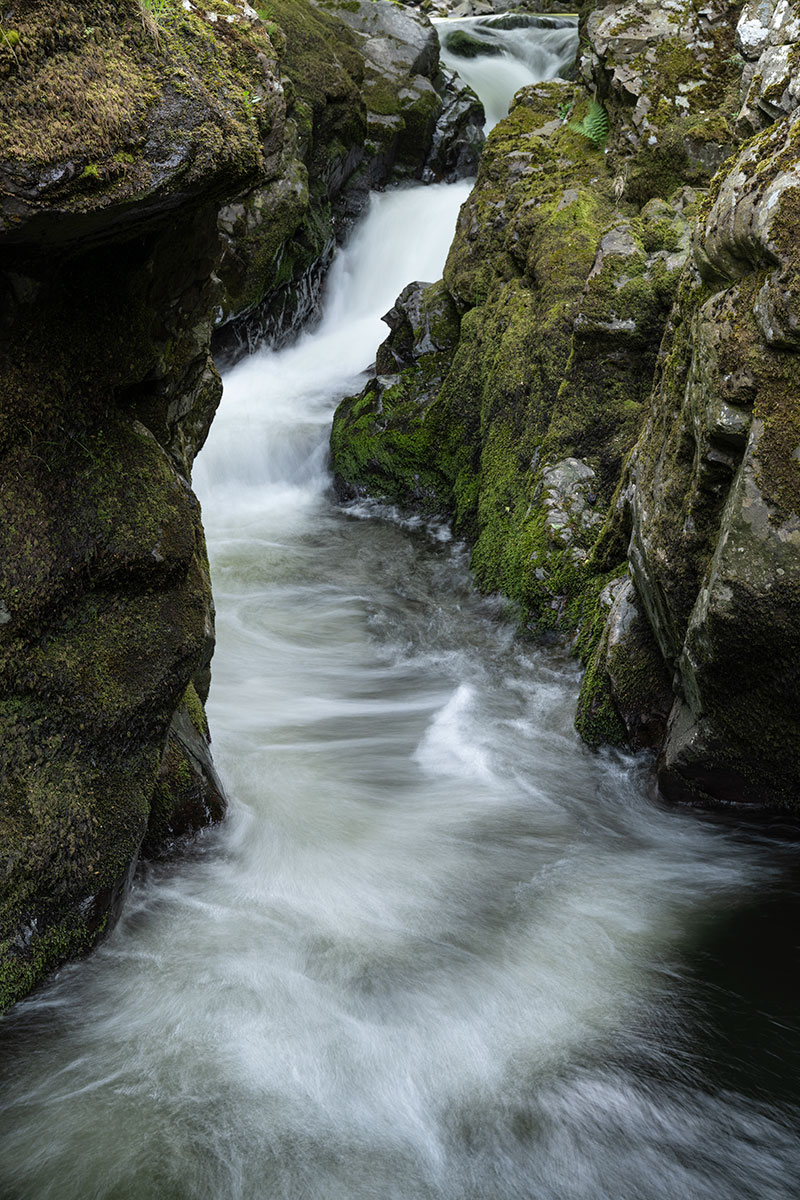
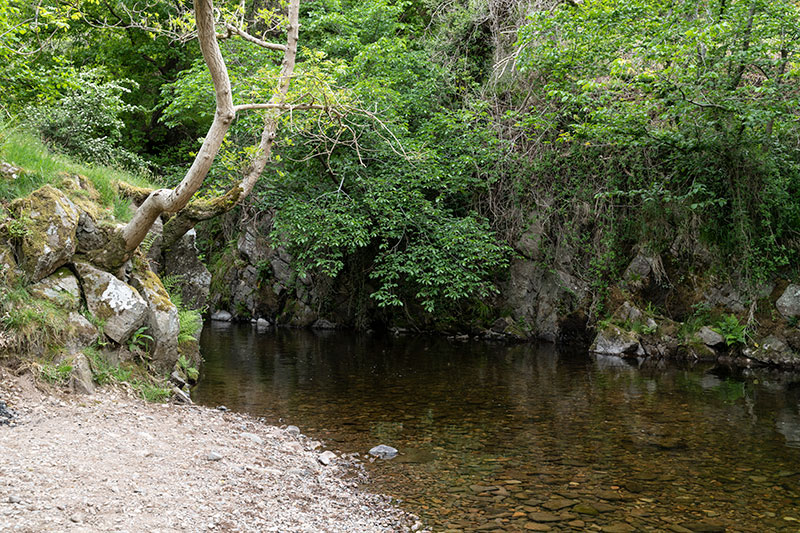
However, below the bridge the river enters a narrow deep mini-gorge, the linn itself. You take a footpath to the left after crossing the bridge and soon enough encounter the more dramatic stretch. The path then drops down, an easy enough scramble to a calm shallow pool of clear water with a pebble beach. The fast-flowing gorge above is not a tripod time exposure – it’s me clinging on to rocks right over the water, holding camera in contact with contours of the stone able to give it a stable support. Again, there is no phone signal and I realised it wasn’t that clever to be balancing (with £4k of camera and lens!) over a deep fast-flowing turbulent plunge a couple of metres below. I had left my camera bag and tripod (useless on the ledge) near the path high above and lowered myself down the rocks to the viewpoint I wanted. It’s something which people clearly do but safer in company.
As for the pool just round the bend after the narrow gorge ends, it’s not all that photogenic but you could bring your own naiad along. Maybe with a wetsuit… this water looks inviting and in the heat of summer it would be fine, but it’s a cold mountain stream nevertheless. Hethpool is very definitely farm land and lambs were everywhere on the walk, so taking a dog to enjoy this very dog-friendly pool would require care and control.
These three linns were photographed on separate sorties, with Stichill Linn in early March a mid-day venture, and both Roughting Linn and Hethpool Linn early evenings in June. Winter can be different but the bare trees let in more light and heavy rainfall transforms any of these. – David Kilpatrick
I now offer an AirBnB in Kelso – the former offices of PHOTOpro, Photon, Freelance Photographer, f2, Master Photography and Cameracraft converted to a flat by my daughter and son-in-law who sailed the Caribbean for a yea, and set it up so it would be suitable for visitors and for their return while buying a home nearby. Everyone loves the town and it’s great to welcome them. I am happy to give pointers to help visiting photographers and the flat has 50+Mbps fibre broadband (from a 900Mpbs service). After returning they converted the opposite wing of the house so in addition to East Wing there’s also West Wing AirBnB – two three-bedroom wings of the house, with their own entrances, licensed to accommodate 10 guests between them or six in any one wing.
NX Studio (version.1.0) – new software that enables the seamless viewing, processing and editing of still images and video. Nikon digital camera users can download the software, free of charge, from today.
The intuitive software integrates the functions of Nikon’s current image viewing software, ViewNX-i*, and its image-processing and editing software, Capture NX-D*, allowing users to view, process and edit images in a single application.
NX Studio inherits a wide range of existing functions from ViewNX-i and Capture NX-D, including detailed editing functions such as Picture Control and White Balance settings, and Exposure Compensation for RAW data. In addition, it includes Colour Control Points that allow users to adjust colours within a specified area, and a Retouch Brush feature for advanced correction. Its intuitive menu structure is organised by workflow, which improves the overall response speed for each function and provides a smoother editing process for both stills and video.
The software will enable users to transfer images to Nikon’s image sharing and storage service, NIKON IMAGE SPACE, and will be continually updated to ensure compatibility with new camera models.
Forgive me, Ron, wherever you are, for breaking my word and letting the world know about this story. I found the negatives by chance, on the eve of the 25 years before the writings are due to be revealed. I do not know where they are, but perhaps I was meant to photograph the box and to be told what was inside it – otherwise it might be that it has all been forgotten, and the people who set this in motion are all now dead. At least by telling this story, and showing the evidence of the pictures, I may set things in motion to ensure that what was originally intended does happen.
The few of you who know me through my photographic magazines will know that I have no politics but tend to be assumed to be coming from the left, and have no religion though people mistakenly assign me some concern with affairs of the spirit. Similar assumptions are often made in matters of money, or education. The truth is I have very little of any of these things.
Over twenty-five years ago, I made the acquaintance of a man called Ron Wilkinson who had the ability to carve wood unusually finely, in the style and perhaps even to the standard of Grinling Gibbons. Having the above-mentioned lack of education I promptly wrote an article about him in which Grinling (Chatsworth House, et al) was transmuted to Orlando (more at home with the lute than the chisel). Ron forgave me, and I photographed his work over a period of two or three years.
One day in 1975, he called me urgently to his home and workshop. He thought I might have an interest in some writings. An elderly – and apparently uneducated – lady in the nearby village had produced a huge volume of automatic writing. She believed this to be the work of St John the Divine (the topical one – Revelations). I had a brief opportunity to read some of this; it had a metre and verse structure, though not in rhyme, and a quality which seemed unlikely to come from the conscious mind of the ‘channel’ herself, whom I met. Ron then swore me to secrecy about what he was going to ask me to do – I was to photograph a chest, which a ‘group of people’ had paid for to hold these works until the new Millennium.
The chest was to be held securely in a chamber inside a mountain in Scotland, and against the express wishes of his sponsors, Ron wanted a photographic record before it was lost for ever. I set up two flash heads, and shot the chest in cramped conditions using a 35mm camera on Agfachrome film, which I had been using regularly and always had processed by A H Leach of Brighouse, the main professional Agfa lab in my area. Ron was to have the entire roll of slides, so that no copies would exist outside his keeping, even for me.
This film, however, was not be a triumph of process control. I was told that the Agfachrome had been processed, and fixed, in black and white negative chemicals. By this time the chest had been filled with the manuscripts and sent on its journey north. I could not believe the misfortune and I wondered, at the time, whether ‘darkroom forces’ had been at work Leach’s then worked miracles (figuratively; I should watch my words). Somehow they recovered some of the colour into a few of the extremely grainy, dense frames. They made hand C-type 12 x 15s, and their artists carefully retouched them to restore apparently natural colours. They then made 5 x 4 copy negatives and final 10 x 8 prints, which showed the details Ron had wanted to keep on record.
I filed those copy negs and thought little more of it – 25 years seemed so far away then that I never considered it likely I would be there to see the end of the Year 2000. Ron, rather suddenly, gained the (deserved) patronage of the Duke of Devonshire. He left his south Yorkshire village cottage, and the next time I saw him he and his wife Eda had a lovely farmhouse looking across the Chatsworth estate. He had become, however, very reserved. I could no longer photograph his carvings; he was busy restoring the Gibbons work in Chatsworth House. When I visited him, I could feel the tension, and I think he was not in the best of health. I am not sure when Ron died, or if Eda is still with us, or would remember me if she was; I am sure that someone will tell me.
I found the copy negatives by chance, when looking for another photograph from 1975. I had not forgotten, but I had consigned the story to the backroom of memory. I scanned the 24-year-old negatives. Modern digital techniques made far superior ‘prints’ emerge, even if the crossed curves which had once made half the print almost blue could not be eliminated entirely. Had those negatives been the intended 35mm slides, they would have been handed over; and all my commercial ‘packshots’ of that date were long ago consigned to the bin. The 5 x 4 copy negs had survived because they were kept separately.
If I feel sure of anything, it is that the Duke of Devonshire himself had some part in the encystment of the automatic writings – of the ‘songs of angels’, and ‘pearls of wisdom’, as the old lady identifed them. I may be wrong with the first name; I did not take notes. I do not know who else will have been privy to the location of the chest, whether they are still alive, whether their plans and intentions have been forgotten or kept alive. If the writings are of any importance they must be published either in the Year 2000 (which the public see as the start of the new Millennium) or preferably on January 1st, 2001. The year 2000 is merely the final year of the second millennium, just the same way that the year 100 was the last year of the first century. Regards of our calendar errors and arbitrary dating, it is in 2001 that we should be celebrating the future.
Everything is in place – the Internet is complete and globally functioning, we have the fingers and the keyboards to transcribe the manuscripts, and we have the scanners or digital cameras to record each page in evidence. It is only necessary now to start the work – if it has not already been started – and to open Ron’s locked and vaulted box to the world, electronically, in the single moment of a new server going live on World Wide Web.
Whether I believe in any of this does not matter one bit; it is a certainty that many millions of people in the world will read, study, translate and absorb the words. From what I saw and read myself, I believe this will do nothing but good. Words, whether written or spoken, can be magic bullets as indeed can photographs.
If we are to witness a battle between Good (with a capital G) and Evil (likewise) then it will be fought on Internet between words and images and much though I regret to have to say this, you probably all know very well where my beloved photography takes its place vis-a-vis God vs Auld Nick.
If there are two things you can be sure the Devil has in his museum of triumphs over mankind, they’ll be a five-string banjo and a Leica.
The second coming won’t need the Word to be made Flesh, nor even into a book. Our computers, our satellites, our cables and our TV screens are all the flesh that words need now.
And as for Lucifer? Well, with a name like that he must have dominion over the realms of lens and light if not the darkroom!
Received from the organisers today – and we don’t honestly see that it will return in the same form, ever. Perhaps some other technology show, as it already encompassed digital comms, design, film-making, 3D printing and many other non-photo things. Or perhaps – is it too much to hope? – a show once again mostly about photography:
90 years of photokina – 1924 to 2014. The final one was in 2018.
photokina will be suspended until further notice
After 70 years, decreases in the imaging market force a hard cut
In view of the further massive decline in markets for imaging products, Koelnmesse has decided to discontinue organising photokina at its Cologne location for the time being. “Unfortunately, at present the framework conditions in the industry do not provide a viable basis for the leading international trade fair for photography, video and imaging,” according to Gerald Böse, President and Chief Executive Officer of Koelnmesse. “This hard cut after a 70-year shared history was very difficult for us. The trend in this industry, with which we have always had a close and trusting partnership, is very painful for us to witness. But we are facing the situation with a clear, honest decision against continuing this event, a decision to which, unfortunately, we have no alternative.”
Even before the coronavirus pandemic began, the imaging market was already subject to strong upheaval, with annual declines in the double digits. The momentum in this direction intensified massively in 2020, most recently reporting a decline in the 50-percent range. Recently, these developments have had a profound effect on photokina, which – in Cologne since 1950 – for generations has been the top address for the imaging industry and ranks among the most favourably and emotionally charged brands in the trade fair world.
Since 2014, Koelnmesse, together with the German Photo Industry Association, has taken its cue from downward market trends, responding with adjustments to the underlying concept of the trade fair as well as considerable investment in new exhibitor and visitor segments. “These changes in conceptual design, along with a shift in intervals and a change of dates, did not fundamentally improve the situation of the event,” says Oliver Frese, Management Board member and Chief Operating Officer of Koelnmesse. “While there are more photographs taken today than ever before, the integration of smartphone photography and videography, together with image-based communication, e.g. via social media, was not able to cushion the elimination of large segments of the classic market. As a result, the overall situation is not compatible with the quality standards of photokina as a globally renowned brand representing the highest quality and professionalism in the international imaging market.”
Koelnmesse has made its decision in close coordination with the German Photo Industry Association. Kai Hillebrandt, Chairman of that association, remarked: “Our partners in Cologne have done everything in their power to maintain photokina as the leading global trade fair. Nonetheless, an event held in 2022 could not have met the expectations of the entire imaging community that those efforts were intended to serve. That is why we, on behalf of our association, are joining them in taking this regrettably unavoidable step. We would like to take this opportunity to thank the team in Cologne for a tremendous 70 years together!”
Your contact:
Guido Gudat Vice President Corporate Communications